
Mila Antonova
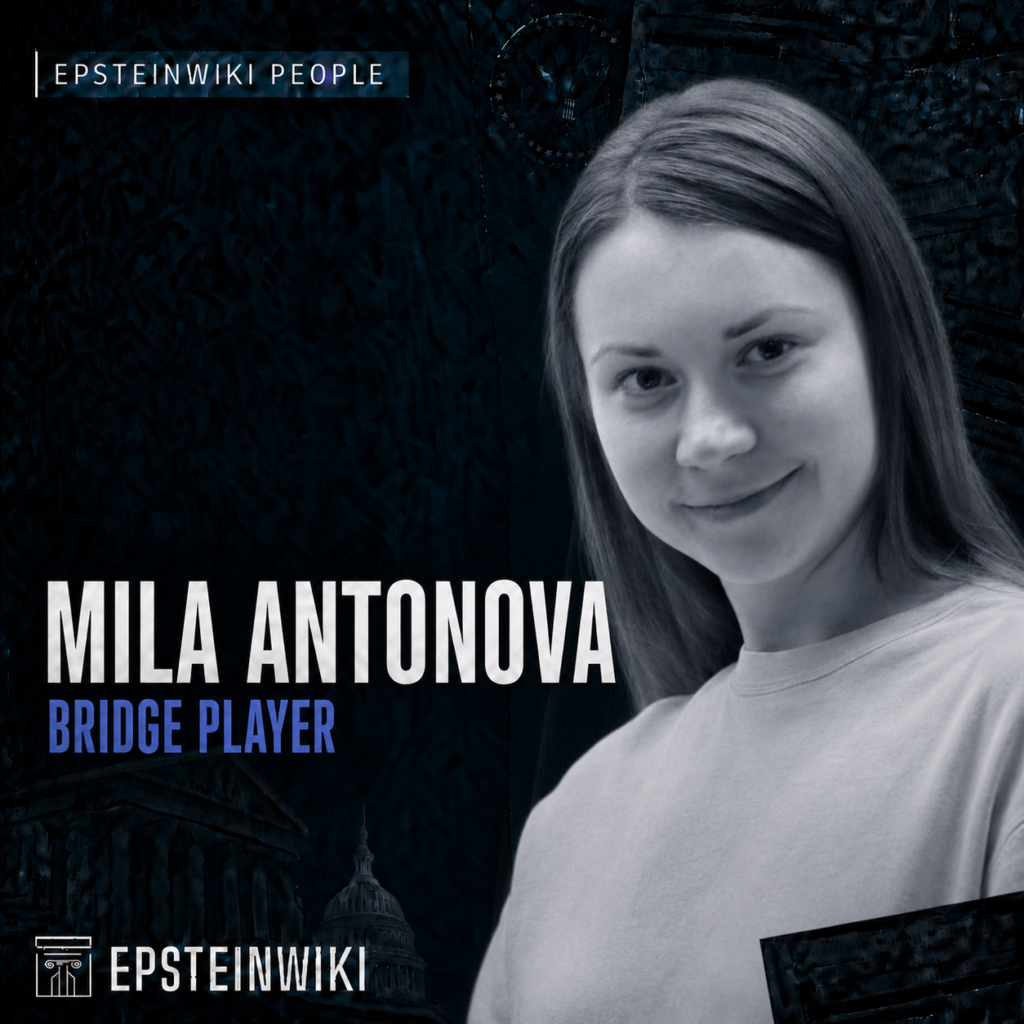
The Russian bridge player received money, education funding, immigration assistance, and apartment access from Jeffrey Epstein after an introduction by Bill Gates adviser Boris Nikolic. Released records show Epstein later invoked that support while pressing Gates and his chief of staff for acknowledgment and reimbursement.
Mila Antonova entered Jeffrey Epstein’s orbit through bridge.
She had played the game seriously, promoted it publicly, and met Microsoft cofounder Bill Gates at a tournament. Gates later testified to Congress that he and Antonova had an affair. Boris Nikolic, then one of Gates’s closest advisers, learned of the relationship and later introduced Antonova to Epstein while she was seeking financial backing for an online bridge venture.
The proposed investment did not happen. Something more consequential did.
Epstein gave Antonova money, helped fund her software education, participated in immigration assistance, and made apartments under his control available to her in New York. Antonova thanked Epstein and Nikolic in a 2017 email for helping her obtain greater stability and control over her life.
Epstein then converted his claimed generosity into pressure aimed at Gates.
In messages to Nikolic and Gates chief of staff Larry Cohen, Epstein repeatedly emphasized that he had paid for Antonova’s education, helped with her immigration status, sent her money, and housed her. He complained that he had received neither thanks nor reimbursement. He referred to Antonova in degrading terms, described publicity that could embarrass Gates, invoked the “sanctity of friendship,” and later warned that Gates was “playing with fire.”
Those messages are evidence of a pressure campaign. They do not prove that Antonova participated in it, knew about it, or authorized Epstein to use information about her private life. Her lawyer has said she had no knowledge of Epstein’s communications with Gates’s representatives and no reason to believe Epstein was using her circumstances as leverage. Gates testified that Epstein never successfully blackmailed him and that Gates paid him nothing.
This distinction is essential. Antonova was not charged with an Epstein related crime. No released record reviewed for this profile establishes that she recruited anyone for Epstein, facilitated abuse, participated in trafficking, or knowingly assisted an extortion scheme. The evidence instead shows how Epstein’s patronage could create access, obligation, sensitive knowledge, and potential leverage around another person.
Antonova’s story is therefore not a sidebar to the Gates and Epstein relationship. It is a documented case study in how Epstein placed himself between people, provided assistance that created dependency or gratitude, and later recast that assistance as a debt someone else was expected to pay.
Content Warning
This article discusses Jeffrey Epstein’s sexual abuse and trafficking network, unequal power relationships, financial dependency, private sexual relationships, and possible coercive pressure. It does not allege that Mila Antonova participated in Epstein’s crimes or that she was sexually abused by him.
Executive Snapshot
Full name: Mila Antonova
Known public roles: Russian born bridge player, bridge promoter, entrepreneur, and software engineer
Documented connection to Jeffrey Epstein: Introduced by Boris Nikolic; attended a meeting with Epstein and Nikolic in 2013; received financial support, software education funding, immigration related assistance, and access to Epstein controlled apartments; corresponded directly with Epstein and members of his staff
Connection to Bill Gates: Met Gates through competitive bridge; Gates testified in 2026 that they had an affair
Approximate documented period involving Epstein: 2013 through at least 2018, with Epstein continuing to invoke her circumstances in communications through January 2019
Primary locations: New York City, California, and bridge events in the United States
Epstein connection rating: 3 out of 5, documented recurring support and communication
Why the rating is not higher: The records establish more than an incidental mention, but they do not establish employment by Epstein, participation in his criminal enterprise, recruitment of victims, facilitation of abuse, or knowledge of his later pressure on Gates
Legal status: No known Epstein related criminal charge, civil finding, or judicial determination against Antonova
Central evidence: Emails, wire instructions, calendar records, apartment logistics, photographs, press reporting, statements from Antonova’s lawyer, and Bill Gates’s 2026 congressional testimony
Central unresolved issue: Whether Epstein offered assistance to Antonova primarily to help her, to gain leverage over Gates, or for a combination of motives that changed over time
Evidence limit: The released records show what Epstein said and did. They do not establish that every claim he made about Gates, Nikolic, or Antonova was true.
Overview
Mila Antonova is a Russian born bridge player who built a public identity around teaching and promoting contract bridge before moving into software engineering. Her name became internationally known in May 2023, when The Wall Street Journal reported that Jeffrey Epstein had learned about her past relationship with Bill Gates and later appeared to use that knowledge to threaten him.
The public record has expanded substantially since that first report.
The most important new material includes Department of Justice records released under the Epstein Files Transparency Act and a June 2026 transcribed interview of Bill Gates conducted by the House Committee on Oversight and Government Reform. Those sources confirm the affair, document Antonova’s financial and logistical ties to Epstein, and expose the language Epstein used when he discussed her with men in Gates’s circle.
The resulting chronology has three distinct phases.
First, Antonova developed an independent relationship with Gates through bridge. Nikolic learned of that relationship.
Second, Nikolic introduced Antonova to Epstein while she was trying to finance BridgePlanet, an online bridge education business. Epstein declined to fund the venture but began supporting Antonova personally. The released evidence includes a $10,000 gift, instructions for two $7,000 transfers, help with software school, immigration assistance, and repeated stays in New York apartments.
Third, Epstein began using those expenditures and Antonova’s private relationship with Gates as pressure points. He told Nikolic that Gates should be informed that Antonova still contacted him. He sent Gates and Cohen messages referring to an unnamed old friend. He said he would provide more money despite receiving no thanks or reimbursement. He described Antonova’s financial hardship to Nikolic in humiliating language and speculated about the publicity value of the story. He claimed Gates had asked him to delay exposure for three years, a claim Gates has denied. He repeatedly sought a response from Cohen and Gates.
The evidence does not show Antonova participating in the third phase. It shows Epstein talking about her, forwarding her communications, and presenting his aid to her as an obligation Gates should recognize.
That is why this profile places Antonova at the center of the documented chronology without assigning her responsibility for Epstein’s conduct.
Identity Verification
The name Mila Antonova is not unique. Identification therefore requires more than finding the same name in an email or photograph.
The identification used in this profile rests on several matching facts:
- The woman described in the records was a Russian bridge player.
- She operated or promoted a bridge venture using the names BridgePlanet and Bridge Union.
- She met Bill Gates at a bridge tournament.
- Boris Nikolic knew both Gates and Antonova and arranged an appointment involving Antonova and Epstein.
- The recipient of Epstein’s support later described becoming a software engineer after attending Hack Reactor.
- Gates identified Mila Antonova by name during his 2026 congressional interview.
- Antonova’s lawyer confirmed key parts of the relationship and support chronology to Fortune.
A surviving social media account under the name Mila Antonova and the handle BridgeUnion describes its owner as a contract bridge promoter seeking to bring the game to a new generation. A public IgniteNYC presentation identifies Antonova as a Russian entrepreneur, bridge player, and teacher.
The released records sometimes redact sender names, misspell Antonova’s surname as “Antanova,” or use only the first name Mila. This profile attributes a record to Antonova only when context provides a strong match. A first name alone is not enough.
The two House Oversight photographs discussed below require an additional caution. Their identifiers and EpsteinWiki descriptions associate the images with Gates and Antonova, but a photograph by itself does not establish the date, location, purpose, or nature of a relationship. Gates’s testimony and other evidence provide the identification context.
Bridge Career and Public Profile
Before the Epstein reporting, Antonova’s visible public work focused on bridge.
In her recorded IgniteNYC talk, she described bridge as a powerful intellectual and social game. She said the game helped her learn English and presented herself as both a player and a teacher. The presentation captured a person trying to broaden the game’s appeal rather than someone publicly connected to wealth, political influence, or criminal allegations.
Antonova also interviewed Gates in a bridge setting. Contemporary video and later reporting show them discussing the game, and Antonova joked about trying to distract him while they played. The clip later attracted attention because of the affair, but its original subject was bridge.
Her business concept sought to expand that work online. Reports have called the proposed venture BridgePlanet. Released banking communications identify Bridge Union Inc. The available evidence suggests the names were connected to the same larger effort to teach and promote bridge, but the surviving records do not fully establish the corporate history or whether BridgePlanet and Bridge Union were legally identical.
The distinction matters because Epstein’s payments went through a business account. That does not by itself make them business investments. In December 2013 Epstein described one transfer as a gift. In October 2014 he instructed his accountant to send money to Bridge Union Inc. The records do not provide a contract, equity agreement, loan instrument, invoice, or statement of services supporting those transfers.
Antonova later changed fields. In her July 2017 email to Epstein, she said financial support and sponsorship of her Hack Reactor education gave her practical skills and enabled her to obtain work as a software engineer after receiving employment authorization. The email is a direct first person description of the effect of Epstein’s support, though it does not explain every payment or arrangement behind that support.
Relationship With Bill Gates
Antonova’s relationship with Bill Gates preceded her documented introduction to Epstein.
Through her lawyer, Antonova told Fortune that she met Gates at a bridge tournament in 2009 and maintained a relationship with him for a time. Gates gave Congress a more explicit account. During his June 10, 2026 interview, he confirmed that Antonova was the woman investigators called the bridge player and acknowledged that he had an affair with her.
Gates said he met Antonova at a bridge tournament and described her as a serious bridge player. He also testified that the women discussed in that portion of the interview were adults. The public record does not support describing Antonova as a minor during her relationship with Gates.
The affair was private conduct between adults. It is relevant here only because Epstein learned about it and later appeared to use that knowledge while seeking access, money, acknowledgment, or renewed communication from Gates.
The evidence does not establish exactly when the affair began or ended. Public accounts often place the relationship around 2010. Gates’s testimony confirms the relationship but does not provide a complete dating chronology. Antonova has not offered a detailed public account of the affair.
Gates was married to Melinda French Gates during the relevant period. The personal harm caused by his infidelity belongs to the Gates family. That fact should not be converted into blame directed at Antonova for Epstein’s later behavior.
Boris Nikolic as the Connector
Boris Nikolic was a physician, biotechnology investor, Gates adviser, and intermediary between Gates, Antonova, and Epstein.
Gates testified that Nikolic learned of the Antonova affair after a dinner in California. Gates said Antonova was supposed to meet him after the dinner, but he was delayed. Nikolic waited with her until Gates arrived. This incident gave Nikolic direct knowledge of the relationship.
Nikolic later introduced Antonova to Epstein. The Wall Street Journal reported that the introduction occurred in 2013 when Antonova was seeking investment in her online bridge project. Fortune’s later reconstruction, based on released records, also identifies Nikolic as the organizer and connector.
A November 7, 2013 calendar reminder reads “3:00 Appt w/Mila and Boris,” followed by the parenthetical notation “Boris Organized.” The appointment was scheduled for ninety minutes.
That record establishes a planned appointment involving a person identified as Mila and Boris. Read alongside the business proposal, later correspondence, and statements from the people involved, it strongly supports the conclusion that the calendar entry concerns Antonova and Nikolic.
The calendar record does not establish what was said, who attended for the entire period, or whether Epstein made any promise. Reporting indicates Antonova and Nikolic presented a proposal seeking $500,000 for BridgePlanet at Epstein’s Manhattan townhouse. Epstein did not make that investment.
Nikolic’s role did not end with the introduction. Antonova’s 2017 email credited both Epstein and Nikolic with changing her circumstances. She said the attorney Nikolic recommended helped her immigration case and that she eventually obtained a green card. Epstein later claimed to Gates’s staff that he had helped organize the visa process.
Nikolic has not been charged with an Epstein related crime. He told Fortune that Epstein inserted himself as a mediator in Nikolic’s separation from Gates’s investment office and used lies to pursue his own agenda. The Antonova records nevertheless show that Nikolic was a material connector and remained a recipient of Epstein’s messages about her.
The November 2013 Townhouse Pitch
The reported purpose of Antonova’s 2013 meeting with Epstein was investment.
Antonova and Nikolic presented BridgePlanet as an online bridge instruction business. According to The Wall Street Journal, the proposal sought $500,000. Epstein declined to invest. No released investment contract, term sheet, or equity agreement reviewed for this profile indicates that he became an owner.
This meeting is important for two reasons.
First, it provides a documented origin for Antonova’s direct contact with Epstein. The connection did not begin as a social introduction unrelated to her work. It began with a request for business support.
Second, Epstein’s refusal to invest did not end the relationship. He shifted from a formal business possibility to personal assistance. That shift reduced transparency. A business investment would ordinarily produce terms, ownership records, reporting duties, and a defined purpose. Gifts, tuition payments, immigration assistance, and apartment access could be provided without the same institutional controls.
This pattern does not prove that Epstein planned a leverage operation from the first meeting. Motive cannot be read backward with certainty. It does show that the relationship developed in a way that gave Epstein information about Antonova’s finances, immigration concerns, housing needs, career change, and prior relationship with Gates.
Those details later appeared in Epstein’s communications to Gates’s advisers.
The First Documented Gift
A December 2013 email chain documents a $10,000 transfer.
Epstein offered to send a $10,000 gift “to make things easier.” The recipient explained that she did not have a personal bank account, offered a PayPal account or the Bridge Union Inc. business account, and mentioned a recent marriage and plans to sign an agreement with an immigration lawyer. Epstein instructed that a $10,000 gift be sent.
Two days later the recipient wrote that she had received the gift and thanked Epstein. She asked whether she would have to pay taxes on it.
The context strongly identifies the recipient as Antonova. The email references Bridge Union Inc., immigration concerns, and a chronology consistent with her later description. Some personal fields in the released version are redacted, so the attribution should still be expressed with that limitation.
The document establishes that Epstein characterized the payment as a gift. It does not establish why he offered it, what expectations he had, whether tax reporting occurred, or whether anyone else knew about it at the time.
The recipient’s tax question is significant. It is consistent with understanding the money as a gift rather than compensation or an investment. No evidence in the chain identifies a service Antonova was expected to perform for Epstein.
The October 2014 Wire Instructions
The clearest direct financial instruction appears in an October 9, 2014 email from Epstein to accountant Richard Kahn.
The message included wiring information for Bridge Union Inc. and directed Kahn to send $7,000 “this month” and another $7,000 the next month. A related email chain records confirmation that the money was received and thanks Epstein.
These records support a planned total of $14,000 across two months. They establish an instruction for two transfers and confirmation of at least one receipt. They should not be used to claim that both transfers were completed unless a second confirmation or financial record is produced.
The use of Bridge Union Inc. raises questions that the released messages do not answer:
- Was the money booked as a gift, loan, investment, or business payment?
- Did Bridge Union Inc. provide an invoice or accounting entry?
- Did Epstein or one of his entities receive any ownership interest?
- Was the second $7,000 transfer completed?
- Did Kahn or another financial employee conduct compliance review?
Nothing in the messages reviewed here indicates that Antonova performed work for Epstein in exchange for the transfer. Her lawyer has described the support as unsolicited gifts.
Coding School and a New Career
Epstein also paid for Antonova’s software education.
In a June 15, 2016 message to Nikolic, Epstein wrote that Nikolic could tell “your boy” that he still heard from Mila and had put her through computer school. The phrase “your boy” is reasonably understood as Gates in context, but the email does not name him.
The message is the earliest located example in which Epstein explicitly tied his support for Antonova to communication directed toward someone in Gates’s circle. It reads less like a private update about a student and more like information Epstein wanted relayed.
Antonova’s own July 2017 email identifies the school as Hack Reactor. She wrote that Epstein’s financial support and sponsorship of her education allowed her to gain practical skills and obtain work as a software engineer after she received a work permit.
This evidence establishes that Antonova understood Epstein to have sponsored her education and believed the support materially benefited her. It does not establish the exact tuition amount, payment date, recipient account, or terms. The underlying invoice and school payment record have not been publicly identified in the materials reviewed for this profile.
In 2023 Antonova told The Wall Street Journal that Epstein paid the school directly. She said nothing was exchanged for the payment and that she did not know why he made it.
Immigration Assistance
Immigration help was another important part of the relationship.
The December 2013 gift chain references Antonova’s marriage and an anticipated agreement with an immigration lawyer. In her July 2017 email, Antonova said an attorney recommended by Nikolic handled a difficult case professionally. She wrote that other lawyers had told her the case had no chance, but that after several years of work it was approved and she received a green card in 2016.
Epstein later told Cohen that he had helped organize a visa. His July 2017 pressure message claimed that Gates had asked him to “push this out three years,” that he had paid for school, and that he helped organize immigration assistance.
Gates denied asking Epstein to help Antonova. His testimony was unequivocal on that point. He said Epstein’s claim that Gates encouraged or requested the assistance was false.
The available evidence therefore supports three narrower conclusions:
- Antonova received immigration related help.
- She credited Nikolic’s attorney recommendation and Epstein’s financial support as part of the broader assistance that stabilized her life.
- Epstein later cited immigration help when pressuring Gates’s office.
It does not establish that Gates requested the help, that Epstein controlled the legal process, or that the immigration result was improper.
Immigration status can create unusual vulnerability. A person navigating work authorization, marriage related status, legal fees, and uncertain residency may depend heavily on advisers and financial sponsors. That context makes it especially important not to treat gratitude in Antonova’s emails as proof of informed participation in Epstein’s later strategy.
Epstein Controlled Apartment Stays
Antonova also stayed in apartments managed by Epstein’s staff.
A November 2014 email chain records Lesley Groff arranging apartment 11P at 301 East 66th Street for Antonova from November 24 through November 27. Antonova also expected to return from December 8 through December 11. Groff supplied an apartment code and wireless network password. Antonova confirmed her arrival and wrote that everything was great, thanking Groff for accommodating her.
This was not an isolated arrangement. Fortune reported, through Antonova’s lawyer, that Antonova used Epstein controlled apartments several times between 2014 and 2018. Her lawyer said Epstein was not present during those stays.
A April 24, 2018 staff message instructed that a welcome letter be printed for “Mila Antanova” before an April 26 arrival in apartment 7J. The surname is misspelled, but the context and subsequent email make the identification strong.
On April 30, 2018, Epstein informed Cohen that he had to put Mila up in New York for the week, emphasized that he was not there, and added: “playing with fire.”
The apartment evidence establishes accommodation and logistical support. It does not establish sexual contact, abuse, or Epstein’s physical presence. The explicit statement that he was not there, combined with Antonova’s lawyer’s account, weighs against describing the stays as private visits with Epstein.
The significance lies elsewhere. Epstein arranged housing for Antonova and then told Gates’s chief of staff about it in language that implied risk.
Antonova’s July 2017 Account
Antonova’s July 21, 2017 email is the most important direct statement from her in the released evidence.
Epstein wrote that he and Nikolic were together and wondering where she was and how she was doing. Antonova responded warmly. She said Epstein and Nikolic had created an opportunity for her to grow and gain control over her life. She described relief from severe stress and fear.
She then provided a detailed update:
- Her immigration case had succeeded and she had received a green card the previous year.
- She and her husband had separated.
- Epstein’s financial support and sponsorship of Hack Reactor gave her practical software skills.
- She obtained a job as a software engineer but had left the startup and was preparing for technical interviews.
- She was living in Palo Alto and staying with a friend until she found work.
- She was developing another business idea.
- Her budget had forced her to stop traveling to bridge tournaments.
The full chain appears in EFTA02641851, while a shorter released version appears in EFTA02367549. Another related copy, EFTA00693263, includes an address and bank information that are redacted in the public text.
These duplicates are not independent corroborating witnesses. They are multiple productions or versions of the same correspondence. They confirm preservation and context, but they should not be counted as separate events.
Antonova’s gratitude is real evidence of how she viewed the assistance at that time. It is not proof that she understood Epstein’s motives or knew what he was saying about her to other people.
Within a day, Epstein began forwarding the substance of her circumstances into Gates’s professional circle.
The July 2017 Pressure Campaign
On July 22, 2017, Epstein emailed Gates and Cohen. In the released chain, he told Gates that he had heard from an old friend and thought they should speak. Cohen replied that Gates was unavailable and offered to talk.
Epstein then wrote that he would provide more money to Antonova even though he had received neither thanks nor reimbursement. He gave Cohen until the next night to tell him not to do so. The exchange appears in EFTA02642503 and a related copy, EFTA01039786.
The structure of the message matters. Epstein did not simply ask whether Gates wanted to reimburse a specific invoice. He invoked an unnamed old friend, sought a conversation, announced that he would spend more, complained about the absence of thanks and repayment, and imposed a short deadline.
Three days later Epstein sent Nikolic a much more revealing message. In EFTA02641692, also preserved as EFTA01039678, he described Antonova’s financial hardship and her residence on a friend’s sofa. He called Gates cheap, referred to Antonova as Gates’s former girl and “toy,” and said the story could displace major political news from the front pages.
The email is degrading toward Antonova. It reduces her career, immigration struggle, and housing insecurity to material for embarrassing Gates. There is no indication Antonova saw the message or consented to the description.
On July 29 Epstein escalated the argument in a message to Cohen. In EFTA01039131, duplicated in EFTA02642021, Epstein attributed a statement to Gates asking him to delay matters for three years. Epstein then listed school costs, visa help, and Antonova’s financial problems before invoking the “sanctity of friendship” and asking Cohen for his thoughts.
Gates has denied asking Epstein to support Antonova or delay exposure. No independent message from Gates confirming Epstein’s quoted words has been identified.
The July sequence establishes pressure, but legal labels require caution. A completed blackmail offense ordinarily requires proof of specific demands, threats, intent, and jurisdictional elements. These records show Epstein linking sensitive personal information to requests for recognition or reimbursement. Gates described the conduct as threatening and as movement toward blackmail, while also saying he was not successfully blackmailed.
“Pressure campaign” is therefore the most defensible description of the full record. “Attempted blackmail” is a reasonable interpretation discussed by Gates and investigators, but it is not a judicial finding.
Continued Pressure in 2017 and 2018
Epstein continued sending Antonova related updates to Cohen after July 2017.
An October 27, 2017 email carried the subject “decision time. MILA.” Its body reproduced a first person update saying that Antonova had registered for a national bridge tournament in San Diego and had visited her parents in Russia.
The released page does not show a clear demand. Its importance comes from the audience and subject line. Epstein forwarded details of Antonova’s personal travel and bridge activity to Gates’s chief of staff under language suggesting that some decision was required.
On December 18, Epstein asked Cohen to alert him if press inquiries arrived. In the same email chain, he said he had separately asked why he had received no approval from Gates and no offer to repay what Epstein claimed he had advanced at Gates’s request. Gates denies making that request. The combination of a press reference and a repayment complaint strengthens the evidence of pressure, while stopping short of an explicit written ultimatum.
In January 2018 a brief email from Mila to Epstein asked what time they would meet the next day. The record establishes direct scheduling contact. It does not identify the location, purpose, other attendees, or whether the meeting occurred.
In April, Epstein’s staff prepared apartment 7J for Antonova’s arrival. Four days later Epstein told Cohen that he had housed her, stated that he had not been present, and wrote that Gates was “playing with fire.”
This was the clearest warning language in the located correspondence. It still did not explicitly say, “pay me or I will disclose the affair.” It paired sensitive information with an ominous statement and sent it to the chief of staff of the person whose reputation could be harmed.
Antonova’s lawyer told Fortune that Antonova had no knowledge of these communications and no basis to believe Epstein used her financial situation as leverage against Gates. No released email reviewed for this profile contradicts that statement.
The 2019 Reimbursement Messages
Epstein was still seeking reimbursement in 2019.
On January 5, 2019, he emailed Gates and Cohen that at some point they would want to reimburse him. He said he felt awkward asking and that the situation made little sense. A related chain shows Cohen asking whether Epstein could talk.
The email does not name Antonova in its visible text. Its placement in the continuing correspondence and later testimony supports the interpretation that it concerned expenses Epstein associated with her, but that relationship should be stated as context rather than a fact visible on the face of the page.
Later that month Epstein wrote that he hoped Gates would follow Jeff Bezos’s lead. Bezos and his wife had recently announced their divorce. The meaning of that reference is unclear. It may have been a remark about public disclosure of a relationship, marital separation, or something else. It should not be treated as a proven threat without the full surrounding exchange.
The 2019 correspondence creates a chronology problem for Gates’s testimony. Gates told investigators that he recalled the reimbursement request arriving at or shortly after the end of his direct contact with Epstein, which he placed around late 2014 or early 2015. Released messages show explicit reimbursement requests in 2017 and 2019.
That does not necessarily prove Gates lied. He may have received an earlier request that has not been located, misremembered the date, or been referring to the first in a longer series. It does mean his recollection is incomplete or inconsistent with the dated record now available.
Gates’s 2026 Congressional Testimony
The House Oversight Committee released Gates’s transcript after interviewing him on June 10, 2026. The Committee’s release page also includes the transcript of former Epstein assistant Lesley Groff.
Gates made several significant statements about Antonova and Epstein:
- He confirmed that Antonova was the bridge player with whom he had an affair.
- He said he met her at a bridge tournament and considered her a serious player.
- He confirmed that Nikolic learned about the relationship after waiting with Antonova when Gates was delayed.
- He said Epstein later sought reimbursement for expenses Epstein claimed to have paid for Antonova.
- He denied ever asking Epstein to help her.
- He said he directed Cohen not to reimburse Epstein.
- He said Epstein’s request involved thousands of dollars, not tens of thousands.
- He said he never paid Epstein.
- He described the reimbursement request as a step beyond Epstein’s earlier veiled references and as threatening.
- He said Epstein never successfully blackmailed him, but the released messages raised a serious probability that Epstein contemplated doing so.
Gates’s testimony is valuable because it provides first person confirmation of the affair and his response to Epstein’s pressure. It is not neutral or infallible. Gates was describing conduct that could damage his reputation, recalling events more than a decade later, and disputing claims made by a dead man whose records are incomplete.
The interview was not a criminal trial. Gates was represented by counsel, and Committee staff reminded him that knowingly making materially false statements to Congress can violate federal law. No court has ruled on the truth of every statement.
The Chronology Conflict
The most important conflict between Gates’s testimony and the released record concerns timing.
Gates initially placed Epstein’s reimbursement request in late 2014 or early 2015. He later said it came right at or soon after the end of their direct contact. Yet the clearest located reimbursement messages are dated July 2017 and January 2019.
There are several possible explanations:
- Epstein made an earlier request that has not been located or released.
- Gates confused the date of the first request with the period when he ended direct meetings.
- Gates knew of later demands through Cohen but did not remember their dates.
- The reimbursement campaign began earlier and continued for years.
- Gates’s testimony understated the duration of the pressure.
The available evidence cannot conclusively choose among these explanations.
The amount also deserves scrutiny. Gates recalled a request involving thousands, not tens of thousands. The known direct support includes a $10,000 gift, at least one $7,000 transfer with a second instructed transfer, coding school tuition, apartment use, and possible legal or immigration expenses. The total could exceed Gates’s recollection, but the records do not establish which expenses Epstein asked Gates to repay or their exact total.
Congress should obtain the underlying invoices, bank records, tuition receipts, apartment ledgers, legal bills, and complete Gates office correspondence before assigning a final amount.
Photographic Evidence
EpsteinWiki has published two House Oversight image records associated with Gates and Antonova:
- Photograph depicting Bill Gates and Mila Antonova at a hotel, identifier HOUSE_OVERSIGHT_050603
- Photograph depicting Bill Gates and Mila Antonova in a hotel room, identifier HOUSE_OVERSIGHT_071978
The images are relevant because they appear to place Gates and Antonova together. Their evidentiary value is limited without original metadata, an authenticated source chain, a date, a photographer, and independent location confirmation.
The photographs do not prove that Epstein took them, possessed the originals when the relationship occurred, arranged the encounter, or used the images as leverage. They also do not establish criminal conduct. Gates’s testimony independently confirms the affair, so the images are not the sole basis for reporting that relationship.
Any publication of intimate or private photographs should consider privacy, provenance, and the possibility that redistributing them advances the same humiliation strategy visible in Epstein’s emails. Describing their existence and evidentiary limits is often more responsible than reproducing them.
Evidence Appearances
| Identifier | Date | Record type | Antonova’s exact role | Direct source | What it establishes | What it does not establish |
|---|---|---|---|---|---|---|
| EFTA02122268 | November 7, 2013 | Calendar reminder | Named participant in appointment with Mila and Boris | View record | A ninety minute appointment was scheduled and described as organized by Boris | Attendance, discussion content, or an agreement |
| EFTA02357103 | December 10 to 12, 2013 | Email chain and wire instructions | Apparent recipient of $10,000 gift through Bridge Union Inc. | View record | Epstein offered and ordered a $10,000 gift; recipient confirmed receipt | Epstein’s motive, tax treatment, or any exchange of services |
| EFTA00998689 | October 9, 2014 | Payment instruction | Intended recipient through Bridge Union Inc. | View record | Epstein instructed Kahn to send $7,000 in October and another $7,000 the next month | Completion of both transfers or their accounting treatment |
| EFTA00998799 | October 10, 2014 | Related email chain | Recipient confirming money arrived | View record | At least one transfer was received and acknowledged | Receipt of the second instructed transfer |
| EFTA02089819 | November 17 to 24, 2014 | Apartment logistics | Guest in Epstein controlled apartment 11P | View record | Groff arranged housing and Antonova confirmed arrival | Epstein’s presence, sexual contact, or wrongdoing |
| EFTA02460103 | June 15, 2016 | Epstein email to Nikolic | Subject of update about contact and computer school | View record | Epstein said he still heard from Mila and funded computer school | That Gates requested or knew about the support |
| EFTA02367549 | July 21, 2017 | Email from apparent Antonova account | Describes immigration result, software education, employment, and gratitude | View record | Antonova credited Epstein and Nikolic with meaningful help | Knowledge of Epstein’s pressure on Gates |
| EFTA02641851 | July 21 to 23, 2017 | Longer email chain | Gives detailed life and financial update | View record | Antonova discussed housing, work, bridge, immigration, and finances | Permission for Epstein to forward or weaponize the information |
| EFTA02642503 | July 22, 2017 | Epstein, Gates, and Cohen email chain | Unnamed old friend and recipient of proposed additional support | View record | Epstein linked renewed contact, further spending, thanks, and reimbursement | A completed extortion offense or Antonova’s awareness |
| EFTA02641692 | July 25, 2017 | Epstein email to Nikolic | Subject of degrading financial and relationship description | View record | Epstein considered Antonova’s hardship potentially embarrassing to Gates | Truth of every claim or Antonova’s consent |
| EFTA01039131 | July 29, 2017 | Epstein email to Cohen | Subject of school, visa, and housing references | View record | Epstein invoked claimed support and “sanctity of friendship” | Truth of the words Epstein attributed to Gates |
| EFTA02574755 | October 27, 2017 | Epstein email to Cohen | Subject of travel and bridge update | View record | Epstein continued forwarding Antonova related information to Cohen | The meaning of “decision time” or any response by Gates |
| EFTA00922837 | December 18, 2017 | Epstein and Cohen email chain | Contextual subject of claimed advances and repayment | View record | Epstein paired concern about press inquiries with a complaint about approval and repayment | That Gates requested the advances or that press had contacted either man |
| EFTA00908624 | January 19, 2018 | Scheduling email | Sender asking Epstein about a meeting time | View record | Direct scheduling contact continued into 2018 | Meeting purpose, location, or occurrence |
| EFTA02244643 | April 24, 2018 | Staff apartment instruction | Expected guest in apartment 7J | View record | Staff prepared housing for Antonova’s arrival | Epstein’s presence or improper conduct |
| EFTA00818853 | April 30, 2018 | Epstein email to Cohen | Subject of housing disclosure and warning | View record | Epstein told Cohen he housed Mila and wrote “playing with fire” | An explicit payment demand in that message or Antonova’s knowledge |
| EFTA02606561 | January 5, 2019 | Epstein email to Gates and Cohen | Contextual subject of reimbursement campaign | View record | Epstein again requested reimbursement | The expense category on the face of this page |
| Bill Gates Transcript | June 10, 2026 | Congressional transcribed interview | Identified by Gates as bridge player and former affair partner | View transcript | Gates confirmed the affair, reimbursement pressure, nonpayment, and Nikolic’s knowledge | Independent verification of every recollection or claim |
Legal Status, Allegations, Denials, and Limits
Mila Antonova: No located public record establishes an Epstein related charge, conviction, civil liability finding, or allegation that she participated in trafficking or sexual abuse. Her lawyer said she met Epstein only twice, received unsolicited assistance, provided nothing in exchange, and did not know that Epstein discussed her with Gates’s staff.
Bill Gates: Gates admitted the affair and acknowledged meetings with Epstein. He denied asking Epstein to help Antonova, denied paying Epstein, and said he was not successfully blackmailed. He described Epstein’s conduct as threatening and said the evidence suggests Epstein contemplated blackmail.
Jeffrey Epstein: Epstein pleaded guilty in Florida in 2008 to offenses involving prostitution and a minor and was federally charged in 2019 with sex trafficking related crimes. He died before trial on the federal charges. His messages about Antonova contain claims, insults, and strategic language. They are evidence of what he wrote, not automatic proof that his assertions were true.
Boris Nikolic: Nikolic introduced Antonova to Epstein and received messages from Epstein about her. He has not been charged with an Epstein related crime. He has said Epstein used lies to pursue his own agenda.
Larry Cohen: Cohen received Epstein’s pressure messages as Gates’s chief of staff. The released chains show some brief replies and requests to talk. They do not establish that Cohen agreed with Epstein, paid him, or threatened Antonova.
Richard Kahn: Kahn received at least one wire instruction from Epstein involving Antonova. A payment instruction establishes administrative involvement, not knowledge of Epstein’s motive or of any pressure campaign.
Lesley Groff: Groff arranged apartment access for Antonova. Her logistical role is documented. The apartment emails do not establish that she knew why Epstein supported Antonova or how he later described the support to Gates.
Survivor Centered Analysis
The Antonova records must be read against the larger system Epstein built around girls and young women.
Survivors have described a world in which money, education, housing, travel, employment, introductions, and promises of advancement were not neutral benefits. They could become tools of access, dependency, control, silence, or retaliation. Not every recipient of Epstein’s help was abused, recruited, or aware of his crimes. The structural pattern still matters.
Antonova appears in the evidence as an adult with financial, immigration, housing, and career needs. Epstein met several of those needs. He gained information about her private relationship, financial hardship, legal status, location, education, and work. He then circulated that information among powerful men and used demeaning language about her body and relationship history.
That conduct raises a survivor centered concern even without evidence that Epstein sexually abused Antonova. A benefactor can transform aid into control by keeping a ledger that the recipient never agreed existed. Epstein’s messages suggest he viewed his expenditures not simply as help to Antonova but as a claim on Gates.
The records also demonstrate why women connected to powerful men are often blamed for strategies designed by those men. Antonova did not write the “playing with fire” email. She did not demand reimbursement from Gates. She did not call herself a toy or propose a front page scandal. Epstein did those things.
Reporting should therefore avoid sensational labels that reduce Antonova to Gates’s former mistress. Her relationship with Gates is relevant, but her identity and agency extend beyond it. The central accountability questions concern the men who knew the private information, moved the money, controlled the housing, and decided to use her circumstances as leverage.
What the Evidence Establishes
The evidence establishes that:
- Antonova was a serious bridge player and bridge promoter.
- She met Gates through bridge and had an affair with him, according to Gates’s congressional testimony and Antonova’s more limited confirmation through counsel.
- Nikolic knew about the relationship and introduced Antonova to Epstein.
- A November 2013 appointment involving Mila and Boris was scheduled by Epstein’s office and identified as organized by Boris.
- Antonova presented a bridge business proposal to Epstein, according to consistent reporting.
- Epstein did not make the requested $500,000 investment.
- Epstein offered a $10,000 gift connected to Bridge Union Inc. and the recipient confirmed receiving it.
- Epstein instructed Kahn to send $7,000 in one month and another $7,000 the next.
- At least one $7,000 transfer was acknowledged.
- Epstein funded Antonova’s software education.
- Antonova credited that support with helping her become a software engineer.
- Antonova received immigration related help involving an attorney recommended by Nikolic.
- Antonova stayed in Epstein controlled New York apartments on multiple occasions.
- Epstein and Antonova remained in direct contact into at least 2018.
- Epstein repeatedly told people in Gates’s circle about his support for Antonova.
- Epstein asked for thanks, acknowledgment, or reimbursement.
- Epstein described potential publicity about Antonova as harmful to Gates.
- Epstein used ominous and relational language, including “sanctity of friendship” and “playing with fire.”
- Gates directed that Epstein not be reimbursed and paid him nothing, according to Gates’s testimony.
- Antonova’s lawyer denied that she knew of the pressure communications.
What the Evidence Does Not Establish
The evidence does not establish that:
- Antonova participated in Epstein’s sexual abuse or trafficking.
- Antonova recruited any woman or girl for Epstein.
- Antonova knew the full scope of Epstein’s crimes when she accepted assistance.
- Antonova knew Epstein intended to use her circumstances against Gates.
- Antonova authorized Epstein to seek reimbursement from Gates.
- Antonova provided sex, services, information, or silence in exchange for money.
- Epstein was present during Antonova’s apartment stays.
- Gates asked Epstein to support Antonova.
- Epstein’s quoted account of Gates asking for a three year delay was true.
- Gates reimbursed Epstein.
- Epstein made an explicit written threat to expose the affair in exchange for a specified payment.
- A court or jury found that Epstein blackmailed Gates.
- The photographs associated with Gates and Antonova were taken, obtained, or used by Epstein.
- Every record containing the name Mila refers to Antonova.
- The full financial total is known.
Detailed Timeline
2009: Antonova met Gates at a bridge tournament, according to her lawyer’s statement to Fortune.
Around 2010: Antonova and Gates maintained a relationship. Gates later confirmed it was an affair.
Before November 2013: Nikolic learned of the Gates and Antonova relationship and introduced Antonova to Epstein.
November 7, 2013: Epstein’s calendar recorded a ninety minute appointment with Mila and Boris, organized by Boris.
November 2013: Antonova and Nikolic reportedly presented BridgePlanet to Epstein and sought $500,000 in investment. Epstein did not invest.
December 10 to 12, 2013: Epstein offered and ordered a $10,000 gift. The recipient, apparently Antonova, confirmed receipt and asked about taxes.
October 9 to 10, 2014: Epstein instructed Kahn to send $7,000 to Mila through Bridge Union Inc. and repeat the transfer the next month. A recipient confirmed that money arrived.
November 24 to 27, 2014: Antonova stayed in apartment 11P at 301 East 66th Street. A second December stay was planned.
2014 through 2018: Antonova used Epstein controlled apartments several times, according to her lawyer.
By June 2016: Epstein told Nikolic he still heard from Mila and had put her through computer school.
2016: Antonova obtained a green card, according to her 2017 email.
July 21, 2017: Antonova sent Epstein a detailed update and credited him and Nikolic with helping her gain stability, immigration status, education, and a software career.
July 22, 2017: Epstein contacted Gates and Cohen about an old friend, offered to spend more money, and complained that he had received neither thanks nor reimbursement.
July 25, 2017: Epstein described Antonova’s hardship to Nikolic, insulted Gates, demeaned Antonova, and discussed the possible publicity value of the story.
July 29, 2017: Epstein told Cohen that Gates had asked him to delay matters for three years, a claim Gates denies. Epstein cited school, immigration help, and Antonova’s finances while invoking friendship.
October 27, 2017: Epstein forwarded an Antonova related travel and bridge update to Cohen under the subject “decision time. MILA.”
December 18, 2017: Epstein asked Cohen for notice of press inquiries and complained that Gates had not approved or offered to repay alleged advances.
January 19, 2018: An email attributed to Mila asked Epstein what time they would meet the next day.
April 24, 2018: Epstein’s staff prepared apartment 7J for Antonova’s April 26 arrival.
April 30, 2018: Epstein told Cohen that he housed Mila in New York, said he was not present, and added “playing with fire.”
January 5, 2019: Epstein again told Gates and Cohen he expected reimbursement.
May 21, 2023: The Wall Street Journal first publicly reported that Epstein appeared to threaten Gates using knowledge of the Antonova affair.
March 14, 2026: Fortune published a broader reconstruction using newly released records and statements from Antonova’s lawyer.
June 10, 2026: Gates testified before House Oversight, confirmed the affair, denied asking Epstein to help Antonova, and described the reimbursement pressure.
June 23, 2026: The Committee released the Gates transcript to the public.
Reliability and Limitations
This profile relies on records with different evidentiary strengths.
Contemporaneous emails and calendar records are strongest for proving that a message was sent, an appointment was scheduled, a payment was ordered, or housing was arranged. They are weaker for proving the truth of a writer’s claims about another person.
Duplicate EFTA records often reproduce the same underlying email. They help recover context and redactions but do not represent independent events.
Gates’s testimony is direct evidence of his knowledge and recollection. It confirms the affair and his response to Epstein. Its timing conflicts with dated records, and Gates had personal and reputational interests in the subject.
Antonova’s statements through counsel are important denials and explanations. They have not been tested through public testimony or cross examination.
Statements by Epstein require special caution. He was a convicted sex offender, habitual manipulator, and unreliable narrator. A claim in his email is evidence that he made the claim. It is not sufficient proof that Gates asked him to act or that Antonova understood his purpose.
News reports provide interviews and narrative reconstruction but may rely on confidential sources. This article prioritizes direct records where available and attributes conclusions to the publication that reported them.
Photographs require provenance and metadata. They should not be assigned dates, locations, or purposes based only on appearance.
Missing records remain a major limitation. The public does not have every bank statement, apartment ledger, tuition invoice, legal bill, text message, phone log, or Gates office communication. Absence from the released files does not prove an event did not occur.
Fact Check
Verification status: Substantially verified with material unresolved questions
Last checked: September 3, 2026
Verified by primary records: Scheduled 2013 appointment; $10,000 gift chain; October 2014 wire instruction; at least one receipt confirmation; 2014 and 2018 apartment arrangements; 2016 computer school reference; Antonova’s 2017 account of support; Epstein’s 2017 and 2018 pressure messages; 2019 reimbursement request; Gates’s 2026 testimony
Verified by direct testimony: Gates’s affair with Antonova; Nikolic’s knowledge of the affair; Gates’s denial that he requested assistance; Gates’s instruction not to reimburse Epstein; Gates’s description of the pressure as threatening
Verified through attributed reporting and counsel statements: Antonova met Epstein twice; Epstein was absent from her apartment stays; she received unsolicited gifts; she did not know about the Gates pressure communications; nothing was exchanged for the school payment
Not independently verified: Exact total paid for Antonova; completion of every instructed wire; exact legal fees; complete apartment history; Epstein’s claim that Gates requested a three year delay; full provenance of photographs; precise beginning and end of the Gates relationship
No evidence located: Criminal participation by Antonova, recruitment activity, knowledge of Epstein’s trafficking, or intentional participation in the pressure campaign
Related People and Organizations
Bill Gates: Microsoft cofounder who met Antonova through bridge, had an affair with her, met repeatedly with Epstein, and became the target of Epstein’s reimbursement pressure.
Jeffrey Epstein: Convicted sex offender who provided Antonova with money, education funding, immigration related assistance, and housing, then invoked that support in communications with Gates’s circle.
Boris Nikolic: Gates adviser who knew about the affair, introduced Antonova to Epstein, organized the 2013 meeting, and recommended an immigration lawyer.
Larry Cohen: Gates chief of staff who received several Antonova related messages from Epstein.
Richard Kahn: Epstein accountant who received the October 2014 instruction to wire money to Bridge Union Inc.
Lesley Groff: Epstein assistant who arranged Antonova’s apartment access.
Melinda French Gates: Gates’s former wife. The affair and Gates’s relationship with Epstein affected matters within their marriage, but she is not shown participating in the Antonova support or pressure communications.
BridgePlanet: Proposed online bridge education venture for which Antonova reportedly sought investment.
Bridge Union Inc.: Entity whose banking information appeared in Epstein’s gift and wire correspondence.
Hack Reactor: Software education program Antonova said Epstein sponsored.
Gates Ventures: Gates’s private office, where Cohen worked and where the decision not to reimburse Epstein was made, according to Gates.
House Committee on Oversight and Government Reform: Congressional committee that interviewed Gates and released his transcript.
United States Department of Justice: Custodian and publisher of millions of pages released under the Epstein Files Transparency Act.
Questions for House Oversight
Questions for Mila Antonova
- When and where did Antonova first meet Gates?
- What was the duration of their personal relationship?
- When did Nikolic first learn about it?
- What did Nikolic tell Antonova about Epstein before the introduction?
- Did Antonova know about Epstein’s 2008 conviction before meeting him?
- Who attended the November 2013 BridgePlanet presentation?
- What written materials were presented?
- Why did Epstein decline the proposed investment?
- Who first proposed the $10,000 gift?
- What did Antonova understand the gift to be for?
- Was the gift reported for tax purposes?
- Did Antonova receive both instructed $7,000 transfers?
- How were the payments recorded by Bridge Union Inc.?
- Did Epstein receive equity, services, information, or any other benefit?
- What portion of Hack Reactor tuition did Epstein pay?
- Did Epstein pay the school directly?
- What immigration expenses did Epstein pay?
- Which attorney did Nikolic recommend?
- How many times did Antonova stay in Epstein controlled apartments?
- Who offered the apartments and what rules governed their use?
- Did Antonova ever meet Epstein at an apartment?
- Did Epstein ever ask Antonova about Gates?
- Did he ask for photographs, messages, or private information?
- When did Antonova first learn that Epstein was contacting Gates’s office about her?
- Did anyone from Gates’s office contact her about the pressure campaign?
- Did Antonova authorize Epstein to seek reimbursement?
- Did she ever believe that his help created a debt to Gates?
- Did Epstein ever threaten, pressure, or intimidate her?
- What records does Antonova retain?
- What privacy protections would allow her to provide evidence safely?
Questions for Bill Gates
- When did the affair begin and end?
- When did Gates first learn that Nikolic knew?
- When did Gates first learn that Epstein had met Antonova?
- Did Gates receive Epstein’s July 22, 2017 old friend email directly?
- Did Gates read it at the time?
- What did Cohen report after speaking with Epstein?
- Did Gates ever discuss Antonova with Epstein before the reimbursement requests?
- Why did Gates place the request in late 2014 or early 2015 when released demands are dated 2017 and 2019?
- Was there an earlier request that has not been released?
- What amount did Epstein seek?
- Which expenses did Epstein identify?
- Did Gates preserve every related email and message?
- Did Gates or his staff warn Antonova that Epstein was using her circumstances?
- Did Gates’s security, legal, or communications teams assess Epstein as a threat?
- Was law enforcement consulted?
- Did Gates discuss the matter with Nikolic?
- Why did Gates continue indirect communication through Cohen?
- What did Gates understand “playing with fire” to mean?
- What did he understand the Bezos reference to mean?
- Did Gates or any related entity provide Epstein with money, access, introductions, or donations after the first Antonova demand?
Questions for Boris Nikolic
- Why did Nikolic select Epstein as a potential investor for Antonova?
- What did he disclose about Epstein’s criminal history?
- Did Nikolic tell Epstein about the affair?
- Did he attend the full November 2013 meeting?
- Did he know about the $10,000 gift and later wires?
- Which immigration attorney did he recommend?
- Did he ask Epstein to fund Antonova’s education?
- What did Epstein mean by “your boy” in the 2016 message?
- Did Nikolic relay that message to Gates?
- How did Nikolic respond to Epstein’s July 25, 2017 degrading email?
- Did Nikolic warn Antonova or Gates?
- Does Nikolic retain messages not present in the public release?
Questions for Larry Cohen and Gates’s Office
- How many Antonova related messages did Cohen receive?
- Which messages did he forward to Gates?
- Did Cohen ever tell Epstein to stop contacting Antonova?
- Did Cohen ever tell Epstein to stop using her circumstances as leverage?
- What was discussed in calls requested after the July 2017 and January 2019 emails?
- Did Cohen understand the messages as threats?
- Why did Cohen continue responding?
- Did Gates’s office create a written incident report?
- Were Antonova’s privacy and safety considered?
- Did anyone seek to recover or secure photographs involving Gates and Antonova?
Questions for Epstein’s Staff and Financial Representatives
- What account funded the $10,000 gift?
- Was the second $7,000 transfer completed?
- What tuition payments were made to Hack Reactor?
- What legal or immigration bills were paid?
- What apartment costs were attributed to Antonova?
- How were these payments classified in Epstein’s books?
- Did Kahn, Groff, or another employee know Epstein was seeking reimbursement from Gates?
- Were any Antonova related files, photographs, or communications maintained separately as leverage material?
Conclusion
Mila Antonova’s documented connection to Jeffrey Epstein began with an introduction by Boris Nikolic and a failed bridge business pitch. It developed into a years long pattern of financial and logistical support.
Epstein gave money. He paid for education. He involved himself in immigration assistance. His staff provided apartments. Antonova expressed gratitude and described real benefits to her career and stability.
Then Epstein used the record of that help against someone else.
He told Nikolic that Gates should know he still heard from Antonova. He contacted Gates and Cohen about an old friend. He complained about missing thanks and reimbursement. He described Antonova’s hardship as a potential public embarrassment. He invoked friendship, forwarded private updates, demanded attention, and warned that Gates was playing with fire.
The record supports the conclusion that Epstein was cultivating leverage. It does not prove that Antonova helped him do it.
That distinction protects factual accuracy and recognizes the power imbalance visible in the evidence. Antonova’s financial needs, immigration case, housing, education, and private relationship became assets in Epstein’s hands. He was the person who chose to circulate them and attach demands to them.
The unresolved questions now belong to Congress, the institutions that possessed the records, and the powerful people who received the warnings. They should not be displaced onto the woman whose private life Epstein treated as currency.
Sources
- House Oversight Committee release of the Gates and Groff transcripts
- Bill Gates transcribed interview, June 10, 2026
- United States Department of Justice Epstein Library
- Fortune: “Playing with fire”: Epstein bankrolled a woman tied to Bill Gates
- The Wall Street Journal: Jeffrey Epstein Appeared to Threaten Bill Gates Over Microsoft Cofounder’s Affair
- The Guardian: Jeffrey Epstein reportedly threatened Bill Gates over alleged affair
- Fox News: Public bridge background and Antonova video
- Mila Antonova: Bridge Is a Powerful Mind Game
- EpsteinWiki: Mila Antonova
- EpsteinWiki: Photograph depicting Bill Gates and Mila Antonova at a hotel
- EpsteinWiki: Photograph depicting Bill Gates and Mila Antonova in a hotel room
- EFTA02122268: November 2013 calendar appointment
- EFTA02357103: December 2013 gift and banking chain
- EFTA00998689: October 2014 wire instruction
- EFTA00998799: Transfer receipt confirmation
- EFTA02089819: November 2014 apartment logistics
- EFTA02460103: June 2016 computer school message
- EFTA02367549: Antonova’s July 2017 life update
- EFTA02641851: Extended July 2017 correspondence
- EFTA02642503: July 2017 old friend and reimbursement chain
- EFTA02641692: July 2017 email about Antonova’s finances and publicity
- EFTA01039131: July 2017 “sanctity of friendship” email
- EFTA02574755: October 2017 “decision time” email
- EFTA00922837: December 2017 press inquiry and repayment chain
- EFTA00908624: January 2018 scheduling email
- EFTA02244643: April 2018 apartment welcome letter instruction
- EFTA00818853: April 2018 “playing with fire” email
- EFTA02606561: January 2019 reimbursement request
- EFTA02606604: Related January 2019 correspondence