
301 East 66th Street: The Manhattan Apartment Network Connected to Jeffrey Epstein
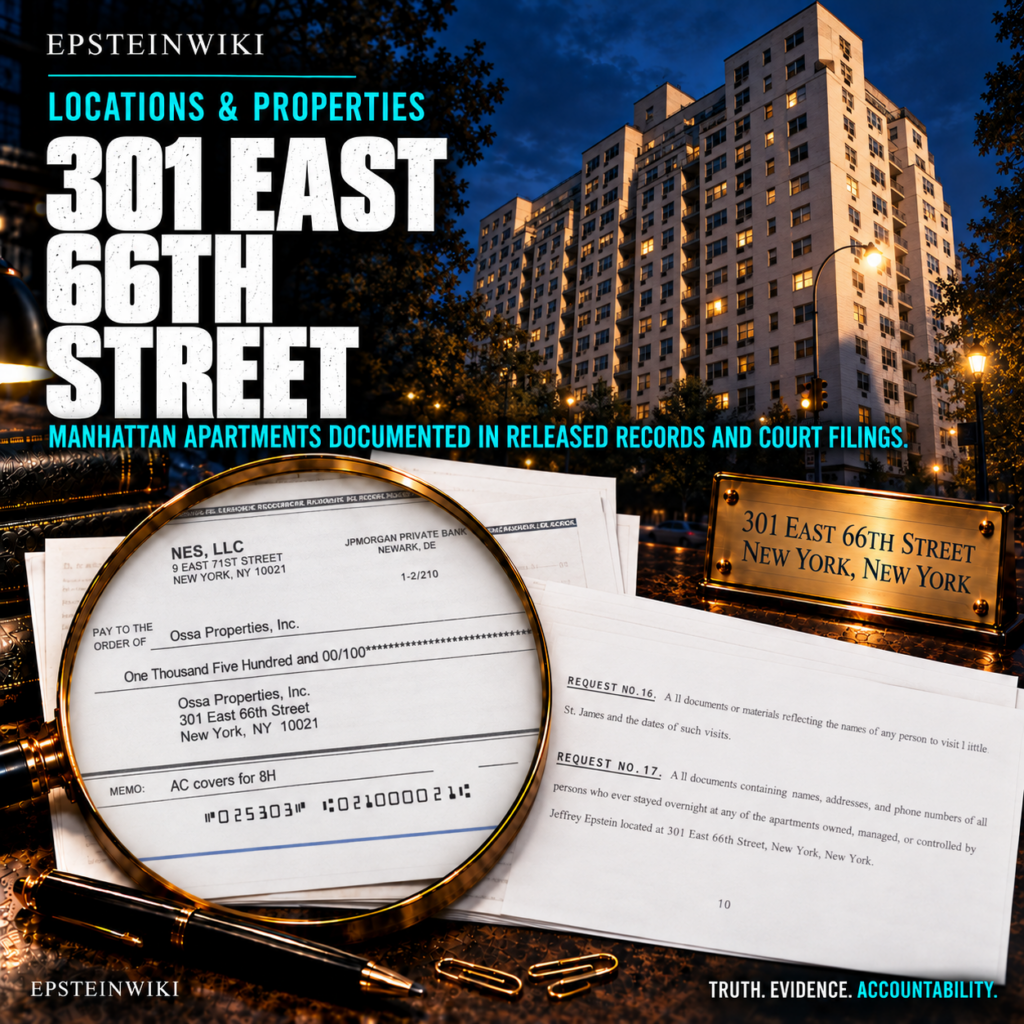
Snapshot
| Field | Finding |
|---|---|
| Address | 301 East 66th Street, New York, New York |
| Neighborhood | Lenox Hill, Upper East Side, Manhattan |
| Building type | Full service residential apartment building with a doorman, roof deck, garden, laundry facilities, and parking |
| Construction | Mid 1950s |
| Reported scale | Approximately 199 to 200 apartments in a 15 or 16 story building, depending on the source and method of counting |
| Principal building entities | 301/66 Owners Corp and Ossa Properties |
| Central ownership connection | Public reporting identifies Jeffrey Epstein’s brother, Mark Epstein, as the owner or controller of Ossa Properties and of a large block of apartments in the building |
| Jeffrey Epstein connection | Jeffrey Epstein used multiple apartments for guests, employees, associates, offices, pilots, household personnel, girlfriends, and other people in his orbit |
| Alleged model housing | Witness accounts, contact records, litigation material, and reporting connect some apartments to models and young women, but the evidence is not equally specific for every unit or occupant |
| Documented units | Released records identify or discuss units including 3M, 7J, 8A, 8H, 10B, 10F, 10N, 11B, 11J, and 11P, with different evidence for each |
| Best documented individual unit | Apartment 8H, associated in building records and delivery instructions with Karyna Shuliak |
| Key testimony | Lesley Groff told congressional investigators that Epstein used about ten apartments, including two offices and roughly eight guest apartments |
| Evidentiary warning | Ownership, residence, employment, guest use, and criminal participation are separate questions. An address alone does not prove wrongdoing |
| Present status | The building remains an ordinary occupied residential property. Current residents must not be treated as connected to Epstein without specific evidence |
Key Takeaways
- 301 East 66th Street was not simply one more Epstein residence. The available record describes a distributed apartment network that supported travel, staffing, lodging, office work, relationship management, and the movement of guests through Manhattan.
- Jeffrey Epstein did not need to hold conventional title to every apartment in order to exercise practical control over apartments. Staff communications show that his office could assign lodging, coordinate cleaning, arrange deliveries, maintain units, and prepare apartments for particular guests.
- Mark Epstein and entities associated with him are central to the ownership and management history. That relationship is important, but it does not by itself prove that Mark Epstein knew of or participated in Jeffrey Epstein’s crimes. Mark Epstein has denied knowledge of criminal use.
- Former assistant Lesley Groff gave the clearest numerical description. She recalled about ten Epstein apartments, with two functioning as offices and the remainder serving as guest apartments. She described stays by employees, pilots, girlfriends, dignitaries, and people receiving medical care.
- Other evidence raises more serious questions about model housing and young women. Address book labels, witness accounts, payments, testimony, and litigation questions collectively warrant investigation. They do not establish that every woman housed in the building was abused or trafficked.
- The building must be understood as infrastructure. Its value was discretion, flexibility, and proximity to Epstein’s townhouse at 9 East 71st Street, not architectural grandeur.
- The record contains both inculpatory and limiting evidence. Some witnesses described model housing and apartments used by women in Epstein’s orbit. Groff denied that the units were used to house masseuses and also described plainly noncriminal stays.
- The strongest responsible conclusion is that Epstein had dependable access to a substantial cluster of apartments within a building tied financially and operationally to his brother. The precise number, unit by unit purpose, and degree of knowledge held by each owner, manager, employee, and guest remain partly unresolved.
Why 301 East 66th Street Matters
The Manhattan townhouse at 9 East 71st Street was Jeffrey Epstein’s most visible New York property. It was a residence, office, social venue, and crime scene. The apartments at 301 East 66th Street served a different purpose.
They created capacity.
Multiple apartments in one ordinary residential building could accommodate employees, pilots, visitors, romantic partners, foreign guests, models, and people who needed privacy. Units could be cleaned, furnished, repaired, reassigned, or left available. A person could stay near Epstein’s townhouse without appearing on a hotel register or sharing the townhouse itself.
This made 301 East 66th Street part of the support system around Epstein. It was less conspicuous than the townhouse and more adaptable. The documentary record suggests repeated institutional use rather than an occasional favor involving one spare apartment.
Building Profile
| Feature | Reported description | Evidentiary significance |
|---|---|---|
| Era | Built in the mid 1950s | A large postwar residential building, not a private mansion |
| Size | About 199 to 200 apartments | Made a large internal apartment cluster less conspicuous |
| Height | Sources list 15 or 16 stories | The variation reflects real estate counting conventions and does not affect the core findings |
| Staffing | Full time doorman and live in superintendent | Staff could receive visitors, packages, letters, and instructions |
| Amenities | Roof deck, garden, laundry facilities, and parking | Supported extended residential stays |
| Location | East 66th Street near Second Avenue | Close to Midtown institutions and a short trip from Epstein’s townhouse |
| Exterior | Conventional white brick residential facade | Offered far less public visibility than 9 East 71st Street |
| Ownership pattern | Large block associated with 301/66 Owners Corp and Ossa Properties | Permitted coordinated access to multiple apartments |
Public real estate listings disagree slightly about the construction year, floor count, and exact number of apartments. Those discrepancies are normal for large New York buildings that have undergone combinations, conversions, or different counting methods. They should be reported rather than falsely harmonized.
The Building and the Townhouse Were Different Parts of One Manhattan System
| Feature | 9 East 71st Street | 301 East 66th Street |
|---|---|---|
| Primary form | Private townhouse | Large apartment building |
| Public association | Directly identified with Jeffrey Epstein | Publicly tied to entities associated with Mark Epstein, while Jeffrey used multiple units |
| Main documented function | Residence, meetings, entertainment, massage scheduling, household operations | Guest lodging, employee housing, offices, temporary stays, and apartment support |
| Visibility | Highly distinctive and closely associated with Epstein | Ordinary residential appearance |
| Control method | Central household staff and direct residential control | Unit assignments, keys, cleaning, repairs, deliveries, and building coordination |
| Investigative value | Site specific evidence of Epstein’s conduct | Evidence of the wider logistical network around that conduct |
The two properties should not be collapsed into one. The townhouse was a principal destination. The East 66th Street apartments were a reserve of space that could extend the reach of the townhouse operation.
Ownership Origins
Public reporting traces the building’s unusual ownership history through developer Myles Horn and a business relationship involving Leslie Wexner. During the New York real estate downturn around 1990, Horn reportedly transferred an interest in the building to Wexner. Ossa Properties later became associated with the property.
Jeffrey Epstein was then serving as Wexner’s financial adviser and held unusually broad authority over parts of Wexner’s affairs. Mark Epstein has said that Jeffrey alerted him to the investment opportunity at 301 East 66th Street.
That history makes the building relevant to the transition between the Wexner era of Epstein’s financial life and the later network of businesses and properties associated with the Epstein brothers. It does not, standing alone, reveal the full consideration paid, the beneficial ownership at each stage, or the purpose for which particular apartments were later used.
Leslie Wexner and Myles Horn
The Wexner and Horn history is important because it helps explain how the building entered the orbit of the Epstein family. It is not evidence that either man knew about later uses of individual apartments.
The responsible sequence is:
- Myles Horn was involved in the development or ownership of the building.
- Reporting says Horn transferred an interest during the real estate downturn to Leslie Wexner.
- Wexner and Ossa Properties were later linked through public business records.
- Mark Epstein became the central public figure associated with Ossa and the building.
- Jeffrey Epstein subsequently used a group of apartments there.
Each step needs separate documentation. A chain of commercial relationships is not a chain of criminal liability.
301/66 Owners Corp and Ossa Properties
Two names recur throughout reporting and released records: 301/66 Owners Corp and Ossa Properties.
301/66 Owners Corp appears as the cooperative ownership entity connected to the building. Ossa Properties appears in property management, rent, correspondence, and payment records. Reports have described Mark Epstein as the owner of Ossa and as controlling a very large block of apartments, sometimes stated as more than 150 units.
The exact legal relationship among the cooperative corporation, Ossa, individual units, mortgages, shareholders, tenants, and beneficial owners cannot be reduced to a single label. New York cooperative property structures separate ownership of the real estate from proprietary leases and shares allocated to apartments. The public record must therefore be read with attention to whether a document concerns the land, corporate shares, a proprietary lease, a management role, a rental, or actual occupancy.
Ownership, Management, Control, and Use
| Question | What the evidence supports | What remains uncertain |
|---|---|---|
| Who controlled Ossa Properties | Reporting consistently identifies Mark Epstein | The complete historical ownership record and every affiliate relationship |
| Who owned the building | 301/66 Owners Corp appears as the cooperative entity | The beneficial and share ownership of every apartment at every relevant date |
| Who managed apartments | Ossa appears in management notices, rent records, and invoices | Whether every Epstein used unit was managed under the same agreement |
| Who selected occupants | Jeffrey Epstein and his office could request or assign lodging | The formal authority supporting every assignment |
| Who paid | Records show payments involving Epstein connected entities, MC2, Ossa, and 301/66 Owners Corp | The purpose of every payment and whether some were reimbursements, rent, fees, or capital expenses |
| Who knew the purpose | Different employees knew different operational facts | Whether any owner or manager knew of criminal conduct in a particular unit |
This distinction is the core of the article. Legal ownership is not the same as operational control. Operational control is not the same as occupancy. Occupancy is not the same as criminal conduct.
Mark Epstein’s Role
Mark Epstein is a necessary figure in the property history because of his relationship to Ossa Properties and the unusually large apartment concentration attributed to him.
He has publicly stated that Jeffrey informed him of the opportunity. He has also said that he did not live at the building, did not monitor who used apartments, and did not know that any apartment was being used for criminal activity. Reporting has quoted him as describing Jeffrey as a renter or user of apartments rather than the owner of the building.
Investigators should test those claims against leases, ledgers, access records, communications, tax records, and maintenance instructions. The present public evidence proves a close property and family overlap. It does not by itself prove Mark Epstein’s knowledge of abuse, trafficking, or any other crime.
Jeffrey Epstein’s Practical Control
The operational record matters more than a simple title search. Jeffrey Epstein’s assistants handled requests for apartments. Staff arranged cleaning and repairs. Units were prepared for guests. Deliveries were routed to specific apartments. Building personnel received instructions. Visitors were told where to stay.
This is evidence of practical control.
Practical control can exist through rental agreements, family arrangements, corporate accounts, informal permission, or a combination of these. It does not require personal title. For a network analysis, the critical questions are who could place a person in a unit, who paid the costs, who held the keys, who ordered maintenance, and who decided when an apartment was available.
How Many Apartments Did Epstein Use
No single public source provides a definitive list for the entire period.
Lesley Groff told congressional investigators that she believed Epstein had about ten apartments. She recalled two as offices and about eight as guest apartments. Other reporting, drawing on a wider date range and additional records, has identified more than a dozen units or described approximately fifteen apartments operating in a lodging system between 2009 and 2019.
These accounts are not necessarily contradictory. The number may have changed over time. Some units may have been temporary. Some may have been offices rather than bedrooms. Some may have been controlled through companies or associates. Some unit numbers may appear only because a delivery, bill, or entity used the address.
The safest conclusion is that Epstein had access to a substantial and changing cluster, probably around ten at points in time and potentially more across the full historical period.
Unit by Unit Evidence Chart
| Unit | Publicly reported or documented connection | Evidence level | Caution |
|---|---|---|---|
| 3M | Curbed reported that a ranch manager was offered this apartment in 2017 and was warned about a roach problem | Reported from released records | Guest offer does not establish occupancy or wrongdoing |
| 7J | Appears in reporting and released apartment records connected to the wider Epstein system | Partial documentation | Publicly available evidence does not establish one continuous use |
| 8A | Appears in reporting and released records concerning the apartment cluster | Partial documentation | Occupant and purpose require date specific verification |
| 8H | Building invoice and delivery records associate the unit with Karyna Shuliak | Strong documentary connection | Her presence does not by itself establish criminal activity in the apartment |
| 10B | Identified in reporting or released records as part of the apartment network | Partial documentation | Exact use and dates should not be inferred without the underlying record |
| 10F | Used as an address in records linked to an Epstein connected corporate entity | Documentary address connection | A corporate address does not prove residential occupancy |
| 10N | Identified in reporting or released records concerning the building | Partial documentation | The public record does not yet support a definitive occupant history |
| 11B | Appears in reporting and apartment related records | Partial documentation | More complete leasing and access records are needed |
| 11J | An Epstein file identifies it in guest lodging coordination | Strong guest unit evidence | Guest use is not proof of misconduct |
| 11P | Identified with 11J in guest lodging coordination | Strong guest unit evidence | Purpose must be assessed for each stay |
This chart is an evidence map, not a roster of culpability. Unit numbers should be tied to dates and documents before any occupant claim is made.
The Guest Apartment System
The strongest overall interpretation is that at least part of the cluster functioned like private corporate lodging.
Guests did not necessarily make ordinary hotel reservations or negotiate individual leases. Epstein or a staff member could decide that an apartment was available. Assistants then coordinated keys, cleaning, supplies, maintenance, arrivals, and departures. Some guests stayed briefly. Others stayed for longer periods. Employees and pilots could use units while working in New York.
This structure served legitimate and potentially illegitimate purposes at the same time. Hosting a pilot, an employee, a foreign dignitary, or a cancer patient is not criminal. The same private lodging capacity could also reduce scrutiny around young women or vulnerable visitors. The investigative importance lies in the system’s flexibility and opacity.
Lesley Groff’s Congressional Testimony
In testimony released by the United States House Committee on Oversight and Government Reform, former Epstein assistant Lesley Groff described the apartment arrangement in unusually concrete terms.
Groff said she thought Epstein owned the apartments, although her belief was based on her work experience rather than a title examination. She estimated that there were about ten. Two became offices. The others were guest apartments.
She recalled traveling assistants using them. She said two women identified in the transcript as Lyn and Jojo had an apartment. She recalled an estate manager staying there, as well as Epstein’s pilots. She said attorney Darren Indyke lived there briefly. She also confirmed stays by former Israeli prime minister Ehud Barak and his wife, Nili Priel.
Groff described a mother and son staying for about six months while the son received treatment at Memorial Sloan Kettering Cancer Center. That example is important because it demonstrates that the apartment system was used for compassionate and ordinary lodging as well as for people in Epstein’s personal and professional network.
Groff denied that the apartments were used to house masseuses. She did acknowledge that girlfriends stayed there. Her testimony should be presented in full, not edited into a single incriminating or exculpatory claim.
The March 2013 Housing Email
A March 14, 2013 email released as EFTA00956524 illustrates the assignment process.
A woman asked whether Epstein would be in New York and whether there was a place where she could stay, also referring to a Czech friend. Epstein forwarded the request to Groff and asked whether an apartment was available.
When congressional investigators showed Groff the email, she said the possible lodging would have been at 301 East 66th Street. She explained that she arranged housing for women and men when Epstein directed her to do so.
The document proves that Epstein could initiate an apartment assignment through his assistant. It does not, without more evidence, establish why either woman was visiting or whether either experienced abuse.
Staff Housing
Employees were among the best documented categories of occupants. The building could house assistants visiting New York, household personnel, pilots, estate staff, and professional advisers.
This arrangement benefited Epstein in several ways. Staff could remain available without living inside the townhouse. Travel crews could arrive before a flight or remain after one. Employees from Palm Beach, New Mexico, Paris, or the Virgin Islands could work in Manhattan without a public hotel trail. Long term personnel could be rewarded with desirable housing.
Housing can also create dependency. An employee whose residence is controlled by an employer may face additional pressure when asked to perform questionable tasks. That general risk does not prove coercion in any individual case, but it is relevant when evaluating an organization in which employees scheduled massages, routed young women, managed travel, and protected Epstein’s privacy.
Pilots and Estate Personnel
Groff recalled that Epstein’s pilots each had an apartment. Reporting also describes pilot Larry Visoski requesting or discussing apartments for himself, other pilots, and family members. Estate personnel could be placed in a unit during New York work.
The pilot connection demonstrates how the building linked Epstein’s geographic network. His aircraft connected Manhattan with Palm Beach, New Mexico, Paris, the United States Virgin Islands, and other destinations. Housing flight personnel near the Manhattan base supported rapid and private travel.
Nothing about a pilot’s stay is inherently suspicious. The significance is logistical. The apartment network helped sustain the transportation system that moved Epstein, employees, guests, and survivors among his properties.
Offices Inside the Building
Groff recalled that two apartments became offices. Corporate and legal records also used the building address for Epstein connected entities or personnel.
Residential apartments used as offices can blur personal, corporate, and household functions. Mail, invoices, visitors, staff work, and lodging may all pass through the same building. That makes conventional public records less informative because an address may describe a registered office, working office, mailing point, residence, or temporary accommodation.
Researchers should identify the precise unit, entity, year, and document before describing any company as operating from the building.
Corporate Addresses and Affiliated Entities
Reporting and records connect the building address to people or entities including Darren Indyke, 9 East 71st Street Corp, NES LLC, Aviloop, and SLK Designs. The exact unit and function vary by record.
| Record type | What it can prove | What it cannot prove alone |
|---|---|---|
| Corporate filing | An entity declared an address | That staff worked there every day |
| Rent check | A payer transferred money to a landlord or manager | The identity of every occupant |
| Delivery instruction | A recipient was expected at a unit | Permanent residence or criminal activity |
| Maintenance email | Staff had access and arranged work | Ownership of the apartment |
| Guest instruction | A unit was prepared for a named stay | Knowledge of another person’s conduct |
| Cooperative record | Shares or lease rights existed | Actual day to day use |
Model Housing Allegations
The most serious allegation about 301 East 66th Street is that some apartments housed models or young women connected to Epstein and Jean Luc Brunel.
Several categories of evidence support continued scrutiny:
- Contact records reportedly labeled apartment numbers or contacts as apartments for models.
- Former staff and witnesses described young women or models staying in apartments.
- MC2 Model Management made a documented payment to Ossa Properties.
- Litigation questioning raised allegations that numerous underage girls stayed in the building.
- The wider record establishes that Epstein and Brunel cultivated access to aspiring models and young women.
The evidence must not be overstated. A model may have stayed for a legitimate reason. A payment does not identify an occupant. An attorney’s deposition question is not a factual finding. A witness’s refusal to answer is not corroboration. The cumulative pattern is significant, but each proposition requires its own proof.
The Address Book Label
Published reporting on Epstein’s address books has described entries for the building as apartments for models. Such a label is probative because it suggests a recognized internal category rather than an isolated visit.
The label does not reveal:
- which models stayed there
- their ages
- the dates of their stays
- who recruited them
- whether they met Epstein
- whether any crime occurred
Address book evidence is best used as an investigative lead that can be matched against leases, flight logs, telephone records, calendars, immigration records, interviews, and financial transactions.
MC2 Model Management and Jean Luc Brunel
EFTA02701063 and EFTA00616936 document a 2012 payment of $4,500 from MC2 Model Management to Ossa Properties.
MC2 was associated with Jean Luc Brunel, a French modeling agent who had a long relationship with Epstein. Numerous women accused Brunel of sexual abuse. French authorities charged him with rape of minors, and he died in custody in 2022 before trial. His death prevented a final adjudication of those charges.
The rent payment links a modeling company in Epstein’s network to the building’s management. It does not identify the apartment, the occupant, or the reason for the payment by itself. Investigators should pair the payment with MC2 ledgers, Ossa rent rolls, bank records, and occupancy files.
Maritza Vasquez’s Account
Independent reporting has cited former housekeeper Maritza Vasquez as describing models housed in two or three Epstein apartments, with approximately four young women in an apartment at a time.
This is a significant witness account because it describes both purpose and scale. It should still be treated as testimony requiring corroboration. The exact dates, unit numbers, identities, ages, and circumstances are not fully established in the public record.
Vasquez’s account becomes more important when read beside the address book label, the MC2 payment, and the documented apartment assignment system. It should not be used to declare every unidentified resident a model or survivor.
The 2010 Deposition Questions
In a deposition released in the Epstein files, an attorney asked a witness whether at least sixteen underage girls stayed in condominiums at 301 East 66th Street and whether they were prostituted. The relevant page is EFTA00182450.
The witness declined to answer.
This document establishes that the allegation existed in litigation and was put directly to a witness. It does not establish that the allegation was true. Questions asked by counsel are not evidence of the facts embedded in them, and a refusal to answer is not an admission.
The page belongs in the evidence record because it identifies a specific investigative claim. It must always be labeled as an allegation contained in questioning.
Survivors and Vulnerable Women
The purpose of examining the building is not to catalogue famous visitors. It is to understand the conditions that could isolate or control women and girls.
Private apartments can remove a person from hotel staff, public lobbies, formal booking records, and ordinary witnesses. Housing controlled by a wealthy benefactor can also entangle shelter, immigration help, employment promises, modeling opportunities, travel, and personal loyalty.
Some women in Epstein’s orbit were employees. Some were girlfriends. Some were models. Some were survivors. Some may have occupied more than one category at different times. Public evidence does not permit every woman to be placed into one fixed label.
Responsible reporting should avoid publishing the names of private people merely because they appear in an address record. It should foreground survivor accounts where consent permits, preserve uncertainty, and focus on the people who controlled access, money, travel, and assignments.
Foreign Visitors, Immigration, and Dependency
Epstein and Brunel frequently operated around young women from outside the United States. International travel can deepen dependency when a visitor relies on a host for housing, money, transportation, employment contacts, or immigration guidance.
The March 2013 email referring to a Czech friend demonstrates that foreign visitors could be placed through the apartment system. It does not prove immigration misconduct. Any visa related claim requires a visa application, sponsorship record, immigration file, or sworn testimony.
Questions about passports, visas, work authorization, recruitment promises, and return travel are legitimate areas for investigation. Nationality alone is not evidence of victimization or illegality.
Karyna Shuliak and Apartment 8H
Apartment 8H has a comparatively strong documentary trail.
EFTA00525536 is an invoice associated with the apartment that names 301/66 Owners Corp and Ossa Properties in connection with Karyna Shuliak. EFTA00533574 contains delivery instructions placing Shuliak at 8H.
Shuliak was a close associate and later reported girlfriend of Epstein. She was named as a beneficiary in a will signed shortly before his death. Her association with the unit demonstrates how the apartment network housed people in Epstein’s intimate circle.
It does not prove that crimes occurred in 8H or that Shuliak knew about conduct in other properties. The records establish association and use, not culpability.
Ehud Barak and Nili Priel
Former Israeli prime minister Ehud Barak and his wife, Nili Priel, repeatedly stayed in an apartment at 301 East 66th Street. Groff confirmed their use of an apartment in her congressional testimony. Internal communications reportedly referred to it as Ehud’s apartment, although the phrase described recurring use rather than necessarily legal ownership.
EFTA02278459 contains apartment maintenance instructions connected to the stay. Other records, including EFTA02575361 and EFTA02589113, document correspondence and meeting arrangements involving Barak and Epstein.
Barak has said that his relationship with Epstein involved business, science, philanthropy, and introductions, and he has denied participating in sexual misconduct. Staying in an apartment supplied through Epstein’s network is evidence of access and relationship. It is not evidence of participation in Epstein’s crimes.
The Barak Apartment Security System
Drop Site News reported that Israeli government security personnel helped install or maintain security equipment in the apartment used by Barak beginning in 2016, with officials from Israel’s mission to the United Nations involved in coordination.
If accurate, the arrangement demonstrates the sensitivity attached to the stay and the degree to which the unit was treated as a recurring lodging site. It raises questions about who had access to the equipment, how the system interacted with building infrastructure, and whether records were retained.
It does not establish espionage, surveillance of other residents, or intelligence activity by Epstein. Those claims require direct technical or testimonial evidence. The presence of protective security equipment for a former head of government has legitimate explanations.
Steve Bannon and the Secure Apartment Description
Reporting based on released communications says Steve Bannon was offered an apartment at 301 East 66th Street and that the unit was described as secure, with a rear entrance.
That description helps explain why the building appealed to prominent guests. Alternate access and private lodging could reduce public exposure. The offer is evidence of hospitality and access, not evidence that Bannon owned the apartment, accepted every proposed stay, or participated in sexual misconduct.
Any claim about a completed stay should be tied to a dated message, key record, visitor record, or corroborating witness rather than inferred from an offer.
Other Guests and the Danger of Guilt by Address
The building reportedly hosted politicians, business contacts, employees, pilots, household staff, medical visitors, romantic partners, and personal acquaintances. Some stays were short. Some were recurring. Some people may have used an apartment without ever meeting another resident.
A 200 unit building is not a private compound. Many residents had no relationship to Epstein. Even within apartments available to his office, presence does not prove knowledge of crimes.
EpsteinWiki should never present a resident list as a suspect list. Each person requires a source, date, purpose, and evidence classification.
The Doorman and Front Desk
Released records and reporting show that building staff could act as a conduit for guests, deliveries, keys, and written instructions. Welcome letters and packages could be left with the doorman. Staff could be notified about an expected arrival or directed to admit a visitor.
Front desk records, if preserved, could be among the most valuable missing sources. They might identify dates of entry, unit destinations, keys issued, contractors, vehicle arrivals, or unusual after hours activity.
Doormen and building workers should not be presumed to know the purpose of a visit. In a large residential building, routine service can support an apartment system without exposing the staff member to the relationships behind it.
Keys, Access, and Guest Entry
EFTA02189270 concerns guest entry and lodging coordination. EFTA02088306 identifies apartments 11J and 11P in connection with guest accommodations.
Access evidence can reveal practical control more clearly than title records. Key questions include:
- Who held master or spare keys
- Whether Epstein’s staff could admit guests without an occupant present
- Whether front desk authorization remained on file
- Who changed locks between occupants
- Whether keys moved between the townhouse and the building
- Whether electronic entry records existed
The public record shows coordination, but not a complete access log.
Cleaning and Turnover
A recurring guest system requires cleaning, linen changes, supplies, inspections, and rapid turnover. Reporting describes assistants and housekeepers operating apartments in a manner similar to private lodging.
Cleaning records could establish occupancy dates even when no guest register exists. Laundry bills, supply orders, housekeeping calendars, repair tickets, gratuities, and elevator logs can all corroborate a stay.
These mundane records matter because organizations leave traces at points of routine labor. They may also identify workers who observed conditions but were never interviewed by investigators.
Repairs, Painting, and Renovations
The released files show coordinated maintenance across multiple apartments.
EFTA00544547 discusses painting six apartments and involves Richard Kahn or an HBRK related account. EFTA01949313 contains renovation specifications. EFTA02425330 is an Ossa management letter. EFTA00554459 is a 2019 fire safety notice.
The painting of six apartments in a coordinated project supports the conclusion that the units were managed as a group. It does not establish the purpose of every unit or the identity of every occupant.
Contractor invoices, insurance certificates, work permits, and building alteration agreements could provide a more complete unit chronology.
Building Labor Notices
EFTA00541036 is a 2018 building service employee strike notice sent in connection with a J. Epstein account. EFTA00569895 is another resident notice connected to building operations.
Such records appear ordinary, but they help establish that Epstein related personnel or accounts were embedded in routine building administration. They may identify the mailing address, account name, or staff member who handled a unit at a particular time.
Administrative documents should be used to build a chronology, not inflated into proof of criminal conduct.
Financial Flows
Money moved among Epstein connected entities, building entities, and third parties. The available records raise several distinct categories:
| Payment category | Example | Possible meaning | Required corroboration |
|---|---|---|---|
| Rent | MC2 payment to Ossa | Apartment rent or housing expense | Lease, unit ledger, invoice |
| Building payment | Payment to 301/66 Owners Corp | Maintenance, assessment, shares, or another obligation | Account statement and payment memo |
| Renovation | Painting and apartment work | Preparation, repair, or turnover | Contractor invoice and unit list |
| Reimbursement | Staff or affiliate payment | Expense recovery | Expense report and bank record |
| Corporate expense | Entity uses building address or pays cost | Office or employee housing | Corporate ledger and occupancy record |
No payment should be assigned a criminal purpose without evidence connecting the money to a person, unit, and act.
The 2014 Payments to 301/66 Owners Corp
A financial schedule in EFTA01681893 lists two 2014 payments connected to 301/66 Owners Corp: $182,219 on April 10 and $50,000 on May 2.
The accompanying note describes the entity as appearing to own 301 East 66th Street, where Epstein allegedly housed young models, and as an affiliate of Ossa Properties owned by Mark Epstein.
This is useful but layered evidence. The dates and amounts are financial entries. The description of model housing is an allegation in the schedule or its source material. The document does not, on its face, allocate the money to a particular apartment or occupant.
Investigators need the originating bank records, general ledger, account statements, and invoices to determine the purpose of the payments.
The Reported Mortgage Transfer
Public reporting has identified a mortgage of approximately $7.24 million associated with the building’s transfer history. Reporters have noted difficulty locating a conventional arm’s length sale record that fully explains how the large apartment interest moved among the relevant parties.
A mortgage transfer is not necessarily a sale. It can reflect refinancing, assignment, restructuring, security for another obligation, or movement among related entities. The absence of a familiar deed record does not by itself prove concealment.
The unresolved question is whether the building interest was purchased on ordinary terms, transferred as part of another business arrangement, or financed through a relationship connected to Wexner and Jeffrey Epstein.
Relationship Map
| Person or entity | Documented relationship to the building | Important limitation |
|---|---|---|
| Mark Epstein | Associated with Ossa Properties and a large apartment block | Association does not prove knowledge of Jeffrey Epstein’s crimes |
| Jeffrey Epstein | Directed lodging, used offices, and maintained access to multiple apartments | Exact legal interest in each unit remains unclear |
| 301/66 Owners Corp | Cooperative ownership entity | Corporate ownership is distinct from occupancy |
| Ossa Properties | Management, rent, invoice, and property role | Scope varied by unit and date |
| Lesley Groff | Arranged lodging at Epstein’s direction | Her estimate was based on work experience, not title records |
| Karyna Shuliak | Associated with apartment 8H | Residence does not prove misconduct |
| MC2 Model Management | Made a payment to Ossa | Payment purpose and occupant need corroboration |
| Jean Luc Brunel | Connected to MC2 and Epstein’s model network | The specific unit history is incomplete |
| Ehud Barak and Nili Priel | Recurring guests in an apartment | Guest status is not criminal involvement |
| Pilots and estate staff | Housed in units for work and travel | Employment alone does not imply knowledge of abuse |
Timeline
| Period | Event | Significance |
|---|---|---|
| Mid 1950s | Building constructed | Establishes the large conventional residential setting |
| Around 1990 | Myles Horn and Leslie Wexner transaction reported | Beginning of the modern ownership history relevant to the Epstein network |
| Early 1990s | Ossa Properties becomes connected to the building | Mark Epstein’s property role develops |
| 1990s and 2000s | Jeffrey Epstein gains access to apartments | Precise start date and unit count remain unclear |
| 2009 to 2019 | Reporting describes an active private lodging system | Period with extensive surviving email and administrative evidence |
| 2010 | Deposition includes allegations about minors housed in condominiums | Allegation entered litigation record but was not resolved by the refusal to answer |
| 2012 | MC2 pays $4,500 to Ossa Properties | Direct financial link between modeling company and building manager |
| 2013 | Email asks Groff to locate an apartment for visitors | Shows practical assignment process |
| 2014 | Payments of $182,219 and $50,000 listed to 301/66 Owners Corp | Requires underlying accounting records |
| 2015 to 2019 | Barak and Priel use an apartment repeatedly | High profile recurring guest arrangement |
| 2016 onward | Security equipment reportedly coordinated for Barak’s stay | Shows specialized preparation of a guest unit |
| 2017 | Ranch manager reportedly offered apartment 3M | Example of employee or associate lodging |
| 2018 | Building service strike notice reaches Epstein account | Routine administrative connection |
| 2019 | Epstein arrested and apartment network receives press scrutiny | Public awareness expands beyond the townhouse |
| 2026 | Congressional testimony and further file releases add detail | New evidence clarifies guest apartments while leaving ownership questions open |
Evidence Strength Assessment
| Proposition | Assessment | Reason |
|---|---|---|
| Epstein used multiple apartments | Strong | Emails, testimony, maintenance records, guest coordination, and reporting converge |
| The cluster included offices and guest units | Strong | Groff testimony and corporate records support both functions |
| Mark Epstein controlled Ossa Properties | Strong | Consistent public reporting and business records |
| More than 150 apartments were associated with Mark Epstein | Substantial but structure dependent | Reported widely, though cooperative ownership terminology requires precision |
| Models stayed in some units | Substantial but incomplete | Witness accounts, labels, and financial links converge without a complete roster |
| Underage girls were housed in at least sixteen units | Unproven public allegation | Appears in deposition questioning without a factual finding |
| Every guest knew about Epstein’s crimes | Unsupported | No basis for collective inference |
| The building was used only for illicit purposes | False | Documented staff, medical, office, and ordinary guest uses |
| Mark Epstein knew apartments facilitated abuse | Not established by the public record | Requires direct communications, testimony, or financial evidence of knowledge |
| Crimes occurred in every identified unit | Unsupported | Unit connection and criminal conduct are separate propositions |
What the Evidence Establishes
The public record establishes that Jeffrey Epstein enjoyed reliable access to multiple apartments at 301 East 66th Street. His staff could arrange lodging. Apartments were cleaned, repaired, painted, furnished, and prepared. Employees, pilots, associates, girlfriends, dignitaries, and other guests stayed there. Some units functioned as offices.
The record also establishes that entities associated with Mark Epstein had a major ownership or management role in the building. It establishes a payment from MC2 to Ossa and financial transfers involving 301/66 Owners Corp. It supports serious inquiry into the housing of models and young women.
Taken together, the apartments were a significant component of Epstein’s Manhattan infrastructure.
What the Evidence Does Not Establish
The public record does not establish that every apartment in the building was available to Epstein. It does not establish a single permanent unit list for every year. It does not establish that every model was a survivor, every employee was a facilitator, or every guest knew of abuse.
It does not prove that Mark Epstein knew of criminal activity. It does not prove that Leslie Wexner knew how apartments were later used. It does not prove that protective security equipment installed for Ehud Barak was part of an intelligence operation.
It does not turn current owners, tenants, building employees, or visitors into public figures connected to the case.
Common Errors and Myths
| Claim | Correction |
|---|---|
| Jeffrey Epstein owned the entire building | Reporting more often attributes the major ownership position to Mark Epstein and related entities, while Jeffrey used apartments |
| Every unit was an apartment for models | The building contained about 200 units and many ordinary residents. Even the Epstein controlled cluster had multiple purposes |
| Groff admitted the apartments housed masseuses | Groff denied that claim in her congressional testimony |
| A refusal to answer proved sixteen minors were housed there | A refusal is not an admission, and counsel’s question is not proof |
| Everyone who stayed there was involved in abuse | Guest use alone proves no such thing |
| The MC2 payment proves trafficking | It proves a payment from the modeling company to Ossa, not its purpose |
| Apartment 8H was a proven crime scene | Records associate it with Karyna Shuliak, but do not establish a crime there |
| Barak’s security system proves espionage | The public evidence supports a security installation, not espionage |
| Present residents are part of the Epstein network | No. Current residents must be treated as private people unless specific evidence shows otherwise |
Current Ownership and Present Day Status
Recent reporting indicates that Mark Epstein or entities associated with him may still hold a very large share of apartments in the building. Exact current holdings should be verified through the latest cooperative, financing, tax, and corporate records.
The building continues to operate as a residential property. Apartments have ordinary residents, sales, rentals, maintenance needs, and building services. Historical investigation must not intrude on present residents or publish identifying information unrelated to the public interest.
A building can be historically significant without treating it as frozen in the period of Epstein’s activity.
Survivor Centered Assessment
The apartment network matters because control over housing can become control over movement, privacy, money, and opportunity.
For an aspiring model or foreign visitor, a free Manhattan apartment may have appeared generous. It could also create dependency on the person providing the key. For an employee, housing could bind work and personal life. For a survivor, being placed away from a hotel or independent contact point could reduce opportunities to seek help.
Researchers should ask survivors what the apartment system meant to them rather than assuming that a lease or address explains their experience. Names, immigration information, medical details, and residential histories should be handled with consent and care.
The purpose of documenting infrastructure is accountability for the people who built, funded, and directed it, not renewed exposure of the people who may have been harmed within it.
Investigative Significance
301 East 66th Street connects several parts of the Epstein investigation that are often studied separately:
- the financial relationship between Jeffrey Epstein, Mark Epstein, and the Wexner business orbit
- the use of corporate entities to hold or manage residential space
- the logistics of staffing and private aviation
- the recruitment and housing of models and young women
- the hosting of political and business figures
- the role of assistants in assigning rooms and managing access
- the difference between nominal ownership and practical control
It is therefore best understood as a network node. The building linked money, people, corporate records, travel, household labor, and private hospitality.
Questions for Further Investigation
Ownership and finance
- What was the complete chain of title, cooperative share ownership, and beneficial ownership from Myles Horn through the Wexner and Ossa periods?
- What consideration was paid for the building interest or apartment shares?
- What did the reported $7.24 million mortgage secure?
- Did Jeffrey Epstein finance any acquisition, renovation, assessment, or operating expense?
- Which bank accounts funded the 2014 payments to 301/66 Owners Corp?
- What were the $182,219 and $50,000 payments for?
- Were apartment costs treated as personal expenses, business expenses, compensation, gifts, or loans?
- Did any Epstein controlled foundation pay building costs?
- Did Ossa maintain separate ledgers for apartments used by Jeffrey Epstein?
- Were any related party transactions reported to cooperative shareholders or lenders?
Units and occupancy
- Which apartments were available to Epstein in each year?
- Which were offices, guest units, employee residences, or long term homes?
- Who signed each proprietary lease or sublease?
- Who held the keys to each unit?
- Did the front desk maintain standing admission lists?
- Are guest logs, package records, or key logs preserved?
- Which apartments were painted in the six unit project?
- What renovations were made under the specifications in EFTA01949313?
- Were walls, doors, locks, cameras, or communications systems altered?
- Why did the number of apartments described by witnesses change over time?
Models and young women
- Which unit or units did the MC2 payment cover?
- Who authorized the $4,500 payment?
- Did MC2 maintain housing rosters or expense reports?
- Which address book entries were labeled as apartments for models?
- Who created and updated those entries?
- Can Maritza Vasquez’s account be matched to leases, calendars, or other witnesses?
- What were the names and ages of the women described in litigation, and can they be approached in a survivor centered manner?
- Were modeling jobs, visas, travel, or education offered in connection with housing?
- Did Brunel or other agents hold keys or direct access?
- Were any residents recruited for massages at 9 East 71st Street?
- Did any survivor identify a specific apartment in a police report or sealed civil filing?
- Were minors ever left without an independent guardian in a unit?
Staff and administration
- Which assistants handled apartment assignments?
- Who supervised cleaning and linen turnover?
- Were housekeepers assigned from the townhouse to the building?
- Did employees receive apartments as compensation?
- Were housing benefits reported for tax purposes?
- Which pilots had units, and during what periods?
- Did staff understand which apartments were controlled by Ossa and which were controlled by Jeffrey Epstein?
- Were building employees ever interviewed by federal investigators?
- Did any worker report suspicious conduct to management?
- What records were preserved after Epstein’s 2019 arrest?
Guests and security
- Which high profile guests actually stayed, as opposed to merely receiving offers?
- Who paid for security work in the apartment used by Ehud Barak?
- What equipment was installed, and who could access it?
- Were security devices removed, and were data or logs retained?
- What did the description of a secure apartment with a rear entrance mean in practice?
- Were visitors able to enter through a garage or service entrance?
- Did the building maintain camera footage, and what was its retention period?
- Did Epstein’s staff receive alerts when particular guests arrived?
Knowledge and accountability
- What did Mark Epstein know about the identities and purposes of occupants?
- Did Ossa employees ever communicate concerns about young residents?
- Did any cooperative board member question the concentration of apartments or guest turnover?
- Did Jeffrey Epstein describe the apartments to accountants, lawyers, or family members?
- Were the units disclosed to prosecutors during the 2007 and 2008 non prosecution negotiations?
- Did federal agents search any apartment in 2019?
- Did the estate identify apartment related claims, leases, deposits, or personal property?
- Which questions remain answerable through unsealed grand jury, civil discovery, or estate records?
Evidence Index
| Record | Subject | Use in this article |
|---|---|---|
| EFTA00182450 | Deposition question about alleged housing of minors | Documents the allegation, not its truth |
| EFTA00525536 | Apartment 8H invoice | Connects 8H, building entities, and Karyna Shuliak |
| EFTA00533574 | Delivery instructions | Places Shuliak at 8H for delivery purposes |
| EFTA00541036 | Building service strike notice | Shows routine building administration tied to an Epstein account |
| EFTA00544547 | Painting six apartments | Supports coordinated maintenance of multiple units |
| EFTA00554459 | Fire safety notice | Routine resident and building record |
| EFTA00569895 | Resident notice | Building administration evidence |
| EFTA00571580 | Building record | Distinguishes ownership and tenant categories |
| EFTA00616936 | MC2 rent payment record | Links MC2 payment to Ossa Properties |
| EFTA00956524 | March 2013 apartment request | Shows Epstein directing Groff to arrange lodging |
| EFTA01681893 | 2014 payment schedule | Lists payments to 301/66 Owners Corp and an allegation about model housing |
| EFTA01949313 | Renovation specifications | Documents apartment work |
| EFTA02088306 | Guest units 11J and 11P | Identifies specific guest accommodation units |
| EFTA02189270 | Guest entry coordination | Shows operational access management |
| EFTA02278459 | Apartment maintenance for Barak stay | Supports recurring guest use and preparation |
| EFTA02425330 | Ossa management letter | Documents management role |
| EFTA02575361 | Barak correspondence | Supports relationship and meeting chronology |
| EFTA02589113 | Barak meeting arrangements | Supports relationship and access history |
| EFTA02701063 | MC2 payment material | Financial link between modeling company and Ossa |
Sources
- United States House Committee on Oversight and Government Reform, Lesley Groff transcript
- Curbed, The Nondescript Condo Building Where Jeffrey Epstein Kept His Victims
- Business Insider, The NYC Building at the Center of Jeffrey Epstein’s Web
- The Real Deal, Jeffrey Epstein’s Real Estate Ties to His Brother Mark
- The Real Deal, Who Is Mark Epstein? Investor Tries to Shed Brother’s Shadow
- The Wall Street Journal, Wealth of Jeffrey Epstein’s Brother Is Also a Mystery
- Drop Site News, Israeli Government Security Apparatus Installed at Epstein Apartment Used by Ehud Barak
- Ellie Leonard, The Mystery of 301 East 66th Street
- StreetEasy, 301 East 66th Street Building Profile
- Corcoran, 301 East 66th Street Building Profile