
From Operation Stolen Globe to Trial Discovery: What the Filed Records Show
Snapshot
- Historical exhibits filed on October 21, 2026 trace investigative activity, preservation requests and evidence collection across several years.
- Three records document Operation Stolen Globe in 2009, 2010 and 2016. Other exhibits describe a 2019 device-search request and the assembly of discovery in 2020 and 2021.
- The exhibits document requests and transfers, but do not provide a complete record of what was received or disclosed to the defense.
The opening page of Document 874-2 shows that Ghislaine Maxwell submitted the exhibit batches by email on September 22, 2026. The compilation bears an October 21 court filing stamp. Much of what follows consists of older investigative records and correspondence, rather than events occurring on the filing date.
Read together, the exhibits show several distinct stages in the handling of evidence: investigators seeking records, lawyers asking that material be preserved, the FBI transferring information to prosecutors, and prosecutors preparing material for the defense. Keeping those stages separate is essential to understanding what the record does and does not establish.
Operation Stolen Globe appears in three different records
An investigation timeline entry dated October 29, 2009 records an instruction to open a file and request a U.S. Attorney’s Office case number for Operation Stolen Globe. The page is a retrospective summary. It identifies a starting point in the documentary chronology but does not supply the underlying investigative file.
A March 22, 2010 email then asks for grand-jury subpoenas in the operation using a phone-number spreadsheet. The forwarded message describes numbers associated with several locations, a further spreadsheet still being prepared, and problems copying some of Alfredo Rodriguez’s deposition CDs.
The exhibit does not reproduce the attachment named in the email, the subpoenas, their returns or the deposition recordings. It documents the request and the materials under discussion, but not what every requested record ultimately contained.
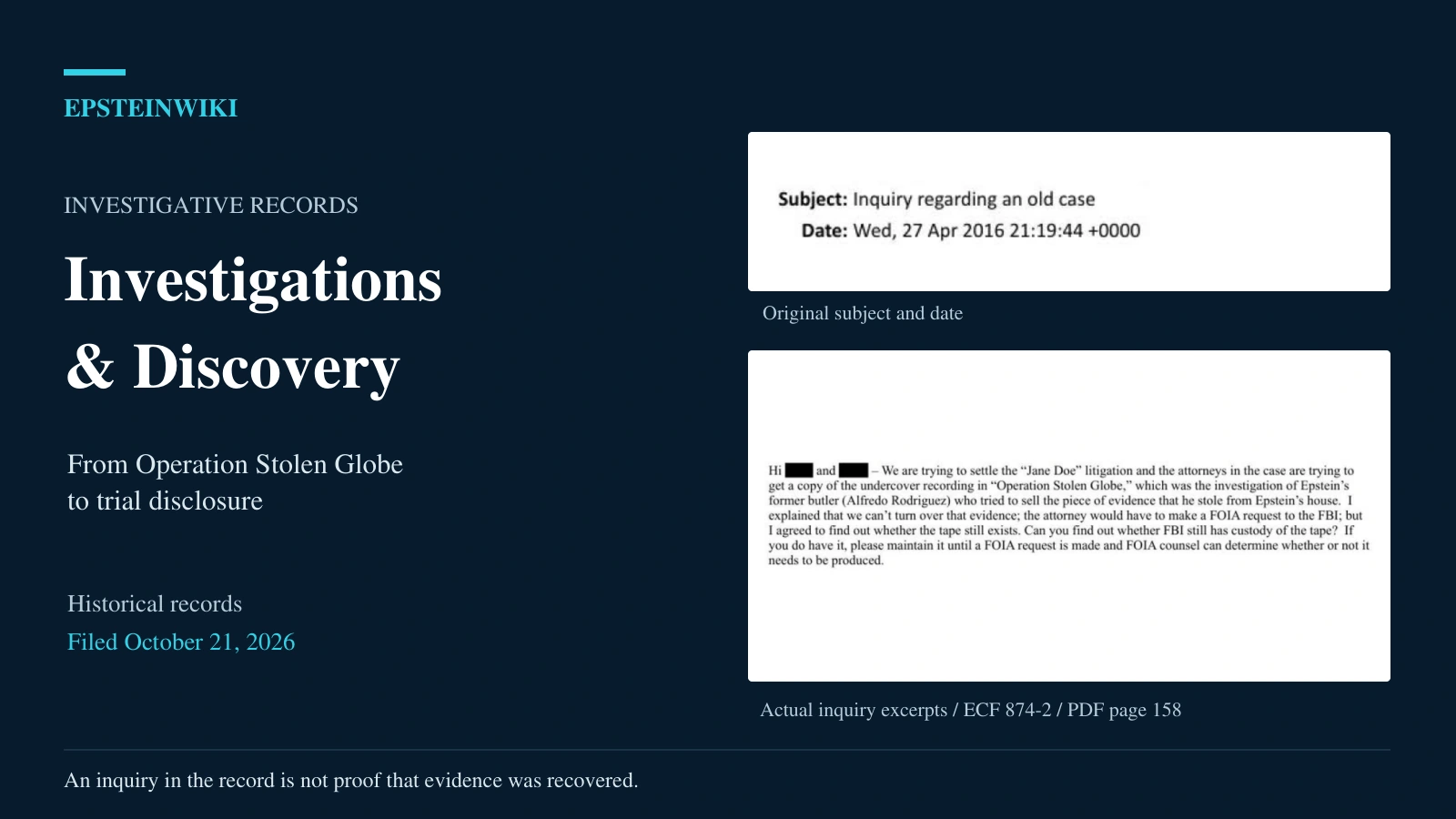
The most explicit explanation comes in an April 27, 2016 preservation inquiry. An assistant U.S. attorney describes Operation Stolen Globe as the investigation of Rodriguez, Epstein’s former butler, over an attempt to sell evidence taken from Epstein’s home. The prosecutor asks whether the FBI still has an undercover recording and requests that it be maintained pending a possible Freedom of Information Act request.
The inquiry does not confirm whether the tape was located or released. Together, the three exhibits document the operation, the subpoena-preparation request and the later effort to determine the recording’s status. They do not identify a confidential source or establish the origin and handling of every item later introduced in court.
A 2019 affidavit describes devices, not their eventual forensic contents
The compilation’s first exhibit is a search-affidavit copy concerning 27 electronic devices recovered from Little Saint James on August 12, 2019. The listed equipment includes computers, storage equipment and a digital camera. A later page states that the devices had been transported to the Southern District of New York.
The affidavit explains why investigators believed searches could reveal evidence. It also states that the investigation continued after Epstein’s death. Those are statements made in support of a search request, not a report of what a completed forensic examination found.
The execution page has a September 2019 date with the day left blank and no visible judicial signature. This copy should therefore not be described as a newly issued 2026 warrant or as a complete executed search-warrant record. Its dated narrative also should not be confused with a recurring 2017 footer elsewhere on the pages.
The distinction matters for subsequent emails about evidence collection. A device inventory establishes what a document says was seized. A search request describes what investigators sought. Neither, without the corresponding results and production history, answers what prosecutors or defense counsel ultimately reviewed.
The August 2020 emails show discovery being assembled
An August 18, 2020 discovery request asks for the FBI file, search-warrant returns, device-extraction paperwork, scanned documents and material from seized disks. It also asks for inventories tracking images that would not be included in ordinary copies.
The following exchanges describe the state of that work. An agent says certain files are ready and explains that preparing the disk material is more time-consuming. Prosecutors seek documentation of extraction dates and discuss providing defense counsel an opportunity to review material in person while copies excluding nude images are prepared.
An August 20 message describes a box of media, a thumbdrive inventory and additional disks being handed over. It identifies VHS tapes, cassettes, microcassettes, newspaper articles and other records, while noting that work on redactions and disk copies continues.
The email chain shows investigators and prosecutors organizing case materials and planning defense access, but it is not a complete log of disclosures to the defense. An internal request for an item does not, by itself, establish that the item was never disclosed before trial.
Missing copies require careful comparison
A September 2020 exchange involving civil counsel describes efforts to locate a volume of a 2009 deposition. The reporting service says it cannot find that volume, and the videography service is reported to have no remaining video copy. Counsel instead supplies contemporaneous investigator notes. A prosecutor asks whether a protective order or other restriction governs sharing the civil-case material.
Separately, Estate counsel’s September 14, 2020 email says a requested plaintiff’s deposition transcript has been located. The surrounding exchange shows that the request first needed clarification.
A custodian’s inability to locate a copy does not establish that every copy was lost. The Estate’s statement likewise leaves open whether the transcript was delivered, whether it was complete and whether it included the missing volume. Connecting these exchanges would require the full requests and records of what was produced.
Estate correspondence records assurances and later production efforts
A reformatted reproduction of July 2020 correspondence records assurances from Estate counsel about cooperation with law enforcement. Counsel says the trust provision discussed in the exchange would not be used to retaliate against employees for providing information. The message also says the co-executors had made no distributions to Maxwell, would give advance notice of a disbursement during the criminal proceeding, and were not then prepared to waive applicable privileges.
The filed pages reproduce the email text rather than images of the original messages. They record the Estate lawyer’s representations at that time, not an immunity agreement, a comprehensive account of finances or a permanent waiver of privilege.
The 2021 correspondence later in the packet follows additional requests over several months. Estate counsel reported on October 13 that flight logs had been gathered and would be prepared for production. Prosecutors repeatedly sought a timetable as trial approached.
Crucially, an October 14 email states that prosecutors wanted to provide the materials to defense counsel immediately upon receipt. The October 24 exchange then records a subpoena being sent to the Estate. The exhibit does not include the attached subpoena, the flight logs or confirmation of every subsequent production step.
The statement about surveillance video is narrower than a claim of destruction
The same chain contains an April 2021 statement from Estate counsel that the Estate was not aware of historical surveillance video. The wording describes the lawyer’s reported knowledge at that time.
It does not prove that no recording ever existed, that all seized devices lacked video or that anyone destroyed footage. Those are different propositions requiring different evidence. The page is repeated elsewhere in the compilation, but duplication does not provide independent corroboration.
A documented process, with identifiable gaps
The collection permits a meaningful chronology: a named investigation in 2009, a 2010 subpoena request, a 2016 preservation inquiry, a 2019 device-search affidavit and discovery correspondence from 2020 and 2021. It also makes clear where the available record stops.
The underlying spreadsheets, some recordings, full forensic results and complete production history are not supplied by these selected exhibits. Statements about planned defense access must be read alongside the collection delays. Questions about confidential sources, missing records or disclosure violations cannot be resolved simply by treating every request as unfulfilled or every internal transfer as a completed defense production.
Related coverage
- Rule 59(e) filing overview
- Zorro Ranch imagery and judicial notice
- NPA negotiations and victim notification
- Florida file review and FOIA records
- Complete exhibit source guide
Sources
- Document 874-2 and submission email.
- Exhibit 17: Operation Stolen Globe timeline entry.
- Exhibit 16: March 22, 2010 subpoena-preparation email.
- Exhibit 56: April 27, 2016 recording-preservation inquiry.
- Exhibit 1: 2019 device-search affidavit copy.
- Exhibit 51: August 2020 FBI and prosecutor discovery correspondence.
- Exhibit 26: September 2020 search for deposition records.
- Exhibit 43: Estate counsel’s deposition-transcript response.
- Exhibit 30: reproduction of July 2020 Estate correspondence.
- Exhibit 47: 2021 document requests and Estate production correspondence.