
Ghislaine Maxwell’s Rule 59(e) Motion and October 21, 2026 Exhibit Filing
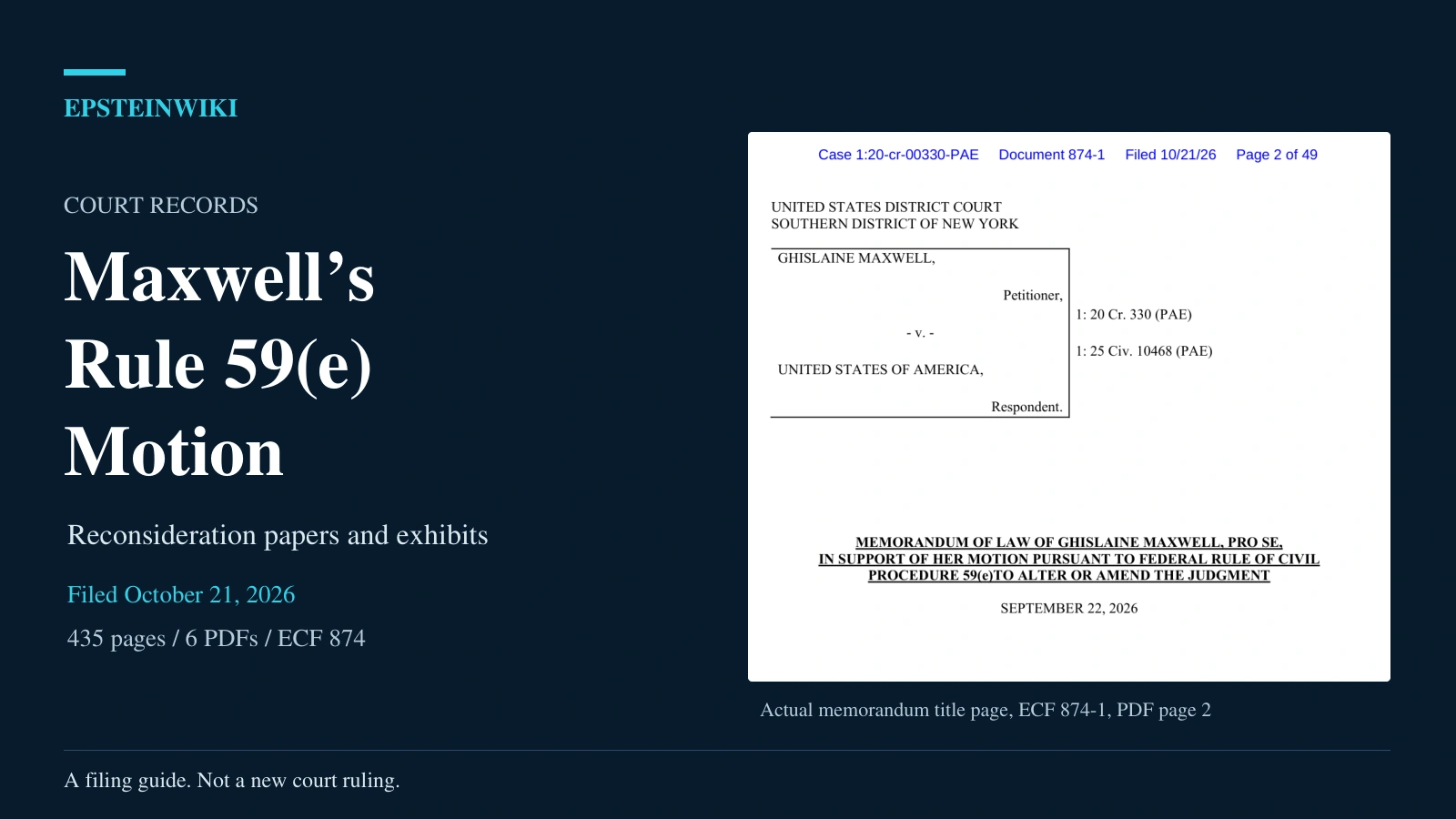
The October 21, 2026 filing in United States v. Maxwell makes public a redacted set of Ghislaine Maxwell’s reconsideration papers and exhibits. The six PDFs total 435 pages. They show what she wants Judge Paul A. Engelmayer to reconsider, not that the court has accepted her arguments or granted a new trial.
Snapshot
- Case: United States v. Maxwell, 1:20-cr-00330-PAE, with related civil proceeding 1:25-cv-10468-PAE.
- Public filing: October 21, 2026, docket entry 874 and five attachments.
- Original submission: Emails dated September 22 and 23, 2026.
- Main request: Alter or amend the judgment rejecting Maxwell’s post-conviction petition under 28 U.S.C. § 2255.
- Main subjects: The Florida non-prosecution agreement; investigative records and disclosure; the address book; Zorro Ranch and other chronology disputes; trial evidence; and later public disclosures.
- Status shown by these files: A motion, supporting materials, and an unsigned proposed order. The packet contains no signed order granting the requested relief.
Maxwell’s memorandum sets out the request, while the submission emails distinguish the September submission dates from October public filing.
A new public filing, not 435 pages of newly created evidence
The government’s cover letter says prosecutors are submitting redacted papers pursuant to an October 16 order, docket entry 872. It does not endorse Maxwell’s allegations or say the court has found a discovery violation.
The September 22 submission includes Maxwell’s memorandum and a separate request for judicial notice. Subsequent emails attach historical investigative documents, correspondence, deposition and trial excerpts, prior decisions, later public disclosures, and materials assembled to support her arguments. The October 21 stamp does not establish when every underlying document was created, when it first became public, or what the defense previously received.
The six-file structure is:
- ECF 874, one page: the government filing letter.
- ECF 874-1, 49 pages: email, memorandum, judicial-notice request, and proposed order.
- ECF 874-2, 162 pages: first two numbered exhibit batches, labeled Exhibits 1 through 58.
- ECF 874-3, 34 pages: judicial-notice exhibits, including aerial imagery, attribution captures, a New Mexico report excerpt, and redacted Florida court-record material.
- ECF 874-4, 80 pages: the batch labeled Exhibits 57 through 78.
- ECF 874-5, 109 pages: the batch labeled Exhibits 79 through 93.
Some labels overlap and some pages repeat. Exhibit numbers, PDF pages, original transcript pages, and Bates identifiers are not interchangeable.
The judgment Maxwell wants reconsidered
The August 2026 decision, docket entry 869, rejected Maxwell’s § 2255 petition. Her September memorandum invokes Federal Rule of Civil Procedure 59(e), arguing that later disclosures changed the record and that other material points were not adequately resolved. Those are grounds she advances for reconsideration, not findings that the earlier judgment was erroneous.
The September 23 order, docket entry 870, directed government review for victim-identifying information. It concerned safe public docketing, not the merits of the motion.
The October cover letter describes a motion concerning the July 27 order. The memorandum’s opening distinguishes the July 27 restriction on further filings from the judgment denying relief and repeatedly challenges docket entry 869. The August decision’s signature page is dated August 25, although its criminal-docket stamp says August 24.
New Mexico records and the Zorro Ranch argument
The first section of the memorandum cites an August 5, 2026 complaint by New Mexico against the Department of Justice. Maxwell argues that its account of cooperation supports further inquiry into what New Mexico supplied, when SDNY received it, and what the defense received. An allegation in another lawsuit is not itself a judicial finding that prosecutors withheld evidence.
The judicial-notice request asks the court to consider Google Earth imagery labeled October 5, 1997 and July 31, 2005, the displayed attribution information, and a report’s account of construction at Zorro Ranch. Maxwell argues that the later main residence could not properly corroborate an earlier event if it had not yet been built.
The filed report excerpt discusses the main residence alongside older buildings. A construction date for the later mansion cannot establish that the ranch had no structures or that an earlier visit was impossible. Nor does a photograph establish which building a witness meant without comparison to the actual testimony. Maxwell’s request itself says she is not asking the court to judicially notice witness credibility or ultimate disputed inferences.
The non-prosecution agreement and Main Justice
The NPA sections renew Maxwell’s argument about the scope of Epstein’s Florida non-prosecution agreement. She relies on correspondence, deposition excerpts, drafting history, references to New York conduct, and descriptions of review by senior Justice Department officials. She argues that these records require reconsideration of the agreement’s geographic reach and coconspirator provision.
An attached Acosta deposition excerpt expressly includes a district limitation during discussion of immunity. Knowledge of New York conduct, review in Washington, and the legal scope of a promise are different questions. The packet cannot fairly be summarized as proof that Maxwell received nationwide immunity.
Exhibit 15 also illustrates why source format matters. It presents a transcription of a purported 2009 call note beneath researcher commentary that refers to “Claude’s analysis” and offers a hypothesis about the caller. That commentary is not part of an original government facsimile and should not be reported as an established identification. Its presence does not, by itself, establish that the underlying note is false or that the rest of the packet has the same provenance.
The address book and Operation Stolen Globe
The memorandum’s address-book sections question the provenance, handling, and disclosure history of trial exhibit GX 52. Maxwell connects those questions to records mentioning Operation Stolen Globe and seeks confidential-source material, subpoenas, deposition recordings, and related records. She asks whether attorney Brad Edwards was a source referenced in government material. That is a disputed question raised by her motion, not a judicial finding identifying him.
The memorandum’s later discussion of GX 52 also recognizes that the prior judgment relied on authentication testimony, a limiting instruction, and discovery about Edwards’s publicly known involvement. Participation in acquiring material, the authenticity of an exhibit, the completeness of discovery, and the legal effect of an omission are separate issues. Investigative correspondence does not resolve them all.
Witness contacts, civil lawyers, and estate cooperation
The witness-development and estate sections argue that contacts among civil lawyers, prosecutors, therapists, support people, witnesses, and the estate could bear on disclosure, possible challenges to witness credibility, or the independence of accounts. Maxwell asks what information entered government possession and whether relevant material reached the defense.
Her own qualifications matter: the existence of shared contacts does not establish that a witness’s memory was false. The discussion of estate material also acknowledges that the record does not establish the estate actually supplied a particular disputed MySpace item. Cooperation, access, receipt, content, and nondisclosure each require their own evidence.
The massage table and historical investigative records
The massage-table argument concerns former Palm Beach officer Gregory Parkinson’s testimony, grand-jury material, and evidence custody. Maxwell distinguishes the table’s location from a separate assertion about who seized it and argues that these matters affected authentication and the prosecution’s interstate-commerce presentation.
The following page acknowledges contrary reasoning in the prior decision, including corroborating evidence and the court’s conclusion that an asserted discrepancy need not show perjury. The motion is not a finding that an officer lied or that evidence was fabricated. The actual transcript text must be checked against the exhibit labels before alleging a contradiction.
Other renewed issues
The remaining memorandum sections address later reporting about Juror 50; household-rule and property timelines; correspondence and diary material; delayed prosecution; access to Epstein Files Transparency Act releases; sentencing; confinement conditions; selective prosecution; and the distinction between an old issue and later evidence concerning it. Some sections ask for factual development rather than assert a proven result.
The discussion of Phang v. Blanche cites separate transparency litigation distinguishing interview notes from FD-302 summaries. Maxwell expressly says that ruling does not establish a Brady rule for her case. A public-access decision and a criminal-discovery violation are not interchangeable.
The relief requested and the unsigned order
The conclusion asks the court to alter or amend its judgment. Alternatively, Maxwell requests targeted discovery, expansion of the record, private judicial review of protected material, an evidentiary hearing, and reconsideration of a certificate of appealability. Her stated approach identifies particular records and disputes rather than demanding unrestricted access to every Epstein file.
The final page of ECF 874-1 is headed “[PROPOSED] ORDER.” It includes language granting judicial notice, but its date and signature lines are blank. It is language submitted for the judge’s consideration, not an executed ruling. None of these six PDFs supplies a signed order granting the requested relief.
What the packet establishes, and what remains disputed
The filing puts Maxwell’s arguments and supporting records on the public docket. It does not establish every allegation. Several distinctions matter when assessing the exhibits:
- A new filing date does not establish that each document is newly discovered.
- A lawyer’s argument, witness account, investigator’s summary, and judicial finding have different status.
- Public-release redactions do not establish what prosecutors or the defense possessed before trial.
- Inclusion in a court filing does not authenticate every annotation or establish every inference.
- A person’s name in an investigative record does not establish wrongdoing or an unconstitutional charging decision.
- A photograph, ownership record, or construction date must be connected to the actual testimony before it can resolve a chronology dispute.
This packet expands public access to Maxwell’s submissions; it contains no ruling changing her conviction.
Related coverage
- Zorro Ranch imagery and judicial notice
- NPA negotiations and victim notification
- Operation Stolen Globe and trial discovery
- Florida file review and FOIA records
- Complete exhibit source guide
Sources and complete exhibits
- Government filing letter, ECF 874, one page.
- Memorandum and judicial-notice request, ECF 874-1, 49 pages.
- First two exhibit batches, ECF 874-2, 162 pages.
- Judicial-notice exhibits, ECF 874-3, 34 pages.
- Third exhibit batch, ECF 874-4, 80 pages.
- Fourth exhibit batch, ECF 874-5, 109 pages.
- August 2026 § 2255 decision, ECF 869.
- September 23 redaction-review order, ECF 870.
Related coverage: Ghislaine Maxwell and United States v. Ghislaine Maxwell.