
Scott Rothstein: The Ponzi Lawyer Inside Jeffrey Epstein’s Retaliation Lawsuit
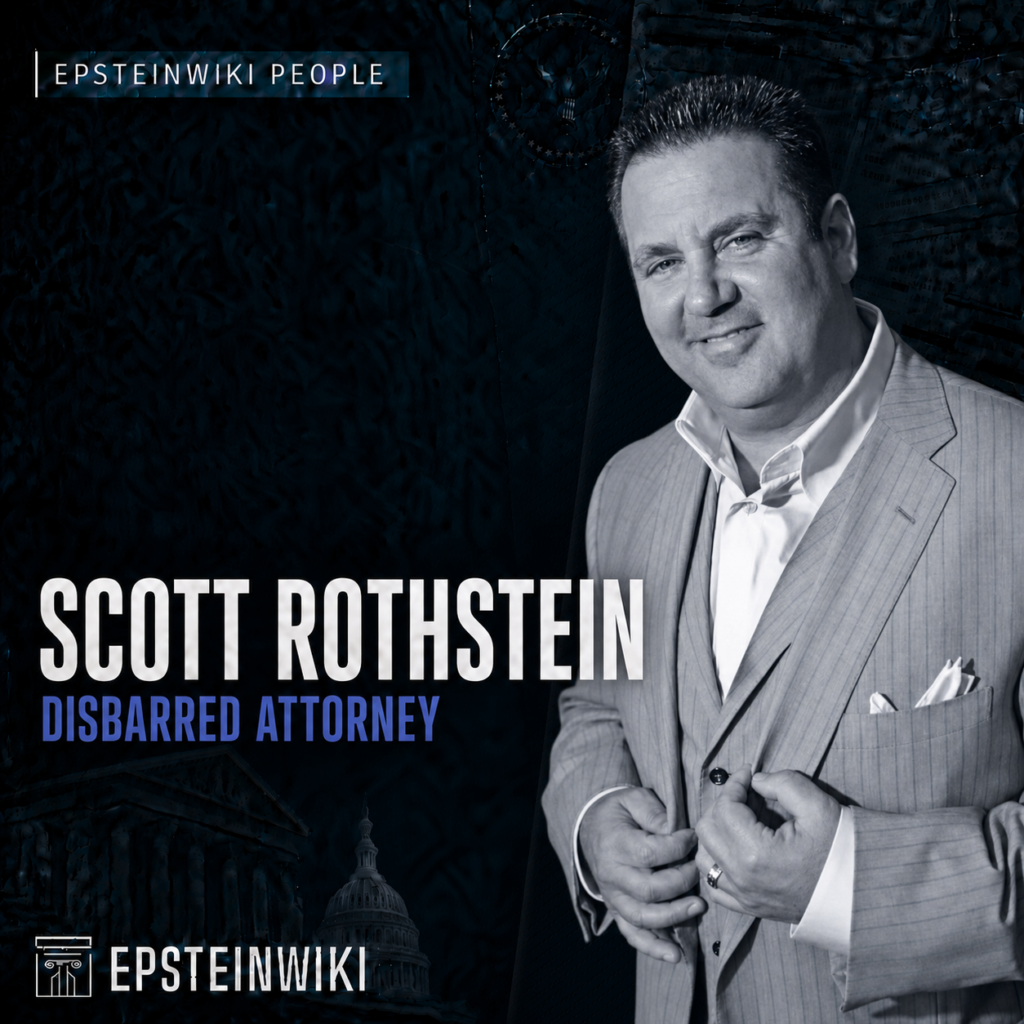
The convicted architect of a $1.2 billion fraud used real Epstein survivor files to sell fictitious legal settlements. Jeffrey Epstein then sued Rothstein and survivor attorney Bradley Edwards, but later admitted that his accusations against Edwards were false and retaliatory.
Content Warning
This profile discusses sexual abuse of minors, survivor litigation, financial exploitation, intimidation, alleged blackmail, and institutional misconduct.
Scott Rothstein was not accused of participating in Jeffrey Epstein’s sexual abuse. His documented connection to the Epstein record arose through litigation, fraud, and the misuse of survivor case files.
Snapshot
| Field | Documented information |
|---|---|
| Full name | Scott W. Rothstein |
| Born | June 10, 1962 |
| Profession | Former Florida attorney |
| Principal firm | Rothstein Rosenfeldt Adler, P.A., commonly called RRA |
| Bar status | Disbarred in Florida in November 2009 |
| Criminal case | United States v. Scott W. Rothstein, No. 0:09 cr 60331, Southern District of Florida |
| Guilty plea | January 27, 2010 |
| Convictions | RICO conspiracy, money laundering conspiracy, mail and wire fraud conspiracy, and two wire fraud counts |
| Sentence | Fifty years in federal prison, followed by three years of supervised release |
| Epstein connection | RRA represented Epstein survivors; Rothstein used genuine Epstein litigation files to promote fictitious settlement investments; Epstein sued Rothstein and Bradley Edwards in 2009; Rothstein was later deposed |
| Separate Maxwell connection | Maxwell alleged that a Rothstein related proposal became a blackmail threat involving Ted Waitt; Waitt denied that characterization and denied direct contact with Rothstein |
| Documented social relationship with Epstein | None established in the reviewed record |
| Connection rating | 3 out of 5, significant legal and documentary intersection without evidence of a social partnership |
| Criminal accusation involving Epstein’s abuse | None found in the reviewed record |
| Last fact check | September 3, 2026 |
Overview
Scott Rothstein enters the Epstein record through a collision between two systems of abuse.
One was Epstein’s sexual exploitation of girls and young women, followed by years of litigation in which survivors fought for compensation, recognition, and accountability.
The other was Rothstein’s enormous financial fraud. Through his Fort Lauderdale law firm, Rothstein sold investments in confidential civil settlements that often did not exist. He represented that investors could buy settlement payments at a discount and collect the full amount later. In reality, prosecutors said that new money was used to repay earlier investors, finance the law firm, purchase luxury property, make political and charitable contributions, and support Rothstein’s public image.
The two systems intersected because attorney Bradley J. Edwards brought several Epstein survivor cases into RRA during 2009. Those were genuine cases involving real women and real allegations. Rothstein used the existence of the cases, the physical case files, and the prospect of future settlements to persuade investors that his broader settlement investment business was legitimate.
That does not mean the survivors’ claims were fraudulent. It means their files and their suffering were converted into props for a separate fraud without their consent.
After RRA collapsed, Epstein filed a civil lawsuit against Rothstein and Edwards. Epstein alleged that both men had used litigation against him as part of a racketeering and extortion scheme. Edwards denied involvement in Rothstein’s crimes and countersued Epstein for malicious prosecution. Years later, on the day Edwards’s case was scheduled for trial, Epstein settled and publicly admitted that his accusations against Edwards were false and had been brought to damage Edwards and stop his work for survivors.
Rothstein was also drawn into a separate dispute involving Ghislaine Maxwell and her former partner Ted Waitt. Maxwell later described a proposal associated with Rothstein as blackmail. A 2011 email in the federal Epstein files preserves her account. Waitt, however, told the House Oversight Committee in 2026 that he understood the approach as a business proposal, declined it, had no direct contact with Rothstein, and did not believe it caused his breakup with Maxwell.
The Scott Rothstein story is therefore not a simple association entry. It is a case study in how survivor litigation became vulnerable to exploitation from several directions at once.
Important Points
- Rothstein was a convicted financial criminal, but the reviewed record does not accuse him of participating in Epstein’s sexual abuse.
- The strongest Epstein connection is documented in court records. Rothstein’s law firm represented survivors, and Rothstein used genuine Epstein case files to market fictitious settlement investments.
- Epstein sued Rothstein and Bradley Edwards after the Ponzi scheme collapsed. The complaint contained Epstein’s allegations, not judicial findings.
- Epstein later admitted that his accusations against Edwards were false and retaliatory. That admission is essential when reading the earlier complaint.
- Rothstein gave sworn deposition testimony that became part of the litigation record. His credibility must be evaluated in light of his fraud conviction, cooperation agreement, and the government’s later assertion that he supplied materially false information during cooperation.
- Maxwell’s account of a Rothstein related blackmail threat conflicts with Waitt’s 2026 testimony. The available record establishes the existence of an approach or proposal. It does not conclusively establish criminal blackmail.
- No reviewed source establishes a friendship, financial partnership, flight, visit, or social relationship between Rothstein and Epstein.
Identity Verification
The Scott Rothstein in the Epstein litigation is Scott W. Rothstein, the former chairman and chief executive officer of Rothstein Rosenfeldt Adler in Fort Lauderdale, Florida.
The identity is confirmed across several independent records:
- The Justice Department’s sentencing announcement identifies Scott Rothstein, then age forty seven, as the Fort Lauderdale attorney who operated a $1.2 billion Ponzi scheme through RRA.
- The amended complaint filed by Jeffrey Epstein names Scott Rothstein individually and identifies him as RRA’s former managing partner and chief executive officer.
- The 2015 Florida appellate decision carries the caption Bradley J. Edwards v. Jeffrey Epstein and Scott Rothstein and identifies the same Palm Beach County case.
- The Eleventh Circuit’s 2019 decision identifies Rothstein as a federal prisoner challenging the government’s withdrawal of a proposed sentence reduction.
There is no reasonable identity conflict in these records.
Early Life, Education, and Legal Career
Public biographical accounts identify Rothstein as a Bronx native born on June 10, 1962. He earned an undergraduate degree from the University of Florida and a law degree from Nova Southeastern University.
Rothstein practiced labor and employment law before building the firm that became Rothstein Rosenfeldt Adler. RRA expanded rapidly. It promoted itself as a full service firm and occupied prominent offices in Fort Lauderdale. Rothstein cultivated relationships with politicians, business owners, law enforcement officers, charitable institutions, and local civic leaders.
That public legitimacy was important to the fraud. Investors were not merely buying promises from an unknown promoter. They were entering a polished law office, meeting lawyers and staff, viewing files, receiving documents that appeared legal and confidential, and dealing with a man surrounded by visible markers of influence.
The Justice Department later said that Ponzi proceeds financed RRA’s operations, political contributions, charitable donations, luxury gifts, security provided by police officers, business acquisitions, and social access. The firm was both the platform for the scheme and one of its principal beneficiaries.
Rothstein’s professional status therefore matters to the Epstein connection. Survivor case files were valuable to him precisely because they came from a functioning law office and concerned a wealthy, notorious defendant whose settlements could appear large enough to justify extraordinary returns.
The $1.2 Billion Ponzi Scheme
According to Rothstein’s guilty plea and the Justice Department’s official account, the fraud operated from about 2005 through November 2009.
The principal pitch involved supposed confidential civil settlements. Rothstein represented that a claimant had agreed to receive payments over time but wanted immediate cash. An investor could supposedly pay a discounted lump sum, acquire the right to the future payments, and later receive the settlement’s full face value.
The confidential nature of the supposed cases protected the scheme from ordinary scrutiny. Investors were told that privacy rules restricted direct contact with the parties. False settlement agreements, false bank records, false online account information, and fabricated court documents helped create the appearance of legitimacy.
Prosecutors said the investment vehicles did not exist. Money from later investors paid obligations to earlier investors. Other funds supported Rothstein, RRA, and people or institutions in his orbit.
The government also described a separate fraud against actual RRA clients. Rothstein and others secretly settled a case against the clients’ interests, fabricated a federal court order claiming that the clients had won approximately $23 million, and induced the clients to transfer about $57 million in supposed bond payments.
This history is relevant because the Epstein litigation was not the source of Rothstein’s criminality. His scheme was larger, older, and spread across many fictitious transactions. The Epstein cases were useful assets inside that scheme because they were real, highly sensitive, and connected to a wealthy defendant.
Collapse, Guilty Plea, and Sentence
RRA collapsed in the autumn of 2009. Rothstein traveled to Morocco as the scheme unraveled, then returned to the United States.
Federal prosecutors filed a criminal information on December 1, 2009. The charging document accused Rothstein of using RRA as a racketeering enterprise and sought forfeiture of extensive property and business interests.
On January 27, 2010, Rothstein pleaded guilty to five federal counts:
- Conspiracy to violate the Racketeer Influenced and Corrupt Organizations Act.
- Conspiracy to commit money laundering.
- Conspiracy to commit mail fraud and wire fraud.
- Wire fraud.
- A second count of wire fraud.
On June 9, 2010, United States District Judge James I. Cohn sentenced him to fifty years in prison, followed by three years of supervised release. The judgment incorporated a forfeiture order covering real estate, vehicles, bank accounts, investments, and other property.
Some later Epstein related filings referred to Rothstein as serving life in prison. That description is inaccurate if read literally. His imposed sentence was fifty years. Given his age, writers sometimes used life as shorthand for its practical effect, but the legal sentence was not life imprisonment.
Bradley Edwards and the Survivor Cases at RRA
Bradley Edwards had been litigating against Epstein before joining RRA. His work included representation of women who said Epstein sexually abused them when they were minors.
Edwards became an RRA partner in April 2009 and remained until the firm collapsed in November. Three Epstein related civil matters were associated with the firm during that period. Court filings commonly identify them as the Jane Doe, L.M., and E.W. cases.
Edwards’s move placed sensitive survivor records inside an institution controlled by Rothstein. Those files reportedly filled numerous boxes and contained pleadings, investigative material, discovery, and information about Epstein’s wealth and contacts.
The victims represented in those files did not become participants in Rothstein’s Ponzi scheme merely because Rothstein exploited their cases. Their claims must be separated from the fraudulent investments he created around them.
That distinction was blurred repeatedly in Epstein’s lawsuit. Epstein’s complaint treated unusual litigation tactics, large settlement discussions, and Rothstein’s investor representations as evidence of a coordinated scheme. But the later record established that Edwards was not charged in the Ponzi prosecution, and Epstein ultimately admitted that his accusations against Edwards were false.
How Rothstein Used the Epstein Files
The documentary record establishes a disturbing method.
Rothstein told prospective investors that RRA possessed major claims against Epstein and that additional women could pursue claims worth hundreds of millions of dollars. He used the existence of real cases to support claims about fictitious settlements.
The amended Epstein complaint alleged that Rothstein directed investigators to bring the Epstein files into his office and allowed an investment representative to inspect them. Separate investor litigation cited within later filings alleged that thirteen bankers’ boxes were displayed to demonstrate that the claims and evidence were real.
A 2017 motion preserved in the federal production repeated allegations from the Razorback investor complaint. According to that account, investors were offered an opportunity to invest in a supposed $30 million settlement involving a different underage girl who was not actually an RRA client. The real case files gave credibility to a fictional transaction.
The same filing said Rothstein claimed that investigators had identified celebrities, dignitaries, and international figures connected to Epstein’s aircraft. Discovery directed at pilots and famous associates could therefore be presented to investors as evidence that the cases threatened explosive publicity and enormous settlements.
The clearest conclusion is not that the survivor cases were fabricated. It is that Rothstein appropriated authentic legal work, confidential records, and the reputational danger surrounding Epstein to sell investments that prosecutors proved were fraudulent.
This was a second exploitation of the survivors. Their accounts were already being contested by a wealthy defendant. Rothstein then treated the files as financial theater.
Epstein Sues Rothstein and Edwards
In December 2009, shortly after the collapse of RRA, Epstein sued Rothstein, Edwards, and initially one survivor identified by initials. The case was filed in the Circuit Court for the Fifteenth Judicial Circuit in Palm Beach County under case number 50 2009 CA 040800.
The federal production contains Epstein’s amended complaint. It asserted claims including abuse of process, civil racketeering, fraud, and conspiracy.
Epstein alleged that Rothstein and Edwards had used the survivor cases to:
- Attract money into the Ponzi scheme.
- Finance litigation against Epstein.
- Pursue discovery about famous people for publicity rather than for legitimate case needs.
- Pressure Epstein with the threat of further claims and public exposure.
- Present fictitious settlement opportunities to investors.
The complaint also cited Epstein’s 2007 federal non prosecution agreement and his civil settlements with numerous women. Its framing treated the government deal and private settlements as evidence that further litigation was abusive.
That framing requires caution. Survivors were not parties to the secret negotiation that produced the non prosecution agreement. Their later Crime Victims’ Rights Act litigation argued that prosecutors violated federal law by concealing the deal from them. The existence of the agreement did not erase their claims or make continued representation improper.
The complaint proves that Epstein made allegations against Rothstein and Edwards. It does not prove that the allegations were true.
Why Epstein’s Lawsuit Became a Retaliation Case
Edwards responded with counterclaims, including malicious prosecution. He maintained that Epstein had sued him to punish and stop his representation of survivors.
The case continued for years after Epstein dismissed his claims against Edwards without prejudice. A 2013 mediation summary filed for Epstein argued that he had possessed probable cause when he sued because the collapse of RRA, the investor allegations, and the suspicious use of case files created an appearance of misconduct.
That document is advocacy written for Epstein. It is useful because it states his theory and procedural position. It is not a neutral adjudication.
In 2014, a trial court granted summary judgment against Edwards’s malicious prosecution claim based on Florida’s litigation privilege. The Florida Fourth District Court of Appeal reversed in 2015. The appellate court held that the privilege did not bar a properly supported malicious prosecution claim and noted that material factual disputes remained.
The case returned to the trial court. Trial was scheduled for December 4, 2018.
That morning, Epstein settled.
As part of the settlement, Epstein issued a public apology. He admitted that the lawsuit against Edwards was an unreasonable attempt to damage Edwards’s reputation and stop him from pursuing cases. He acknowledged that it failed and that Edwards continued representing his clients.
Courthouse News Service reported the settlement and apology and explained that the agreement prevented a trial at which survivors were expected to testify.
The apology concerned Edwards. It did not erase Rothstein’s proven financial crimes. But it fundamentally changes how Epstein’s original lawsuit must be read. The complaint cannot responsibly be cited as proof that Edwards joined Rothstein’s fraud when the plaintiff later admitted that his accusations against Edwards were false and retaliatory.
Rothstein’s Depositions
Rothstein’s cooperation with prosecutors made him an important witness in the RRA bankruptcy and related civil cases.
A federal court authorized extensive depositions under unusually strict security conditions. Rothstein was held at a confidential location, and parties questioned him through controlled proceedings. The federal court’s February 2012 order specifically granted Epstein permission to participate in a second deposition after finding evidence that Rothstein had personal involvement in the civil actions used to support the Ponzi scheme.
The Epstein record identifies two especially important transcripts:
- A January 25, 2012 deposition of Jeffrey Epstein in Epstein v. Rothstein.
- A June 14, 2012 deposition of Scott Rothstein in the same litigation.
An evidentiary index in the federal files identifies both transcripts among the exhibits assembled for the later malicious prosecution case. EpsteinWiki also maintains a document entry for the June 14, 2012 notice and Rothstein deposition.
Rothstein’s testimony should not be treated as self validating. He had pleaded guilty, sought credit for cooperation, and possessed intimate knowledge of the scheme. Those facts made him both valuable and compromised.
The government initially filed a placeholder motion that could have supported a lower sentence if his cooperation proved complete and truthful. It later withdrew that motion after concluding that Rothstein had supplied materially false information. In 2019, the Eleventh Circuit upheld the withdrawal.
That ruling does not establish that every statement Rothstein made was false. It does mean that any important claim from his depositions requires corroboration from records, other witnesses, or judicial findings.
The Separate Maxwell and Ted Waitt Dispute
Rothstein’s name also appears in a separate narrative involving Ghislaine Maxwell and Gateway cofounder Ted Waitt.
Waitt and Maxwell were in a romantic relationship from approximately 2004 to 2010. Maxwell later claimed that Rothstein made blackmail threats connected to litigation involving Epstein and that the pressure helped destroy the relationship.
A March 24, 2011 email from Maxwell to Epstein, released as EFTA02029153, preserves her version. Maxwell wrote that an intermediary approached Waitt, that Rothstein later became more desperate, and that Waitt said he was being blackmailed. She also wrote that Waitt did not pay.
The same record contains earlier emails from Waitt concerning a proposed investment associated with Rothstein’s firm. Waitt described the proposal as feeling dirty or like a scam and advised against it. His concern focused on a sexual harassment settlement, an offshore component, the law firm, and a proposed early payoff.
The email establishes that Maxwell communicated this account to Epstein in 2011. It does not independently prove that Rothstein committed blackmail against Waitt.
Waitt’s 2026 Testimony Conflicts With Maxwell’s Account
The House Oversight Committee interviewed Waitt on April 30, 2026 and released the official transcript on May 13.
Waitt testified that he had no direct contact with Rothstein. He said the proposal reached him through intermediaries, including a person connected to his family office.
When Committee staff presented Maxwell’s claim that Rothstein’s blackmail threats ended the relationship, Waitt said he had no idea why she would say that. He testified that he was not aware of blackmail threats at the time and that the Rothstein matter had nothing to do with the breakup.
Waitt’s attorney clarified that Waitt understood the approach as a business deal that had been proposed and declined, not as blackmail.
The testimony creates a direct conflict:
| Question | Maxwell’s account | Waitt’s account |
|---|---|---|
| Nature of approach | A proposal that became blackmail | A business proposal that he rejected |
| Direct Rothstein contact | Maxwell described an approach through intermediaries | Waitt said he never had direct contact with Rothstein |
| Payment to Rothstein | Maxwell wrote that Waitt paid nothing | Waitt described no payment |
| Effect on relationship | Maxwell later said the threats contributed to the breakup | Waitt said they did not |
| Corroboration | Email chain records that a proposal existed | No reviewed adjudication finds that the proposal was criminal blackmail |
The appropriate conclusion is limited. A Rothstein linked proposal reached Waitt’s circle. Waitt regarded it as suspicious and declined it. Maxwell later characterized related communications as blackmail. Waitt rejected that characterization under questioning by Congress.
Evidence Appearances
| Stable identifier | Date | Record type | Rothstein’s exact role | Source | What it establishes | What it does not establish |
|---|---|---|---|---|---|---|
| EFTA00295800 | Filed after July 2010 | Amended civil complaint | Named defendant with Bradley Edwards | Direct record | Epstein alleged that Rothstein used RRA, survivor cases, case files, and litigation activity in a racketeering and fraud scheme | It does not prove Epstein’s allegations and must be read beside his later apology to Edwards |
| EFTA01734350 | 2013 | Mediation summary | Original defendant and central factual subject | Direct record | Epstein’s counsel said the Epstein cases were used as Ponzi bait and explained why Epstein claimed probable cause to sue | It is advocacy, not a neutral finding |
| EFTA02029153 | March 24, 2011, with 2009 emails attached | Email chain | Subject of a proposed investment and alleged blackmail account | Direct record | Maxwell told Epstein that Waitt described the situation as blackmail; Waitt’s emails show he considered the proposal suspicious and declined involvement | It does not establish a completed payment or judicially proven blackmail |
| EFTA00583952 | June 30, 2017 | Summary judgment filing | Convicted Ponzi operator whose conduct formed part of Epstein’s probable cause argument | Direct record | Epstein continued to rely on Rothstein’s crimes and use of case files in defending against Edwards’s malicious prosecution claim | It does not establish that Edwards participated in Rothstein’s crimes |
| EFTA00619811 | June 30, 2017 | Parallel copy of summary judgment filing | Same role as above | Direct record | Preserves allegations from the Razorback investor case about genuine Epstein files being used to support a fictitious $30 million settlement investment | Repetition in a second copy is not independent corroboration |
| EFTA02765043 | Later exhibit index | Deponent and named party | Direct record | Identifies the January 2012 Epstein deposition and June 2012 Rothstein deposition as exhibits in the litigation | An index alone does not establish the truth of testimony inside the transcripts |
Several records in the federal production are duplicate copies or later briefs quoting earlier litigation. A high document count does not equal multiple independent incidents.
Connection Rating
3 out of 5: Significant legal and documentary intersection.
The rating reflects the depth of the documented connection, not culpability for Epstein’s crimes.
Rothstein receives a middle range score because:
- His law firm represented several Epstein survivors.
- He personally used genuine Epstein litigation materials to give credibility to fraudulent settlement investments.
- Epstein sued him as a named defendant.
- Rothstein gave deposition testimony in the case.
- His name appears in the separate Maxwell and Waitt dispute.
The rating is not higher because the reviewed record does not establish that Rothstein socialized with Epstein, traveled with him, visited his properties, advised him, received money from him, or participated in his sexual abuse.
Legal Status and Present Custody
Rothstein’s fifty year federal sentence remains the controlling public judgment.
The government once considered seeking a reduction based on cooperation. It filed a motion preserving the court’s ability to act but later withdrew it after concluding that Rothstein had provided materially false information. The district court allowed the withdrawal, and the Eleventh Circuit affirmed in 2019.
Rothstein’s incarceration location has not been publicly maintained in the ordinary manner because of witness security protections. Public reporting has described him as being in the federal witness protection system.
As of September 3, 2026, the reviewed public court record does not show that his fifty year sentence has been reduced or vacated. His precise facility and projected release information should not be guessed from unofficial databases.
Reliability and Evidentiary Limitations
Rothstein’s credibility
Rothstein admitted operating one of the largest Ponzi schemes in United States history. He forged documents, lied to investors, misused client matters, and benefited from the appearance of legal legitimacy.
He also cooperated with prosecutors while hoping for a sentence benefit. The government later accused him of supplying materially false information and withdrew its sentence reduction motion.
His testimony is evidence, but it requires corroboration.
Epstein’s pleadings
Epstein’s complaints and motions are statements by a litigant. They show what he alleged and how his lawyers constructed his case.
They do not transform allegations into facts. Epstein’s 2018 apology demonstrates the danger of treating his pleadings as neutral truth.
Maxwell’s email
Maxwell’s 2011 email is authentic as a produced record, but its contents are her account of events. It contains hearsay about what Waitt allegedly said and does not include a finding by a court or law enforcement agency.
Waitt’s testimony
Waitt’s 2026 statements are formal congressional testimony, but they remain one witness’s recollection more than fifteen years after the events. He repeatedly distinguished what he remembered from what documents appeared to show.
Duplicate records
The federal production contains repeated copies of filings. Those repetitions can confirm circulation and preservation, but they do not create independent corroboration.
What the Record Establishes
The reviewed evidence supports the following conclusions:
- Rothstein operated a $1.2 billion Ponzi scheme through RRA.
- He pleaded guilty to five federal counts and received a fifty year prison sentence.
- RRA represented several Epstein survivors during part of 2009.
- Rothstein used genuine Epstein litigation files and the existence of real claims to market fictitious settlement investments.
- Epstein sued Rothstein and Edwards in Palm Beach County.
- Rothstein was deposed in connection with the litigation.
- Epstein later admitted that his accusations against Edwards were false and retaliatory.
- A Rothstein linked investment proposal reached Waitt’s circle.
- Maxwell characterized later developments as blackmail, while Waitt denied that characterization and denied direct contact with Rothstein.
- No reviewed record establishes that Rothstein participated in Epstein’s sexual abuse.
What This Profile Does Not Claim
This profile does not claim that:
- Rothstein was a member of Epstein’s social circle.
- Rothstein flew on Epstein’s aircraft.
- Rothstein visited Epstein’s homes or island.
- Rothstein helped recruit, traffic, or abuse girls or women for Epstein.
- Bradley Edwards participated in Rothstein’s Ponzi scheme.
- The survivor lawsuits handled by Edwards were fictitious.
- Every statement Rothstein made under oath was false.
- Maxwell’s blackmail allegation was proven.
- Waitt’s later recollection disproves every part of Maxwell’s account.
- A person named in the litigation is guilty of an unrelated crime.
Survivor Centered Analysis
The most important people in this history are the women whose cases were used as instruments by powerful men.
The survivors sought legal representation after Epstein received a secret federal agreement that protected him and unnamed potential coconspirators from federal prosecution. Their civil claims were among the few remaining paths to accountability.
Rothstein turned those claims into evidence for investors. He used the physical volume of case files, the threat of publicity, and the prospect of large settlements to make fictional investment opportunities appear credible.
Epstein then used Rothstein’s criminal collapse to attack the attorney representing the women. His lawsuit placed survivors and their counsel under further pressure and prolonged collateral litigation for nearly a decade.
When the malicious prosecution case finally approached trial, Epstein settled and apologized. That outcome vindicated Edwards, but it did not return the years consumed by the retaliation suit. It also prevented the expected public trial testimony from occurring in that forum.
The pattern is institutional. Confidentiality, professional prestige, wealthy defendants, controlled access to records, and adversarial delay all shaped whose account was treated as credible.
Survivor centered reporting must therefore keep two propositions together:
Rothstein’s fraud was real and devastating.
Epstein’s attempt to use that fraud to discredit survivor counsel was also, by Epstein’s eventual admission, false and retaliatory.
Timeline
| Date | Event |
|---|---|
| About 2005 | Federal prosecutors said Rothstein’s Ponzi scheme began operating through RRA |
| September 24, 2007 | Epstein entered the federal non prosecution agreement that later became the subject of survivor rights litigation |
| 2008 | Survivor litigation against Epstein continued in federal and state courts |
| April 2009 | Bradley Edwards joined RRA and brought active Epstein survivor cases into the firm |
| July 23, 2009 | Waitt wrote that a Rothstein linked proposal involving a sexual harassment settlement felt dirty or like a scam |
| October 2009 | Emails show Waitt and Maxwell discussing RRA and litigation connected to Epstein and Maxwell |
| October and November 2009 | Rothstein’s scheme collapsed; he traveled to Morocco and returned |
| November 2009 | RRA entered dissolution and bankruptcy proceedings; Rothstein was disbarred |
| December 1, 2009 | Federal prosecutors charged Rothstein |
| December 2009 | Epstein sued Rothstein, Edwards, and initially a survivor in Palm Beach County |
| January 27, 2010 | Rothstein pleaded guilty to five federal counts |
| June 9, 2010 | Rothstein received a fifty year prison sentence |
| March 24, 2011 | Maxwell emailed Epstein her account of the alleged Rothstein blackmail involving Waitt |
| December 2011 | Rothstein underwent extended depositions in RRA related proceedings |
| January 25, 2012 | Epstein gave a deposition in Epstein v. Rothstein |
| June 14, 2012 | Rothstein gave a deposition in the same litigation |
| October 2013 | The parties prepared for mediation in the Edwards counterclaim |
| May 2014 | Trial court entered summary judgment against Edwards on litigation privilege grounds |
| November 12, 2015 | Florida’s Fourth District Court of Appeal reversed and remanded |
| June 30, 2017 | Epstein filed a summary judgment motion again relying on Rothstein and investor litigation |
| 2017 | Federal prosecutors withdrew the pending sentence reduction motion after concluding that Rothstein supplied materially false information |
| December 4, 2018 | Epstein settled Edwards’s malicious prosecution case and publicly apologized |
| September 30, 2019 | Eleventh Circuit affirmed the withdrawal of Rothstein’s sentence reduction motion |
| April 30, 2026 | Waitt testified before the House Oversight Committee |
| May 13, 2026 | The Committee released Waitt’s transcript |
| September 3, 2026 | This profile was last fact checked |
Media and Public Statements
Rothstein’s public image changed rapidly from politically connected attorney and philanthropist to convicted racketeer.
The Justice Department described his case as an abuse of trust affecting friends, relatives, clients, investors, lawyers, political figures, and charitable organizations. That account is supported by his guilty plea and sentence.
Epstein’s public position also changed. For years, his lawyers defended the lawsuit against Edwards as supported by probable cause. In 2018, Epstein admitted that his claims against Edwards were false and intended to damage his professional reputation and stop him from pursuing survivor cases.
Maxwell’s public legal team later promoted a different version of the Waitt breakup. Her sentencing presentation portrayed her as a victim of a Rothstein blackmail effort. That characterization should be attributed to Maxwell and her lawyers.
Waitt’s 2026 testimony rejected the claim. He said the proposal was presented as a business opportunity, he declined it, he had no direct communication with Rothstein, and the matter did not cause the breakup.
Independent reporting has helped preserve this conflict. Northern Plains News examined Waitt’s congressional testimony and placed the Rothstein proposal within the broader Maxwell and Epstein timeline. That reporting is useful as analysis, while the official transcript remains the primary source for Waitt’s answers.
Fact Check
| Claim | Verification status | Best evidence | Assessment |
|---|---|---|---|
| Rothstein ran a $1.2 billion Ponzi scheme | Verified | Justice Department sentencing release and guilty plea record | Established by conviction and admission |
| The scheme operated through RRA | Verified | Justice Department release | Established |
| Rothstein received a fifty year sentence | Verified | Sentencing release and Eleventh Circuit opinion | Established |
| Rothstein received a life sentence | False if stated literally | Sentencing judgment summary | The sentence was fifty years |
| Bradley Edwards worked at RRA in 2009 | Verified | Court filings and appellate record | Established |
| RRA handled genuine Epstein survivor cases | Verified | Case dockets, pleadings, and later settlement reporting | Established |
| Rothstein used Epstein case files to persuade investors | Strongly verified | Investor allegations quoted in litigation, Epstein filings, and federal court finding supporting deposition access | Supported by multiple court records, though some details come from pleaded allegations |
| The survivor cases were fake | Unsupported and misleading | Epstein’s later apology and underlying civil record | Real cases were used to support fake investments |
| Edwards joined Rothstein’s Ponzi scheme | Contradicted | No criminal charge against Edwards; Epstein’s 2018 apology | Epstein admitted his accusations against Edwards were false |
| Rothstein was Epstein’s friend | Unverified | No reviewed flight, social, business, or correspondence record | No evidence found in the reviewed material |
| Rothstein personally met Epstein | Unresolved | Litigation created opportunities for indirect or formal contact, but no reviewed source proves a meeting | Do not state as fact |
| Rothstein was deposed in Epstein’s lawsuit | Verified | Federal court order, exhibit index, and transcript notice | Established |
| Maxwell told Epstein that Waitt considered Rothstein’s conduct blackmail | Verified as a statement | EFTA02029153 | Establishes Maxwell’s report, not the truth of the accusation |
| Waitt paid Rothstein | Contradicted by reviewed accounts | Maxwell email and Waitt testimony | Both accounts indicate no payment |
| Rothstein directly contacted Waitt | Contradicted by Waitt | 2026 House transcript | Waitt said he had no direct contact |
| Rothstein caused Waitt and Maxwell to separate | Disputed | Maxwell’s later account versus Waitt’s testimony | Cannot be resolved from available evidence |
| Rothstein’s sentence was reduced for cooperation | Contradicted | Eleventh Circuit 2019 opinion | Government withdrew the motion and the court allowed it |
Verification standard: Verified means supported by a primary record or a final legal outcome. Strongly verified means supported by multiple records but still requiring care about whether a statement originated as an allegation. Disputed means credible records conflict. Unresolved means the available evidence is insufficient.
Last checked: September 3, 2026.
Related People
- Jeffrey Epstein, plaintiff in the retaliation lawsuit and convicted sex offender whose survivor cases were used in Rothstein’s fraud.
- Bradley J. Edwards, survivor attorney, former RRA partner, defendant in Epstein’s lawsuit, and successful malicious prosecution counterclaimant.
- Ghislaine Maxwell, Epstein associate and convicted participant in his trafficking operation who described the Waitt matter as blackmail.
- Ted Waitt, Maxwell’s former partner who rejected the blackmail characterization in 2026 testimony.
- Michael Fisten, investigator who worked on Epstein related matters at RRA.
- Ken Jenne, former Broward sheriff and RRA investigator identified in Epstein related filings.
- L.M., Epstein survivor whose case appeared in the RRA and retaliation litigation record.
- Jane Doe, pseudonymous survivor whose federal case was among the matters referenced in the Rothstein litigation.
- E.W., survivor whose state case was handled in the same period.
Related Organizations and Cases
- Rothstein Rosenfeldt Adler
- Epstein v. Rothstein and Edwards
- United States v. Scott W. Rothstein
- House Committee on Oversight and Government Reform
- Jeffrey Epstein non prosecution agreement
- Crime Victims’ Rights Act litigation
- RRA bankruptcy
Questions for the House Oversight Committee
The Rothstein proposal and Maxwell’s account
- Has the Committee obtained every email attached to or referenced in EFTA02029153?
- Who was the intermediary identified in the emails as AJ?
- Was AJ interviewed by federal investigators after RRA collapsed?
- Did AJ retain documents describing the proposed transaction presented to Waitt?
- Who prepared the investment materials that Waitt reviewed in July 2009?
- Did those materials refer to Maxwell by name?
- Did they refer to any specific Epstein survivor or pending case?
- What offshore entity was involved in the proposed transaction?
- Did RRA records show that the proposed settlement existed?
- Did prosecutors examine whether the proposal to Waitt was part of the charged Ponzi scheme?
- Did Maxwell communicate directly with Rothstein?
- Did Epstein communicate directly with Rothstein?
- Did Maxwell or Epstein ask any lawyer, investigator, or intermediary to negotiate with Rothstein?
- What evidence caused Maxwell to describe the proposal as blackmail?
- Was any threat written, recorded, or witnessed?
- Did Maxwell report the alleged threat to law enforcement?
- Did Waitt’s family office preserve the full proposal and its attachments?
- Has the Committee interviewed the family office official approached through Mr. Discala?
- Did any person ask for money specifically in exchange for keeping Maxwell’s name out of litigation?
- If so, what amount was requested, by whom, and on whose authority?
Survivor files and the Ponzi scheme
- Which Epstein case files did Rothstein show to prospective investors?
- Who authorized those files to be moved into Rothstein’s office?
- Were survivor names, medical information, addresses, or statements exposed?
- Were survivors notified that their files had been displayed?
- Did RRA maintain a log of every person who reviewed the files?
- Did federal investigators seize complete copies of the boxes?
- Are any seized survivor records still under seal or in government custody?
- Were fictitious settlement documents created using details copied from real survivor files?
- Did investors receive identifying information about real survivors?
- How many fictitious Epstein related settlements were marketed?
- What total amount did investors transfer based on Epstein related representations?
- Did any bank compliance department flag those transactions?
- Did RRA trust account records identify the supposed settlements by survivor name or pseudonym?
- Were any Ponzi proceeds used to fund legitimate survivor litigation costs?
- If so, were survivors or their attorneys later required to reimburse those costs to the bankruptcy estate?
- Did the bankruptcy trustee adopt special procedures to protect survivor privacy?
Epstein’s retaliation lawsuit
- Did any federal prosecutor provide Epstein or his lawyers with nonpublic information about the Rothstein investigation?
- Did Epstein’s criminal defense team coordinate with investors suing RRA?
- Who decided to name a survivor as a defendant in Epstein’s original complaint?
- Did Epstein offer money or settlement terms conditioned on Edwards ending representation of other survivors?
- What discovery did Epstein seek about survivor communications, litigation financing, and confidential files?
- Did the retaliation suit interfere with the Crime Victims’ Rights Act case?
- Did any public official communicate with Epstein’s team about the Rothstein allegations?
- Did Epstein’s attorneys know of evidence contradicting the allegations against Edwards before the claims were dismissed?
- Why did the litigation continue until the morning of trial in 2018?
- Is Epstein’s complete apology and settlement statement preserved in the public federal production?
- What records explain Epstein’s decision to admit retaliation?
- Did any insurer fund Epstein’s defense or settlement in Edwards’s counterclaim?
Rothstein’s testimony and cooperation
- Has the Committee obtained the complete June 14, 2012 Rothstein deposition rather than excerpts?
- Which portions of that testimony were corroborated by bank records or seized RRA documents?
- Which portions were later challenged as false?
- Did the materially false information cited by prosecutors concern Epstein, Maxwell, Edwards, or unrelated matters?
- Has the Justice Department identified every government interview in which Rothstein discussed Epstein related litigation?
- Were those interview reports provided to survivor counsel?
- Did Rothstein ever identify communications with Epstein or Maxwell that are not in the public production?
- Did Rothstein identify every investor who was shown Epstein case files?
- Can protected survivor information be separated from records needed for congressional review?
- Will the Committee publish a document index showing which Rothstein materials remain withheld and why?
Conclusion
Scott Rothstein was not simply a Florida fraudster whose name happened to appear near Epstein’s.
He controlled the law firm where several survivor cases were housed. He used the reality of those cases, the physical files, and the threat of scandal surrounding Epstein to give false settlement investments the appearance of truth.
Epstein then turned Rothstein’s crimes into a weapon against Bradley Edwards. He pursued litigation that lasted almost nine years before admitting that his accusations against Edwards were false and retaliatory.
The separate Maxwell and Waitt episode remains disputed. Maxwell called it blackmail. Waitt said it was a suspicious business proposal that he rejected and that it did not end their relationship. The documents prove the dispute existed, not that one account has been conclusively established.
The central lesson is clearer.
Survivor files became currency in conflicts among wealthy men, lawyers, investors, and institutions. Rothstein used them to sell fraud. Epstein used Rothstein’s fraud to attack survivor counsel. Years of litigation were required to untangle the two.
Any serious investigation should now determine who saw the files, what was copied from them, how much money was raised with them, and whether federal authorities fully protected the women whose private histories had already been exploited once.
Sources
- United States Department of Justice: Fort Lauderdale Attorney Sentenced to 50 Years in Billion Dollar Ponzi Scheme
- FBI: Fort Lauderdale Attorney Pleads Guilty in Billion Dollar Ponzi Scheme
- United States v. Rothstein, Eleventh Circuit opinion, September 30, 2019
- Bradley J. Edwards v. Jeffrey Epstein and Scott Rothstein, Florida Fourth District Court of Appeal
- Federal order granting Epstein participation in Rothstein’s second deposition
- EFTA00295800: Jeffrey Epstein’s amended complaint against Scott Rothstein and Bradley Edwards
- EFTA01734350: Jeffrey Epstein’s 2013 mediation summary
- EFTA02029153: Maxwell, Epstein, and Waitt email chain concerning Rothstein
- EFTA00583952: 2017 summary judgment filing
- EFTA00619811: Parallel copy of 2017 summary judgment filing
- EFTA02765043: Evidentiary index identifying Epstein and Rothstein depositions
- EpsteinWiki: Notice of Filing Transcript and Deposition of Scott Rothstein, June 14, 2012
- Courthouse News Service: Wealthy Sex Offender Settles Suit, Averting Accusers’ Testimony
- House Oversight Committee: Ted Waitt Interview Transcript, April 30, 2026
- House Oversight Committee: Release of Waitt and Lutnick Transcripts
- The Guardian: Gateway Cofounder Detailed His Romantic Relationship With Ghislaine Maxwell
- Northern Plains News: Ted Waitt Testimony Pulls Gateway’s Plains Origin Story Into the Epstein Investigation