
Steven Hyman
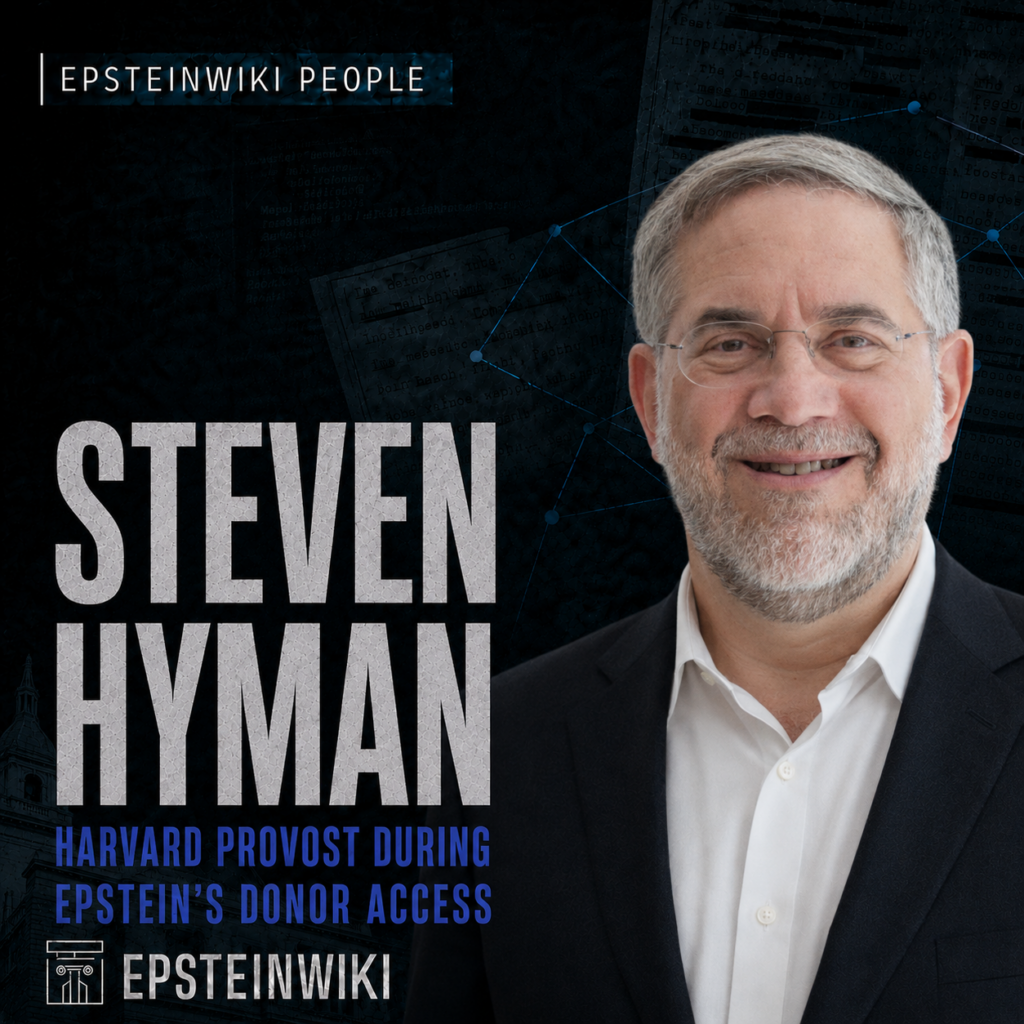
Snapshot
Full name: Steven Edward Hyman
Profession: Psychiatrist, neuroscientist, academic administrator, and scientific adviser
Primary institutional relevance: Provost of Harvard University from December 2001 through June 2011
Other major public role: Director of the National Institute of Mental Health from 1996 through 2001
Current professional roles: Harvard University Distinguished Service Professor, Harald McPike Professor of Stem Cell and Regenerative Biology, and director of the Stanley Center for Psychiatric Research at the Broad Institute of MIT and Harvard
Documented Epstein connection: Hyman was listed among the faculty guests at a December 2, 2003 donor dinner at the Harvard president’s residence attended by Jeffrey Epstein. Hyman has said he does not recall the dinner, occasionally saw Epstein at donor receptions, and does not remember personally interacting with him.
Institutional connection: Hyman was Harvard’s chief academic officer during Epstein’s largest known Harvard gift, Epstein’s Visiting Fellow appointment, Epstein’s 2006 arrest, the September 2006 Gift Policy Committee discussion, and Harvard’s acceptance of four additional gifts before Epstein’s 2008 conviction.
Direct correspondence located: None in the public records reviewed for this article
Direct Epstein funding to Hyman located: None
Documented Epstein travel or property visit: None located
Documented contact after Epstein’s 2008 conviction: None located
Survivor allegation against Hyman: None located
Criminal, civil, licensing, or research misconduct finding connected to Epstein: None located
Role classification: Senior institutional officeholder, documented prearrest event attendee, and potential witness to Harvard’s donor governance. The evidence reviewed does not establish that Hyman was a personal Epstein associate or a participant in Epstein’s crimes.
EpsteinWiki involvement rating: 2 of 5
Rating explanation: Hyman’s relevance exceeds a name only reference because he attended a documented Harvard donor event with Epstein and held senior institutional authority during important gift and access decisions. The rating remains below levels assigned to direct financial beneficiaries, repeated correspondents, travelers, defenders, postconviction associates, or operational enablers because those categories are not established here.
────────────────────────────────────────────────────────
Overview
Steven E. Hyman belongs in the Epstein record because he led Harvard’s academic administration during a period when Jeffrey Epstein converted wealth into proximity to prominent researchers and institutional legitimacy. Hyman was provost when Epstein made his largest known Harvard contribution, obtained Visiting Fellow status in the psychology department, appeared at a donor dinner with senior Harvard figures, was arrested in Florida, and became the subject of a university Gift Policy Committee discussion.
The record presents a significant institutional accountability question. It does not presently establish a personal Hyman and Epstein partnership.
Hyman is not shown in the reviewed evidence as an Epstein correspondent, passenger, property guest, paid adviser, grant recipient, defender, or postconviction associate. Three public Epstein corpus communications mention him, but all three were written by other people to Epstein. Hyman was not a sender, recipient, or copied party. Those references establish that people in Epstein’s network discussed Hyman. They do not establish that Hyman knew about those communications or participated in them.
The strongest personal proximity evidence is a Harvard development record for a December 2003 dinner at Elmwood, the Harvard president’s official residence. Epstein and Hyman were both listed among the attendees. The strongest governance evidence concerns Harvard’s September 2006 Gift Policy Committee discussion after Epstein’s arrest. Harvard’s 2020 report states that the committee was chaired by the provost, but the public report does not publish an attendance list or identify Hyman’s individual actions.
This distinction is central. Senior institutional authority creates a legitimate duty to answer questions about policy, information flow, and oversight. It does not automatically establish knowledge of crimes or personal participation in a donor relationship.
The appropriate conclusion is therefore narrow but important. Hyman is a relevant senior officeholder and potentially important witness to Harvard’s Epstein era. The released evidence does not prove that he personally enabled Epstein’s sexual abuse, accepted Epstein’s money, maintained a friendship with him, or helped rehabilitate him after his conviction.
────────────────────────────────────────────────────────
Identity Verification
The Steven Hyman discussed in this article is Steven Edward Hyman, the American psychiatrist and neuroscientist who served as Harvard provost and previously directed the National Institute of Mental Health.
Identity is supported by Harvard’s official faculty biography, the Harvard Mind Brain Behavior profile, institutional histories, and federal securities disclosures concerning his corporate board roles.
The name appears in Epstein related records as both Steven Hyman and Steve Hyman. The surrounding descriptions identify the Harvard provost or neuroscientist, making the institutional match clear in the three corpus communications analyzed below.
Care is still required. Hyman is a common surname, and public record searches can return unrelated people. No legal, licensing, corporate, or financial record should be attributed to the Harvard scientist without corroborating identifiers such as profession, institution, location, or biography.
────────────────────────────────────────────────────────
Professional Background
Hyman trained as a physician and psychiatrist and developed a career at the intersection of clinical neuroscience, government research policy, academic administration, and biotechnology.
He served as director of the National Institute of Mental Health from 1996 through 2001. The position placed him at the center of federal psychiatric research policy, grant priorities, and debates about the biological foundations of mental illness.
Harvard selected Hyman as provost in 2001. The provost is the university’s chief academic officer and has broad responsibilities involving academic programs, faculty policy, research, institutional planning, and governance. Harvard is decentralized, so the provost does not personally approve every faculty appointment, donor interaction, research gift, or department decision. Even so, the office is one of the university’s most powerful and carries responsibility for the systems through which those decisions are governed.
After leaving the provost’s office in 2011, Hyman returned to research leadership. He became director of the Stanley Center for Psychiatric Research at the Broad Institute. His academic work has focused on psychiatric disorders, genetics, neuroscience, addiction, and the limits of traditional diagnostic categories.
Hyman has also served on nonprofit, scientific, and biotechnology boards. Securities filings identify board roles at Voyager Therapeutics and Cyclerion Therapeutics. Those roles create ordinary disclosure and conflict management obligations. No reviewed evidence connects Epstein to those companies or establishes that the positions had any Epstein related purpose.
Hyman’s professional stature matters to this article because Epstein repeatedly sought proximity to authoritative scientists and respected institutions. However, stature alone is not evidence of an Epstein relationship. The article evaluates only documented intersections.
────────────────────────────────────────────────────────
Role Classification
Hyman’s documented role is best classified as senior institutional accountability with limited personal proximity.
That classification rests on four verified elements.
First, he was Harvard’s provost during the university’s most consequential Epstein period.
Second, a Harvard development record lists him at a 2003 donor dinner attended by Epstein.
Third, the provost chaired the Gift Policy Committee when it discussed Epstein after the 2006 arrest.
Fourth, Harvard continued accepting Epstein gifts before his conviction even though the institution had discussed the criminal charges and ended his Visiting Fellow status.
The public record does not establish that Hyman personally solicited Epstein’s gifts, approved the Visiting Fellow appointment, attended the 2006 committee meeting, approved the later gifts, communicated with Epstein, visited his properties, or continued contact after the conviction.
This is not a semantic distinction. EpsteinWiki’s credibility depends on separating authority from proven action and proximity from participation.
────────────────────────────────────────────────────────
Involvement Rating: 2 of 5
EpsteinWiki assigns Hyman a rating of 2 of 5.
A level 1 rating would understate the record because Hyman was not merely mentioned in an address book or distant record. He occupied the provost’s office throughout Epstein’s most important Harvard years, appeared at a documented dinner with Epstein, and led the institutional structure that included the Gift Policy Committee.
A level 3 or higher rating would overstate the released evidence. No direct communications, financial transfers to Hyman, Epstein sponsored travel, property visits, public defense, postconviction association, survivor allegation, or operational assistance have been located.
The rating reflects institutional proximity and unanswered governance responsibility. It is not an accusation that Hyman participated in abuse or trafficking.
────────────────────────────────────────────────────────
Timeline of the Documented Record
1996 through 2001
Hyman served as director of the National Institute of Mental Health. Epstein was already cultivating relationships with scientists and academic institutions during this wider period, but no reviewed source establishes contact between Hyman and Epstein through Hyman’s federal role.
December 2001
Hyman became Harvard provost.
2003
Epstein made his largest known gift to Harvard, $6.5 million, supporting the Program for Evolutionary Dynamics. On December 2, 2003, Harvard President Lawrence Summers hosted a dinner at Elmwood. A later disclosed development record listed Epstein, Hyman, Alfonso Caramazza, Marc Hauser, and Stephen Kosslyn among those present.
2005 through 2006 academic year
Harvard admitted Epstein as a Visiting Fellow in the psychology department. Stephen Kosslyn recommended the appointment. Harvard’s later review found that Epstein did not possess the academic qualifications normally associated with the status.
July 2006
Epstein was arrested in Palm Beach following the police investigation into sexual conduct involving underage girls. Harvard accepted some Epstein money after the arrest but before the conviction.
September 12, 2006
Harvard’s Gift Policy Committee discussed Epstein. The provost chaired the committee. Available notes referenced the pending charges, a possible new gift, Epstein’s office or telephone access, and his Visiting Fellow status. Formal minutes did not record Epstein’s name or the substance of the discussion.
September 15, 2006
Harvard refunded Epstein’s Visiting Fellow tuition after he withdrew. This ended his formal Visiting Fellow affiliation.
July 2006 through July 1, 2007
Harvard accepted four gifts from Epstein totaling $736,000. Harvard’s 2020 report did not find evidence that the four gifts were presented to the Gift Policy Committee.
2008
Epstein pleaded guilty in Florida to state charges, including an offense involving a minor. Harvard’s review later reported that it accepted no further gifts from him after the conviction.
June 5, 2010
Stephen Kosslyn wrote to Epstein that Steve Hyman had asked Kosslyn to see him during Kosslyn’s negotiations about a possible move to Stanford. Hyman was not part of the email. EFTA00750995
June 2011
Hyman completed his term as provost.
January 3, 2013
Kosslyn wrote to Epstein about the board of the Minerva Project and said it included Steve Hyman and other people Epstein knew. Hyman was not part of the email. EFTA00670872
March 9, 2018
Artificial intelligence researcher Joscha Bach wrote to Epstein about meeting Hyman, Daniel Kahneman, and Robert Horvitz at a Telefónica workshop involving artificial intelligence and health. Hyman was not part of the email. EFTA00863049
2020
Harvard released its institutional review of Epstein’s gifts, affiliation, and campus access. According to Hyman’s later statement, the review did not interview him.
2021
Harvard sanctioned Martin Nowak after reviewing Epstein’s postconviction access to the Program for Evolutionary Dynamics. The action concerned Nowak’s conduct and Harvard policy. It was not a finding against Hyman.
2026
The Harvard Crimson and Pablo Torre Finds Out reported on previously undisclosed Harvard development contact records, including the 2003 Elmwood dinner. Hyman told The Crimson that he did not recall the dinner, occasionally saw Epstein at donor receptions, and did not remember personally interacting with him. He also said Harvard did not interview him during the 2020 inquiry.
────────────────────────────────────────────────────────
Harvard’s Financial Relationship With Epstein
Harvard’s 2020 report calculated that Epstein gave the university $9,179,000 between 1998 and 2007. His largest contribution was a $6.5 million gift in 2003 that supported the Program for Evolutionary Dynamics.
The financial relationship predates Hyman’s provostship, but much of its most important period overlapped with his tenure. The total does not mean Hyman controlled or personally approved the money. Harvard’s structure distributes authority among the president, provost, schools, departments, faculty leaders, development offices, and gift review bodies.
Epstein gained more than the satisfaction of supporting research. Harvard’s name, faculty access, donor events, a Visiting Fellow designation, and proximity to intellectual projects helped him present himself as a serious patron of science.
This reputational value is relevant even where a gift supported legitimate research. The question is not whether every funded scientist acted improperly. The question is how institutional prestige was made available to a donor whose qualifications and conduct should have received more scrutiny.
Harvard accepted four gifts totaling $736,000 after Epstein’s July 2006 arrest and before July 1, 2007. The university later found no evidence that those gifts were presented to the Gift Policy Committee. That finding identifies a systems failure. An institutional discussion about a donor did not become an effective, documented rule that stopped later contributions.
The public report does not assign that failure to Hyman individually. It does place the failure within the administration he helped lead.
────────────────────────────────────────────────────────
The December 2, 2003 Dinner at Elmwood
The clearest record placing Hyman and Epstein at the same event is a Harvard development contact report disclosed in 2026.
Lawrence Summers hosted the dinner at Elmwood, the president’s official residence. The record listed Epstein and several Harvard faculty leaders, including Hyman, Alfonso Caramazza, Marc Hauser, and Stephen Kosslyn.
The event took place before Epstein’s 2006 arrest and before the public exposure of his crimes. Attendance cannot establish that Hyman knew about sexual abuse, viewed Epstein as a close associate, or personally discussed anything with him.
It does establish Epstein’s institutional standing. He was welcomed into the university president’s residence and placed with the provost and prominent academics. That environment supplied status and access regardless of whether every attendee had a personal relationship with him.
Hyman told The Harvard Crimson that he could not recall the dinner. He said he occasionally saw Epstein at donor receptions but did not remember personally interacting with him. A lack of memory more than two decades later is not disproved by the attendance record. The two statements can coexist: the institutional record can show attendance while Hyman genuinely does not remember the occasion.
No reviewed document establishes the seating arrangement, conversation topics, duration of Hyman’s attendance, or whether he and Epstein spoke directly. Those questions should remain open.
────────────────────────────────────────────────────────
Epstein’s Visiting Fellow Status
Harvard admitted Epstein as a Visiting Fellow in the psychology department for the 2005 through 2006 academic year. Stephen Kosslyn, then the department chair, recommended him. Epstein was readmitted for the following academic year before withdrawing after his arrest.
Harvard’s review found significant weaknesses in the process. Epstein lacked the conventional academic credentials expected of a Visiting Fellow. The application did not accurately describe his background, and the status gave him an academic association that could be used to enhance his reputation.
The public report does not identify Hyman as the approver. It does not establish that he reviewed the application, knew about Kosslyn’s Epstein related funding, or knew that Epstein’s qualifications were deficient.
The episode remains institutionally relevant because the psychology department operated within the academic system overseen by the provost. Senior accountability means asking whether the rules were adequate, whether departments disclosed donor conflicts, and whether unusual appointments received meaningful review. It does not mean assuming the provost personally handled each application.
Epstein’s withdrawal after his arrest removed the formal title. It did not end all of his Harvard access. Harvard’s later report documented more than forty visits to Program for Evolutionary Dynamics offices from 2010 through 2018, after his conviction. Those later visits occurred after Hyman had left the provost’s office in 2011 for most of that period and were addressed in Harvard’s proceedings concerning Martin Nowak. The record does not tie Hyman to arranging or approving those visits.
────────────────────────────────────────────────────────
The September 12, 2006 Gift Policy Committee Discussion
The Gift Policy Committee meeting is the most consequential unresolved part of Hyman’s record.
Harvard’s 2020 report states that the committee discussed Epstein during a regular meeting on September 12, 2006. It describes the committee as chaired by the provost. Hyman held that office.
The available agenda and participant notes referenced criminal charges pending against Epstein, a possible new gift, office or telephone access, and his Visiting Fellow status. The formal minutes omitted Epstein’s name and did not record the substance or result of the discussion.
The public report does not provide the attendance list. It does not state that Hyman attended. It does not quote him, identify a vote by him, or attribute a recommendation to him. It would therefore be inaccurate to write that Hyman personally approved or rejected anything at that meeting.
The committee’s known institutional response was incomplete. Epstein’s Visiting Fellow status ended, but Harvard did not create or circulate an effective universitywide ban on accepting further gifts. Four gifts were accepted after the arrest.
The governance questions are direct. Was Hyman present? What information did he receive? Did he ask about the police allegations? Did anyone recommend a comprehensive separation? Who decided that the Visiting Fellow issue and the gift issue could be handled differently? Why did the formal minutes omit a matter serious enough to appear on agendas and private notes?
Until Harvard publishes the complete committee file or witnesses provide attributable accounts, those questions cannot be answered responsibly.
────────────────────────────────────────────────────────
What Harvard Knew After the 2006 Arrest
The arrest and the conviction must not be collapsed into one event. In September 2006, Epstein had not been convicted. Institutions must respect the difference between allegations and adjudicated guilt.
Harvard nevertheless had enough information to recognize serious risk. Its committee discussed the pending criminal charges. Epstein’s Visiting Fellow status ended. The university considered questions involving his physical and telephone access. Those actions show that officials did not treat the matter as routine.
The institutional failure was fragmentation. Academic affiliation, physical access, faculty relationships, development contacts, and gift acceptance were treated as separate channels. Ending one credential did not necessarily end the others.
That fragmentation benefited Epstein. He did not require a single formal title to gain prestige. Invitations, faculty associations, research sponsorship, office visits, web biographies, and donor recognition could each reinforce the appearance that Harvard accepted him as a serious intellectual patron.
Hyman’s responsibility must be evaluated at the level the evidence supports. As provost, he was positioned to understand or improve academic governance. The record does not yet disclose what he knew or did in response to the Epstein discussion.
────────────────────────────────────────────────────────
The Four Gifts Accepted After the Arrest
Harvard accepted four Epstein gifts totaling $736,000 after the July 2006 arrest and before July 1, 2007.
These were preconviction gifts, a distinction Harvard emphasized in reporting that it accepted no money from Epstein after his 2008 conviction. That chronology is accurate, but it does not eliminate the governance concern. University officials had discussed the serious pending charges before at least some of the later transactions were completed.
Harvard’s report found no evidence that the four gifts were presented to the Gift Policy Committee. This can mean the committee did not review them, that records were incomplete, or that the transactions proceeded through channels not connected to the earlier discussion. The report does not establish that Hyman knew about each gift.
The key institutional issue is why the September discussion did not generate a durable and communicated decision. If senior officials believed Epstein presented enough risk to end his Visiting Fellow affiliation, the public deserves to understand why the gift system continued operating.
No evidence reviewed here shows that Hyman received any part of the money, directed it to his research, or personally solicited it.
────────────────────────────────────────────────────────
The June 5, 2010 Kosslyn Email
On June 5, 2010, Stephen Kosslyn emailed Epstein during negotiations concerning a possible move from Harvard to Stanford. Kosslyn wrote that Steve Hyman had told him to come see him and speculated that Hyman might create a vice provost position to retain him. EFTA00750995
The same underlying communication appears in another production as EFTA02414399. The duplicate does not establish a second event.
Hyman was not the sender, recipient, or copied party. The record proves that Kosslyn discussed an anticipated conversation with Hyman while communicating with Epstein. It does not prove that Hyman knew Kosslyn was briefing Epstein, consulted Epstein, created a position at Epstein’s request, or discussed Epstein at all.
The email is relevant because it shows how a Harvard academic with a direct Epstein relationship brought internal university matters into his conversations with Epstein. It is not direct evidence against Hyman.
────────────────────────────────────────────────────────
The January 3, 2013 Kosslyn Email
On January 3, 2013, Kosslyn wrote to Epstein that he had accepted a part time role as founding dean of a new university. He described Lawrence Summers as chair of the board and wrote that the board also included Steve Hyman and other people Epstein knew. EFTA00670872
A duplicate copy appears as EFTA00951656.
Public announcements identified the new institution as the Minerva Project. The email establishes Kosslyn’s statement to Epstein and Kosslyn’s belief that Epstein knew people on the board.
It does not establish the nature, duration, or depth of any Hyman and Epstein acquaintance. The phrase could refer to Harvard donor receptions, the 2003 dinner, social familiarity, or Kosslyn’s assumption. Hyman was not part of the communication. No reviewed record shows that Epstein held a role at Minerva, influenced Hyman’s participation, or communicated with Hyman about the project.
This receipt supports a limited conclusion: Kosslyn represented Hyman to Epstein as someone Epstein knew. It cannot independently prove friendship or collaboration.
────────────────────────────────────────────────────────
The March 9, 2018 Joscha Bach Email
On March 9, 2018, artificial intelligence researcher Joscha Bach wrote to Epstein about a two day Telefónica workshop involving artificial intelligence and health applications. Bach said he met Hyman, Daniel Kahneman, and Robert Horvitz and described Hyman as the most interesting person he met there. EFTA00863049
A duplicate chain appears as EFTA00863486.
This was Bach’s report to Epstein. It was not a message from Hyman. The document does not establish that Epstein organized the workshop, attended it, directed Bach to approach Hyman, obtained confidential information from Hyman, or contacted Hyman afterward.
The receipt shows that a person communicating with Epstein encountered Hyman at an independently described professional event and later reported the impression to Epstein. That is evidence about Bach’s communication and Epstein’s informational network, not proof of Hyman’s participation in that network.
────────────────────────────────────────────────────────
Duplicate Records and False Inflation
Epstein document releases frequently contain multiple copies of the same email. A message may appear in separate productions, forwarding chains, attachment collections, or agency datasets.
This article treats the June 2010 Kosslyn email as one underlying event even though it appears as EFTA00750995 and EFTA02414399. It treats the January 2013 email as one event despite EFTA00670872 and EFTA00951656. It treats the March 2018 Bach report as one event despite EFTA00863049 and EFTA00863486.
Counting six document identifiers as six Hyman contacts would be false inflation. None of the six records is a direct Hyman communication.
The duplicate identifiers are still listed so readers can trace provenance and compare productions. Receipt quantity must never be confused with event quantity.
────────────────────────────────────────────────────────
What the Public Corpus Search Found
The reviewed Epstein corpus contains three underlying communications mentioning Hyman.
- Kosslyn told Epstein in 2010 that Hyman wanted to meet with him about Kosslyn’s Harvard future.
- Kosslyn told Epstein in 2013 that a board included Hyman and other people Epstein knew.
- Bach told Epstein in 2018 that he had met Hyman at a professional workshop.
Each communication was written by someone else. None shows Hyman sending information to Epstein, receiving instructions from Epstein, requesting money, arranging an introduction, or acknowledging a relationship.
The 2003 dinner record is stronger evidence of shared physical proximity than the later corpus mentions. Even there, the record does not establish a personal conversation.
────────────────────────────────────────────────────────
What the Public Corpus Search Did Not Find
The records reviewed for this article did not locate:
- An email, text, letter, or calendar invitation sent by Hyman to Epstein
- An email, text, letter, or calendar invitation sent by Epstein to Hyman
- Hyman on a surviving Epstein flight manifest
- Hyman at Little Saint James, Great Saint James, the New York townhouse, the Palm Beach residence, the New Mexico ranch, or Epstein’s Paris residence
- A payment from Epstein or an Epstein controlled entity to Hyman
- An Epstein grant directed to Hyman’s laboratory or program
- A postconviction meeting between Hyman and Epstein
- A public defense of Epstein by Hyman
- A survivor accusation against Hyman
- A criminal charge, civil liability finding, licensing action, or research misconduct finding connecting Hyman to Epstein
Negative search results are not proof that no undisclosed record exists. Public collections may be incomplete, misindexed, duplicated, redacted, or affected by optical character recognition errors. The correct conclusion is that no such record was located in the reviewed public evidence.
────────────────────────────────────────────────────────
Harvard’s 2020 Institutional Review
Harvard’s 2020 report is the central official source for the university’s Epstein relationship. It confirmed the scale of the gifts, described the Visiting Fellow appointment, documented the 2006 committee discussion, and examined Epstein’s later access to the Program for Evolutionary Dynamics.
The review reported that Harvard accepted no Epstein gift after his 2008 conviction. It also determined that Epstein continued visiting the Program for Evolutionary Dynamics more than forty times from 2010 through 2018. Harvard later sanctioned Martin Nowak in connection with policy failures surrounding that access.
Harvard donated $200,937 in remaining Epstein linked funds to organizations supporting survivors of trafficking and sexual assault.
The review was commissioned and conducted within Harvard’s legal structure with outside counsel. It was not a criminal investigation, public commission, or survivor controlled inquiry. Its scope focused heavily on gifts, affiliations, and access. The public report did not inventory every contact involving Epstein and Harvard personnel.
The 2026 disclosure of development contact reports showed that relevant records existed outside the narrative presented in 2020. The Elmwood dinner was not described in the public report even though Harvard said investigators examined extensive development material.
Hyman’s statement that he was not interviewed is a significant methodological limitation. He was provost during the largest gift, Visiting Fellow period, arrest, committee discussion, and later gifts. Even an interview producing limited memory could have clarified procedures, identified records, and preserved his account.
Failure to interview Hyman does not prove that Harvard protected him or concealed misconduct. It establishes a gap in the public review process.
────────────────────────────────────────────────────────
The 2026 Disclosure and Hyman’s Response
The Harvard Crimson’s 2026 investigation reported that Harvard’s internal development database included forty seven contact reports documenting interactions involving Epstein and Harvard affiliates from 1992 through 2018.
The records included the December 2003 dinner at Elmwood. The disclosure expanded the public understanding of Epstein’s institutional access and exposed encounters not discussed in Harvard’s 2020 report.
Hyman responded that he could not recall the dinner, occasionally saw Epstein at donor receptions, and did not remember personally interacting with him. He also stated that Harvard had not interviewed him for the 2020 review and noted that records of his provost calendar existed.
These statements should be reported in full context. Hyman did not deny that the institutional record listed him at the dinner. He described his lack of recollection and limited remembered contact. No evidence currently disproves that account.
Harvard indicated that it would examine newly released material. Any resulting review should disclose its scope, investigators, interview list, evidentiary standards, findings, and documentary basis.
────────────────────────────────────────────────────────
Was Hyman an Epstein Enabler?
The current record does not support classifying Hyman as a proven personal enabler.
Some people in Epstein’s academic network accepted direct money, maintained extensive correspondence, visited his properties, arranged events, defended him publicly, or continued personal relationships after his conviction. The reviewed evidence does not place Hyman in those categories.
His accountability is institutional. He led Harvard’s academic administration while Epstein gained access and prestige. He attended one documented prearrest donor dinner. The committee chaired by the provost discussed Epstein after the arrest, but the institution continued taking gifts. Harvard later reviewed the relationship without interviewing him, according to his account.
That record warrants questions and document disclosure. It does not justify claims that Hyman facilitated abuse, treated survivors, knew about trafficking, accepted Epstein’s money, or helped Epstein evade law enforcement.
The fairest characterization is that Hyman was a senior officeholder inside an institution whose safeguards failed. The missing evidence concerns what he knew, when he knew it, what authority he exercised, and what instructions his office issued.
────────────────────────────────────────────────────────
Professional Record, Boards, and Financial Interests
Hyman has held influential scientific, academic, public service, nonprofit, and commercial roles.
His official biographies identify leadership at the National Institute of Mental Health, Harvard, and the Broad Institute. His scholarship includes work on addiction, molecular neuroscience, psychiatric genetics, drug development, and criticism of diagnostic systems that do not map cleanly onto biology.
A Voyager Therapeutics securities filing identifies Hyman as a company director beginning in September 2015. A Cyclerion Therapeutics filing identifies his board appointment in July 2022.
These are public professional and financial interests. They should be disclosed when relevant to his scientific or corporate work. No reviewed evidence links Epstein to those board appointments, the companies, or compensation arising from them.
The public records reviewed did not identify a criminal case, civil fraud judgment, medical licensing sanction, research misconduct finding, securities enforcement action, or personal bankruptcy involving this Steven E. Hyman. This is a time limited public record finding, not a guarantee that no complaint has ever existed.
Scientific disagreement with Hyman’s views is not evidence of misconduct. EpsteinWiki should not use professional controversies unrelated to Epstein as insinuation.
────────────────────────────────────────────────────────
Evidence Receipt Ledger
Harvard 2020 Report
Type: Institutional review
What it establishes: Harvard’s gift totals, the Visiting Fellow process, the September 2006 Gift Policy Committee discussion, preconviction gifts after the arrest, and later Program for Evolutionary Dynamics access.
What it does not establish: Hyman’s attendance at the September meeting, his knowledge of particular gifts, or a personal relationship with Epstein.
December 2, 2003 Development Contact Report
Type: Harvard institutional development record described in 2026 reporting
What it establishes: Hyman and Epstein were listed at the same donor dinner at Elmwood.
What it does not establish: A private conversation, friendship, knowledge of abuse, or later contact.
Open The Harvard Crimson’s report
EFTA00750995
Date: June 5, 2010
Type: Stephen Kosslyn email to Epstein
What it establishes: Kosslyn told Epstein that Hyman wanted to meet with him concerning his Harvard future.
What it does not establish: That Hyman knew of the email, communicated with Epstein, or took action at Epstein’s request.
EFTA02414399
Type: Duplicate production of the June 2010 Kosslyn communication
What it establishes: Corroborates the existence and text of the same underlying message.
What it does not establish: A separate contact or direct Hyman involvement.
EFTA00670872
Date: January 3, 2013
Type: Stephen Kosslyn email to Epstein
What it establishes: Kosslyn described a board as including Hyman and other people Epstein knew.
What it does not establish: The nature of any acquaintance, direct contact, or Epstein influence over the board.
EFTA00951656
Type: Duplicate production of the January 2013 communication
What it establishes: Corroborates the same underlying message.
What it does not establish: A second event or independent Hyman contact.
EFTA00863049
Date: March 9, 2018
Type: Joscha Bach email to Epstein
What it establishes: Bach told Epstein that he met Hyman at a professional workshop.
What it does not establish: That Epstein arranged the meeting or that Hyman knew Bach would report it to Epstein.
EFTA00863486
Type: Duplicate chain containing the March 2018 Bach report
What it establishes: Preserves another copy of the same underlying communication.
What it does not establish: A separate Hyman and Epstein connection.
────────────────────────────────────────────────────────
What the Evidence Establishes
The reviewed evidence establishes the following:
- Hyman served as Harvard provost from 2001 through 2011.
- Epstein gave Harvard millions of dollars during a period overlapping with Hyman’s tenure.
- A Harvard development record lists Hyman and Epstein at the December 2003 Elmwood dinner.
- Hyman says he does not recall the dinner and does not remember personally interacting with Epstein.
- Epstein received Visiting Fellow status during Hyman’s provostship through a process later criticized by Harvard.
- Harvard’s Gift Policy Committee discussed Epstein after his 2006 arrest.
- The provost chaired that committee.
- The public report does not establish whether Hyman attended or what he said.
- Harvard accepted four Epstein gifts totaling $736,000 after the arrest and before the conviction.
- Harvard’s review found no evidence that those four gifts were presented to the committee.
- Three underlying emails to Epstein mention Hyman, but Hyman was not part of any of the communications.
- Harvard’s 2020 review did not interview Hyman, according to Hyman.
- The 2026 disclosure revealed development contacts that were not discussed in the 2020 public report.
────────────────────────────────────────────────────────
What the Evidence Does Not Establish
The reviewed evidence does not establish that:
- Hyman participated in Epstein’s sexual abuse or trafficking
- Hyman knew Epstein was abusing girls
- A survivor accused Hyman of misconduct
- Hyman received Epstein money
- Hyman solicited or personally approved Epstein’s Harvard gifts
- Hyman approved Epstein’s Visiting Fellow application
- Hyman attended the September 2006 committee meeting
- Hyman supported accepting gifts after the arrest
- Hyman communicated directly with Epstein
- Hyman traveled on Epstein’s aircraft
- Hyman visited an Epstein residence or island
- Hyman met Epstein after the 2008 conviction
- Hyman publicly defended Epstein
- Epstein influenced Hyman’s Minerva or corporate board roles
- Hyman knew Kosslyn or Bach was discussing him with Epstein
- Hyman concealed documents from Harvard’s review
- Hyman was charged, sued, disciplined, or sanctioned in connection with Epstein
────────────────────────────────────────────────────────
Survivor Perspective and Institutional Impact
Epstein’s crimes were sustained not only through private secrecy but through public legitimacy. Elite institutions treated him as a donor, intellectual patron, and useful connector. That recognition made him appear credible while girls and young women were being exploited.
For survivors, the Harvard record illustrates how institutional systems can divide responsibility until no individual appears accountable. One office handles gifts. Another approves academic status. Faculty manage access. Development staff cultivate the donor. A committee discusses risk. Formal minutes omit the discussion. Each action can appear limited while the combined system produces access and prestige.
Hyman’s role matters because he sat near the top of that system. Asking what he knew and did is not the same as accusing him of abuse. It is an effort to understand why warning information did not produce a complete institutional separation.
Harvard’s later donation of remaining Epstein funds to survivor serving organizations was a constructive response. It did not restore the lost opportunity to act decisively in 2006 or explain every governance decision.
A survivor centered account must resist two errors. It must not erase senior officials simply because their personal role is unclear. It must also not manufacture personal guilt where the records support only institutional questions.
────────────────────────────────────────────────────────
Media Coverage and Public Statements
The most important Hyman specific reporting is The Harvard Crimson’s 2026 investigation, produced with records highlighted by Pablo Torre Finds Out. It disclosed the Elmwood dinner and reported Hyman’s response.
Hyman said he could not recall the dinner. He acknowledged occasionally seeing Epstein at donor receptions but said he did not remember personally interacting with him. He also stated that Harvard’s 2020 review did not interview him.
Harvard Magazine’s 2020 account summarized the institutional report and the university’s handling of remaining funds. Harvard Magazine’s 2021 report covered the sanctions against Nowak and the later access failures.
No reviewed source contains a detailed public interview in which Hyman answers the complete set of governance questions raised here. His published response addresses memory of the dinner and the absence of a 2020 interview, but not the September 2006 committee process or the four later gifts.
────────────────────────────────────────────────────────
Sleuth Research Review
The public work of Ellie Leonard and American Freakshow was reviewed for Hyman specific leads and context. No Hyman specific conclusion in this article depends on an unverified sleuth claim.
This does not diminish the value of independent researchers. Their work frequently identifies documents, relationships, duplicates, and institutional patterns missed by conventional reporting. For this page, the controlling conclusions come from Harvard records, direct EFTA documents, official biographies, securities filings, and attributable reporting.
If a future sleuth report identifies a new Hyman record, EpsteinWiki should verify the original document, determine whether Hyman is a sender, recipient, copied party, subject, or incidental mention, and distinguish a proposal from a completed event.
────────────────────────────────────────────────────────
Reliability and Limitations
The evidence is strongest for Hyman’s office, tenure dates, the donor dinner record, Harvard’s aggregate gifts, the Visiting Fellow process, and the existence of the 2006 committee discussion.
The evidence is weaker regarding Hyman’s personal knowledge and conduct because Harvard has not published a complete attendance list, verbatim committee record, provost correspondence set, calendar archive, or interview transcript.
The EFTA references are direct records of what Kosslyn and Bach wrote to Epstein. They are not direct records of what Hyman said or knew. Third party statements can be mistaken, incomplete, boastful, or based on assumption.
The public Epstein corpus is incomplete and contains duplicate records, redactions, missing attachments, and search limitations. A negative search result should be updated if new material emerges.
Harvard’s 2020 report is authoritative about what its investigators reported finding. It is not the same as an independent government investigation. The 2026 contact report disclosure demonstrates that a lengthy institutional review can still leave important interactions out of its public narrative.
────────────────────────────────────────────────────────
Fact Check
Claim: Hyman was Epstein’s psychiatrist.
Finding: Unsupported. No reviewed source establishes a clinical relationship.
Claim: Hyman received money from Epstein.
Finding: Unsupported. No direct payment or grant to Hyman was located.
Claim: Hyman attended a Harvard dinner with Epstein.
Finding: Supported by a Harvard development contact record. The record does not establish a personal conversation.
Claim: Hyman remembers meeting Epstein.
Finding: Misleading. Hyman said he occasionally saw Epstein at donor receptions but did not remember personally interacting with him and did not recall the 2003 dinner.
Claim: Hyman approved Epstein’s Visiting Fellow appointment.
Finding: Not established by the public Harvard report.
Claim: Hyman chaired the committee that discussed Epstein in 2006.
Finding: The provost chaired the committee, and Hyman was provost. His attendance and individual actions are not established in the published record.
Claim: Hyman personally approved gifts after Epstein’s arrest.
Finding: Unsupported. Harvard found no evidence that the four gifts were presented to the committee.
Claim: Hyman corresponded with Epstein.
Finding: No direct correspondence was located. Other people mentioned Hyman in emails to Epstein.
Claim: Hyman had contact with Epstein after the 2008 conviction.
Finding: No such contact was located.
Claim: Harvard interviewed Hyman for its 2020 review.
Finding: Hyman said Harvard did not interview him.
Claim: Hyman was sanctioned in the Harvard Epstein investigation.
Finding: False based on the reviewed record. Harvard sanctioned Martin Nowak, not Hyman.
Claim: Hyman has been accused by an Epstein survivor.
Finding: No survivor allegation against Hyman was located.
────────────────────────────────────────────────────────
Investigative Assessment
Hyman’s file is an example of why EpsteinWiki needs more than one category of association.
The record is too substantial to dismiss as a meaningless name mention. Hyman led Harvard’s academic administration during the largest Epstein gift, the Visiting Fellow appointment, the arrest, the policy discussion, and the later gifts. He attended a documented donor dinner with Epstein.
The record is also too limited to call him a proven personal enabler. There are no located direct messages, payments, trips, property visits, public defenses, postconviction meetings, or survivor allegations.
The most important unanswered issue is institutional knowledge. Harvard’s report confirms that senior systems recognized the Epstein problem in 2006. It does not explain why recognition failed to become a comprehensive decision. Hyman’s office is relevant to that failure, but his individual conduct remains largely undocumented.
The next evidentiary priority is not speculation. It is disclosure of the full September 2006 committee materials, Hyman’s provost calendar, relevant development contacts, communications involving the president and provost offices, and a complete interview record from Harvard’s past and current reviews.
────────────────────────────────────────────────────────
Questions That Still Need Answers
- Did Hyman attend the September 12, 2006 Gift Policy Committee meeting?
- If he attended, what information about the Palm Beach allegations was presented?
- What did Hyman say or recommend during the Epstein discussion?
- Was any vote taken, and how did each participant vote?
- Why did the formal minutes omit Epstein’s name and the discussion?
- Who prepared the agenda and participant notes that referenced Epstein?
- Did Hyman review those notes or approve the formal minutes?
- Did the committee consider a complete ban on future Epstein gifts?
- Why did ending the Visiting Fellow affiliation not produce a universitywide separation?
- Who approved each of the four gifts accepted after the arrest?
- When did Hyman learn that those gifts had been accepted?
- Did the provost’s office receive notice of any of the transactions?
- Were the gifts already pledged before the arrest, and did Harvard consider returning them?
- What risk review did development personnel conduct after the arrest?
- Did Hyman know about Epstein’s original Visiting Fellow application?
- Did he know that Epstein lacked conventional academic qualifications for the status?
- Did he know about Kosslyn’s prior Epstein funded research support?
- Did any faculty member disclose an Epstein financial relationship to the provost’s office?
- What conversations occurred before and after the December 2003 Elmwood dinner?
- Where was Hyman seated at the dinner?
- Did Hyman and Epstein speak directly, and if so, what did they discuss?
- Which donor receptions did Hyman attend where Epstein was present?
- Do development contact reports identify additional Hyman and Epstein events?
- What do Hyman’s provost calendars show?
- What relevant emails, memoranda, visitor logs, telephone records, and meeting files remain unreleased?
- Why did Harvard’s 2020 review not interview Hyman?
- Who made the decision not to interview him?
- Did investigators review his complete calendar and correspondence even without interviewing him?
- Did Hyman offer to be interviewed before or after the report was published?
- Has Harvard’s later review interviewed him?
- Will Harvard publish the interview or a detailed summary?
- Why were forty seven development contact reports not fully analyzed in the 2020 public narrative?
- Did Hyman know that Epstein continued visiting Harvard after the conviction?
- Did he learn about any postconviction visit before leaving the provost’s office in 2011?
- Did the provost’s office receive complaints or warnings about Epstein’s access?
- What did Kosslyn mean when he told Epstein that Hyman wanted to see him in 2010?
- Did Kosslyn tell Hyman that he was discussing his Harvard negotiations with Epstein?
- What did Kosslyn mean by describing Hyman as one of the people Epstein knew in 2013?
- Was that description based on the 2003 dinner, donor receptions, or other contact?
- Did Epstein ever attempt to reach Hyman through Kosslyn, Summers, Nowak, Caramazza, Hauser, or another intermediary?
- Are there unreleased Epstein records that directly name Hyman as a sender, recipient, visitor, or proposed contact?
- Did Harvard preserve all relevant provost office records under a litigation or investigation hold?
- Will Harvard release a complete list of officials interviewed in 2020 and in the later review?
- Will Harvard permit an independent survivor informed review of the underlying records?
- What reforms now ensure that a donor risk decision reaches every school, department, development office, and access point?
────────────────────────────────────────────────────────
Related People and Organizations
- Jeffrey Epstein: Donor whose Harvard gifts, affiliation, and institutional access are the subject of the record.
- Lawrence Summers: Harvard president during the 2003 dinner and much of Hyman’s provostship.
- Stephen Kosslyn: Psychology department chair who recommended Epstein’s Visiting Fellow appointment and later mentioned Hyman in emails to Epstein.
- Martin Nowak: Director of the Program for Evolutionary Dynamics, which received major Epstein support and hosted Epstein after his conviction.
- Alfonso Caramazza: Harvard professor listed at the 2003 dinner.
- Marc Hauser: Harvard professor listed at the 2003 dinner.
- Daniel Kahneman: Scientist mentioned with Hyman in Bach’s 2018 workshop report.
- Joscha Bach: Researcher who reported meeting Hyman to Epstein.
- Robert Horvitz: Scientist mentioned in the 2018 workshop communication.
- Harvard University: Institution whose gifts, donor controls, appointments, and access policies are central to Hyman’s relevance.
- Program for Evolutionary Dynamics: Harvard program supported by Epstein’s largest known university gift.
- Gift Policy Committee: Harvard body that discussed Epstein after his arrest.
- Broad Institute: Hyman’s later research institution. No reviewed evidence ties Epstein to Hyman’s role there.
- Minerva Project: Educational venture referenced in Kosslyn’s 2013 email. No reviewed evidence establishes Epstein influence over Hyman’s participation.
────────────────────────────────────────────────────────
Related EpsteinWiki Pages
- Jeffrey Epstein
- Harvard University
- Lawrence Summers
- Stephen Kosslyn
- Martin Nowak
- Alfonso Caramazza
- Marc Hauser
- Daniel Kahneman
- The Psychologists Who Helped Jeffrey Epstein Stay Powerful
────────────────────────────────────────────────────────
Source List
Primary and Institutional Sources
- Harvard University, Report Regarding Jeffrey Epstein’s Connections to Harvard
- Harvard president’s 2020 report statement
- Harvard official Steven Hyman biography
- Harvard Mind Brain Behavior profile
- EFTA00750995, Stephen Kosslyn email mentioning Hyman
- EFTA02414399, duplicate production of the June 2010 communication
- EFTA00670872, Kosslyn board reference
- EFTA00951656, duplicate production of the January 2013 communication
- EFTA00863049, Joscha Bach workshop report
- EFTA00863486, duplicate chain containing the Bach report
- Voyager Therapeutics 2025 proxy statement
- Cyclerion Therapeutics board appointment filing
Reporting and Context
- The Harvard Crimson, Harvard Promised a Full Review of Its Epstein Ties
- Harvard Magazine, Harvard Reports Jeffrey Epstein Gifts
- Harvard Magazine, Martin Nowak Sanctioned for Jeffrey Epstein Involvement
- Minerva Project announcement naming Stephen Kosslyn founding dean
- Harvard Gazette, Steven Hyman awarded the Sarnat Prize