
Michael Reiter: The Palm Beach Police Chief Who Refused to Let the Epstein Case Disappear
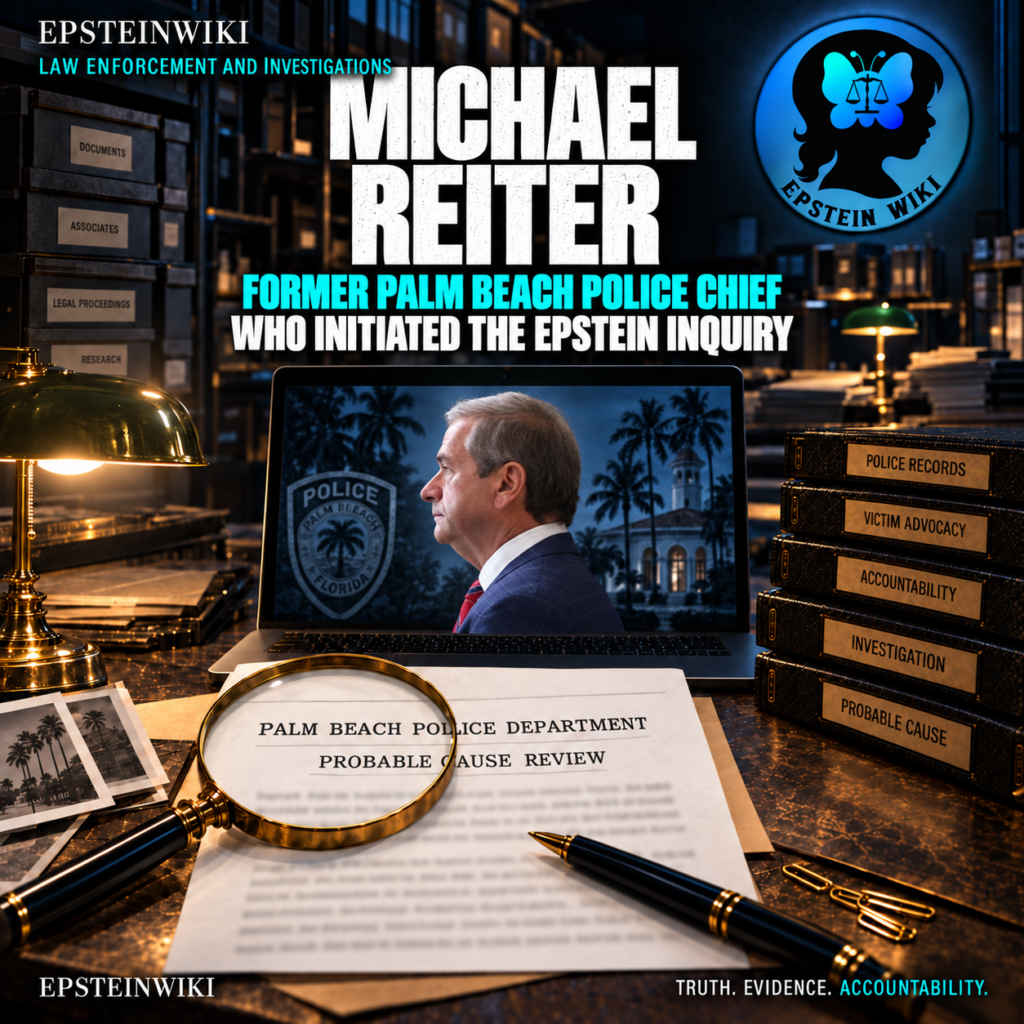
Michael Reiter was chief of the Palm Beach Police Department when a family reported in 2005 that Jeffrey Epstein had sexually abused a fourteen year old girl. Detective Joseph Recarey led the investigation. Reiter supervised it, defended it against outside pressure, challenged State Attorney Barry Krischer when prosecutors appeared unwilling to pursue the evidence, and referred the matter to the FBI.
His importance is institutional. Reiter did not discover every victim, conduct every interview, or control the final charging decisions. He was the police executive who kept a local investigation alive when Epstein had wealth, prominent lawyers, social influence, and an expanding private intelligence effort. The later federal case began because Palm Beach police would not accept the state response as the final word.
The record also requires care. Some statements attributed to Reiter come from contemporaneous police records. Others come from his sworn 2009 deposition, later media interviews, or an FBI interview conducted in 2019 and released years afterward. This article identifies those differences and does not treat every allegation as independently proven.
Snapshot
Full name: Michael S. Reiter
Known for: Serving as Palm Beach police chief during the first major criminal investigation of Jeffrey Epstein
Police service: Joined the Palm Beach Police Department in 1981 and served as chief from March 2001 until February 2009
Role in the Epstein case: Supervised the department, supported the investigation led by Detective Joseph Recarey, challenged the state prosecution strategy, and referred the case to federal authorities
Central conflict: Reiter believed the evidence supported serious felony charges. State Attorney Barry Krischer ultimately presented the case to a grand jury that returned one felony solicitation count
Key documentary acts: Reiter wrote to Krischer on May 1, 2006, criticized the treatment of the case as highly unusual, and urged him to disqualify himself if he would not proceed appropriately
Later testimony: Reiter gave a lengthy sworn deposition on November 23, 2009, describing pressure, surveillance, prosecutorial resistance, and the decision to seek federal help
Current historical significance: Reiter is a central witness to the gap between the evidence assembled by Palm Beach police and the unusually favorable resolution Epstein received
Early Life, Education, and Police Career
Reiter was born in Pittsburgh, Pennsylvania. He worked in campus policing there before joining the Palm Beach Police Department as a patrol officer in 1981.
He earned a bachelor’s degree in criminal justice from Florida Atlantic University in 1988 and later earned a master’s degree in human resource management from Palm Beach Atlantic University. His professional education included the FBI National Academy and the United States Secret Service Dignitary Protection Program.
His rise through the department included investigative and command assignments. He worked as a detective, became a sergeant in 1985, led the Organized Crime, Vice and Narcotics unit by 1989, became a captain in 1992, a major in 1993, and assistant chief in 1998. Palm Beach appointed him police chief in March 2001.
Reiter had already worked sensitive cases before Epstein. In 1984, he participated in the investigation of the drug related death of David Kennedy, a son of Robert F. Kennedy. That experience placed him inside the unusual policing environment of Palm Beach, where ordinary criminal investigations could involve nationally prominent families, intense press attention, private security teams, and wealthy residents with direct access to powerful attorneys and officials.
Leading Police in an Unusually Wealthy Town
Palm Beach is a small municipality with a concentration of wealth and influence far beyond its size. Police leadership there requires attention to conventional crime, protective intelligence, visiting dignitaries, public events, and the expectations of residents who can retain large legal and investigative teams.
As chief, Reiter promoted community programs and served in county security roles. His management record included the Citizen Police Academy, the Teen Police Academy, volunteer policing programs, crime watch activity, counterterrorism coordination, and election security planning.
That background matters because the Epstein investigation was never only a question of whether a detective could assemble probable cause. It became a test of whether a small police department could preserve the integrity of an investigation while confronting social pressure, legal attacks, private surveillance, and resistance from the office that controlled state prosecution.
Epstein Donations and the Conflict Problem
Before Epstein became a police suspect, he had presented himself as a supporter of law enforcement. Records and Reiter’s later FBI interview describe donations to a police scholarship fund and an offered check connected to the purchase of an automated fingerprint identification terminal.
The released FBI summaries differ on the amount. One version records a check for about $90,000. Later reporting and other records have described it as $100,000. The responsible conclusion is that Epstein offered a large donation for police equipment near the period when the first victim came forward. The department did not use the money, and Reiter ordered it returned once Epstein became the subject of investigation.
Reiter explained that donations from wealthy residents were not unusual in Palm Beach. That context does not erase the conflict risk. It makes his response more important. Returning the money created a boundary between Epstein’s earlier public support and the criminal inquiry. It also protected the department from the claim that accepting his money had purchased favorable treatment.
The donation later fueled suspicion among survivors and members of the public who believed powerful people had bought protection. Reiter said this perception was one reason he spoke publicly after retirement. The available record supports the narrower conclusion that Epstein cultivated the department before the criminal case, but the department under Reiter investigated him and did not cash the large equipment check.
How the Palm Beach Investigation Began
The documented criminal investigation began in March 2005, when the family of a fourteen year old girl contacted Palm Beach police. Officer Michele Pagan took the initial report. The girl described being brought to Epstein’s mansion at 358 El Brillo Way for what was presented as a paid massage. She said the encounter became sexual.
Detective Joseph Recarey became the lead investigator. Under Reiter’s command, the inquiry expanded from one complaint into a pattern investigation. Police identified girls who had been paid to provide massages and then paid again for recruiting other girls. Many were minors. The referral system allowed Epstein to obtain a continuing supply of new teenagers through peer relationships and financial need.
The survivors were not interchangeable witnesses. They had different ages, experiences, family circumstances, and levels of willingness to speak with police. Some feared public exposure. Some feared Epstein. Some had been taught by the recruitment structure to understand payments and referrals as normal. Investigators still found repeated features across their accounts.
The broader chronology is covered in the Palm Beach County Investigation. Reiter’s specific contribution was to give Recarey time, institutional backing, surveillance resources, and permission to pursue the case wherever the evidence led.
Evidence Developed by the Police Department
Palm Beach police used several investigative methods rather than relying on a single accusation. Officers conducted victim and witness interviews, watched activity around the mansion, examined telephone and message records, interviewed employees, reviewed discarded materials obtained through lawful trash collection, and executed a search warrant.
The patterns mattered. Girls described being directed to massage Epstein, being paid in cash, being subjected to sexual contact, and being offered additional money to recruit others. Records connected recruiters, employees, appointment scheduling, and repeated visits. Surveillance showed young people entering and leaving the property. A massage room and related physical evidence supported the accounts of how encounters were organized.
Police trash searches also recovered evidence of Epstein’s interest in sexual domination and the training of sexual servants. Such material did not prove a particular assault by itself. In context, however, it informed the investigators’ understanding of the conduct described by survivors.
The October 2005 search of the mansion produced further records and images. The investigation eventually identified many potential victims. The later federal inquiry expanded that number further.
Reiter believed the police had built a strong case. In his 2009 deposition, he described the work as careful and substantial. His confidence did not mean every possible charge was guaranteed to result in conviction. It meant he believed the evidence justified serious prosecution and should be tested in court rather than reduced to a minor matter because the witnesses were teenage girls.
Reiter’s Support for Joseph Recarey
Recarey carried much of the daily investigative burden. Reiter carried the command responsibility. He approved the continued commitment of resources, received briefings, dealt with officials and attorneys, and defended the investigation when Epstein’s representatives attacked its methods and witnesses.
That division is important. Public retellings sometimes credit a police chief with work done by detectives, or describe a detective as acting alone. The record shows a partnership with distinct roles. Recarey assembled evidence and maintained contact with survivors. Reiter used the authority of the chief’s office to preserve the investigation and escalate it when local prosecution stalled.
The two men also became targets of private attention. Reiter later testified that he noticed surveillance for an extended period. Reporting on his deposition said private investigators working for Epstein followed Reiter and Recarey and may have collected trash from Reiter’s home. Reiter could describe what he observed and what he believed, but he did not claim personal knowledge of every person who authorized each act.
This pressure had an institutional purpose whether or not every suspected act can be fully reconstructed. Surveillance can reveal routines, relationships, sources, and vulnerabilities. It can also make public employees feel watched and raise the personal cost of continuing an investigation.
Pressure from Gerry Goldsmith
In his sworn deposition, Reiter described contacts from Gerry Goldsmith, a local figure who had served on a town pension board and knew Epstein. Reiter said Goldsmith approached him more than once and urged him to back away from charges.
According to Reiter, Goldsmith minimized the case by portraying the girls as prostitutes and the conduct as paid sexual services. That framing repeated a core defense strategy: convert the sexual abuse of minors into a dispute about the character of the girls.
Reiter’s account was testimony, not a criminal finding against Goldsmith. Goldsmith denied wrongdoing in public reporting. The significance of the episode is that Reiter described pressure arriving through a person embedded in Palm Beach civic life, before the public fully understood the scope of the investigation.
The survivor centered point is essential. Calling minors prostitutes shifts responsibility from the adult who organized and paid for sexual access onto children whose economic needs and social connections were used against them. Reiter later argued publicly that law enforcement and courts should not label sexually exploited children that way.
The Break with State Attorney Barry Krischer
The Palm Beach Police Department did not have authority to file and try the full state case on its own. That power rested with State Attorney Barry Krischer and his prosecutors.
Reiter’s relationship with Krischer changed as the case progressed. Reiter later testified that Krischer initially responded strongly when the suspect was discussed without a name. Once Epstein’s identity and legal team became central, Reiter perceived a different tone and a narrowing willingness to prosecute.
The Justice Department’s Office of Professional Responsibility summarized the dispute. According to its report, Reiter was disturbed when Krischer suggested that police issue Epstein a notice to appear on misdemeanor charges. Reiter believed a case involving multiple teenage victims and potential felonies required direct prosecutorial attention. The suggestion caused him to question the objectivity and approach of the State Attorney’s Office.
Krischer’s office raised concerns about witness credibility, inconsistencies, social media pages, and the difficulty of presenting the girls to a jury. Those issues can matter in any prosecution. The dispute was whether prosecutors were evaluating them fairly or adopting the defense team’s attacks before a court had heard the evidence.
The state prosecutors also faced the possibility, under the law then in force, that minors could themselves be treated as offenders in prostitution cases. That legal framework distorted the analysis. It created a risk that children exploited by an adult would be judged as participants in their own abuse.
The May 1, 2006 Letter
On May 1, 2006, Reiter sent Krischer a personal and confidential letter with the police case materials. The letter is among the most important contemporaneous records in the Florida investigation.
Reiter wrote that he continued to find the office’s treatment of the cases highly unusual. He asked Krischer to examine his conscience and determine whether he should remain involved. If Krischer was unwilling to proceed appropriately, Reiter urged him to disqualify himself and permit another state attorney to review the matter.
This was not ordinary administrative correspondence. A municipal police chief was warning the elected state attorney that the handling of a major sexual abuse case had become so troubling that recusal should be considered.
Reiter’s letter did not prove corrupt intent. It did create a contemporaneous record showing that the later controversy was not invented after Epstein received a lenient deal. Before the grand jury result, before the federal agreement, and before investigative reporting made the case nationally notorious, the police chief had already objected in writing.
The Grand Jury and the Narrow State Charge
Krischer’s office presented the matter to a state grand jury. On July 19, 2006, the grand jury returned one count of felony solicitation of prostitution. The indictment did not identify a minor victim and did not reflect the range of conduct documented by police.
The result was a profound narrowing of the case. Palm Beach police had investigated repeated sexual conduct involving minors and a recruitment system. The charge resembled the treatment of an adult customer repeatedly soliciting paid sex.
Grand jury proceedings were secret, which limited public understanding of what evidence prosecutors presented and how they characterized it. Later litigation and reporting increased scrutiny of whether the process gave the victims’ evidence a fair presentation.
Reiter did not accept the indictment as proof that the underlying evidence had been weak. He saw it as confirmation that the state process was failing.
Referring the Case to the FBI
Reiter and Recarey took the case to the FBI because they were dissatisfied with the state response. The 2020 Justice Department review confirms that the police chief and lead detective made the federal referral. Palm Beach police introduced victims to federal investigators and shared the evidence already developed.
The FBI opened its investigation in July 2006. Federal agents identified additional victims and worked with Assistant United States Attorney A. Marie Villafaña. By May 2007, prosecutors had prepared a draft indictment containing sixty counts.
That sequence establishes a direct line from the local investigation to the proposed federal prosecution. The FBI did not begin with an unrelated discovery years later. It received a developed case because Reiter and Recarey refused to let the state outcome end the matter.
For more on the federal prosecutor, see A. Marie Villafaña. For the larger chronology, see the complete Epstein investigation timeline.
The Federal Agreement Reiter Did Not Control
The federal investigation did not produce the public trial Reiter expected. On September 24, 2007, the United States Attorney’s Office for the Southern District of Florida signed a non prosecution agreement with Epstein.
The agreement ended the federal investigation in exchange for a state resolution. It also extended protection to four named potential accomplices and any potential accomplices. Survivors were not told about the agreement before it was signed.
Epstein pleaded guilty on June 30, 2008, to felony solicitation of prostitution and procurement of a minor for prostitution. He received an eighteen month county jail sentence, served less than thirteen months, and was allowed extensive work release.
Reiter did not negotiate, sign, or approve the federal agreement. By that stage, charging authority belonged to state and federal prosecutors. His role had been to develop the local case and place it before agencies with the power to act.
The distinction matters when assigning responsibility. Police can conduct a thorough investigation and still be unable to force prosecutors to bring the charges they recommend. The DOJ Office of Professional Responsibility executive summary and the non prosecution agreement litigation document what happened after the federal referral.
Retirement and the 2009 Deposition
Reiter announced his retirement in January 2009 and left the department on February 27, 2009. He had served Palm Beach for twenty eight years, including eight as chief.
On November 23, 2009, he gave a full day of sworn testimony in civil litigation involving Epstein. The deposition is a major source because it preserves his detailed account close to the events and subjects it to questioning by lawyers.
Reiter described the development of the police case, his interactions with Krischer’s office, the pressure he attributed to Goldsmith, private surveillance, defense attacks on victims, and his decision to seek federal intervention. He testified that the state response changed after Epstein’s lawyers became involved and that he believed Krischer did not want to prosecute the case seriously.
Those were Reiter’s observations and conclusions. The deposition should not be treated as a judicial finding that every suspicion was proven. Its value is that it records under oath what the police chief saw, was told, did, and believed during the original investigation.
The 2019 FBI Interview and the Reported Trump Call
In October 2019, FBI agents interviewed Reiter about the Epstein investigation. A summary of that interview later became public in two released document versions.
According to the summary, Reiter said Donald Trump called the Palm Beach Police Department in July 2006, after the investigation became public. Reiter recalled Trump saying words to the effect of, “Thank goodness you’re stopping him, everyone has known he’s been doing this.”
Reiter also told the FBI that Trump described Ghislaine Maxwell as Epstein’s operative, called her evil, and urged investigators to focus on her. The summary says Trump claimed that he had once been around Epstein when teenagers were present, left, and later threw Epstein out of his club.
In 2026, Reiter confirmed to the Miami Herald that he was the redacted person interviewed by the FBI. Reuters independently reported his confirmation and the contents of the released summary.
The evidentiary limits are important. The document is an FBI summary of Reiter’s 2019 recollection of an alleged 2006 telephone call. It is not a recording, transcript, telephone log, or contemporaneous Reiter memorandum. The Justice Department said it was not aware of corroborating evidence that the call occurred. The White House said the call may or may not have happened.
The summary therefore supports a precise statement: Reiter told the FBI in 2019 that Trump had made those comments in 2006, and Reiter later confirmed that he was the interview subject. It does not, by itself, establish exactly what Trump knew, when he learned it, whether every quoted phrase is exact, or whether the claim that Epstein had been expelled from Mar a Lago was accurate.
The timing still makes the account historically significant. If accurately remembered, the call would show that Trump discussed Epstein’s conduct and Maxwell’s role with the police chief after the Palm Beach case became public. Any stronger conclusion requires additional evidence.
Public Advocacy and Media Appearances
After Epstein’s 2019 federal arrest, Reiter became more visible in public accounts of the original investigation. He appeared in television interviews and documentaries, including Dateline and the Netflix series Jeffrey Epstein: Filthy Rich.
Reiter explained that he spoke in part because some survivors believed Palm Beach police had been paid off. He wanted to distinguish the work of the local investigators from the later charging and plea decisions.
He also criticized the language used against the victims. Describing exploited minors as prostitutes reproduced the defense strategy that had weakened the case. His later advocacy emphasized that children cannot be assigned adult responsibility for a system created by a wealthy adult who paid them, recruited through them, and used their vulnerabilities.
This does not make police work immune from scrutiny. Survivor centered reporting should still examine how officers interviewed teenagers, protected their privacy, understood trauma, and communicated with families. Reiter’s record is strongest where documentary evidence shows he defended a serious investigation and challenged institutions that minimized it.
Assessing Reiter’s Role and Credibility
Reiter’s account is unusually well supported in several areas.
First, his May 2006 letter proves that he objected to the state handling before the outcome was known. Second, the Justice Department review confirms that the police chief and lead detective referred the case to the FBI because they were dissatisfied with the state process. Third, his 2009 deposition records his account under oath. Fourth, the scope of the later federal investigation supports his belief that the original complaint pointed to a broader pattern.
Other parts require qualification. His beliefs about who authorized surveillance, why particular officials changed position, and what political or social influences operated behind closed doors were not always based on direct proof. His account of the Trump call was documented thirteen years after the alleged conversation and currently lacks independent corroboration.
Credibility is not all or nothing. A careful article can conclude that Reiter played a documented and consequential role while separately identifying claims that remain allegations or recollections.
The strongest evidence shows a chief who backed his detectives, returned Epstein’s offered money, protested prosecutorial narrowing in writing, and escalated the case to federal authorities. Those acts are verifiable and central to understanding why the investigation survived at all.
Life After the Police Department
After retiring, Reiter founded Michael Reiter and Associates, a security and investigative consulting firm. His work drew on decades of experience in police administration, investigations, protective intelligence, crisis management, and security planning.
He also remained involved in Palm Beach civic history and law enforcement remembrance. His public legacy, however, is now inseparable from the Epstein investigation.
Reiter was not the official who determined the final state charge, signed the federal agreement, approved work release, or kept survivors uninformed. He was the official who documented his objections and tried to move the case beyond an office he believed would not prosecute it properly.
Why Michael Reiter Matters
The Epstein case is often described as a story of institutional failure. Reiter’s role shows that institutions are not monolithic. Within the same system, some officials preserved evidence and pushed forward while others narrowed, delayed, or ended the case.
His actions mattered at four decisive points.
- He supported the expansion of one family’s complaint into a pattern investigation.
- He maintained separation between the department and Epstein by returning the large equipment donation.
- He created a written record challenging the State Attorney’s Office before the grand jury outcome.
- He referred the case to the FBI when the state process appeared inadequate.
These decisions did not produce justice for survivors in 2006. They did preserve a record. That record later helped journalists, courts, federal reviewers, and the public reconstruct how much authorities knew and how far the ultimate resolution departed from the available evidence.
Reiter’s story is therefore not a simple tale of success. It is evidence of both resistance and limitation: a police chief could keep the case alive, but he could not compel prosecutors to use it.
Evidence Appearances
EFTA00188608 contains Michael Reiter’s November 23, 2009, sworn deposition within a larger litigation record. It is the most detailed primary source for his account of prosecutorial resistance, outside pressure, surveillance, and the investigative history.
EFTA02847284 contains the full Justice Department Office of Professional Responsibility report. It confirms the local referral to the FBI, summarizes Reiter’s dispute with Krischer, and reconstructs the state and federal charging process.
EFTA01249718 contains a four page FBI interview summary from 2019. It records the donation history, the Palm Beach investigation, the federal referral, and Reiter’s account of the reported 2006 Trump call.
EFTA00153737 contains another released version of the FBI interview summary, with similar material and slightly different transcription.
EFTA00259984 contains archived 2009 reporting on Reiter’s deposition, including his account of pressure from Gerry Goldsmith, private surveillance, and the break with Krischer’s office.
EFTA00798522 contains court materials preserving the Miami Herald investigation Perversion of Justice, including reporting on Reiter, Recarey, Krischer, and the Florida plea arrangement.
FBI_VAULT_PART_01 contains FBI released material and contemporary reporting about the Palm Beach investigation and conflict surrounding Reiter’s department.
HOUSE_OVERSIGHT_011908 contains material concerning Epstein’s prior donations to Palm Beach police and the large equipment contribution returned after the investigation began.
EFTA00100567 and EFTA00090979 contain litigation indexes identifying the two volumes of Reiter’s November 2009 deposition.
Sources
- United States Department of Justice, Office of Professional Responsibility, Executive Summary
- Michael Reiter letter to Barry Krischer, May 1, 2006
- Reuters, Trump told police chief everyone knew about Epstein, FBI document says
- The Guardian, former police chief describes reported Trump call
- DocumentCloud, Michael Reiter deposition, Volume I
- WPBF, former police chief believed Epstein would spend the rest of his life in prison
- Florida Atlantic University alumni profile, Michael Reiter
Questions That Remain
- What complete record exists of the offered police equipment donation, including the check, return correspondence, and accounting records?
- Who authorized the surveillance of Reiter and Recarey, what information was collected, and which lawyers or investigators received it?
- What communications occurred between Epstein’s representatives and Krischer’s office before the prosecution strategy changed?
- What evidence did the state grand jury receive, which witnesses testified, and how did prosecutors describe the teenage victims?
- Are there telephone records, calendars, notes, or witnesses that could corroborate Reiter’s account of the reported July 2006 Trump call?
- When did federal decision makers first learn that local police believed the state process had been compromised or inadequately handled?
- Which Palm Beach police records remain sealed, withheld, missing, or dispersed across later civil and federal files?
- What safeguards have police and prosecutors adopted to prevent sexually exploited minors from being treated as offenders or discredited because of trauma, poverty, or social media activity?