
Bruce E. Reinhart
Where this face shows up in the released Epstein files photos. Open Face Files
Snapshot
| Field | Documented Information |
|---|---|
| Full name | Bruce E. Reinhart |
| Professional role at issue | Florida attorney in private practice in 2009; subsequently served as a federal magistrate judge |
| Documented Epstein related work | Legal representation of witnesses and people connected to Epstein civil litigation |
| Principal records | October 2009 pilot log letter, November 2009 legal invoice, federal service lists |
| Relevant witnesses | David Rodgers, Bill Hammond and other individuals named on the invoice or in discovery disputes |
| Important limitation | An attorney’s representation of a witness or defendant does not establish knowledge of or involvement in the client’s misconduct |
Introduction
Bruce E. Reinhart’s name appears in Epstein related civil discovery because he represented people whose testimony or records were sought in lawsuits against Jeffrey Epstein. His work concerned interviews, witness preparation, depositions and aviation logs. The released invoices and correspondence allow a precise reconstruction of some of that work. This article distinguishes between representation of Epstein, representation of people connected with Epstein, and the limited nature of the records that prove each professional action.
Important Points and Key Takeaways
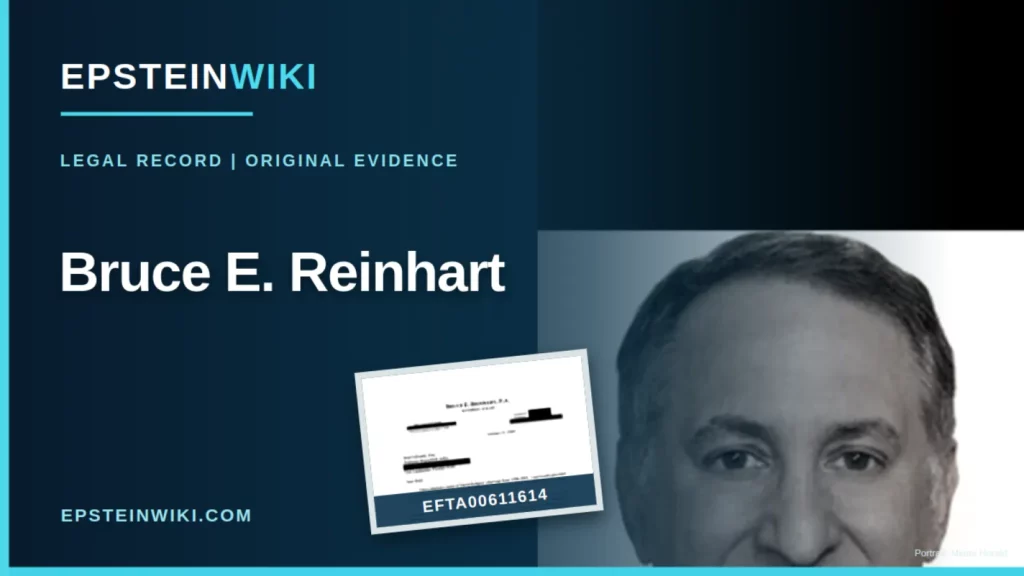
- Reinhart’s signed October 23, 2009 letter addresses production of pilot logs belonging to David Rodgers and proposes confidentiality conditions.
- A November 2009 invoice billed to Epstein lawyer Jack Goldberger identifies meetings and preparation involving pilots and other witnesses.
- The source documents identify several different clients and roles across related proceedings; they should not be merged into one undifferentiated representation.
- Discussions of protecting logs in civil discovery are documented advocacy acts, not proof of falsification or concealment of a crime.
Professional Role and Correct Attribution
Reinhart’s October 2009 letterhead identifies him as an attorney at law. Multiple court service lists name his practice alongside counsel for other parties. An attorney can represent a witness for a deposition, represent a party to civil litigation, and participate in a dispute over a subpoena without occupying the same role in every proceeding.
The plaintiff’s service list attached to the May 1, 2009 First Amended Complaint in Jane Doe No. 101 v. Epstein, No. 9:09-cv-80591, lists Reinhart as “Co-counsel for Defendant, Jeffrey Epstein” (Document 9, p. 21; EFTA00213181). A separate service list in No. 9:08-cv-80119 identifies him as counsel for Sarah Kellen (Document 152, p. 8; EFTA00222298). These are the filing authors’ descriptions of counsel, not judicial findings about the scope of an attorney-client relationship. They should not be generalized into a claim that Reinhart represented Epstein in every related proceeding.
The October 23, 2009 Pilot Log Letter
In his letter to attorney Brad Edwards, Reinhart said he had obtained David Rodgers’ personal pilot logs for 1998 through 2002 and previously supplied copies covering 2002 through 2005. He proposed conditions that would restrict use to the litigation where Rodgers was subpoenaed, limit public dissemination and require notice before public filing. The letter is a direct documentary record of a negotiating position.
It does not itself prove that the proposed protective order was accepted, that all relevant flight records were produced, or that any specific original log was altered. Those questions would require the operative court order, the subpoena returns and comparison of original and produced documents.
The November 2009 Invoice
Invoice 240, dated November 2, 2009, bears the heading regarding Jeffrey Epstein and is addressed to Jack Goldberger. Its entries include phone and email work concerning Bill Hammond, a meeting concerning employee depositions, a meeting and deposition involving Larry Visoski, and preparation and deposition work involving David Rodgers. Listed time entries and billing rates document tasks recorded and billed, not the full substance of any private conversation.
Because the invoice is addressed to another lawyer, it must not be misread as a bank confirmation or as a statement that each named pilot individually paid for counsel. It helps establish the professional relationship and the economic mechanism of legal support while leaving ultimate reimbursement arrangements to further records.
Witnesses, Pilots and Discovery
The EpsteinWiki investigation of pilot David Rodgers discusses how his personal logs differed from company records and why document provenance matters. Reinhart’s involvement is particularly relevant where a witness’s personal notebook was requested in civil discovery.
The Bill Hammond record independently places the attorney in related discussions. A witness’s presence on a billing entry does not alone prove adverse testimony, concealment or loyalty to an accused party.
Later Public Discussion and Limits of the 2009 Record
Later disputes about the judiciary or contemporary political controversies should not be retroactively inserted into the 2009 Epstein record. The relevant primary questions are what Reinhart filed, who he represented in each case, what conditions he requested, and what the court granted. No record cited here establishes that he participated in sexual abuse or tampered with the flight logs.
The distinction is necessary even where public debate relies on the fact that someone worked at a United States Attorney’s Office during an earlier phase of the investigation. Tenure at an institution is not the same as direct responsibility for each action taken there.
Chronology
| Date | Recorded event |
|---|---|
| 2008 and 2009 | Federal civil cases seek witness testimony and aviation records connected with Epstein. |
| September and October 2009 | Reinhart invoice entries describe work with pilots, witnesses and counsel. |
| October 23, 2009 | Letter to Brad Edwards proposes conditions for production of Rodgers’ logs. |
| November 2, 2009 | Invoice 240 records services and charges relating to the Epstein matter. |
| After 2009 | Reinhart’s later judicial work must be distinguished from his earlier private practice activities. |
Evidence Appearances and Document Register
This index identifies the records supporting the analysis. Duplicate copies and party assertions must not be counted as independent proof.
| Evidence file | Significance |
|---|---|
| EFTA00611614 | Signed October 23, 2009 pilot log production letter. |
| EFTA01111305 | November 2009 invoice with witness and pilot related billing entries. |
| EFTA00213048 | Federal case service list naming attorney roles. |
| EFTA00222291 | Related federal filing listing counsel for parties and related cases. |
What the Evidence Does Not Establish
- Different litigation parties and their counsel must be identified by the exact pleading or docket.
- Participation as an attorney does not establish involvement in the abuse of minors.
- No verified portrait or claim about an individual’s motivation is needed to analyze these records.
Questions and Answers
Does the October letter establish a final protective order or log destruction?
The October letter does not establish a final protective order or proof of log destruction.
What are the limits of the billing descriptions?
Billing descriptions do not reveal confidential legal advice or conclusively establish who ultimately paid a bill.
November 2026 House Oversight report
The House Oversight majority’s November 10, 2026 report examines Reinhart’s move from the U.S. Attorney’s Office into private practice and his representation of Epstein associates. It quotes Kellen saying Epstein selected and paid him for a civil deposition around 2008 or 2009, expressly not for the non-prosecution agreement. Her statement that she felt he worked for Epstein is her account of that relationship. The agreement was signed in September 2007, before Reinhart’s January 2008 departure from government. (majority report, printed pp. 50 to 53; Kellen transcript, p. 107.)
An earlier primary record is more precise about his government knowledge. In its July 19, 2013 responses to requests for admission, the government admitted that Reinhart learned confidential, nonpublic information about the Epstein matter while an AUSA and discussed it with another AUSA working on the matter. It denied that he participated in decision-making. These responses do not establish that he negotiated the agreement, disclosed information to Epstein or shaped the charging decision. (Government responses, request 15, Document 213-1, p. 9, refiled as Document 361-31.)
The report’s discussion of shared business addresses and Acosta’s uncertainty raises questions about professional boundaries. An address overlap or a witness’s lack of knowledge does not itself resolve those questions. See EpsteinWiki’s analysis of the November 2026 report for the source comparison.
Related EpsteinWiki Articles
Sources
- Bruce Reinhart October 2009 letter
- November 2009 invoice
- Federal court service list
- Epstein Data Wiki, David Rodgers
- Epstein Data Wiki, Bill Hammond
The sources are cited for their distinct documentary roles. Legal arguments are attributed to advocates, judicial orders to the court, and interviews to their speakers. Nothing in a docket caption proves that every named lawyer personally took every action.