
EFTA00161528: FBI “Names in JE File” Email, July 22, 2025
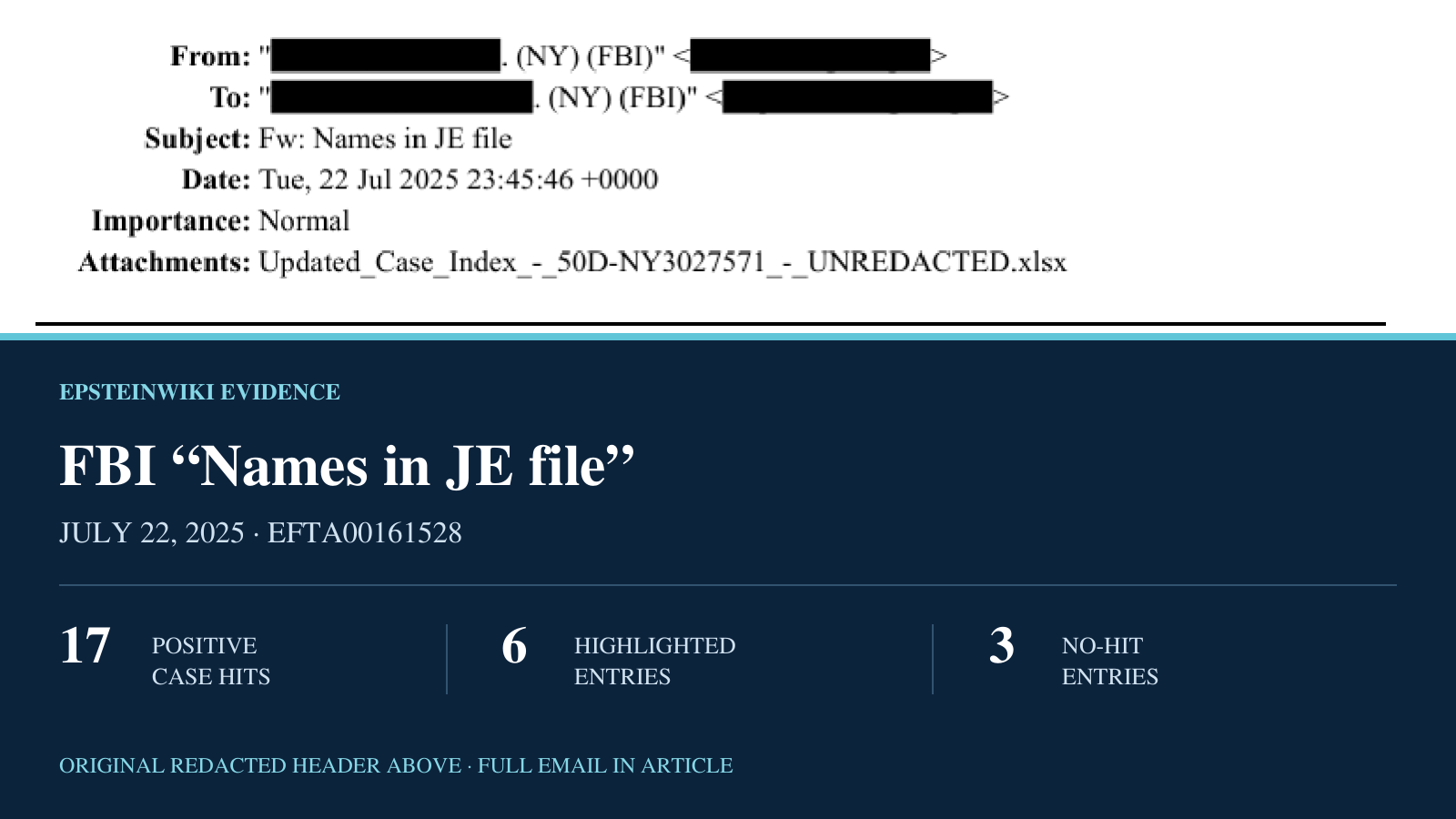
Snapshot
| Field | Documented detail |
|---|---|
| Record | EFTA00161528: FBI email with the subject “Names in JE file” |
| Document date | July 22, 2025 |
| Reviewed extent | One PDF page, including the forwarded header and the complete visible message |
| Positive case hits | 17 displayed names; six highlighted in yellow |
| No hit | Three displayed names |
| Referenced attachment | An Excel case index is named in the header but is not included in this one-page PDF. |
| Redactions | FBI sender and recipient names and email addresses are concealed. |
| Evidentiary limit | The page records an internal case-file name check and one summarized allegation. It supplies no underlying case serials, interview, charging decision, or court finding. |
The July 22, 2025 FBI email lists 17 names under “Positive case hits” and three under “No hit.” Six positive entries are highlighted in yellow. The writer directs the recipient to an attached spreadsheet for the corresponding serials and says the highlighted entries contain “salacious information.” The released email page does not supply those underlying records or define that description.
The Donald Trump entry includes a brief allegation summary and a statement that the identified victim ultimately refused to cooperate. The page does not identify that person or establish the allegation as fact. Trump has denied wrongdoing connected with Epstein, and the White House has rejected the later public allegations. This article examines what this particular email records without adding an identity or details absent from it.
Key Takeaways
- The document contains 20 displayed name entries: 17 positive hits and three no-hit results. These are counts of entries in this email.
- The six yellow highlights are Donald Trump, Prince Andrew, Jes Staley, Leon Black, Glen Dubin, and Harvey Weinstein. The other 11 positive-hit entries are not highlighted.
- A positive hit establishes that the writer reported a case-file match. The email does not explain the match, identify the underlying serial, or allege misconduct by every listed person.
- The only individualized allegation summary appears beside Trump. Its brief wording does not provide the underlying interview, an evaluation of credibility, or the outcome of an investigation.
- The attachment name includes “UNREDACTED,” but the visible email has redacted sender and recipient details. The spreadsheet itself is absent from the PDF.
- The source spelling “Glen Dubin” and the single name “Didier” are retained. The page alone does not justify silently correcting one or expanding the other.
The Email and Its Timestamps
The upper header identifies a forwarded message with the subject “Fw: Names in JE file,” normal importance, and a timestamp of Tuesday, July 22, 2025 at 23:45:46 +0000. The visible sender and recipient labels contain “(NY) (FBI),” while their personal identifiers are redacted. The forwarding body contains only “FYSA” before the earlier message.
The embedded message is dated Tuesday, July 22, 2025 at 7:39 PM and has the subject “Names in JE file.” Its displayed timestamp does not include a timezone. The date of the exchange is clear, but the page does not establish an exact elapsed time between the two messages without an assumption about the embedded timestamp.
| Element | Visible record | Interpretive boundary |
|---|---|---|
| Earlier message | July 22, 2025, 7:39 PM; subject “Names in JE file” | No timezone is printed beside this timestamp. |
| Forwarded message | July 22, 2025, 23:45:46 +0000; subject “Fw: Names in JE file” | The numeric offset identifies this header’s timestamp as UTC. |
| Participants | Redacted names and addresses; visible “(NY) (FBI)” labels | The page does not establish the individuals’ identities. |
| Page identifier | EFTA00161528, printed at the lower right | This identifies the released page; it is separate from an FBI case or serial number. |
The Complete Positive-Hit List
The positive-hit section directs the reader to the attachment for serials. The following table preserves the order and spelling of every entry and records the actual yellow highlighting visible in the page image. Highlighting is the email writer’s classification; the page provides no definition of “salacious information” and no underlying evidence for the other highlighted names.
| Name as displayed | Yellow highlight | Additional information on this page |
|---|---|---|
| Donald Trump | Yes | Brief allegation and noncooperation note, discussed below. |
| Prince Andrew | Yes | No individualized explanation. |
| Jes Staley | Yes | No individualized explanation. |
| Leon Black | Yes | No individualized explanation. |
| Glen Dubin | Yes | No individualized explanation. |
| Harvey Weinstein | Yes | No individualized explanation. |
| Bill Clinton | No | No individualized explanation. |
| Alan Dershowitz | No | No individualized explanation. |
| David Copperfield | No | No individualized explanation. |
| Les Wexner | No | No individualized explanation. |
| Jean Luc Brunel | No | No individualized explanation. |
| Naomi Campbell | No | No individualized explanation. |
| Chris Tucker | No | No individualized explanation. |
| Larry Summers | No | No individualized explanation. |
| Kevin Spacey | No | No individualized explanation. |
| Didier | No | No individualized explanation. |
| Bill Gates | No | No individualized explanation. |
The unhighlighted entries are still within the positive-hit section. The layout distinguishes the existence of a reported match from the writer’s highlighted subset. Absence of highlighting supplies no separate finding about the person’s conduct, and the table should not be converted into a ranking of culpability.
The Three No-Hit Entries
The final section of the email lists Adnan Khashoggi, Reid Hoffman, and Piers Morgan under “No hit.” No explanation follows. The page does not describe the collection searched, spelling variants, date range, query terms, or completeness of the check. A no-hit result therefore applies to the check reported in this message and cannot establish that a name is absent from every Epstein-related record.
The Note Beside Donald Trump
The parenthetical after Trump’s name reads: “one identified victim claimed abuse by Trump but ultimately refused to cooperate.” The whole entry, including that parenthetical, is highlighted. It records the writer’s summary of an allegation and of the person’s cooperation status as described in July 2025.
The email’s single sentence does not identify the complainant, state an age, specify a date or place of alleged abuse, quote an interview, explain why the person refused to cooperate, or state how investigators evaluated the account. It also does not say that the allegation was withdrawn or recanted. Treating noncooperation as proof of falsity, or treating the allegation’s presence as proof that it happened, would go beyond the page.
AFP’s March 7, 2026 reporting records Trump’s denial of wrongdoing and the White House’s rejection of allegations discussed in later FBI interview releases. That response is relevant broader context, but this email supplies no serial or witness identifier that would independently establish which later interview record corresponds to its parenthetical. No such identity match is asserted here.
The Referenced Excel Attachment
The attachment line names Updated_Case_Index_-_50D-NY3027571_-_UNREDACTED.xlsx. The filename describes an updated case index and contains a case reference. The message’s instruction to consult the attachment for serials indicates that the email is a summary pointing to another record.
The one-page PDF contains neither spreadsheet rows nor a list of serials, and it has no embedded file attachment. The filename alone cannot establish the workbook’s contents, the source of each match, the date when each underlying record was created, or whether a name appears as a witness, subject, contact, third-party reference, or allegation. “UNREDACTED” is part of the attachment’s filename, not a description of the redacted email page.
Contemporaneous and Release Context
The DOJ and FBI July 2025 memorandum stated that their review found no incriminating client list, no credible evidence of blackmail of prominent individuals, and no evidence that would support opening investigations against uncharged third parties. Those are the agencies’ stated conclusions from their broader review, rather than findings made by this later email.
The July 22 message shows an internal exchange about names in the case file after that public memorandum. Its existence documents continued internal communication. A name match and a predicate for opening an investigation answer different questions, so this page alone does not establish that the memorandum’s conclusions were reversed or that a new investigation was opened.
DOJ’s January 30, 2026 release statement said its wider production included material submitted by members of the public that could be false, and it rejected certain claims against Trump. The statement does not identify EFTA00161528 or resolve the parenthetical on this page. Its release date should not be substituted for the date of the email, and the email does not establish its own first public-release date.
Source, Redactions, and Verification Limits
The public document viewer and its one-page PDF were checked on October 12, 2026. The complete page image was reviewed, including the headings, all 20 name entries, six yellow highlights, headers, redaction bars, and lower-right EFTA identifier. Text extraction alone omits the yellow highlighting and can misrepresent redaction edges.
The DOJ Data Set 9 file address returned an age-verification page during this check, so a current DOJ PDF could not be compared byte for byte. The analysis uses the inspected mirrored copy. This access result does not establish that DOJ removed, withheld, or resealed the document.
DOJ’s disclosure notice cautions that released material may inadvertently contain personal information and explains that victim-identifying information has been redacted. The visible FBI participant redactions remain intact here. The unnamed person referenced in the Trump note is not linked here to another complainant.
What This Record Establishes
- Documented: A July 22, 2025 FBI-labeled email reported 17 positive case hits, marked six with yellow highlighting, and reported three no-hit entries.
- Documented: The message referred the recipient to an Excel attachment for serials and included one brief allegation and noncooperation summary beside Trump’s name.
- Unresolved in this record: The search method, the underlying serials, the contents of the absent workbook, and the reason each name matched.
- Unresolved in this record: The complainant’s identity, which is not disclosed on this page, the supporting evidence for the allegation, the reason the person refused to cooperate, and any resulting investigative or judicial outcome.
- Research priority: A lawfully released version of the referenced workbook and its corresponding records would permit verification of the matches without guessing identities or reversing redactions.
Primary Document
Open EFTA00161528 in the document viewer or inspect the full one-page PDF to check the exact wording and highlighting. The linked page preserves the existing redactions.
Sources
- EFTA00161528: Names in JE file, July 22, 2025. Complete one-page email, examined as a primary document image through the public mirror.
- DOJ and FBI memorandum on the Epstein review, July 2025. Two-page agency memorandum; the review conclusions discussed here appear on page 1.
- DOJ release statement, January 30, 2026. Context for the wider release and DOJ’s warnings about submitted material.
- AFP, March 7, 2026: White House response to later released allegations. Used for the reported denial and response, not as a substitute for this email’s contents.
- DOJ disclosure and privacy notice. Source for the agency’s published privacy warning.