
Seth Lloyd
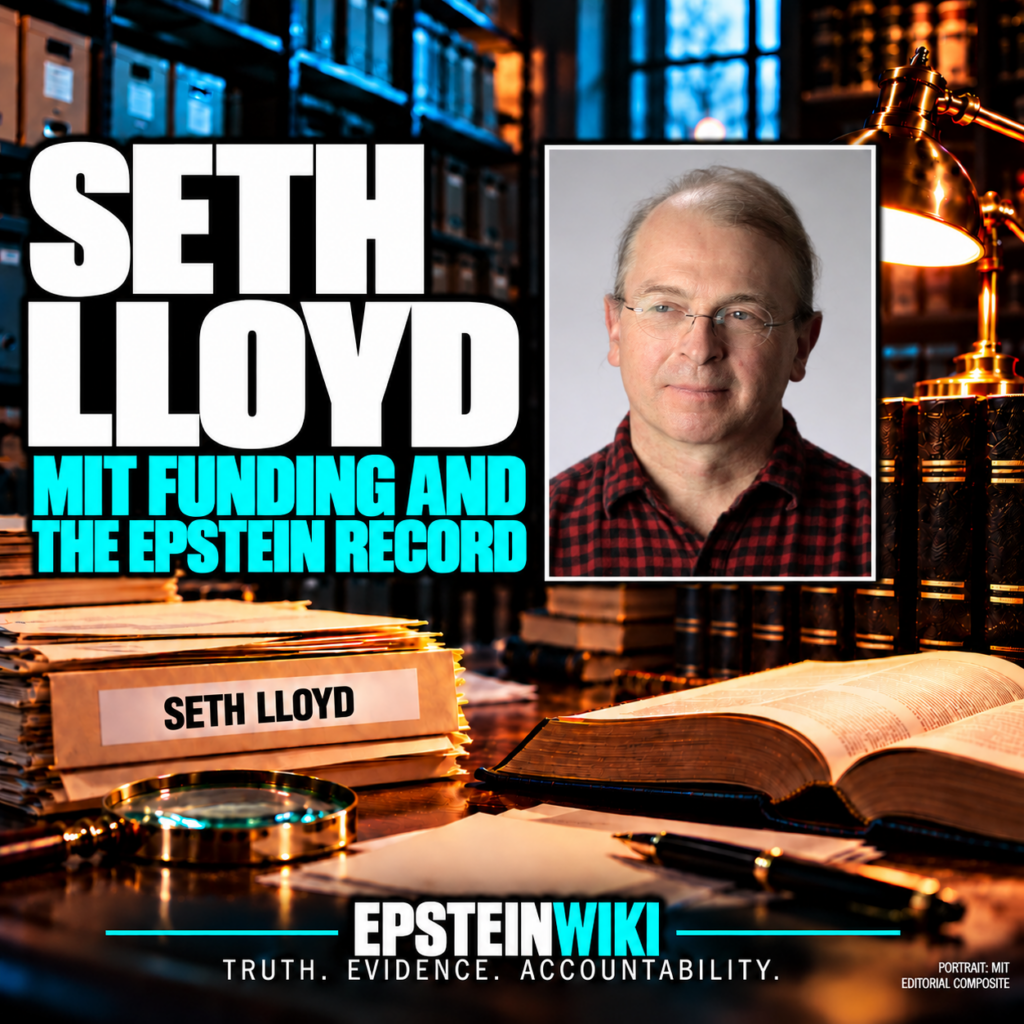
Snapshot
| Field | Documented information |
|---|---|
| Public identity | Seth Lloyd, physicist and quantum information researcher |
| MIT affiliation | Professor of Mechanical Engineering, as listed by MIT when checked October 7, 2026 |
| Beginning of relationship | Met Epstein in 2004 through a scientific and donor gathering |
| Research funding recorded by MIT | $225,000, consisting of two $50,000 installments in 2012 and $125,000 in 2017 |
| Separate personal payment | Lloyd reported a $60,000 personal research gift in approximately 2005 or 2006; it was not part of MIT’s donation total |
| Additional financial record | A 2005 tax return excerpt lists $100,000 in consulting compensation to Seth Lloyd; its relationship to the reported personal gift is unresolved |
| Institutional consequence | Paid administrative leave announced January 10, 2020; five years of restrictions announced December 18, 2020 |
| Critical distinction | The initial fact finding report and the later faculty review differed on whether Lloyd concealed the donor’s identity or circumvented vetting |
| Evidence limit | Funding, friendship, correspondence and institutional misconduct findings do not themselves establish participation in Epstein’s sexual crimes |
| Last checked | October 7, 2026 |
MIT’s public accounting places Seth Lloyd at the center of an academic relationship that continued after Jeffrey Epstein’s 2008 conviction. The record includes research money, direct personal contact, an apology to survivors, conflicting conclusions about disclosure, and formal faculty discipline. It requires a careful separation of what Lloyd acknowledged, what investigators inferred, what MIT ultimately found and what individual emails actually establish.
The financial record also needs separate categories. Money paid to MIT for a professor’s work is not automatically money deposited in that professor’s personal account. A donor’s offer is not a completed payment. A foundation’s tax return is a separate kind of evidence from a recipient’s retrospective explanation. Treating those categories as interchangeable obscures the most important questions in this case.
Important Points
- Lloyd’s knowledge of Epstein’s conviction is not merely inferred from a name appearing in an address book. He publicly acknowledged visiting Epstein during his sentence and maintaining contact afterward.
- The central disclosure dispute concerns both Epstein’s identity and his criminal history. They are different facts, and MIT’s final disciplinary statement treated them differently.
- The 2017 wire correspondence identifies MIT’s gift office and confirms receipt. It is stronger evidence of an institutional donation than a scheduling entry or an unfulfilled pledge.
- The $100,000 consulting entry in an earlier tax record must not be silently substituted for, or automatically added to, the $60,000 gift described in the MIT investigation.
- A calendar entry establishes a plan; an email may establish a request, an acknowledgment or a report of a meeting. Neither necessarily proves attendance or criminal conduct.
- The published five year sanction was an employment measure. It was not a criminal sentence or a permanent removal from MIT.
Scientific Role and the Beginning of the Relationship
MIT’s faculty profile describes Lloyd’s work in quantum computation, quantum communication, quantum control and complex systems. His scientific role matters because Epstein sought relationships with researchers and support for scientific work. It does not supply evidence for claims that the research itself was a covert criminal operation.
Lloyd’s MIT curriculum vitae records that he joined the faculty in 1994 after studies at Harvard, Cambridge and Rockefeller University. His career therefore long preceded the documented Epstein relationship. The scientific background helps explain why he would have been present at gatherings of researchers and prospective patrons, without excusing his later decisions about the donor.
Edge’s contemporary account of its February 24, 2004 dinner places both men at the Indian Summer Restaurant in Monterey, California. Lloyd contributed his own account of discussing quantum information with Sergey Brin and Larry Page before Epstein joined the conversation about the origins of life. This is a contemporary record of an actual scientific conversation, rather than a later claim based only on a guest list.
Lloyd’s August 2019 apology identifies 2004 as the year they met. He said their discussions continued during Epstein’s visits to Harvard, and that a foundation grant supported his research. His account acknowledged that he continued the relationship after learning of Epstein’s conviction.
The Money: Institutional Donations and Personal Payments
The Goodwin Procter donation accounting records three payments for Lloyd’s work: two installments in 2012 and a further gift in 2017. The report separately records the personal gift Lloyd described to investigators. Its MIT total does not include that personal payment.
| Period | Amount | Recipient or description | How to read the record |
|---|---|---|---|
| Approximately 2005 or 2006 | $60,000 | Personal gift described by Lloyd | His account says it supported scientific research; separate from MIT’s gifts |
| June 2012 | $50,000 | MIT, for Lloyd’s research | First installment of the $100,000 pledge |
| December 2012 | $50,000 | MIT, for Lloyd’s research | Second installment of the same pledge |
| June 2017 | $125,000 | MIT, for Lloyd’s research | Later gift, with a wire receipt confirmation in the correspondence |
| MIT research support total | $225,000 | The three institutional payments above | Not a total of every possible personal or consulting payment |
Lloyd’s January 2020 explanation said the earlier personal grant became a gift after an attempted corporate arrangement took too long to establish. He said he paid gift tax and used the money for research. These are his statements about treatment and use of the funds, not an independent audit of his tax returns or spending.
MIT’s broader January 2020 accounting identified $850,000 from Epstein across the Institute between 2002 and 2017. Of that sum, $525,000 supported the Media Lab, $225,000 supported Lloyd’s work, and the earlier $100,000 supported Marvin Minsky. The Media Lab total must not be added to Lloyd’s own research funding as though he received it.
An Unreconciled Consulting Entry in the Tax Records
EFTA01714002, page 3 preserves a page from a 2005 Form 990 PF. In Part VIII, the table for independent contractors names Seth Lloyd, describes the service as consulting and records compensation of $100,000. The name and amount are visible in the released scan. This is a direct tax record entry, not an amount derived from an automated biography or a count of document mentions.
That entry does not by itself explain whether the listed compensation overlaps with the approximately $60,000 personal gift Lloyd later described, reflects a different accounting treatment, or concerns another payment. No reconciliation is established by the sources cited here. It would be misleading to turn the discrepancy into a new aggregate total or to infer a false statement, tax offense or undisclosed additional gift without the underlying payment and accounting records.
The accessible scan mirror permits comparison with the source page. The relevant page is the third page of the released document, although the tax form itself labels it page 6. The distinction matters when locating the entry. Personal address information is unnecessary to understanding the financial evidence and is not reproduced here.
The 2012 Correspondence and the Disclosure Dispute
The June 2012 fund correspondence shows MIT personnel working with Epstein’s office to establish a discretionary research account. An early part of the chain treats Lesley Groff as though she might be the donor and even suggests a fund name using her name. A June 15 message signed Seth instead tells Groff to send an email stating that Jeffrey wishes to donate. The chain supports an initial misunderstanding followed by explicit identification; it does not establish that the suggested fund name was ultimately adopted.
The June 22 and June 24 exchange is particularly important. Richard Kahn identified himself as Epstein’s accountant, identified Epstein as the donor, and described a $100,000 gift in two $50,000 installments. MIT’s reply acknowledged the gift on Epstein’s behalf and instructed that the check be payable to MIT. This establishes institutional notice of the donor’s identity before the anticipated first payment. It does not establish that those staff members knew his criminal record.
Goodwin Procter’s January 2020 assessment inferred that Lloyd’s initial failure to name Epstein was intended to obscure the donor and hinder scrutiny. The investigators also concluded that Lloyd had not disclosed the conviction to the staff processing the gifts. These were findings of an investigation commissioned for MIT, not a court judgment.
Lloyd’s January 16 rebuttal denied hiding the donor’s identity or attempting to defeat vetting. He said he asked his department how to handle gifts, followed its procedures and supplied the relevant emails to investigators. He maintained his apology for accepting the support while disputing the report’s conclusions about concealment. His denial concerns procedure and intent; it does not deny receiving Epstein’s support.
Faculty chair Rick Danheiser’s contemporary analysis explained why the disagreement could not be resolved simply by saying that MIT eventually knew the name. The dispute concerned the inference about Lloyd’s initial motive. Danheiser also noted that Lloyd had publicly acknowledged Epstein’s financial support in at least six research papers submitted between 2010 and 2013. Those acknowledgments are relevant to a concealment claim, but public acknowledgment does not substitute for disclosing a donor’s conviction to the officials evaluating a gift.
The 2016 Request and the Completed 2017 Gift
Lloyd’s July 31, 2016 funding request thanked Epstein for earlier support and asked whether he would provide more. Lloyd explained that flexible funds supported visitors, students and activities that government grants could not cover. He also sought assistance for his 2017 to 2018 sabbatical and offered to investigate MIT’s willingness to accept additional donations. Epstein replied by proposing a call. A duplicate version of the substantive request appears in EFTA00632307.
The email describes a previous $100,000 donation as having occurred two years earlier. That wording does not align neatly with MIT’s documented 2012 installments. Without a corresponding receipt or accounting entry, it should not be converted into a newly established 2014 donation. The email is reliable evidence of what Lloyd wrote and requested, while the payment date requires a different kind of support.
The May 18, 2017 donation chain records Lloyd thanking the prospective donors for offering $120,000 and introducing an MIT gift officer to handle the transfer. That figure is an offer under discussion. It should not replace the $125,000 later recorded in the completed gift or be counted as a second payment.
The June 1, 2017 wire chain carries Epstein’s instruction to send $125,000 to MIT for Lloyd from Gratitude, the foundation identified in the institutional report as Gratitude America. Lloyd expressed thanks and discussed the perceived financial advantages of routing the support through MIT as a gift. The chain then records Kahn sending the wire and MIT’s gift office confirming receipt and credit to Lloyd’s research account.
The same chain says earlier gifts had been recorded anonymously and that the office would continue that treatment. In this context, anonymous recording is compatible with internal officials knowing who supplied the money. Lloyd’s estimate that the gift route would reduce deductions does not independently establish the correct tax treatment or any tax violation.
Personal Contact, Scientific Exchanges and What They Establish
The institutional account of personal contact says Lloyd visited Epstein’s Florida office during work release and visited his private island for a short lunch. The work release setting is more precise than the frequent shorthand that he visited Epstein in prison. The report does not turn either visit into a finding that Lloyd participated in abuse.
A December 2009 travel itinerary names Lloyd on a commercial Boston to West Palm Beach round trip booked for December 11 to December 13. It establishes a reservation appearing in the released correspondence. It is not a passenger manifest proving the flights were taken, and the itinerary alone does not establish who ultimately funded the trip or whom he met.
An August 2, 2015 exchange records Epstein inviting Lloyd to meet in Santa Fe. Lloyd replied that he was there too, discussed possible timing, and mentioned scientific questions they had previously discussed in Cambridge. The message is evidence of familiarity and a proposed meeting; it is not a confirmed record of a visit to Epstein’s New Mexico property.
The March 26 and March 27, 2017 exchange contains reciprocal expressions of enjoyment following an unspecified occasion. Its brevity is a reason for restraint. It establishes friendly contact, but it does not identify the activity, location or all participants. Assigning an incriminating event to it without supporting records would supply information the email does not contain.
The October 30, 2017 email about Mikhail Lukin’s computer is more specific. Epstein told Lloyd that he had taken a group to see the computer and that Lloyd had been missed. Lloyd responded favorably about Lukin. The wording therefore supports continuing scientific correspondence while cutting against a claim that this particular email proves Lloyd attended that visit.
Epstein’s December 2018 schedule includes Lloyd in a planned December 2 lunch during a Cambridge area trip. A schedule is not an attendance record. The entry should not be used on its own to state that a meeting occurred, especially when comparing an itinerary with a person’s retrospective account of when contact ended.
Research Publicity and the Scientific American Proposal
The October 2014 article correspondence shows a proposal to publicize Lloyd’s research on quantum effects in photosynthesis while incorporating Epstein’s name. A forwarded reply from Lloyd says he made minor scientific corrections and changes to attribution. Another correspondent proposed placing his name on the piece as an editor and securing publication with a major science outlet. The message documents an effort to obtain scientific legitimacy and publicity, rather than proof that the proposed publication occurred.
Scientific American’s February 2026 investigation said the proposed article was never published by the magazine and that no guest editor page for Epstein was created. Lloyd told the publication that, if Epstein had submitted an article listing him as a coauthor, he had not been told. The magazine’s former editor also denied that Epstein influenced its coverage. Those statements matter: the aspiration expressed in a correspondent’s email is not evidence that a publisher granted Epstein editorial control.
Lloyd’s documented editing of a draft and his later statement about not knowing of a coauthored submission concern different steps. The cited material does not establish that he approved every proposed use of his name or knew that a final manuscript had been submitted. It also does not erase his recorded participation in the draft exchange.
The Apology and the Effect on Survivors and Students
Lloyd’s August 22, 2019 apology to Epstein’s victims described his continued participation in scientific discussions and acceptance of later grants as professional and moral failures. He said he had accepted Epstein’s expressions of remorse instead of investigating the publicly available allegations, and that the Miami Herald’s November 2018 survivor interviews changed his understanding of the harm. He acknowledged that his association had helped protect Epstein’s reputation and said he had committed resources to assist survivors.
An apology is evidence of the speaker’s acknowledgment and stated intentions. It is not proof that all promised assistance was delivered, nor does it resolve disputed facts about financial disclosure. Lloyd’s apology also concerns the consequences of granting a powerful offender continued credibility. That issue can be evaluated without claiming that every academic contact knew of, or participated in, ongoing crimes.
A February 2021 student guest column in The Tech argued that the sanctions were insufficient and that Lloyd should be removed. The authors criticized the imbalance between punishment of individual faculty and accountability of senior administrators. This was a published argument about institutional responsibility, not an additional adjudicated finding. It shows why the December decision did not close the controversy for members of the campus community.
What MIT Ultimately Found and Imposed
MIT’s January 10, 2020 announcement placed Lloyd on paid administrative leave following the Goodwin report. The later review was a separate process with a fact reviewing faculty panel and an evaluation committee that considered discipline.
Provost Martin Schmidt’s December 18, 2020 decision reported a majority finding that Lloyd violated MIT’s conflict of interest and faculty misconduct policies by failing to disclose Epstein’s conviction in connection with the 2012 donations. A minority could not determine whether the conflict policy had been violated. The full panel found no policy violation in accepting the approximately 2005 or 2006 gift or the 2017 donation. Crucially, it did not find that Lloyd tried to conceal the donor’s name or circumvent vetting.
The announced disciplinary measures lasted five years and limited compensation, solicitation of donors and foundations, participation in first year advising, and other faculty privileges. Professional conduct training was required before resuming certain campus activities, including teaching. The public announcement did not specify every restriction or a precise pay reduction.
Both stages belong in an accurate account. Reporting only the January investigation would omit a material later finding favorable to Lloyd on the concealment issue. Reporting only that favorable finding would omit the policy violations and sanctions. The distinction is between institutional conclusions on different questions, not a choice between total vindication and proof of criminal complicity.
Current Status and the Renewed Scrutiny in 2026
MIT’s official faculty directory, checked October 7, 2026, continued to list Lloyd as Professor of Mechanical Engineering. The Tech’s February 2026 reporting also described him as retaining his tenured professorship. Neither source supports labeling him fired or resigned.
The five year duration announced in December 2020 should not be treated as an indefinite sanction. Conversely, the passage of time alone does not establish the exact implementation dates, completion of every condition or the contents of an individual personnel record. The public record supports reporting the announced term and the verified current affiliation separately.
MIT president Sally Kornbluth’s February 11, 2026 interview with The Tech addressed the newly released files. She said MIT was monitoring the disclosures rather than then conducting a new internal investigation and declined to discuss individual cases. That was the administration’s position at the date of the interview, not a guarantee about every later institutional decision. She also described additional levels of donor review introduced after the earlier controversy.
Greg Conners’s August 2026 commentary on academic due diligence includes Lloyd as an example of a scientist accepting support after Epstein’s conviction. Its broader argument concerns the responsibility to investigate benefactors. The underlying financial history is more precise than a single gift: MIT recorded three payments totaling $225,000, separate from the personal payment and the unresolved consulting entry described above.
Evidence Appearances and Reading Guide
The following identifiers lead to the released evidence. Some records are duplicates or chains containing earlier messages. They should not be counted as separate payments or separate meetings merely because they have different document numbers. Accessible mirror references are included in the source list for comparison with the archive viewer.
| Evidence | What it records | Principal limit |
|---|---|---|
| EFTA01714002 | 2005 Form 990 PF excerpt, page 3, consulting entry for Seth Lloyd | Relationship to the reported personal gift is unresolved |
| EFTA00410642 | June 2012 arrangements for an MIT research account | Proposed fund naming is not proof of final naming |
| EFTA02166869 | Kahn’s pledge notice and MIT’s response in June 2012 | Donor identity is distinct from knowledge of his conviction |
| EFTA02455892; EFTA00632307 | July 2016 research and sabbatical request | Overlapping versions, not separate requests or confirmed payments |
| EFTA02389767 | May 2017 proposed $120,000 donation | Precedes the completed $125,000 gift |
| EFTA02349247 | June 2017 instruction, transfer arrangements and receipt confirmation | Institutional research gift, not a demonstrated personal wire |
| EFTA00559336 | December 2009 commercial flight booking | Booking is not proof of travel or reimbursement |
| EFTA00849647 | August 2015 proposed Santa Fe meeting | No confirmed attendance at a property |
| EFTA00645045 | October 2014 research publicity proposal and draft edits | Proposed publication is not actual publication |
| EFTA02366597 | March 2017 friendly exchange | Occasion is unidentified |
| EFTA02575605 | October 2017 scientific correspondence | Says Lloyd was missed at the reported visit |
| EFTA00285514 | December 2018 itinerary naming Lloyd | Scheduled lunch is not confirmed attendance |
Key Takeaways
- The documented relationship involved funding and continued personal and scientific engagement after Epstein’s conviction. Its significance extends beyond a passive name in a contact list.
- MIT’s final disciplinary record must accompany the initial investigative report. They do not make identical findings about concealment and vetting.
- The primary correspondence supports a more exact account of the donation process and reveals details that broad summaries lose.
- The tax record discrepancy remains a question requiring reconciliation, not permission to manufacture an enlarged payment total.
- Academic misconduct, reputational assistance and criminal participation are distinct propositions. The cited evidence must be evaluated at the level it actually supports.
Related EpsteinWiki Coverage
- MIT Media Lab
- Joi Ito: MIT Media Lab Director and Jeffrey Epstein Associate
- Lesley Groff
- Martin Nowak and Jeffrey Epstein
Sources
- Goodwin Procter, Report Concerning Jeffrey Epstein’s Interactions with MIT, January 10, 2020, especially printed pages 5, 9 to 13 and 19 to 21; PDF page numbers are two greater than printed body page numbers.
- MIT News, release of the fact finding results and announcement of paid leave, January 10, 2020
- MIT Provost Martin Schmidt, Decision on Professor Seth Lloyd, December 18, 2020
- Seth Lloyd, apology to Epstein’s victims, August 22, 2019
- Seth Lloyd, What I told MIT about Epstein’s donations, January 16, 2020
- MIT Department of Mechanical Engineering, official Seth Lloyd faculty profile
- Seth Lloyd, MIT curriculum vitae
- Edge Foundation, contemporary 2004 dinner account, including Lloyd’s contribution
- Rick Danheiser, Epstein and MIT: The Unanswered Questions, MIT Faculty Newsletter, January and February 2020
- Wenbo Wu, The Tech, report on the disciplinary decision, January 6, 2021
- The Tech, student guest column criticizing the disciplinary decision, February 25, 2021
- Dan Vergano and Ari Sen, Scientific American investigation and responses, February 5, 2026
- The Tech, renewed MIT scrutiny and Lloyd’s retained professorship, February 2, 2026
- Jada Ogueh and Samuel Yuan, The Tech interview with Sally Kornbluth, published February 19, 2026
- Greg Conners, commentary on academic due diligence, August 29, 2026
- EFTA01714002 accessible document mirror
- EFTA00410642 accessible document mirror
- EFTA02166869 accessible document mirror
- EFTA02455892 accessible document mirror
- EFTA00632307 accessible document mirror
- EFTA02389767 accessible document mirror
- EFTA02349247 accessible document mirror
- EFTA00559336 accessible document mirror
- EFTA00849647 accessible document mirror
- EFTA00645045 accessible document mirror
- EFTA02366597 accessible document mirror
- EFTA02575605 accessible document mirror
- EFTA00285514 accessible document mirror