
Sleuth Report: Bekah Day Questions Paolo Zampolli on Epstein, Modeling and Accountability
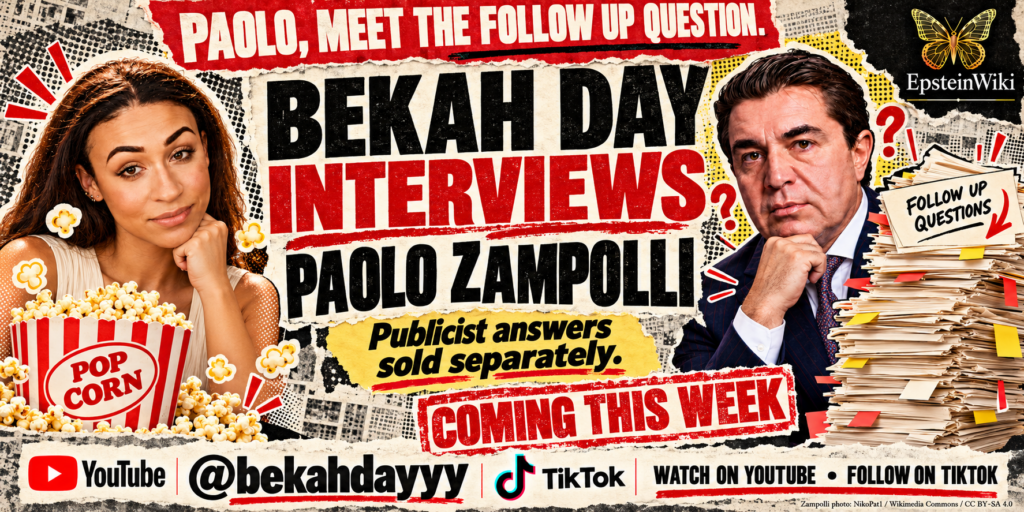
Snapshot
| Field | Documented information |
|---|---|
| Podcast | The Bad Decisions Podcast with Scott Nathan |
| Participants | Host Scott Michael Nathan, Paolo Zampolli and Bekah Day |
| Release date | October 7, 2026 |
| YouTube source | Video SZXBJdCj3AM, with a displayed runtime of 1:05:45 when checked |
| Publisher audio edition | Paolo Zampolli in Bekah Day’s Hot Seat!, distributed by Hurrdat Media |
| Coverage | Complete supplied 65:45 source-video transcript, compared with the complete 71:15.8 publisher audio recording, including the inserted Italian segment |
| Review method | Supplied speaker-labeled machine transcript, checked against an independent full-audio transcription and a separate Italian-language pass; speech is paraphrased, not certified verbatim |
| Timestamp convention | Times follow the supplied 65:45 source-video transcript and are approximate navigation aids. The longer podcast edition has different timings |
| Embedded start point | 27:40, the point supplied for this report |
| Main subjects | Epstein and modeling access, the Elite acquisition attempt, FashionTV, redacted FBI accounts, Maxwell and TerraMar, media pressure, property allegations and disputed personal accounts |
| Evidentiary distinction | An interview statement, an allegation preserved in a file, a contemporaneous news report and an official finding carry different weight |
| Last checked | October 7, 2026 |
The Bad Decisions discussion puts Bekah Day’s questions directly to Paolo Zampolli, with Scott Michael Nathan hosting and occasionally pressing for clarification. The central issues are concrete: how models encountered Jeffrey Epstein, what the attempted Elite acquisition involved, what Zampolli knew about associates, and whether documents support the answers he gives.
The complete source-video transcript, compared with the publisher’s audio edition, shows why the entire discussion matters. The later exchanges cover townhouse rentals, Sultan Ahmed bin Sulayem, an archival television clip, Ghislaine Maxwell’s TerraMar project, model apartments, a disputed phone, diplomatic immunity and the timeline of Zampolli’s relationship with Amanda Ungaro. All are included here rather than stopping at the supplied 27:40 point or relying on the publisher’s chapter labels.
The discussion produces explanations and denials, but it does not resolve every factual dispute. Several of the strongest questions concern records that can be checked. Others rely on uncertain identification, a disputed translation, private correspondence or an account that has not been independently established. Those differences matter to the report’s conclusions.
Important Points
- Zampolli describes Epstein as a business rival who poached models, while also explaining discussions in which Epstein would provide money for an Elite acquisition and Zampolli would operate the business. Those accounts can coexist; the proposed transaction deserves examination on its own terms.
- Contemporary reporting supports an unsuccessful acquisition attempt involving Zampolli and Epstein. It does not establish completed joint ownership, the precise bid structure or a criminal purpose.
- The July 2019 FBI proffer records a former model’s allegation of an affair with her agent and her account of Epstein looking through portfolios. It does not independently establish the affair’s dates, the model’s contractual status at the time or Zampolli’s knowledge of later abuse.
- The October 2018 email discussed in the interview contains a serious accusation by a redacted sender. Its inclusion in the released files does not turn that accusation into a government finding.
- Zampolli denies causing Day’s TikTok account to be deleted. He also argues that creators who disparage people should face financial consequences. The interview does not establish who caused the account restriction.
- Reports from September 2000 support Day’s statement that Michel Adam Lisowski was convicted of sexual assaults and sentenced. The material checked does not establish the separate assertion that he actually entered prison that year.
- The late Maxwell exchange requires a source distinction: Day’s published correspondence comes from a private archive, while TerraMar’s own historical publication independently documents an alliance involving Zampolli.
- The full recording contains important qualifications and corrections. An alleged relationship is not a dated contract record; a complaint is not a conviction; and a first name in a magazine profile does not authenticate a disputed identity.
Watch the Interview
Watch from the beginning or open the supplied 27:40 starting point.
The time guide follows the supplied transcript of the 65:45 source video. The public YouTube cut has not been compared frame by frame with that source file. Speaker labels and timestamps are machine-generated and should be checked against playback before quotation. The complete publisher audio recording was also reviewed through independent transcription; it runs 71:15.8 and has different timing. The Italian clip received a separate language-specific check. These sources support paraphrased coverage of the whole discussion, not a certified verbatim transcript.
Full Recording Guide
| Source-video transcript time | Exchange | What the reader should distinguish |
|---|---|---|
| 00:00 | Preview of the FashionTV and Lisowski confrontation | This is a preview of an exchange revisited at 28:46, not a separate allegation |
| 02:02 | Nathan introduces the guests and the purpose of a direct conversation | Publisher framing is not an evidentiary finding |
| 03:00 | UN General Assembly, Vatican contacts and diplomatic connections | Zampolli’s account of his role versus independently documented appointments and UN history |
| 07:34 | Claimed extortion complaints, litigation and a contemplated countersuit | Complaints, asserted investigations and prospective litigation are different procedural events |
| 10:22 | Day’s coverage, its duration and alleged financial incentives | Competing accounts of motives do not resolve the underlying evidence |
| 12:14 | Day asks about her TikTok account; Zampolli denies deleting it | Denial, chronology and evidence of causation must remain separate |
| 14:13 | Zampolli describes meeting Melania in Milan and encouraging a move to America | His recollection is not the same question as who later introduced the Trumps |
| 17:35 | John Casablancas, the modeling industry and questions about teenage models | Day’s premise and Zampolli’s claimed lack of knowledge |
| 21:30 | Former ID Models personnel and Epstein’s alleged poaching | Agency history does not by itself establish who arranged later employment or abuse |
| 22:46 | The attempted Elite purchase and Epstein’s proposed financing | Attempted acquisition versus completed partnership |
| 24:54 | Epstein’s perceived commercial influence and Zampolli’s account of an antagonistic relationship | Industry perception versus actual company ownership |
| 28:46 | Lisowski, FashionTV and an inauguration-week event | Conviction versus time served; private event versus official presidential event |
| 33:33 | A redacted model’s FBI account | Alleged affair, uncertain timing and an unverified identity |
| 35:38 | The October 2018 accusation naming Zampolli and other people | A sender’s accusation versus an investigative conclusion |
| 39:22 | Manhattan townhouse rentals and the meaning of a reported FBI inquiry | Municipal enforcement records and federal-investigation claims are separate |
| 40:54 | Sulayem, real estate, Epstein’s warning and the video-email reference | The direction and limits of the actual correspondence |
| 43:54 | A proposed connection involving Svetlana Pozhidaeva | The interview question does not authenticate a route to Epstein |
| 44:57 to 48:00 | Inserted Italian television report about luxury real estate | Archival narration and first-name identification have limited evidentiary reach |
| 48:05 | Naomi Campbell | Knowing someone, representing them and working together are distinct claims |
| 48:53 | Maxwell, TerraMar and correspondence | Private-archive emails versus independently published organizational records |
| 51:34 | Passport-production referral | Proposed introduction to a supplier versus issuing passports or arranging citizenship |
| 52:50 | Disputed comments about Brazilian women | Original wording, translation and the speaker’s explanation |
| 54:51 | Model apartments and a proposed live-streaming concept | A proposal and publicity do not establish implementation |
| 56:18 | How a disputed phone reached Zampolli’s household | His account of possession versus an independently verified chain of custody |
| 59:54 | Ron Burkle and an immunity remark | A claimed joke versus the actual legal scope of diplomatic immunity |
| 1:00:29 | Alleged violence against Ungaro and Zampolli’s denial | The interview presents a dispute, not an adjudication |
| 1:01:10 | The date and circumstances of meeting Ungaro | An “Amanda” in an old profile cannot be identified by first name alone |
| 1:03:49 | Giuseppe Cipriani and Harvey Weinstein | Social or business access does not itself prove knowledge of crimes |
| 1:05:02 to 1:05:45 | Final host response and outro | End of the supplied source-video timeline |
Diplomatic Standing and the Opening Frame
The opening discussion at 03:00 allows Zampolli to describe his recent UN General Assembly activities, contacts with Cardinal Pietro Parolin and other leaders, and longstanding participation in diplomatic events. He presents those relationships as part of the experience behind his current role. Nathan begins with largely biographical questions before turning the floor over to Day.
The presidential digest for March 11, 2025 records the announcement of Zampolli’s appointment as Special Envoy for Global Partnerships. That documented appointment should be separated from broader claims he makes about personal influence or the origins of international initiatives.
The UN’s own 2030 Agenda describes the Sustainable Development Goals as the product of intergovernmental work and extensive consultation, adopted by world leaders in September 2015. Zampolli’s comments about creating or advancing the ocean goal are his account of his involvement. They are not sufficient to credit one individual with creating Goal 14.
At 14:13, Day asks how Zampolli first met Melania. He describes a scouting visit to Milan in the mid-1990s and says he encouraged her to work in the United States. He refers to published books and defends her reputation. The conversation then turns to his account of meeting John Casablancas as a teenager and entering the international agency network. When Day asks about Casablancas’s relationships with teenage models, Zampolli says he remembers seeing him with his wife and had not asked her age. That answer addresses his claimed awareness; it does not independently settle the history Day raises.
Litigation, TikTok and Pressure on Critics
The litigation discussion begins before Day’s main questions. Zampolli says he reported alleged extortion to the FBI and pursued complaints in other jurisdictions. He also discusses lawyers preparing a $100 million countersuit. The latter is a prospective legal action in his account, not a filed judgment or verified damages award.
The public docket for Drake v. Zampolli independently establishes a separate civil case filed in the Southern District of New York on September 3, 2026, assigned to Judge Ronnie Abrams. The mirror was last retrieved on September 4. It should not be used to claim that no later response, order or other development exists. Nor should remarks about an unnamed prior guest be converted into an authenticated response to every allegation in that pleading.
At 10:22, Zampolli questions how much time Day and other creators spend covering him and whether the subject makes them money. Day says she began covering him in July 2025 and describes Epstein-related reporting as comparatively unprofitable for her. Neither account of motivation determines whether a particular document has been accurately represented.
Day’s TikTok question at 12:14 assumes that Zampolli caused her account’s removal. He denies doing so, says he learned that the account was down, and returns to the question of creators’ accountability. He argues for financial consequences, including freezing revenue, for people he regards as disparaging others.
That is a significant position about online criticism, but it is not proof that such a policy exists or that he exercised authority over TikTok. Later, at 48:53, Day links her account loss chronologically to publishing Maxwell correspondence. Timing alone does not establish who reported an account, why a platform acted or whether an official intervened. The necessary evidence would include platform notices, appeal records and any relevant communications.
The exchanges also include personal attacks on previous guests and repeated comments about Day’s appearance. Those moments help explain the interview’s tone and interruptions. Their presence does not authenticate the accusations being made about third parties, and the underlying private allegations are not repeated here as facts.
Epstein, Model Poaching and the Elite Acquisition Attempt
At 21:30, Day asks how a former ID model came to work for Epstein. Zampolli describes an agency with frequent turnover and says Epstein, working with Jean-Luc Brunel, took models from his business. He presents this as the reason for an antagonistic relationship and says he was not invited to Epstein’s island.
Nathan then asks the obvious commercial follow-up: how does that account fit with the attempted Elite acquisition? Zampolli says Epstein approached him, that agency-management experience mattered to qualification for the purchase, and that the contemplated arrangement involved Epstein supplying money while Zampolli ran the business. He also describes Epstein as gathering information during their discussions.
British Vogue’s August 26, 2004 report, citing the New York Post, says Creative World, owned by Eddie and Jules Trump, outbid Zampolli and Epstein. It explicitly distinguishes those buyers from Donald Trump and says the Swiss parent was unaffected. This supports a reported unsuccessful acquisition attempt. It does not supply the original bid filing, financing agreement, allocation of ownership or proof of a completed partnership.
The July 2019 proffer also records an interviewee’s recollection that the two men were trying to buy Elite. That is another kind of evidence: a later witness account, rather than the transaction documents themselves. The interview adds Zampolli’s explanation of the proposed roles, but does not remove the need for the actual auction and financing records.
During the Elite discussion, Zampolli says people in his industry considered Epstein an owner or controlling figure behind Victoria’s Secret. He tells a story about confusing Epstein’s role with Les Wexner’s and sending portfolios in pursuit of business. Wexner’s own 2019 explanation describes Epstein managing his personal finances under a power of attorney. That source documents a financial-advisory relationship; Zampolli’s claimed perception should not be presented as proof that Epstein owned Victoria’s Secret.
The important distinction is between a claimed hostile relationship, commercially useful access and a proposed transaction. Evidence of one does not automatically erase the others. Equally, none of those categories alone establishes knowledge of sexual abuse or participation in it.
FashionTV and the Lisowski Conviction Question
The FashionTV exchange, previewed in the cold open, is one of Day’s clearest challenges about continued association. She asks why Zampolli maintained a friendship with Michel Adam Lisowski despite a sexual-assault conviction. Zampolli says he had not investigated that history and describes the friendship as longstanding and cordial. He does not offer documentary support for a different legal outcome.
Le Monde’s September 21, 2000 report and Le Parisien’s September 20 report describe a Paris conviction on September 19 for sexual assaults against a model in 1997. They report a two-year sentence, with one year unsuspended, and an arrest warrant. Those contemporary reports support the conviction and sentence. They do not, by themselves, establish when imprisonment actually began or the eventual appeal outcome.
The discussion then turns to a 2017 inauguration-week event. Zampolli distinguishes a private event during the week from an official presidential event, says Donald Trump neither attended nor was invited, and describes FashionTV cameras covering the gathering. Those are his answers. The event’s branding, organizers, invitation list and footage would be the appropriate records for testing them.
The Redacted Model’s Account
Day’s question at 33:33 concerns an FBI interview in which a former model described a sexual relationship with her agent and Epstein’s access to her portfolio. Zampolli says he has not read the files about himself, cannot identify the woman and cannot say when any relationship occurred relative to representation by the agency. He acknowledges having had relationships generally. That is neither a specific admission to the interviewee’s allegation nor a categorical denial of every part of it.
PDF page 4 of EFTA00090773, stamped EFTA00090776, identifies the ID Models agent using the spelling Paolo Zempoli and records the redacted interviewee’s account of an affair with the agent. The corresponding handwritten page, stamped EFTA00105201, contains the same general allegation. Neither passage establishes precise dates or independently proves that a signed agency contract was in force at the time.
The typed account also describes Epstein viewing portfolios and an earlier nightclub encounter. It leaves the identity of the person who collected the woman’s telephone number redacted and records uncertainty about the later caller who invited her to dinner. It does not identify Zampolli as that caller or place him at the later encounter in Epstein’s house.
Day speculates about the woman’s identity during the interview, but acknowledges that it cannot be confirmed from the redacted record. This report does not adopt or repeat that identification. A match proposed in conversation cannot override a redaction or convert biographical similarities into proof.
The separate August 26, 2019 interview must also remain separate. It describes a different former ID model leaving the agency and later being approached while working at a coffee shop. Its sequence does not establish an ID Models referral to Epstein.
There is another important discrepancy in the July material: the typed version names Epstein in a sentence about introducing Melania and Donald Trump, while the handwritten notes use a pronoun in a passage about the agent and an ambassador. Neither supplies an eyewitness account of that introduction or establishes why the versions differ. Melania Trump’s April 9, 2026 statement separately denies that Epstein introduced the couple. The interview’s account of meeting Melania in Milan should not be used to silently resolve this documentary discrepancy.
The October 2018 Email and the Limits of a File Mention
The exchange beginning at 35:38 addresses an email grouping Zampolli with other named people in a severe accusation. Zampolli rejects the implication, says he does not know the other people and argues that publication of a file does not justify how an accusation is presented. Day responds that the document was released publicly and is open to discussion.
EFTA01018591 is an October 25, 2018 email chain. A redacted sender calls Zampolli and others “killers”; Epstein asks about messages being received from his address and denies writing a deposition against the sender. The record does not identify a killing, establish a victim, attach substantiating evidence or record a government finding against the people named.
EFTA02618736 repeats the underlying accusation in another email export. It is not a second independent witness. EFTA02619619 and EFTA02619777 contain related questions or accusations about words and a supposed deposition. The existence and contents of such a deposition are not established by asking whether it exists.
The responsible evidentiary conclusion is narrow: the accusation was made and preserved. That fact is open to scrutiny, but the cited messages do not prove it. The sender’s private distress should not be used either to sensationalize the story or as an unsupported medical explanation.
Townhouse Rentals and Sulayem Correspondence
At 39:22, Day asks about alleged unlicensed room rentals at Zampolli’s Manhattan townhouse and a reported FBI inquiry. Zampolli says he understood the rentals to comply with New York City rules. He disputes the suggested connection between a federal investigation and the rentals, saying his earlier reference concerned a different allegation.
Curbed’s July 27, 2026 investigation reports rentals, compliance assertions and references to FBI investigations. Its reporting does not establish that the FBI was investigating rental violations. Municipal complaints, served notices, hearing outcomes and federal investigations need to be checked separately.
New York City’s OATH case-status records supply an important additional fact. Ticket 035669017Z, arising from an April 12, 2023 inspection, concerns nonpermanent use of a permanent residence. It records a February 3, 2025 decision and the hearing-result code SETTL IN-VIO. The respondent is 1701 Caledonia Corp. This is an administrative settlement-in-violation disposition against a corporation, not a criminal conviction or a personal finding against Zampolli. The settlement agreement itself was not obtained.
Four related 2023 building-code tickets show the same decision date and disposition. Separate July 2026 notices concern correction-certification requirements and list hearings scheduled for October 8, 2026. Those follow-up notices are not, by themselves, evidence of new rental activity. The records therefore cannot be summarized as complaints producing no enforcement. They also do not settle the distinct question of a currently unlicensed or unregistered rental operation, which would require additional registration and classification checks.
At 40:54, Day asks about Sultan Ahmed bin Sulayem and Epstein’s warning about Zampolli. Zampolli describes a real-estate relationship with Sulayem and treats the warning as evidence of Epstein interfering with it. EFTA00642630 records a planned dinner in February 2011 and Epstein’s allegation that Zampolli sold stories to the press. That press-related continuation is essential context. The email does not establish that the dinner took place or had an illicit purpose.
The subsequent video-email reference needs a correction in direction. EFTA00749241 shows Epstein writing approvingly about a “torture video” on April 24, 2009. EFTA00749245 repeats that message in a reply chain. It is not a visible message from Sulayem thanking Epstein. The recipient remains redacted in the inspected copies, and the video itself is absent. These pages do not establish what the footage depicted, who made it or whether any particular person committed violence.
Zampolli says Sulayem’s association does not bother him and again says he was not invited to Epstein’s island. Day explicitly says she has not accused him of going there. That clarification should remain alongside the question rather than being lost in a summary of associations. At 42:47, Day raises Ungaro’s reported presence on an Epstein aircraft; Zampolli disputes Ungaro’s account of victimhood. That exchange does not independently establish the flight’s circumstances or resolve her allegations.
The Archival Clip and Naomi Campbell
At 43:54, Day asks about an alleged connection involving Svetlana Pozhidaeva and offers a video. The guests dispute how to display it and whether it should have been supplied beforehand. Zampolli asks to see whom she means and says he meets many people.
The inserted Italian report at approximately 44:57 to 48:00 concerns Zampolli’s move from modeling into luxury real estate. It describes showing an apartment and using helicopter and boat excursions to market New York property. The narration calls a woman accompanying a prospective buyer Svetlana. That first name alone does not authenticate the identity proposed in the surrounding question. The segment does not describe sending someone to Epstein or establish responsibility for a later relationship with him.
At 48:05, Day asks about Naomi Campbell. Zampolli says he knows her but never represented her or worked with her through his modeling agency; he describes UN visits. Those are separate propositions. A social acquaintance or joint appearance cannot by itself establish an agency contract, a referral or knowledge of another person’s wrongdoing.
Maxwell, TerraMar and the Passport Discussion
At 48:53, Day asks about communications with Ghislaine Maxwell and what Zampolli understood TerraMar to be. He describes its online ocean-citizenship idea, recalls Maxwell at the United Nations and says he registered on the website. He acknowledges knowing her while describing limited engagement. He says he did not know she was Epstein’s girlfriend and never saw them together. Those are his claims about his own knowledge, not independently established history. He also raises the possibility that circulated messages could be fabricated or taken out of context, without supplying evidence of a specific alteration during the exchange.
Day’s June 2026 publication, Skeletons in the Diplomatic Closet, requires careful provenance. Its account describes a private mailbox archive, rather than a DOJ release. A screenshot in a private-source investigation is not automatically an EFTA record, and a claim about a whole archive does not authenticate every individual message. The source distinction remains important even when the underlying relationships are independently documented.
TerraMar’s own August 20, 2013 publication names Paolo Zampoli alongside TerraMar, Stuart Beck and the Global Partnerships Forum in establishing the Sustainable Oceans Alliance. This supports a named alliance partnership. It does not automatically establish a TerraMar board position, control over the organization or knowledge of Maxwell’s crimes. It also means the public record should not be reduced to nothing more than an anonymous website registration.
At 51:34, Day asks about a passport company mentioned in correspondence she dates to 2012. Zampolli describes the possibility of referring Maxwell to a business producing modern biometric passports, drawing on work he says he did for a small country. The conversation does not establish that a referral became a contract, that passports were issued, or that citizenship was sold. Those would require separate records.
The TerraMar discussion also returns to ocean advocacy. Whatever Zampolli’s contribution, the UN’s adopted 2030 Agenda provides the institutional context for Goal 14. Advocacy, partnership membership, website registration and formal governmental authority should not be merged into one claim.
Brazilian-Women Remarks, Model Apartments and a Disputed Phone
At 52:50, Day asks whether Zampolli stands by comments about Brazilian women attributed to an Italian television interview. She reads a translation. He disputes the translation and context, denies using a particular insult, and explains his comments by referring to Brazilian television dramas. The episode does not independently settle the original wording or whether the translation is accurate. His explanation is a response to the criticism, not a verified account of an entire nationality.
At 54:51, Day asks how many model apartments the agency maintained and whether a proposed project to stream models’ lives inside their homes ever materialized. Zampolli describes a small number of apartments, says he was the owner rather than their daily manager, and says the streaming concept remained an idea. The distinction is important: a publicity proposal is not proof that residents were filmed, that a service operated or that consent requirements were met.
At 56:18, Nathan asks how a phone said to belong to Ungaro reached Zampolli’s household. Zampolli says it may have been among devices returned with other family belongings and refers to a video he proposes supplying. Nathan clarifies whether the phone came from that collection of belongings rather than police or Homeland Security.
This is an account of possession, not an independently verified chain of custody. The interview does not establish which device was in the bundle, its ownership, whether its data was accessed or whether any public agency transferred it. The children’s personal details and location are unnecessary to evaluating those questions.
The Final Questions: Immunity, Alleged Violence, Dates and Social Access
At 59:54, Day describes a purported email to Ron Burkle, which she dates to 2014, referring to diplomatic immunity. The original message and its surrounding thread were not independently obtained for this report. Zampolli characterizes the remark as a joke and says he does not have immunity in the United States. The statement is his explanation of the message. Neither a boast nor a joke determines an individual’s legal status, and the interview is not a legal ruling on immunity.
At 1:00:29, Day asks about alleged violence against Ungaro and injuries she attributes to it. Zampolli denies hitting her and attributes the bruising to kickboxing. These are conflicting accounts. The podcast does not establish the cause of an injury or adjudicate an assault allegation; his alternative explanation should not be converted into a finding against Ungaro.
At 1:01:10, Day challenges the timeline of when Zampolli met Ungaro, referring to a 2001 Vanity Fair profile that mentions a model called Amanda. He disputes both the identification and chronology and insists that he met Ungaro when she was 19. Nancy Jo Sales’s original profile, The Incredible Paolo, is a necessary check: the relevant opening identifies the model by first name only. That passage alone cannot establish that the woman was Ungaro or settle the date of their relationship. A contemporaneous source can be genuine while the proposed name match remains unproved.
After the exchange marked 1:03:49, the final substantive question concerns Giuseppe Cipriani and Harvey Weinstein. Zampolli says he did not see Cipriani with Epstein and describes Weinstein’s pre-scandal influence in entertainment as the reason many businesspeople wanted access to him. That is an explanation of the social and commercial setting, not proof about what anyone knew at a particular time. The interview closes with Nathan responding to that explanation and the program’s outro.
Evidence Appearances and Their Limits
| Record | Date or locator | What it contributes | Limit |
|---|---|---|---|
| EFTA00090773 | July 12, 2019 interview; PDF page 4, Bates EFTA00090776 | Alleged affair with an agent, portfolio access, nightclub account and recollection of an Elite purchase attempt | Interview summary, not a verdict; exact affair dates and later invitation attribution remain unresolved |
| EFTA00105195 | PDF pages 7 and 8, Bates EFTA00105201 and EFTA00105202 | Corresponding handwritten notes | Material introduction-attribution discrepancy; no basis to identify the redacted person |
| EFTA00086883 | Interview August 26, 2019; drafted March 23, 2020; entered April 23, 2020 | Separate former ID model’s account of later recruitment | Does not establish a Zampolli referral; dates have different functions |
| EFTA01018591 | October 25, 2018 | Accusation by a redacted sender and Epstein’s replies | No substantiated killing or official finding |
| EFTA02618736 | October 25, 2018 | Another export containing the same accusation | Repetition, not independent corroboration |
| EFTA02619619 and EFTA02619777 | October 25, 2018 | Related questions about a supposed deposition and words attributed to the sender | Do not establish that the document existed or what it contained |
| EFTA00642630 | February 15 and 16, 2011 | Sulayem dinner plan and Epstein’s press-related warning | No completed dinner or illicit purpose established |
| EFTA00749241 and EFTA00749245 | April 24 and 25, 2009 | Epstein’s video remark and a repeated reply chain | Recipient redacted in inspected copies; the footage is absent |
| EFTA02418453 | September 28 and 29, 2010 | A Zampolli-originated UN event article forwarded to Epstein at Zampolli’s request | Contextual correspondence, not proof of attendance or a criminal arrangement |
The EFTA links above lead to readable reproductions of released documents. They should be read as the particular records described, rather than as an index of guilt. Not every contextual record in the table is specifically named by its identifier in the interview.
What Is Established, What Is Disputed and What Remains Open
- Established by source records: the episode’s release; the particular statements preserved in the reviewed recording; the existence and contents of the cited interview summaries and email chains; the municipal dataset’s corporate administrative dispositions; Zampolli’s announced appointment; and TerraMar’s publication naming an alliance partnership.
- Supported by contemporary reporting: the unsuccessful Elite acquisition attempt and the reported Lisowski conviction and sentence. These reports should not be expanded into unseen transaction documents, a final appeal history or verified prison-entry dates.
- Disputed in the interview: responsibility for Day’s TikTok account restriction; aspects of the modeling history; the meaning of various associations; rental compliance; the interpretation of Maxwell correspondence; translation of the Brazilian-women remarks; alleged violence; and the Ungaro relationship timeline.
- Unresolved by the material reviewed: the precise Elite bid and financing structure, the timing of the alleged affair in the redacted model’s account, the identity of the October 2018 email sender, the underlying video referenced in the 2009 correspondence, the platform’s actual reasons for restricting Day’s account, and the complete chain of custody of the disputed phone.
The interview’s value is that it places specific questions and Zampolli’s responses in the same public record. Its limitations are equally clear. General denials cannot erase a document’s actual contents; a document mention cannot supply facts the document does not contain. The next useful step for each dispute is the relevant original record, with dates, authorship and procedural status intact.
Related EpsteinWiki Articles
- Paolo Zampolli and Jeffrey Epstein: The Arrangement Records
- Bekah Day and her research
- Victoria Drake’s civil case
- Sultan Ahmed bin Sulayem and Jeffrey Epstein: The Arrangement Records
Full Sources
- YouTube episode, Scott Michael Nathan and Bekah Day collaboration, released October 7, 2026. The supplied embed begins at 27:40.
- Supplied 65:45 source-video transcript, with speaker labels and approximate turn timestamps, used as the principal timeline and compared with the separately transcribed publisher audio. The working transcript is not linked as a public source.
- Publisher audio recording and official RSS feed, Hurrdat Media, Paolo Zampolli in Bekah Day’s Hot Seat!, October 7, 2026.
- July 2019 proffer compilation, particularly PDF page 4; corresponding handwritten notes, PDF pages 7 and 8; and separate August 2019 interview.
- October 2018 chain EFTA01018591, repeated chain EFTA02618736, related message EFTA02619619 and related message EFTA02619777.
- Sulayem dinner correspondence, February 2011; UN event-link forwarding, September 2010; and April 24 and April 25, 2009 video-email records.
- British Vogue, August 26, 2004, contemporary Elite acquisition reporting, citing the New York Post.
- Le Monde, September 21, 2000 and Le Parisien, September 20, 2000, Lisowski conviction and sentence reporting.
- NYC OATH case-status dataset, tickets 035669017Z through the four related 2023 notices; DOB complaints dataset, complaints 1633904 and 1731369.
- Day’s Skeletons in the Diplomatic Closet, June 2026, for the stated provenance of privately published Maxwell correspondence. The underlying mailbox and screenshots were not independently authenticated in this review.
- Curbed, July 27, 2026, Adam Robb’s townhouse-rental investigation.
- TerraMar’s August 20, 2013 publication, archived first-party description of the Sustainable Oceans Alliance.
- Nancy Jo Sales, The Incredible Paolo, author-hosted scan of the October 2001 Vanity Fair profile.
- Drake v. Zampolli public docket, case 1:26-cv-07582; snapshot last retrieved September 4, 2026.
- Presidential appointment digest, March 11, 2025; UN 2030 Agenda; Wexner’s 2019 letter; and Melania Trump’s April 9, 2026 statement.