
Sleuth Report: Todd Blanche Under Scrutiny From Forgery Allegations, Financial Conflicts, Judicial Rebukes, and Ethics Complaints
Todd W. Blanche moved from representing Donald Trump in criminal proceedings to holding one of the most powerful law enforcement positions in the United States. As of July 15, 2026, Blanche was serving as acting attorney general while appearing before the Senate as Trump’s nominee to lead the Justice Department permanently.
That transition makes Blanche’s former client relationships, financial interests, recusals, investigative decisions, and professional conduct matters of legitimate public concern.
The public record includes an unresolved legal malpractice lawsuit involving an engagement agreement that a forensic document examiner described as containing simulated forgeries. It also includes a federal judge’s referral of Blanche to New York attorney disciplinary authorities, a cryptocurrency policy he signed before completing publicly disclosed digital asset transactions, his personal questioning of Ghislaine Maxwell, acknowledged failures in the Justice Department’s Epstein document release, and a prosecution dismissed after a judge found that the government failed to rebut a presumption of vindictiveness.
These records do not prove that Blanche committed a crime. No court has ruled that he forged the disputed engagement agreement. No public disciplinary order has suspended or disbarred him. No public finding establishes that he traded favorable treatment for Maxwell’s statements or deliberately exposed victim information through the Epstein file release.
The records do establish a repeated pattern of unresolved conflict questions, disputed documents, incomplete disclosures, judicial criticism, and professional complaints.
Key Findings
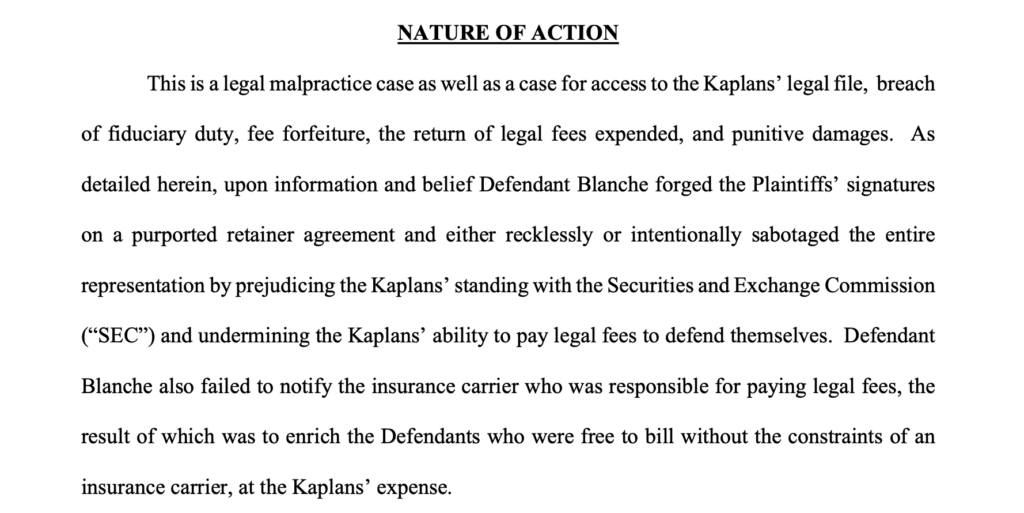
Former clients Adam and Daniel Kaplan accused Blanche and Cadwalader, Wickersham & Taft LLP of malpractice, excessive billing, withholding their legal file, and relying on an engagement agreement they say they never signed.
A forensic document examiner retained by the Kaplans concluded that the signatures attributed to both brothers were simulated forgeries and were probably produced by a common writer. The examiner did not inspect the physical original and acknowledged that additional evidence could alter his opinion.
Blanche and Cadwalader deny the accusation. They claim the Kaplans signed the agreement during an August 13, 2021 meeting and say witnesses and contemporaneous documents support that account.
No court has decided who created the disputed signatures.
More than 100 former judges supported a New York ethics complaint accusing Blanche of professional misconduct in connection with his government service.
A federal government ethics watchdog asked the Justice Department inspector general to investigate whether Blanche participated in cryptocurrency policy while still holding financial interests covered by his ethics agreement.
Official Epstein records establish that Blanche personally questioned Ghislaine Maxwell about Trump, Epstein, the birthday book, and other sensitive subjects during a recorded proffer process.
A February 2026 Justice Department court filing listed Blanche in its signature block and acknowledged human error, technical errors, quality control weaknesses, and the temporary removal of thousands of Epstein related documents.
A Florida federal judge found that litigation used to support an extraordinary Trump IRS settlement was pursued in bad faith and for an improper purpose. The judge questioned Blanche’s failure to recuse and transmitted the order to New York disciplinary authorities.
A federal judge dismissed the Kilmar Abrego Garcia indictment after finding that the government failed to rebut a presumption of vindictiveness. Blanche’s own public statements were an important part of the court’s analysis.
Former Clients Alleged Malpractice, Forgery, and Withholding of Their Legal File
In June 2023, former clients Adam S. Kaplan and Daniel E. Kaplan sued Todd Blanche and his former firm, Cadwalader, Wickersham & Taft LLP, in the New York Supreme Court in Nassau County.
The case is Adam S. Kaplan and Daniel E. Kaplan v. Cadwalader, Wickersham & Taft LLP, Todd Blanche, and Jared Stanisci, Index No. 609236/2023.
The brothers alleged that Blanche and the firm mishandled their response to a Securities and Exchange Commission investigation. They accused the defendants of failing to pursue possible insurance coverage, charging inadequately explained fees, ending the representation while fees remained disputed, and withholding portions of their legal file.
The most serious allegation concerns an engagement agreement Cadwalader produced after the representation deteriorated. The Kaplans denied signing it and alleged that the signatures attributed to them were forged.
The Kaplans sought at least $1.65 million and access to their complete legal file. Blanche told Reuters that the case had “no legitimate legal or factual basis.” The allegations therefore remain sharply disputed.
Readers can examine the original Kaplan complaint, the amended complaint filed in NYSCEF, and the Reuters report documenting the allegations and Blanche’s denial.
The Forensic Examiner Called the Signatures Simulated Forgeries
The Kaplans filed a five page report from forensic document examiner Jeffrey H. Luber.
Luber identified the questioned engagement agreement as item Q1. He compared the signatures against multiple samples attributed to Adam and Daniel Kaplan, including affidavits, checks, deeds, correspondence, discovery responses, and attorney retainer agreements.
Luber concluded that Adam Kaplan did not write the signature attributed to him. He reached the same conclusion regarding Daniel Kaplan. He characterized both questioned signatures as simulated forgeries and stated that they were probably written by a common writer. (New York Courts)
That conclusion is important, but the report contains a major limitation.
Luber examined a machine copy and a macro photograph rather than the physical original. He wrote that examination of the original was preferable and that additional evidence could cause him to supplement or revise his opinion. (New York Courts)
The report therefore supports the Kaplans’ allegation. It does not provide a complete examination of the original paper, ink, toner, pressure impressions, printing history, scanning history, or electronic metadata.
The Disputed Agreement Is Publicly Available
The August 13, 2021 engagement agreement was filed as NYSCEF Document 32.
The final page contains the challenged signatures. The document itself does not establish who placed those signatures on the page, when they were placed there, whether they were written on the physical document, or whether the page was later scanned, assembled, or altered. (New York Courts)
Blanche and Cadwalader Deny the Forgery Allegation
In their answer and counterclaims, Blanche and Cadwalader denied that the agreement was forged.
They alleged that Blanche brought two copies of the agreement to an August 13, 2021 meeting. According to their filing, the Kaplans and their parents reviewed the documents privately, after which Adam and Daniel Kaplan returned a signed copy to Blanche. The defendants also pursued counterclaims for allegedly unpaid legal fees. (New York Courts)
Cadwalader made additional claims in a January 23, 2023 letter responding to the forgery allegation.
The firm said witnesses observed the agreement being signed, Blanche was present, and contemporaneous documentary evidence supported its account. Cadwalader also pointed to approximately $1.65 million in payments made during the representation.
These claims create a testable factual dispute.
The forensic examiner says the signatures were simulated. Cadwalader says the clients signed the document in front of witnesses. The most important receipts are therefore the physical original, its electronic history, the alleged witness testimony, and the contemporaneous documents Cadwalader referenced.
The Kaplans Demanded the Physical Original and Metadata
On March 6, 2024, the Kaplans filed a formal demand to inspect the original engagement agreement.
The demand sought access for handwriting examination and ink dating analysis. An original could potentially reveal pressure marks, ink differences, toner patterns, page substitution, or other characteristics unavailable from a scanned copy.
The plaintiffs also sought drafts, metadata, transmission records, software information, the date the signed PDF entered Cadwalader’s system, the identities of witnesses, and the records the firm said corroborated the signing.
Those requests can be reviewed in the plaintiffs’ document demand and the defendants’ discovery responses.
There Has Been No Final Ruling on the Alleged Forgery
The official docket contains filings through July 2026, including discovery disputes, deposition notices, dismissal papers, and motions to compel. It does not contain a final judgment determining who created the questioned signatures.
The case has been stayed, and significant motions remain unresolved. An earlier ruling concerning access to the clients’ legal files did not decide the forgery or malpractice claims.
The accurate conclusion is that a former client lawsuit alleges forgery, a retained forensic examiner supports that allegation, Blanche and Cadwalader deny it, and the court has not decided the central factual dispute.
Public Ethics Complaints Against Blanche
Public criticism of Blanche is not limited to political commentary. Former clients, legal ethics organizations, former judges, and government watchdog groups have submitted formal complaints or requests for investigation.
A complaint is not a disciplinary finding. It is a request for a court, grievance committee, inspector general, or other authority to investigate or grant relief.
More Than 100 Former Judges Supported a New York Complaint
On June 22, 2026, Lawyers Defending American Democracy and Democracy Defenders Fund submitted a 69 page complaint asking New York’s Attorney Grievance Committee to investigate Blanche.
The complaint was supported by a bipartisan group of more than 100 former federal and state judges. It alleged failures involving competence, independence, former client conflicts, prosecutorial authority, the Trump IRS matter, and the Justice Department’s handling of Epstein related records. (LDAD)
The filing and supporting materials are available through the public complaint page maintained by Lawyers Defending American Democracy.
These are allegations submitted for disciplinary review. They are not findings entered after a completed proceeding.
The New York City Bar Opposed Blanche’s Nomination
On July 13, 2026, the New York City Bar Association urged the Senate to reject Blanche’s nomination as attorney general.
The organization cited concerns involving politically motivated prosecutions, constitutional rights, compliance with court orders, loyalty to Trump, Justice Department independence, and professional ethics. Its report also discussed the complaint supported by former judges. (New York City Bar Association)
Readers can review the New York City Bar Association report.
The City Bar’s position is an institutional assessment. It is not a disciplinary judgment.
The Legal Accountability Center Filed a Separate Complaint
On September 11, 2025, the Legal Accountability Center publicly posted another complaint concerning Blanche’s government and private practice conduct.
The complaint addressed his participation in the Maxwell interview, his previous representation of Trump, possible conflict questions, and his responsibility for Justice Department conduct. (Legal Accountability Center)
The Legal Accountability Center complaint page provides the organization’s summary and a link to its underlying filing.
The complaint does not establish that Blanche promised Maxwell favorable treatment, concealed evidence, or violated a recusal obligation. It asks disciplinary officials to investigate those questions.
New York Grievance Proceedings Are Generally Confidential
New York generally keeps attorney complaint investigations confidential unless they advance to public proceedings or result in public discipline.
The absence of a published order does not prove that no complaint was filed or reviewed. It means only that no corresponding public censure, suspension, or disbarment order was located.
Federal Watchdog Requested an Investigation Into Blanche’s Cryptocurrency Interests
A separate conflict question concerns Blanche’s cryptocurrency holdings and his role in changing federal cryptocurrency enforcement policy.
Blanche Disclosed Substantial Digital Asset Holdings
Blanche’s public financial disclosure listed between $100,001 and $250,000 in Bitcoin and between $50,001 and $100,000 in Ethereum.
It also listed smaller holdings in Solana, Cardano, Ethereum Classic, Polygon, Polkadot, Basic Attention Token, Quant, and Decentraland, along with Coinbase stock.
Readers can examine Blanche’s public financial disclosure.
His Ethics Agreement Required Divestment or a Written Waiver
In his February 10, 2025 ethics agreement, Blanche agreed to divest covered virtual currency interests.
Until completing those transactions, he agreed not to participate personally and substantially in a particular matter that directly and predictably affected those interests unless he received a written waiver or qualified for an applicable exemption. (Extapps2)
Blanche Signed a Major Cryptocurrency Policy Memorandum
On April 7, 2025, Blanche signed a Justice Department memorandum titled Ending Regulation by Prosecution.
The memorandum narrowed certain cryptocurrency enforcement priorities, instructed one Justice Department unit to cease cryptocurrency enforcement, and disbanded the National Cryptocurrency Enforcement Team effective immediately. (Department of Justice)
A later transaction disclosure reported a Bitcoin sale valued between $100,001 and $250,000 on June 2, 2025, almost two months after the policy memorandum.
The disclosure also reported transactions involving Coinbase stock and other digital assets. Its annotation stated that Bitcoin, Ethereum, Solana, and Cardano were gifted in their entirety to Blanche’s adult children and grandchild.
Readers can examine the June 2025 transaction report.
Campaign Legal Center Asked the Inspector General to Investigate
In January 2026, Campaign Legal Center asked the Justice Department Office of Inspector General to investigate whether Blanche’s participation in the cryptocurrency policy violated federal conflict rules or his ethics agreement.
Campaign Legal Center later corrected its estimate of Blanche’s relevant digital asset holdings to a range of approximately $159,011 to $485,000. (Campaign Legal Center)
Readers can review the corrected complaint page and the complete inspector general complaint.
This was a watchdog complaint requesting an investigation. It was not a federal government finding or criminal referral.
The central missing receipt is any written ethics waiver authorizing Blanche to participate in the cryptocurrency policy before completing the relevant transactions. No such waiver was located in the public records reviewed for this article.
Epstein File Receipts Document Blanche’s Direct Role
The Epstein records do not merely mention Blanche in news coverage. Official transcripts, audio files, court submissions, and related records directly document his role in the Justice Department’s handling of the Epstein and Maxwell matters.
These records concern Blanche’s government conduct. They do not establish that he was personally associated with Jeffrey Epstein before entering government.
Blanche Personally Questioned Ghislaine Maxwell
The official transcript of Maxwell’s July 24, 2025 interview identifies Todd Blanche, Deputy Attorney General, as appearing for the United States.
At the beginning of the session, Blanche identified himself and confirmed that the interview was being recorded. An FBI official described it as a recorded proffer interview.
Readers can examine the complete July 24 interview transcript through the Justice Department’s official release.
The Justice Department also maintains an official Maxwell interview archive containing the transcripts and audio. (Department of Justice)
Epstein Data catalogs a copy of the transcript as DOJ OGR 00022393 and the corresponding opening audio as DOJ OGR 00022985. Epstein Data is an independent archive and should not be confused with an official government database. (epstein-data.com)
The transcript shows that Blanche personally questioned Maxwell about Epstein’s relationships, properties, alleged recruitment practices, prominent associates, Donald Trump, Bill Clinton, Prince Andrew, and Epstein’s birthday book.
The existence of the transcript allows readers to evaluate Blanche’s questions and Maxwell’s answers directly rather than relying on political characterizations of the interview.
The Interview Was a Proffer, Not a Cooperation Agreement
Blanche explained during the first interview that the arrangement was not a cooperation agreement and that the government had not promised to take any action in exchange for Maxwell’s statements.
The proffer terms provided limited protection concerning the government’s use of her statements, subject to exceptions described in the agreement.
That distinction matters.
A proffer agreement can define how prosecutors may use a person’s statements. It does not necessarily guarantee leniency, a sentence reduction, a transfer, or a pardon.
The exact agreement, any separate discussions, and communications concerning Maxwell’s prison placement or possible relief remain important records for independent review.
Blanche Questioned Maxwell About Trump and Epstein
During the interview, Blanche asked Maxwell what she had observed concerning Trump’s relationship with Epstein.
Maxwell said she had seen Trump and Epstein together socially and described them as friendly. She also gave statements favorable to Trump and denied witnessing inappropriate conduct by him.
Those were Maxwell’s statements during a proffer interview. They were not independent factual findings by investigators.
Maxwell is a convicted participant in Epstein’s trafficking operation and had her own legal interests when she spoke. The transcript proves what Blanche asked and what Maxwell answered. It does not prove that her answers were complete, accurate, or independently corroborated.
Blanche Asked About Trump’s Alleged Birthday Book Contribution
The transcript also shows Blanche questioning Maxwell about Epstein’s 2003 birthday book.
Maxwell confirmed that she helped coordinate the book but said she could not remember whether Trump submitted a contribution. Blanche followed up by asking whether she personally requested a letter from Trump and whether she remembered the reported image or drawing associated with it.
Maxwell again said she did not remember soliciting a contribution from Trump. She stated that both she and Epstein asked people to contribute.
Epstein Data catalogs a corresponding audio segment as DOJ OGR 00022990. (epstein-data.com)
This is a useful receipt because it establishes that Blanche considered the Trump birthday book issue material enough to question Maxwell about it directly.
Maxwell’s claimed lack of memory does not resolve whether a Trump contribution existed, who requested it, or what documentary evidence the Justice Department or Epstein’s estate possessed.
The Second Interview Used the Same Proffer Agreement
The second interview took place on July 25, 2025.
The official July 25 transcript again describes the session as a recorded proffer interview. Blanche asked Maxwell and her attorney to initial the agreement they had signed the previous day.
Epstein Data preserves portions of the second day recordings under the following identifiers:
These recordings document the interview itself and are stronger evidence of what occurred than later summaries or political commentary.
An Internal FBI Briefing Referred to Blanche’s Interview
Epstein Data also preserves an FBI New York internal daily briefing under the identifier EFTA01656324.
The briefing reportedly summarized press coverage stating that Maxwell had answered questions from Blanche and that he intended to meet with her again.
Its evidentiary value is limited. It appears to be an internal news briefing summarizing outside reporting, not an FBI investigative report establishing the truth of Maxwell’s statements.
It nevertheless shows that Blanche’s unusual personal participation in the interview was being circulated internally within the FBI.
DOJ Acknowledged Errors and Document Removals in the Epstein Release
A February 5, 2026 Justice Department letter filed in the Epstein and Maxwell criminal matters provides another direct receipt concerning Blanche’s role.
The filing’s signature block listed Attorney General Pamela Bondi, Deputy Attorney General Todd Blanche, and U.S. Attorney Jay Clayton. Clayton electronically signed the submission on behalf of the Department.
Readers can examine the complete February 5, 2026 court filing.
Thousands of Documents Were Temporarily Removed
The Justice Department told the court that thousands of documents had been temporarily removed from its public Epstein library for additional review.
The filing stated that approximately 9,500 documents covered by Maxwell protective orders had been removed temporarily. It also stated that at least approximately 7,000 documents had been flagged following concerns submitted by victims, victims’ attorneys, or through newly identified information.
The removals were presented as part of an effort to review possible victim identifying information and compliance with court orders.
DOJ Acknowledged Human and Technical Errors
The filing acknowledged human errors, technical errors, and weaknesses in some quality control procedures.
The Department described the scale of the release, limitations in technical capabilities, and the difficulty of reviewing millions of pages while protecting victim information.
This acknowledgment does not establish that Blanche personally caused each error.
It does establish that the Justice Department leadership publicly associated with the release admitted that the process failed in important ways.
Epstein Data Conducted an Independent Removal Audit
Epstein Data published an independent document removal audit.
The audit estimated that tens of thousands of files had become unavailable from the Justice Department library after publication. It describes its methodology, including authenticated rescans, sampling, and statistical adjustment. (epstein-data.com)
This audit is not an official government finding.
Epstein Data expressly identifies itself as independent and states that the report was generated with artificial intelligence assistance and may contain errors. Its estimates should therefore be presented as independent analysis requiring reproduction and verification, not as a definitive DOJ admission.
The February 5 court filing remains the primary government receipt for confirmed removals, quality control problems, and acknowledged errors.
What the Epstein Records Establish About Blanche
The official records establish that Blanche personally participated in Maxwell’s proffer interviews.
They establish that he questioned her about Trump, Epstein, and the birthday book.
They establish that the second day proceeded under the same written proffer agreement.
They establish that the February 2026 court submission listed Blanche as part of the Justice Department leadership addressing document removals and release failures.
They do not establish that Blanche was an Epstein associate.
They do not establish that he appeared in Epstein’s historic flight logs.
They do not establish that Epstein paid him or that he maintained a personal relationship with Epstein.
The documented concern is Blanche’s official handling of Maxwell and the Epstein files, not an unsupported claim that he belonged to Epstein’s personal network.
A Florida Judge Referred Blanche to New York Disciplinary Authorities
A separate controversy developed in Donald J. Trump, et al. v. Internal Revenue Service and Department of the Treasury, Case No. 1:26-cv-20609-KMW, in the Southern District of Florida.
The case concerned an extraordinary proposed settlement between the Trump administration and Trump, his family, and associated entities.
The Proposed Arrangement Included a $1.776 Billion Fund
The settlement contemplated a $1.776 billion Anti Weaponization Fund.
The related proposed release contained broad language protecting Trump, relatives, businesses, and affiliates.
Judge Kathleen Williams observed that Blanche alone signed the proposed release order for the government.
The judge also noted that Blanche had previously represented Trump and had not recused himself from participating in the matter.
The Release Could Have Restricted Investigations and Audits
The court described language that could have blocked current or potential federal investigations and restricted future audits involving the covered parties.
The order questioned whether Trump and the executive branch agencies he controlled were genuine adversaries or were instead using litigation to obtain judicial approval for an arrangement they had already negotiated.
The Judge Found Bad Faith and Improper Purpose
Judge Williams found that the plaintiffs pursued the lawsuit in bad faith and for an improper purpose.
She imposed sanctions against the plaintiffs and their private counsel. She did not impose a monetary sanction personally against Blanche.
The court expressly declined to make a final determination that fraud on the court had occurred under the demanding legal standard governing that claim.
The accurate description is therefore that the judge found bad faith and improper purpose surrounding the litigation. She did not enter a fraud judgment against Blanche.
Blanche Was Referred to New York, Not the Florida Bar
Judge Williams directed that her order be transmitted to New York attorney disciplinary authorities for consideration of Blanche’s conduct.
The court separately referred another lawyer to Florida disciplinary authorities.
It is therefore inaccurate to describe the order as a Florida Bar complaint against Blanche. It was a New York disciplinary referral arising from a Florida federal case.
The Abrego Garcia Indictment Was Dismissed After Blanche’s Statements
Blanche also played a significant role in the federal prosecution of Kilmar Abrego Garcia.
Abrego Garcia had been removed to El Salvador despite an existing order protecting him from removal to that country. After he successfully challenged the government’s conduct, federal officials reopened an older investigation and charged him with human smuggling offenses.
The Court Found an Unrebutted Presumption of Vindictiveness
In May 2026, Chief U.S. District Judge Waverly Crenshaw dismissed the indictment.
The court concluded that the government failed to rebut a presumption that the prosecution was vindictive. Blanche’s public statements connecting the reopened investigation to Abrego Garcia’s successful litigation were central to the court’s analysis.
The judge found insufficient evidence to establish actual vindictiveness.
That distinction matters. The court did not make a final finding that Blanche personally acted with a proven retaliatory motive. It found that the government had not overcome the legal presumption created by the sequence of events and official statements.
The written dismissal decision provides the complete analysis.
A New York Grievance Complaint Followed
Campaign for Accountability later asked New York disciplinary authorities to investigate Blanche’s conduct in connection with the prosecution.
The complaint alleged possible violations involving prosecutorial authority, prejudice to the administration of justice, public statements, and supervisory responsibility. (ABC News)
Readers can review the Campaign for Accountability announcement and the underlying complaint.
The complaint is a request for investigation. It is not a disciplinary ruling.
DOJ Proposed an Internal Review Process for State Bar Complaints
In March 2026, the Justice Department proposed a rule concerning state bar complaints against current and former DOJ lawyers.
The proposal would provide an internal Department review before government attorneys participated in certain state disciplinary investigative steps. DOJ would ask state bar authorities to suspend parallel proceedings while the Department conducted its review.
The proposal also stated that the Department could take appropriate action if a state bar refused to pause its investigation. (Federal Register)
Readers can examine the Federal Register proposal.
The public record reviewed here does not establish that Blanche personally drafted the proposal or created it to obstruct complaints against himself.
The timing nevertheless creates an independence concern. Senior Justice Department officials were facing public professional complaints while the Department proposed a system that could delay outside disciplinary investigations of its lawyers.
What the Evidence Establishes
The public evidence establishes that former clients sued Blanche and Cadwalader and alleged that an engagement agreement contained forged signatures.
A forensic examiner retained by those clients concluded that both signatures were simulated forgeries and were probably produced by a common writer.
The examiner did not inspect the physical original and acknowledged that additional evidence could change his opinion.
Blanche and Cadwalader deny the allegation and claim witnesses and contemporaneous evidence support their account.
No court has decided who created the disputed signatures.
Multiple professional complaints and requests for investigation involving Blanche are publicly documented.
More than 100 former judges supported one New York ethics complaint.
Blanche signed a cryptocurrency enforcement memorandum before the disclosed completion of significant digital asset transactions.
His ethics agreement required divestment or a written waiver before participating in certain matters directly and predictably affecting those interests.
No public waiver was located.
Official records establish that Blanche personally questioned Maxwell during a proffer process.
He questioned her about Trump, Epstein, and the birthday book.
The Justice Department acknowledged thousands of temporary document removals, human error, technical errors, and weaknesses in quality control during its handling of Epstein related records.
A Florida judge questioned Blanche’s failure to recuse and sent the court’s order to New York disciplinary authorities.
A federal court dismissed the Abrego Garcia indictment after finding that the government failed to rebut a presumption of vindictiveness.
What Has Not Been Proven
No court has found that Blanche personally forged the Kaplan engagement agreement.
No criminal forgery or fraud charge arising from that lawsuit has been filed against him.
The Florida court did not find Blanche personally liable for fraud on the court.
No public inspector general finding establishes that Blanche violated federal conflict of interest law through the cryptocurrency policy.
The Maxwell transcripts do not establish that her answers were truthful or independently corroborated.
No public evidence reviewed for this article establishes that Blanche promised Maxwell a transfer, pardon, commutation, or other favorable treatment.
The Epstein records reviewed here do not establish that Blanche was a member of Epstein’s personal network.
No public New York order located for this article censures, suspends, or disbars Blanche.
The Unanswered Questions
Where Is the Original Engagement Agreement?
The physical agreement should be examined for ink, paper, toner, pressure impressions, page substitution, and other forensic characteristics.
Its chain of custody should also be documented from August 2021 through its production in the dispute.
Where Is the Agreement’s Metadata?
Cadwalader should identify when the agreement was created, revised, printed, scanned, uploaded, and transmitted.
The firm should identify every person who accessed or modified the relevant electronic file.
Who Witnessed the Alleged Signing?
Cadwalader has asserted that witnesses saw the Kaplans sign the agreement.
Those individuals should be identified and questioned under oath about where the signing occurred, who held the document, who saw each signature placed on the page, and what happened to the original afterward.
What Was the Contemporaneous Evidence?
Cadwalader’s January 2023 letter said contemporaneous documents contradicted the forgery allegation.
Those records should be produced and authenticated.
Did Blanche Receive a Cryptocurrency Ethics Waiver?
The Justice Department or Office of Government Ethics should release any written waiver authorizing Blanche to participate in the April 2025 cryptocurrency policy before completing his relevant transactions.
If no waiver exists, officials should explain why the policy did not constitute a covered matter under his ethics agreement.
What Recusal Analysis Covered the Trump IRS Matter?
DOJ should release any ethics opinion, recusal analysis, authorization, or waiver allowing Trump’s former personal lawyer to participate on behalf of the United States in a settlement benefiting Trump and related parties.
What Were the Complete Maxwell Proffer Terms?
The complete agreement should be examined alongside any separate communications with Maxwell’s lawyers.
Records should identify whether prison placement, sentence relief, clemency, or future cooperation were discussed before or after the interviews.
Why Was Blanche Personally Conducting the Interview?
DOJ should explain why the deputy attorney general personally questioned Maxwell rather than relying on career prosecutors and FBI agents without a former client conflict involving Trump.
What Records Were Removed From the Epstein Library?
DOJ should publish a complete removal log identifying each document removed, the reason for removal, the date of restoration, and whether the restored document differed from the original release.
What Is the Status of the New York Complaints?
Blanche should disclose whether he has received notices concerning the publicly documented complaints or the Florida judge’s referral.
He should also disclose whether he has submitted written responses, subject to any lawful confidentiality restrictions.
Conclusion
No single unresolved complaint proves that Todd Blanche committed professional misconduct.
The concern comes from the repetition.
A disputed engagement agreement appears in litigation involving former clients.
A forensic examiner describes the signatures as simulated forgeries.
A former personal lawyer for Trump participates in a government settlement offering extraordinary benefits to Trump and related parties.
A government official changes cryptocurrency enforcement policy before completing disclosed digital asset transactions.
The same former Trump lawyer personally questions Ghislaine Maxwell about Trump and Epstein.
The Justice Department later acknowledges significant failures in the Epstein file release under leadership that includes Blanche.
A prosecution influenced by Blanche’s public statements is dismissed because the government cannot overcome a presumption of vindictiveness.
Multiple professional complaints accumulate while DOJ proposes a process that could delay state disciplinary investigations of government lawyers.
The responsible conclusion is not that every allegation has been proven. It is that Blanche has repeatedly occupied overlapping positions involving former client loyalty, government power, personal financial interests, and control over politically sensitive evidence.
That pattern demands authenticated records, written waivers, clear recusals, independent review, and public answers.
Primary Sources and Receipts
Kaplan Lawsuit
- Official NYSCEF docket, Index No. 609236/2023
- Original Kaplan complaint
- Amended complaint, NYSCEF Document 20
- Luber forensic report, NYSCEF Document 2
- Answer and counterclaims, NYSCEF Document 31
- Disputed engagement agreement, NYSCEF Document 32
- Demand to inspect the original, NYSCEF Document 51
- Cadwalader response letter, NYSCEF Document 53
- Reuters report on the lawsuit and Blanche’s denial
Ethics Complaints
- Lawyers Defending American Democracy complaint page
- New York City Bar opposition report
- Legal Accountability Center complaint
- Campaign for Accountability complaint concerning Abrego Garcia
Cryptocurrency Records
- Blanche financial disclosure
- Blanche ethics agreement
- Ending Regulation by Prosecution memorandum
- Blanche transaction disclosure
- Campaign Legal Center corrected complaint page
- Complete Campaign Legal Center complaint
Maxwell Interviews and Epstein Files
- Official Justice Department Maxwell interview archive
- July 24, 2025 interview transcript
- July 25, 2025 interview transcript
- Epstein Data transcript record DOJ OGR 00022393
- Epstein Data audio record DOJ OGR 00022985
- Epstein Data birthday book audio DOJ OGR 00022990
- FBI internal briefing EFTA01656324
- February 5, 2026 DOJ court filing
- Independent Epstein Data document removal audit
Florida IRS Litigation
July 13, 2026 sanctions and referral order