
Lana Pozhidaeva
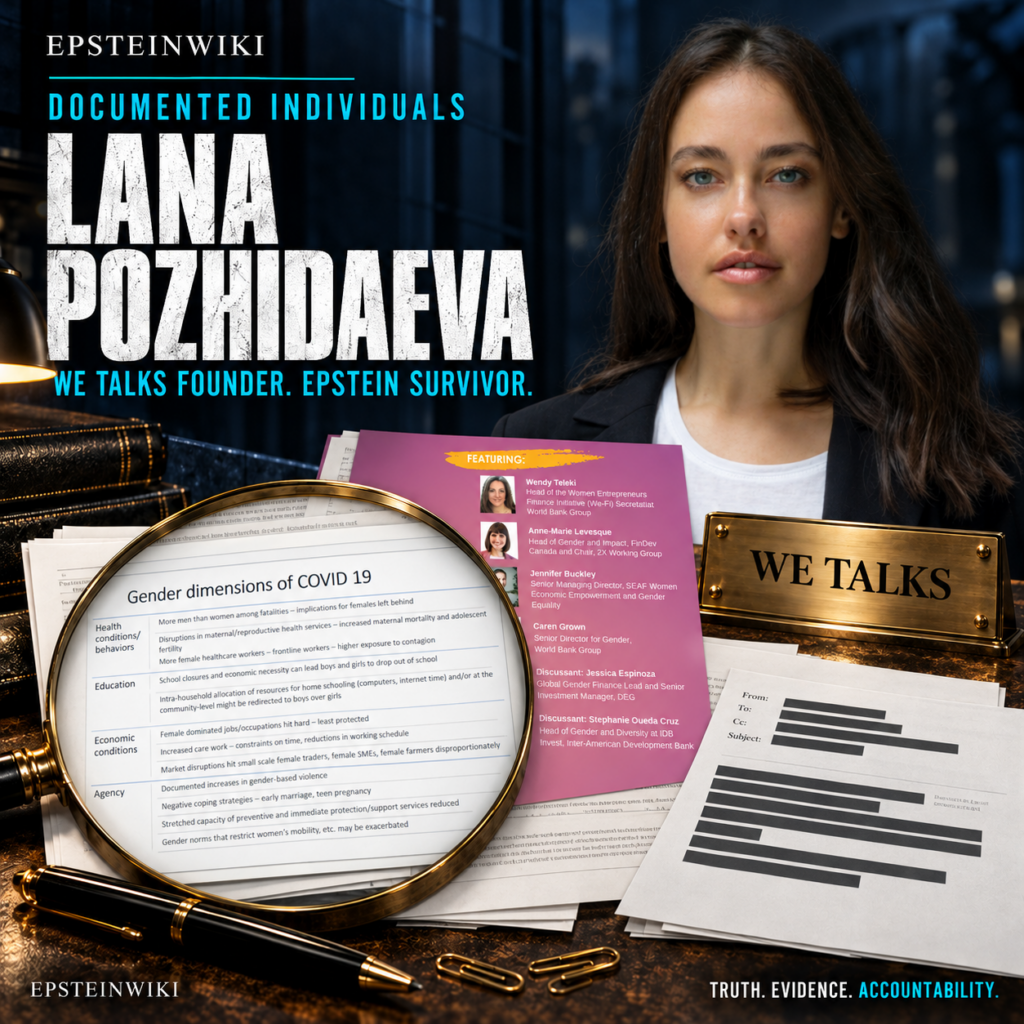
Svetlana “Lana” Pozhidaeva is a Russian born former model and finance professional who worked in Jeffrey Epstein’s orbit from approximately 2008 until his death in 2019. Released correspondence and investigative reporting document that she served as an assistant, coordinated travel and meetings, helped connect Epstein to Russian contacts, received substantial financial support, and recruited young women from Russia, Ukraine, and elsewhere in the former Soviet Union. Pozhidaeva has acknowledged recruiting women and has described that conduct as shameful and deeply regretted.
Pozhidaeva also identifies as a survivor of adult human trafficking. She says Epstein sexually exploited and physically abused her, controlled her immigration status, housing, finances, and access to medical care, and used fear and dependency to keep her in his network. Her account illustrates a difficult but essential point about trafficking systems: a person can be victimized and can also participate in conduct that exposes other people to harm. Neither fact erases the other.
No public record reviewed for this article shows that Pozhidaeva has been criminally charged or found civilly liable for conduct connected to Epstein. Allegations that she or her family acted for Russian intelligence remain disputed and unproven. This article distinguishes documentary evidence, reported findings, her own account, and unresolved allegations.
Snapshot
| Field | Detail |
|---|---|
| Full name | Svetlana Pozhidaeva |
| Common name | Lana Pozhidaeva |
| Nationality | Russian |
| Born | Reported as 1984, Moscow, Soviet Union |
| Education | Undergraduate and master’s degrees with honors from the Moscow State Institute of International Relations, commonly known as MGIMO |
| Languages reported in her résumé | Russian, English, French, Italian, and Spanish |
| Early work | Finance analyst, investment firm employee, and model |
| Epstein connection | Model in an Epstein financed agency, later assistant, event and travel coordinator, recruiter, and intermediary |
| Approximate period in Epstein’s orbit | Late 2007 or early 2008 through 2019 |
| Documented locations | New York, Palm Beach, Paris, New Mexico, the U.S. Virgin Islands, Russia, Ukraine, Switzerland, and other international destinations |
| Organizations | MC2 Model Management, Education Advance, WE Talks, Enhanced Education, and Bridge Funding Global |
| Archive indicators | Listed in an Epstein address book with two telephone numbers; an independent archive index associates her with 161 correspondence items dated May 2009 through June 2019 |
| Public position | Acknowledges recruiting women, says Epstein coerced and abused her, and identifies as an adult trafficking survivor |
| Legal status | No located criminal charge or civil judgment against her arising from the Epstein matter |
| Privacy note | She later changed her legal identity and relocated. EpsteinWiki does not republish the replacement name or present location because of her stated safety concerns |
Key Takeaways
- Pozhidaeva’s connection to Epstein was sustained, operational, and documented over roughly a decade. It was not a single social encounter or an incidental name in an address book.
- Emails and investigative reconstructions show that she recruited and evaluated women for Epstein, helped some obtain travel documents, arranged massage instruction, and participated in logistics surrounding visits. She has admitted recruiting women.
- Pozhidaeva says she was simultaneously a victim of Epstein’s sexual, physical, psychological, financial, and immigration related coercion. Her lawyer and trafficking experts describe those mechanisms as consistent with methods used to entrap foreign models and compel victims to recruit others.
- Epstein and entities associated with him paid her salary, made recurring transfers, provided visa support, transferred more than $237,000 marked “for the family,” and financed projects with which she was associated. She says at least some large payments were loans that increased her dependency.
- She helped Epstein navigate elite, philanthropic, diplomatic, and Russian networks. Her access included events connected to the United Nations, Davos, the St. Petersburg International Economic Forum, and people in finance, technology, diplomacy, and Russian government circles.
- Reporting about her father’s possible intelligence background is circumstantial and contested. His training, employment, a family email referring to an “FSB past,” and correspondence with an FSB pension office raise questions. They do not prove that Pozhidaeva, her father, or Epstein acted on behalf of Russian intelligence.
- No evidence located for this article establishes that Pozhidaeva was charged, convicted, or adjudged liable for trafficking or recruitment. The absence of a charge does not negate the documented conduct, but documentary evidence must not be converted into a criminal verdict that no court issued.
Biography and Professional Background
Pozhidaeva was born and raised in Moscow. Her maternal grandfather, Marcel Platonov, was a Soviet military surgeon and gynecologist. Investigative reports state that he participated in the Soviet deployment connected to the 1962 Cuban Missile Crisis and received an apartment in Moscow’s House on the Embankment, a residence associated with the Soviet political and military elite.
Her parents, Yury and Irina Pozhidaev, graduated from the Military Institute of Foreign Languages in Moscow. The school trained interpreters and military specialists, and some alumni entered foreign intelligence or military attaché work. Yury Pozhidaev trained as a Persian language military interpreter and served with a Soviet advisory corps in Afghanistan beginning in 1978. He attained the rank of lieutenant colonel. Later employment reported by OCCRP and Important Stories included security roles connected to Technopromexport, Russian Railways International, and Caspian Services on projects involving Iran and the North South transport corridor.
Pozhidaeva attended MGIMO, an elite university that trains diplomats, international business professionals, and government officials. A résumé found in released records describes undergraduate and graduate degrees with honors, study in France, several foreign languages, and internships at the Russian Foreign Ministry and Lukoil. She later worked as an analyst at Credit Europe Bank and at Russian investment firms.
In 2008, at approximately age 24, she changed direction and pursued modeling. She was a finalist in a Maxim magazine competition, signed with Elite Models in Milan, and was represented in the United States by MC2 Model Management. MC2 was run by Jean-Luc Brunel and financed by Epstein. Brunel later faced accusations of procuring and sexually abusing girls and young women. He died in French custody in 2022 while under investigation.
After Epstein’s death, Pozhidaeva withdrew from public view, changed her legal identity, and continued living in the United States. Reporting describes later work in finance, private credit, fundraising for women entrepreneurs, and mentoring young people in foster care. She co-founded Bridge Funding Global in San Francisco. She has also said that she is assembling a resource library for Epstein survivors. EpsteinWiki does not publish her replacement legal name or present location.
Connection to Jeffrey Epstein
Pozhidaeva says she met Epstein in Paris in late 2007 or early 2008. A released message from an Epstein assistant supplied “Lana’s” telephone numbers and asked Epstein to call her. MC2 subsequently brought her to the United States. Epstein or an Epstein affiliated foundation later supported her immigration status.
According to Pozhidaeva, Epstein initially promised to teach her business. She says that when she asked about professional courses, he instead encouraged massage instruction. She told OCCRP that physical abuse began during her first visit to his Palm Beach residence. She described isolation from family, disordered eating, insomnia, depression, and pressure to present an outward image of success.
Over time, her work expanded beyond modeling. Available records and reporting attribute the following functions to her:
- Personal assistance and household related coordination.
- Scheduling, travel, introductions, and meeting logistics.
- Recruitment and evaluation of women for Epstein.
- Assistance with passports, visas, and travel documentation for prospective recruits.
- Coordination of massage instruction and visits to Epstein properties.
- Attendance at elite events and cultivation of philanthropic or diplomatic contacts.
- Facilitation of some contacts involving Russian officials and business figures.
- Development of Education Advance and WE Talks with Epstein funding or operational support.
Pozhidaeva says Epstein controlled her through immigration sponsorship, housing, money, purported loans, threats to her family, and the belief that his Russian connections made resistance dangerous. She has said that he pressured her to find other women as a way of diverting his attention from her. Brad Edwards, a lawyer who has represented Epstein survivors, told OCCRP that Epstein commonly used foreign models’ visa status and controlled medical access to increase dependency.
The released record also depicts Pozhidaeva as a trusted and useful operator. Epstein placed her around influential people, supported her projects, and relied on her for tasks extending far beyond clerical assistance. That operational authority is relevant to accountability. Her claim of coercion is relevant to understanding how she acquired and exercised it.
Documented Communications and Meetings
An independent archive profile associates Pozhidaeva with 161 correspondence items from May 2009 through June 2019. It categorizes 83 as sent and 78 as received. Its resolved counterparties include Epstein in 71 messages, Lesley Groff in 28, Jojo Fontanilla in six, Lynn Fontanilla in five, Karyna Shuliak in four, and smaller counts involving Merwin de la Cruz, Richard Kahn, and Mark Tollison. These figures are index counts, not a complete total of every released reference. Sender names and entity matching can produce omissions or duplicates.
Recruitment and evaluation
By 2010, correspondence reviewed by Important Stories shows Pozhidaeva sourcing young women in former Soviet countries. Messages discuss travel to Kyiv and Moscow, introductions, physical appearance, temperament, and perceived suitability for Epstein. Some communications concerned passports or Schengen visas. Reporting identified an instance in which she proposed arranging a meeting with a 17 year old. The underlying file is not linked here because the government release reportedly failed to redact the young person’s identity.
Pozhidaeva also arranged foot massage lessons before some women traveled to Epstein’s island. Other correspondence includes a nude image of a prospective recruit and degrading evaluations of women’s bodies. Epstein’s own messages reveal his focus on youth, thinness, and sexual availability. These records are important evidence of an organized screening and recruitment process, but EpsteinWiki avoids reproducing unnecessary sexual images, victim names, or gratuitous descriptions.
The “Julia Santos” account
Beginning around 2016, recruiting correspondence used the name “Julia Santos.” Important Stories linked that account to Pozhidaeva by matching references to her parents, brother, boyfriend, travel, and communications under her own name. Its review identified 18 women whom the account recruited for meetings or sexualized events, most from Russia and Ukraine.
Pozhidaeva told OCCRP that a group of female assistants used the account. This creates an attribution limit: the account is strongly connected to her and some messages can be matched to her circumstances, but not every message should automatically be assigned to her without content specific corroboration. The evidence supports her involvement in the account’s recruiting activity. It does not support assuming sole authorship of all messages sent from it.
Elite and diplomatic contacts
Pozhidaeva attended or helped organize activity around the United Nations, the World Economic Forum in Davos, and other high status gatherings. She has identified herself in a released photograph with Epstein, Bill Gates, and former Norwegian diplomat Terje Rød-Larsen. She told OCCRP that such photographs helped her convince her family that she had an extraordinary career, even when she was actually waiting outside meetings and performing service work.
Epstein introduced her to Elon Musk in 2012 and attempted to arrange a meeting in Paris. The messages establish an introduction and proposed social contact. They do not establish wrongdoing by Musk. Correspondence also connects her to meetings or logistics involving Russian ambassador Vitaly Churkin, Churkin’s son Maxim, and Sergei Belyakov, a former Russian deputy economic development minister and graduate of the FSB Academy.
Belyakov supplied a recommendation supporting Pozhidaeva’s United States visa and stated that she had helped develop the St. Petersburg International Economic Forum agenda. Pozhidaeva told OCCRP that this was an embellishment requested by Epstein and that she attended the forum but did not plan its agenda. Other messages indicate that she helped prepare contacts with Russian finance officials.
Royal and celebrity references
Pozhidaeva was photographed leaving Epstein’s Manhattan residence in 2010 on a day Prince Andrew was present. In 2013 she sent Epstein files titled “Mette” and “Mette 2.” Norwegian reporting later identified the images as photographs of Crown Princess Mette Marit taken at Epstein’s Palm Beach residence. Those facts establish proximity and image sharing, not misconduct by every person depicted or present.
In 2026, reporting about Bard College president Leon Botstein cited Pozhidaeva as a witness to his interactions with Epstein, including a 2012 visit to Epstein’s island. Bard announced an independent review. Her account is evidence requiring evaluation within that inquiry, not a judicial finding against Botstein.
Financial Support, Gifts, Travel, and Benefits
| Item | Documented or reported detail | Evidentiary qualification |
|---|---|---|
| Early compensation | Epstein wrote that she earned about $30,000 annually after taxes early in the relationship | Reported from correspondence, not a complete payroll record |
| Recurring payments | A released transfer instruction shows $8,333 monthly payments through Enhanced Education from at least 2017 | Strong documentary evidence of regular financial support |
| Family transfer | More than $237,000 arrived from the offshore Butterfly Trust before her parents’ December 2015 visit, marked “for the family” | Pozhidaeva says it was a loan; publicly available records reviewed here do not resolve the terms |
| Immigration support | MC2 and later an Epstein affiliated foundation supported her United States visa status | Relevant to her claim that Epstein controlled her ability to remain in the country |
| Education Advance | A nonprofit she co-founded reported $56,500 in 2017 revenue, including $55,000 from the J. Epstein Virgin Islands Foundation | Tax reporting and contemporaneous journalism document the donation |
| WE Talks | Correspondence says Epstein funded the women’s event platform, which was registered at an Epstein address | Records show operational involvement extending beyond a detached charitable gift |
| Travel and lodging | She stayed at or visited Epstein properties in Palm Beach, New York, New Mexico, Paris, and the U.S. Virgin Islands and traveled for Epstein related work | No indexed commercial flight log entry was located under her name, but absence from those logs does not negate other travel evidence |
| Network access | Epstein arranged introductions and access to senior figures and international events | Access was a professional benefit and also part of the dependency and image management she describes |
Education Advance was co-founded by Pozhidaeva and investor Pendleton King Jr. Contemporary reporting found that the J. Epstein Virgin Islands Foundation supplied nearly all of its reported 2017 revenue. Pozhidaeva said approximately $50,000 supported a Buddhist program associated with MIT. Public records reviewed here do not fully explain the project’s longer term activities.
WE Talks was promoted as a women’s empowerment platform modeled on conference talks. Viktoria Drokova served as a co-director, and Maria Drokova participated. Correspondence shows that Pozhidaeva discussed operations with Epstein and that his money supported the project. In one exchange, Pozhidaeva and Maria Drokova discussed defending the acceptance of Epstein’s money by emphasizing the purported social value of funded projects. That exchange is relevant because Epstein was already a registered sex offender and the project’s women’s empowerment branding could improve his public image.
Financial support can be both a benefit and a mechanism of control. The record establishes that Epstein provided Pozhidaeva with income, large transfers, immigration assistance, travel, housing related support, organizational funding, and elite access. Her account is that the same arrangements functioned as debts, leverage, and barriers to leaving. The released records do not yet provide a complete ledger or every loan agreement needed to resolve each payment’s legal character.
Connected People and Organizations
| Person or organization | Connection to Pozhidaeva and the Epstein record |
|---|---|
| Jeffrey Epstein | Employer, financier, alleged abuser, immigration sponsor, and principal recipient of recruiting and logistical work |
| Lesley Groff | Epstein assistant and frequent correspondence counterparty in archive indexing |
| Jean-Luc Brunel | Ran MC2 Model Management, which represented Pozhidaeva in the United States and was financed by Epstein |
| MC2 Model Management | Modeling agency that helped bring her into the United States portion of Epstein’s network |
| Yury Pozhidaev | Father, Soviet military interpreter and retired lieutenant colonel; visited Epstein; possible FSB ties remain disputed and unproven |
| Irina Pozhidaeva | Mother; visited Epstein and, according to released messages, suggested a Ukrainian woman to the network |
| Sergei Pozhidaev | Brother; visited the United States while Pozhidaeva explored work contacts for him |
| Sergei Belyakov | Russian official and FSB Academy graduate; Epstein contact who supplied a visa recommendation for Pozhidaeva |
| Vitaly Churkin | Russian ambassador to the United Nations and Epstein visitor; part of the diplomatic network around which Pozhidaeva worked |
| Maxim Churkin | Churkin’s son; received career related attention from Epstein |
| Maria Drokova | Epstein public relations associate and participant in discussions about WE Talks and Epstein’s image |
| Viktoria Drokova | WE Talks co-director and Maria Drokova’s sister |
| Pendleton King Jr. | Pozhidaeva’s former boyfriend and co-founder of Education Advance |
| Education Advance | Nonprofit that received most of its disclosed 2017 support from an Epstein foundation |
| WE Talks | Women’s empowerment platform registered at an Epstein address and funded with his support |
| Enhanced Education | Epstein linked entity used for recurring monthly payments to Pozhidaeva |
| Butterfly Trust | Offshore structure that transferred more than $237,000 to her account before her parents’ visit |
| J. Epstein Virgin Islands Foundation | Major donor to Education Advance and part of Epstein’s philanthropic network |
| International Peace Institute | Institution within Epstein and Rød-Larsen’s diplomatic network; Pozhidaeva has described some diplomatic work as a façade |
| Bridge Funding Global | Later fundraising venture co-founded by Pozhidaeva after the Epstein period |
Evidence Appearances
| Evidence source | Appearance | What it contributes | Limits |
|---|---|---|---|
| Epstein address book | Two telephone numbers under her name | Direct placement in Epstein’s contact system | An address book entry alone does not prove conduct |
| Released résumé, EFTA02408860 | Education, languages, internships, and employment history | Primary document for professional background | A résumé is self reported and may contain embellishment |
| Transfer instruction, EFTA02633246 | Recurring payment of $8,333 through Enhanced Education | Documents sustained financial support | Does not by itself define the payment’s purpose or tax treatment |
| WE Talks record, EFTA00811860 | Epstein funding and address connection | Links Epstein directly to the project’s operations | Must be read with other correspondence to assess control |
| Recruitment record, EFTA02622513 | Material connected to a recruited woman who had survived exploitation as a teenager | Shows the vulnerability of at least one person in the recruiting stream | Victim identity must remain protected |
| Weight control instruction, EFTA00964428 | Epstein directed that a woman not keep food because he wanted her to lose weight | Evidence of dehumanizing control over women in the network | Message attribution and surrounding context still matter |
| Musk introduction, EFTA00661909 | Epstein introduced Pozhidaeva to Elon Musk | Establishes an introduction | Does not establish misconduct by Musk |
| Paris meeting attempt, EFTA01895036 | Epstein sought to arrange additional contact with Musk | Shows Epstein using Pozhidaeva in elite social networking | A proposed meeting may not have occurred |
| Independent correspondence index | 161 items, May 2009 to June 2019 | Demonstrates duration and volume and identifies frequent counterparties | Index counts depend on entity resolution and are not a complete archive census |
| OCCRP interviews | Three days of interviews with Pozhidaeva, plus documentary review and expert reporting | Provides her first person account and tests intelligence allegations | Her account is evidence, not independent proof of every claimed event |
| Wall Street Journal interview | Detailed survivor account and redaction failure reporting | Documents her public identification as a trafficking survivor | Some material is based on her recollection and protected source review |
| Important Stories investigation | Recruitment reconstruction, alias analysis, family background, and financial links | Connects dispersed records and identifies 18 women associated with the alias account | Some conclusions are investigative inferences and are disputed by Pozhidaeva |
Evidence and Accountability Chart
| Claim | Evidence level | Assessment |
|---|---|---|
| Pozhidaeva worked closely for Epstein for years | Established | Supported by correspondence, payments, photographs, her own account, and multiple investigations |
| She recruited women for Epstein | Established | Supported by messages, alias reconstruction, travel and visa logistics, and her admission |
| She arranged massage preparation and travel documentation | Strongly supported | Documented in correspondence reviewed by multiple outlets |
| Epstein paid and financially supported her | Established | Supported by transfer instructions, foundation records, and nonprofit filings |
| Epstein abused and coerced her | Credible first person allegation with corroborating context | Her detailed account aligns with documented dependency mechanisms and known patterns, but not every incident has an independent public record |
| She was both victimized and involved in victimizing conduct | Best supported synthesis | Her survivor account and her admitted recruitment can coexist; the precise degree of coercion affecting each act remains fact specific |
| She alone wrote every “Julia Santos” message | Not established | The account is strongly linked to her, but she says several assistants shared it |
| Her father served in the FSB | Unresolved | Training, employment pattern, her 2015 email, and FSB pension correspondence support scrutiny; both she and her father deny the claim |
| Pozhidaeva was a Russian intelligence operative | Not established | No public charge, personnel record, operational directive, or independently verified proof located |
| Epstein exchanged sensitive information with her father | Not established | OCCRP reported that no such evidence has emerged |
| Every prominent person she met participated in wrongdoing | Not established | Introductions, photographs, travel, and meetings require person specific evidence |
| Pozhidaeva committed a crime | Not adjudicated | Documentary evidence raises serious accountability questions, but no located criminal judgment establishes guilt |
Chronology
| Date | Event |
|---|---|
| 1984 | Reported birth in Moscow |
| Early 2000s | Studies at MGIMO, including time in France; completes undergraduate and master’s degrees with honors |
| Before 2008 | Works in banking and Russian investment firms |
| 2008 | Enters modeling, reaches the final stage of a Maxim competition, signs with Elite Models, and is represented in the United States by MC2 |
| Late 2007 or early 2008 | Meets Epstein in Paris, according to her account; a released assistant message provides her telephone numbers to Epstein |
| 2009 | Archive correspondence begins; Epstein assists with visa issues and international event access |
| By 2010 | Messages show recruitment activity involving women from former Soviet countries; she is photographed leaving Epstein’s Manhattan residence on a day Prince Andrew is present |
| 2011 to 2012 | Works around Epstein’s diplomatic and elite contacts; Epstein introduces her to Elon Musk and tries to arrange a Paris meeting |
| 2012 | By her later account, is present in Epstein related activity that included Leon Botstein’s island visit |
| 2013 | Sends files labeled “Mette” and “Mette 2,” later reported as images of Crown Princess Mette Marit at the Palm Beach residence |
| 2014 | Sergei Belyakov provides a recommendation supporting her visa extension |
| 2015 | Epstein’s Butterfly Trust transfers more than $237,000 marked “for the family”; her parents visit the United States and Epstein’s Palm Beach residence; she emails a reference to her father’s “FSB past” |
| 2016 | Recruiting communications increasingly use the “Julia Santos” alias account |
| 2017 | Recurring $8,333 monthly transfers are documented; Education Advance receives $55,000 from an Epstein foundation; the alias account continues evaluating women |
| 2018 | WE Talks develops with Epstein funding and operational discussion; Pozhidaeva and Maria Drokova discuss how to defend accepting his money |
| 2019 | WE Talks events are held in Moscow; Epstein is arrested in July and dies in custody in August; Pozhidaeva’s indexed correspondence extends through June |
| 2020 | She changes her legal identity and begins rebuilding her life outside public view |
| 2026 | A mass United States government release exposes her name in material that she says should have protected victim information; the Wall Street Journal, OCCRP, Important Stories, and others publish major investigations and interviews |
Public Statements and Responses
Pozhidaeva has made four central assertions in her public account.
First, she says Epstein manipulated, sexually exploited, and physically abused her. She describes the first physical abuse as occurring during her initial Florida visit and says the relationship produced nightmares, insomnia, depression, disordered eating, and persistent fear.
Second, she acknowledges recruiting women. She has called it the most embarrassing and regrettable part of her history and says that her own abuse narrowed her ability to recognize the harm to others. This is not a denial of the conduct. It is her explanation of the coercive conditions under which it occurred.
Third, she says Epstein controlled the practical foundations of her life. Those included visa sponsorship, housing, salary, purported loans, elite access, and threats or implied leverage involving her family. She says she believed leaving could endanger relatives in Russia.
Fourth, she denies any Russian intelligence role and denies that her father had FSB ties. She says the 2015 reference to his “FSB past” was a fabricated story intended to impress her boyfriend. Her father separately denied an FSB connection to the Wall Street Journal. Those denials do not resolve the circumstantial evidence about his background, but the public record does not establish that either of them was an intelligence operative.
Following publication of later investigations, an attorney for Pozhidaeva asked reporters to stop contacting her and her family. She has said that she will not give further interviews in order to protect her mental health and the integrity of her recovery.
The January 2026 government release is also part of her public response. She says the Justice Department failed to redact her name in email bodies even though related identifying information was masked. The department later applied additional redactions after requests. She says the exposure led to harassment and unsupported accusations that she was a spy. The episode raises a separate accountability issue about protecting survivor identities in mass document disclosures.
Legal Status
No public record located in the preparation of this article shows that Pozhidaeva has been criminally charged, convicted, or held civilly liable for trafficking, conspiracy, recruitment, or another Epstein related offense.
Her appearance in released correspondence, an address book, photographs, financial records, or investigative databases does not itself create criminal liability. Her admission that she recruited women is significant evidence of conduct, but criminal responsibility would require application of a specific statute, proof of required intent, consideration of timing and jurisdiction, and evaluation of defenses including coercion or duress.
Her identification as a survivor is also not equivalent to a judicial ruling on every allegation she makes. Public reporting indicates that her account was presented with support from experienced survivor counsel and within a broader record of Epstein’s methods. The public source set reviewed here does not establish whether she received compensation from a survivor fund or the terms of any confidential resolution.
The distinction between factual documentation and legal adjudication is essential. EpsteinWiki can state what records show, what Pozhidaeva admits, what she alleges, and what reporters found. It cannot substitute those materials for a charge, trial, or judgment that did not occur.
What Evidence Establishes
- Pozhidaeva had a long term, direct, and operational relationship with Epstein.
- She progressed from modeling into assistance, coordination, recruiting, and network building.
- She recruited and evaluated women and assisted with logistics that brought some of them into Epstein’s environment.
- She has admitted recruiting and expressed remorse.
- Epstein and his entities supported her financially, professionally, and through immigration arrangements.
- She helped operate or promote organizations funded by Epstein, including Education Advance and WE Talks.
- She interacted with Epstein’s assistants, household employees, financial personnel, diplomatic contacts, and elite social network.
- She now describes herself as an adult trafficking survivor and alleges sustained abuse and coercive control by Epstein.
- Her family background and her father’s later security work justify careful reporting and further document review.
- A government redaction failure publicly exposed information that she says identified her as a survivor.
What Evidence Does Not Establish
- It does not establish that Pozhidaeva acted voluntarily in every documented recruiting episode or that coercion eliminates the harm to recruited women.
- It does not establish that she personally authored every message sent through the “Julia Santos” account.
- It does not establish that she, her father, or another family member worked for Russian intelligence.
- It does not establish that Epstein shared classified or sensitive information with her family.
- It does not establish wrongdoing by every person who met her, appeared in a photograph, attended an event, or received an introduction.
- It does not establish that every contemplated trip or meeting occurred.
- It does not provide a complete accounting of payments, loans, expenses, visa sponsorship, or organizational funding.
- It does not establish a criminal conviction or civil judgment against Pozhidaeva.
- It does not justify publishing the identities of recruited women, survivor records, her replacement identity, or her current location.
Why This Person Matters
Pozhidaeva is important to understanding Epstein’s system because her record crosses several layers that are too often studied separately. She was a foreign model whose immigration and finances depended on Epstein. She became an assistant with access to his homes and inner operations. She recruited other women. She helped move between modeling, diplomacy, philanthropy, finance, and Russian official circles. She later built women’s empowerment projects with his money. She now identifies as one of his trafficking survivors.
That combination complicates any simple division between “victim” and “associate.” Trafficking networks can turn victims into recruiters, gatekeepers, and enforcers. Recognizing coercion does not require ignoring the people placed at risk through their actions. Recognizing harmful conduct does not require denying the abuse used to produce compliance. A responsible account preserves both dimensions and avoids forcing the evidence into a single moral category.
Her case also shows how Epstein used ordinary systems as instruments of control. Visa sponsorship, modeling contracts, loans, housing, medical access, professional mentorship, and nonprofit funding could appear legitimate in isolation. Combined under one powerful person, they created dependency and reputational camouflage.
Finally, the intelligence allegations demonstrate the need for disciplined standards. Pozhidaeva’s family history and her father’s career raise legitimate questions. They do not prove espionage. Inflated claims can obscure the already substantial documentary evidence of recruitment, finance, coercion, and elite access.
Open Questions
- Which specific “Julia Santos” messages can be attributed to Pozhidaeva through metadata, travel records, or personal details, and which were written by other assistants?
- What were the full terms, repayment history, and accounting treatment of the more than $237,000 transfer and other payments described as loans?
- Which Epstein entity sponsored each stage of her immigration status, and what communications accompanied sponsorship renewals?
- How many women did Pozhidaeva personally recruit, refer, screen, transport, or prepare for meetings, beyond the 18 linked by one investigation to the alias account?
- What did recruited women understand about the purpose of travel, massage instruction, photo sessions, or meetings before they arrived?
- How were responsibilities divided among Pozhidaeva, Lesley Groff, the Fontanillas, Karyna Shuliak, and other assistants?
- What records exist for Education Advance and WE Talks beyond the released emails, tax filings, incorporation documents, and public events?
- Did Epstein use the projects primarily for philanthropy, image rehabilitation, access to women, network building, or several purposes at once?
- What independent evidence can confirm or disprove Yury Pozhidaev’s alleged FSB affiliation?
- What role, if any, did Pozhidaeva play in Epstein’s contacts with Belyakov, Vitaly Churkin, Russian finance officials, and the St. Petersburg forum beyond scheduling and introductions?
- Why did government reviewers fail to redact her name consistently, and what safeguards now prevent similar exposure of survivor information?
- Are additional sealed, withheld, or poorly indexed records likely to change the current understanding of her victimization, agency, or responsibility?
Related EpsteinWiki Pages
- Jeffrey Epstein
- Lesley Groff
- Jean-Luc Brunel
- Maria Drokova
- Viktoria Drokova
- Karyna Shuliak
- Sergei Belyakov
- Vitaly Churkin
- Terje Rød-Larsen
- Leon Botstein
- MC2 Model Management
- WE Talks
- Education Advance
- J. Epstein Virgin Islands Foundation
- Epstein’s Russian and post-Soviet recruitment network
Sources
Primary and archive materials
- United States Department of Justice, Epstein Library
- EFTA02408860, résumé and biographical record
- EFTA02633246, recurring payment instruction
- EFTA00811860, WE Talks funding and address record
- EFTA02622513, recruitment related record with survivor privacy implications
- EFTA00964428, Epstein weight control instruction concerning a woman in the network
- EFTA00661909, introduction involving Elon Musk
- EFTA01895036, proposed Paris meeting
- Epstein Exposed, Lana Pozhidaeva archive profile and correspondence index
Investigative and contemporaneous reporting
- The Wall Street Journal, “Epstein Files Exposed Her Name. Now Svetlana Pozhidaeva Tells Her Story”
- OCCRP, “Amid Reports of Family Ties to Russian Intelligence, Longtime Epstein Assistant Speaks Out”
- Important Stories, investigation of Pozhidaeva’s background, recruitment, and Epstein relationship
- Explainer, “From the House on the Embankment to Epstein’s Island”
- The Daily Beast, reporting on Epstein funding for Education Advance
- Geneva Solutions, reporting on Epstein and the International Peace Institute
- VG, reporting on the “Mette” photographs
- The Guardian, reporting on Leon Botstein and Pozhidaeva’s witness account
Editorial note: Archive counts are dynamic and depend on indexing and identity resolution. This article prioritizes primary records for specific claims and uses investigative reporting to connect dispersed records, report interviews, and identify contested interpretations. Survivor names and identifying details are omitted where disclosure is unnecessary.