
Bennet J. Moskowitz and Jeffrey Epstein: Legal Representation, Payments and Estate Litigation
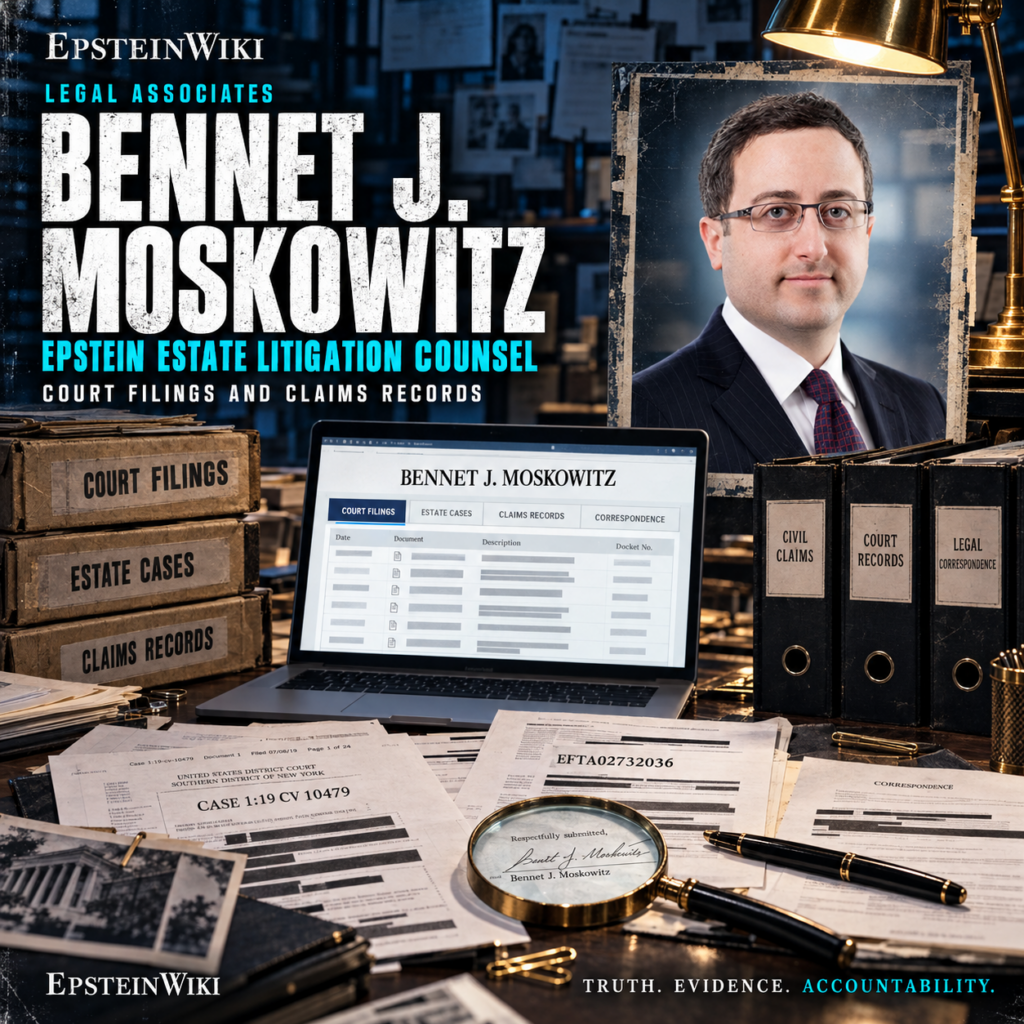
Snapshot
Bennet J. Moskowitz is a New York litigation attorney whose name appears in Jeffrey Epstein’s schedules, legal invoices, payment instructions and court filings. After Epstein’s death, Moskowitz represented estate coexecutors Darren Indyke and Richard Kahn in lawsuits brought by women alleging abuse.
His law firm biography says he represented the coexecutors in dozens of lawsuits, assisted with an independent claims program and worked on a separate structured mediation process.
The records establish legal representation and payments to a law firm. They do not establish that Moskowitz participated in Epstein’s sexual abuse or trafficking.
Who Is Bennet J. Moskowitz?
Moskowitz earned a B.A. from New York University in 2005 and a J.D. from Columbia Law School in 2008. His Troutman Pepper Locke biography describes work involving civil litigation, fraud disputes, claims arising from alleged criminal misconduct and alternative dispute resolution.
His biography also lists representation of Ivanka Trump, Nassau County and Newsmax. Those are separate professional engagements. They do not establish an Epstein connection for those clients.
Moskowitz is distinct from Dr. Bruce W. Moskowitz, a physician who appears elsewhere in Epstein’s records. An Epstein distribution list names “Bennet Moskowitz Esq” and “Dr. Bruce Moskowitz” as separate recipients. The shared surname does not establish a family relationship.
The First Documented Contacts
An August 26, 2009 message from Epstein assistant Lesley Groff relayed Moskowitz’s availability for a telephone call. He hoped to include a partner. The message documents a proposed conversation, but not whether the call took place or what was discussed.
An Epstein schedule for April 7 and 8 lists an 11:15 appointment with Bennet Moskowitz at Epstein’s East 71st Street residence, immediately before an 11:30 appointment with Rich Kahn. The extracted schedule does not visibly establish its year. It shows an appointment was scheduled, not that the meeting occurred.
A September 13, 2010 message sought to arrange another conference call involving Moskowitz and other people concerning New York attorney information. Some names in the extracted text are uncertain and should not be silently corrected.
These are the earliest contacts identified in the cited records. They do not prove when Moskowitz first became Epstein’s lawyer.
The Troutman Sanders Client File
The firm’s December 2010 invoice identifies Epstein as client 238227. Its matter number is 238227.000001, and its description reads “Zwirn/Dubin dispute.” The timekeeper summary lists Moskowitz at $265 per hour.
That invoice refers to earlier bills. The matter suffix does not mean this was Epstein’s first Troutman Sanders invoice, and the referenced earlier bills are not all available in the cited release.
A later October 2018 invoice uses client number 238227 with a different matter suffix, 238227.000015, for Gerber v. Financial Trust Company. Its payment instructions name “B J Moskowitz” as the reference attorney.
A payment bearing that reference was a payment on the firm’s client matter. It was not automatically a personal payment to Moskowitz.
Chart: What the 2010 Ledger Actually Shows
The outstanding legal invoices ledger, EFTA00727857, separates bills, a write off, payments and an outstanding balance. Those categories cannot be combined as though each were a new payment.
| Troutman Sanders ledger measure | Amount | Meaning |
|---|---|---|
| Total billed | $82,833.59 | Legal invoices listed in the ledger |
| Write off | $10,968.10 | Reduction of the billed amount |
| Revised billed amount | $71,865.49 | Total billed after the write off |
| Payments recorded | $65,716.05 | Amount paid at that accounting point |
| Outstanding balance | $6,149.44 | Revised billings less payments |
A January 18, 2011 message from Richard Kahn separately identifies $65,716.05 paid to date on the Moskowitz matter. That amount matches the first three bank transfers in the next chart. The ledger balance and Kahn’s later open invoice describe different accounting snapshots.
Chart: Identified Payments to Troutman Sanders
The August 2010 bank statement, its wire instruction and subsequent records document payments to Troutman Sanders, with Moskowitz named in the client reference.
| Period | Identified payments | Total | Evidence and limitation |
|---|---|---|---|
| August through November 2010 | 3 | $65,716.05 | August, September and November bank statements |
| January 2011 through June 2013 | 10 | $47,749.92 | January 2011 instruction, matching statement, June 2013 statement and the document reconstruction |
| February 2014 | 1 | $450.00 | Authorization naming the client file and matching debit |
| October 2018 | 1 | $48,960.59 | Bank debit matching the Gerber invoice |
| Total identified | 15 | $162,876.56 | Identified transactions, not a complete lifetime accounting |
The Epstein Data payment reconstruction enumerates thirteen JPMorgan wires from August 2010 through June 2013 totaling $113,465.97. The chart then adds the two later Deutsche Bank transactions.
The 2014 authorization identifies the Moskowitz client file, while its matching statement line does not repeat that reference. The 2018 statement names the firm and exactly matches its invoice amount, but likewise lacks the client number on the bank line. These distinctions matter when tracing the transactions.
Some invoices referenced in the records are missing. The $162,876.56 figure is therefore the total of identified firm payments, not a verified total of every payment Epstein ever made for this legal work. It is also not Moskowitz’s personal income.
The 2018 Gerber Bill
The October 17, 2018 invoice totals $48,960.59, comprising $40,017 in fees and $8,943.59 in costs.
The invoice attributes 27 hours at $595 per hour, totaling $16,065, to Moskowitz. Other firm personnel billed the remaining legal work. The total invoice cannot accurately be described as a personal bill from him.
The work concerned Gerber v. Financial Trust Company, a federal case filed in August 2018 and voluntarily dismissed without prejudice in October. A dismissal without prejudice did not decide the underlying allegations on their merits.
A released defense memorandum supplies litigation context. A declaration bearing Moskowitz’s name appears among the released material as an internal draft. The draft should not be presented as a filed original without identifying a filed copy.
The Hoffenberg Letter and the January 2019 Unsealing Response
A July 2016 letter withdrawing Hoffenberg v. Epstein copied Moskowitz. That copy entry does not establish that he represented Hoffenberg, authored the letter or directed the withdrawal.
In another matter, Moskowitz and Martin Weinberg signed Epstein’s January 2019 response to a request to unseal appellate briefs. The response said Epstein did not oppose unsealing the briefs if proposed redactions protected alleged victims’ identities.
That was a position on a particular request. It does not establish Epstein’s position on every sealed record.
Representation of Epstein’s Estate
After Epstein’s death in August 2019, Darren Indyke and Richard Kahn became estate coexecutors. Moskowitz represented them in litigation and estate matters. EpsteinWiki’s Darren Indyke profile and Epstein financial network article provide context for their roles.
The following filings identify specific proceedings in which Moskowitz appeared or submitted papers. His firm’s description of dozens of lawsuits extends beyond this list.
- 1:19-cv-07675: The federal docket records a September 25, 2019 notice of appearance for the estate and a consent request for more time.
- 1:19-cv-07625: An October 2019 letter and November declaration document his work. This action was later dismissed following the plaintiff’s resolution of her claims through the compensation program.
- 1:19-cv-08673: An October letter, November response and anonymity memorandum document disputed procedural questions.
- 1:19-cv-09610: A November letter sought to vacate an anonymity order so the defendants could respond. A December declaration accompanied later estate papers.
- 1:19-cv-10475: A released filing documents estate counsel’s involvement.
- 1:19-cv-10788: A released filing documents involvement in this separate survivor action.
- 1:19-cv-11869: A January 2020 letter appears in Anastasia Doe v. Indyke and Kahn.
- 1:20-cv-00484: A May 2020 declaration placed earlier opinions and orders before the court.
- 1:20-cv-02365: A 2021 declaration accompanied estate papers concerning a plaintiff’s anonymity request.
- 1:19-cv-10577, 1:19-cv-10479 and 1:19-cv-10476: A filing addressing related proceedings documents further activity across three distinct cases.
A filing establishes what was submitted and for whom. It does not establish that each lawsuit had the same allegations, defendants or result.
What Happened in the Survivor Anonymity Disputes?
The estate’s position cannot be reduced to a simple claim that it supported or opposed anonymity. The parties disputed separate questions about public identification, disclosure to defense counsel and possible further disclosure during litigation.
In 1:19-cv-08673, plaintiffs’ lawyers questioned the estate’s position after Moskowitz’s October 29, 2019 letter. His November response disputed the suggestion that the estate opposed pseudonymity. His November 15 memorandum expressly said the defendants did not object to keeping the plaintiff’s identity from the general public.
The dispute remained substantive. The estate’s proposed order allowed further disclosure when necessary to defend the case. The plaintiff’s reply argued that the language gave defendants too much discretion. A later joint stipulation records agreed terms.
In 1:19-cv-09610, Moskowitz’s November 20, 2019 letter asked the court to vacate an existing anonymity order because the defendants had not yet been heard. The letter also said they did not object to protecting the plaintiff’s identity from public disclosure. Both parts are necessary to understand his position.
Discovery Disputes and Survivor Compensation
Survivor counsel and estate counsel also disputed access to records, a proposed confidentiality agreement, depositions and whether lawsuits should pause while claimants considered the estate’s compensation program.
In July 2020, ABC News reported a plaintiff lawyer’s allegation that the estate had delayed document production and a deposition of Indyke. Moskowitz declined to comment to ABC News on those allegations. Another estate lawyer disputed the account and said an agreement was needed to protect the plaintiff’s identity before producing documents containing her name.
In August 2020, ABC News reported that Moskowitz argued in court that the lack of a confidentiality agreement was blocking production. He also proposed pausing the lawsuit while the plaintiff considered a compensation claim. The plaintiff’s lawyer disputed the need for that agreement and wanted the lawsuit to proceed. These were opposing litigation positions, not findings that every accusation made by either side was true.
The compensation proposal itself prompted objections. Reuters reported on a November 2019 hearing at which a judge criticized the estate for leaving accusers without enough information. The Guardian reported on the February 2020 dispute between estate counsel and the United States Virgin Islands attorney general over the proposed fund.
What Was the Estate Worth?
In a December 3, 2019 letter to claimants’ counsel, Moskowitz said the coexecutors could not then calculate the estate’s net value accurately. He identified potential taxes in the United States and France, possible federal forfeiture, pending lawsuits and claims whose future cost was unknown.
A preliminary gross probate valuation therefore cannot be treated as the money available to compensate survivors. The letter states the estate’s position at that date. It is not an independent audit.
An August 2021 estate filing stated that the compensation program had awarded nearly $125 million to approximately 150 eligible claimants. The filing also asserted that participants were free to tell their stories publicly. That figure concerns a particular program at a particular point. It is not the total of every later survivor settlement.
Congressional Request and Continued Estate Work
In July 2025, Representatives Robert Garcia and Ro Khanna addressed a request to Moskowitz and two other estate lawyers for a copy of Epstein’s so called birthday book. Being named as estate counsel does not establish that he created the book or knew every entry.
The 2026 docket for Lesniewski et al. v. Wexner et al., 1:26-cv-02613, records an April 3 letter motion by Moskowitz for the estate coexecutors. It also records an April 17 notice of appearance for Nine East 71st Street Corporation and a letter filed for both the corporation and the coexecutors.
EpsteinWiki’s 9 East 71st Street article supplies the property context. The docket documents legal representation. It does not make Moskowitz a defendant or establish the allegations against the parties he represented.
Key Takeaways
- Moskowitz’s documented connection to Epstein was legal representation. The cited records begin with a 2009 scheduling message and continue through estate litigation after Epstein’s death.
- Client number 238227 identifies Epstein’s Troutman Sanders account. Payment instructions named “B J Moskowitz” as reference attorney, while the firm received the funds.
- The 2010 ledger records $82,833.59 billed, a $10,968.10 write off, $65,716.05 paid and $6,149.44 outstanding at its accounting point.
- A wider document reconstruction identifies fifteen firm payments totaling $162,876.56. Missing invoices and possible unlocated transactions prevent treating that as a final lifetime total.
- His firm reports work in dozens of estate lawsuits. The linked case filings identify examples without claiming a complete docket census.
- In anonymity litigation, he stated that the estate did not oppose protecting plaintiffs’ identities from the public while contesting disclosure rules and, in one case, requesting that an order be vacated so the defense could respond.
- No cited record establishes that Moskowitz participated in Epstein’s sexual abuse or trafficking.
Questions Raised by the Records
- Which additional federal and state cases make up the full set of lawsuits described by Moskowitz’s firm, and what was the final disposition of each?
- What was the complete amount billed and paid on Epstein’s Troutman Sanders account? Some invoices referenced by the available documents are missing.
- Was the December 2010 Zwirn/Dubin invoice paid? The cited payment reconstruction has not established a matching payment for that invoice.
- Did the scheduled East 71st Street appointment occur, and what work concerned it?
- What was discussed on the calls proposed in the 2009 and 2010 messages?
- Are Bennet and Bruce Moskowitz related? The cited records identify them separately but do not resolve that question.
Evidence Appearances
- EFTA02435663: August 2009 call scheduling message
- EFTA00314248: East 71st Street appointment schedule
- EFTA02422562: September 2010 conference call request
- EFTA01083374: Zwirn/Dubin invoice and client reference
- EFTA00727857: outstanding legal invoices ledger
- EFTA01483234: August 2010 bank statement
- EFTA01581597: August 2010 wire instruction
- EFTA01483256: September 2010 bank statement
- EFTA01483294: November 2010 bank statement
- EFTA01990161: Kahn’s January 2011 accounting message
- EFTA01581400: January 2011 wire instruction
- EFTA01360227: February 2014 payment authorization
- EFTA00594947: Hoffenberg withdrawal letter
- EFTA00804463: Gerber invoice and timekeeper summary
- EFTA01287941: October 2018 bank debit matching the invoice
- EFTA00801681: January 2019 unsealing response
- EFTA02750881: October 2019 anonymity letter
- EFTA02750939: November 2019 anonymity memorandum
- EFTA02738030: request concerning a separate anonymity order
- EFTA00023230: December 2019 estate valuation letter
- EFTA02752626: August 2021 estate compensation filing
Source List
- Troutman Pepper Locke biography and representative matters
- Epstein Data review and payment reconstruction
- Federal docket for Doe 1 et al. v. Jeffrey Epstein et al.
- Reuters report on the November 2019 compensation hearing
- The Guardian report on the Virgin Islands compensation dispute
- ABC News report on the July 2020 discovery dispute
- ABC News report on the August 2020 confidentiality dispute
- United States House Oversight Democrats request to estate counsel
- Federal docket for Lesniewski et al. v. Wexner et al.