
The Mindshift Conference: Jeffrey Epstein’s 2011 Science Gathering on Little Saint James
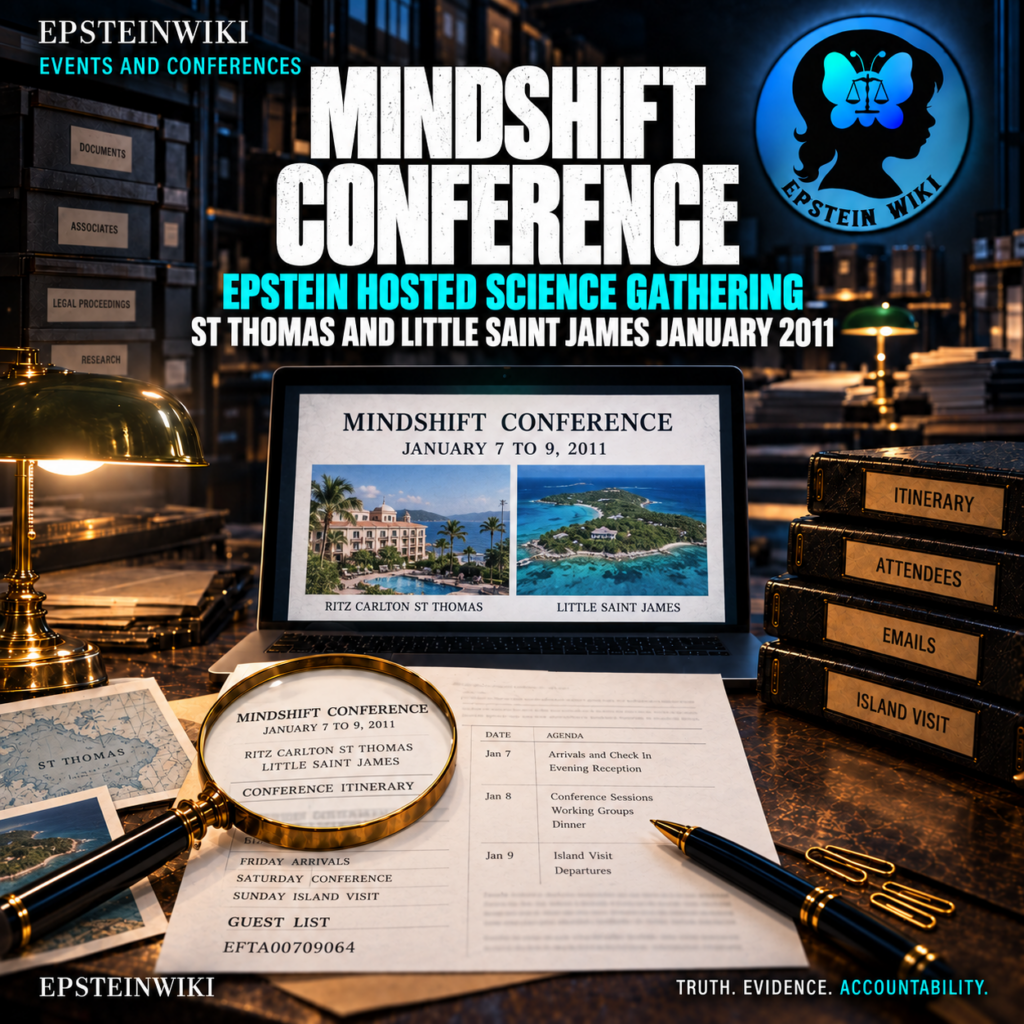
Snapshot
Event name: Mindshift Conference
Event dates: January 7 through January 10, 2011
Hotel booking window: January 7 through January 11, 2011
Locations: The Ritz Carlton on St. Thomas and Jeffrey Epstein’s private island, Little Saint James, in the United States Virgin Islands
Hosts and organizers: Jeffrey Epstein and Al Seckel
Funding claim: Promotional material said the event was made possible by the Jeffrey Epstein Foundation
Meeting size: Fourteen principal participants were publicly promoted. The final itinerary named eleven companions. Earlier records also identify invited or tentative guests who were not on the final promotional list.
Subjects advertised: Artificial intelligence, complexity theory, theoretical physics, evolutionary biology, cognitive neuroscience, minimally invasive surgery, encryption, financial systems, and emerging technologies
Primary EpsteinWiki category: Conferences and Gatherings
Secondary categories: Academics, Educational and Research Institutions, Estates and Properties, and The Epstein Files
Why it matters: The conference brought prominent scientists, technologists, and entrepreneurs into Epstein’s orbit after his 2008 conviction. It also overlapped with a documented effort by Al Seckel and others to improve Epstein’s online reputation and replace reporting about his sex offense case with flattering material about science and philanthropy.
The Mindshift Conference was not a routine academic meeting. It was a private gathering financed and hosted by Jeffrey Epstein less than two years after his release from jail. The official meetings occurred in a hotel suite on St. Thomas. Early plans proposed two visits to Little Saint James, but the final schedule documents one Saturday lunch there. Epstein’s private island later became central to survivor allegations and federal sex trafficking investigations.
The conference gave Epstein access to accomplished scientists, engineers, technologists, and future business contacts. It also supplied content for his science website and supported the public image he was trying to build as a curious patron of advanced research.
The surviving files do not establish that the academics or companions who attended participated in Epstein’s crimes. Attendance, correspondence, or an appearance on an itinerary is not proof of criminal conduct. The evidentiary importance of the conference lies in what it reveals about Epstein’s post conviction rehabilitation strategy, elite access, scientific patronage, island hospitality, and relationship building.
Content Note
This article discusses Jeffrey Epstein’s post conviction reputation campaign and his use of a property associated with sexual abuse and trafficking allegations. It does not imply that every person invited to or present at the conference knew about, enabled, or participated in his crimes.
What Was the Mindshift Conference?
The Mindshift Conference was a small, invitation only gathering organized by Al Seckel and financed by Jeffrey Epstein. It took place in January 2011 on St. Thomas and Little Saint James.
Promotional copy described the participants as an intimate group of exceptional thinkers and achievers. The stated goal was to bring together people with different backgrounds and expertise to push the frontiers of important subjects. The proposed topics ranged from theoretical physics and cognitive neuroscience to encryption, emerging technologies, and new financial systems.
The formal description made the event sound like a prestigious interdisciplinary retreat. The itinerary reveals a hybrid program. Scientific meetings were scheduled at the Ritz Carlton. Meals, demonstrations, games, wine tasting, stargazing, and island visits provided extended social access. Epstein was not simply underwriting a lecture series. He was placing himself at the center of an intimate network building environment.
The event occurred after Epstein had pleaded guilty in Florida to solicitation of prostitution and procuring a person under 18 for prostitution. He completed his jail sentence in 2009. His criminal history was publicly searchable when invitations were planned and the conference took place.
The Conference’s Origins
The planning record reaches back to April 16, 2009. According to reporting based on the released emails, Epstein asked Seckel to assemble a list of “smart, out of the box types” for a gathering then envisioned for Florida.
The early list included people who later appeared in conference planning, including Dan Dubno, Ron Reisman, Paul Kirkaas, and Gerald Sussman. Over the following year, the idea developed into the Mindshift Conference.
Seckel occupied an unusually useful position. He had cultivated relationships with scientists and public intellectuals for decades. He was also married to Isabel Maxwell, the sister of Ghislaine Maxwell. That relationship placed him inside the extended Maxwell family network while his scientific contacts gave him access to potential guests who could add intellectual prestige.
The surviving emails show Epstein and Seckel shaping the guest list, publicity, logistics, and program. By November 2010, Seckel sent Epstein promotional text announcing the event. The document said the conference would be supported by the Jeffrey Epstein Foundation and listed the subjects and confirmed attendees.
This origin matters because the conference did not emerge from a university, scientific society, or peer reviewed research initiative. It was privately assembled around Epstein’s interests and relationships.
Al Seckel’s Role
Al Seckel was the principal organizer and intellectual broker. He was known for books and presentations about optical illusions and perception. He described himself in scientific terms and developed relationships with prominent academics.
Later reporting raised substantial questions about his credentials. Cornell’s alumni office reportedly confirmed that an Alfred Paul Seckel attended but did not earn a degree. People around Caltech sometimes assumed he had been a graduate student or postdoctoral researcher, although he was not. Caltech associated scientists eventually warned him against using their names in official contexts.
Seckel’s limited formal credentials did not prevent him from accessing prestigious scientific circles. He knew Murray Gell Mann and Richard Feynman and later developed relationships with Christof Koch and Shinsuke Shimojo. That social capital allowed him to act as a gatekeeper between Epstein and respected researchers.
The documentary record shows that Seckel invoiced $25,000 to organize a science conference. No corresponding payment record was located. The files also place him at the center of travel instructions, hotel arrangements, programming, guest communications, and promotional writing.
His role extended beyond event planning. During the same period, Seckel offered to help suppress negative search results about Epstein and build websites emphasizing science, philanthropy, sports, and other favorable subjects. This overlap is essential to understanding the conference’s larger function.
Epstein’s Reputation Campaign
The conference was planned while Epstein was trying to reshape what people found when they searched his name online.
In September 2010, Seckel asked Epstein whether he wanted the damaging search results associated with his name to disappear. He said that he and conference participant Pablos Holman could make it happen for approximately $20,000 to $25,000. Epstein asked whether positive articles would be needed to displace negative results. Seckel said that was the plan.
The proposal expanded into a network of websites. Two sites would present Epstein’s support for science and charity. Other sites would cover sports, cooking, photographs, and video. Seckel described tactics intended to manipulate search rankings, monitor new coverage, and push reporting about Epstein’s criminal case away from prominent search results.
The science site promoted the Mindshift Conference. It described Epstein as an entrepreneur, philanthropist, and sponsor. It displayed prestigious names beside his own and promised to share the results of the discussions.
The conference therefore served at least two functions. It created a real gathering of scientists and technologists. It also produced material that could present Epstein to the public as a science patron instead of a convicted sex offender.
It would be too strong to claim that every attendee understood or participated in the reputation campaign. The evidence establishes that Seckel and Epstein were working on both projects during the same period, that the science website promoted the conference, and that the site formed part of the favorable content strategy.
Dates and Locations
Three different date ranges appear in the records, and they should not be collapsed. A hotel contract covered January 7 through January 11. An early guest communication contemplated travel through January 12. Cecile de Jongh’s final schedule, sent on January 7, documents conference programming from Friday, January 7, through Monday, January 10.
The December 22 itinerary placed formal meetings in a rented suite at the Ritz Carlton on St. Thomas. It proposed Saturday and Sunday sessions from 9:00 a.m. to noon and 3:30 p.m. to 5:00 p.m., plus a Monday session from 9:00 a.m. to 11:30 a.m. It also proposed Little Saint James visits on both Saturday and Monday.
An updated December 30 itinerary specified the Ritz Carlton’s Great Bay Terrace for Friday’s opening reception and the Presidential Suite for formal sessions. It moved the Saturday island trip to 11:45 a.m. through 3:00 p.m. and still proposed a Monday island visit.
The final day by day schedule is the strongest available evidence of the program that organizers intended to execute. It documents only one island visit, on Saturday. The earlier proposed Monday trip does not appear in that final schedule.
| Date | Final scheduled program |
|---|---|
| Friday, January 7 | Reception from 7:00 to 8:00 p.m. and buffet dinner from 8:00 to 9:00 p.m. on the Great Bay Terrace at the Ritz Carlton |
| Saturday, January 8 | Breakfast, meeting in the Presidential Suite from 9:00 to 11:30 a.m., transfer to American Yacht Harbor C Dock, travel aboard the Lady G, lunch on Little Saint James from noon to 3:30 p.m., and dinner at Oceana |
| Sunday, January 9 | Breakfast, morning meeting from 9:00 a.m. to noon, lunch, afternoon meeting from 2:30 to 4:30 p.m., dinner at Oasis, and a 9:30 p.m. meeting in the Presidential Suite |
| Monday, January 10 | Breakfast, morning meeting from 9:00 a.m. to noon, lunch, afternoon meeting from 2:30 to 4:30 p.m., and dinner at Old Stone Farmhouse |
The final schedule proves that an island visit was an organized part of the conference, not an incidental private excursion. It does not prove that every listed participant boarded the boat or entered Little Saint James. Passenger manifests, photographs, and complete attendance sheets have not been located in the reviewed releases.
The Advertised Attendees
Promotional material identifies fourteen principals, including Epstein and Seckel. The files use several different evidentiary verbs: invited, confirmed, booked, listed, scheduled, and thanked. Those words are not interchangeable. The following matrix separates them.
| Person | Preconference evidence | Evidence tied to the event or its aftermath | Safe conclusion |
|---|---|---|---|
| Jeffrey Epstein | Host, funder, and promoter | Named throughout the final schedule and later wrote private critiques | Host and sponsor |
| Al Seckel | Organizer and author of invitations, program, and publicity | Managed follow up and received attendee messages | Organizer and participant |
| Murray Gell Mann | Confirmed and promoted | Assigned Diplomacy activity and named in Epstein’s post conference critique | Strong evidence of participation |
| Christof Koch | Confirmed and promoted | Assigned a presentation or activity in planning records | Listed and scheduled; complete attendance record not located |
| Frances Arnold | Confirmed and promoted | Sent Epstein a January 17 thank you for the conference | Documented attendee |
| Gerald Sussman | Confirmed and promoted | Assigned telescope activity and later publicly described accepting the invitation | Documented attendee |
| Catherine Mohr | Added as confirmed and promoted | Sent a January 11 message expressing appreciation and discussing collaborations formed there | Documented attendee |
| Leonard Mlodinow | Confirmed and promoted | Assigned an olfactory demonstration and named in Epstein’s critique | Strong evidence of participation |
| Reichart Von Wolfsheild | Confirmed and promoted under spelling variants | Praised in Epstein’s critique; exchanged Qtask messages with Epstein immediately afterward | Strong evidence of participation |
| Dan Dubno | Confirmed and promoted | Assigned technology tricks as an evening activity | Listed and scheduled; complete attendance record not located |
| Pablos Holman | Confirmed and promoted | Assigned lock picking and named in Epstein’s critique | Strong evidence of participation |
| Ron Reisman | Confirmed and promoted under spelling variants | Named in Epstein’s critique | Strong evidence of participation |
| Brock Pierce | Confirmed and promoted | Assigned wine tasting, praised in Epstein’s critique, and maintained later contact | Strong evidence of participation |
| Paul Kirkaas | Confirmed and promoted | Assigned a presentation or activity and named in Epstein’s critique | Strong evidence of participation |
The institutional labels in promotional biographies described the individuals, not institutional sponsorship. The surviving records do not show Caltech, MIT, Stanford, NASA Ames, the Santa Fe Institute, or Intellectual Ventures formally sponsoring Mindshift.
Invited, Tentative, or Interested People Not Established as Attendees
An October 12 list said that all named invitees were confirmed and booked except Nathan Myhrvold, who remained tentative. Myhrvold did not appear on the final promotional list. Seckel also wrote that Danny Hillis, Ed Witten, and Kip Thorne had been invited but were unavailable.
Other correspondence records interest or an invitation without establishing attendance. David Stern asked whether he could come to Mindshift. Epstein forwarded an invitation to a recipient displayed as “Jes Stale” and said the recipient and his daughter could attend. Neither appears on the final public participant list reviewed for this article.
These distinctions prevent an invitation from being reported as attendance. No conclusion about a person’s presence should rest on an invitation alone.
Spouses and Companions Listed in the Itinerary
The itinerary separately named spouses and companions who could join meals, evening activities, and island tours while the formal meetings remained limited to invitees.
The listed companions were:
- Isabel Maxwell
- Mary McFadden
- Lisa Dubno
- Julie Sussman
- Donna Scott
- Marcia Reisman
- Olga Yefremova
- Alexander Maxwell Djerassi
- Elizabeth Seckel
- Kip Miller
- Michael Molesky
In 2026, reporting focused on Alexander Maxwell Djerassi and Michael Molesky after their names appeared in the itinerary. Both later became trustees of the Djerassi Resident Artists Program. The organization said it had no involvement in the conference and had never received a donation from or had contact with Epstein or Ghislaine Maxwell.
Maxwell Djerassi said that he and Molesky were on a family vacation in St. Thomas with his mother, Isabel Maxwell, who invited them to join a conference lunch. He said they did not know about Epstein’s crimes at the time and were horrified when they learned of them later.
The final companion list therefore contained eleven names. An earlier version contained nine and omitted Donna Scott and Kip Miller. The companion list demonstrates the social reach of the event. It does not establish that each listed person traveled, attended every activity, entered Little Saint James, or knew the full identity and history of the host.
Conference Logistics
The planning records show a professionally organized event. Allyson Catanzaro of All Destinations Inc. handled airline bookings. Island Meetings & Incentives handled arrival transportation, with Judi Nagelberg identified as the local contact. The Ritz Carlton supplied guest rooms, meals, meeting space, and a Presidential Suite.
The December itinerary told guests that tickets had been fully booked and that they should already have received their flight information. It advised participants to print and carry the document. Spouses and companions could enjoy St. Thomas independently during closed sessions and would rejoin the group for meals, evening activities, and island visits.
The email was copied to Epstein, Cecile de Jongh, and Judi Nagelberg. Other records define their functions more clearly. De Jongh relayed approvals, coordinated with the organizer, arranged meals and island timing, and distributed the final schedule. She told Seckel that Nagelberg was the group’s organizer on the ground. Nagelberg obtained hotel information, pressed for overdue rooming and program details, negotiated the meeting space, and coordinated transportation and catering requirements.
The correspondence also records last minute pressure. In December, Nagelberg warned that the hotel needed final details and that planning was “down to the wire.” The hotel initially had meeting rooms only for January 8 and 9. Nagelberg then secured use of a Presidential Suite for January 8 through 10 at $2,200 plus 8 percent tax per day, with wireless internet included and audiovisual equipment and catered food charged separately.
These records establish logistical roles. They do not establish that Nagelberg or de Jongh knew about or participated in Epstein’s sexual abuse. Their relevance here is the operational history of the conference.
The itinerary also said Epstein might record private interviews with selected guests for his website. This detail directly connects the gathering to content production. The event offered Epstein the possibility of obtaining video material featuring respected specialists under the branding of his science interests.
Hotel Contract and Known Costs
The Ritz Carlton contract named the event “Mindshift” and projected 32 attendees, including spouses. It reserved 16 rooms for January 7 through January 11 at a room rate of $599. The contract listed total room charges of $45,114.88 and an initial deposit of $12,814.61. Function fees were waived. Cancellation within 72 hours carried a 100 percent charge, while earlier cancellation carried an 80 percent charge.
The contract was sent by Nagelberg to de Jongh and Darren Indyke for approval. Epstein responded that he needed an attendee list and added, “you know how I feel about spouses.” The remark indicates his direct attention to the guest composition, although the final itinerary still listed companions.
| Cost item | Documentary amount | What remains unknown |
|---|---|---|
| Organizer invoice | $25,000 | A payment record was not located |
| Sixteen hotel rooms | $45,114.88 | Whether the final hotel bill matched the contracted amount |
| Initial hotel deposit | $12,814.61 | Which account ultimately funded it |
| Standard room rate | $599 per room | Taxes and incidentals attributable to each guest |
| Presidential Suite | $2,200 plus 8 percent tax per day | Final number of billable days and total audiovisual or catering charges |
| Meals | Charged to the Master Account | Exact total not located |
| Airfare | Tickets described as fully booked | Exact total and final passenger list not located |
| Ground and marine transportation | Professionally arranged | Exact fees and complete passenger manifests not located |
The $25,000 Organizer Invoice
On May 19, 2010, Epstein instructed Seckel to invoice Enhanced Education for a $25,000 coordination fee for a science symposium. Enhanced Education was a trade name associated with the J. Epstein Virgin Islands Foundation. The surviving invoice described the work as setting up a science conference and arranging speakers, demonstrations, exhibits, and a venue.
The invoice deserves careful treatment. It is dated July 19, 2010, while its line item carries a May 19 date. It also displays a $20,000 shipping figure even though the balance due is $25,000. Separate wire instructions identify IllusionWorks LLC. Seckel later transmitted the invoice and wire information.
The records establish that $25,000 was billed. They do not, by themselves, establish that the invoice was paid. Earlier wording that treated payment as proven has therefore been corrected.
What Participants Were Expected to Do
Mindshift was designed around short contributions and demonstrations rather than a conventional sequence of peer reviewed papers. On November 18, Seckel divided the program into two broad days. The first covered artificial intelligence, complexity theory, theoretical physics, evolutionary biology, and cognitive neuroscience. The second covered minimally invasive surgery, encryption and decryption, new financial systems, and emerging technologies.
Epstein asked for a real hour by hour agenda and information about security requirements. A later plan assigned hour long blocks and proposed an island barbecue. By December 11, Seckel instructed each invitee to prepare a 15 to 20 minute presentation followed by roughly 30 minutes of discussion. Each was also asked to bring a playful demonstration or activity.
Murray Gell Mann was expected to speak. Gerald Sussman would bring a telescope and lead a tour of the sky. Leonard Mlodinow would conduct an olfactory demonstration and provide copies of The Grand Design, the book he wrote with Stephen Hawking. Reichart Von Wolfsheild was expected to offer an unusual surprise. The itinerary anticipated additional activities from Christof Koch, Paul Kirkaas, and Ron Reisman.
The activity list was unusually specific:
- Murray Gell Mann was to lead the strategy game Diplomacy.
- Dan Dubno was to demonstrate technology tricks.
- Pablos Holman was to lead lock picking with bump keys supplied to guests.
- Al Seckel planned puzzles and film screenings.
- Frances Arnold proposed an evolutionary word game and possibly a directed evolution demonstration.
- Brock Pierce was to lead a wine tasting.
- Catherine Mohr proposed flash pickling and knife skills.
- Leonard Mlodinow planned an olfactory demonstration and copies of The Grand Design.
- Gerald Sussman planned telescope viewing and stargazing.
- Reichart Von Wolfsheild promised a surprise, while Christof Koch, Paul Kirkaas, and Ron Reisman were also expected to contribute activities.
The final entertainment plan included recent films such as The King’s Speech, The Social Network, 127 Hours, and True Grit. These activities created informal time in which participants could form relationships outside the scheduled discussions.
The conference’s intellectual breadth may have been genuinely interesting to guests. It also reflected Epstein’s preference for collecting experts across disciplines and placing himself inside conversations among them. His role did not depend on possessing recognized scientific credentials. Money, hospitality, and access allowed him to convene the room.
Frances Arnold’s Attendance and Later Explanation
Frances Arnold was a Caltech professor known for pioneering directed evolution. She received the Nobel Prize in Chemistry in 2018, seven years after Mindshift.
Released correspondence includes a post conference message thanking Epstein for hosting the gathering and inviting him to visit Caltech, where she could tell him more about laboratory evolution. When asked about the record in 2026, Arnold said someone had organized a conference where she met Epstein briefly. She said she had no meaningful relationship with him and would have declined had she known about his history.
Additional files complicated the claim that she had no contact before the event. A June 2010 email indicated that she had spoken with Epstein and believed he knew about subjects that interested her. Follow up correspondence suggested another conversation was planned. Arnold told the student newspaper that she did not remember the earlier interaction but accepted that the email indicated one may have occurred.
Nothing in the public record accuses Arnold of participating in Epstein’s crimes. The importance of the exchange is narrower. It shows how incomplete personal recollection can conflict with contemporaneous correspondence and why documentary evidence must be checked before firm claims are made.
Gerald Sussman’s Explanation
Gerald Sussman later described the invitation in direct terms. He said he knew nothing about Epstein but thought that if a wealthy man wanted to discuss science, there was no reason not to get on a plane and go.
That explanation captures a recurring feature of Epstein’s academic network. Wealth itself opened doors. Researchers did not necessarily require a long institutional relationship, a formal grant process, or due diligence before accepting access and hospitality.
Sussman’s statement is not evidence of criminal knowledge. It is evidence of the vulnerability created when private wealth is treated as sufficient qualification for entry into scientific life.
Brock Pierce and the Cryptocurrency Connection
Brock Pierce attended as an entrepreneur associated with virtual currencies and online gaming. Cryptocurrency was still an emerging field in 2011, and the conference explicitly advertised new financial systems and emerging technologies as subjects.
The event appears to have introduced or strengthened a relationship between Pierce and Epstein. Later files contain communications about cryptocurrency, investments, meetings, and introductions. Reporting has linked Pierce to Epstein’s early interest in cryptocurrency ventures.
Pierce’s representative previously said that he did not know who Epstein was when he traveled commercially to the conference. Attendance alone does not prove participation in Epstein’s crimes.
The long term importance is relational. Mindshift placed an early cryptocurrency entrepreneur inside Epstein’s network at a moment when digital currency was developing from a specialist interest into an investable industry.
Pablos Holman and the Online Cleanup Proposal
Pablos Holman was invited for his work in technology, security, and futurism. Released emails place him in a more specific contemporaneous role.
In September 2010, Seckel told Epstein that he and Holman had discussed making damaging search results disappear. Seckel proposed a paid project using favorable content, search manipulation, monitoring, and redirection.
The record supports saying that Seckel represented Holman as involved in the discussion. Further evidence would be needed to define exactly which actions Holman personally approved or performed. Seckel’s claims about other people were not always reliable.
Even with that caution, the timing is significant. A technology participant in the coming conference was named in planning for Epstein’s reputation repair. The conference and the cleanup effort were not isolated worlds.
Reichart Von Wolfsheild and the Qtask Allegation
Reichart Von Wolfsheild, whose name appears under several spellings, was invited as an expert in software architecture, data compression, and encryption.
Victims’ lawyer Brad Edwards later wrote that Epstein approached Von Wolfsheild during the Mindshift trip about gaining access to Qtask data associated with Edwards’s legal work. According to Edwards, Von Wolfsheild refused and reported the approach.
This account comes from Edwards’s memoir and is therefore a secondary source. Released emails soon after the conference show Epstein asking Von Wolfsheild how to try Qtask and whether a tutorial existed. The emails are consistent with Epstein’s interest in the platform, but they do not independently reproduce the alleged island conversation.
The context is important. Qtask held information connected to litigation involving Epstein and survivors. If Edwards’s account is accurate, Epstein used a science conference guest relationship to probe for access to a system connected to his legal adversaries.
The proper conclusion is limited. The memoir alleges the approach. The emails independently establish Epstein’s immediate interest in using Qtask. Neither fact proves that Von Wolfsheild provided unauthorized access.
The Strange “Susan” Critique
Two January 2011 records show Epstein’s dissatisfaction more directly than earlier summaries suggested. On January 11, Epstein emailed himself a note with the subject “mindshift” that called the event extremely poor and criticized Murray Gell Mann, Paul Kirkaas, Frances Arnold, Leonard Mlodinow, Ron Reisman, and Pablos Holman. It praised Reichart Von Wolfsheild and described Brock Pierce as fun. One misspelled name may refer to Catherine Mohr, but the identification is not certain enough to state as fact.
On January 12, Epstein sent himself a second message written in the voice of someone addressing “Mr Epstein.” It called Mindshift the worst meeting “we have ever funded” and asked for reimbursement to the foundation. The underlying EFTA record is an email from Epstein to himself. It does not itself identify an author named Susan.
Later reporting says Epstein forwarded the criticism to Seckel as if it came from a woman named Susan and that Seckel identified “Susan” as Epstein. No Susan appears on the detailed participant or companion lists.
The exchange suggests Epstein may have used a fictional intermediary to deliver criticism or create distance from his own judgment. It also undercuts the polished public presentation of the conference as an unqualified intellectual success.
The primary documents allow a firmer but narrower conclusion: Epstein composed or preserved the critiques in his own email account and sent them to himself. The additional claim that he presented one to Seckel as Susan’s review depends on the later reported chain.
What Was Published, Recorded, or Preserved
The conference was designed to generate more than private conversation. The science website posted promotional copy, participant biographies, subject areas, and conference imagery. The copy promised that results from the discussions would be shared.
The itinerary said Epstein might tape private one on one interviews with selected attendees for the website. A planning email also asked whether sessions would be recorded for the blog. No complete conference recording, interview set, proceedings, or promised results summary has been identified in the reviewed public record.
Later reporting found that most proposed question and answer features did not materialize. An interview with Seckel did appear and later disappeared. The surviving media record is therefore asymmetrical: extensive promotion before the meeting, but little durable intellectual output afterward.
| Proposed or published item | Current evidentiary status |
|---|---|
| Public Mindshift announcement | Preserved in EFTA records and web archives |
| Participant names and biographies | Preserved in promotional material |
| Conference photographs | Some imagery appeared with promotion; a complete authenticated set has not been located |
| Session recordings | Discussed in planning; no complete set identified |
| Private attendee interviews | Proposed; no complete set identified |
| Results summary | Promised; no published summary identified |
| Seckel interview | Reported as published and later removed |
This gap matters because the prestige value of the guests was immediately useful to Epstein even if the conference produced no conventional academic record.
Mindshift as Reputation Laundering
The phrase reputation laundering describes the use of respected people, institutions, philanthropy, or cultural work to improve the standing of a person with a damaged public record.
Mindshift fits that model in several documented ways.
First, Epstein financed and hosted respected scientists after his conviction. Their presence created legitimate photographs, correspondence, biographies, and relationships that could be associated with his name.
Second, Seckel wrote promotional material placing Epstein beside a Nobel laureate, Caltech professors, an MIT professor, a NASA scientist, and technology entrepreneurs.
Third, the conference appeared on Epstein’s science website, which was one element of a broader plan to displace negative search results.
Fourth, the itinerary contemplated private recorded interviews for Epstein’s website.
Fifth, the event brought guests to Little Saint James, allowing Epstein to present the island as an intellectual retreat rather than only the site described by survivors.
This does not prove that attendees knowingly lent themselves to a reputation campaign. The laundering effect can exist even when individual guests believe they are simply attending a stimulating conference.
The Scientific Funding Problem
Mindshift illustrates a recurring weakness in privately funded science. Researchers need money, equipment, access, and introductions. Wealthy patrons can offer all four with fewer procedures than universities or government funders.
That flexibility can support valuable work. It can also remove safeguards. A donor may gain proximity to experts without meaningful scrutiny. Prestigious researchers may assume someone else has completed due diligence. Institutions can benefit indirectly while denying a formal relationship. Social invitations can develop into donations, consulting, investments, or long term access.
Epstein understood this economy. He did not need to produce original science. He needed to fund gatherings, ask informed questions, and connect specialists who might value one another. The resulting network made him appear credible and intellectually important.
The lesson is not that scientists who accept private support are guilty by association. It is that institutions need transparent standards for donors, private conferences, travel, gifts, and post conviction benefactors.
Little Saint James as a Networking Venue
Survivors and investigators have described Little Saint James as a location connected to Epstein’s abuse and trafficking operation. Mindshift used the same property as a hospitality and networking asset.
Early itineraries proposed two island visits, group meals, hikes led by Epstein, and social activities. The final January 7 schedule documents one Saturday trip aboard the Lady G and lunch on Little Saint James. It replaces the proposed Monday island visit with hotel meetings and lunch. Guests could experience a private Caribbean island while interacting with people from science, medicine, technology, media, and finance.
This dual use matters. Elite hospitality can transform a location’s public meaning. A property associated with survivor accounts could also be presented to influential visitors as a beautiful retreat devoted to ideas.
The conference does not establish that guests witnessed abuse, and a name on an itinerary does not prove a person entered the island. It does show that Epstein continued to use the island openly for elite relationship building after his conviction.
The Maxwell Network
Mindshift also intersected with the extended Maxwell family.
Al Seckel was married to Isabel Maxwell. Isabel was Ghislaine Maxwell’s sister and a technology executive with experience in internet search. She appeared on the companion list. Her son Alexander Maxwell Djerassi was also listed.
The reputation project’s planning materials identified Isabel and Christine Maxwell among people with search expertise. This linked the conference organizer’s family relationships with the effort to change Epstein’s digital profile.
The presence of Maxwell relatives must be described precisely. A family connection or conference appearance is not proof of involvement in Ghislaine Maxwell’s crimes. The evidence does establish that Epstein’s scientific event, technology contacts, and reputation strategy overlapped with the extended Maxwell network.
Comparison With Epstein’s 2006 Physics Conference
Mindshift was not Epstein’s first scientific gathering in the Virgin Islands. In 2006, before his Florida conviction, a conference organized by physicist Lawrence Krauss focused on gravity and the energy of empty space. It drew prominent specialists including Stephen Hawking, Gerard ‘t Hooft, David Gross, Frank Wilczek, Jim Peebles, Alan Guth, Kip Thorne, Lisa Randall, Barry Barish, and Maria Spiropulu. Contemporary material described St. Thomas meetings and an excursion or dinner connected to Little Saint James.
The two events should not be treated as identical.
| Feature | 2006 physics gathering | 2011 Mindshift Conference |
|---|---|---|
| Legal context | Before Epstein’s 2008 Florida conviction | After his conviction and jail sentence |
| Intellectual scope | Concentrated on gravity, cosmology, and theoretical physics | Deliberately interdisciplinary, spanning science, medicine, technology, security, and finance |
| Participant structure | More than 20 specialists in related fields | Fourteen promoted principals plus eleven named companions |
| Public framing | A high level specialist physics meeting | A private salon promoted through Epstein’s science website |
| Island role | Social hospitality connected to the scientific event | A scheduled lunch and visit within the final conference program |
| Reputation context | Epstein was cultivating scientific status | The event overlapped with a documented effort to suppress negative search results after conviction |
The continuity is more important than superficial similarity. Epstein repeatedly used scientific convening, celebrated names, Virgin Islands hospitality, and Little Saint James to build status and relationships. The 2011 event is more revealing because it shows that this access continued after his criminal record was public.
Evidence Appearances
| Record | What it shows | Evidentiary limit |
|---|---|---|
| EFTA00709064 | The detailed December 22, 2010 travel and conference instructions, schedule, island visits, activities, companions, and copied organizers | A listed name does not prove attendance at every activity or knowledge of Epstein’s crimes |
| EFTA00900788 | Updated December 30 itinerary, meal venues, Presidential Suite sessions, activity details, and final eleven person companion list | It remained a plan and must be checked against the later final schedule |
| EFTA01779543 | De Jongh’s January 7 final schedule, including exact meeting times and the Saturday Lady G trip to Little Saint James | It documents the intended final program, not a passenger manifest |
| EFTA00751951 | The proposed division of scientific and technology subjects across two days | A proposed topic does not prove the discussion occurred as planned |
| EFTA01832069 | Seckel’s request for 15 to 20 minute presentations and activities | It states expectations, not completed presentations |
| EFTA02417540 | October invitee status, Nathan Myhrvold as tentative, Catherine Mohr as confirmed, and unavailable invitees | Confirmation and booking are stronger than invitation but do not prove final attendance |
| EFTA02415741 | Seckel’s promotional text, conference subjects, funding claim, and confirmed attendee list | Promotional biographies reflect how organizers presented participants |
| EFTA00752613 | The public science site announcement presenting Epstein as sponsor and host | The page was reputation content, not independent journalism |
| EFTA00778078 | Ritz Carlton contract for 16 rooms, 32 projected attendees, rates, deposit, and cancellation terms | Contracted costs may differ from the final bill |
| EFTA00641627 | Hotel request for the rooming list and agenda | It documents operational planning only |
| EFTA00752793 | De Jongh identifies Nagelberg as the organizer on the ground | It defines a logistics role, not knowledge of crimes |
| EFTA00900367 | Nagelberg warns that hotel planning is down to the wire | It documents last minute coordination |
| EFTA01831685 | Hotel correspondence about obtaining a presidential suite for meetings | It documents planning, not the substance of the discussions |
| EFTA00734529 | Epstein’s instruction to invoice Enhanced Education $25,000 for conference coordination | It does not prove payment |
| EFTA00731043 | The $25,000 conference coordination invoice | The invoice contains date and line item anomalies and is not a receipt |
| EFTA00731044 | Wire instructions naming IllusionWorks LLC | Wire instructions do not prove a transfer occurred |
| EFTA00661379 | Frances Arnold’s January 17 thank you and Caltech invitation | It proves her post conference communication, not knowledge of Epstein’s crimes |
| EFTA01787488 | Catherine Mohr’s January 11 appreciation and references to potential collaborations | It documents her participation and reaction, not later completed collaborations |
| EFTA01834957 | Epstein’s January 11 private critique naming multiple participants | Informal and misspelled descriptions require cautious identification |
| EFTA00901814 | Epstein’s January 12 self email criticizing the meeting in a third person voice | The document itself does not identify “Susan” |
| EFTA02421209 | Seckel’s September 2010 proposal concerning removal or displacement of negative search results | Seckel’s claims about what others could accomplish require independent verification |
| EFTA00754635 | The favorable website and search strategy | It documents an organized reputation plan |
| EFTA00754636 | Additional pages of the search and content plan | Proposed actions are not proof that every tactic succeeded |
| EFTA00754637 | Further details of the proposed web ecosystem | The plan should be distinguished from completed work |
| EFTA01835022 | Epstein’s January 15, 2011 question about trying Qtask | It establishes interest in the platform, not unauthorized access |
| EFTA01793279 | Post conference Qtask follow up correspondence | It does not prove that access was granted |
| EFTA01791598 | Additional Qtask follow up | It documents continued interest only |
| EFTA01792001 | Further Qtask correspondence after Mindshift | It does not independently prove the memoir account of the island conversation |
| HOUSE_OVERSIGHT_022132 | Later discussion of Mindshift, Epstein, Seckel, and related allegations | Later summaries must be checked against contemporaneous records |
Timeline
| Date | Event |
|---|---|
| 2007 | Al Seckel marries Isabel Maxwell |
| June 30, 2008 | Epstein pleads guilty in Florida to solicitation of prostitution and procuring a person under 18 for prostitution |
| April 16, 2009 | Epstein asks Seckel to identify unconventional thinkers for a proposed gathering |
| July 2009 | Epstein is released from jail after serving approximately 13 months |
| June 2010 | Correspondence reflects contact between Frances Arnold and Epstein before the conference |
| September 2010 | Seckel proposes an online reputation project and refers to discussions with Pablos Holman |
| October 2010 | Seckel provides a larger strategy for favorable science, charity, and lifestyle websites |
| November 2010 | Promotional text announces the Mindshift Conference and its invited participants |
| December 22, 2010 | Seckel circulates detailed travel instructions and the itinerary |
| January 7, 2011 | Opening reception and dinner at the Ritz Carlton |
| January 8, 2011 | Ritz meeting, travel aboard the Lady G, and scheduled lunch on Little Saint James |
| January 9, 2011 | Morning and afternoon sessions, group meals, and a late Presidential Suite meeting |
| January 10, 2011 | Final meeting day and dinner at Old Stone Farmhouse |
| January 11, 2011 | Epstein writes the first private critique; Catherine Mohr sends an appreciative message |
| January 12, 2011 | Epstein sends himself a second critique written in a third person voice |
| January 15, 2011 | Epstein asks Von Wolfsheild how to try Qtask |
| 2015 | Reporting details questions about Seckel’s credentials and alleged business conduct |
| 2018 | Frances Arnold receives the Nobel Prize in Chemistry |
| 2019 | Renewed reporting examines Brock Pierce’s attendance and Epstein relationship |
| 2025 to 2026 | Large document releases produce new scrutiny of Mindshift, attendees, and the reputation campaign |
What the Evidence Establishes
The records establish that Epstein and Seckel organized and financed a private interdisciplinary conference in January 2011.
They establish that formal meetings were planned for the Ritz Carlton on St. Thomas. Early itineraries proposed two Little Saint James visits. The final schedule documents one, on Saturday, January 8.
They establish that distinguished academics, technologists, entrepreneurs, and companions were invited or listed, including Murray Gell Mann, Frances Arnold, Christof Koch, Gerald Sussman, Brock Pierce, Pablos Holman, and Isabel Maxwell.
They establish that Epstein’s science website used the conference to promote him as a philanthropist and scientific patron.
They establish that Seckel was simultaneously helping Epstein create favorable websites and trying to displace negative search results concerning his criminal case.
They establish that private participant interviews were contemplated for Epstein’s website.
They establish that at least some relationships continued after the conference.
What the Evidence Does Not Establish
The evidence does not establish that every listed invitee attended every session or island visit.
It does not establish that every attendee knew the details of Epstein’s conviction before accepting the invitation.
It does not establish that any named scientist or companion participated in Epstein’s sexual abuse or trafficking crimes merely by attending the conference.
It does not establish that the participants’ universities or employers formally sponsored the event.
It does not establish that every proposed online reputation tactic was implemented or succeeded.
It does not establish that every statement Al Seckel made about other people’s involvement was accurate.
It does not establish that Von Wolfsheild gave Epstein access to Qtask. The available account says he refused.
It does not establish that scientific discussion was fake or devoid of substance. A real intellectual meeting and a reputation campaign can operate at the same time.
Why the Conference Matters to EpsteinWiki
Mindshift is a compact map of Epstein’s post conviction operating method.
He used money to convene experts. He used hospitality to create intimacy. He used Little Saint James as an elite social venue. He used respectable names to strengthen his public image. He explored emerging technology and investment opportunities. He considered recording guests for his own website. He remained close to the extended Maxwell network. He also gained access to people whose expertise intersected with his legal, financial, and technological interests.
The event demonstrates why Epstein’s academic network cannot be reduced to donations alone. Conferences, dinners, flights, private islands, interviews, and introductions all created value. They gave Epstein knowledge, credibility, content, and relationships.
For survivors, the timing is especially stark. While survivors continued to live with the consequences of his conduct and legal battles remained active, Epstein was rebuilding elite access through science and technology.
Questions That Remain
- Who attended every formal session at the Ritz Carlton?
- Who visited Little Saint James on Saturday, January 8?
Additional itinerary question: Why was the proposed Monday island visit removed from the final schedule?
- Were complete attendance records, photographs, or transportation logs created?
- What was the exact total cost of the conference?
- Which Epstein entity paid the hotel, airfare, transportation, meals, and organizer fees?
- Was the claimed Jeffrey Epstein Foundation grant recorded in tax or corporate filings?
- Did any university reimburse costs or classify attendance as official travel?
- Did attendees receive speaking fees, honoraria, gifts, or research offers?
- What presentations were delivered during each meeting block?
- Were any conference papers, notes, recordings, or slide decks preserved?
- Which guests participated in private interviews for Epstein’s website?
- Where are those recordings now?
- Did Epstein obtain permission to use participants’ names and institutional affiliations in promotional material?
- What due diligence did invitees conduct before accepting travel from a recently convicted sex offender?
- Did Seckel disclose Epstein’s conviction to invitees?
- Which attendees knew the details of Epstein’s Florida plea?
- Did anyone decline after learning about his record?
- What role did Cecile de Jongh play in local planning?
- What services did Judi Nagelberg or her business provide?
- Who staffed the Ritz Carlton meetings and island visits?
- Which staff members and other unlisted people were present during the island program?
- Did any guest observe conduct that concerned them?
- What did Pablos Holman personally agree to do in the reputation project?
- Which members of the proposed search and website team performed paid work?
- Did the Mindshift announcement improve Epstein’s search results?
- Were conference interviews used as search engine content?
- Why did Epstein or “Susan” privately criticize a meeting publicly advertised as prestigious?
- What contacts, investments, or donations resulted directly from Mindshift?
- What did Brock Pierce present about virtual currency?
- Did the conference influence Epstein’s later cryptocurrency investments or introductions?
- What exactly did Epstein ask Von Wolfsheild about Qtask during the trip?
- Did anyone else at Mindshift know about Epstein’s interest in litigation data?
- Did participants maintain contact with Epstein after January 2011?
- Which institutions later reviewed their employees’ attendance?
- Have all surviving conference emails and photographs been released?
- Were there later Mindshift gatherings or only the January 2011 event?
- Did Epstein plan additional conferences using the same model?
Sources
Primary Evidence
- EFTA00709064, detailed Mindshift itinerary and travel instructions
- EFTA00900788, updated itinerary and final companion list
- EFTA01779543, January 7 final schedule
- EFTA00751951, proposed two day subject plan
- EFTA01832069, presentation and activity instructions
- EFTA02417540, October invitee status list
- EFTA02415741, Seckel’s Mindshift promotional copy and participant list
- EFTA00752613, Epstein science website conference announcement
- EFTA00778078, Ritz Carlton contract and room charges
- EFTA00641627, hotel request for rooming and agenda details
- EFTA00752793, de Jongh identifies Nagelberg as on the ground organizer
- EFTA00900367, last minute hotel planning correspondence
- EFTA01831685, Ritz Carlton meeting suite correspondence
- EFTA00734529, instruction to bill the conference coordination fee
- EFTA00731043, $25,000 conference invoice
- EFTA00731044, IllusionWorks LLC wire instructions
- EFTA00661379, Frances Arnold post conference message
- EFTA01787488, Catherine Mohr post conference message
- EFTA01834957, Epstein’s first private critique
- EFTA00901814, Epstein’s third person critique
- EFTA02421209, online reputation proposal
- EFTA00754635, search and website strategy
- EFTA00754636, expanded web content plan
- EFTA00754637, additional reputation strategy material
- EFTA01835022, Epstein’s Qtask inquiry
- EFTA01793279, Qtask follow up
- EFTA01791598, additional Qtask correspondence
- EFTA01792001, further Qtask correspondence
- HOUSE_OVERSIGHT_022132, later Mindshift and Seckel discussion
Sleuth, Investigative, and Institutional Reporting
- R. Howard Stone and Epstein Data, Qtask investigation
- R. Howard Stone, Al Seckel profile and invoice evidence
- The California Tech, The Mindshift Conference: Nobel Laureates, an Academic Impostor, and Jeffrey Epstein
- Cronkite News, how Epstein used a sports blog and web network to suppress negative coverage
- Hyperallergic, trustees of an artist residency visited Epstein’s island
- Tablet, The Illusionist: Al Seckel Has Left the Country
- The Hollywood Reporter, Brock Pierce and Jeffrey Epstein
- The Chronicle of Higher Education, Epstein’s former science blog
- Edge, Lawrence Krauss on the 2006 Virgin Islands physics conference