
Deepak Chopra: Sexual Misconduct Allegations and His Jeffrey Epstein Connections
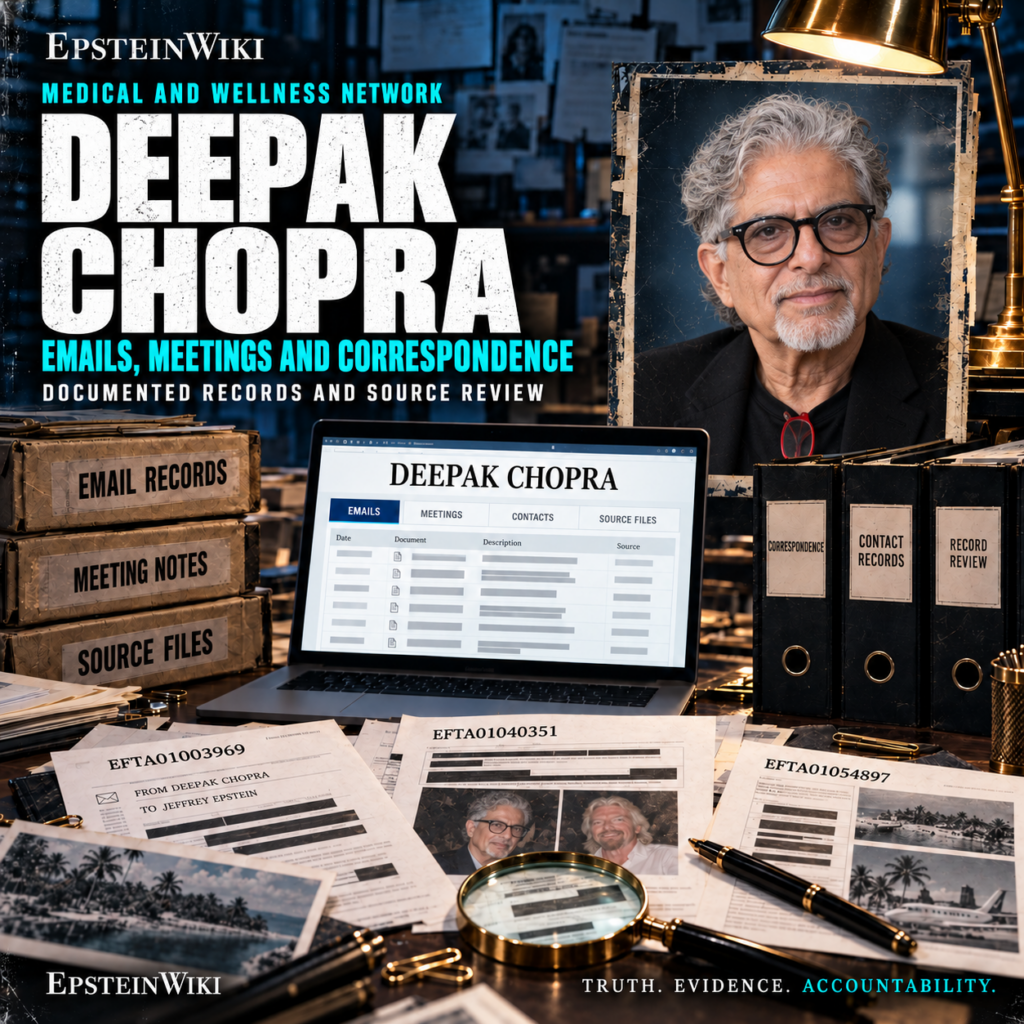
Snapshot
Deepak Chopra is a physician, author, and influential figure in the wellness industry. Public allegations about his conduct toward women predate his relationship with Jeffrey Epstein. They include a former employee’s sexual harassment claims, a former Chopra Center client’s account of an alleged sexual relationship while she sought help with addiction, and an artist’s account of an invitation to meet privately when she was 16.
A separate body of evidence documents Chopra’s relationship with Epstein from 2016 through 2019. It includes frequent correspondence, social meetings, discussions about women, invitations, research proposals, and a $50,000 payment from an Epstein controlled foundation to the Chopra Foundation.
The allegations against Chopra and his Epstein correspondence must be examined together without claiming that one proves the other. The reviewed evidence does not establish that Chopra participated in Epstein’s abuse or that the women who accused Chopra were part of Epstein’s network.
Key Takeaways
- Joyce Weaver accused Chopra of sexual harassment and retaliation in the 1990s. A jury rejected her employment case in 2000. Chopra denied her allegations.
- A former Chopra Center client published a detailed account in 2021. She alleged that Chopra initiated a sexual relationship while she was receiving help for addiction and had disclosed earlier sexual abuse. Chopra denied her account.
- Artist Sevda Rubens spoke publicly in 2026. She said Chopra sought a private late night meeting at a meditation event when she was 16. She said she declined. Her account does not allege sexual contact.
- Chopra and Epstein were introduced in July 2016. Their messages continued into 2019, years after Epstein’s conviction involving a minor.
- Chopra advised Epstein on a book about his abuse allegations. In September 2016, he proposed ways to confuse and undermine its author. In October, he advised Epstein to ignore the book.
- Their messages repeatedly discussed women. Chopra agreed in writing when Epstein asked him to find a woman in Israel. He also accepted Epstein’s offer to send two women to one of his events. The reviewed records do not establish their ages or show that the proposed Israeli introduction happened.
- Money moved between the networks. A released image of a paid check records a $50,000 payment from Epstein’s Gratitude America to the Chopra Foundation in October 2017. Separate messages discuss possible funding for research associated with the University of California San Diego.
- No verified island visit was established. The reviewed sources do not place Chopra on Little Saint James or document an Epstein survivor accusing him of participation in Epstein’s abuse.
The 1990s Sexual Harassment Case
The Los Angeles Times reported in 1997 that Joyce Weaver, who worked at the Sharp center associated with Chopra, alleged that Chopra and colleague David Simon made unwelcome sexual overtures. She also complained about having to handle calls involving women she believed were connected to Chopra’s personal life. Chopra and Simon denied the allegations.
Weaver said she lost her job after rejecting Chopra’s advances or raising complaints. Her litigation involved sexual harassment and employment claims. In March 2000, a San Diego jury rejected her case. Contemporary reporting on the verdict described a brief jury deliberation. The Los Angeles Times account reported that the jury found Weaver was employed by the hospital sponsoring Chopra’s work rather than by Chopra’s company.
That result is an essential part of the record. It should not be described as a court finding that Chopra committed harassment. Nor does the verdict independently resolve every disputed personal interaction Weaver described.
Chopra brought his own claim alleging Weaver had tried to blackmail him with false accusations. A jury rejected that claim in January 2000. A judge then set aside that verdict and granted Chopra a new trial because of concerns about the first trial’s fairness. Reporting on the later ruling documents why the initial verdict against Chopra must not be presented as a final judgment.
Another former worker, Jyl Auxter, brought a claim connected to the same workplace. The Los Angeles Times reported that Auxter accused Simon, not Chopra personally, of harassment. Her case belongs in the history of litigation surrounding the center, but it is not a second direct sexual harassment accusation against Chopra.
A separate 1996 magazine story claimed Chopra had hired a sex worker. The Los Angeles Times reported that the woman recanted, the magazine apologized, and it agreed to pay Chopra’s legal fees after he sued. The recanted claim must not be treated as established misconduct or merged with Weaver’s case.
The Former Chopra Center Client’s 2021 Account
A first person account published by Lioness in September 2021 describes a woman’s experience at the Chopra Center more than twenty years earlier. The publication withheld her name at her request.
The writer said she arrived seeking help for addiction. She described regular meetings with Chopra in which she told him about earlier sexual abuse and other trauma. According to her account, he began by kissing her after a meeting, later kissed her on the lips, told her he had feelings for her, and described their connection in spiritual terms.
She alleged that Chopra took her to a motel, where they had sex, and that the relationship continued while she remained involved with the center. She described feeling dependent on him, withdrawing from the center’s other activities, and experiencing serious harm to her recovery. Her account also describes an encounter during a retreat in Goa, India, and the depression and relapse she said followed the relationship.
These are allegations made by the writer. Lioness stated that its editors checked her account against diary entries and interviewed people to whom she had described events close to the time they occurred. The publication also stated that Chopra denied the allegations.
The woman described sexual contact when she was an adult. Her central allegation concerns the use of authority and trust over someone seeking help with addiction after disclosing sexual trauma. Her account does not allege that Epstein was involved.
Sevda Rubens’s Account About an Encounter at 16
India Today reported Rubens’s public allegation in February 2026. Artist Sevda Rubens said she attended a meditation event hosted by Chopra in Europe when she was 16. She alleged that he gave her his personal telephone number and encouraged her to meet him privately late at night.
Rubens said she declined and left feeling uncomfortable. Her account does not allege that a private meeting took place or that sexual contact occurred. The reviewed reporting does not establish the event’s exact date or provide an independent record of their interaction.
Rubens spoke out while Chopra’s Epstein emails were receiving renewed attention. That timing does not connect her alleged encounter to Epstein.
How Chopra Entered Epstein’s Circle
The July 6, 2016 email, EFTA02458425 shows Chopra thanking Barnaby Marsh for arranging an introduction to Epstein. Chopra thanked Epstein for his time and guidance, proposed a public discussion with physicist Lawrence Krauss, and offered to send articles and material from an upcoming book.
The email establishes a direct introduction and Chopra’s interest in continuing the contact. Epstein’s 2008 conviction involving a minor was already public. The message alone does not establish what Chopra knew about the full history of Epstein’s abuse on the day they met.
Their correspondence continued through 2019. CNN reported reviewing hundreds of messages. Raw search counts showing Chopra’s name thousands of times include duplicated documents and quoted email chains, so they should not be reported as thousands of distinct meetings.
The August 2016 Message About Younger Women
The August 6, 2016 exchange, EFTA02339289 began with Epstein asking Chopra what experiences and people he enjoyed. Chopra wrote about his career, books, and personal interests. He said his “biological needs” were met occasionally and said he enjoyed the company of younger women whom he described as intellectually sharp and aware.
This is Chopra’s own statement to Epstein shortly after their introduction. It does not identify a particular woman, establish her age, or describe a specific sexual act. It is relevant to the later messages because it shows that discussions about women were present early in their relationship.
Chopra’s Advice About Filthy Rich
Epstein Data’s examination of the source records documents Chopra’s reaction to publicity for Filthy Rich, the 2016 book by James Patterson and John Connolly about Epstein and the allegations against him.
In a September 23 exchange, EFTA01744027, Epstein sent Chopra a link to preview material. A second reply, EFTA01744103, proposed inviting an author to dinner, confusing him, and finding a writer who could challenge his credibility. Chopra suggested discussing ways to make the author ineffective and undermine him.
The scope of that advice matters. Chopra did more than offer Epstein a casual reassurance. He proposed a response to a book dealing with Epstein’s public reputation and abuse allegations. The messages do not establish that his proposed tactics were carried out.
After the book appeared, Chopra’s October 16 message, EFTA02447957, advised Epstein to ignore it completely. These exchanges establish awareness of publicity about the allegations. They do not prove how much of the book Chopra read.
The Withdrawn Lawsuit Exchange
A House Oversight record reproduced by Voice of San Diego contains a November 2016 exchange after Epstein sent Chopra a news item about a withdrawn civil lawsuit. The woman had alleged that Donald Trump and Epstein sexually assaulted her when she was 13.
Chopra asked whether the woman had also dropped her case against Epstein. Epstein answered yes. Chopra replied, “Good.”
The document shows Chopra discussing a public allegation involving Epstein and a minor. It does not prove the underlying claim in the withdrawn lawsuit. The plaintiff in that particular exchange should not be identified as Virginia Giuffre; that identification has appeared in some coverage without support from the cited exchange.
Messages About Women and Travel
The following records show the range of sexualized and social correspondence. None establishes the age of a woman described simply as a “girl.”
- Israel invitation: EFTA02382260 records Chopra inviting Epstein to Israel, suggesting he could use a fake name and telling him to bring his “girls.” An invitation does not establish that Epstein went.
- Request for a woman in Israel: EFTA02357374 records Epstein’s March 2017 request to find him a “cute Israeli blonde.” Chopra replied, “I can,” and described the women he had in mind in sexualized terms. The document does not show a completed introduction.
- Sexualized wordplay: EFTA02656821 contains the March 2017 exchange in which discussion of consciousness turns to “cute girls” and sexual innuendo. The language is documented. The identity and age of any woman supposedly being discussed are not.
- Other invitations: EFTA00946474 concerns Switzerland, while EFTA02659438 concerns a healing event and retreat. Chopra referred to women accompanying Epstein. These records do not establish that they traveled.
- A female friend: EFTA00679040 records Chopra comparing a woman to Epstein’s “girls.” The message does not identify who the women around Epstein were or what Chopra knew about their circumstances.
- A meeting with his son in law: EFTA01619579 contains a 2018 exchange in which Chopra suggested Epstein might meet his son in law, then added that they could not talk about “girls.” The remark shows the subject was familiar in their conversations. It does not explain precisely what Chopra meant.
In a separate October 2016 text record, EFTA01619496, a correspondent said they enjoyed watching Chopra focus on his “prey.” Chopra answered that he was “not a predator Just a lover.” The correspondent’s identifying information is redacted. The text cannot conclusively be attributed to Epstein from its visible header.
The Two Women Offered for a Wall Street Event
The November 2017 email chain, EFTA02562196 shows Chopra inviting Epstein to an event on Wall Street. Epstein replied that he was in Florida but wanted to send “two girls.” Chopra requested their names and said he would arrange for them to be guests.
Further arrangements in EFTA02558485 concern passes and contact information. They show planning beyond a single casual remark. They do not establish the women’s ages, their relationship to Epstein, or whether they entered the event.
The same chain records a separate invitation for Chopra to dine with Epstein, Woody Allen, Soon Yi Previn, and Miroslav Lajčák. Chopra wrote that he was delayed and could not attend that dinner. The cancellation should not be mistaken for evidence that he never attended any other Epstein dinner.
Meetings, Homes, and Conferences
Voice of San Diego’s document review and CNN’s reporting describe repeated contact and messages indicating visits at Epstein’s New York, Palm Beach, and Paris residences. Reporting based on calendars has identified at least a dozen meetings or appointments between 2016 and 2019. A scheduled appointment is not necessarily a completed visit, so individual entries need their own corroboration.
Several records give more specific context:
- New York social contact: Messages and reporting describe dinners at Epstein’s Manhattan home, including gatherings involving Woody Allen. These should be distinguished from the particular November 2017 dinner Chopra cancelled.
- An introduction to Michael Wolff: Ellie Leonard’s transcription of Wolff’s Epstein emails includes a January 2017 exchange in which Epstein asked Wolff what he thought of “my buddy deepak.” Wolff responded positively and requested Chopra’s email address. This documents Epstein presenting Chopra as a social contact. It does not independently establish what the men subsequently discussed.
- Science of Consciousness conference: EFTA02391123 includes a May 2017 exchange in which Epstein said he would see Chopra at the San Diego conference and mentioned Noam Chomsky. The attached program lists Chopra and Chomsky. The message establishes their plan; additional reporting describes Epstein attending.
- Chopra Center visit: EFTA02394767 discusses Epstein coming to the Carlsbad center and the possibility of an Ayurvedic massage. The correspondence does not establish that a massage occurred.
- Public debate: EFTA02387473 records an invitation connected to Chopra’s debate with Michael Shermer. It should not be converted into a claim of attendance without further evidence.
- Later correspondence: EFTA02634652 documents contact in 2019, close to the end of the period reflected in the released messages.
EpsteinWiki’s conferences and gatherings index provides context for the wider events network. Neither conference participation nor an invitation establishes involvement in Epstein’s crimes.
The $50,000 Payment to the Chopra Foundation
The released image of check 332, EFTA01348681 records a $50,000 payment dated October 18, 2017, from Epstein’s Gratitude America to the Chopra Foundation. Epstein Data’s review of Gratitude America’s checks identifies the payment as paid. The Daily Beast’s investigation of the foundation separately reported that Gratitude America listed the Chopra Foundation among its recipients.
This payment is distinct from the proposed University of California San Diego research funding. The available check establishes a transfer to the foundation. It does not establish what Chopra personally received, the purpose imposed on the funds, or what any individual at the recipient organization knew about their source. It does make a description of the relationship as purely conversational incomplete.
The University Research Proposal
The correspondence in EFTA01013830 discusses researcher V. S. Ramachandran and a proposed study of savant syndrome associated with the University of California San Diego. The messages consider possible funding figures ranging from $500,000 to $3 million. Those figures describe proposals, not verified contributions.
A separate document, EFTA00982555, records Epstein instructing accountant Richard Kahn to send $25,000 through Gratitude America for research associated with the University of California Regents. The instruction should be distinguished from the separately documented $50,000 check to the Chopra Foundation.
These records show Chopra’s role in bringing Epstein into research conversations. EpsteinWiki’s Enhanced Education article offers broader context on his education and research interests.
Chopra’s Account of the Relationship
Salon reported Chopra’s October 2025 statement to CBS News. Chopra said Epstein had expressed interest in meditation because of insomnia and described their meetings as roughly 30 minute meditation sessions.
The released correspondence covers subjects beyond sleep or meditation, including social plans, women, publishing, research, and funding. Emails cannot establish everything said during private meetings, but Chopra’s description of those meetings does not account for the breadth of their documented contact.
In February 2026, Chopra said he had never participated in criminal or exploitative conduct. He described his contact as limited and unrelated to abuse, acknowledged poor judgment in the tone of some messages, and expressed support for survivors. The records allow readers to assess the word “limited” against years of correspondence, meetings, invitations, and a payment to his foundation. They do not prove he participated in Epstein’s crimes.
KPBS reported the University of California San Diego’s response: Chopra’s unpaid voluntary clinical professor appointment was due to end on June 30, 2026. The university said he had no active responsibilities at the time. Its decision is a professional consequence, not a criminal finding.
What Is Established and What Remains Open
- Established by public reporting: Weaver made sexual harassment and retaliation allegations. A jury rejected her employment case. Chopra denied the allegations.
- Established as published allegations: A former center client gave a detailed account of an alleged sexual relationship during treatment. Chopra denied it. Rubens described an invitation to meet privately when she was 16 and said she declined.
- Established by released records: Chopra and Epstein corresponded for years, discussed women, planned meetings, addressed publicity about abuse allegations, pursued research contacts, and arranged for two women Epstein offered to send to an event.
- Established by a payment record: Gratitude America paid $50,000 to the Chopra Foundation in October 2017.
- Not established by the reviewed records: The ages of the women described as Epstein’s “girls” in particular messages, a completed introduction following the Israel request, the attendance of the two women at the Wall Street event, or Chopra’s participation in Epstein’s abuse.
- Not established by the reviewed records: A Chopra visit to Little Saint James. Claims circulating about unidentified images or videos require reliable identification and location evidence before they can be reported as an island visit.
The record is substantial, but it contains different kinds of evidence. A woman’s account, a jury verdict, an email, a proposed meeting, and a paid check answer different questions. None should be made to prove more than it actually shows.
Questions the Evidence Does Not Resolve
- Did anyone act on Chopra’s written agreement to find Epstein a woman in Israel?
- Who were the two women Epstein offered to send to the Wall Street event, and did they attend?
- What was the intended use of Gratitude America’s $50,000 payment to the Chopra Foundation?
- Which scheduled visits to Epstein’s homes can be independently confirmed as completed meetings?
- Did Chopra ever visit Little Saint James? The reviewed material does not verify such a visit.
- What happened after the initial verdict in Chopra’s claim against Weaver was set aside and a new trial was ordered? The contemporary rulings cited here do not establish a final outcome for that separate claim.
Sources
- Los Angeles Times, 1997: Weaver and Auxter allegations, denials, and the recanted magazine claim.
- Los Angeles Times, 2000: related cases and jury findings.
- Rediff, 2000: verdict in Weaver’s employment case and later ruling setting aside the verdict in Chopra’s separate claim.
- Lioness, 2021: former Chopra Center client’s first person account, editorial verification statement, and Chopra’s denial.
- India Today, 2026: Sevda Rubens’s account.
- EFTA02458425: July 2016 introduction through Barnaby Marsh.
- EFTA02339289: August 2016 discussion of Chopra’s interests and younger women.
- EFTA01744027: September 2016 Filthy Rich exchange, EFTA01744103: proposal concerning the author, and EFTA02447957: October advice to ignore the book.
- Epstein Data: documentary history of Filthy Rich.
- House Oversight record: November 2016 exchange about a withdrawn lawsuit.
- EFTA02382260: Israel invitation and suggestion to use a fake name, EFTA02357374: request to find a woman, and EFTA02656821: sexualized exchange.
- EFTA00946474: Switzerland correspondence, EFTA02659438: healing event invitation, EFTA00679040: reference to Epstein’s “girls”, and EFTA01619579: 2018 son in law exchange.
- EFTA01619496: October 2016 text with a redacted correspondent.
- EFTA02562196: November 2017 event arrangements and cancelled dinner and EFTA02558485: further arrangements for the women.
- EFTA02391123: Science of Consciousness conference program and correspondence, EFTA02394767: Chopra Center visit planning, and EFTA02387473: debate invitation.
- EFTA01348681: $50,000 check to the Chopra Foundation and Epstein Data: review of Gratitude America’s payment records.
- EFTA01013830: proposed savant syndrome research funding and EFTA00982555: $25,000 research payment instruction.
- EFTA02634652: correspondence from 2019.
- Ellie Leonard: transcription of Michael Wolff’s exchanges with Epstein, including the Chopra introduction.
- Voice of San Diego: investigation of the Chopra and Epstein messages.
- CNN: review of messages and reported visits.
- Salon: Chopra’s 2025 explanation and analysis of the correspondence.
- KPBS: university response and interview about the documents.