
How Jeffrey Epstein’s Business and Trafficking System Worked
Snapshot
- Article type: EpsteinWiki knowledge base article
- Primary subject: Jeffrey Epstein’s financial, trafficking, recruitment, and influence systems
- Period covered: Approximately 1974 through 2019
- Status: Living article
- Evidence base: Survivor testimony, court records, FBI records, financial documents, institutional investigations, emails, calendars, flight records, and EFTA files
- Last updated: July 30, 2026
A Living, Survivor Centered Evidence Report
This is a living EpsteinWiki report. It is designed to be updated whenever new court records, survivor testimony, financial documents, government transcripts, institutional investigations, or Epstein Data files become available.
The report excludes the separate 9/11 hypothesis. Its focus is the documented structure that allowed Jeffrey Epstein to recruit and abuse girls and young women, move them between properties, offer some survivors to other powerful people, obtain enormous payments from wealthy clients, maintain access to banks and institutions, and protect his reputation after becoming a registered sex offender.
Key Takeaways
- Epstein’s operation combined a trafficking system with a private financial and influence business. The two systems shared money, properties, staff, transportation, introductions, and professional legitimacy.
- The central recruitment mechanism was intentionally ordinary. Girls were invited to provide a paid massage, the encounter became sexual, and some victims were then paid to recruit more girls.
- Ghislaine Maxwell was not merely a girlfriend or social companion. A federal jury convicted her of conspiring with Epstein to recruit, groom, transport, and sexually abuse minors.
- Employees and associates maintained the machinery by answering telephones, scheduling massages, arranging travel, managing properties, paying expenses, and coordinating access.
- Survivor testimony establishes that Epstein’s system was not limited to his own abuse. Survivors described being directed, offered, or “lent out” to other powerful men.
- Epstein used cash, tuition, housing, travel, employment, gifts, professional opportunities, and access to elite circles to create dependency, gratitude, silence, and compliance.
- Modeling, schools, social clubs, wealthy households, friendship referrals, and donor relationships created recruitment and access channels.
- Epstein’s financial business remains unusually opaque. Leslie Wexner gave him exceptional authority over personal and business affairs. Leon Black later paid him at least $158 million, with later Senate findings identifying approximately $170 million.
- Major banks continued serving Epstein after his 2008 conviction. Regulatory and civil records show suspicious cash withdrawals, payments to women, settlement expenses, legal payments, and transfers involving numerous Epstein entities.
- Lawyers, bankers, accountants, academics, doctors, public officials, and cultural institutions gave Epstein access and legitimacy. Association alone does not establish criminal participation, but the combined network helped him appear safe, useful, and protected.
- There is no single reliable “client list.” The evidence instead shows overlapping categories that include alleged sexual recipients, financial clients, recruiters, employees, professional advisers, social contacts, institutional enablers, and reputation assets.
Important Evidence Notice
This article distinguishes documented facts, survivor allegations, disputed claims, and unresolved investigative questions. Inclusion in an address book, calendar, flight record, email, photograph, financial record, or social network does not independently establish participation in Epstein’s crimes. Each allegation must be attributed to its original source.
Evidence Standard
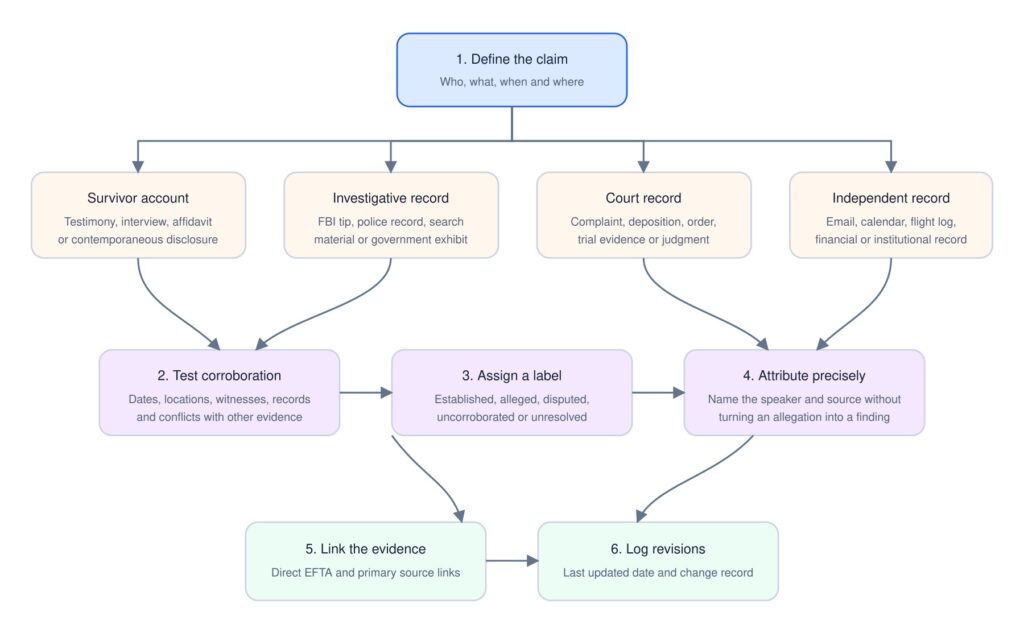
Survivor Testimony
Survivor testimony is substantive evidence. It is not erased because prosecutors declined to charge a person, because a disclosure occurred years later, because trauma affected recall, or because an accused person denied the allegation.
Documentary Corroboration
Corroboration may include emails, schedules, message pads, flight records, financial transfers, photographs, address books, property records, employee testimony, contemporaneous journals, police reports, FBI interviews, court filings, and admissions.
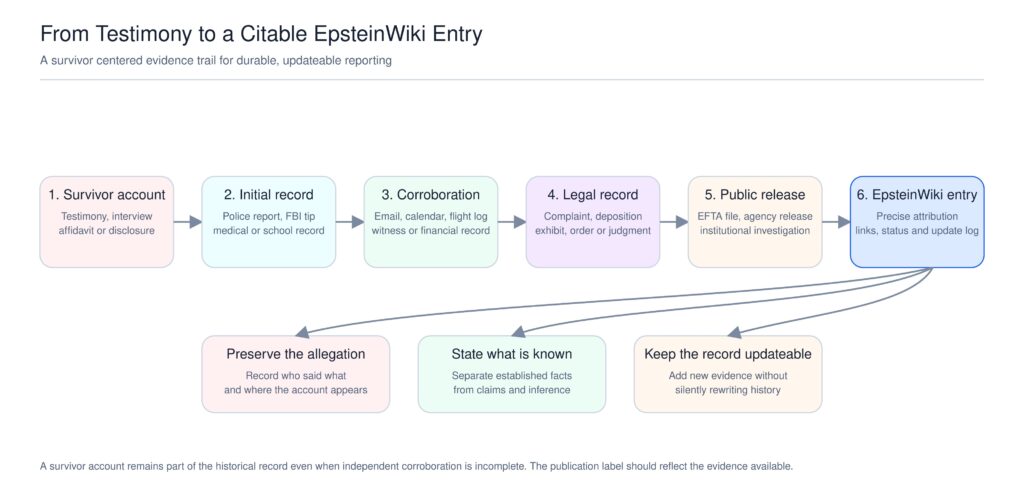
Legal Status
This report distinguishes among:
- A criminal conviction
- A criminal charge
- Sworn survivor testimony
- A civil allegation
- A regulatory finding
- A financial settlement
- Documentary association
- An investigative lead
- Unsupported speculation
A denial is not an adjudication. A settlement is not automatically an admission. A dismissal based on time limits, jurisdiction, standing, or a prior agreement does not establish that the underlying conduct did not occur.
Language Used in This Report
“Trafficking system” refers to the structure used to recruit, groom, transport, schedule, compensate, control, and sexually exploit victims.
“Business system” refers to Epstein’s financial advisory work, entity structure, client payments, banking relationships, property ownership, employment network, and influence brokerage.
“Alleged sexual recipient” means a survivor reported that Epstein or Maxwell directed, offered, or delivered her to that person. It does not mean the person was criminally convicted.
“Financial client” means a person paid Epstein or received financial, tax, estate, investment, or related services. That classification does not establish sexual participation.
“Enabler” is used only when evidence supports a role in financing, protecting, normalizing, maintaining, or concealing the operation.
The System in One View
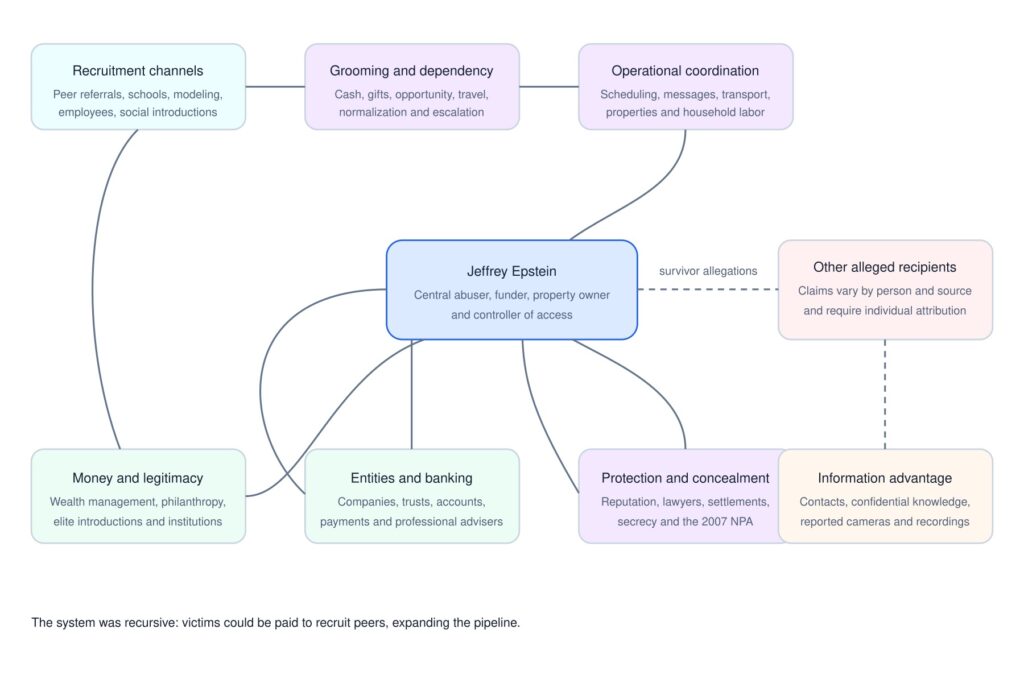
Epstein’s operation worked as a repeating cycle:
1. A girl or young woman entered through a massage referral, friendship, school, modeling opportunity, employment offer, donor relationship, social introduction, or promise of financial assistance.
2. Epstein, Maxwell, or another trusted person normalized the setting and reduced the victim’s sense of danger.
3. Money, travel, tuition, gifts, housing, employment, or elite access created an incentive or feeling of obligation.
4. A massage or private meeting became sexual.
5. The victim was paid in cash and was sometimes offered additional money to recruit friends.
6. Staff recorded contact information, scheduled future appointments, arranged transportation, and maintained access to the properties.
7. Some survivors were moved between New York, Palm Beach, New Mexico, the United States Virgin Islands, Paris, London, and other locations.
8. Survivor testimony states that some victims were directed or offered to other influential men.
9. Banks, businesses, trusts, aircraft, properties, lawyers, accountants, and staff kept the operation functional.
- Elite relationships and charitable, academic, political, and professional associations helped Epstein present himself as respectable and indispensable.
- When scrutiny increased, legal pressure, settlements, reputation management, private investigations, nondisclosure arrangements, and the 2007 nonprosecution agreement reduced accountability.
This was not a single company with a single payroll and written trafficking plan. It was an ecosystem in which criminal activity operated through ordinary looking financial, domestic, social, educational, and professional systems.
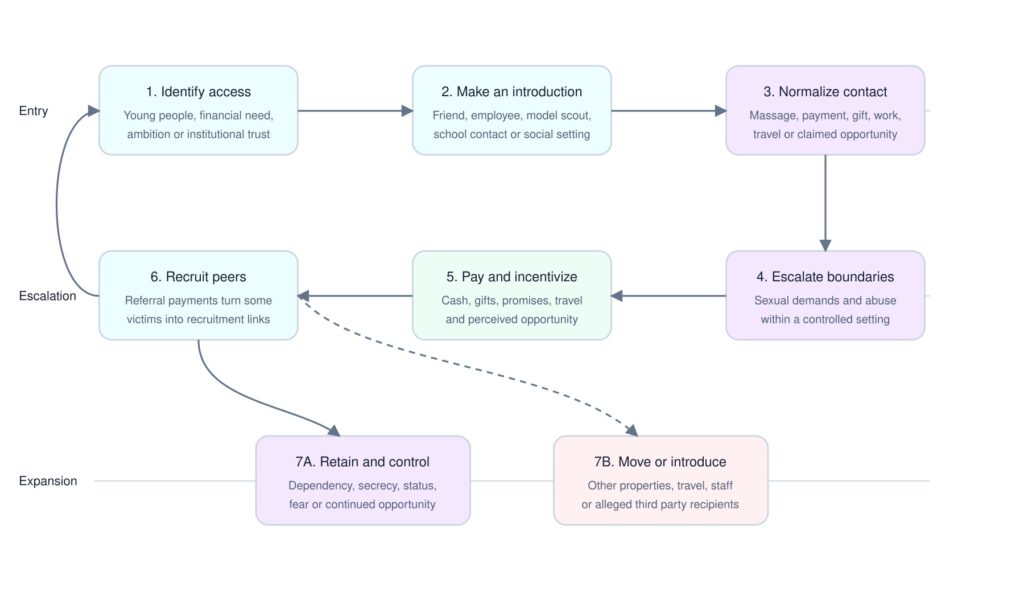
The Recruitment Engine
The Massage Entry Point
The 2019 federal indictment described the core mechanism. Girls were recruited to provide massages at Epstein’s New York and Palm Beach residences. Epstein then escalated those massages into sexual contact and paid the girls hundreds of dollars in cash.
DOJ account of the 2019 federal charges
The massage framing served several purposes:
- It made the invitation appear like ordinary paid work.
- It provided a reason for a young person to enter a bedroom or massage room alone.
- It created gradual boundary violations rather than announcing the sexual demand in advance.
- It gave staff a neutral word to use in schedules, calls, and messages.
- It allowed Epstein and his defenders to mischaracterize organized abuse as individual prostitution.
Paid Peer Recruitment
Epstein paid some victims to bring additional girls. The new girl was paid for the encounter, while the recruiter received a referral payment. This turned a victim’s friendship network into a self expanding recruitment chain.
The Department of Justice stated that this system gave Epstein a steady supply of new victims, including girls as young as fourteen.
DOJ description of the recruitment network
The structure exploited economic need and social trust. A teenager was more likely to accept a paid massage job recommended by a friend than an invitation from an unknown adult man.
Recruitment Through Schools and Donor Access
The July 2026 Interlochen external investigation substantially expands the institutional record.
Interlochen reported that Epstein was a donor from 1990 through 2003. He funded scholarships for individual students and financed a named lodge. Investigators contacted eight alumni believed to have relevant Epstein information. Six agreed to interviews, and two reported physical sexual conduct by Epstein.
One alum reported that Epstein and Maxwell offered to pay her tuition and did so. She said they later withdrew support for additional schooling after she did not engage in requested conduct. She described Epstein touching her at his Interlochen lodge and during trips to New York that he financed.
Another alum said Epstein paid for her trip to New York after graduation. She described being taken to a room with a massage table, giving Epstein a massage, and possibly being asked to remove her top. Two other individuals provided information corroborating her account.
The second alum’s mother said she called Interlochen and warned that Epstein was preying on its students. According to the mother, the person who answered said Epstein was not a teacher and the reported conduct occurred away from campus. She said no one followed up. Investigators found no surviving institutional record of the warning.
The report also documented a broader historical problem. Alumni described donors and trustees as receiving broad access to students, classes, rehearsals, dormitory areas, and personal information.
Interlochen external investigation report
The Interlochen investigators documented reports rather than deciding whether every incident occurred as described. That limitation must remain attached to the findings. The firsthand accounts nevertheless reveal how scholarships, donor status, travel, and campus access could become part of a grooming and recruitment system.
Recruitment Through Mar a Lago
Virginia Giuffre said Ghislaine Maxwell recruited her while she was working at the Mar a Lago spa. The location mattered because it placed Maxwell near young female employees in a luxury environment where wealthy adults appeared legitimate and opportunity seemed plausible.
Giuffre recruitment record EFTA00208128
Related Mar a Lago recruitment record EFTA00210958
The evidence establishes recruitment at Mar a Lago. It does not establish that the club’s management knew that Maxwell was recruiting Giuffre for abuse.
Recruitment Through Modeling
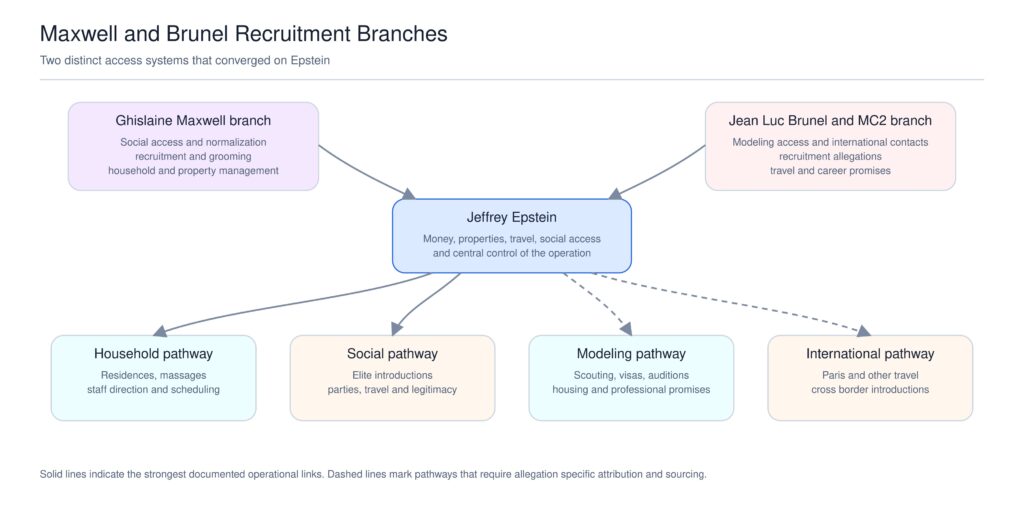
Jean Luc Brunel provided Epstein with access to aspiring models and international modeling networks. Survivors and investigators described modeling promises, travel, lodging, and career opportunities as recruitment tools.
Brunel founded MC2 Model Management with financial support associated with Epstein. The name MC2 visibly echoed Epstein’s interest in physics and the equation associated with Albert Einstein. The business provided a legitimate looking structure through which young women could be identified, transported, housed, introduced, and controlled.
The name itself does not establish the purpose of the company. The relevant evidence is the combination of Epstein financing, Brunel’s modeling access, survivor testimony, international travel, housing, and allegations concerning young women.
Juliette Bryant said she was recruited in South Africa through what appeared to be a modeling opportunity, transported into Epstein’s environment, deprived of control over her passport, and repeatedly sexually abused by Epstein.
Juliette Bryant’s survivor account
Brunel died in French custody in 2022 while under investigation. His death ended the possibility of a full criminal trial and left significant questions concerning the modeling pipeline unresolved.
Recruitment Through Employment and Assistance
Epstein’s environment repeatedly blurred employment, personal service, education, travel, and sexual access. Young women could be described as assistants, massage providers, models, students, girlfriends, guests, or employees while moving through the same properties and schedules.
David Blaine records illustrate the surrounding introduction culture without establishing sexual wrongdoing by Blaine. Documents show travel, dinners, visa assistance for an unidentified woman, references to a “French girl,” and a request that Blaine help Epstein find an assistant in South Africa.
Blaine aircraft and car logistics EFTA01888219
Blaine transportation record EFTA02163591
Blaine dinner schedule EFTA02130123
Blaine proposed dinner guest list EFTA01924576
Blaine daily schedule EFTA01975392
These records show access, introductions, and social coordination. No direct survivor allegation of sexual misconduct by Blaine has been located in the evidence reviewed for this edition.
Grooming, Dependency, and Control
Maxwell’s Trust Building Role
Ghislaine Maxwell gave the operation something Epstein could not supply alone: the reassuring presence of an adult woman.
The federal case established that Maxwell:
- Befriended minor victims.
- Asked about their families and personal lives.
- Took girls shopping or to the movies.
- Encouraged them to accept Epstein’s financial help.
- Normalized sexual conversation and sexualized massages.
- Was present during sexual interactions.
- Helped entice and transport minors between Epstein’s properties.
Maxwell was convicted in December 2021 and sentenced to twenty years in prison.
DOJ overview of Maxwell’s conviction and trafficking role
Money as Both Payment and Grooming
Cash served several different functions:
- Payment after sexualized massage encounters
- Recruitment fees for bringing another girl
- Immediate reinforcement that made returning appear economically necessary
- A way to avoid the visibility created by ordinary payroll systems
- A way to reframe abuse as a commercial transaction
Money was supplemented by tuition, rent, travel, clothing, medical assistance, education, employment, and gifts. This combination could make a survivor feel both dependent upon Epstein and indebted to him.
Gifts and Educational Assistance
The Maxwell prosecution described financial assistance as a grooming tool. Maxwell encouraged girls to accept travel or educational expenses so that they would feel obligated to Epstein.
DOJ account of Maxwell’s grooming methods
The Interlochen report supplies a direct institutional example. One alum said Epstein and Maxwell paid her tuition and later withdrew educational support after she resisted requested conduct.
Passport, Travel, and Isolation
International travel increased dependence. A young woman traveling on Epstein’s aircraft or staying at one of his properties could become separated from familiar people, money, transportation, and her passport.
Juliette Bryant described losing control of her passport after entering Epstein’s travel system. Other records document assistants arranging aircraft, cars, hotels, visas, and appointments.
Isolation did not always require physical confinement. Control over transportation, lodging, money, schedules, or immigration assistance could sharply reduce a young person’s practical ability to leave.
The Properties as Operational Infrastructure
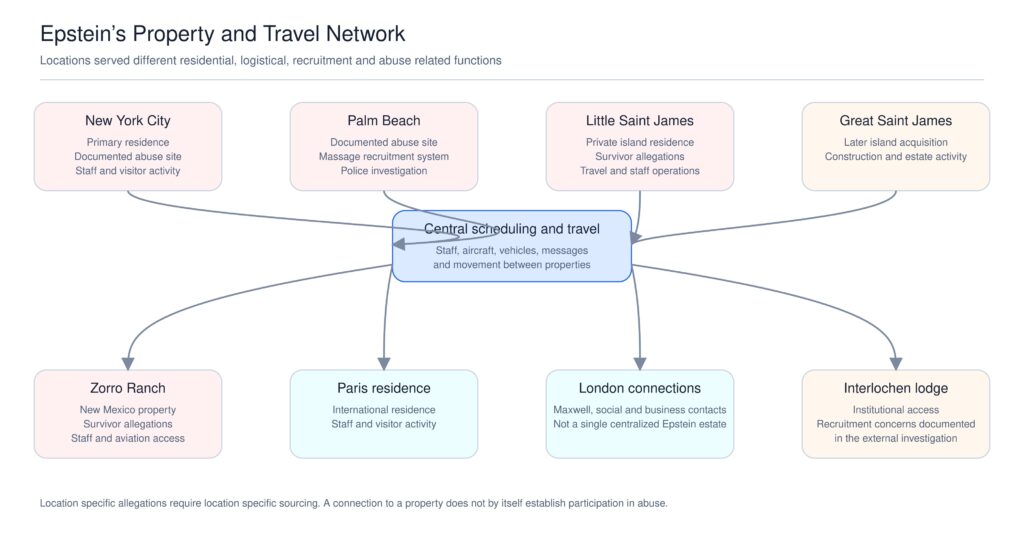
Epstein’s properties were not interchangeable vacation homes. They formed a distributed operational network.
9 East 71st Street, New York
The Manhattan townhouse functioned as:
- A residence
- A meeting site for wealthy clients and public figures
- A location for massages and sexual abuse
- An office and scheduling center
- A place where staff, young women, clients, and social contacts could be introduced to one another
Its scale allowed business meetings, private encounters, staff work, and social events to occur within the same building.
Kathryn Ruemmler testified in 2026 that Epstein commonly scheduled consecutive meetings around the dining room table, creating brief introductions as one influential visitor departed and another arrived. This description helps explain how the townhouse operated as an influence exchange as well as a residence.
Palm Beach
The Palm Beach house was a central site of the massage recruitment system. Police records, victim interviews, employee testimony, and the 2019 indictment describe repeated appointments, cash payments, and peer recruitment.
Zorro Ranch, New Mexico
The ranch provided geographic isolation, private aviation access, staff, guest accommodations, and distance from routine public observation. Survivors and witnesses placed young women and influential visitors there.
Little Saint James and Great Saint James
The Virgin Islands properties offered privacy, controlled transportation, local business entities, aircraft and marine access, and reduced visibility. Financial records later showed Epstein entities paying operating expenses, employees, contractors, women, and legal costs connected with his Virgin Islands presence.
Paris and London
The Paris apartment and Maxwell’s London residence extended the system internationally. The Maxwell case established that grooming and abuse occurred across multiple jurisdictions, including London.
Interlochen Lodge
Epstein’s named lodge gave him an on campus site associated with donor prestige. The building was renamed Green Lake Lodge in 2009 and demolished in June 2026 after local law enforcement was offered an opportunity to photograph the interior and exterior for possible evidentiary use.
Scheduling, Transportation, and Administrative Labor
Why the Assistants Matter
A trafficking system operating across several homes could not function through Epstein’s memory alone. It required administrative labor.
The 2019 indictment stated that employees and associates contacted victims and scheduled sexual encounters. Records show staff coordinating:
- Massage appointments
- Telephone messages
- Cars and drivers
- Aircraft and pilots
- Hotels and apartments
- Medical and beauty appointments
- School and tuition payments
- Guest lists and dinners
- Passports and visa matters
- Property access
- Cash and expenses
Sarah Kellen
Sarah Kellen appears repeatedly in survivor accounts, schedules, message records, and the administration of Epstein’s properties. Survivors described her arranging massages, travel, and access.
Kellen was named as a potential co conspirator in the 2007 nonprosecution agreement. She has not been criminally convicted for participating in Epstein’s trafficking operation.
Lesley Groff
Lesley Groff served as a longtime executive assistant and appears extensively in scheduling, correspondence, travel, payments, gifts, and logistics records.
Her records are significant because they show how ordinary executive assistance could maintain an environment in which business meetings, women, travel, properties, and private appointments were continuously coordinated.
Groff was also named as a potential co conspirator in the nonprosecution agreement. She has denied knowingly participating in sexual abuse or trafficking and has not been criminally convicted for doing so.
Nadia Marcinkova
Nadia Marcinkova appears in survivor accounts and records as both a young woman brought into Epstein’s environment and a later employee or associate. Her position illustrates why the categories of victim, recruiter, employee, and facilitator may overlap.
Marcinkova was named as a potential co conspirator in the 2007 agreement. She has not been criminally convicted for participating in Epstein’s trafficking operation.
Adriana Ross
Adriana Ross was associated with property and household operations and was named as a potential co conspirator in the 2007 agreement. She has not been criminally convicted for trafficking participation.
Pilots and Drivers
Pilots and drivers connected Epstein’s otherwise separate properties. Flight records can establish that a person traveled, but they cannot establish what the passenger knew or what occurred at the destination.
The most important investigative questions are:
- Who requested each flight
- Who arranged the passengers
- Whether any passenger was a minor
- Which staff member handled passports or ground transportation
- Whether the manifest was complete
- Which property and employee received the passengers
Pilot and flight interview EFTA00159180
Household Employees
Household employees observed the daily environment, maintained rooms, admitted guests, answered telephones, served meals, handled laundry, and encountered young women.
Palm Beach house manager Alfredo Rodriguez preserved a copy of Epstein’s contact book. He later pleaded guilty to obstruction after attempting to sell it rather than delivering it directly to investigators. His conduct complicated the chain of custody, but the book became an important map of Epstein’s contacts.
Household testimony is particularly valuable because it can connect schedules and message records to what actually occurred inside the properties.
The Legal Meaning of the 2007 Names
The nonprosecution agreement’s protection of “potential co conspirators” was extraordinarily consequential. It did not constitute a conviction or factual finding against every person named. It did, however, reduce the government’s ability to prosecute people who may have helped operate the system.
DOJ statement on the 2006 through 2008 investigation
Operation Leap Year timeline EFTA00224943
Delivery to Other Powerful Men
The available evidence does not support describing every prominent Epstein associate as a sexual client. It does support the conclusion that some survivors were directed or offered to other men.
The “Lent Out” Evidence
A federal prosecution memorandum records a survivor using the phrase “lent out” to describe occasions when Epstein or Maxwell directed her to engage in sexual contact with other men.
Federal prosecution memorandum EFTA02731082
Jane Doe Number Three
A released filing alleged that Epstein trafficked Jane Doe Number Three to politicians, business executives, foreign presidents, a prime minister, and other world leaders. It further alleged that Epstein required her to report back about the encounters so that he could potentially use the information for blackmail.
Jane Doe Number Three filing EFTA00021553
The blackmail allegation is important, but the currently public record does not establish a complete recording system, identify every alleged target, or prove that every sexual encounter was recorded.
People Named in Giuffre Related Records
Unsealed records identified people about whom Virginia Giuffre testified that she had been sexually trafficked. The names included:
- Prince Andrew
- Jean Luc Brunel
- Glenn Dubin
- Bill Richardson
- George Mitchell
- Marvin Minsky
- Thomas Pritzker
- Leslie Wexner
- Stephen Kaufmann
- Additional people whose identities remained redacted
Federal unsealing order identifying the testimony
The people named did not receive identical allegations, and several denied wrongdoing. Individual dossiers must preserve the exact survivor account, supporting evidence, denial, and legal outcome.
Prince Andrew
Virginia Giuffre alleged that Epstein and Maxwell trafficked her to Prince Andrew. A photograph places Giuffre with Andrew and Maxwell. Andrew denied the allegation and later settled Giuffre’s civil case without admitting liability.
Prince Andrew is among the strongest documented alleged recipient cases because the record combines direct survivor testimony, a photograph, witness evidence, public denials, and a civil settlement.
Jes Staley
Jes Staley occupied overlapping roles:
- Senior JPMorgan banker
- Close Epstein associate
- Alleged sexual participant
- Alleged institutional protector
A Jane Doe plaintiff alleged that Staley sexually assaulted her and observed trafficking related conduct. JPMorgan later sued Staley, alleging that he concealed information and placed his interests and Epstein’s interests above the bank.
Federal court decision summarizing the allegations
The United Kingdom Financial Conduct Authority found that Staley approved misleading statements about the nature of his relationship with Epstein. The Upper Tribunal upheld Staley’s industry ban.
FCA account of the Staley decision
The official tribunal decision records Staley writing, “That was fun. Say hi to Snow White.” Epstein responded by asking which character Staley wanted next. The exchange is sexualized and coded, but it does not independently identify “Snow White,” establish her age, or prove exactly what occurred.
Relevant Epstein Data records include:
Staley has denied the assault allegation and has not been criminally convicted for participating in Epstein’s trafficking operation.
Donald Trump
The Trump record contains several distinct categories that must not be collapsed:
- A long documented social relationship with Epstein
- Social and telephone records
- Virginia Giuffre’s recruitment at Mar a Lago
- Stacey Williams’s allegation that Epstein brought her to Trump and Trump groped her while Epstein watched
- A 2016 Jane Doe complaint alleging rape when she was thirteen, which was withdrawn before adjudication
- FBI tips and witness records that require individual reliability assessment
- Records in which separate witnesses denied or did not support particular allegations
Civil complaint preserved in FBI materials EFTA00019101
Victim associate interview EFTA00158466
FBI prominent names summary EFTA01660622
Victim interview containing a separate denial EFTA00158500
Victim interview recording an Epstein telephone call with Trump EFTA01248567
Pilot and flight record EFTA00159180
Trump has denied sexual wrongdoing and denied involvement in Epstein’s crimes. No criminal court has convicted Trump of participating in Epstein’s trafficking system.
Other Alleged Recipients
Survivor accounts and released records also require individual evaluation of allegations concerning Glenn Dubin, Bill Richardson, George Mitchell, Marvin Minsky, Jean Luc Brunel, Alan Dershowitz, Thomas Pritzker, Leslie Wexner, Stephen Kaufmann, and unidentified men.
Several denied the allegations. Giuffre later stated that she may have misidentified Dershowitz and withdrew that allegation as part of a legal resolution. That later qualification must be included whenever her earlier Dershowitz allegation is discussed.
Prominent names record EFTA01660622
FBI record concerning Glenn Dubin EFTA01249021
Accusation compilation EFTA00022133
Information Collection and Potential Leverage
What Is Documented
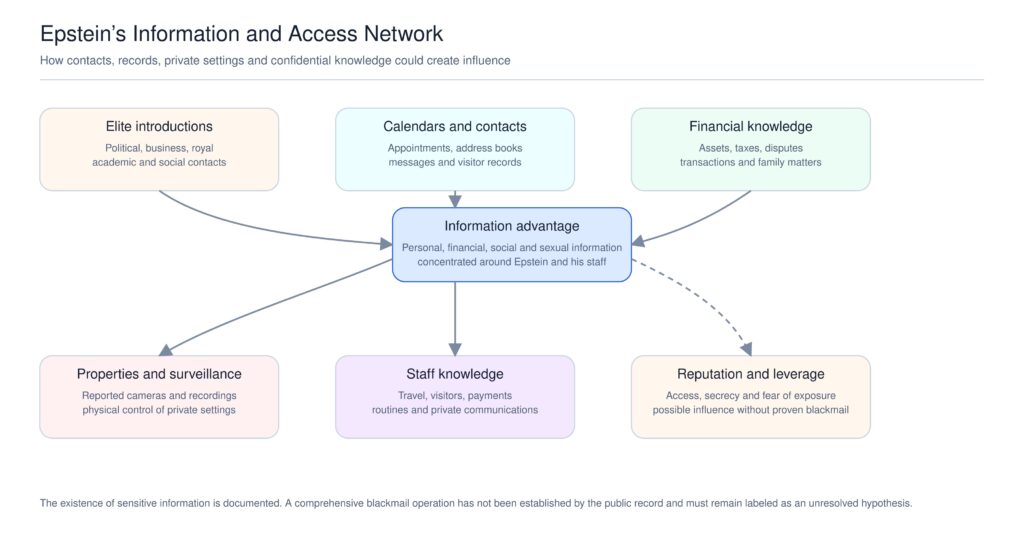
The record establishes that Epstein collected information through:
- Dense social networks
- Consecutive private meetings
- Telephone messages
- Detailed schedules
- Contact books
- Introductions among powerful people
- Financial advisory relationships
- Access to personal, legal, tax, estate, and reputational problems
- Survivor accounts that Epstein required reports concerning encounters with other men
This made Epstein an information broker even without proving a formal intelligence operation.
Cameras and Recordings
Witnesses and law enforcement records have described cameras or surveillance equipment at Epstein properties. Public tips also alleged recordings.
Public tip alleging the existence of recordings EFTA00020493
A public tip is evidence that an allegation was reported, not proof that the allegation was true. The released record does not yet establish a complete archive of compromising recordings, who controlled it, or how it was used.
David Copperfield as an Unresolved Knowledge Subject
Johanna Sjoberg testified that David Copperfield asked whether she knew girls were being paid to find other girls. Telephone and witness records also place Copperfield in repeated contact with Epstein.
Copperfield related court record EFTA00081180
Later FBI records reportedly show that investigators examined whether Copperfield and Epstein referred possible victims to one another. No criminal charge established that such referrals occurred. Copperfield denied knowing about Epstein’s crimes.
The proper classification is unresolved knowledge and possible referral subject, not proven trafficking participant.
Epstein’s Financial Business
Why His Profession Is Difficult to Define
Epstein described himself as a financier and adviser to extremely wealthy people, yet his public client list was remarkably small and his services were unusually opaque.
His apparent work included:
- Tax and estate planning
- Trust and entity design
- Investment and asset advice
- Problem solving for wealthy families
- Negotiation
- Due diligence and information gathering
- Introductions
- Reputation advice
- Access to lawyers, bankers, academics, scientists, political figures, and international contacts
This made him less like an ordinary portfolio manager and more like a private fixer for people with complex fortunes and sensitive problems.
The Dalton School and Entry Into Elite Networks
Epstein began teaching at the Dalton School despite lacking a completed college degree. Dalton placed him near wealthy New York families and students whose parents worked in finance, business, culture, and politics.
Donald Barr was the departing Dalton headmaster during the period in which Epstein was hired. Public accounts often state that Barr hired him, but the precise internal decision process and the person who approved the appointment should not be stated more definitively without Dalton personnel records.
Dalton did not teach Epstein financial crime. It gave a young man without conventional credentials entry into an unusually wealthy social network. That access helped lead to his next documented career at Bear Stearns.
Bear Stearns
After leaving the Dalton School, Epstein joined Bear Stearns. He worked in options and special situations and gained exposure to wealthy clients, complex transactions, risk, confidential financial information, and Wall Street relationship building.
The record does not establish that Bear Stearns taught Epstein to launder money. It does show that the firm gave him the technical vocabulary, elite contacts, and financial credibility that supported his later private advisory business.
Intercontinental Assets Group
After Bear Stearns, Epstein created Intercontinental Assets Group. He presented the firm as recovering money lost through fraud or misconduct and assisting wealthy clients with difficult financial problems.
The business remains poorly documented. Its importance is that Epstein began marketing secrecy, recovery, investigation, and access rather than a transparent investment product.
Towers Financial and Steven Hoffenberg
Epstein worked with Steven Hoffenberg at Towers Financial, which later collapsed in a major Ponzi scheme. Hoffenberg pleaded guilty and received a lengthy prison sentence.
Hoffenberg later described Epstein as deeply involved. Epstein was not charged in the Towers Financial prosecution. Hoffenberg’s statements are relevant but should not be converted into an adjudicated finding that Epstein participated in the Ponzi scheme.
Leslie Wexner
Leslie Wexner was the relationship that transformed Epstein’s apparent status.
Wexner gave Epstein broad power of attorney and extraordinary access to his finances, properties, companies, and personal affairs. Epstein acquired or controlled valuable property associated with Wexner, including the Manhattan townhouse that became central to Epstein’s business and abuse system.
The unresolved questions include:
- Why Wexner granted Epstein such extensive authority
- How much Epstein earned from the relationship
- Which assets were transferred and on what terms
- Whether all transactions were properly accounted for
- What Wexner and his advisers knew about Epstein’s conduct at different times
Wexner has said Epstein misappropriated substantial sums from him and denied knowledge of Epstein’s crimes.
Leon Black
Leon Black became Epstein’s largest publicly documented financial client after Epstein’s 2008 conviction.
The Dechert review identified $158 million in payments from Black to Epstein between 2012 and 2017. The Senate Finance Committee later reported evidence that the actual amount was approximately $170 million.
Senate Finance Committee investigation into Black’s payments
Senate findings concerning financing of Epstein’s operations
The documented services involved tax and estate planning. Senate investigators reported that money Black paid Epstein helped finance Epstein’s Virgin Islands operations.
Black denied participating in Epstein’s criminal conduct. He has not been criminally convicted for participating in the trafficking system.
Relevant Epstein Data records include:
- Survivor journal EFTA02731420
- Survivor evidence compilation EFTA00073205
- EFTA00087968
- EFTA00096366
- EFTA01246236
- EFTA02731576
- EFTA00156644
Financial Advice as Access to Secrets
A private adviser working on taxes, trusts, inheritance, divorce, debt, litigation, reputation, or family disputes gains access to exceptionally sensitive information.
That access had independent value. Epstein could understand:
- Where assets were held
- Which family members were in conflict
- Which transactions were vulnerable to scrutiny
- Which professionals controlled the client relationship
- Which legal or reputational risks frightened the client
- Which introductions or favors the client needed
This does not prove that every financial engagement was blackmail. It explains why Epstein’s financial and information roles reinforced one another.
Entities, Trusts, and Movement of Money
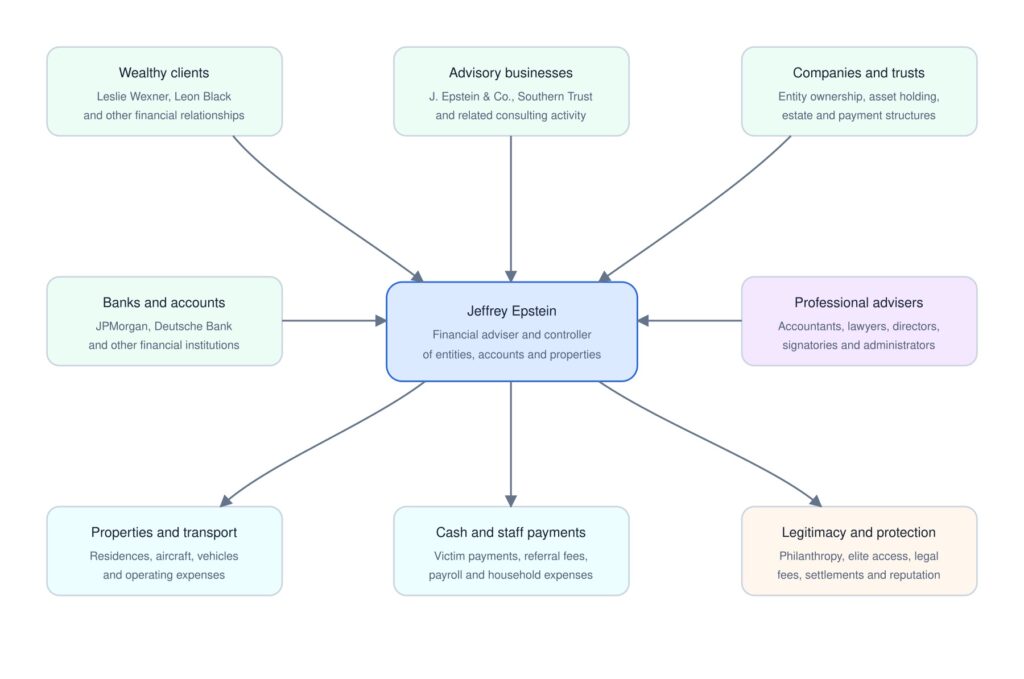
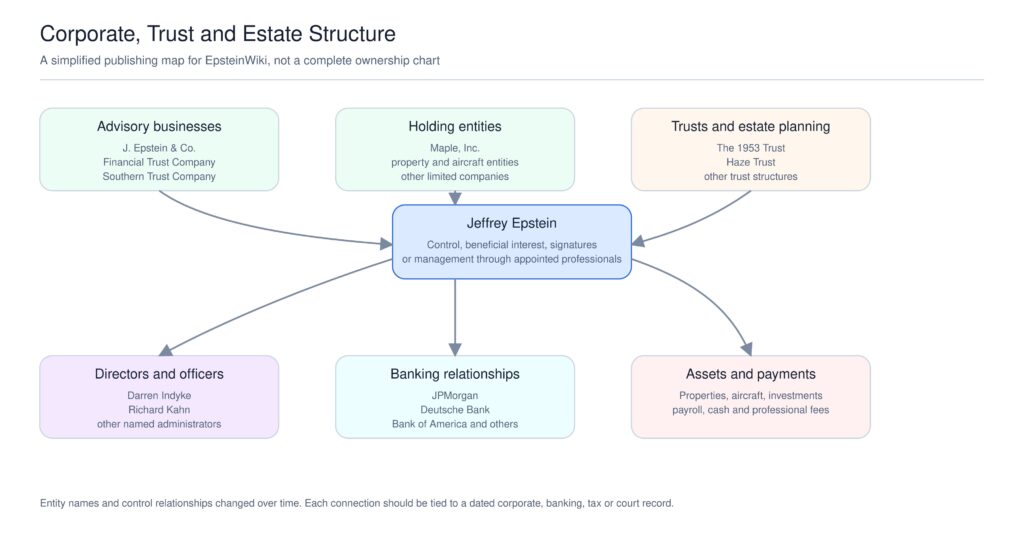
Epstein used numerous companies and trusts rather than operating through one easily understood business.
Important entities included:
- Financial Trust Company
- Southern Trust Company
- Haze Trust
- Gratitude America
- Plan D
- NES LLC
- Hyperion Air
- JEGE entities
- Property holding companies
The entity network served legitimate functions such as owning aircraft, holding property, employing staff, making investments, and conducting advisory work. The same fragmentation also made it harder to see the full movement of money across the system.
Southern Trust
Southern Trust became a major Virgin Islands entity and received valuable local tax benefits. Epstein described data analysis and other business activity, but the company’s actual operations and extraordinary value remain contested.
Epstein estate inventory identifying Southern Trust’s value EFTA00076491
Haze Trust
Released records identify Haze Trust transactions and high risk reviews that warrant continued tracing.
- Haze Trust alert record EFTA01369019
- Haze Trust urgent inquiry EFTA01386360
- Haze Trust transaction exhibit EFTA00080250
- Haze Trust high risk customer record EFTA00168946
- Consolidated Epstein entity and balance record EFTA01381149
The records support intensive financial reconstruction. They do not independently prove that every trust transaction was money laundering.
Darren Indyke
Darren Indyke served as Epstein’s longtime lawyer and handled trusts, entities, property, estate planning, and administrative matters. He later became a coexecutor of Epstein’s estate.
Indyke’s significance lies in duration and proximity. He appears across the structures that held and moved Epstein’s assets.
The evidence requires transaction level analysis. Legal work for Epstein does not itself prove knowing participation in trafficking or laundering.
Richard Kahn
Richard Kahn served as Epstein’s accountant and financial manager and later as a coexecutor of the estate. Records connect him to payments, accounts, entities, tax matters, and property expenses.
Kahn and Indyke became central to the Epstein Victims’ Compensation Program through their estate roles. Their long access to Epstein’s financial system makes them essential witnesses for reconstructing how money entered, moved through, and exited the network.
Harry Beller
Harry Beller appears in the financial and professional network and should remain a focused research subject, particularly for records surrounding Epstein’s money, accounting relationships, and the period around September 2001.
Current evidence does not justify assigning Beller a criminal role without transaction specific documentation. The next step is to identify every entity, account, engagement letter, payment authorization, and communication connecting Beller to Epstein.
Banking Infrastructure and Compliance Failures
JPMorgan
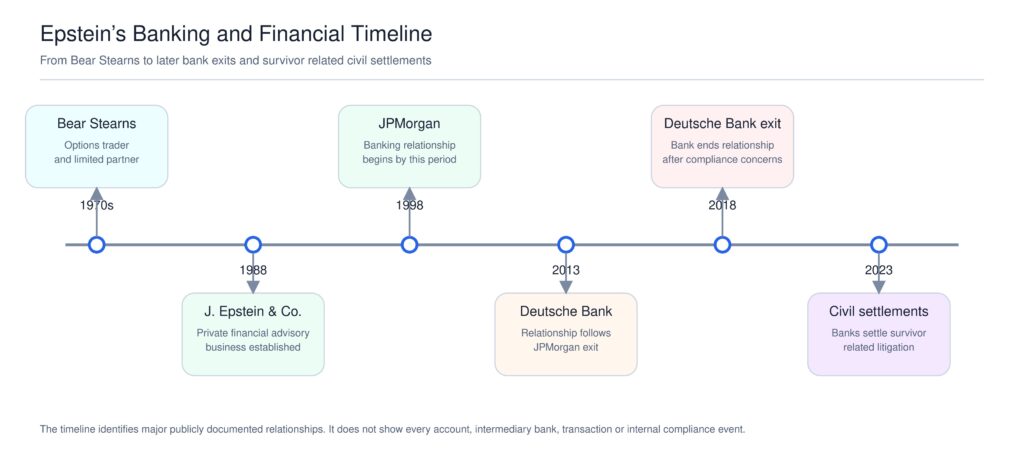
JPMorgan maintained Epstein as a client for years after warnings and internal concerns. Civil litigation alleged that Jes Staley protected the relationship and that the bank benefited from Epstein’s wealth and introductions.
The bank later reached major settlements with survivors and the United States Virgin Islands without admitting all allegations.
The record shows why banking mattered. Epstein required:
- Large incoming client payments
- Frequent cash withdrawals
- Wires to women and associates
- Payments for properties and aircraft
- Legal and settlement payments
- Accounts for numerous entities and trusts
- International transfers
JPMorgan suspicious activity record EFTA00090637
Deutsche Bank
After JPMorgan ended the relationship, Deutsche Bank accepted Epstein.
New York regulators found serious compliance failures involving:
- Payments to women
- Settlement and legal expenses
- Tuition, hotel, and rent payments
- Payments involving Russian models
- Suspicious cash withdrawals
- Failure to monitor activity adequately despite Epstein’s known criminal history
The New York Department of Financial Services imposed a $150 million penalty in 2020.
Bank of America and Leon Black Payments
Senate Finance investigators reported that a major bank waited years to report Black’s enormous transfers to Epstein. In 2026, Senator Ron Wyden connected Bank of America’s survivor settlement to failures involving payments from Black to Epstein.
Senate statement concerning the Bank of America settlement
Cash as Trafficking Infrastructure
Cash was operationally important because it paid victims and recruiters immediately while reducing ordinary payment records.
Large, repeated cash withdrawals by a registered sex offender whose known offense involved paying girls for sexualized massages should have triggered exceptional scrutiny.
Operation Chain Reaction
A released memorandum from Operation Chain Reaction described allegedly illegitimate wires connected to drug and prostitution activity and referenced fourteen additional redacted targets.
Operation Chain Reaction memorandum EFTA00173953
The memorandum establishes an investigative lead and the existence of a broader inquiry. It does not establish that Epstein was convicted of money laundering or that every redacted target was part of his trafficking operation.
Current Money Laundering Assessment
Epstein was investigated for possible laundering related conduct but was not federally convicted of money laundering.
The strongest responsible conclusion is:
- His entity structure was unusually complex.
- His banking activity included numerous high risk indicators.
- Banks documented or failed to timely report suspicious transactions.
- Client payments financed the environment in which the trafficking system operated.
- Some transfers remain unexplained or inadequately explained.
- A complete forensic accounting has not been made public.
The evidence supports a continuing money laundering investigation. It does not justify declaring every unexplained payment a proven laundering transaction.
Professional Legitimacy and Influence Brokerage
Why Respectable People Mattered
Epstein surrounded himself with politicians, lawyers, bankers, scientists, academics, doctors, philanthropists, artists, entertainers, and members of royal families.
These relationships provided:
- Social proof for young victims and their families
- Access to new wealthy clients
- Introductions across institutions
- Invitations to private events
- Reputation rehabilitation after conviction
- Advice during legal or media crises
- The appearance that powerful people had accepted him
Association alone does not prove knowledge of trafficking. The cumulative effect nevertheless strengthened Epstein’s legitimacy.
Kathryn Ruemmler
Kathryn Ruemmler’s July 15, 2026 House Oversight testimony provides a detailed example of Epstein using a respected professional relationship after his conviction.
Ruemmler testified that:
- Epstein contacted her in July 2014.
- He initially discussed a proposed donor advised fund involving Bill Gates.
- He referred a major financial institution client that retained her.
- Epstein remained a primary adviser to that shared client.
- He referred additional clients and regularly sought her advice.
- She knew he had pleaded guilty to prostitution related offenses, including solicitation of a minor.
- She relied partly upon Epstein’s account and a letter from attorney Stephanie Thacker claiming that he had not intentionally targeted minors.
- She communicated with him frequently until his July 2019 arrest.
- She visited his New York townhouse repeatedly and visited his Paris residence.
- Epstein introduced her to Leon Black.
- She helped edit material intended to respond to negative reporting about Epstein.
- Epstein gave her travel upgrades, spa treatments, massages, handbags, an Apple Watch with an Hermès band, a Fendi coat and bag, Bergdorf Goodman gift cards, and an approximately $10,000 Hermès bag.
- She declined a $50,000 private aviation card and an offer to travel on Epstein’s aircraft.
- She was listed as a backup executor in a draft will, although she said she learned about the designation later.
Ruemmler denied witnessing abuse, knowing of continuing criminal conduct, receiving compensation from Epstein, participating in trafficking, or using government contacts for him.
Her testimony establishes sustained professional, social, advisory, and reputational contact. It does not establish that she participated in Epstein’s trafficking operation.
Relevant Epstein Data records include:
Universities, Science, and Philanthropy
Epstein donated to institutions, funded researchers, hosted scientists, and promoted ambitious projects. These relationships gave him intellectual prestige and access to new networks.
The relevant question is not whether every academic knew about abuse. It is how institutions evaluated a convicted sex offender’s money, what access donations produced, and whether prestige was allowed to replace due diligence.
The Council on Foreign Relations and Elite Policy Access
Epstein’s invitations and memberships placed him near people working in finance, foreign affairs, intelligence, diplomacy, and national security.
An invitation to visit CIA headquarters with Council on Foreign Relations members demonstrates access to elite policy circles. It does not establish that Epstein worked for the CIA or another intelligence service.
Legal Protection and Reputation Management
The 2007 Nonprosecution Agreement
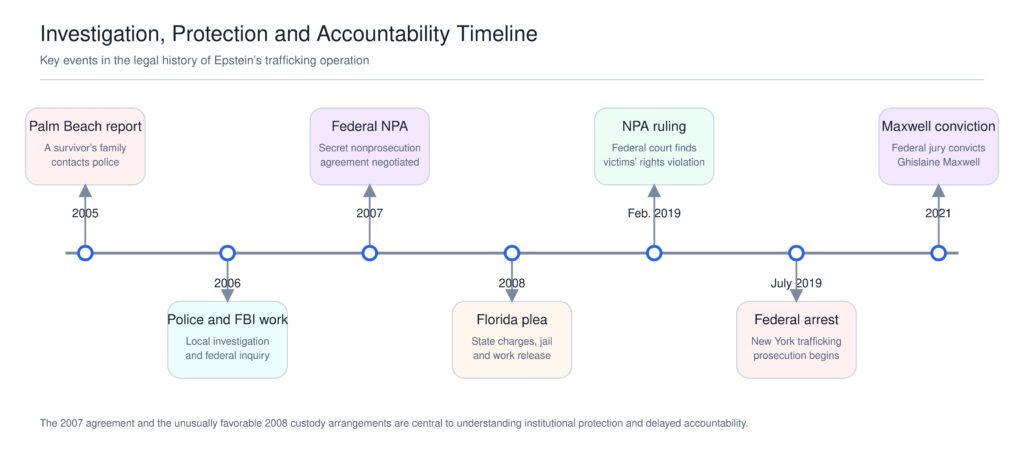
The federal nonprosecution agreement was a structural turning point.
It:
- Avoided a federal indictment
- Protected named potential co conspirators
- Was negotiated without informing victims before execution
- Allowed Epstein to resolve the matter through state charges
- Contributed to a public narrative that minimized the scale of the abuse
The Department of Justice Office of Professional Responsibility later concluded that victims were not treated with the expected forthrightness and sensitivity and that Alexander Acosta exercised poor judgment.
DOJ statement concerning the nonprosecution agreement
Operation Leap Year timeline EFTA00224943
Post Conviction Rehabilitation
After his 2008 conviction, Epstein continued meeting:
- Billionaires
- Bankers
- Lawyers
- Scientists
- University leaders
- Political figures
- Public relations advisers
The network allowed him to present the conviction as a resolved, limited prostitution matter rather than evidence of a broad system involving minors.
Gifts as Relationship Maintenance
Ruemmler described Epstein as a prolific gift giver. Similar patterns appear elsewhere in the network.
Gifts could perform several functions:
- Create goodwill
- Normalize personal access
- Establish reciprocity
- Demonstrate wealth
- Make assistance appear casual
- Keep influential people engaged
Receiving a gift does not prove corruption. Repeated expensive gifts from a registered sex offender to people providing professional credibility warrant careful documentation.
Private Investigators, Legal Pressure, and Settlements
Survivors and journalists described surveillance, aggressive legal tactics, reputation attacks, and pressure. Settlements and confidentiality provisions could resolve individual claims while limiting public access to evidence.
These tools were not unique to Epstein. His wealth allowed him to deploy them repeatedly and across jurisdictions.
The Roles of Key Network Members
Jeffrey Epstein
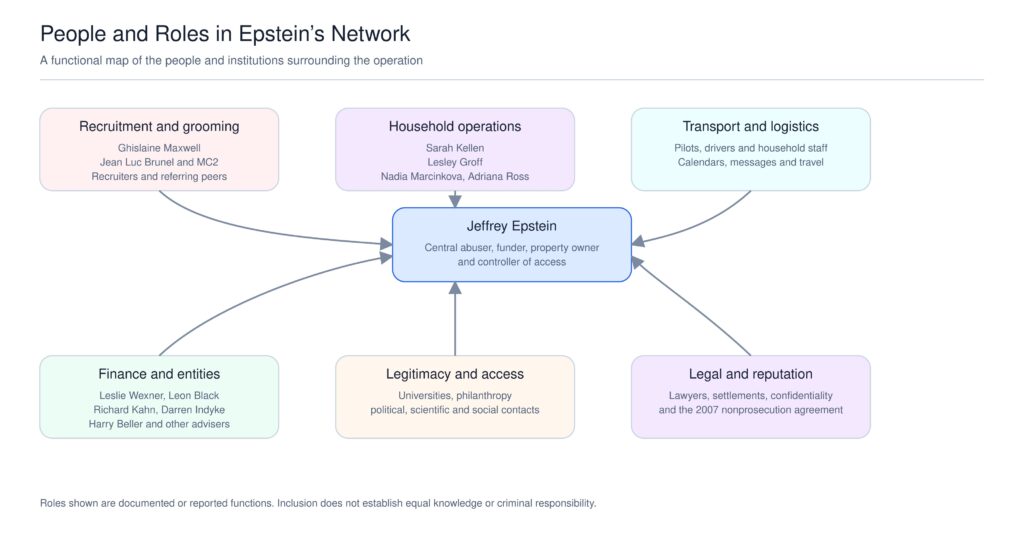
Central organizer, abuser, financier, property controller, relationship broker, and beneficiary of the system.
Ghislaine Maxwell
Convicted recruiter, groomer, transporter, facilitator, and participant in abuse. She also supplied social legitimacy, elite access, and an adult female presence that made victims feel safer.
Sarah Kellen
Scheduling and logistics associate repeatedly named in survivor and administrative records. Named as a potential co conspirator but not criminally convicted.
Lesley Groff
Executive assistant associated with scheduling, travel, gifts, correspondence, and access. Named as a potential co conspirator, denied knowing participation, and was not criminally convicted.
Nadia Marcinkova
Young woman in Epstein’s environment who later appeared as an employee or associate. Her record may include overlapping victim and facilitator dynamics. Named as a potential co conspirator but not criminally convicted.
Adriana Ross
Property and household associate named as a potential co conspirator. Not criminally convicted.
Jean Luc Brunel
Modeling executive accused by survivors of supplying access to young women and participating in abuse. Associated with MC2 Model Management. Died before trial.
Darren Indyke
Longtime attorney connected to trusts, entities, property, estate planning, and estate administration. Essential financial witness. No criminal conviction for trafficking or laundering.
Richard Kahn
Longtime accountant and financial manager connected to accounts, entities, taxes, payments, and estate administration. Essential financial witness. No criminal conviction for trafficking or laundering.
Leslie Wexner
Early financial patron and client who gave Epstein exceptional authority and access to assets. Wexner said Epstein misappropriated money and denied knowledge of his crimes.
Leon Black
Largest publicly documented post conviction financial client. Paid at least $158 million, with later Senate evidence placing the total near $170 million. Denied participating in Epstein’s crimes.
Jes Staley
Senior banker, close associate, alleged sexual participant, and alleged institutional protector. Regulatory findings established that he misrepresented the nature of the relationship. He denied sexual assault allegations.
Kathryn Ruemmler
Post conviction professional and social associate who received referrals, gifts, introductions, and requests for advice. Her relationship contributed professional legitimacy. No evidence currently establishes participation in trafficking.
Alleged Sexual Recipients
Survivor testimony identifies several men as people to whom victims were allegedly sent. Each case requires a separate dossier because allegation strength, corroboration, denial, settlement, and legal outcome differ.
Why There Was No Conventional Client List
The demand for a single client list assumes that Epstein kept one document labeling every man who received sexual access. The public evidence does not show such a document.
Instead, the system produced fragments:
- Survivor testimony
- Appointment calendars
- Message pads
- Flight records
- Address books
- Photographs
- Financial transfers
- Property visits
- Staff instructions
- Legal filings
- FBI interviews and tips
- Emails using coded or ambiguous language
A person may appear in one fragment because of a business meeting, friendship, flight, dinner, legal matter, or sexual allegation. The responsible method is to reconstruct the relationship and classify the evidence, not to treat every name as proof of abuse.
Current Working Model
The evidence supports viewing Epstein as several things at once:
- A serial sexual abuser
- An organizer of a trafficking and recruitment system
- A private financial adviser to billionaires
- A fixer for sensitive financial and reputational problems
- An information broker
- A connector among wealthy, political, academic, cultural, and international networks
- A controller of properties, aircraft, trusts, companies, and staff that supported both his legitimate and criminal activities
The business and trafficking systems were not separate worlds. They strengthened one another.
The financial business supplied money, property, travel, staff, and legitimacy.
The elite network supplied clients, introductions, protection, and credibility.
The trafficking operation supplied sexual access, dependency, and potentially compromising information.
The professional network helped Epstein continue operating after public registration as a sex offender.
Questions That Remain Unanswered
- What was the complete source of Epstein’s wealth before Wexner?
- What precisely did Epstein do for every major financial client?
- Why were payments from Leon Black so large compared with payments to licensed advisers?
- Which entities paid trafficking related expenses?
- Which staff members knew the ages of victims and the sexual nature of appointments?
- Who authorized every large cash withdrawal?
- Which banks filed suspicious activity reports, and when?
- What was the full purpose of Southern Trust?
- Which records remain unavailable from Haze Trust and other entities?
- Who controlled Epstein’s surveillance equipment and any resulting recordings?
- Which alleged recipients remain hidden behind redactions?
- What did schools, universities, charities, clubs, and donors know about access to young people?
- Which lawyers and reputation advisers helped shape the false narrative that Epstein had merely paid adult women for sex?
- Why were potential co conspirators protected by the 2007 agreement?
- What evidence was lost because Epstein, Brunel, and other central figures died before complete trials?
Update Protocol for This Living Report
Every future update should include:
- Date of update
- New source and direct link
- Epstein Data number when available
- People and entities affected
- Evidence category
- What the source establishes
- What the source does not establish
- Whether the source corroborates, contradicts, or merely expands an existing claim
- Any denial, legal outcome, or credibility limitation
Evidence Categories
Use the following labels:
- Conviction
- Sworn survivor testimony
- Contemporaneous documentary evidence
- Financial record
- Government finding
- Civil allegation
- Witness interview
- Public tip
- Investigative lead
- Unresolved inference
Change Log
July 30, 2026
- Created the living system report.
- Integrated the July 2026 Interlochen external investigation.
- Integrated Kathryn Ruemmler’s July 15, 2026 House Oversight testimony.
- Integrated the trafficking recipient evidence report.
- Integrated banking, trust, entity, and money laundering leads.
- Excluded the separate 9/11 hypothesis pending a dedicated evidence review.
Glossary
A short glossary would make the financial material easier to understand:
- Beneficial owner: The person who ultimately owns or controls an asset, even when another entity holds the legal title.
- Nonprosecution agreement: An agreement in which prosecutors promise not to bring specified charges under stated conditions.
- Referral payment: Money provided for introducing another person into the recruitment system.
- Shell company: A legal entity with little or no independent operation, often used to hold assets or conduct transactions.
- Trust: A legal arrangement in which a trustee controls property for specified beneficiaries.
- EFTA number: The identifying number assigned to a document within the released Epstein evidence collections.
Principal Epstein Data Evidence
Core Trafficking and Survivor Evidence
- Jane Doe Number Three filing EFTA00021553
- Federal prosecution memorandum recording “lent out” EFTA02731082
- Survivor journal EFTA02731420
- Survivor evidence compilation EFTA00073205
- Victim associate interview EFTA00158466
- Giuffre recruitment record EFTA00208128
- Related Mar a Lago recruitment record EFTA00210958
FBI Interviews, Tips, and Names Records
- FBI prominent names summary EFTA01660622
- FBI NTOC names compilation EFTA01660679
- Related FBI tip compilation EFTA01660651
- Protected source interview EFTA01245620
- Protected source interview EFTA02858481
- Protected source interview EFTA02858491
- Protected source interview EFTA02858495
- FBI crisis intake EFTA02858497
Financial and Entity Records
- Operation Chain Reaction memorandum EFTA00173953
- Haze Trust alert record EFTA01369019
- Haze Trust urgent inquiry EFTA01386360
- Haze Trust transaction exhibit EFTA00080250
- Haze Trust high risk customer record EFTA00168946
- Consolidated entity and balance record EFTA01381149
- Epstein estate inventory EFTA00076491
- JPMorgan suspicious activity record EFTA00090637
- FBI suspicious activity interview EFTA00128968
Scheduling, Travel, and Access Records
- Blaine aircraft and car logistics EFTA01888219
- Blaine transportation record EFTA02163591
- Blaine dinner schedule EFTA02130123
- Blaine proposed dinner list EFTA01924576
- Blaine daily schedule EFTA01975392
- Pilot and flight interview EFTA00159180
Legal and Institutional Records
- Operation Leap Year timeline EFTA00224943
- Copperfield testimony record EFTA00081180
- Ruemmler related record EFTA02484285
- Ruemmler related record EFTA02486838
- Ruemmler reputation response record EFTA02610779
- Ruemmler related record EFTA02462711
External Sources
- DOJ charges against Jeffrey Epstein
- DOJ overview of Ghislaine Maxwell’s conviction
- DOJ statement concerning the Epstein nonprosecution agreement
- Interlochen external investigation
- Senate Finance investigation into Leon Black’s payments
- Senate Finance findings concerning Epstein financing
- FCA findings concerning Jes Staley
- Federal court decision concerning Staley allegations
- Federal unsealing order concerning Giuffre testimony