
What EFTA00725936 Really Is: A Survivor’s Proposed Witness List, Not an Epstein Client List
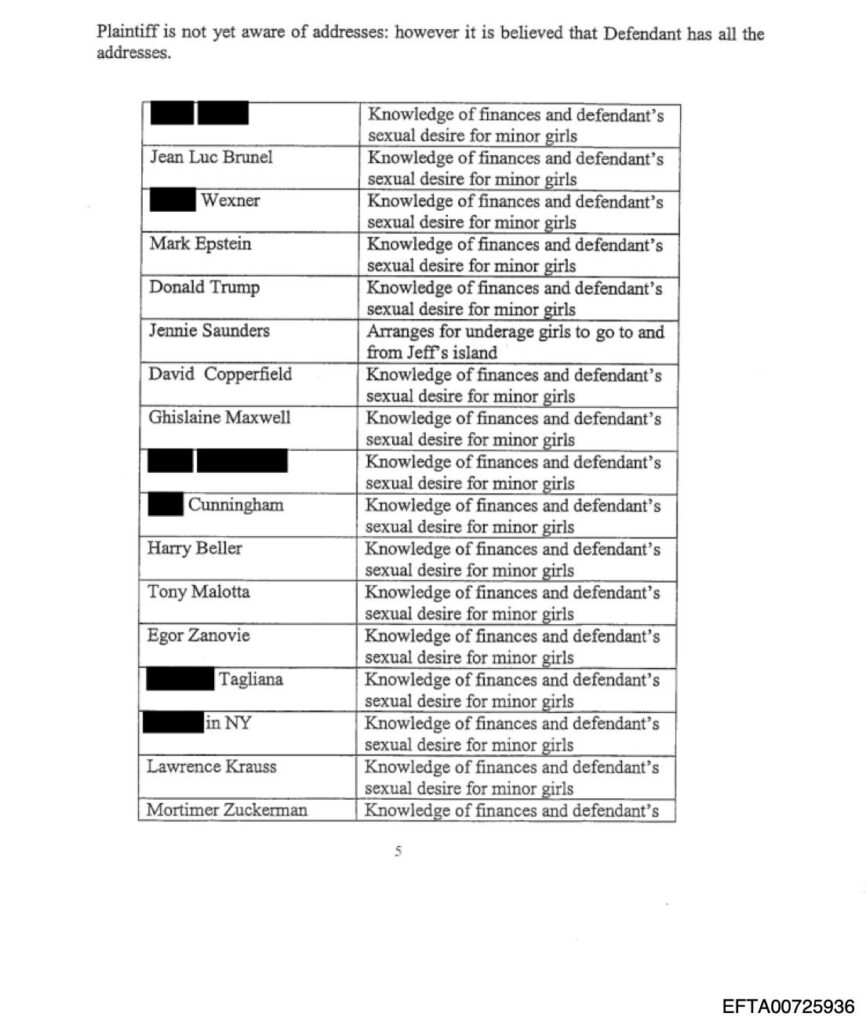
The viral page names Donald Trump, David Copperfield, Jean Luc Brunel, Ghislaine Maxwell, Lawrence Krauss, Mortimer Zuckerman, and others, but its legal meaning requires the complete document
Snapshot
EFTA00725936 is one page from an anonymous survivor’s 2009 discovery responses in a Palm Beach County civil lawsuit against Jeffrey Epstein.
The page identifies people the survivor, her attorneys, or their agents believed might possess information relevant to the lawsuit. Most of the visible names are assigned the same proposed subject matter: knowledge of Epstein’s finances and his “sexual desire for minor girls.”
Jennie Saunders receives a different and considerably more specific description. The response claims she arranged for underage girls to travel to and from Epstein’s island.
The document is important, but it has been repeatedly mislabeled online.
It is not a client list. It is not an FBI conclusion. It is not a list of proven coconspirators. It is not a court finding that everyone named actually possessed the knowledge attributed to them.
It is a survivor’s unverified interrogatory response, prepared with assistance from her attorney, identifying potential witnesses and subjects for discovery.
Document Identification
Evidence range: EFTA00725932 through EFTA00725951
Viral page: EFTA00725936
Court: Circuit Court of the Fifteenth Judicial Circuit in and for Palm Beach County, Florida
Case number: 50 2008 CA 028058
Plaintiff: Anonymous Epstein survivor
Defendant: Jeffrey Epstein
Document title: Notice of Service of Plaintiff’s Unverified Better Answers to Defendant’s Interrogatories
Date served: August 4, 2009
Attorney for plaintiff: Bradley Edwards of Rothstein Rosenfeldt Adler
Length: 20 pages
The filing states that Epstein served 26 interrogatories on or about December 10, 2008. Interrogatories are written questions exchanged during civil discovery. The survivor’s attorneys served these revised answers approximately eight months later.
The Question That Produced the List
The names appear in response to Interrogatory Number 5.
Epstein asked the survivor to list all people known or believed by her, her agents, or her attorneys to have knowledge concerning any issue in the lawsuit. He also asked her to specify the subject about which each potential witness possessed information.
That wording is critical.
The response was not limited to people the survivor personally knew or personally observed. It expressly included people identified by her attorneys or agents.
A person could therefore appear because counsel believed the individual might have relevant information, because the person appeared in other records, because further discovery was contemplated, or because the survivor personally identified that person.
The table does not reveal which of those paths led to each name.
The Names Visible on EFTA00725936
The readable names on the viral page include:
Jean Luc Brunel
A partially redacted Wexner entry
Donald Trump
Jennie Saunders
David Copperfield
Ghislaine Maxwell
A partially redacted Cunningham entry
Tony Malotta
Egor Zanovie
A partially redacted Tagliana entry
A partially redacted entry ending with “in NY”
Lawrence Krauss
Mortimer Zuckerman
Several additional entries are completely concealed.
Except for Jennie Saunders, the readable names are generally assigned the same description: knowledge of Epstein’s finances and his sexual interest in minor girls.
The use of identical language for many people does not establish that each person witnessed the same conduct or possessed the same information. The document does not explain the factual basis for assigning that description to each name.
The Jennie Saunders Allegation
The most specific entry on EFTA00725936 concerns Jennie Saunders, now known as Jennie Enterprise, a founder of the private Core Club in Manhattan.
The discovery response states that Saunders “arranges for underage girls to go to and from Jeff’s island.”
That is an allegation made in civil discovery. This page does not provide dates, travelers, transportation records, communications, or testimony explaining the allegation.
Later records independently establish that Saunders had a substantial relationship with Epstein. Released correspondence shows that they communicated about business, real estate, investments, Core Club matters, and personal plans.
For example, EFTA01776636 contains correspondence from Saunders using her Core Club signature. Other released communications identify Epstein as a founding Core Club member and show that Saunders continued communicating with him after his 2008 conviction.
A separate telephone message records that Saunders planned to travel to Epstein’s island and that another person would arrange her ticket and coordinate with architects. That message corroborates island travel and direct contact. It does not, by itself, corroborate the allegation that Saunders arranged transportation for underage girls.
The distinction matters. The 2009 interrogatory response is evidence that the survivor’s legal team made the allegation. It is not proof that the allegation was judicially established.
Donald Trump’s Appearance on the List
Donald Trump is listed as a potential witness concerning Epstein’s finances and sexual interest in minor girls.
The document does not accuse Trump of sexually abusing the plaintiff. It does not identify a conversation in which Epstein disclosed an interest in minors to Trump. It does not explain whether the entry came from the survivor, her attorneys, another witness, or information obtained during discovery.
The page therefore establishes a limited but important fact: by August 2009, attorneys representing an Epstein survivor had identified Trump as someone they believed could possess information relevant to Epstein’s finances and sexual interest in underage girls.
It does not establish that Trump was deposed, that he admitted possessing such knowledge, or that a judge found the assertion true.
Calling this page proof that Trump was an Epstein “client” misstates the document.
David Copperfield’s Appearance on the List
David Copperfield receives the same general description as Trump, Brunel, Mark Epstein, Maxwell, Krauss, and Zuckerman.
The response attributes to Copperfield possible knowledge of Epstein’s finances and sexual interest in minor girls. It does not accuse Copperfield of abusing this plaintiff, transporting her, paying her, or participating in Epstein’s conduct.
Other evidence concerning Copperfield must be evaluated separately. His inclusion here establishes that the survivor’s legal team considered him a potential source of relevant information. It does not establish why they reached that conclusion.
The List Continues Beyond the Viral Page
EFTA00725936 is only the first full page of a much larger discovery list.
The names and categories continue through EFTA00725937, EFTA00725938, EFTA00725939, EFTA00725940, EFTA00725941, and EFTA00725942.
Readable entries include Janusz Banasiak, Michael Reiter, Detective Joseph Recarey, Bob and Todd Meister, Larry Visoski, Abigail Wexner, Sandy Berger, Officer Munyan, Officer Minot, Sergeant Sorge, David Rodgers, Alfredo Rodriguez, Leon Black, Ron Burkle, Juan Alessi, Maria Alessi, Jimmy Cayne, Maximilia Cordero, Ellen Cunningham, Eric Gany, Bella Klein, Adam Perry Lang, Governor Bill Richardson, Howard Rubenstein, and others.
The response also identifies broad groups rather than specific individuals. These include:
People who visited Epstein while he was incarcerated
Minor girls identified in the non prosecution agreement
Other girls the survivor alleged Epstein sexually exploited
FBI agents who investigated Epstein
State and federal prosecutors
Accountants, bankers, bookkeepers, financial institutions, real estate advisers, and financial planners
People or entities with knowledge of Epstein’s charitable and political donations
Reporters and other media figures
Additional witnesses identified through continuing discovery
This breadth shows that the answer functioned as an investigative and litigation roadmap. It was not a narrowly defined list of offenders.
A Similar List Appears in Another Survivor’s Case
A separate discovery response from another anonymous survivor appears in EFTA00727684.
That filing came from a different Palm Beach County lawsuit, case number 50 2008 CA 028051. It repeats much of the same potential witness list, including Brunel, Wexner, Mark Epstein, Trump, Saunders, Copperfield, Maxwell, Krauss, and Zuckerman.
The Saunders description also appears in the second survivor’s response.
The substantial overlap reasonably suggests that the witness list was developed at least partly by the survivors’ shared legal team as a broad discovery tool. It should not automatically be treated as a separate personal accusation made from each survivor’s firsthand knowledge.
This does not make the list meaningless. Attorneys may identify potential witnesses through police records, other survivors, financial records, depositions, correspondence, and prior investigation.
It does mean the list must not be misrepresented as direct sworn testimony that each survivor personally witnessed every named person acquiring the knowledge attributed to them.
Why the Word Unverified Matters
The document is expressly titled “Unverified Better Answers.”
It is not captioned as an affidavit, deposition, trial transcript, or declaration under penalty of perjury. The released copy includes a jurat page associated with counsel, but the filing itself continues to identify the responses as unverified.
That limits its evidentiary weight.
The document proves that these answers were served in civil discovery. It proves that the survivor and her legal team identified the listed people as potential witnesses. It does not prove that the assertions were admitted into evidence, tested through cross examination, accepted by Epstein, or adopted by the court.
The Survivor’s Account in the Complete Document
The full filing contains far more than the witness list.
The survivor objected to providing Epstein with her current address because she feared that disclosure could compromise her safety and privacy.
She stated that she first went to Epstein’s Palm Beach residence in July 2002 while she was a child and continued visiting until approximately September 2005. She estimated that she went to the residence more than 100 times.
She alleged that Epstein paid her $200 when he sexually touched or abused her. She also stated that he paid her $200 for each other minor girl she brought to the house. She estimated that she brought more than 50 girls.
The survivor described psychological trauma, anxiety, depression, impaired education, loss of earning capacity, substance dependence, humiliation, and lasting damage to her sense of self.
She also said she had spoken with the FBI or United States Attorney’s Office approximately eight to ten times during 2007 and 2008. She recalled telling investigators about Epstein’s abuse, payments, and investigators who allegedly came to her home and photographed her property.
These statements remain allegations made in a civil case. They also show why stripping EFTA00725936 from its surrounding pages creates a distorted account. The complete document is principally a survivor’s description of exploitation and its consequences, not a celebrity name list.
The Case Did Not Produce a Verdict on the Witness List
Later federal litigation identifies the Palm Beach action as a survivor lawsuit seeking damages from Epstein.
A 2017 federal court filing states that the civil action was settled without proceeding to trial.
Because the case settled, the witness list was not tested through a public trial. There was no jury verdict determining that every named person possessed the knowledge attributed to them.
Settlement also means the public record may not contain depositions, subpoenas, document productions, or private negotiations that followed the interrogatory response.
The absence of a trial finding does not disprove the list. It means the surviving page cannot be treated as though such a finding exists.
What the Evidence Proves
EFTA00725936 proves that an Epstein survivor’s legal team identified Trump, Copperfield, Brunel, Maxwell, Mark Epstein, Krauss, Zuckerman, Saunders, and others as potential witnesses in 2009.
It proves that the legal team attributed possible knowledge of Epstein’s finances and sexual interest in minor girls to most of those people.
It proves that the response made a distinct allegation that Saunders arranged travel for underage girls to and from Epstein’s island.
It proves that the potential witness list was broader than the names appearing in the viral screenshot.
The similar response in another survivor’s case also shows that much of the list was reused across related litigation.
What the Evidence Does Not Prove
The document does not prove that everyone named had firsthand knowledge.
It does not establish how the survivor’s attorneys developed each entry.
It does not prove that every person was interviewed or deposed.
It does not show that the named people were Epstein’s clients.
It does not establish that everyone on the list visited an Epstein property.
It does not accuse every listed person of participating in sexual abuse.
It does not prove the Saunders transportation allegation without corroborating evidence.
It does not constitute a judicial finding, FBI conclusion, criminal charge, or jury verdict.
A name appearing in discovery is an investigative lead. It is not a conviction.
Evidence Assessment
EFTA00725936 is significant because it documents what survivor counsel believed should be investigated in 2009, shortly after Epstein received extraordinary protection through the federal non prosecution agreement and his lenient Florida resolution.
The page points toward potential witnesses across Epstein’s financial, social, household, political, academic, and entertainment networks. Its evidentiary value increases when individual entries can be matched with emails, travel records, financial documents, depositions, telephone messages, or testimony.
Its limitations are equally important. The response is unverified, uses repeated language, includes many broad categories, and supplies almost no factual basis for individual entries. A nearly identical list in a second survivor’s case suggests that counsel compiled a shared discovery roadmap rather than recording only firsthand survivor identifications.
The correct conclusion is neither that the page proves nothing nor that it proves everyone named knowingly participated in Epstein’s crimes.
It proves that these people were identified as potential sources of information in survivor litigation. The unanswered question is what evidence supported each identification and what subsequent discovery revealed.
Sources
- EFTA00725932, complete 20 page discovery response
- EFTA00725936, viral witness list page
- EFTA00725937, continuation of witness list
- EFTA00725938, continuation of witness list
- EFTA00725939, continuation of witness list
- EFTA00725940, continuation of witness list
- EFTA00725941, law enforcement and survivor witness categories
- EFTA00725942, financial and additional discovery categories
- EFTA00727684, similar interrogatory responses in a second survivor’s case
- EFTA01776636, released Jennie Saunders correspondence
- 2017 federal filing identifying the Palm Beach survivor cases and settlements