Zinta Braukis
Snapshot
Zinta Braukis is a model whose name appears in Jeffrey Epstein related court records and in a handwritten letter recovered from Epstein’s property. The current EpsteinWiki entry uses the spelling “Zinia Braukis,” but the primary records reviewed for this article use “Zinta Braukis.”
The most significant evidence appears in two distinct sources.
First, an attorney questioned Jeffrey Epstein about Braukis during a 2010 civil deposition. The attorney described her as a model Epstein knew and asked whether Epstein had sexual contact with her while she was underage and whether she later received a modeling contract. Epstein refused to answer each question.
Those questions document allegations made during litigation. They are not testimony confirming the allegations, and they were not converted into judicial findings.
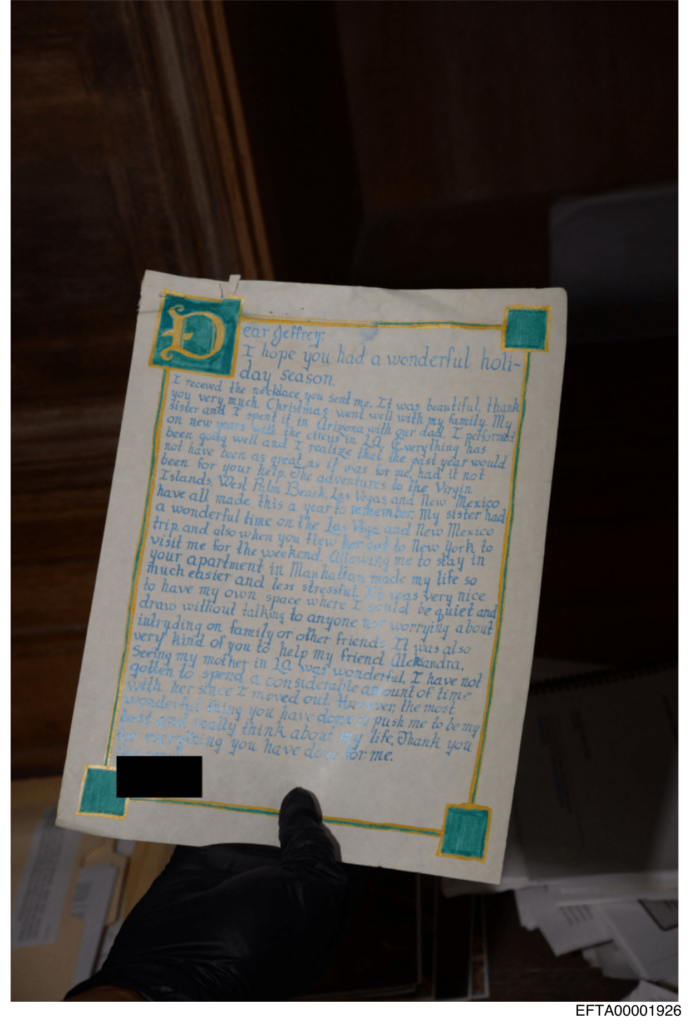
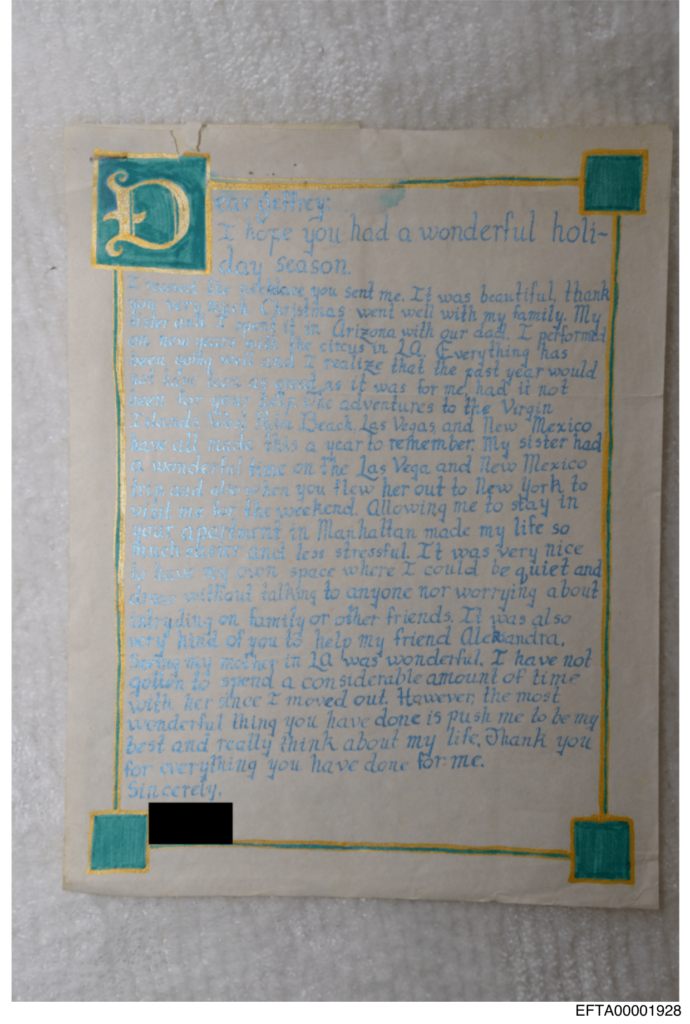
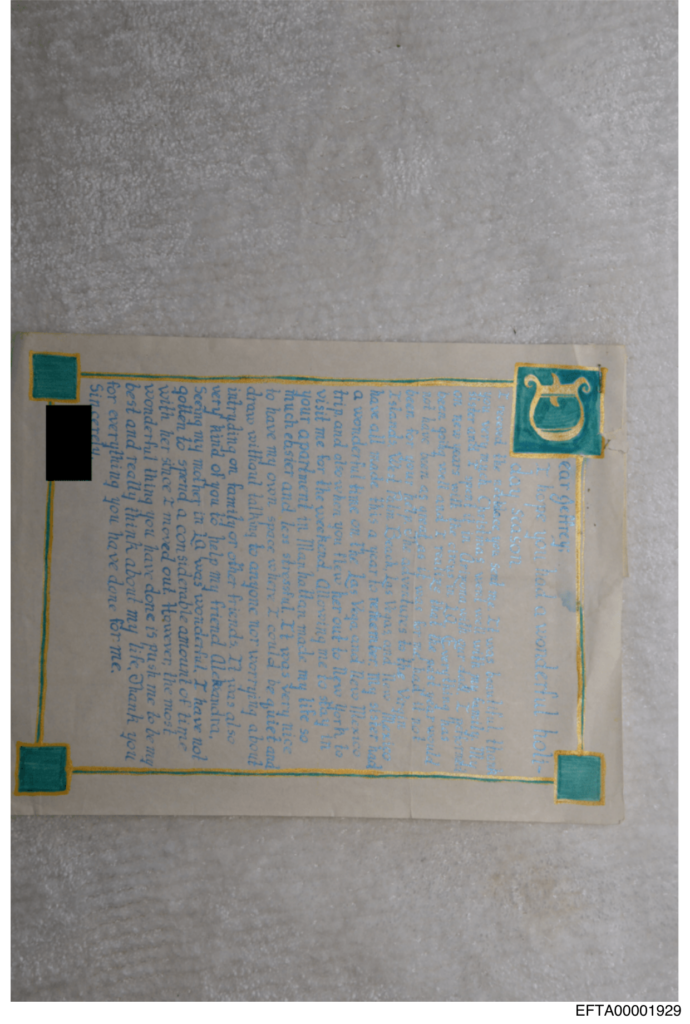
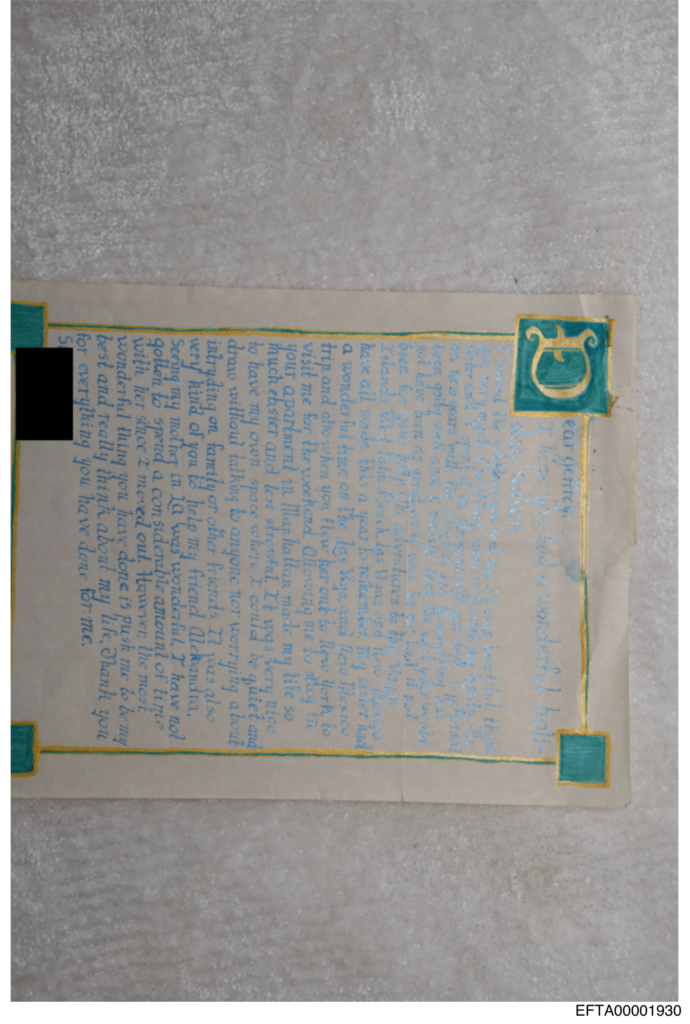
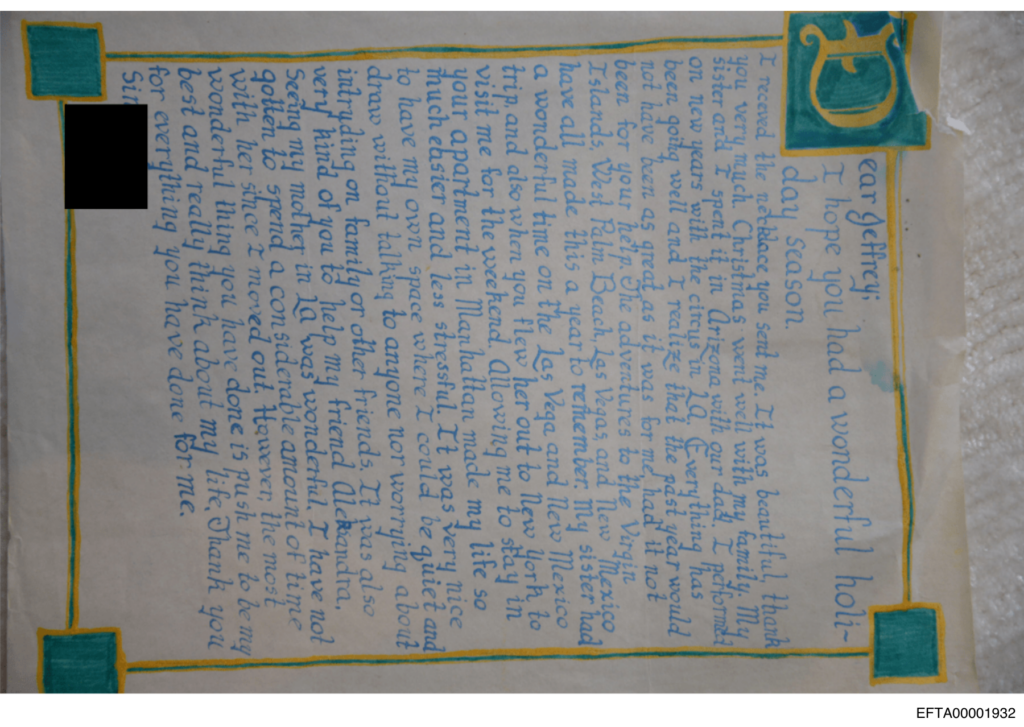
Second, EFTA00001926 through EFTA00001932 preserve photographs of a handwritten letter and envelope associated with Braukis. The letter thanks Epstein for a necklace, travel, access to an apartment in Manhattan, assistance for her sister and a friend, and experiences in the Virgin Islands, West Palm Beach, Las Vegas, and New Mexico.
The letter independently establishes a personal relationship in which Epstein provided gifts, travel, lodging, and other assistance. It does not identify the writer’s age, describe sexual activity, or prove the allegations posed during the deposition.
The public record therefore supports describing Braukis as a model connected with Epstein and as the subject of a serious but unadjudicated allegation. The evidence presently available does not justify labeling her a participant in Epstein’s crimes.
Correct Name and Spelling
The spelling supported by the primary evidence is Zinta Braukis.
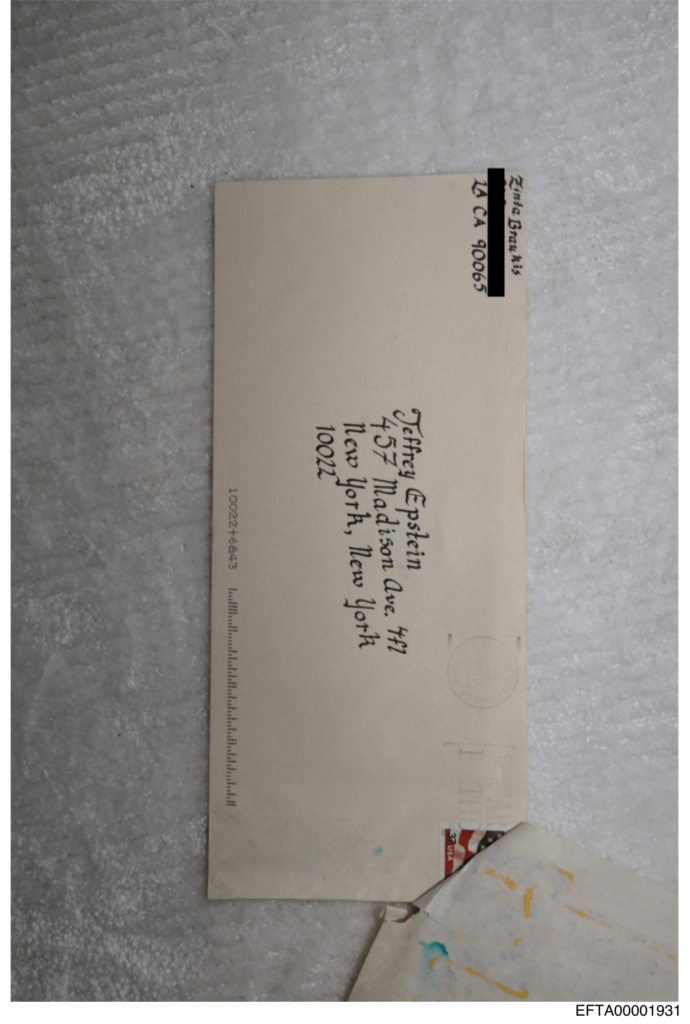
Court filings from Epstein v. Rothstein identify a person named Zinta Braukis. The envelope photographed in EFTA00001931 also uses that spelling.
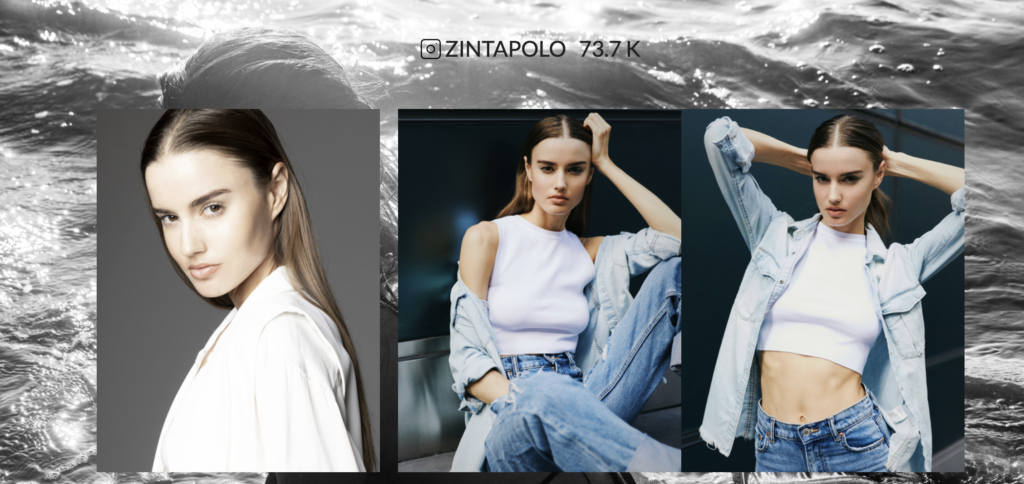
A public modeling profile identifies a Los Angeles model named Zinta Braukis. The profile lists her with Photogenics in Los Angeles and Silent Models in New York.
The spelling “Zinia Braukis” appears to be a later indexing or transcription error. No primary record reviewed for this article establishes that Zinia was her legal or professional name.
The EpsteinWiki page may retain the existing title for continuity and search purposes, but the article should explain that Zinta is the documented spelling.
Public Modeling Record
A January 2011 Models.com profile identifies Zinta Braukis as a model from Los Angeles.
The profile lists Photogenics as her mother agency and Silent Models as her New York agency. It also describes interests in polo and helicopter piloting.
The profile provides no birth year. It lists only April 7 as her date of birth.
Researchers have attempted to estimate Braukis’s age from photographs and online comments. Those estimates are not reliable evidence and should not be repeated as fact.
The public profile is consistent with the description of Braukis as a model in the Epstein deposition. It does not independently prove that the model in the profile and the person discussed in every court record are the same individual.
The matching name, Los Angeles connection, modeling career, and New York agency make the identification plausible. A definitive identity claim would require additional confirmation.
Appearance in Epstein v. Rothstein
Braukis’s name appeared in Epstein v. Rothstein, No. 50 2009 CA 040800 MB, a Florida civil action involving Jeffrey Epstein, attorney Bradley Edwards, and disbarred lawyer Scott Rothstein.
The case produced extensive discovery involving Epstein’s conduct, employees, survivors, aircraft, properties, police records, and people within his social and professional network.
A witness and exhibit list filed in the case included Zinta Braukis by name. Public copies of the filings are available through the Epstein v. Rothstein exhibit list and a related court filing identifying Braukis.
Appearance on an exhibit or witness list does not prove that the person testified. It also does not establish that every assertion attorneys expected to raise would have been admissible or proven.
The filings establish that Braukis was considered relevant to the litigation.
The 2010 Epstein Deposition
Jeffrey Epstein was questioned under oath during civil litigation in 2010.
A public compilation of Epstein deposition materials preserves the relevant exchange.
An attorney asked Epstein whether he knew Zinta Braukis. Epstein refused to answer.
The attorney then described Braukis as another model Epstein knew. Epstein again refused to answer.
The questioning continued with an allegation that Epstein had engaged in sexual activity with Braukis while she was underage. The attorney also asked whether she received a modeling contract as a result. Epstein refused to answer those questions.
The exchange is significant because it places Braukis within a line of questioning about models, minors, Jean Luc Brunel, and Epstein’s access to young women.
However, an attorney’s question is not evidence by itself.
What Epstein’s Refusal Means
Epstein’s refusal to answer does not confirm the allegations contained in the questions.
A deposition transcript establishes that:
- The attorney asked the questions.
- The attorney possessed or claimed to possess a basis for raising Braukis’s name.
- Epstein declined to provide substantive answers.
- No denial, admission, or explanation was obtained during that exchange.
A refusal can prevent evidence from being tested. It does not automatically convert the premise of a question into an established fact.
The transcript therefore supports stating that an allegation involving Braukis was raised during litigation. It does not support stating as fact that Epstein sexually abused her while she was underage or obtained a modeling contract for her in exchange for sexual activity.
Those allegations require corroboration from testimony, agency records, communications, travel records, or other primary evidence.
The Handwritten Letter
A separate federal evidence release contains a handwritten letter addressed to Epstein.
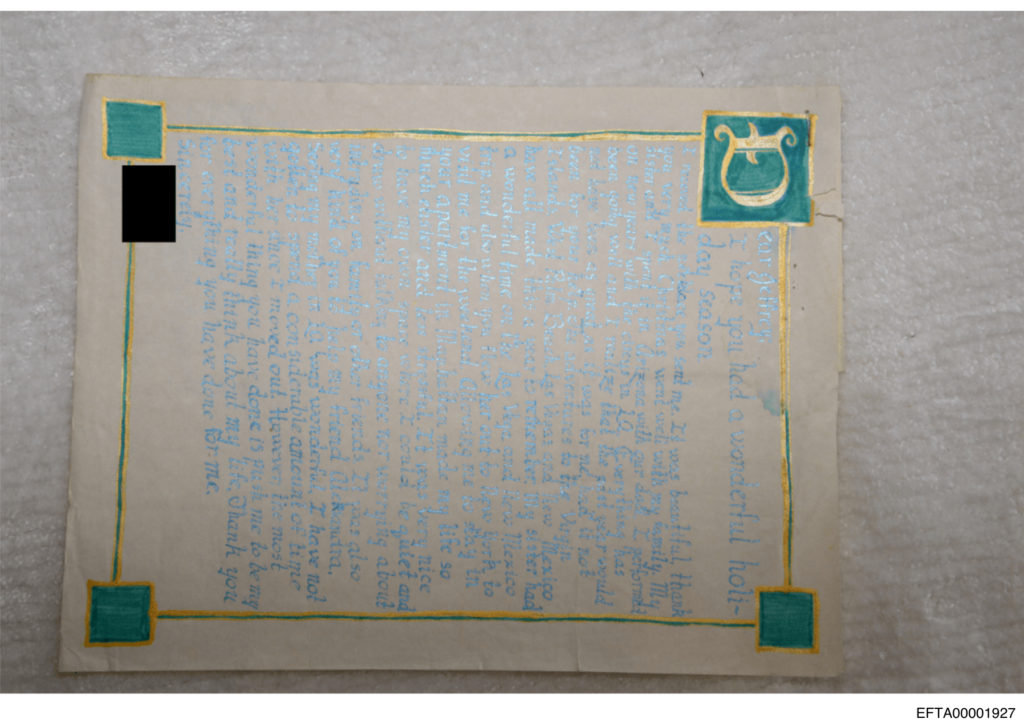
The letter appears across the image sequence EFTA00001926, EFTA00001927, EFTA00001928, EFTA00001929, EFTA00001930, EFTA00001931, and EFTA00001932.
The sequence contains photographs or alternate views of the letter and its envelope. Some pages contain duplicated or limited visual information.
The envelope identifies the sender as Zinta Braukis and is addressed to Jeffrey Epstein at his Manhattan address.
The signature within the photographed letter was redacted in the public release. The envelope supplies the documentary connection to Braukis.
The letter does not display a clearly legible date. References to Christmas, New Year’s, travel, and family visits provide context but do not establish the year.
The Necklace
The writer begins by thanking Epstein for a necklace.
The letter describes the necklace as beautiful and expresses gratitude for the gift.
This establishes that Epstein sent the writer jewelry. The document does not identify the necklace’s value, the date it was purchased, or the reason it was given.
Gift giving is important within the wider Epstein record because survivors and witnesses have described money, education, travel, housing, clothing, and other assistance being used to create trust, dependency, obligation, or access.
That broader pattern does not prove that every gift was part of grooming. The necklace must be interpreted alongside the writer’s age, the nature of the relationship, and other evidence that is not presently available.
Travel to Epstein Locations
The letter says the previous year included adventures in the Virgin Islands, West Palm Beach, Las Vegas, and New Mexico.
Several of those locations correspond with places associated with Epstein.
Epstein maintained a residence in Palm Beach, Florida. He also owned Zorro Ranch in New Mexico and properties in the United States Virgin Islands.
The letter therefore places the writer within a pattern of travel involving multiple Epstein locations.
It does not specify:
- The dates of the trips
- Who travelled with her
- Which aircraft were used
- Whether Epstein was present during every visit
- Where she stayed at each destination
- What occurred during the trips
- Whether the travel was connected with modeling work
The letter establishes travel and access. It does not independently establish abuse.
The Virgin Islands Reference
The writer identified the Virgin Islands as one of the experiences that made the previous year memorable.
Because the FBI photographed the letter among materials associated with Epstein’s property, the reference is relevant to the investigation of Epstein’s island operations.
The document does not expressly identify Little St. James. It also does not say whether the writer stayed on an Epstein owned island, visited another Virgin Islands property, or travelled there for another purpose.
Researchers should avoid changing the general phrase “Virgin Islands” into a documented visit to Little St. James without additional evidence.
Flight manifests, pilot records, calendars, photographs, or household records could clarify the destination.
West Palm Beach
The writer also referred to West Palm Beach.
Epstein’s Florida residence was located in Palm Beach, which is adjacent to West Palm Beach. Travelers and staff sometimes used the wider West Palm Beach designation when referring to the region.
The letter does not name Epstein’s Palm Beach mansion or describe events inside the property.
It supports the conclusion that the writer travelled to the area. It does not prove that every part of the visit occurred at Epstein’s residence.
The distinction matters because geographic proximity is not identical to documented presence inside a particular property.
Las Vegas and New Mexico
The letter refers to travel to Las Vegas and New Mexico.
It states that the writer’s sister accompanied her on a Las Vegas and New Mexico trip. The writer thanked Epstein for helping create those experiences.
The New Mexico reference may concern Epstein’s Zorro Ranch, but the letter does not name the ranch.
The Las Vegas reference is more ambiguous. Epstein had social, financial, scientific, and entertainment contacts in Las Vegas, but the letter does not identify a host, property, event, or purpose.
The trips demonstrate that Epstein’s assistance extended beyond a single location. They do not reveal whether the travel involved work, recreation, introductions, or another arrangement.
The Manhattan Apartment
The writer thanked Epstein for allowing her to stay in his apartment in Manhattan.
She explained that having her own space made her life easier and less stressful. She described being able to remain quiet and work on her drawings without feeling that she was intruding on family or friends.
This passage documents housing assistance from Epstein in New York.
The letter does not identify which apartment she used. Epstein owned or controlled several New York properties, and his businesses maintained residential units used by employees, associates, guests, and young women.
The document should not be used to assign Braukis to a specific building without a lease, address, property record, or corroborating communication.
Housing can create practical and financial dependence. Whether that occurred in this case cannot be determined from the letter alone.
Travel Provided for Her Sister
The letter states that Epstein flew the writer’s sister to New York for a weekend visit.
This demonstrates that Epstein’s assistance extended to a member of the writer’s family.
The letter does not identify the sister, her age, the flight, or who accompanied her.
Those details should remain private unless they become necessary to evaluate a specific public interest question and are supported by reliable records.
The family assistance is relevant because it shows Epstein integrating himself into the writer’s personal life. It does not establish that the sister experienced or witnessed misconduct.
Assistance for Alexandra
The writer also thanked Epstein for helping a friend named Alexandra.
The letter does not provide Alexandra’s surname or explain the assistance.
No responsible identification can be made from a first name alone. Epstein’s records contain multiple people named Alexandra.
The reference establishes that the writer asked for or knew about assistance Epstein provided to another person. It does not establish that Alexandra travelled, modeled, worked for Epstein, or experienced misconduct.
Researchers should not merge this person with other women in the archive merely because they share a first name.
Emotional Tone of the Letter
The writer expressed extensive gratitude and credited Epstein with making the previous year memorable.
She thanked him for pushing her to perform at her best and to think seriously about her life. She also thanked him for gifts, travel, lodging, and assistance involving family and friends.
The tone suggests trust, appreciation, and a meaningful imbalance in resources. Epstein controlled access to travel, property, gifts, and influential networks that could materially affect a young model’s life.
Gratitude does not disprove exploitation.
People who experience grooming may feel affection, loyalty, gratitude, confusion, fear, or obligation toward the person providing attention and resources. A positive letter cannot be used by itself to determine whether abuse occurred.
The opposite is also true. The grateful tone does not prove that grooming or abuse occurred. That conclusion requires evidence about the writer’s age, the relationship, and Epstein’s conduct.
How the Letter Was Recovered
The released images were created during the federal investigation of Epstein’s property.
The Wikimedia record for EFTA00001926 identifies the image as an FBI photograph associated with the August 12, 2019 search of Little St. James.
That metadata concerns the government photograph, not the date the letter was written.
The evidence therefore establishes that investigators documented the letter after Epstein’s July 2019 arrest and death.
It does not establish where Epstein originally received the letter, when it was written, how long he kept it, or why it was present at the property searched by the FBI.
Duplicate Images and Document Classification
The EFTA sequence should not be described as seven separate letters.
The records appear to preserve multiple photographs, alternate views, or reproductions associated with one letter and envelope.
This distinction matters when counting evidence. A database may return several EFTA identifiers for a single physical object because investigators photographed different sides, pages, or positions.
The number of image files does not equal the number of communications.
The evidentiary value comes from the content, sender identification, recovery context, and relationship between the images.
The Modeling Contract Allegation
During Epstein’s deposition, the attorney asked whether Braukis received a modeling contract after alleged sexual contact with Epstein while she was underage.
The public modeling profile confirms that a Zinta Braukis was represented by agencies in Los Angeles and New York by January 2011.
That chronological proximity makes the deposition question worthy of further investigation. It does not prove that Epstein or Jean Luc Brunel obtained either agency contract.
No agency agreement, payment record, email, or witness statement reviewed for this article establishes that Epstein arranged Braukis’s representation.
The deposition question and modeling profile should therefore be presented together but not treated as mutual corroboration of the allegation.
Further verification would require agency records, communications with bookers, payment documentation, or testimony from people directly involved.
Possible Connection to Jean Luc Brunel
The deposition questions involving Braukis appeared within a broader sequence concerning models, Epstein, Ghislaine Maxwell, and Jean Luc Brunel.
Brunel operated modeling agencies and was accused by multiple women of sexual assault and of helping Epstein obtain access to young women. Brunel denied wrongdoing before his death in French custody in 2022.
The placement of Braukis’s name within that questioning suggests that attorneys were investigating whether her modeling career intersected with the Epstein and Brunel network.
The transcript does not establish that Braukis met Brunel, signed with one of his agencies, travelled with him, or received a contract through him.
Neither Photogenics nor Silent Models should be described as Brunel controlled agencies without corporate evidence supporting that claim.
Survivor Classification
EpsteinWiki has placed Braukis within survivor related categories.
The deposition question raises a specific allegation that Epstein engaged in sexual activity with her while she was underage. That allegation warrants careful preservation and investigation.
However, the public record reviewed for this article does not contain a statement from Braukis identifying herself as an Epstein survivor. It also does not contain testimony in which she confirms the allegation.
A survivor centered approach should neither erase the allegation nor impose a public identity on someone who has not been shown to have chosen it.
The most accurate classification is:
- A person directly connected with Epstein through documentary evidence
- A model identified in civil litigation
- The subject of an unadjudicated allegation involving possible underage sexual contact
- A possible survivor whose own account has not been located in the public record
This wording preserves the evidence without claiming knowledge Braukis has not publicly supplied.
Privacy Concerns
Some released filings and images contain information that could identify private individuals.
EpsteinWiki should not repeat Braukis’s historical street address, family details, or information about unnamed relatives. Those details add little to the evidentiary analysis and could expose people who have never entered the public record voluntarily.
The Department of Justice acknowledges that the volume of released material may have resulted in the accidental publication of private information. The DOJ Epstein Library directs the public to report material that should have been protected.
The public interest lies in understanding Epstein’s conduct, travel system, gifts, housing, modeling connections, and possible access to minors.
It does not require reproducing a private person’s residential address.
Evidence Still Needed
Several unresolved questions could materially change the assessment of this relationship:
- Braukis’s age when she first met Epstein
- The date of the handwritten letter
- The dates of the Virgin Islands, Florida, Las Vegas, and New Mexico trips
- Passenger manifests corresponding with those trips
- The identity of the Manhattan apartment
- Records showing who paid Braukis’s housing or modeling expenses
- Communications between Epstein and her modeling agencies
- Evidence showing whether Jean Luc Brunel was involved
- The basis for the attorney’s underage sexual contact allegation
- Any statement, interview, claim, or testimony provided by Braukis
- Records concerning the necklace and other gifts
- Calendars or household records documenting meetings with Epstein
Until those materials are located, the public record remains important but incomplete.
What the Evidence Establishes
The available evidence establishes that:
- The primary records use the name Zinta Braukis.
- “Zinia Braukis” appears to be a later spelling or indexing variation.
- A Zinta Braukis had a public modeling profile in 2011.
- The profile connected her with agencies in Los Angeles and New York.
- Braukis’s name appeared in Epstein v. Rothstein court materials.
- An attorney questioned Epstein about whether he knew Braukis.
- The attorney described Braukis as a model Epstein knew.
- The attorney raised an allegation involving sexual contact while she was underage.
- The attorney asked whether she received a modeling contract.
- Epstein refused to answer those questions.
- A handwritten letter associated with Braukis was recovered from Epstein’s property.
- The letter thanked Epstein for a necklace.
- The writer described travel to the Virgin Islands, West Palm Beach, Las Vegas, and New Mexico.
- The writer thanked Epstein for access to a Manhattan apartment.
- The writer said Epstein flew her sister to New York for a visit.
- The writer thanked Epstein for helping a friend named Alexandra.
- The letter demonstrates a personal relationship involving gifts, travel, lodging, and assistance.
- The released EFTA sequence contains multiple images associated with one letter and envelope.
- The FBI documented the material during the 2019 investigation.
- No publicly identified court judgment reviewed for this article determined what happened between Epstein and Braukis.
What the Evidence Does Not Establish
The available evidence does not establish that:
- Zinia is the correct spelling of Braukis’s name.
- The public modeling profile provides her birth year.
- Online estimates of her age are reliable.
- The attorney’s deposition questions were proven true.
- Epstein’s refusal to answer constituted an admission.
- Braukis publicly identified herself as a survivor.
- Braukis received a modeling contract from Epstein.
- Jean Luc Brunel arranged her modeling representation.
- Photogenics or Silent Models participated in Epstein’s trafficking operation.
- The necklace was payment for sexual activity.
- Every trip described in the letter was made on Epstein’s aircraft.
- The Virgin Islands trip necessarily involved Little St. James.
- The New Mexico trip necessarily involved Zorro Ranch.
- Sexual activity occurred during any trip.
- The writer was underage when the letter was written.
- The Manhattan apartment can be identified from the letter alone.
- The writer’s sister or friend Alexandra experienced misconduct.
- The letter’s positive tone disproves possible grooming or abuse.
- The letter’s grateful tone proves grooming or abuse.
- Multiple EFTA image numbers represent multiple separate letters.
Investigative Assessment
The current public record supports a stronger conclusion than merely stating that Braukis’s name appeared in litigation.
The handwritten letter establishes direct personal contact with Epstein. It documents gifts, lodging, travel across several Epstein associated locations, help for family and friends, and Epstein’s influence over the writer’s personal development.
The deposition adds a separate and more serious evidentiary layer. An attorney directly accused Epstein of engaging in sexual activity with Braukis while she was underage and linked that allegation to a modeling contract.
Epstein’s refusal prevented the allegation from being tested through his testimony. It did not prove the allegation.
The matching modeling record confirms that a Zinta Braukis worked as a model, but it does not connect her agency representation to Epstein or Brunel.
The evidence therefore supports describing Braukis as a documented Epstein contact and the subject of a serious allegation involving possible underage exploitation. It does not currently support a definitive finding that she was abused, recruited, or trafficked.
Further investigation should focus on dates, age, flight records, housing records, agency communications, and the evidentiary basis for the questions asked during Epstein’s deposition.
Key Takeaways
- The documented name is Zinta Braukis, not Zinia Braukis.
- Braukis was publicly identified as a model from Los Angeles.
- Her name appeared in Epstein related Florida civil litigation.
- An attorney asked Epstein whether he had sexual contact with her while she was underage.
- The attorney also asked whether she received a modeling contract.
- Epstein refused to answer every question in that exchange.
- Attorney questions preserve allegations but do not prove them.
- A handwritten letter associated with Braukis was recovered from Epstein’s property.
- The letter documents a necklace, travel, Manhattan lodging, and assistance involving family and friends.
- The writer visited or described travel to several locations associated with Epstein.
- The letter does not state the writer’s age or describe sexual activity.
- A grateful letter does not prove or disprove grooming.
- No public statement from Braukis confirming the allegations was located for this article.
- She should be treated as a possible survivor without imposing a public identity she has not been shown to have chosen.
- Private addresses and identifying information concerning relatives should not be republished.
Related EpsteinWiki Articles
- Jeffrey Epstein
- Jean Luc Brunel
- Ghislaine Maxwell
- MC2 Model Management
- The Network of Jean Luc Brunel
- Epstein Victims and Survivor List
- Witness Statements and Depositions Litigation
- Deposition Transcripts
- Zorro Ranch
- Little St. James Operations
- How to Read an Epstein Document
- Handwritten Letter and Envelope Addressed to Jeffrey Epstein
Primary Court and Government Sources
- Epstein v. Rothstein exhibit list
- Related Epstein v. Rothstein filing identifying Zinta Braukis
- Public compilation of Epstein deposition materials
- United States Department of Justice Epstein Library
- FBI photograph record for the handwritten letter
- Zinta Braukis public modeling profile
Primary Epstein Data Evidence
- EFTA00001926 contains a photograph of the handwritten letter addressed to Epstein.
- EFTA00001927 is part of the released image sequence associated with the letter.
- EFTA00001928 contains another photograph or view of the handwritten letter.
- EFTA00001929 preserves additional imagery associated with the same evidence sequence.
- EFTA00001930 contains another view of the handwritten letter.
- EFTA00001931 contains the envelope identifying Zinta Braukis and Jeffrey Epstein.
- EFTA00001932 completes the released letter and envelope image sequence.
These records should be treated as multiple images associated with one physical communication unless additional evidence establishes otherwise.