
Jeffrey Epstein’s Vila Olímpia Apartment in São Paulo, Brazil
Snapshot
Jeffrey Epstein owned an apartment in the Vila Olímpia district of São Paulo, Brazil, from May 2003 until August 2005. Brazilian property reporting describes the unit as a roughly 93 square meter residence in a high end condominium, with an original plan containing two bedrooms, two bathrooms, and two parking spaces. The deed reportedly listed Epstein as a consultant.
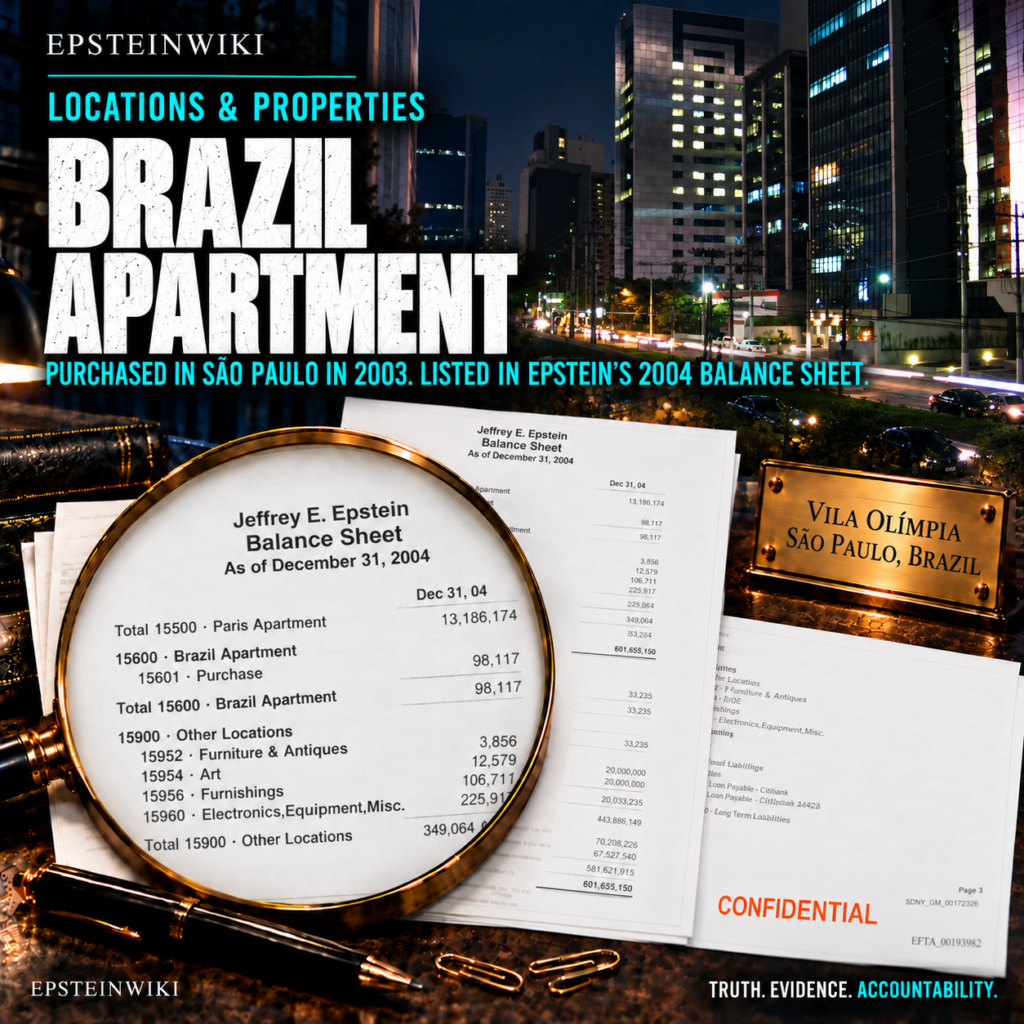
The public evidence for ownership is unusually strong. A Brazilian property record reported by BBC News Brasil documents the purchase and sale. Epstein’s own cash basis balance sheet separately lists a “Brazil Apartment” with a book value of $98,117 as of December 31, 2004. The property therefore belongs in any serious accounting of Epstein’s international real estate holdings.
The apartment also intersects with records concerning Brazilian model and fashion entrepreneur Ana Maria Gomes Macedo. Epstein sold the unit to Macedo in 2005 for substantially less than he had paid. Travel invoices under her name predate the purchase. A package from an Epstein associated address reached her soon after the purchase. Later emails show that their relationship continued for years.
Those connections merit investigation. They do not prove that the apartment was used for recruitment, trafficking, or abuse. Sworn testimony alleges that Epstein and Jean Luc Brunel were involved with women and possibly underage girls in Brazil, but the testimony does not identify the Vila Olímpia apartment as a location where misconduct occurred.
This article separates what is documented about the property from what is alleged about Epstein’s wider Brazilian network.
Key Takeaways
- Brazilian property reporting says Epstein purchased a roughly 93 square meter apartment in Vila Olímpia on May 5, 2003, for R$245,000.
- Epstein’s internal balance sheet lists a “Brazil Apartment” at $98,117 as of December 31, 2004. This independently corroborates ownership.
- Epstein sold the apartment to Ana Maria Gomes Macedo on August 1, 2005, for R$179,300.
- The sale price was R$65,700 below the reported purchase price, a nominal decline of about 26.8 percent.
- Travel, shipping, payment, and email records document a relationship between Epstein and Macedo before, during, and after his ownership of the property.
- Sworn testimony connects Epstein and Jean Luc Brunel to alleged sexual exploitation in Brazil. It does not connect that conduct to this apartment.
- No reviewed record proves that Epstein retained access to or control of the unit after the 2005 sale.
- The exact street address and unit number are omitted because reporting indicates that the residence remains privately owned, and publishing those details would not improve the evidentiary analysis.
Property Profile Chart
| Field | Documented information | Source strength |
|---|---|---|
| Location | Vila Olímpia, São Paulo, Brazil | Strong, based on reported land registry records |
| Property type | Apartment in a high end condominium | Strong |
| Private area | Approximately 93 square meters, or about 1,001 square feet | Strong |
| Original layout | Two bedrooms, two bathrooms, two parking spaces | Strong |
| Purchase date | May 5, 2003 | Strong |
| Reported buyer | Jeffrey Epstein | Strong |
| Occupation on deed | Consultant | Strong |
| Purchase price | R$245,000 | Strong |
| Internal 2004 book value | $98,117 | Strong, from Epstein’s own balance sheet |
| Sale date | August 1, 2005 | Strong |
| Reported buyer in 2005 | Ana Maria Gomes Macedo | Strong |
| Sale price | R$179,300 | Strong |
| Proven use for recruitment or abuse | None established in the reviewed records | No direct evidence |
Why the Apartment Matters
The São Paulo apartment expands the documented geography of Epstein’s property network beyond the residences most often associated with him in New York, Palm Beach, New Mexico, Paris, and the United States Virgin Islands.
Its importance rests on four points.
First, ownership is supported by both an external property record and an internal financial record. That combination is stronger than an isolated address book entry, travel reference, or recollection.
Second, the purchase sits within a period when Epstein was maintaining relationships across modeling, travel, finance, and elite social networks. Brazil had a major modeling industry and appears repeatedly in records concerning Jean Luc Brunel.
Third, Epstein transferred the property to Macedo at a price well below the amount he reportedly paid. That transaction requires explanation even though a below cost transfer, by itself, does not prove concealment, compensation, or wrongdoing.
Fourth, the apartment supplies a concrete asset around which investigators can organize other evidence. Deeds, condominium records, payment files, visitor records, local legal work, tax registration, and travel dates could answer questions that the currently public record cannot.
Internal Accounting Proof
Epstein’s cash basis balance sheet dated December 31, 2004, contains a real estate schedule. It lists the Paris residence and then a separate category titled “Brazil Apartment.” Beneath that category, the account “Purchase” carries a value of $98,117.
The entry appears in EFTA01304421. Duplicate copies of the same financial material appear in EFTA01682558, EFTA01308282, EFTA01720231, and EFTA01720157.
This evidence matters because it is an internal accounting record, not a retrospective media description. It shows that Epstein or his accountants treated the Brazilian apartment as an Epstein asset at the end of 2004.
The $98,117 figure should not be compared mechanically with the R$245,000 deed price. The two figures are in different currencies and may reflect exchange rates, closing costs, or accounting treatment. What the ledger establishes is the existence of an asset account and the value assigned to it in Epstein’s records.
Property Record and Timeline
| Date | Event | Evidentiary meaning |
|---|---|---|
| October 11, 2002 | Travel accounting includes an invoice under a version of Macedo’s name | Documents a relationship before the apartment purchase |
| November 5, 2002 | A second travel entry appears under “Maced/Anna” | Further pre purchase contact, purpose not established |
| May 5, 2003 | Epstein purchases the Vila Olímpia apartment for R$245,000 | Establishes ownership |
| June 10, 2003 | A package is shipped from an Epstein associated New York address to Macedo | Documents contact soon after purchase |
| June 12, 2003 | The package is recorded as delivered | Confirms completion of shipment |
| June 25, 2003 | A financial record contains a payment identified as $803.75 to Macedo | Documents a payment during the ownership period |
| December 31, 2004 | Epstein’s balance sheet values the “Brazil Apartment” at $98,117 | Internal corroboration of ownership |
| August 1, 2005 | Epstein sells the unit to Macedo for R$179,300 | Transfers title after just under 27 months |
| June 2010 | Macedo thanks Epstein for what he had done for her | Shows continued relationship after the sale and Epstein’s conviction |
| March 2011 | Macedo asks Epstein for help buying dresses for a new showroom | Shows continued financial or business solicitation |
| February 2026 | Brazilian reporting identifies the deed and reports a confidential federal inquiry into broader Epstein related activity | Renewed official and public scrutiny |
The timeline establishes continuity of contact. It does not, on its own, establish the purpose of the apartment.
Purchase and Sale Price Chart
| Transaction | Amount in Brazilian reais | Change from purchase price |
|---|---|---|
| Epstein purchase, May 2003 | R$245,000 | Baseline |
| Sale to Macedo, August 2005 | R$179,300 | R$65,700 lower |
| Nominal percentage change | 26.8 percent decrease |
The comparison is nominal. It does not account for inflation, taxes, condominium liabilities, exchange rates, renovations, furnishings, debt, or any private agreement between the parties.
Epstein’s Brazilian Tax Registration and Acquisition Infrastructure
Brazilian reporting states that Epstein possessed a Brazilian CPF taxpayer number. A CPF can be necessary for property and financial transactions in Brazil. Its existence would therefore be consistent with the practical requirements of acquiring real estate in São Paulo.
The CPF is significant because it indicates administrative preparation. Epstein’s Brazilian connection was not limited to a social visit. He entered a system that allowed him to hold and transfer a registered asset.
Reporting has also suggested that Brazilian legal professionals helped facilitate the acquisition. Publicly available reporting does not yet provide a complete engagement file. Investigators would need the purchase contract, powers of attorney, closing statements, identity verification records, and legal invoices before assigning responsibility to any intermediary.
The CPF number itself is not reproduced here. A personal identifier is unnecessary to establish the documented transaction.
Ana Maria Gomes Macedo
Ana Maria Gomes Macedo is a Brazilian model and fashion entrepreneur who appears in Epstein related travel, shipping, payment, address, and email records. Brazilian property reporting identifies her as the person who purchased the Vila Olímpia unit from Epstein in 2005.
Macedo’s appearance in records is relevant because she is the direct counterparty to the sale and because contact with Epstein existed before the transfer. Her documented association with Epstein is not, by itself, proof that she participated in criminal conduct.
A discovery exhibit in litigation involving JPMorgan categorized her among Epstein related individuals. Such a litigation category identifies material sought or organized during discovery. It is not a judicial finding of misconduct. The exhibit can be reviewed through CourtListener.
An unredacted version of Epstein’s address book also includes a Macedo entry associated with 301 East 66th Street in Manhattan. That building housed apartments used by people in Epstein’s orbit. An address book entry establishes a recorded contact or address. It does not establish residence dates, ownership, or knowledge of crimes. The relevant page is available through the Internet Archive.
Relationship Evidence Timeline
| Evidence | What it supports | What it does not prove |
|---|---|---|
| 2002 travel invoices | Epstein’s travel accounting recorded Macedo before the property purchase | Destination, purpose, or who paid the final cost |
| 2003 shipment | A package moved from an Epstein associated New York address to Macedo | Contents or relationship to the apartment |
| 2003 payment record | A payment to Macedo during the ownership period | Purpose of payment |
| 2005 deed transfer | Macedo acquired title from Epstein | Why the price was lower or whether a side agreement existed |
| 2010 email | Macedo expressed gratitude and friendship | What Epstein had done for her |
| 2011 email | Macedo sought help for a showroom and dresses | Whether Epstein provided the requested funds |
The pattern supports a continuing relationship. Each record has a narrower meaning than the pattern as a whole, and none should be stretched beyond its text.
Travel Records Before the Purchase
DOJ-OGR-00015291 is a travel accounting report. It includes an October 11, 2002 invoice carrying a shortened version of Gomes Macedo’s name and an amount of $1,156. A November 5, 2002 entry under “Maced/Anna” lists $1,260.
These entries predate the May 2003 apartment purchase by several months. They help establish that Macedo did not first appear in Epstein’s records when the apartment was sold to her in 2005.
The entries do not, without the underlying tickets and itineraries, establish the route, traveler identity beyond doubt, purpose, or connection to the São Paulo property.
The June 2003 Package and Payment
EFTA00218507 contains a FedEx invoice for a package shipped on June 10, 2003, shortly after the apartment purchase. The sender information names Cecilia Steen and Jeffrey E. Epstein at 457 Madison Avenue in New York. The recipient is Ana Macedo. The package was recorded as delivered on June 12.
The record is significant because it documents direct logistical contact near the start of Epstein’s ownership. The public invoice does not establish the package contents or connect the shipment to furnishing, operating, or maintaining the apartment.
EFTA01654600, a much larger financial record set, also contains a payment record identified as $803.75 to Ana Maria Gomes Macedo on June 25, 2003. The proximity in time is notable. The purpose is not stated clearly enough to characterize it as a property payment, compensation, gift, or business investment.
The 2005 Sale
Brazilian property reporting states that Epstein sold the unit to Macedo on August 1, 2005, for R$179,300. He had held it for just under 27 months.
The sale transferred legal title. Reporting based on the registry stated that Macedo remained the registered owner as of February 2026. There is no reviewed evidence that Epstein retained title, a mortgage interest, a lease, a right of occupancy, or contractual control after the transaction.
Because the apartment is reportedly still a private residence, this article does not publish the exact address or unit number.
What the Discounted Sale Does and Does Not Mean
The recorded sale price was R$65,700 below the purchase price, a nominal decline of about 26.8 percent. That is a legitimate investigative lead.
Possible explanations could include a declining market value, a distressed or accelerated sale, an incomplete statement of consideration, an offset for separate obligations, a gift element, compensation, or a transaction between people with an ongoing personal or business relationship. Those possibilities require evidence.
The price difference alone does not prove a sham sale. It does not prove that Epstein retained beneficial ownership. It does not prove that Macedo received the apartment in exchange for services. It also does not establish tax or reporting violations.
The most useful next records would be the complete deed file, transfer tax valuation, payment method, closing statement, bank records, condominium account, and communications surrounding the sale.
Brazil, Modeling, and Jean Luc Brunel
Brazil matters to the wider Epstein investigation because it appears in evidence concerning the international modeling industry and Jean Luc Brunel. Brunel was a French modeling agent who was accused by numerous women of sexual abuse and of supplying young women and girls to Epstein. Brunel denied wrongdoing before his death in French custody in 2022.
Brazil had a large pool of aspiring models, including young people seeking international careers. That created vulnerabilities that recruiters and powerful intermediaries could exploit through promises of travel, visas, housing, introductions, and work.
This wider context makes Epstein’s São Paulo asset important. It does not convert the apartment into a proven crime scene. A location based conclusion requires location based evidence.
Sworn Testimony About Epstein and Brunel in Brazil
EFTA01111413 is a June 15, 2010 sworn statement from a former modeling agency employee in litigation against Epstein. The witness described Brunel bringing young models, including Brazilian girls, into Epstein’s orbit. The witness also testified that Epstein paid for model visas.
In a section focused on Brazil, the witness said Brunel had a woman in Brazil who provided prostitutes. The witness stated that Epstein traveled to Brazil because he had one or two clients there and said Epstein and Brunel were in Brazil. The witness described uncertainty about ages and said the women could have included girls aged 16 or 17 as well as adults.
This is important sworn testimony, but it must be read with its limitations. Some of the witness’s information was based on what Brunel allegedly said. The testimony includes uncertainty. It does not name the Vila Olímpia apartment, place any survivor inside it, or say that recruitment occurred there.
The testimony supports investigation of Epstein and Brunel’s activities in Brazil. It does not establish the apartment’s operational role.
Survivor and Witness Context
Property research should serve survivor centered accountability. A building is relevant because of what it may reveal about access, movement, money, facilitation, and institutional knowledge. It should not displace the experiences of people harmed by Epstein and his associates.
The public record contains allegations involving Brazilian girls and young women, modeling pathways, visas, and international travel. Those allegations make it especially important to preserve records and invite testimony from people who may have encountered Epstein’s network in Brazil.
At the same time, researchers should not identify possible survivors through apartment records, travel files, or private addresses. Names and identifying details should be published only when a person has chosen to speak publicly or when their inclusion is clearly justified by an authoritative public record.
Did the Apartment Facilitate Recruitment or Abuse?
No reviewed record directly establishes that it did.
There is presently no public visitor log, survivor statement, employee testimony, police report, photograph, message, or condominium record placing recruitment, sexual abuse, or trafficking activity inside the Vila Olímpia unit.
The following facts create grounds for further investigation:
- Epstein owned a residence in São Paulo during a period of international travel and modeling contacts.
- He had an established relationship with Macedo before buying the property.
- He transferred the property to her below his reported purchase price.
- Sworn testimony separately alleges that Epstein and Brunel engaged with women and potentially underage girls in Brazil.
Those facts form a meaningful investigative pattern. They are not a substitute for direct evidence about the apartment.
Brazil After the Apartment Sale
Epstein’s documented Brazilian interests did not end when he sold the São Paulo unit. Later emails show continuing contact with Macedo and an interest in introductions involving prominent Brazilian business figures.
This distinction matters. Evidence after August 2005 may illuminate relationships and network continuity, but it does not prove continuing control of the former property.
The 2010 and 2011 Correspondence
In EFTA01814192, a July 1, 2010 email from Macedo tells Epstein that it was good to have him back, calls him her friend, and says she would never forget what he had done for her. Epstein replied by asking for photos.
The exchange occurred after Epstein’s 2008 Florida conviction and after the apartment sale. It establishes continuing warmth and contact. It does not explain what assistance Macedo was referring to.
EFTA01798556, dated March 23, 2011, contains a request from Macedo for help buying dresses for a new showroom. Her reference to dresses “for the girls” is ambiguous. In a fashion business context, it could refer to models, employees, clients, or another group. It should not be presented as coded proof of recruitment without corroboration.
Brazilian Business Connections
EFTA00947615 contains a November 9, 2012 email in which Epstein proposed connecting Brazilian billionaire Eike Batista with Isabel dos Santos in London or Paris.
The email documents Epstein’s continued interest in Brazilian elite networks years after he sold the São Paulo apartment. It does not connect Batista, dos Santos, or that proposed meeting to the apartment or to sexual misconduct.
This record belongs in the wider map of Epstein’s Brazil contacts, not in the direct proof column for the Vila Olímpia property.
The 2026 Brazilian Inquiry
Brazilian news organizations reported in February 2026 that the Federal Public Prosecutor’s Office opened a confidential proceeding after receiving material about Epstein related communications involving a Brazilian woman. Reporting said the matter was referred to the national unit that combats human trafficking.
The existence of a confidential inquiry shows official interest. It does not establish that charges have been filed, that any named person committed an offense, or that the São Paulo apartment is a subject of the proceeding.
Because the matter is confidential, claims about its targets, evidence, or likely outcome should be treated cautiously unless confirmed by the responsible authority.
Do Not Confuse It With the Rio Apartment Emails
The Vila Olímpia property was in São Paulo and belonged to Epstein from 2003 to 2005. A separate group of 2010 emails concerns a possible apartment purchase in Ipanema, Rio de Janeiro, by Peter Mandelson and his partner.
In EFTA02414642, Mandelson forwarded information to Epstein and asked for advice about the proposed Rio purchase. Related correspondence appears in EFTA00777380, EFTA00777382, EFTA02414612, EFTA02414628, and EFTA02415526.
Those emails do not show that Epstein owned the Ipanema property. They concern his advice about another person’s contemplated transaction. Combining the Rio discussion with Epstein’s documented São Paulo apartment creates a false property history.
| Property reference | City | Period | Epstein’s documented role |
|---|---|---|---|
| Vila Olímpia apartment | São Paulo | 2003 to 2005 | Owner and seller |
| Ipanema apartment emails | Rio de Janeiro | 2010 | Adviser or correspondent concerning another person’s proposed purchase |
Evidence Strength Chart
| Claim | Rating | Basis |
|---|---|---|
| Epstein owned an apartment in São Paulo | Confirmed | Registry reporting and internal balance sheet |
| The apartment was in Vila Olímpia | Confirmed | Brazilian property reporting |
| Epstein sold it to Macedo in 2005 | Confirmed | Registry reporting |
| Epstein knew Macedo before the purchase | Strongly supported | 2002 travel accounting entries |
| Their relationship continued after the sale | Confirmed | 2010 and 2011 emails |
| The sale occurred below the reported purchase price | Confirmed | Reported deed values |
| The discount represented a gift or compensation | Unproven | No agreement or payment explanation located |
| Epstein retained access after the sale | Unproven | No lease, key record, agreement, or witness evidence located |
| The apartment was used for modeling recruitment | Unproven | No apartment specific testimony or record located |
| The apartment was used for abuse or trafficking | Unproven | No apartment specific survivor account or official finding located |
| Epstein and Brunel were involved with women or girls in Brazil | Alleged in sworn testimony | Witness testimony with stated uncertainty and some secondhand information |
| The 2010 Rio property was Epstein’s apartment | Unsupported | Emails concern advice on another person’s proposed purchase |
What the Evidence Establishes
The combined record establishes that Epstein acquired, carried on his books, and sold a residential asset in São Paulo. It establishes that Macedo was connected to him before the purchase, received the apartment from him through a recorded sale, and remained in contact with him afterward.
It also establishes that Brazil was part of Epstein’s broader international field of relationships. Separate sworn testimony raises serious allegations about Epstein and Brunel in Brazil. Later correspondence shows Epstein remained engaged with Brazilian contacts.
These are meaningful findings even without proof that the apartment itself was used in a crime.
What the Evidence Does Not Establish
The reviewed evidence does not establish who occupied the apartment during Epstein’s ownership. It does not establish how often Epstein visited, whether staff maintained it, who held keys, or whether guests stayed there.
It does not establish the purpose of the 2003 payment to Macedo, the contents of the shipped package, the reason for the lower sale price, or the assistance referenced in Macedo’s 2010 email.
It does not prove that Macedo recruited anyone for Epstein or knew about his crimes. It does not prove that survivors entered the apartment. It does not prove that the property facilitated trafficking or abuse.
It also does not establish that Epstein owned the separate Rio apartment discussed in 2010 emails.
Evidentiary Significance
The Vila Olímpia apartment is best understood as a confirmed asset embedded in an incompletely documented relationship network.
The strongest evidence concerns title, dates, price, size, and internal accounting. The next strongest category concerns the continuity of Epstein’s relationship with Macedo. The most serious allegations concern Brazil more broadly, but they currently lack a demonstrated geographic link to this unit.
That hierarchy prevents two opposite errors. The property should not be dismissed as an incidental foreign investment, because it intersects with a person and network that recur in Epstein’s records. It should not be labeled a trafficking site without apartment specific evidence.
The responsible conclusion is that the apartment is a significant investigative node whose operational use remains unresolved.
Questions for Further Investigation
- Who located the property for Epstein, negotiated the purchase, and handled the closing?
- Who applied for or managed Epstein’s Brazilian CPF registration?
- What bank account funded the R$245,000 purchase?
- Did the purchase price recorded in the deed include the entire consideration?
- Who paid condominium fees, utilities, taxes, insurance, furnishings, and maintenance between May 2003 and August 2005?
- Did the building maintain visitor logs, garage records, staff books, security footage, or access card data?
- Who held keys or was authorized to enter the unit?
- How often did Epstein, his employees, Macedo, Brunel, or other associates visit the property?
- Do flight records, hotel records, passports, or calendars place Epstein in São Paulo during the ownership period?
- What were the contents and purpose of the June 2003 package?
- What was the purpose of the June 2003 payment to Macedo?
- Why was the 2005 sale price about 26.8 percent below the reported purchase price?
- How did Macedo fund the acquisition, and where is the corresponding payment record?
- Were there side agreements, loans, gifts, offsets, or continued occupancy rights?
- Did Epstein disclose the sale consistently in United States and Brazilian financial and tax records?
- Did investigators in the United States, France, or Brazil obtain the complete deed and condominium files?
- Have Brazilian models, agency employees, drivers, building workers, or neighbors been offered a safe and confidential way to provide information?
- Does the confidential Brazilian inquiry include the Vila Olímpia property, or is it limited to other communications and conduct?
- Can any survivor testimony place Epstein, Brunel, recruiters, or vulnerable young people at the unit?
- What precisely did Macedo mean when she thanked Epstein in 2010 for everything he had done for her?
Related Evidence
EpsteinWiki’s separate report on Macedo provides broader biographical and network context: Ana Maria Gomes Macedo and Jeffrey Epstein’s Brazil Connections.
Reporting about 301 East 66th Street provides context for the New York address associated with Macedo in Epstein’s address book: The Manhattan building at the center of Epstein’s network.
The public may search the federal release through the United States Department of Justice Epstein Library.
Sources
- BBC News Brasil and G1, Escritura mostra que Jeffrey Epstein comprou apartamento em bairro nobre de São Paulo
- EFTA01304421, Epstein cash basis balance sheet listing the Brazil Apartment
- DOJ-OGR-00015291, travel accounting report
- EFTA00218507, June 2003 FedEx invoice
- EFTA01654600, financial records containing the Macedo payment entry
- EFTA01814192, July 2010 correspondence
- EFTA01798556, March 2011 showroom request
- EFTA00947615, November 2012 Brazilian business introduction email
- EFTA01111413, June 2010 sworn statement concerning modeling and Brazil
- CourtListener, JPMorgan litigation discovery exhibit
- Internet Archive, Epstein address book page containing the Macedo entry
- United States Department of Justice Epstein Library
- Bekah Day, Another Epstein Rabbit Hole Leads to Brazil
- TMC, MPF investiga aliciamento de brasileiras por Jeffrey Epstein