

The Circle Gets Bigger: New Epstein Files Expand the Network — Not the Answers
Another day, another batch of documents — and once again the Jeffrey Epstein record grows outward instead of clearer. Newly surfaced material, reporting, and hearing discussions are not revealing a single hidden mastermind or tidy list of co-conspirators. Instead, they show a pattern: financiers, politicians, academics, royalty, media figures, and corporate leaders repeatedly intersecting with Epstein across decades and continents. What investigators once framed as an isolated criminal operation now looks increasingly like a social ecosystem — one that protected access, influence, and reputation long after serious allegations were known.
Investigative Journalism
From Financier to Ideology: Report Examines Peter Thiel’s Links to Epstein and Democratic Institutions
A Nation investigation explores the overlap between tech investor Peter Thiel’s political influence and his documented contacts with Jeffrey Epstein, arguing the relationship highlights how elite financial, technological, and social networks intersected even after Epstein’s conviction. The article does not allege joint criminal activity but focuses on how Epstein maintained access to powerful figures across industries, including technology and venture capital, while simultaneously cultivating influence in political and intellectual circles. The broader point is institutional: the persistence of those relationships raises questions about how wealth, reputation, and ideological power insulated Epstein socially and why accountability often lagged behind public knowledge of his conduct.
Records Show Epstein Repeatedly Hired Private Investigators, Expanding Questions About Intelligence Gathering
A report from Intelligence Online says documents indicate Jeffrey Epstein repeatedly called on the investigative firm Nardello & Co. to conduct private intelligence and background work, suggesting he actively gathered information on individuals in his orbit. The revelation points to a more deliberate operational strategy: rather than simply networking socially, Epstein may have used professional investigators to vet contacts, manage risks, or collect leverage within elite financial and political circles. The findings add to the growing picture of Epstein as someone who maintained influence partly through information control — cultivating relationships while simultaneously monitoring people around him.
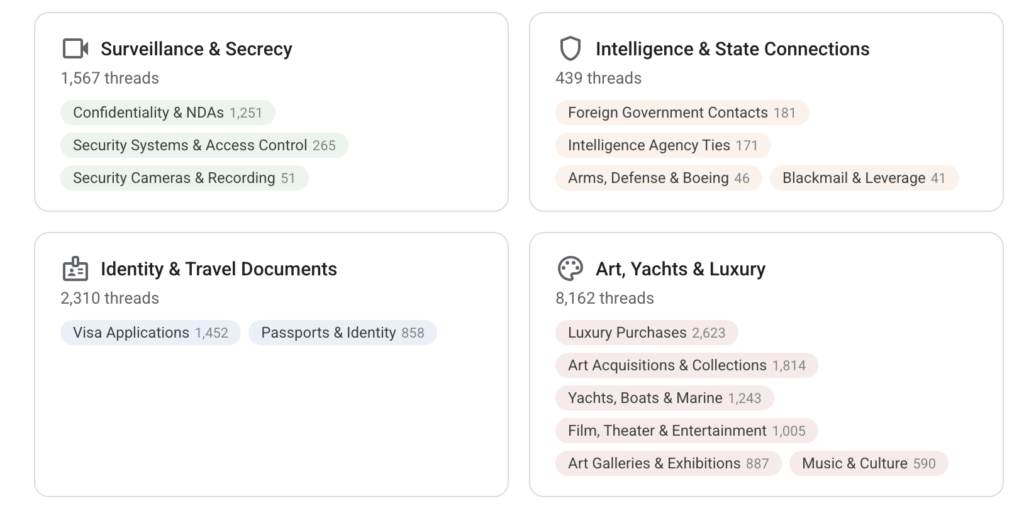
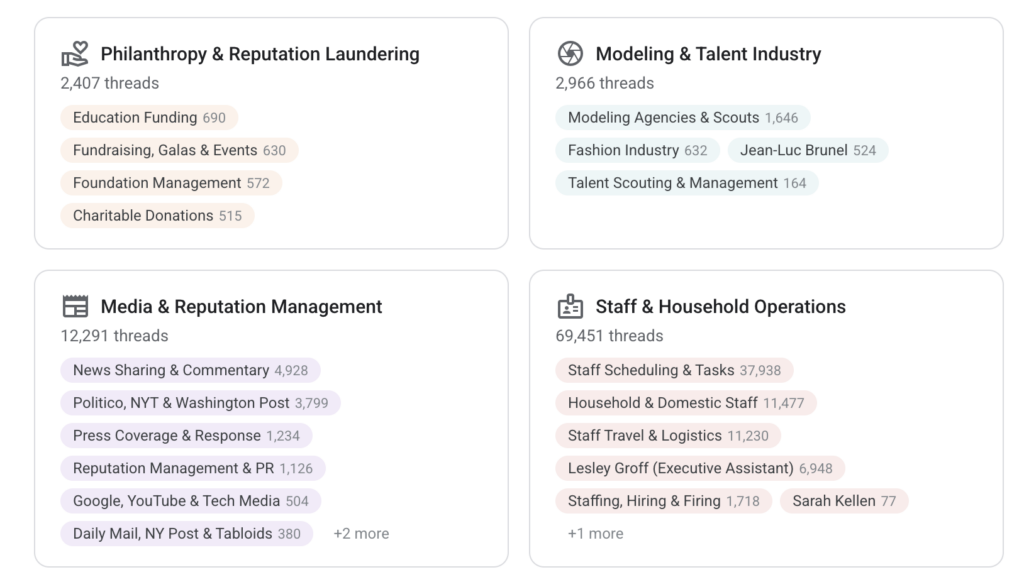
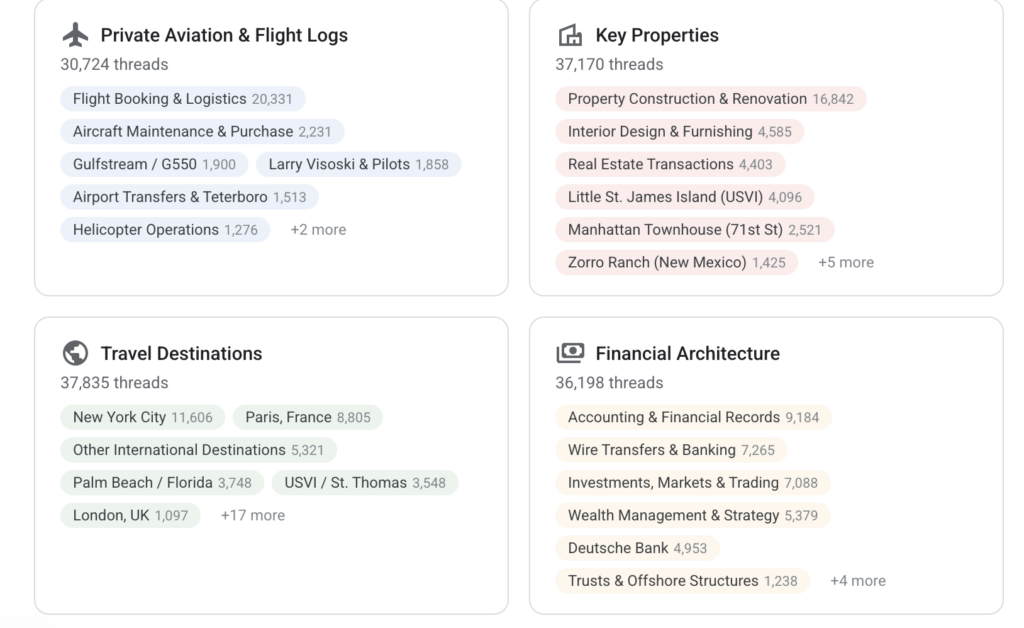
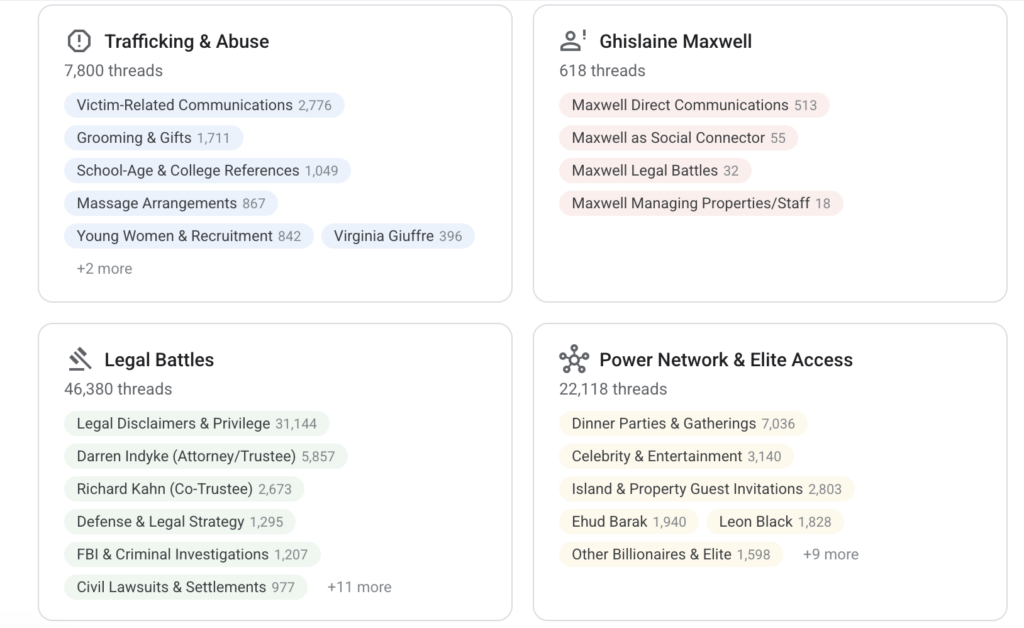
JMail World Publishes Research Taxonomy Aimed at Organizing Large Investigations
The JMail.World taxonomy page outlines a structured classification system for organizing investigative material — grouping items into categories such as people, organizations, communications, financial records, locations, and media evidence. The framework is designed to help researchers map relationships across large document sets and track how different types of records connect within complex investigations. Rather than presenting new allegations, the resource functions as a methodology tool, offering a standardized way to catalogue and cross-reference information so contributors can collaborate and follow patterns across datasets more efficiently.


Report Claims Individual Accessed Epstein’s FedEx Shipping Account, Suggesting Broader Operational Network
An investigative blog post alleges a third party obtained access to Jeffrey Epstein’s FedEx shipping account records, potentially revealing shipping patterns, package origins, and destinations connected to his residences and associates. The claim, if verified, could offer logistical insight into how Epstein’s operation functioned behind the scenes — not just who he contacted, but how materials, documents, or items moved between properties and network participants. While the information has not been confirmed by a court filing or official investigation, it highlights growing interest in reconstructing the operational infrastructure surrounding Epstein’s activities, including communications, travel, and physical delivery systems that may map connections beyond social contacts alone.
Survivor Account Describes Life Inside Epstein’s New Mexico Compound
A Daily Maverick feature recounts testimony from a South African survivor who described experiences at Jeffrey Epstein’s Zorro Ranch property in New Mexico, portraying a highly controlled environment where young women were isolated, monitored, and dependent on the network surrounding Epstein. The account focuses on psychological manipulation as much as physical exploitation, describing grooming, social pressure, and the normalization of abuse within an insular setting populated by wealthy visitors and staff. While the piece does not introduce a new criminal charge, it adds survivor narrative detail to the historical record of how Epstein’s operation functioned day-to-day and why victims often struggled to leave or report what was happening.
Wired Report: Epstein Advised Associate of Elon Musk During Tesla Privatization Effort
A Wired investigation reports that Jeffrey Epstein provided advice to a business associate connected to Elon Musk during discussions around taking Tesla private, revealing the financier was still attempting to insert himself into high-level tech and financial deals years after his conviction. The article indicates Epstein positioned himself as a facilitator and fixer within elite circles, offering strategic and reputational guidance despite being publicly known for past criminal conduct. The episode reinforces a recurring pattern emerging from document disclosures and reporting: Epstein maintained relevance not by formal positions, but by leveraging social access and perceived influence among powerful investors, executives, and intermediaries in technology and finance.
Court Orders Les Wexner to Testify in Ohio State Sexual Abuse Litigation
An Ohio court has ordered billionaire businessman Les Wexner to sit for a deposition in ongoing civil litigation tied to the Ohio State University sexual abuse scandal involving former team doctor Richard Strauss. The ruling compels sworn testimony about Wexner’s knowledge, institutional relationships, and potential connections relevant to the case, which plaintiffs argue may clarify how abuse allegations were handled and whether influential donors or administrators were aware of misconduct. Although the lawsuit centers on university accountability rather than Jeffrey Epstein directly, Wexner’s long-examined past association with Epstein has heightened public interest, as investigators and victims’ attorneys continue mapping overlapping networks of power, philanthropy, and institutional protection.
Prince Andrew Associate Back in Focus as Social Connections Around Epstein Are Re-Examined
A blog post revisits the story of a socialite closely connected to Prince Andrew whose wealth and social access reportedly expanded through elite networking that overlapped with Jeffrey Epstein’s circles. The article argues Epstein’s influence operated partly through social gatekeeping — introductions, status, and access to royalty, financiers, and celebrities — allowing associates to gain legitimacy and financial opportunities. While the piece does not present new legal findings, it underscores how Epstein’s network functioned as a social ecosystem as much as a criminal one, where reputation, proximity to power, and personal relationships helped sustain his standing long after his earlier conviction.
Yale Professor Steps Back From Teaching After Review Triggered by Epstein Email Contacts
A Yale University professor has paused teaching duties after the school opened a review into previously reported emails showing communication with Jeffrey Epstein, according to campus reporting. The professor has said the contact did not involve knowledge of criminal activity, but the correspondence resurfaced amid renewed scrutiny of academics who maintained relationships with Epstein after his conviction. The situation reflects a broader pattern emerging from document releases: universities and professional institutions are reassessing past associations as names appearing in Epstein’s communications continue to raise reputational and ethical questions even when no criminal conduct is alleged.
Les Wexner Reportedly Listed in Epstein Documents, Renewing Focus on Business Ties
A financial news report says longtime Victoria’s Secret owner Les Wexner appears in newly discussed Epstein-related records as a co-conspirator reference, reigniting scrutiny of the business relationship between the retail billionaire and Jeffrey Epstein, who once managed Wexner’s finances and held extensive control over aspects of his wealth. Wexner has previously stated he was unaware of Epstein’s criminal conduct and severed ties years ago, but the appearance of his name in legal or investigative materials adds to the broader examination of how Epstein embedded himself within elite financial and social circles. As additional documents surface, attention continues to focus not only on criminal acts but on the network of powerful associations that enabled Epstein to maintain legitimacy for decades.
Ohio State OB-GYN Named in Epstein Files Denies Any Knowledge of Abuse
An Ohio physician identified in newly discussed Epstein-related records says he had no awareness of criminal conduct and never participated in trafficking activity, responding after his name surfaced in connection with contacts contained in the files. The doctor acknowledged professional or social contact but stated the association did not involve illegal behavior, reflecting a recurring pattern as document releases broaden the circle of people mentioned: inclusion in Epstein’s communications or records does not itself establish wrongdoing, yet it continues to generate scrutiny about how widely his network extended into academic, medical, financial, and social institutions.
Goldman Sachs Lawyer Acknowledges Advising Epstein Despite Not Formally Representing Him
A new report describes testimony from a Goldman Sachs–connected attorney who said she did not officially represent Jeffrey Epstein but still provided him significant legal guidance, adding to the picture of how elite legal and financial professionals interacted with Epstein after his prior conviction. The disclosure feeds ongoing scrutiny of the professional network that continued to assist or counsel Epstein in business and personal matters, even as his criminal history was publicly known. Rather than introducing a new criminal allegation, the story underscores a recurring issue in the Epstein case: the extent to which high-status advisers, bankers, and attorneys maintained relationships that helped him navigate legal and reputational risks while remaining socially and financially connected to powerful circles.
Are Authorities Still Minimizing the Epstein Scandal? Calls Grow for a Broader Investigation
An analysis in The Preamble argues the United States has consistently treated the Jeffrey Epstein case as an isolated criminal prosecution rather than a systemic corruption and trafficking network. The piece contends that while Epstein and a small number of associates were prosecuted, many unanswered questions remain about facilitators, financial enablers, and institutional failures that allowed the operation to function for years. It suggests limited investigations and cautious disclosures have prevented a full accounting of how social, financial, and political power intersected around Epstein, fueling continued public suspicion and renewed demands for wider inquiries, document releases, and accountability beyond the individuals already charged.
Pam Bondi Back in the Spotlight as Questions About Epstein-Era Decisions Resurface
A Left Hook commentary revisits former Florida Attorney General Pam Bondi’s past handling of issues connected to Jeffrey Epstein, arguing her political prominence has revived scrutiny over prosecutorial discretion, donor influence, and accountability in the original investigations. The piece frames the controversy less as a single decision and more as a symbol of how powerful figures and legal institutions intersected around Epstein’s case, with critics questioning whether political relationships affected enforcement choices. The renewed attention reflects a broader public push to re-examine who knew what — and who chose not to act — during the years when Epstein’s network was operating openly.
Today’s Call to Action
Please sign this Petition
Sunlight is the only antidote to corruption, and right now the American people are being denied the truth. For years, powerful men who associated with Jeffrey Epstein have been shielded by secrecy, redactions, and political cowardice. Survivors have waited. The public has waited. And accountability has been delayed far too long. Now, Republican Representative Thomas Massie has publicly threatened to force the release of the Epstein files. He warned that if the Department of Justice continued to stall, he would take action to expose the names of Epstein’s clients and associates who exploited a system built to protect the wealthy and connected. Now it’s time for Rep. Massie to follow through.
Please sign this Petition
In early 2026, the DOJ released a massive trove of documents related to Jeffrey Epstein’s trafficking network. But instead of fully exposing the wealthy and powerful people who enabled Epstein’s abuse, the DOJ withheld roughly 200,000 pages while redacting key details that could identify enablers and co-conspirators. At the same time, the DOJ failed to properly protect victims.
“Make Congress Search for the Epstein Files”: Calls Grow for Full Transparency and Accountability
A growing chorus of activists and watchdog commentators is urging Congress to conduct a full and public search of the complete Jeffrey Epstein document archive, arguing that leadership in the House and Senate must ensure that all files related to Epstein’s networks, abuse patterns, and associated power figures are examined and eventually released to the public under the Epstein Files Transparency Act and related oversight efforts. Proponents contend that piecemeal disclosures and redactions have allowed powerful people to escape scrutiny and that only a systematic legislative review—with public hearings, subpoena authority, and judicial enforcement—can deliver the transparency and accountability survivors, journalists, and the public demand.
EpsteinWiki Calls for Volunteers — “The Work Is Bigger Than Any One Person”
EpsteinWiki put out a volunteer call this week, emphasizing that the scale of cataloging the Epstein Files, court documents, public records, and accountability research is “bigger than any one person,” and needs collaborative effort to maintain accuracy, expand linked evidence pages, build biographies of key figures, and provide a comprehensive public knowledge base for journalists, researchers, survivors, and advocates. The site stresses that volunteers don’t need to be legal experts — just diligent, ethically grounded, and ready to help structure the sprawling document releases into a searchable, linked resource that resists disinformation and preserves verified reporting. This push reflects ongoing demands for transparency, public archival of records under the Epstein Files Transparency Act, and grassroots participation in documenting power networks historically shielded from scrutiny.
In Closing
What matters now is preservation and verification. The public narrative has shifted from “who was Epstein?” to “how was this allowed to continue?” The answer will not come from one witness, one trial, or one sensational name. It will come from records — flight logs, emails, court filings, property records, and testimony — assembled together in a way they never were during his lifetime. EpsteinWiki exists to organize that record so it cannot quietly disappear again. The story is no longer just about a man. It is about a system, and systems only change when their documentation becomes unavoidable.