
Charles III and the Epstein Record: Royal Decisions, Financial Support and Evidence Limits
Snapshot
| Field | Details |
|---|---|
| Subject | Charles III, previously Prince Charles and Prince of Wales. |
| Article focus | Documented references in Epstein records, decisions concerning Andrew, financial reporting, survivor engagement and the monarchy’s institutional response. |
| Direct record references | EFTA02541746 and duplicate EFTA01861978 contain Epstein’s assumption about Charles. EFTA01246381, page 5, records James Hatt’s undated polo recollection. |
| Established institutional actions | Official records document decisions on Andrew’s royal status and honors, the King’s public support for the police process and a separate Privy Council order concerning Peter Mandelson. |
| Current financial distinction | The Crown Estate confirms the completed Royal Lodge lease surrender. AP separately reports a private loan from Charles, relying on an unnamed source. This is separate from the 2022 civil settlement. |
| What this review does not establish | A verified Charles and Epstein meeting, direct correspondence between them, an Epstein property visit by Charles, or Charles’s participation in Epstein’s crimes. This is a bounded evidence assessment, not proof that no further records exist. |
| Review date | October 19, 2026. Developments after this date are outside this version. |
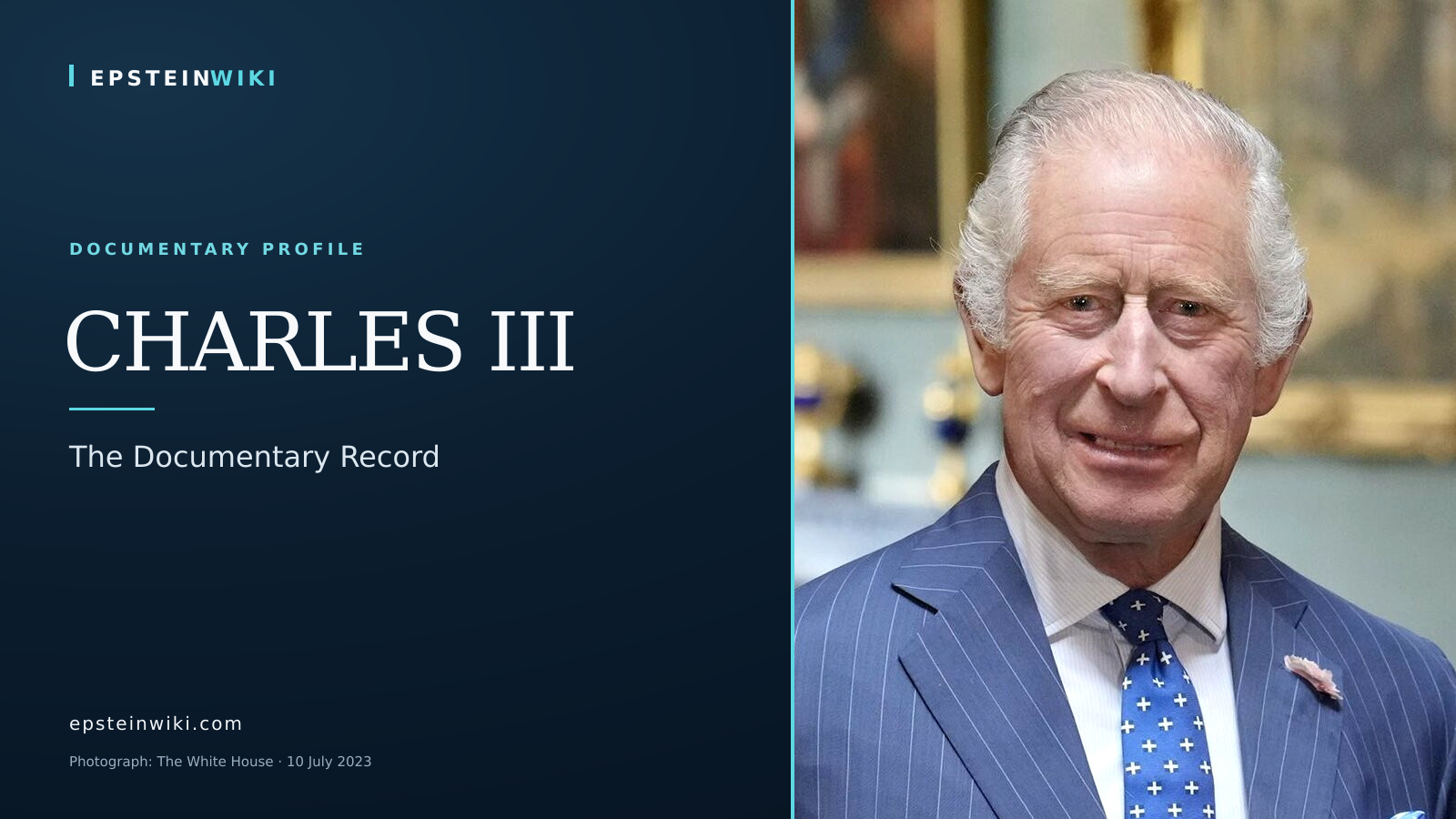
Charles III belongs in the Epstein record because of identifiable references and consequential institutional decisions, not because family membership makes him responsible for another person’s conduct. As Andrew’s brother and, from September 2022, sovereign, Charles has faced questions about royal accountability, financial support, cooperation with investigators and the treatment of survivors. Those questions deserve a record that separates evidence from repetition.
The Royal Family and Jeffrey Epstein overview documents the wider family and institutional history. This article isolates what the reviewed sources establish about Charles. It distinguishes contemporary correspondence, an FBI witness summary, formal royal instruments, public statements and attributed reporting. None of those source types should silently substitute for another.
A particularly relevant Charles reference in the reviewed Epstein correspondence is an assumption voiced by Epstein in 2011. Direct evidence of Charles’s later institutional actions comes from official public records. Keeping that distinction visible protects both the integrity of the investigation and the survivors whose accounts should not be diluted by unsupported claims.
Key Takeaways
- Epstein’s July 21, 2011 message speculated about Charles’s role amid coverage of Andrew’s trade role departure. It does not prove Charles directed the decision.
- James Hatt recalled Charles attending a polo event arranged by Sarah Ferguson. The passage does not place Epstein there and supplies no event date.
- Andrew’s 2019 withdrawal from public duties and January 2022 return of patronages occurred during Elizabeth II’s reign. Charles’s later actions must be dated separately.
- Prince, HRH, peerage registration, honors, military rank, property rights and succession have different legal histories. They were not all extinguished by one announcement.
- Royal Lodge’s October 2026 financial settlement and Andrew’s 2022 settlement with a survivor are different transactions.
- Charles’s public promise of cooperation is documented. The completeness of any private cooperation cannot be measured from that statement alone.
- The latest reviewed police statement says the misconduct investigation continues. The search warrant challenge did not determine the underlying allegations.
How to Read the Charles Evidence
This review asks three separate questions. First, where is Charles actually mentioned in released Epstein material? Second, what decisions did he or the institutions acting in his name publicly make? Third, what remains an allegation, anonymous account or unanswered research question? A document containing a name can answer the first question without answering the other two.
Released correspondence can show what its author wrote. A witness interview can show what that witness told investigators. A government statement can establish an official position or reported search result. A court order establishes the decision it actually makes. None automatically proves every assertion quoted within it.
The evidence review covers the specific records and public sources cited below. It is not a forensic authentication of every email, a complete search of every unreleased royal record or a claim that all pages of the Epstein corpus have been examined. Duplicate productions are identified rather than counted as independent corroboration. The two central records are not the only Charles references: the broader inventory below includes film discussions, professional references, public events and proposed charity roles.
The July 2011 Email: Epstein’s Assumption About Charles
The July 21, 2011 email, page 1, records Epstein replying to David Stern during coverage of Andrew’s departure from his government trade role. Epstein wrote, “I assume he knows that this is charles doing.” The duplicate EFTA01861978 gives the reply time as 22:41:29 and preserves the same exchange.
The opening words matter. Epstein expressed an assumption. The email supplies no Charles instruction, no minutes of a decision and no communication from Charles. Stern’s preceding comment about television coverage does not independently corroborate Epstein’s theory. The date is 2011, not 2010.
The correspondence is relevant because it shows Epstein interpreting pressure on Andrew through a theory about royal family dynamics. It cannot establish that theory as fact. The reviewed exchange does not demonstrate that Charles read it, knew it existed, had spoken to Epstein or knew about the underlying abuse.
David Stern’s separate profile provides context for the intermediary. The same context should not be used to invent a direct Charles and Epstein relationship. One duplicated message remains one message, even when it appears under two production identifiers.
What the Official Trade Departure Record Establishes
The Prime Minister’s July 21, 2011 statement described Andrew’s decision to relinquish his position as the government’s special representative for trade and investment. David Cameron thanked him and anticipated continued royal support for British business. That public statement did not identify Charles as the decision maker.
UK Trade and Investment’s annual report for 2011 to 2012, paragraphs 2.81 to 2.84 on printed page 27, records that Andrew honored existing commitments through the end of March 2012. It also says UKTI would no longer hold a specific budget for his trade work from April 1, 2012, with future official overseas travel costs handled by the Foreign and Commonwealth Office in the usual royal arrangements.
The documentary chronology therefore distinguishes the July announcement, completion of existing commitments and later funding arrangements. A claim that Charles immediately ended every official activity in July 2011 would go beyond these records. Evidence of a private Charles role would require additional correspondence, minutes or a sufficiently grounded firsthand account.
The Appointment Papers and the Limits of Their Disclosure
The government’s May 21, 2026 statement described eleven released documents about creating the trade role and appointing Andrew. It reported that officials found no evidence that formal due diligence or vetting had occurred or been considered. The search focused on records from 1999 through 2001, not the whole subsequent decade.
The released appointment packet, HC 222, numbered pages 7 to 9, includes Sir David Wright’s February 25, 2000 proposal. Wright reported Elizabeth II’s wish for Andrew to succeed the Duke of Kent in trade promotion. This is a record of Wright’s account of the Queen’s wishes, not a Charles instruction or proof of anyone’s knowledge of Epstein’s criminal conduct.
The July 9, 2026 supplementary statement announced thirteen more documents on the appointment, induction, board consideration and media handling. Officials said reasonable searches within the parliamentary request were complete, while promising further responsive material if found. That limited completion claim must not be recast as a complete public archive of Andrew’s service or every royal communication.
These records make institutional accountability more specific: who proposed a role, who approved arrangements, what safeguards were documented and what records were searched. They do not fill the separate evidentiary gap concerning Charles’s involvement in the 2011 departure.
James Hatt’s Polo Account
James Hatt’s FBI interview report, page 5, with page identifier EFTA01246385, attributes to Hatt an account of Sarah Ferguson arranging a polo match for Grigory Luchansky and his daughter. Hatt said Charles attended. The interview took place on November 30, 2020; the report was dictated on July 21, 2021 and entered on September 14, 2021.
The record is an FBI FD 302 interview summary. It is not a verbatim sworn transcript or an FBI determination that every recollection is correct. The passage gives no event date, invitation, program or guest list. It does not say Epstein attended that match.
This is a limited reference to access and social proximity. It should not be converted into a Charles and Epstein meeting or used to assign Charles knowledge of another attendee’s conduct. A date from an adjacent paragraph should not be silently attached to the polo event.
The existing Hatt evidence article covers the wider interview. A stronger account of this particular event would require contemporary event records or independent testimony identifying the same occasion.
Film Screenings, Professional References and Public Events
A November 5, 2010 email, page 1, records Peggy Siegal telling Epstein about Tom Hooper’s account of a Palace refusal of a proposed Colin Firth screening of The King’s Speech for Charles. The discussion also concerns entertainment plans for Andrew. It is a secondhand account of a proposed screening, not a completed event with Charles and Epstein.
Siegal’s December 3, 2010 email, page 1, follows Andrew’s dinner and distinguishes DVDs she left for Andrew from a separate effort to get the Palace and Charles to see the film. The emails distinguish Andrew’s completed dinner from a proposed Charles screening. Neither email places Charles at Epstein’s dinner.
Mike Sitrick’s March 9, 2011 message, page 1, describes consultations with a British defamation lawyer and a friend who had represented Charles while proposed defensive wording circulated. That is a professional connection claimed by an adviser. It is not advice, authorization or assistance from Charles, and it does not prove the proposed statement was issued.
Stern’s July 20, 2013 forward, page 1, carries a BBC article dated July 15 about parliamentary scrutiny of Charles’s tax arrangements. A forwarded article establishes circulation of news. It does not establish a financial relationship between Charles and Epstein.
A September 6, 2018 exchange, page 1, quotes Michael Wolff reporting to Epstein about an evening featuring Charles and other public figures. GQ’s own winners list and the event organizer’s account identify the awards held at Tate Modern on September 5. The correspondence shows Wolff reporting a public event; it does not put Epstein there. EFTA02624352 is a related production, not another Charles meeting.
Promotional Claims and Proposed Charity Roles
An April 5, 2004 financing request, page 1, addressed to Ghislaine Maxwell by Jules Valdinger, invokes Charles among public figures whose artworks were said to be involved in a celebrity plate project. That is the sender’s promotional claim. The document contains no acceptance from Charles and does not show that he knew Maxwell was being approached for financial help.
An undated Nobel Charitable Trust proposal, physical page 5, page identifier EFTA00602146, lists Charles as a candidate for board membership. A separate planning document, physical page 18, printed slide 17 and page identifier EFTA00602164, envisages signed comments from Charles in a publicity plan. These are proposed roles and publicity ambitions. They are not an appointment, acceptance, completed endorsement or proof of Charles funding a project.
An August 5, 2011 message from Boris Nikolic, page 1, claims that a woman being discussed knows Charles while the correspondents are themselves trying to establish her identity. It does not show Charles making an introduction or verifying her claims. The exchange does not establish her identity.
A March 2011 BBC interview request, page 1, names the Prince of Wales among previous guests of the program. The request circulated through Epstein’s legal and political contacts. Charles’s appearance in a program’s guest history does not establish that he arranged or supported the proposed Epstein interview.
Before Charles Became King: The 2019 and 2022 Decisions
Andrew’s November 20, 2019 statement said he had asked Elizabeth II for permission to step back from public duties and that she had agreed. He expressed regret over his association with Epstein and stated a willingness to assist appropriate law enforcement. This establishes the announcement and its stated decision process, not a complete account of private family discussions.
Buckingham Palace’s January 13, 2022 statement announced that Andrew’s military affiliations and royal patronages had been returned to the Queen with her approval and agreement. It said he would continue without public duties and defend the civil case as a private citizen.
Both announcements preceded Charles’s accession. Reporting about Charles’s influence within the family should remain attributed unless supported by direct evidence. An article should not retrospectively credit or blame him as reigning sovereign for decisions issued under Elizabeth II.
The Rowland Archive Sent to the Palace in 2020
The 2021 judgment in Rowland v Stanford, paragraph 18, records that Kevin Gerald Stanford’s emails made clear he provided a copy of an archive to the Lord Chamberlain in May 2020. The archive concerned Jonathan Rowland’s account. Paragraph 14 says the judge had not seen it and had been told it contained up to 30,000 emails spanning more than a decade, including both business and private material.
The 2022 judgment, paragraph 81(ii)(b), also cites a July 10, 2020 email in which Stanford referred to delivering material including the archive to Buckingham Palace. These are concrete records of an institutional disclosure issue. They should not be replaced by a vague assertion that there is no evidence of anything reaching the Palace.
May 2026 reporting about Andrew’s trade communications brought renewed attention to the archive; LBC reported that the Palace declined comment because of the ongoing inquiry. Neither cited judgment establishes that Charles personally received, read or was briefed on the archive. The 2020 delivery preceded his reign. Nor do the judgments establish that every document later released in the Epstein files was part of that archive.
The correct next questions concern the archive’s verified contents, recipient handling, any review undertaken and any subsequent circulation or response. Describing the archive as 30,000 Epstein emails would misstate the judgment. Evidence of delivery to a royal office must be kept distinct from proof of Charles’s personal knowledge.
The Civil Settlement: What Can Be Said About Charles’s Finances
The February 15, 2022 court filing in the civil case against Andrew disclosed a settlement in principle but withheld its amount. Its attached statement contemplated a substantial donation to the claimant’s charity, acknowledged her suffering as an established victim of abuse and recorded Andrew’s regret over his association with Epstein. It contained no admission of the alleged sexual conduct by Andrew.
The public filing does not name Charles as a funder, disclose a private family loan or allocate contributions among relatives. It therefore cannot substantiate a precise Charles payment. Published estimates and reports about private funding must be identified as reporting, rather than inserted into a verified payment total.
The civil settlement guide provides the detailed case context. Settlement ended that civil dispute without a trial determination of the pleaded conduct. It was neither an admission of those allegations nor an acquittal. The absence of public funding details leaves a financial question open; it does not authorize a guessed answer.
The Treasury’s March 3, 2026 parliamentary answer states that no public money was used for the legal or settlement fees in the 2022 case. That is a clear official answer to the public funding question. It does not identify a private payer or disclose a payment ledger.
The Times reported on February 12, 2026 that a source close to the King denied Charles contributed to the settlement, responding to reports of a £1.5 million contribution. The article itself acknowledges that the amount and funding details have not been disclosed by the Palace. A denial attributed to an unnamed source and earlier reports of a contribution cannot be reconciled into a verified sum without additional records.
October 2025: Announcement, Nonuse and Formal Removal
Andrew’s October 17, 2025 statement announced that he would stop using his title and honors after discussions with the King and family. He continued to deny the allegations. Choosing not to use a title differs from the legal steps needed to remove a style, dignity or official registration.
Buckingham Palace’s October 30 announcement said Charles had begun a formal process concerning Andrew’s style, titles and honors, and that formal notice had been served concerning surrender of the Royal Lodge lease. The Royal.uk page currently displays October 31 as its publication label. The announcement, legal instruments and eventual property handback have separate dates.
The same statement expressed the King and Queen’s sympathy for victims and survivors of abuse. That public expression belongs in the record alongside the practical decisions. It does not establish when either learned particular facts, what private briefings they received or whether every survivor request was addressed.
The Formal Instruments and What They Did
| Record | Documented effect | Important limit |
|---|---|---|
| Royal warrant dated October 30, 2025 | Directed Andrew’s removal from the Roll of the Peerage. | The register change is distinct from extinguishing a hereditary peerage. |
| Letters Patent dated November 3, 2025 | Removed entitlement to the style of Royal Highness and the dignity of Prince. | These instruments did not themselves remove Andrew from succession. |
| Honors notice published December 1, 2025 | Recorded cancellation of the Garter and Royal Victorian Order appointments, dated to October 30. | The publication date is not the date of his original appointments or a single date for all other consequences. |
The Commons Library’s explanation of titles and honors distinguishes these mechanisms. It also records the December 2025 Defence Council decision returning Andrew from vice admiral to his retired commander rank. That military decision is separate from Elizabeth II’s 2022 patronage action and from the King’s Letters Patent.
These distinctions are not cosmetic. Accurate attribution shows which institution acted, under what mechanism and with what effect. A headline saying that Charles removed everything collapses several different decisions and obscures the constitutional positions that remained.
The Commons Library also reports that a spokesperson for New Zealand’s prime minister confirmed cancellation of Andrew’s 1990 Commemoration Medal in December 2025, on Christopher Luxon’s advice and Charles’s direction. This is a separately attributed overseas honor decision, not an independently inspected warrant in this review.
Succession Is a Separate Constitutional Question
The official succession list checked for this review places Andrew eighth. His loss of Prince and HRH status should therefore not be described as removal from the line of succession.
The Commons Library briefing explains that altering succession requires legislation and engages the constitutional arrangements with the other Commonwealth realms. It also distinguishes succession from eligibility as a Counsellor of State. Public discussion of possible legislation is not enactment, and the listed status is not evidence of active public duties.
The relevant research task is to track actual legislation and official changes, not infer them from political proposals or generalized descriptions of royal exclusion. This article states the position shown in the cited records as of its review date.
Royal Lodge: Completed Surrender and the Reported Private Loan
The National Audit Office’s June 2026 investigation examined royal residential arrangements across different providers. It recorded Andrew’s October 30, 2025 request to surrender Royal Lodge early and a conditional compensation calculation. A June estimate was not the final financial outcome.
The Crown Estate’s October 9, 2026 announcement confirms that the lease ended and Andrew fully vacated. It reports £1.8 million paid for dilapidations, approximately £302,000 due as compensation under the early surrender terms, and £1.5 million net received. The release does not identify Charles as the source of the money.
AP’s October 9 report separately attributes to an unnamed person familiar with the payment the account that Charles loaned Andrew £1.5 million from private income to ensure timely payment. That attribution must remain attached to the claim. The reviewed report does not supply a loan agreement, repayment schedule or banking records.
The distinction is straightforward: the public landlord confirms its receipt and the lease outcome; the Charles funding account comes from journalism citing an unnamed source. The two accounts should not be presented as identical evidence. The reported loan concerns Royal Lodge costs, not the 2022 civil settlement, and it should not be described as a taxpayer payment.
The Crown Estate’s own explanation distinguishes its independently managed assets and Treasury revenues from the King’s private property. The Royal Household’s financial overview separately describes the Sovereign Grant, Privy Purse and personal assets. A report referring to private income does not identify the exact account used. The Royal Lodge landlord should not be conflated with the King personally or with the privately owned Sandringham estate.
Allowance and Security Reporting Needs a Timeline
November 2024 reporting attributed to royal biographer Robert Hardman the claim that Charles had stopped paying Andrew’s personal allowance and private security costs. That was a reported biographical account, not a published financial statement or proof that every future form of support would cease.
ITV’s October 5, 2026 report described a continuing stipend of undisclosed size from Charles and reported an understanding that the King’s private funds would not be used for Andrew’s judicial review. It separately attributed to a Palace source the position that Andrew’s legal strategy was a matter for him and his lawyers. The reviewed report provides no payment ledger or funding agreement.
These reports concern different dates and possible categories of support. They do not justify an invented date for resuming payments, a permanent cutoff claim or an inference that Charles financed the warrant litigation. Private living support, security, property costs and civil legal expenses must remain separate unless a source connects a specific payment to a specific purpose.
The King’s February 2026 Police Statement
Charles’s February 19, 2026 statement expressed concern about news of Andrew and suspicion of misconduct in public office. It supported a proper investigation by the appropriate authorities and promised full support and cooperation. The King added that the law must take its course and said further comment would be inappropriate while that process continued.
This is direct evidence of Charles’s public position. It does not disclose a list of documents supplied, dates of private approaches by police, witness interviews or the contents of privileged advice. Those practical details require their own records.
It is equally important not to turn the statement into a claim that Charles directed the investigation or adjudicated Andrew’s guilt. Police investigation, prosecutorial decisions and court findings are different institutional acts. A royal statement is not a substitute for any of them.
The Search Warrant Challenge and References to the King
The High Court’s October 8, 2026 order and reasons explain that warrants issued on February 18 and executed on February 19 were unlawful because the statutory route did not properly address privileged or special procedure material. The judge approved the agreed judicial review outcome on July 22. The October hearing addressed public access to the case documents.
Thames Valley Police’s October 8 statement confirms that the misconduct investigation remained ongoing. Separate proceedings concern whether police may lawfully retain seized material. The published court reasons said that hearing would not be ready until 2027. Quashing the warrants did not end the investigation or determine the underlying allegations.
BBC reporting by Sean Coughlan on October 16 described police concerns in released papers that Andrew or his lawyers might invoke the King’s ownership of the Sandringham property to delay a search. Andrew’s lawyers characterized the assertions as speculation. The account concerns anticipated obstacles, not a documented refusal from Charles.
The reported concern concerns what officers feared might happen. It is not a finding that Charles refused permission, ordered obstruction or helped destroy evidence. Nor does the disagreement establish that every aspect of police conduct was lawful. The court ruling and the parties’ competing arguments must remain separate. The conventional judicial review caption referring to the King does not mean Charles personally brought or directed the litigation.
The Request to Meet Survivors During the United States Visit
Representative Ro Khanna’s March 30, 2026 release records his request that Charles meet privately with Epstein survivors during the United States state visit in the week beginning April 27. The accompanying letter frames that meeting as part of accountability and hearing survivors’ concerns. It is a request from a member of Congress, not a subpoena or court order.
ITV reported on March 31 that no meeting was planned and attributed to palace sources concerns about prejudicing the ongoing police investigation. That is a reported explanation, not a published judicial prohibition on a meeting.
Reuters’s report of the April visit quotes Khanna saying the King declined his invitation. The report also attributes to royal sources the explanation that a meeting could affect potential criminal cases. A published Palace response letter has not been verified in this review.
This record allows the request and reported refusal to be documented without guessing a motive. Survivor engagement is a legitimate accountability issue in its own right. It should not be reduced to a public relations footnote, but a declined meeting also cannot establish knowledge of earlier crimes.
A Separate Institutional Action: Mandelson and the Privy Council
The March 10, 2026 Privy Council order records that the King in Council directed Peter Mandelson’s removal from the list of Privy Counsellors. It is a direct formal record of a constitutional action, separate from the decisions concerning Andrew.
The Commons Library account places the order after the Prime Minister’s February statement that he and the King had agreed Mandelson should be removed. The mechanism concerns membership of the Privy Council. It must not be described as the King personally deciding criminal liability, removing every title or ordering an investigative outcome.
This distinction matters wherever the phrase royal action is used. A formal instrument made in the King’s name, often within a ministerial or council process, does not by itself establish the King’s private knowledge of the conduct that prompted public controversy.
Evidence Appearances
| Document | What appears | What it does not establish |
|---|---|---|
| EFTA02541746, page 1 | Epstein’s July 21, 2011 reply to Stern, expressly assuming Charles was behind Andrew’s situation. | A Charles instruction, direct contact or knowledge of abuse. |
| EFTA01861978, page 1 | A duplicate production of the same exchange, with the reply time 22:41:29. | A second independent source corroborating the assumption. |
| EFTA01246381, page 5; page Bates EFTA01246385 | Hatt’s account of a Ferguson arranged polo event attended by Charles. | An event date, verified guest list, Epstein’s attendance or misconduct by Charles. |
| Additional record | Reference type | Limit |
|---|---|---|
| EFTA02415638, page 1 | November 5, 2010 report of a declined proposed film screening. | A Charles and Epstein meeting or a completed screening. |
| EFTA00749561, page 1 | December 3, 2010 discussion of DVDs for Andrew and a separate proposed royal screening. | Charles’s attendance at Andrew’s dinner. |
| EFTA00682314, page 1 | March 9, 2011 adviser’s reference to a person who had represented Charles. | Charles’s advice, instruction or authorization. |
| EFTA01968060, page 1 | July 20, 2013 forward of a BBC article on tax affairs. | A transaction or financial relationship involving Epstein and Charles. |
| EFTA01024174 and EFTA02624352, page 1 | Wolff’s report of the September 2018 GQ evening. | Epstein’s attendance or a separate event for each production. |
| EFTA00579077, page 1 | April 5, 2004 promotional claim in a financing request to Maxwell. | Charles’s consent to Maxwell being approached or a direct relationship. |
| EFTA00602142, page 5, and EFTA00602147, page 18 | Undated planning papers propose a board candidate and publicity comments. | Accepted office, actual comments or participation. |
| EFTA01987172, page 1 | August 5, 2011 third party claim of a social connection. | An introduction by Charles or a verified identity for the woman discussed. |
| EFTA00906083, page 1 | March 2011 interview request names the Prince of Wales as a previous program guest. | Charles’s involvement in the proposed interview. |
Why Name Hits Are Not a Relationship Ledger
Keyword searches can retrieve family descriptions in news clippings, biographical references, forwarded articles and unrelated people named Charles. A search result is a lead to inspect, not a verified relationship. The original page must establish which Charles is meant and what the record actually says.
An item that describes Andrew as Charles’s brother establishes a family description, not Charles’s attendance at Andrew’s meeting. A biography mentioning a royal institution does not establish that the institution introduced anyone to Epstein. A photograph of a public event requires its own event identification; possession of a copy does not place Epstein behind the camera or at the event.
The same rule applies to material submitted by third parties. An allegation in a tip, journalist correspondence or an unsworn compilation must be evaluated as that source type. Government release does not transform it into a corroborated finding. Redactions must not be filled with a guessed royal name.
An August 9, 2013 Stern and Epstein exchange, page 1, illustrates the identification problem. Its reference to Charles (CD) concerns Charles Douglas, identifiable in the nested headers, not Charles III. Even a Charles reference in correspondence discussing Andrew requires checking the actual identity.
Chronology of the Documented Charles Question
Remaining Evidence Gaps
No verified direct communication between Charles and Epstein has been established in the reviewed material. The sources also do not establish a Charles visit to an Epstein property or a firsthand account of Charles participating in Epstein’s crimes. These are findings about this review’s evidence, not a claim to have proved a universal negative.
The 2011 decision question remains open at the level of private discussions. Useful evidence would include contemporary royal or ministerial correspondence, decision minutes or a firsthand account that identifies how the speaker knows. Epstein’s assumption does not supply the missing link.
The polo account lacks an event date and independent event records. The Rowland archive record does not establish its complete contents or whether Charles was briefed. The public civil settlement lacks a disclosed amount and funding allocation. The reported Royal Lodge loan lacks a published agreement. Charles’s cooperation statement lacks a public inventory of what was provided. The survivor meeting account lacks a verified published Palace response letter.
Redactions, confidentiality, unavailable records and source silence should be documented as limits. They should not be treated either as proof of concealment or as proof that nothing happened. Any later addition needs a specific source, a precise claim and an explanation of what changed.
Conclusion
The Charles record is substantial as an institutional accountability record, but much narrower as evidence of personal contact with Epstein. It contains a speculative email, an undated witness recollection of a social event, indirect and promotional references, formal decisions concerning Andrew, public support for the investigative process, reporting about financial assistance and an attributed refusal of a requested survivor meeting.
A rigorous account does not protect institutions from scrutiny. It makes scrutiny usable. The questions are who knew what, when they knew it, what decisions followed, how money moved and whether survivors received meaningful attention. Each deserves evidence appropriate to the claim, rather than an inference drawn from a shared surname or royal position.
Questions and Answers
Is Charles named in released Epstein records?
Yes. The cited July 2011 email names Charles in Epstein’s expressed assumption. The Hatt interview summary also mentions Charles at a polo match. A name appearance does not establish a direct relationship.
Does the July 2011 email prove Charles removed Andrew as trade envoy?
No. The message expresses Epstein’s assumption. The official departure record does not identify Charles as the decision maker, and existing commitments continued after the announcement.
Does the Hatt report place Charles and Epstein at the same polo match?
No. The cited passage says Charles attended an event arranged by Ferguson for Luchansky and his daughter. It does not say Epstein attended.
Did Charles remove all of Andrew’s constitutional positions?
No. Several separate changes affected titles, honors and official status. The official succession page still lists Andrew eighth as of this review.
Did Charles pay Andrew’s 2022 civil settlement?
The public settlement filing does not identify funders or an amount. Reports about private family contributions should not be presented as established payment records.
What is the October 2026 £1.5 million report?
It concerns Royal Lodge costs. AP attributes a private loan by Charles to an unnamed person familiar with the payment. The Crown Estate independently confirms its net receipt but does not identify the ultimate funder.
Did the King refuse police permission to search?
The reviewed material does not establish that. Reporting describes officers’ concerns about a possible permission argument and lawyers’ response. It does not document an actual refusal by Charles.
Did the search warrant ruling clear Andrew?
No. The court identified a defective statutory basis for the warrants. Police say their investigation continues, and separate proceedings address retention of seized material.
Did Charles agree to Khanna’s survivor meeting request?
Reuters reported Khanna saying the invitation was declined. Reports attributed concerns about potential criminal proceedings to royal sources. This review has not verified a published Palace reply letter.
Related EpsteinWiki Articles
- Royal Family and Jeffrey Epstein
- Andrew Mountbatten Windsor profile
- Sarah Ferguson
- Andrew’s arrangement records
- Prince Andrew Civil Settlement
- David Stern and Jeffrey Epstein
- James Hatt’s FBI interview
Sources
Released Epstein records
- EFTA02541746 and EFTA01861978, duplicate July 21, 2011 correspondence.
- EFTA01246381, page 5, and page identifier EFTA01246385, James Hatt interview report.
Official statements, instruments and institutional records
- Prime Minister’s statement, July 21, 2011
- UKTI annual report for 2011 to 2012, paragraphs 2.81 to 2.84
- Andrew’s public duties statement, November 20, 2019
- Buckingham Palace statement, January 13, 2022
- Andrew civil case, documents 78 and 78-1, February 15, 2022
- Andrew’s statement, October 17, 2025
- Buckingham Palace announcement, October 30, 2025
- Gazette notice 4992105, Roll of the Peerage warrant
- Gazette notice 4992102, Letters Patent
- Gazette notice 5007398, honors cancellations
- Commons Library, removal of titles and honors, March 12, 2026
- Royal Household, official succession list
- Statement from Charles, February 19, 2026
- Privy Council removal order concerning Mandelson, March 10, 2026
- Ro Khanna’s survivor meeting request, March 30, 2026
- Government appointment records, HC 222, May 2026
- Trade minister’s statement, May 21, 2026
- Trade minister’s supplementary statement, July 9, 2026
- National Audit Office, royal residential property arrangements, June 2026
- High Court order and reasons, October 8, 2026
- Thames Valley Police statement, October 8, 2026
- Crown Estate announcement, October 9, 2026
Attributed reporting
- ITV, survivor meeting plans and palace source explanation, March 31, 2026
- Reuters, Khanna’s account during the United States visit, syndicated April 29, 2026
- AP, reported private Royal Lodge loan, October 9, 2026
Additional court, financial and reporting sources
- Rowland v Stanford, 2021 judgment, paragraphs 14 and 18
- Rowland v Stanford, 2022 judgment, paragraph 81(ii)(b)
- LBC, Palace archive reporting and response, May 2026
- Treasury written answer 115121, March 3, 2026
- The Times, attributed denial of Charles settlement contribution, February 12, 2026
- The Standard, reported allowance and security cutoff, November 2, 2024
- ITV, stipend and judicial review funding report, October 5, 2026
- BBC via AOL, police search permission concerns, October 16, 2026
Additional released records and event sources
- EFTA02415638
- EFTA00749561
- EFTA00682314
- EFTA01968060
- EFTA01024174
- EFTA02624352
- EFTA00579077
- EFTA00602142
- EFTA00602147
- EFTA01987172
- EFTA00906083
- GQ, 2018 winners list
- Event organizer, GQ awards of September 5, 2018
- EFTA02573653, page 1, Charles Douglas disambiguation.