
Henry Rosovsky
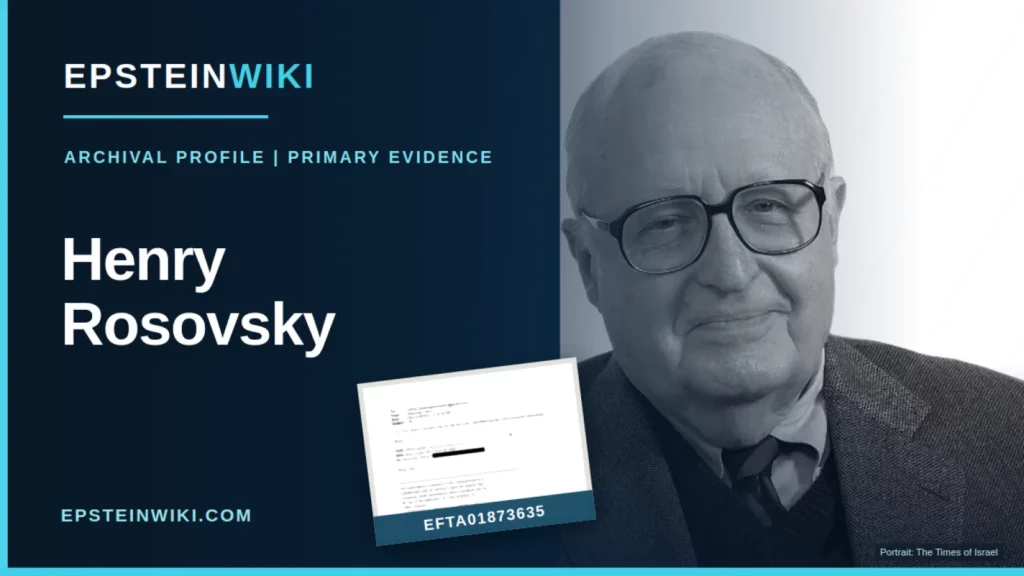
Snapshot
| Field | Documented Information |
|---|---|
| Full name | Henry Rosovsky |
| Born | September 1, 1927, Free City of Danzig |
| Died | November 11, 2022, Cambridge, Massachusetts, age 95 |
| Profession | Economist, historian of Japanese economic development and university administrator |
| Institution | Harvard University |
| Major positions | Dean of Harvard’s Faculty of Arts and Sciences, acting university president, economics professor and Harvard Corporation member |
| Epstein connection | Documented personal correspondence, Cambridge meetings, Harvard Hillel fundraising and appearances in Epstein’s institutional and reputation related records |
| Harvard Hillel connection | A character submission prepared for Epstein’s defense quotes Rosovsky describing a proposed $2 million naming gift and Epstein’s role in obtaining support for the Hillel building. |
| Correspondence period | At least August 2009 through June 2015 |
| Principal records | EFTA02857384, EFTA02078025, EFTA01873635, EFTA02140482, EFTA02102961 and related correspondence |
| Related academic network | Harvard Hillel, Martin Nowak’s Program for Evolutionary Dynamics and Epstein’s Harvard associated philanthropy |
| Later reference | A July 2025 Ghislaine Maxwell interview contains an unresolved reference that cannot reliably establish an allegation against Rosovsky. |
| Evidence status | Direct emails, office correspondence, a defense character submission, Harvard institutional records and a later unsworn interview |
| Critical limitation | Documented contact and fundraising activity do not establish involvement in Epstein’s sexual offenses. Amounts proposed in fundraising discussions are not proof of completed payments. |
Introduction
Henry Rosovsky was one of Harvard University’s most influential academic administrators. A distinguished economist, longtime faculty member, former dean of the Faculty of Arts and Sciences and acting university president, he helped shape Harvard’s undergraduate education and academic leadership over several decades.
Released Jeffrey Epstein records reveal that Rosovsky also maintained a documented personal relationship with Epstein involving university philanthropy, meetings in Cambridge and direct correspondence extending from at least 2009 through 2015.
One of the most significant records concerns Harvard Hillel. A character submission prepared for Epstein’s defense quotes Rosovsky describing how he approached Epstein about a proposed $2 million naming gift for the organization’s building. According to the quoted account, Epstein and Leslie Wexner supported the building project while declining to have the building named after themselves.
The submission was not an ordinary university fundraising report. It was included in material supplied to prosecutors while Epstein’s attorneys were negotiating the resolution of his Florida case. That context matters because an account originally describing philanthropic activity was being used to present Epstein favorably during a criminal investigation.
The documentary record extends beyond fundraising. Emails show Rosovsky communicating with Epstein and his assistants, arranging meetings, discussing Harvard visits and inviting Epstein to his Cambridge apartment. In a May 2015 message, Rosovsky explicitly described Epstein as having visited his apartment many times.
Additional correspondence connects the relationship to the Harvard academic environment surrounding Martin Nowak’s Program for Evolutionary Dynamics.
A separate July 2025 interview with Ghislaine Maxwell contains an ambiguous passage mentioning Rosovsky and a massage. The interview occurred almost three years after Rosovsky’s death, was not sworn testimony and contains an immediate reference to another person. It cannot responsibly be treated as a corroborated allegation against him.
This article examines the documented relationship, the institutional context and the unresolved questions. It distinguishes contemporaneous correspondence from advocacy prepared for Epstein, and it does not treat an appearance in the files as evidence of criminal conduct.
Key Takeaways
- Henry Rosovsky was a former Harvard dean and acting university president who maintained documented contact with Jeffrey Epstein.
- A character submission prepared for Epstein’s Florida defense quotes Rosovsky describing his solicitation of a proposed $2 million naming gift for Harvard Hillel.
- The account credits Epstein with helping obtain support for the Hillel building, but does not independently establish the amount, date or source of every completed payment.
- The philanthropic account was included in material supplied to prosecutors during negotiations concerning Epstein’s Florida case.
- Rosovsky and Epstein exchanged correspondence from at least August 2009 through June 2015.
- Rosovsky’s May 28, 2015 message explicitly describes Epstein as having visited his Cambridge apartment many times.
- Emails also refer to gatherings associated with Martin Nowak’s Harvard research institute.
- A May 2010 Harvard Hillel fundraising communication copied Rosovsky and thanked Epstein for his support.
- A 2017 proposed media narrative named Rosovsky among prominent people who might speak about Epstein’s philanthropic activities. The document does not establish that Rosovsky agreed to participate.
- Rosovsky died on November 11, 2022, and could not respond to the ambiguous statement made about him in Maxwell’s July 2025 interview.
- The records discussed do not establish that Rosovsky participated in Epstein’s sexual abuse or trafficking activities.
Henry Rosovsky’s Academic Career
Early Life and Education
Henry Rosovsky was born in 1927 in the Free City of Danzig, now Gdańsk, Poland.
His family fled Europe during the rise of Nazi persecution and eventually settled in the United States.
During World War II and its aftermath, Rosovsky served in the United States Army’s Counterintelligence Corps. His wartime experience included exposure to the Nuremberg proceedings.
He later studied at the College of William and Mary and earned advanced degrees from Harvard University.
Rosovsky became a specialist in Japanese economic history and economic development, eventually establishing a distinguished academic career at Harvard.
Leadership at Harvard
According to Harvard University’s memorial account, Rosovsky joined the university’s faculty in the 1960s and became one of its most influential administrators.
He served as dean of the Faculty of Arts and Sciences, helped develop Harvard’s Core Curriculum and contributed to the growth of African and African American Studies.
He also served as acting president of Harvard University and held significant institutional leadership positions.
These roles are relevant because Rosovsky possessed longstanding relationships across Harvard’s academic, administrative and philanthropic communities.
Harvard Hillel and Jewish Campus Life
Rosovsky was deeply involved in Harvard’s Jewish academic and community life.
He helped establish Harvard’s Center for Jewish Studies and supported Harvard Hillel, an organization serving Jewish students and the broader university community.
The Hillel building eventually bore his name, connecting his institutional legacy to the fundraising history discussed in the Epstein records.
Harvard’s official memorial confirms that Rosovsky died on November 11, 2022, at age 95.
Harvard Hillel and the Proposed $2 Million Naming Gift
The most consequential historical document connecting Rosovsky to Epstein’s philanthropy appears in EFTA02857384, a mixed public-records production containing material submitted to prosecutors in Florida.
The relevant passage appears on page 82 of the production, within a character submission assembled on Epstein’s behalf.
The submission describes Epstein’s support for educational institutions and quotes Rosovsky concerning fundraising for the Harvard Hillel building.
Rosovsky Approaches Epstein
In the passage attributed to Rosovsky, he describes approaching Epstein about a potential contribution to the building project.
Rosovsky said that a gift of $2 million could allow Epstein to have his name placed on the building.
The account presents this as an attractive naming opportunity because Harvard building names carry unusual institutional prestige.
That description is significant because it directly identifies Rosovsky as a person who solicited Epstein’s support for a university associated philanthropic project.
Epstein and Leslie Wexner
According to the quoted account, Epstein responded that he would raise the necessary naming gift but did not want his own name attached to the building.
Rosovsky also described Leslie Wexner as a participant who did not seek naming recognition.
The account attributes the decision to name the building after Rosovsky to Epstein, either acting independently or together with Wexner.
Rosovsky expressed appreciation for the gesture and credited their involvement with making the building possible.
These statements document Rosovsky’s own account as reproduced in the defense material. They do not constitute independent accounting evidence showing precisely who paid which amounts.
The Difference Between a Proposed Gift and a Completed Payment
The $2 million figure is important, but it must be described accurately.
The document records a proposed naming gift of that amount. It does not provide a complete ledger showing that Epstein personally paid $2 million to Harvard Hillel.
Nor does it establish exactly how much Wexner contributed, when payments were made or how the funds were distributed.
Additional fundraising records, bank documentation and organizational financial statements would be needed to reconstruct the transaction fully.
Rosovsky Hall
The building became known as Rosovsky Hall, which housed the Riesman Center for Harvard Hillel.
The name reflects the honor given to Rosovsky, not proof that he financed the entire construction.
The cited character submission presents Epstein and Wexner’s participation as important to the project. That account must be separated from any independently audited financial history.
Why Rosovsky’s Philanthropic Account Appeared in Epstein’s Florida Case
The placement of Rosovsky’s account inside Epstein’s legal records is particularly significant.
The document was included in a defense submission provided to Florida prosecutors while Epstein’s attorneys were negotiating the resolution of the investigation.
The relevant materials appear within pages 75 through 89 of the 89 page production.
The Defense Submission
Epstein’s lawyers presented accounts of philanthropy, professional accomplishments and positive relationships as part of a broader effort to influence how prosecutors viewed him.
Rosovsky’s description of Epstein’s role in helping Harvard Hillel was included in that context.
This does not mean Rosovsky personally prepared the defense submission.
The document introduces his account as a quotation within material assembled on Epstein’s behalf.
The Transmittal to Prosecutors
Pages 72 through 74 of the same production contain related transmittal material associated with Epstein’s Florida defense attorneys.
The accompanying handwritten communication refers to State Attorney Barry Krischer, attorney Jack Goldberger, attorney Jay Lefkowitz and federal prosecutor Alexander Acosta.
The placement of the materials connects the philanthropic submission to efforts surrounding the Florida prosecution and nonprosecution negotiations.
What Is Not Established
The record does not establish that Rosovsky knew his account would be included in a mitigation package for Epstein’s criminal matter.
It also does not establish that he reviewed the final submission or approved its use by Epstein’s attorneys.
These distinctions matter because a person quoted in a defense document is not automatically responsible for the purposes to which the defense puts that quotation.
The Significance for Epstein’s Reputation
The submission demonstrates how Epstein’s philanthropic relationships could be presented to prosecutors as evidence of favorable character.
Rosovsky’s prominence at Harvard gave his account institutional significance.
That significance does not establish that Rosovsky intended to interfere with the investigation or influence a particular charging decision.
August 2009: Documented Communications Continue
The released correspondence establishes that Rosovsky remained in contact with Epstein after the 2008 Florida conviction.
One early record appears in EFTA02435663.
On August 26, 2009, Epstein’s assistant Lesley Groff relayed a message from Rosovsky concerning his availability for a telephone conversation.
The message indicated that Rosovsky was available during a particular afternoon period and could include another person on the call.
The correspondence confirms a continuing channel of direct communication through Epstein’s office.
It does not by itself establish that the proposed call occurred or disclose every subject discussed.
2011: Rosovsky Appears on Epstein’s Call List
A May 31, 2011 call list prepared for Epstein includes Henry Rosovsky among several individuals whom Epstein’s staff were tracking for contact.
EFTA01866253 records the list.
Other listed names include Woody Allen, Martin Seligman, David Gergen and Michael Wolff.
The presence of multiple names on an administrative call list does not establish that the individuals met each other or participated in a common project.
A separate office communication, EFTA01867101, reports that a message was left for Rosovsky.
The two records provide evidence of an attempted contact.
They should not be inflated into proof of a completed conversation without further documentation.
2012: Meetings and Direct Correspondence
Emails from 2012 provide a more personal view of the relationship.
In EFTA01873635, dated April 16, 2012, Rosovsky replied to Epstein following an earlier gathering.
The message expresses interest in having more time for a direct conversation while describing the assembled group as interesting.
That language supports the conclusion that Rosovsky had attended a gathering involving Epstein and other participants.
A Canceled Appointment
Another record, EFTA02173238, documents a March 2012 scheduling exchange.
Rosovsky wrote about a conflict involving his wife’s birthday and the need to change plans.
The informal tone suggests an established acquaintance rather than a purely administrative exchange.
However, a cancellation should not be counted as a completed meeting.
Personal Versus Institutional Contact
These exchanges demonstrate that Rosovsky’s connection with Epstein extended beyond the historical Harvard Hillel fundraising account.
They show direct communication concerning gatherings and personal availability.
They do not establish that every gathering was connected to fundraising or that academic activities were improper.
2013: Cambridge Scheduling and Canceled Visits
A record from April 2013, EFTA02140482, documents Rosovsky discussing a proposed Epstein visit that apparently did not proceed as expected.
The email suggests Rosovsky believed Epstein had been unable to arrange meetings with other people he wanted to see.
The message reflects familiarity with Epstein’s Cambridge visits and scheduling practices.
It does not independently establish the identities of the additional people Epstein wanted to meet.
Nor should the proposed visit be counted as a completed meeting merely because it appeared in correspondence.
2014: Continued Contact
The relationship remained active in 2014.
EFTA02102961 contains a June 2014 message from Rosovsky concerning a planned encounter that conflicted with a family gathering.
Rosovsky apologized for being unable to attend as planned.
The correspondence demonstrates that the relationship continued at least several years after Epstein’s Florida conviction.
The document records a cancellation rather than a completed visit.
It does not establish the purpose of the canceled meeting or the identities of any additional intended participants.
May 28, 2015: Rosovsky Invites Epstein to His Cambridge Apartment
One of the strongest direct records of the personal relationship is a May 28, 2015 message preserved as EFTA02078025.
Epstein’s assistant had asked about Rosovsky’s availability during an upcoming Harvard visit.
Rosovsky responded that he could meet Epstein at his apartment after an earlier lunch appointment.
Evidence of Earlier Visits
Crucially, Rosovsky’s message described Epstein as having visited the apartment many times previously.
This statement comes from Rosovsky’s own contemporaneous correspondence and is stronger evidence of repeated meetings than a calendar entry alone.
It supports the conclusion that Epstein was not merely an occasional name on Rosovsky’s institutional mailing list.
The pair had an established history of personal visits in Cambridge.
Preference for Private Conversation
Rosovsky also expressed dissatisfaction with trying to speak to Epstein during crowded gatherings at a Harvard research institute.
He indicated that those events did not allow sufficient opportunity for a meaningful individual conversation.
The message therefore distinguishes meetings involving a larger academic group from the more personal conversations Rosovsky preferred.
What the Email Does Not Establish
The message does not provide a complete list of prior visits.
It does not establish the precise topics discussed during those visits or prove that the specific proposed May 2015 appointment occurred.
Nor does it place Rosovsky at Epstein’s private island, on his aircraft or at another Epstein property outside the circumstances described.
Those conclusions would require separate travel, correspondence or witness evidence.
Martin Nowak and Harvard’s Program for Evolutionary Dynamics
The Rosovsky correspondence includes references to gatherings associated with an academic institute directed by Martin Nowak.
Nowak was a Harvard professor whose Program for Evolutionary Dynamics became a significant part of the documented relationship between Epstein and Harvard.
The program studied mathematical and evolutionary questions and received financial support associated with Epstein.
Rosovsky’s Attendance
Rosovsky’s May 2015 message refers to meetings at Martin’s institute.
The surrounding correspondence identifies Martin Nowak as the probable person referenced.
That interpretation is supported by contemporary reporting concerning Rosovsky’s attendance at sessions connected with the Program for Evolutionary Dynamics.
Rosovsky’s Public Description
Reporting by The Harvard Crimson, discussed in the Epstein Data Wiki’s Harvard investigation, records Rosovsky describing attendance at a small number of sessions before losing interest.
This public explanation is consistent with the correspondence indicating that he found crowded institute gatherings unsatisfactory for individual conversations.
Nevertheless, participation in academic sessions does not itself establish involvement in Epstein’s misconduct.
Why the Institute Matters
The Program for Evolutionary Dynamics provided a setting in which Epstein could interact with Harvard scholars and visitors.
The relationship between Epstein, Nowak and the program became an important subject of institutional scrutiny after Epstein’s 2019 arrest.
Rosovsky’s references to the institute place him within the broader academic environment through which Epstein maintained Harvard contacts.
The record does not establish that Rosovsky controlled the program’s funding or supervised its relationship with Epstein.
May 2010: Harvard Hillel Continues Seeking Epstein’s Support
Additional correspondence from Harvard Hillel provides institutional context for Rosovsky’s earlier fundraising activity.
On May 10, 2010, Harvard Hillel president Bernie Steinberg wrote to Epstein concerning the organization’s activities and future financial needs.
The correspondence appears in EFTA00727994.
The letter thanked Epstein for supporting the Harvard Hillel community and discussed a proposed expansion of the organization’s mission.
The Proposed Center for Jewish Life and Leadership
The letter described an ambition to develop a broader center for Jewish life and leadership at Harvard.
It discussed financial goals and the possibility of offering naming recognition to a major supporter.
That proposal should not be confused with the earlier construction history of Rosovsky Hall.
The 2010 letter concerned future organizational development, while the historical character submission described the earlier Hillel building fundraising effort.
Rosovsky Is Copied on the Correspondence
Rosovsky was copied on the May 2010 communication.
His inclusion is consistent with his longstanding involvement with Harvard Hillel.
The letter also described Harvard Hillel’s affiliated but legally independent organizational structure.
This distinction is important when discussing donations. A contribution to Harvard Hillel should not automatically be described as a direct contribution to Harvard University’s central accounts.
What the Letter Establishes
The letter establishes that Harvard Hillel sought continued philanthropic support from Epstein and included Rosovsky in the communication.
It does not establish that every proposed fundraising target was met or that Rosovsky personally controlled Epstein’s contributions.
2017: Rosovsky Named in a Proposed Epstein Reputation Narrative
The released files contain another consequential reference after Rosovsky’s documented personal correspondence.
An August 6, 2017 email from public relations adviser Matthew Hiltzik to Epstein included an outline for a possible story presenting Epstein’s biography, professional activities and philanthropy.
The document is preserved as EFTA00630101.
Third Party Validators
The outline identified prominent individuals who might validate Epstein’s reputation and philanthropic activities.
Rosovsky was named alongside former Treasury Secretary and Harvard president Lawrence Summers and Bill Gates.
The proposed narrative highlighted Epstein’s ties to educational and scientific institutions.
Why Rosovsky’s Inclusion Matters
Rosovsky’s longstanding institutional standing at Harvard could have been valuable to a public relations effort portraying Epstein as a serious supporter of scholarship and philanthropy.
His inclusion demonstrates that the proposed communications strategy contemplated using his name.
However, a planning document identifying a possible validator is not evidence that the person consented to participate.
What Is Not Established
The document does not establish that Rosovsky approved the outline, agreed to be interviewed, provided a statement or participated in the final production of a favorable article.
It is evidence of what Epstein’s public relations adviser proposed, not proof of completed participation by every person listed.
July 2025: The Ambiguous Ghislaine Maxwell Interview Reference
A later record requires particular care because it contains a potentially damaging statement about a person who was already deceased.
On July 24, 2025, Ghislaine Maxwell was interviewed by Deputy Attorney General Todd Blanche.
The interview was a recorded proffer, not sworn court testimony.
The relevant transcript appears in EFTA02846680, particularly transcript pages 100 and 102 through 103.
Rosovsky Is Included on a List
During the interview, Maxwell referred to prominent people she associated with Epstein’s earlier social and professional circle.
Rosovsky’s name appeared in that discussion.
Maxwell described him as a Harvard provost, although Harvard’s independently documented institutional history identifies him as a dean and acting university president.
Her description should not replace the official record of his positions.
The Unresolved Massage Reference
Later in the interview, Maxwell initially associated Rosovsky’s name with a massage.
The interviewer asked follow-up questions about the circumstances.
During that exchange, Maxwell then said “Minsky, sorry” and subsequently referred to Minsky as another person.
The interviewer did not clarify whether she was correcting her identification of Rosovsky or introducing a separate individual.
The questioning moved on without resolving the ambiguity.
Why the Passage Cannot Be Treated as a Confirmed Allegation
The exchange contains several significant evidentiary problems.
First, it was an unsworn interview.
Second, the speaker introduced a possible correction involving another person.
Third, the interviewer did not clarify which person the earlier description concerned.
Fourth, the cited record does not establish the identity, age or circumstances of anyone who allegedly provided a massage.
Fifth, Rosovsky had died on November 11, 2022, nearly three years before the interview, and could not respond.
Even a verified reference to receiving a massage would not, without additional evidence, establish sexual activity, exploitation or criminal conduct.
The proper treatment of the transcript is therefore to identify the unresolved passage without presenting it as a substantiated allegation against Rosovsky.
The Separate Marvin Minsky Reference
The following day’s interview also included discussion of scientist Marvin Minsky.
That separate reference does not establish that the earlier ambiguous statement necessarily concerned the same person.
Joining those passages to resolve Maxwell’s unclear wording would be an inference, not a documentary finding.
Harvard’s Broader Epstein Relationship
Rosovsky’s correspondence should be understood within the wider history of Epstein’s Harvard relationships.
Epstein cultivated connections with scientists, administrators and philanthropic institutions over many years.
Some relationships involved direct grants or donations. Others involved personal meetings, introductions or participation in scholarly activities.
Those categories must be kept separate.
Harvard’s Institutional Review
Following Epstein’s 2019 arrest, Harvard investigated aspects of its historical financial relationship with him.
The university examined donations, institutional contacts and the operation of certain research programs.
The results of that broader review provide context for understanding Epstein’s access to Harvard academic networks.
They do not mean that every faculty member or administrator named in associated correspondence participated in wrongdoing.
The Difference Between Harvard and Harvard Hillel
Harvard Hillel is an independent nonprofit organization affiliated with the Harvard community.
Its fundraising and financial operations should not automatically be merged with those of Harvard University’s central administration.
This distinction is especially important when describing Rosovsky’s account of the proposed Hillel naming gift.
Personal Contact and Institutional Support
Rosovsky’s record includes both personal correspondence and activity related to an institution he supported.
The direct emails show an ongoing acquaintance.
The Hillel documents demonstrate a philanthropic connection.
The reputation related materials show how his institutional standing could be used in efforts to present Epstein favorably.
Each category supports a different conclusion and requires its own evidentiary analysis.
Documented Chronology
| Date | Documented Event | Source |
|---|---|---|
| Before 2007 | Rosovsky’s account describes approaching Epstein about a proposed $2 million Harvard Hillel naming gift. The precise date is not established. | EFTA02857384, page 82 |
| 2007 | Defense material incorporating Rosovsky’s philanthropic account is included in submissions associated with the Florida prosecution negotiations. | EFTA02857384, pages 72 through 89 |
| August 26, 2009 | Lesley Groff relays Rosovsky’s availability for a call. | EFTA02435663 |
| May 10, 2010 | Harvard Hillel sends Epstein a fundraising communication copied to Rosovsky. | EFTA00727994 |
| May 31, 2011 | Rosovsky appears on an Epstein office call list. A related office communication records an attempted contact. | EFTA01866253 |
| March 2012 | Rosovsky sends a scheduling message concerning a conflict with his wife’s birthday. | EFTA02173238 |
| April 16, 2012 | Rosovsky comments on a gathering with Epstein and expresses interest in more direct conversation. | EFTA01873635 |
| April 2013 | Rosovsky comments on an Epstein visit that apparently could not be arranged. | EFTA02140482 |
| June 2014 | Rosovsky cancels a proposed meeting because of a family obligation. | EFTA02102961 |
| May 28, 2015 | Rosovsky invites Epstein to his Cambridge apartment and describes numerous earlier visits. | EFTA02078025 |
| August 6, 2017 | A proposed Epstein reputation narrative lists Rosovsky among potential third party validators. | EFTA00630101 |
| November 11, 2022 | Rosovsky dies at age 95. | Harvard University |
| July 24, 2025 | Ghislaine Maxwell mentions Rosovsky in an unsworn interview containing an unresolved reference to another named person. | EFTA02846680 |
Evidence Appearances and Document Register
The following register identifies significant released records associated with Rosovsky. Duplicate documents and forwarded copies should not be counted as separate events. The character submission and 2025 interview require particular attention to attribution and context.
| Record or ID | Date | What It Shows | Source |
|---|---|---|---|
| EFTA02857384, p. 82 | Undated historical account | Defense submission quotes Rosovsky describing a proposed $2 million Hillel naming gift and Epstein and Wexner’s role. | View record |
| EFTA02857384, pp. 72 to 74 | Florida prosecution period | Related transmittal material associated with the defense submission to prosecutors. | View record |
| EFTA02435663 | August 26, 2009 | Office message relaying Rosovsky’s availability for a telephone conversation. | View record |
| EFTA00727994 | May 10, 2010 | Harvard Hillel letter thanking Epstein for support and copying Rosovsky. | View record |
| EFTA01866253 | May 31, 2011 | Epstein office call list including Rosovsky among several contacts. | View record |
| EFTA01867101 | 2011 | Office communication reporting an attempted contact with Rosovsky. | View record |
| EFTA02173238 | March 2012 | Rosovsky’s scheduling correspondence concerning a birthday conflict. | View record |
| EFTA01873635 | April 16, 2012 | Rosovsky comments on a previous gathering and the possibility of more direct conversation. | View record |
| EFTA02140482 | April 2013 | Correspondence concerning a proposed Epstein visit that did not proceed as expected. | View record |
| EFTA02102961 | June 2014 | Rosovsky cancels a proposed meeting because of family obligations. | View record |
| EFTA02078025 | May 28, 2015 | Rosovsky’s direct invitation to Epstein and acknowledgment of repeated earlier apartment visits. | View record |
| EFTA00630101 | August 6, 2017 | Proposed reputation narrative naming Rosovsky as a potential third party validator. | View record |
| EFTA02846680, pp. 100, 102 to 103 | July 24, 2025 | Unsworn Maxwell interview containing an unresolved identification involving Rosovsky and Minsky. | View record |
| EFTA02847046 | July 25, 2025 | Separate Maxwell interview reference to Marvin Minsky, not sufficient to clarify the previous day’s ambiguous statement. | View record |
What the Evidence Establishes
A Documented Personal Acquaintance
Rosovsky’s direct correspondence and his acknowledgment of repeated apartment visits establish that he knew Epstein personally.
The relationship extended beyond an isolated introduction or a name appearing in institutional records.
Participation in Fundraising Discussions
The character submission attributes to Rosovsky an account of approaching Epstein about a major Harvard Hillel naming gift.
The account documents his description of the solicitation but does not supply a complete financial transaction record.
Continued Contact After Epstein’s Conviction
Emails from 2009 through 2015 establish that communications continued after Epstein’s 2008 Florida guilty pleas.
These contacts included proposed calls, meetings and invitations in Cambridge.
Connections to Harvard’s Academic Environment
Rosovsky’s correspondence references meetings connected with Martin Nowak’s institute.
His attendance at some sessions is also described in contemporary reporting.
Use of His Name in Reputation Materials
Rosovsky’s charitable account appeared in a submission prepared for Epstein’s defense, and his name later appeared in a proposed media strategy.
These documents establish use or proposed use of his reputation, but do not independently establish his approval of those particular uses.
Unresolved Questions and Evidentiary Limitations
Who Paid for Rosovsky Hall?
The cited character submission describes proposed and anticipated support from Epstein and Leslie Wexner.
It does not independently establish the complete payment history or the precise contribution made by each participant.
When Did Rosovsky First Meet Epstein?
The released materials discussed here do not establish the exact date of their first personal meeting.
The historical Hillel account predates the later correspondence, but its precise date is not supplied in the cited passage.
Did Rosovsky Know His Account Would Be Used by Epstein’s Defense?
The cited records do not establish that Rosovsky knew his philanthropic comments would be included in material submitted to prosecutors.
How Often Did They Meet?
Rosovsky’s May 2015 email establishes his own recollection that Epstein had visited his Cambridge apartment repeatedly.
It does not provide a complete count or dates for every meeting.
Did Rosovsky Participate in Epstein’s Financial Operations?
The Hillel fundraising account and correspondence do not establish that Rosovsky managed Epstein’s finances or participated in unrelated financial operations.
Did Rosovsky Attend Epstein’s Private Island?
No island visit is established by the records identified in this article.
What Did Rosovsky Know About Epstein’s Crimes?
The record establishes ongoing contact after Epstein’s Florida conviction, but does not independently establish the full scope of Rosovsky’s knowledge at any particular time.
Personal acquaintance is not evidence of participation in criminal activity.
What Did Maxwell Mean in 2025?
The July 2025 interview does not resolve whether Maxwell’s statement concerned Rosovsky or another person.
The ambiguity, lack of corroboration and Rosovsky’s death before the interview prevent the passage from being treated as a substantiated allegation against him.
Conclusion
Henry Rosovsky’s documented relationship with Jeffrey Epstein extended across university philanthropy, personal correspondence and Harvard’s academic environment.
The most important historical fundraising record is a character submission prepared for Epstein’s defense. It quotes Rosovsky describing how he approached Epstein about a proposed $2 million naming gift for Harvard Hillel and how Epstein and Leslie Wexner were associated with the resulting building project.
That account is significant both for its content and for its use. A prominent Harvard administrator’s praise of Epstein’s philanthropy was placed before prosecutors while Epstein’s legal team was negotiating the resolution of his Florida case.
There is no basis in the cited material to conclude that Rosovsky knowingly prepared a criminal defense submission or intended his account to influence a charging decision.
Separate correspondence demonstrates a sustained personal acquaintance. Messages between 2009 and 2015 document calls, planned meetings, canceled visits and direct invitations. Rosovsky’s May 2015 acknowledgment of numerous prior visits to his Cambridge apartment is particularly important evidence of the relationship’s continuity.
The records also connect him to the Harvard academic environment surrounding Martin Nowak’s research program, while later reputation material shows that Epstein’s advisers considered his institutional standing potentially valuable.
These connections should be scrutinized as part of the broader history of Epstein’s relationships with universities and philanthropic institutions. However, the documentary record does not establish that Rosovsky was involved in Epstein’s sexual offenses or trafficking enterprise.
The ambiguous July 2025 Maxwell interview cannot properly fill that evidentiary gap. It was unsworn, contained an unresolved possible correction involving another person and occurred after Rosovsky’s death.
The strongest supported conclusion is that Rosovsky was a documented personal acquaintance of Epstein and an important participant in a Harvard Hillel fundraising account later used in materials favorable to Epstein.
Further investigation should focus on original fundraising and payment records, the circumstances in which the character statement was obtained, and the complete history of relevant Cambridge meetings. These are distinct questions requiring documentary answers rather than speculation.
Questions and Answers
Who was Henry Rosovsky?
Henry Rosovsky was an economist, former dean of Harvard’s Faculty of Arts and Sciences and acting president of Harvard University. He died on November 11, 2022, at age 95.
Did Henry Rosovsky personally know Jeffrey Epstein?
Yes. Direct correspondence documents their relationship, and Rosovsky’s May 2015 email describes Epstein as having visited his Cambridge apartment many times.
How was Rosovsky connected to Epstein’s philanthropy?
A character submission prepared for Epstein’s defense quotes Rosovsky describing an approach to Epstein concerning a proposed $2 million naming gift for Harvard Hillel.
Did Epstein donate $2 million to Harvard Hillel?
The cited account identifies $2 million as the proposed naming gift. It does not independently establish a completed payment of that amount by Epstein personally.
Was Leslie Wexner involved in the Hillel building?
Rosovsky’s account, as reproduced in the defense submission, identifies Wexner as a participant. The quoted passage does not provide a complete financial breakdown.
Why is the building called Rosovsky Hall?
The building was named to honor Henry Rosovsky. The character submission attributes the naming decision to Epstein, either independently or together with Wexner.
Was Rosovsky’s statement used to defend Epstein?
His philanthropic account was included in material supplied to prosecutors during the Florida case. The record does not establish whether Rosovsky knew how his account would be used.
Did Rosovsky remain in contact with Epstein after 2008?
Yes. Emails document correspondence and scheduling from at least August 2009 through June 2015.
Did Epstein visit Rosovsky’s home?
Rosovsky’s May 28, 2015 message states that Epstein had previously visited his Cambridge apartment many times.
Was Rosovsky involved with Martin Nowak’s institute?
He attended some sessions associated with the Harvard Program for Evolutionary Dynamics and referred to meetings at Martin’s institute in his correspondence.
Was Rosovsky part of Epstein’s public relations strategy?
A 2017 proposed media outline listed him as a potential third party validator. The document does not establish that Rosovsky agreed to participate.
Did Ghislaine Maxwell make an allegation against Rosovsky?
A July 2025 unsworn interview contains an unresolved passage initially naming Rosovsky and then referring to Minsky. Because the identification was not clarified, the passage cannot reliably establish an allegation against Rosovsky.
Was Rosovsky alive when Maxwell gave the interview?
No. Rosovsky died in November 2022. Maxwell’s interview took place in July 2025.
Is there evidence that Rosovsky participated in Epstein’s crimes?
The records discussed here establish personal contact and philanthropic involvement. They do not establish participation in Epstein’s sexual offenses or trafficking activities.
Related EpsteinWiki Articles
- Harvard University and Jeffrey Epstein
- Howard Gardner and Jeffrey Epstein
- Marvin Minsky and Jeffrey Epstein
- Gerald Lefcourt
Sources
- EFTA02857384. Florida public-records production. Pages 72 through 74 contain related transmittal material; page 82 contains the character submission quoting Rosovsky concerning Harvard Hillel.
- EFTA02435663. August 26, 2009 message relayed by Lesley Groff.
- EFTA00727994. May 10, 2010 Harvard Hillel correspondence.
- EFTA01866253. May 31, 2011 Epstein office call list.
- EFTA01867101. Office communication concerning attempted contact with Rosovsky.
- EFTA02173238. March 2012 scheduling correspondence.
- EFTA01873635. April 16, 2012 email concerning a previous gathering.
- EFTA02140482. April 2013 correspondence concerning a proposed visit.
- EFTA02102961. June 2014 scheduling correspondence.
- EFTA02078025. May 28, 2015 invitation and description of repeated apartment visits.
- EFTA00630101. August 6, 2017 proposed Epstein reputation narrative.
- EFTA02846680. July 24, 2025 Ghislaine Maxwell interview, especially transcript pages 100 and 102 through 103.
- EFTA02847046. July 25, 2025 Maxwell interview containing a separate reference to Marvin Minsky.
- Epstein Data Wiki: Henry Rosovsky. Detailed documentary research, page-level citations, correspondence analysis and limitations.
- Epstein Data Wiki: Harvard University and Jeffrey Epstein. Research concerning Harvard Hillel, institutional philanthropy and academic contacts.
- Harvard Gazette, November 16, 2022. Institutional memorial documenting Rosovsky’s career and death.
- Harvard Department of Economics, November 15, 2022. Memorial documenting academic appointments and career history.
- The Harvard Crimson, December 5, 2022. Independent university reporting concerning Rosovsky’s institutional career.
- Harvard Magazine, January 2023. Memorial and discussion of Rosovsky’s academic leadership.