Photographic Evidence of Bill Clinton in the Epstein Files
Snapshot
The released Epstein files contain multiple photographs of Bill Clinton in social, travel, and leisure settings connected in different ways to Jeffrey Epstein and Ghislaine Maxwell. Some images show Clinton with Epstein or Maxwell. Others merely came from an investigative production and show Clinton with public figures at an event that can be independently identified. A separate image documents a painting of Clinton hanging inside an Epstein property. These categories must not be collapsed into one claim.
| Field | Finding |
|---|---|
| Record type | Photographs, photographed artwork, press clippings, and estate images |
| Principal subject | Bill Clinton, 42nd president of the United States |
| Primary public custodians | United States Department of Justice and House Committee on Oversight and Government Reform |
| Core item numbers | EFTA00000862, EFTA00003168, EFTA00003169, EFTA00003170, EFTA00003367, and EFTA00003380 |
| Additional reproduced images | EFTA00037125 and EFTA00037126 |
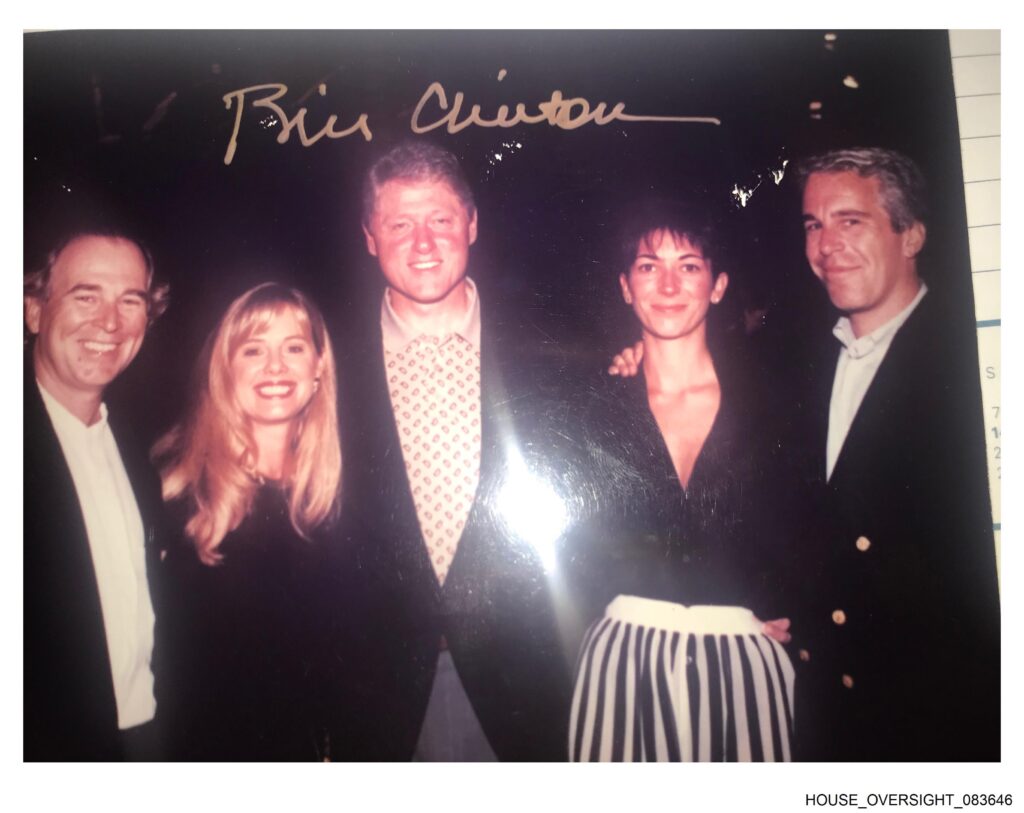
| House estate photograph | Bill Clinton, Jeffrey Epstein, and Ghislaine Maxwell 083646 |
| Known date range | September 29, 1993 for the White House archive sequence; many DOJ images remain undated; April 24, 2002 for the independently identified Apollo event |
| Evidentiary value | Confirms selected encounters, shared settings, possession of images, and the need to compare photographs with travel and documentary records |
| Central limitation | Most released files provide little or no original metadata, date, location, photographer credit, or chain of custody at the individual image level |
| Wrongdoing shown | None of the photographs analyzed here depicts an illegal act by Clinton |
The photographs are evidence of association and context. They are not, standing alone, proof that Clinton participated in Epstein’s crimes. At the same time, their cumulative value is greater than a single celebrity snapshot. They corroborate that Clinton, Epstein, and Maxwell occupied overlapping political, philanthropic, travel, and social networks over a period of years. That overlap is also documented by flight logs and manifests, White House visitor records, emails, and congressional testimony.
What Is This Record?
This page is an evidence guide to photographs of Bill Clinton found in, produced with, or directly relevant to the Epstein files. It is not one photographic record. It is a structured collection of images from several provenance streams:
- DOJ EFTA image files released as individual PDFs or image records.
- Photographs supplied by the Epstein estate to the House Oversight Committee.
- Reproductions of newspaper pages or online stories preserved within investigative files.
- Official White House photographs that independently document an early Clinton, Epstein, and Maxwell encounter.
- Professional press photography that identifies the setting and subjects of an otherwise context-poor DOJ image.
That distinction matters. A photograph seized or collected during an investigation is not automatically a photograph taken by Epstein, at an Epstein property, or during criminal conduct. The phrase “in the Epstein files” describes archival inclusion, not a conclusion about who created the image or why it was retained.
The clearest direct-association images include the House-released signed group photograph showing Clinton with Epstein and Maxwell, an undated DOJ image showing Clinton with Epstein, and multiple images placing Clinton with Maxwell during travel or leisure. The weaker contextual records include a DOJ file showing Clinton with Michael Jackson and Diana Ross at a known political fundraiser where Epstein is not visible, and a photograph of a painting depicting Clinton in a blue dress. Those records still belong in the visual archive, but their meaning is different.
The correct method is therefore image by image analysis. Each file should be tested for visible subjects, redactions, source, possible date, possible location, duplicate status, publication history, and corroborating records. It should also be tested for what it cannot establish.
Source and Provenance
The strongest provenance begins with the government or congressional release itself. The DOJ’s EFTA identifiers provide stable document references, while epstein-data.com offers direct access and searchable preservation. The House Oversight Democrats stated on December 12, 2025 that the committee had received more than 95,000 photographs from the Epstein estate and released a selected group of 19. On December 18, the committee released 70 more and stressed that the estate had supplied the larger cache without contextual information.
| Provenance stream | What it establishes | What it does not establish |
|---|---|---|
| DOJ EFTA file | The image appeared in a federal Epstein-related production under a specific identifier | Who took it, when it was taken, where it was taken, or whether Epstein owned the original |
| House estate production | The image was supplied by Epstein’s estate in response to congressional process | That Epstein personally took it or that every depicted person knew it was in his files |
| Clinton Presidential Library | Official White House photographic metadata, including date and photographer | That the photograph was part of the DOJ EFTA release |
| Getty Images | Professional event caption, date, photographer, and named subjects | Ownership of the DOJ copy or any Epstein connection unless Epstein is shown or separate evidence supplies one |
| AP or Reuters distribution | A journalistic caption and public distribution trail | Original authorship when the credit reads DOJ handout, House handout, or another source via the agency |
| Newspaper clipping inside an EFTA file | What reporting or an image reproduction was retained in the file | The provenance of the underlying original unless the clipping supplies a reliable credit |
The House Oversight December 12 release is the primary source for the signed group image. ABC News reported that the photograph places Clinton in a group of five, with Maxwell and Epstein to one side, and that the broader estate material came from a hard drive associated with one of Epstein’s personal computers and from an email account. The public release did not provide a date, location, or photographer.
For the 1993 White House sequence, the William J. Clinton Presidential Library finding aid identifies Ralph Alswang as the White House photographer and September 29, 1993 as the event date. This official metadata is more probative than later reposts that omit the date or credit.
For EFTA00003367, the key outside comparison is Jonathan Exley’s Getty photograph. Getty captions the event as “A Night At The Apollo,” a Democratic National Committee fundraiser held on April 24, 2002, and identifies Michael Jackson, his children Prince and Paris, Bill Clinton, Diana Ross, and Evan Ross. Getty is not credited as the photographer. Exley is the photographer, while Getty is the archive and licensing distributor.
What the Record Contains
The following inventory separates direct association, contextual inclusion, reproduced reporting, and photographed artwork.
| Record | Visible content | Category | Assessment |
|---|---|---|---|
| House Oversight 083646 | Clinton in an undated group photograph with Epstein, Maxwell, and two other people | Direct association | Strong proof of one shared photographed setting; date and location remain unknown |
| EFTA00003168 | Clinton swimming in an indoor pool; Maxwell appears in the foreground; another person’s face is redacted | Shared leisure setting | Strong visual identification of Clinton and Maxwell; no reliable public date or location |
| EFTA00003169 | Wider alternate view of the indoor pool sequence, with Clinton, Maxwell, and a redacted person | Duplicate or adjacent frame | Corroborates the pool sequence but should not be counted as a separate encounter without evidence |
| EFTA00003170 | Clinton in a hot tub with another person whose face and upper body are substantially redacted | Shared leisure setting | Confirms the photographed setting; identity and status of the other person must not be guessed |
| EFTA00003367 | Clinton with Michael Jackson and Diana Ross, with younger people redacted in the DOJ version | Contextual inclusion | Independently matched to a public fundraiser photographed by Jonathan Exley; Epstein is not visible |
| EFTA00003380 | Mick Jagger and Clinton flanking a third person whose identity is not established by the released file | Social event | Confirms a social photograph in the corpus; it does not establish an Epstein encounter |
| EFTA00037125 | A news reproduction concerning a neck massage given to Clinton during travel | Press clipping | Secondary reproduction, not the original photographic file; survivor privacy requires restraint |
| EFTA00037126 | A news reproduction showing Clinton and Maxwell in or near an aircraft | Press clipping | Supports the public history of shared travel but should be traced to the underlying photograph |
| EFTA00000862 | A painting of Clinton wearing a blue dress and red heels, photographed on a wall | Photographed artwork | Evidence about Epstein’s interior display and possession, not a photograph of Clinton |
| White House sequence | Clinton with Epstein and Maxwell at a September 29, 1993 White House event | Official archival photography | Date and photographer are documented by the Clinton Presidential Library |
The signed group photograph
The estate photograph released by House Democrats is among the most important images because it visibly places all three central figures together. Clinton appears in the middle of a posed group. Epstein and Maxwell are visible beside him. A handwritten inscription or signature associated with Clinton appears on the print. Neither the inscription nor the pose supplies a date. The photograph proves a social encounter and that a copy entered the estate’s files. It does not show the purpose of the meeting or any crime.
The pool sequence
EFTA00003168 and EFTA00003169 appear to be adjacent or near-adjacent frames from the same indoor pool setting. Their evidentiary value lies in corroboration through visual continuity. Clinton and Maxwell appear relaxed in a private leisure environment, while a third person is redacted. The wide view includes architectural details and a projected marine image. Those details may eventually assist location identification, but they are not enough to responsibly name a property.
The hot tub photograph
EFTA00003170 shows Clinton in a hot tub beside a substantially redacted person. The government’s choice to redact the person does not disclose why the redaction was applied. A redacted person may be a survivor, a minor, a family member, or someone protected for another legally recognized reason. Public claims that the redaction automatically identifies a victim go beyond the visible evidence.
The Apollo fundraiser image
EFTA00003367 is a cautionary case study. Without comparison, the image looks like an unidentified social photograph found in the files. The DOJ version obscures younger people. Getty’s professionally captioned frame from the same setting identifies a public April 24, 2002 fundraiser and names the children as members of the Jackson and Ross families. The comparison demonstrates that government redaction can conceal people who are not alleged Epstein victims. It also shows why visual identification must be supported by photographer metadata rather than speculation.
The Clinton painting
EFTA00000862 is regularly described online as a “Bill Clinton photo.” That is imprecise. It is a photograph of a satirical painting depicting Clinton. The artwork was reportedly displayed in an Epstein residence, making the image relevant to property documentation and Epstein’s collecting choices. It is not evidence that Clinton sat for the painting, commissioned it, visited the room, or approved its display.
Key Evidence Points
First, the record contains genuine photographic evidence of contact. The House estate image and official White House sequence place Clinton, Epstein, and Maxwell together. This is stronger than a contact-book entry because it records physical co-presence.
Second, the leisure photographs place Clinton with Maxwell in settings that appear private. The pool and hot tub images raise legitimate questions about date, place, trip, security arrangements, and the identities of other adults responsible for organizing the visit. They do not answer those questions themselves.
Third, at least one released image can be independently located in time. Jonathan Exley’s Apollo fundraiser photograph supplies a reliable April 24, 2002 event context for EFTA00003367. This corrects reports that have assigned a different year or implied an unidentified Epstein setting.
Fourth, some apparent image counts are inflated by alternate frames, clippings, or duplicates. EFTA00003168 and EFTA00003169 likely belong to one sequence. EFTA00037125 and EFTA00037126 reproduce reporting rather than add two newly discovered original negatives. A careful archive counts files, frames, and encounters separately.
Fifth, the photographs fit a broader documentary record. Clinton flew on Epstein aircraft during several international trips in 2002 and 2003. Depending on whether researchers count journeys, itinerary segments, or logged legs, published totals differ. The best-supported formulation is that Clinton took four international trips and appears across roughly 26 flight legs, with some tabulations reporting 27. The September 2002 Africa trip included humanitarian work and a larger delegation.
Sixth, no released flight manifest presently proves Clinton traveled to Little Saint James. A 2011 FBI interview memorializes a witness account placing him there, while public logs, Secret Service records reported through FOIA, Clinton’s denial, and Epstein’s own later denials point the other way. This is a documented conflict, not a settled photographic fact.
Seventh, file custody is not photographic authorship. DOJ, House Oversight, AP, Reuters, Getty, and the Epstein estate play different roles. A caption such as “DOJ via AP” means the DOJ supplied the image and AP distributed it. It does not mean an AP photographer was present.
What the Record Does and Does Not Prove
| Claim | Evidentiary status | Reason |
|---|---|---|
| Clinton met Epstein and Maxwell | Proven | Official and estate photographs show physical co-presence |
| Clinton traveled in Epstein’s social and logistical orbit | Proven in part | Photographs, flight logs, emails, and public statements corroborate shared travel and contacts |
| Clinton was photographed with Maxwell in a pool | Proven | EFTA00003168 and EFTA00003169 show the sequence |
| Clinton was photographed in a hot tub with a redacted person | Proven | EFTA00003170 shows that setting |
| The redacted person was an Epstein survivor | Not established | The file does not publicly identify the person or the legal basis for redaction |
| The pool or hot tub was on Little Saint James | Not established | No verified location metadata accompanies the photographs |
| Every Clinton image was taken by Epstein or his staff | Not established and sometimes false | EFTA00003367 corresponds to a professional public event photographed by Jonathan Exley |
| Clinton knew of Epstein’s abuse when the images were made | Not established by the photographs | Knowledge cannot be inferred from pose, setting, or file inclusion |
| Clinton participated in Epstein’s crimes | Not established | The images analyzed here show no criminal conduct by Clinton |
| Epstein possessed or retained Clinton imagery | Supported | Images appeared in estate or investigative holdings, though the path of every individual copy is incomplete |
| Clinton visited Epstein’s island | Disputed and unproven | A witness account exists, but public travel records and denials do not confirm it |
The distinction between association and complicity is not a technicality. It protects the integrity of the investigation. Overclaiming gives defenders an easy basis to dismiss real evidence, while underclaiming conceals the importance of access. The photographs show access, familiarity, repeated network overlap, and private or semi-private settings. Those facts justify further document comparison and sworn questioning. They do not justify a declaration of guilt.
The same standard applies to all prominent people in the files. Fame does not make a photograph incriminating, and political affiliation does not make it exculpatory. Each claim should be limited to what the image and corroborating evidence can support.
People and Entities Appearing in the Record
| Person or entity | Role in the photographic record |
|---|---|
| Bill Clinton | Principal subject and former United States president |
| Jeffrey Epstein | Appears with Clinton in direct-association photographs; estate or investigative holdings contained other Clinton images |
| Ghislaine Maxwell | Appears with Clinton and Epstein at the White House and in later images, including the pool sequence |
| Michael Jackson | Appears with Clinton in EFTA00003367 at the Apollo fundraiser |
| Diana Ross | Appears in EFTA00003367 and the independently captioned Getty comparison |
| Prince Jackson and Paris Jackson | Identified in Getty’s professionally captioned event photograph; obscured in the DOJ version |
| Evan Ross | Identified in Getty’s professionally captioned event photograph |
| Mick Jagger | Appears with Clinton in EFTA00003380 |
| Ralph Alswang | White House photographer credited for the September 29, 1993 event photographs |
| Jonathan Exley | Photographer credited for the April 24, 2002 Apollo fundraiser image distributed by Getty |
| House Oversight Committee | Recipient and public releaser of estate photographs |
| United States Department of Justice | Public custodian and releaser of EFTA image records |
| Epstein estate | Source of the 95,000-plus photo production described by House Democrats |
| Associated Press and Reuters | News distributors of government or congressional handout images, not necessarily the original photographers |
| Getty Images | Professional photography archive and licensing distributor for Exley’s Apollo image |
Several additional people appear in related travel records, including Doug Band, Kevin Spacey, Chris Tucker, and Ron Burkle. Their presence in manifests or trip photography should be reported only when supported by a specific record. A person’s inclusion in a group trip does not establish knowledge of another passenger’s crimes.
Timeline Significance
| Date | Event | Significance |
|---|---|---|
| September 29, 1993 | Ralph Alswang photographs Clinton with Epstein and Maxwell at a White House event | Establishes documented contact early in Clinton’s presidency |
| 1993 to 1995 | White House visitor records document repeated Epstein access, often connected to aide Mark Middleton | Provides institutional context for the 1993 images |
| February 2002 | Emails discuss motorcade and aircraft logistics involving Clinton’s staff, Maxwell, and Epstein | Shows operational coordination beyond a chance photograph |
| April 24, 2002 | “A Night At The Apollo” DNC fundraiser | Supplies the verified setting for EFTA00003367 |
| September 2002 | Clinton travels through Africa aboard Epstein’s Boeing 727 with a larger delegation | Central context for aircraft and travel photographs |
| April 2003 | Emails discuss a possible Clinton meal at Epstein’s Manhattan residence and guest biographies | Adds documentary context to the social relationship |
| 2003 | Clinton contributes a note to Epstein’s fiftieth birthday album | Shows continued friendly recognition during the same broad period |
| 2005 to 2006 | Records and reporting show continued Maxwell contact with Clinton-linked personnel | Complicates a simple one-date cutoff narrative |
| 2008 | Epstein pleads guilty in Florida to state prostitution-related offenses, including one involving a minor | Changes the public and legal context of all later association claims |
| 2011 | FBI interview records a witness account that Clinton was encountered on Epstein’s island | Creates a disputed lead requiring corroboration |
| January 2015 | Epstein sends multiple denials that Clinton visited the island | Shows active reputation and litigation messaging |
| 2019 | Epstein is arrested on federal sex trafficking charges and dies in federal custody | Leads to expanded evidence review and public demands for release |
| 2021 | Maxwell is convicted on federal sex trafficking-related counts | Confirms the criminal significance of a central person in multiple photographs |
| December 2025 | House and DOJ releases publish major batches of Clinton photographs | Converts previously private or limited images into public evidence |
| February 27, 2026 | Clinton gives a filmed House Oversight deposition | Provides a sworn forum for questions raised by photographs and documents |
| March 2, 2026 | House Oversight releases Clinton deposition video | Permits comparison of testimony with the visual and documentary record |
The timeline shows why the photographs matter as a series. A 1993 White House image, a 2002 public fundraiser image, travel photographs, and later file releases are not one event. Taken together, they chart the duration and variety of contact while preserving the need to distinguish documented fact from inference.
Related Evidence
The photographs become more useful when compared with records that can supply date, location, participants, or purpose.
Aircraft and travel records
The flight logs and manifests document Clinton’s presence on Epstein aircraft during international travel. Researchers should preserve the difference between a trip and a flight leg. An itinerary with several stops produces multiple log entries. This is why the public record contains references to four trips, 26 legs, and sometimes 27 legs without necessarily describing three different datasets.
Clinton staff and Maxwell emails
EFTA02332312, EFTA02333390, and EFTA02333392 concern February 2002 ground and aircraft coordination. EFTA02332565, EFTA02332569, and EFTA02332575 concern guest information for a possible April 2003 Clinton appearance at Epstein’s Manhattan home. These records can test whether an undated dinner or aircraft image fits a known itinerary.
Disputed island account and denials
EFTA01688359, page 17, memorializes a witness account placing Clinton at Epstein’s private island while expressly stating that the witness did not engage in sexual activity with him. That is an allegation recorded by the FBI, not independent proof that the visit occurred. EFTA01747912, EFTA01747689, and EFTA01747366 record Epstein’s 2015 denials that Clinton had been on the island. Epstein’s self-interested denial is also not dispositive.
Banking compliance records
EFTA01420713 shows Deutsche Bank compliance personnel discussing Epstein as a relative or close associate of Clinton and Prince Andrew in 2018. EFTA01356008 contains similar know-your-customer language about a close relationship. These are institutional risk assessments, not findings that Clinton engaged in financial or criminal misconduct.
Press reproductions
EFTA00037125 and EFTA00037126 preserve published reporting about Clinton’s travel. They are useful as leads and evidence of circulation, but the underlying original photographs, captions, and negatives remain preferable when available.
Congressional testimony
The House Oversight Committee announced that Clinton sat for a filmed deposition on February 27, 2026 and released the deposition videos on March 2. Any comparison should rely on the full recording or transcript rather than partisan summaries issued by either side of the committee.
Sleuth and Independent Reporting
Independent researchers have been essential in matching orphaned images to documents, tracking disappearing files, and separating unique records from duplicates. Their work is most reliable when it links directly to primary material and states uncertainty.
Rye Howard Stone’s Document Zero analysis maps Clinton-related EFTA emails into operational sequences involving Maxwell, Epstein, and Doug Band. It connects motorcade-to-plane logistics, event guest vetting, and later denial messaging. These connections add context to photographs but do not convert the images into proof of criminal conduct.
Stone’s Gallery of the Absurd specifically discusses EFTA00003380 and documents the problem of DOJ files disappearing or returning 404 errors. That work is valuable for preservation history. It also models a privacy-conscious approach by avoiding identification of the third person in the party photograph.
Drop Site News examined emails showing Maxwell’s continued interaction with the Clinton network after the best-known 2002 trip. Its report includes the House-released Clinton, Epstein, and Maxwell photograph and the DOJ hot tub image while testing public cutoff claims against later communications.
R. Howard Stone’s Bill Clinton investigation report offers a useful index of EFTA files and disputed claims. Because the page identifies itself as AI-assisted, its citations should be opened and checked rather than copied as conclusions. The underlying file links are the evidentiary layer.
Other photographers and agency archives
Professional photography should be included only when it shows Clinton with Epstein, Maxwell, or an identified survivor, or when it directly identifies the origin of an image already in the files.
Ralph Alswang’s White House photographs qualify because they show Clinton with Epstein and Maxwell and carry official date and event metadata. The Clinton Presidential Library finding aid is the preferred source for photographer credit.
Jonathan Exley’s Getty image qualifies for a narrower reason. It does not show Epstein or a survivor. It identifies the public event and visible family members in EFTA00003367, thereby correcting potential misidentification. The credit should read “photograph by Jonathan Exley, distributed by Getty Images,” not “Getty photographer” unless Getty expressly uses that formulation.
Reuters and AP copies of DOJ images are handouts distributed through wire services. For example, a Reuters-hosted image of Clinton with Michael Jackson and Diana Ross is credited to the United States Department of Justice as a handout via Reuters. The wire service is a publication channel, not proof of original authorship.
Getty images that merely show current hearings, news conferences, or politicians discussing the Epstein files should not be included as photographic evidence of a Clinton-Epstein encounter. Their news value is distinct from the historical visual record analyzed here.
Reliability and Limitations
The visual identifications of Clinton, Epstein, Maxwell, Jackson, Ross, and Jagger are generally high confidence because they are recognizable public figures and have been consistently captioned by major outlets. Confidence about unknown or redacted people is low by design.
The main limitations are:
- Missing original metadata. Many files lack creation date, camera information, filename history, and photographer.
- Unknown chain of custody. A public EFTA identifier proves inclusion in a release, but not how the image first entered government possession.
- Redaction ambiguity. The viewer cannot infer whether a blacked-out face belongs to a minor, survivor, witness, relative, or another protected person.
- Duplicate inflation. Alternate frames and reproduced clippings can be mistakenly counted as independent encounters.
- Location uncertainty. Decor, aircraft cabins, pools, and clothing may suggest a location or trip, but suggestion is not verification.
- Caption drift. News outlets sometimes repeat an incorrect date or transform “DOJ handout via Reuters” into a false photographer credit.
- Selection bias. House committees and executive agencies released only selected portions at different times. The public image set may not be representative of the full archive.
- Political framing. Officials from both parties have emphasized photographs that support partisan narratives.
- Possession ambiguity. A file on a device or in an email account does not establish who saved it, viewed it, or knew it was retained.
The April 24, 2002 Apollo event illustrates why cross-archive verification works. The released DOJ image is weakly captioned. The Getty comparison has a named photographer, event, date, and subjects. The visual setting aligns. That comparison substantially improves context without adding an Epstein encounter that the image does not show.
The pool photographs present the opposite problem. They are direct visual records, but no verified metadata publicly fixes the place or time. In that situation, the responsible entry records what is visible and leaves the location open.
Survivor Safety and Privacy Review
This page does not identify any redacted person. It does not treat redaction as proof that a person was abused, trafficked, underage, or present voluntarily. It does not republish unredacted images of private people merely because versions may circulate elsewhere.
The neck massage image requires particular care. Public reporting has identified the massage provider and discussed her later account, but an evidence guide does not need to repeat her name or intimate details to establish that the photograph exists. Where a survivor has publicly self-identified, her own words should be cited accurately and in context. Self-identification does not eliminate the need to minimize sensationalism.
No one should attempt facial recognition on redacted people, contact possible relatives, or crowdsource private identities. The investigative value of the photographs lies in dates, travel, organizers, properties, known participants, and institutional records. It does not depend on exposing protected individuals.
Descriptions should avoid sexualizing neutral conduct. Swimming, sitting in a hot tub, or posing for a photograph is not inherently evidence of abuse. The relevant question is whether other records establish who arranged the setting, who was present, whether anyone was a minor, and whether witness testimony links the event to criminal conduct.
Survivor-centered reporting also keeps institutional failure in view. The public interest is not satisfied by cycling through celebrity faces while ignoring why warnings were missed, why records were sealed, how trafficking was facilitated, and whether survivors received meaningful notice before releases.
Why This Record Matters
The Clinton photographs matter because Epstein cultivated prestige. Photographs with a sitting or former president could function as social proof regardless of whether the public figure knew how Epstein used the association. A White House image, a signed group print, and photographs from international travel all had potential reputational value inside Epstein’s network.
They also matter because they turn vague claims of acquaintance into specific, testable events. The 1993 White House sequence has a date and photographer. The 2002 Apollo image has an event and named subjects. The pool images have architectural details that may be matched to travel and property records. The signed group photograph contains other people who may be able to provide context without exposing survivors.
The record further demonstrates the danger of visual shortcuts. One DOJ image was a public fundraiser photograph. One was a photograph of a painting. Two were press clippings. Two pool images likely depict one event. A sensational montage that presents all of them as secret Epstein encounters would be misleading.
The correct public-interest question is not “Why is Clinton in a file?” It is “What does each image document, how did it enter the archive, and what independent record can confirm its context?” That method protects against both conspiracy inflation and institutional minimization.
Finally, the photographs support accountability questions about access. Who arranged the trips? Which Clinton staff coordinated with Maxwell? What did security personnel record? When did the relationship end in practice? Why did compliance officials continue describing Epstein as close to Clinton years after Epstein’s 2008 conviction? These questions are more durable than partisan image warfare because they can be answered with records.
Fact Check
| Statement | Rating | Explanation |
|---|---|---|
| The Epstein files contain several photographs of Bill Clinton | True | DOJ EFTA files and House estate releases contain multiple images |
| Every Clinton photograph shows Jeffrey Epstein | False | Several show Maxwell or other public figures without Epstein visible |
| EFTA00000862 is a photograph of Clinton wearing a dress | False | It is a photograph of a painting depicting Clinton |
| The signed House image shows Clinton, Epstein, and Maxwell together | True | The three are visible in the undated group photograph |
| The pool sequence proves Clinton visited Little Saint James | False | The public file does not establish the location |
| A redacted face proves the person is an Epstein victim | False | The reason for any individual redaction is not publicly established |
| EFTA00003367 depicts an unknown private Epstein gathering | False | It matches a professionally documented April 24, 2002 DNC fundraiser |
| Getty took the comparison photograph | Misleading | Jonathan Exley took the photograph; Getty distributes and licenses it |
| AP and Reuters photographers took the released DOJ handouts | Unsupported | Their captions identify the government as source when distributed as handouts |
| Clinton flew on Epstein’s aircraft | True | Flight logs and Clinton’s public account confirm travel |
| Clinton took 26 separate trips with Epstein | False | Twenty-six commonly refers to logged flight legs, not 26 distinct trips |
| Public flight logs prove Clinton went to Epstein’s island | False | No published log currently establishes an island trip |
| No one has ever alleged seeing Clinton on the island | False | A 2011 FBI interview records such a witness account, though it remains uncorroborated by public travel records |
| The photographs show Clinton committing a crime | False | None of the images analyzed here depicts criminal conduct by Clinton |
| Inclusion in the Epstein files proves complicity | False | Inclusion can reflect evidence collection, possession, email attachment, press reporting, or another archival pathway |
| Clinton has been charged with an Epstein-related crime | False | No such charge is identified in the sources reviewed for this page |
Questions Still Unanswered
- Who took EFTA00003168, EFTA00003169, and EFTA00003170?
- What are the date and location of the pool and hot tub photographs?
- Are the pool frames part of a larger sequence, and has the complete sequence been preserved?
- What legal basis was used for each redaction, and can agencies explain the basis without exposing protected people?
- Who are the two additional people in House Oversight photograph 083646, and can the event be identified through nonpublic metadata?
- When and how did the signed print enter Epstein’s possession or estate files?
- Which Clinton trip, if any, corresponds to the leisure photographs?
- Do Secret Service travel records, advance schedules, expense reports, or passport records supply missing context?
- What is the original source of the photograph reproduced in EFTA00037125?
- What is the original source, date, and aircraft location for the Clinton and Maxwell photograph reproduced in EFTA00037126?
- Did DOJ preserve embedded metadata before converting images into public PDF records?
- Why were some public-event participants redacted in EFTA00003367 when professional captions already identified them?
- Were any photographs temporarily removed from government servers, and if so, what written justification governed removal and restoration?
- What questions did House investigators ask Clinton about individual images during his February 27, 2026 deposition?
- Do the full deposition video and any later transcript resolve discrepancies about dates, properties, or security presence?
- What additional Clinton images remain in the estate’s production of more than 95,000 photographs?
- Can researchers publish a deduplicated manifest distinguishing unique encounters, alternate frames, clippings, and artwork?
Related EpsteinWiki Pages
- Bill Clinton
- Photograph: Bill Clinton, Jeffrey Epstein, and Ghislaine Maxwell 083646
- Jeffrey Epstein
- Ghislaine Maxwell
- Flight Logs and Manifests
- Little Saint James
- Doug Band
- Clinton Foundation
- Clinton Global Initiative
- Epstein Aircraft
- House Oversight Committee Releases
- Photographic Evidence
Source List
Primary photographic records
- EFTA00000862: photographed Clinton painting
- EFTA00003168: indoor pool photograph
- EFTA00003169: alternate indoor pool photograph
- EFTA00003170: hot tub photograph
- EFTA00003367: Clinton, Michael Jackson, Diana Ross, and redacted people
- EFTA00003380: Mick Jagger, Clinton, and redacted person
- EFTA00037125: press reproduction of massage photograph
- EFTA00037126: press reproduction of Clinton and Maxwell aircraft photograph
- House Oversight photograph 083646
Official and archival sources
- House Oversight Democrats, December 12, 2025 estate photo release
- House Oversight Democrats, December 18, 2025 additional photo release
- Clinton Presidential Library, White House photograph metadata
- House Oversight, Bill and Hillary Clinton deposition videos
- Jonathan Exley photograph, Getty Images
Related EFTA records
- EFTA02332312, EFTA02333390, and EFTA02333392, February 2002 travel logistics
- EFTA02332565, EFTA02332569, and EFTA02332575, April 2003 guest and meal planning
- EFTA01688359, 2011 FBI interview containing disputed island account
- EFTA01747912, EFTA01747689, and EFTA01747366, 2015 island denials
- EFTA01420713 and EFTA01356008, Deutsche Bank compliance records
Reporting and independent analysis
- Associated Press: Photos of Bill Clinton feature prominently in first DOJ batch
- ABC News: Newly released estate photographs
- TIME: Trump and Bill Clinton among figures in estate photographs
- Snopes: Clinton, Epstein, and Maxwell at the White House
- Drop Site News: Epstein and the Clintons
- Document Zero: The Clinton-Epstein Machine
- Document Zero: Gallery of the Absurd
- R. Howard Stone: Bill Clinton Investigation Report