
John Duffy: JPMorgan Private Bank Executive in the Jeffrey Epstein Record
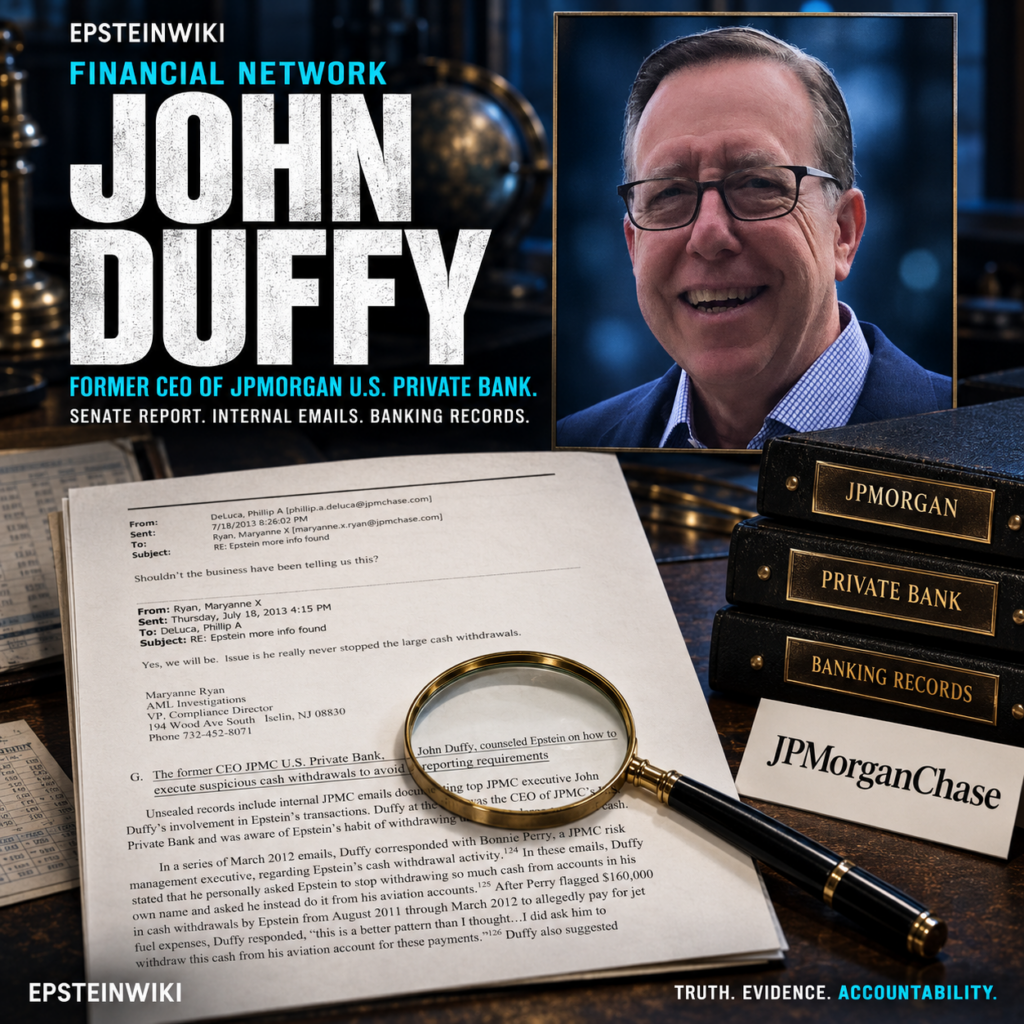
Snapshot
| Field | Detail |
|---|---|
| Full name | John Duffy |
| Profession | Banker and financial adviser |
| Relevant JPMorgan positions | Chief Executive Officer of the United States Private Bank, Vice Chairman of J.P. Morgan Private Bank, and Global Head of Institutional Wealth Management |
| Epstein connection | Senior executive involved in decisions, communications, cash activity discussions, account termination, and continued third party business involving Jeffrey Epstein |
| Direct contact | Records and reporting document calls, emails, and an April 2013 visit to Epstein’s Manhattan residence |
| Cash activity | In 2012, Duffy said he had asked Epstein to move large cash withdrawals from personal accounts to an aviation account |
| Account termination | Released testimony identifies Duffy as the executive who signed Epstein’s termination letter |
| Continued business | In August 2013, Duffy sought approval to continue working with Epstein through other client accounts, particularly accounts connected with Leon Black |
| Deposition | Deposed on July 13, 2023, in litigation involving the United States Virgin Islands and JPMorgan |
| Later career | Remained at JPMorgan until 2020, then became associated with Spayne Lindsay and Co. and NuOrion Capital |
| Criminal status | No public criminal charge against Duffy related to Epstein was identified as of September 16, 2026 |
| Individual liability | No public judgment finding Duffy personally liable for Epstein’s abuse or trafficking was identified |
| EpsteinWiki involvement rating | 4 of 5, documented senior banking involvement with significant decision authority |
John Duffy was a senior JPMorgan Chase private banking executive during the final years of the bank’s relationship with Jeffrey Epstein. The public record places him in a position of authority above Epstein’s relationship managers. It connects him to the monitoring of Epstein’s cash withdrawals, direct conversations with Epstein, the bank’s 2013 decision to terminate the client relationship, and a separate decision to keep working with Epstein when he acted through accounts belonging to other wealthy clients.
Duffy’s importance does not arise from a mere appearance in an address book or email chain. It arises from documented banking actions. He headed the United States Private Bank while Epstein remained one of JPMorgan’s most valuable and sensitive clients. Records show that Duffy knew of the relationship, communicated about unusual cash activity, visited Epstein’s home, signed the termination letter, and then discussed how the bank could preserve business connected to Epstein without continuing to bank Epstein’s own entities.
No public record reviewed for this article establishes that Duffy participated in Epstein’s sexual abuse or trafficking. No public criminal charge against him was identified. However, the record supports close scrutiny of his professional decisions because access to private banking allowed Epstein to move money, obtain credit, withdraw large amounts of cash, and maintain relationships with elite financial institutions long after his 2008 conviction.
Key Takeaways
- Duffy was not a junior banker. He served as Chief Executive Officer of JPMorgan’s United States Private Bank and was among the senior executives aware of Epstein’s relationship.
- In March 2012, Duffy told risk personnel that he had asked Epstein to take cash from an aviation account instead of accounts in Epstein’s own name.
- A 2013 due diligence record stated that Duffy and Mary Erdoes were aware of the Epstein relationship, which was considered sensitive and subject to annual monitoring.
- On March 13, 2013, a JPMorgan email thread recorded Duffy’s approval to open four business accounts for Epstein related entities while the relationship remained under review.
- Duffy visited Epstein’s Manhattan townhouse in April 2013. The following month, the private bank reauthorized Epstein to borrow as much as $50 million against his accounts, according to litigation records and reporting.
- Released deposition testimony identifies Duffy as the person who signed the letter terminating Epstein’s JPMorgan relationship.
- After that termination decision, Duffy asked Erdoes whether JPMorgan could continue working with Epstein through accounts belonging to other clients. Erdoes approved.
- Duffy’s August 2013 emails specifically discussed Leon Black and Epstein’s role as Black’s adviser.
- Duffy was deposed in 2023, but the complete transcript was filed under seal. The missing testimony limits the public’s ability to assess his explanations.
- JPMorgan paid major settlements to Epstein survivors and the United States Virgin Islands. Those settlements did not establish personal liability by Duffy.
Overview
Duffy’s place in the Epstein record sits at the intersection of executive authority, private bank revenue, compliance concerns, and access to wealthy prospective clients.
Epstein banked at JPMorgan from approximately 1998 through 2013. He maintained personal, business, trust, and aviation related accounts. According to the expert report of Jorge Amador, filed in the United States Virgin Islands litigation, the wider relationship included 134 accounts connected with Epstein, his entities, and his associates. More than $1 billion in cash flow moved through those accounts between 2003 and 2013.
Epstein was also commercially important. Internal records described him as part of the private bank’s “wall of cash.” He ranked among the bank’s leading private clients by balances or revenue in several internal reviews. A 2012 report placed him eighth among a team’s top 20 clients by revenue. The 2026 Senate Finance Committee staff report estimated that JPMorgan earned more than $8.1 million in fees from Epstein between 2009 and 2014.
That financial context shaped the environment in which Duffy acted. The bank was not deciding what to do with an ordinary retail customer. It was deciding how to manage a convicted sex offender who controlled a valuable pool of assets and introduced bankers to billionaires.
Identity and Career
This article concerns John Duffy, the longtime JPMorgan banker who became Chief Executive Officer of its United States Private Bank. He should not be confused with other public figures with the same name.
A 2012 Wall Street Journal profile reported that Duffy grew up in Park Slope, Brooklyn, joined JPMorgan in 1982, and worked in corporate and investment banking before moving into senior private banking leadership. Contemporary professional biographies identify him as a former Vice Chairman of J.P. Morgan Private Bank, Global Head of Institutional Wealth Management, and Chief Executive Officer of the United States Private Bank.
The distinction between those titles matters. Available records do not show that Duffy held the same position throughout the entire Epstein relationship. His most relevant period was the early 2010s, when he led the United States Private Bank and participated directly in decisions involving Epstein.
The 2026 Senate report states that Duffy remained at JPMorgan until 2020. It then identifies him as a partner at Spayne Lindsay and Co. and NuOrion Capital. Spayne Lindsay’s own materials describe Duffy as the former Chief Executive Officer of the United States Private Bank at JPMorgan.
Position in JPMorgan’s Chain of Authority
The JPMorgan record contains several different levels of responsibility:
| Level | People documented in the record | General function |
|---|---|---|
| Corporate leadership | Jamie Dimon, Mary Erdoes, Stephen Cutler, Jes Staley | Senior management, business leadership, legal authority, and major retention decisions |
| Private bank leadership | John Duffy | Oversight of the United States Private Bank and escalation of major client decisions |
| Relationship management | Mary Casey, Paul Morris, Justin Nelson, Jeff Matusow, Paul Barrett | Direct coverage, account servicing, client contact, and business development |
| Risk and compliance | Bonnie Perry, Maryanne Ryan, Philip DeLuca, William Langford and others | Due diligence, transaction review, suspicious activity analysis, and escalation |
Duffy occupied the private bank leadership tier. That role did not mean he personally approved every Epstein transaction. It did mean that major questions involving retention, account restrictions, credit access, unusual cash use, and the commercial value of referrals could reach him.
The 2026 Senate Finance Committee staff report identifies Duffy among the executives who oversaw major decisions concerning Epstein. A February 2013 due diligence record stated that Epstein had more than $100 million in assets and that both Erdoes and Duffy were aware of the relationship.
JPMorgan’s Knowledge Before Duffy’s Documented Decisions
By the time Duffy appears prominently in the record, Epstein’s criminal history was not hidden.
Epstein had been investigated by Palm Beach police beginning in 2005. He pleaded guilty in 2008 to Florida offenses that included solicitation of a minor, served a jail sentence, and registered as a sex offender. Civil lawsuits and news reports described allegations involving multiple girls and young women.
JPMorgan also had its own internal warning history. The bank filed suspicious activity reports concerning Epstein as early as 2002. Compliance employees repeatedly reviewed the client. A 2011 due diligence record said that Jes Staley had consulted General Counsel Stephen Cutler and that the decision was made to keep Epstein as a private bank client.
The surviving public record does not establish the exact date on which Duffy learned every fact about Epstein. It does establish that by February 2013 he was identified as aware of the relationship. The 2012 cash correspondence discussed below also shows his direct knowledge of unusually large withdrawals before that date.
The March 2012 Cash Withdrawal Emails
The most consequential Duffy specific banking record concerns Epstein’s cash withdrawals.
In March 2012, Duffy exchanged emails with JPMorgan risk executive Bonnie Perry. The emails concerned $160,000 that Epstein had withdrawn between August 2011 and March 2012, reportedly for aviation fuel.
Duffy wrote that the pattern was better than he had expected and said he had asked Epstein to withdraw the cash from an aviation account for those payments. He also suggested following up with Epstein accountant Harry Beller, whom he described as someone the bank knew.
The source range is JPM SDNYLIT 00230825 through 00230827. A court declaration released as EFTA02818619 identifies the first record in that range as an exhibit filed under seal.
Competing interpretations
The 2026 Senate staff report titled its discussion of this episode by stating that Duffy counseled Epstein on executing suspicious cash withdrawals to avoid reporting requirements. That is the Senate investigators’ interpretation.
The underlying wording establishes a narrower fact. Duffy directed Epstein to use an aviation account rather than personal accounts for the cash withdrawals. The public record reviewed here does not independently establish that Duffy intended to evade a currency reporting rule, conceal the beneficial owner, or prevent a suspicious activity report.
The distinction is important because moving a withdrawal to a business account could be presented as an effort to match an expense with the entity that incurred it. It could also make a troubling pattern appear more consistent with the stated purpose. Determining which explanation is accurate requires evidence of intent and a fuller understanding of the internal risk discussion.
Why the explanation remained questionable
JPMorgan compliance personnel later recorded that traveling abroad to pay for fuel in cash was not normal business practice. They also noted that Epstein maintained multiple homes and would not always have been departing from New York, where the withdrawals occurred.
One compliance message stated that Epstein was known to pay cash for massages, while also noting an asserted lack of proof that the reviewed funds involved minors. That statement shows that the bank’s own personnel were connecting the cash pattern to Epstein’s known conduct, even if they had not traced a particular withdrawal to a particular victim.
The bank did not file a contemporaneous suspicious activity report covering the full pattern identified in these emails, according to the Senate report.
The February 2013 Due Diligence Review
A February 9, 2013 internal review described Epstein’s total assets as exceeding $100 million. It stated that both Mary Erdoes and John Duffy were aware of the relationship.
The record is identified as JPM SDNYLIT 00036258. The Senate report cites it as evidence that senior private bank leadership understood both the scale and sensitivity of the account.
Other 2013 due diligence language described senior management as aware of Epstein and said that the accounts received yearly monitoring because the client was sensitive.
Annual monitoring does not establish adequate monitoring. Later litigation focused on the gap between the bank’s formal recognition of risk and the speed or quality of its response to cash withdrawals, wires, payments to women, and the relationship’s commercial value.
The March 2013 Approval of Four Business Accounts
EFTA01583634 is a March 13, 2013 JPMorgan Private Bank email thread requesting approval to open four business accounts for Epstein related entities. The thread records Duffy’s approval.
The account descriptions included an entity characterized as an investment company managing Epstein’s personal assets, with deposit and asset brokerage functions. This was therefore more than a proposed social introduction or a scheduling exchange. It concerned additional banking infrastructure for entities tied to an existing client.
The timing is significant. The approval came after the February 2013 due diligence review identified Duffy and Erdoes as aware of Epstein’s sensitive relationship, and shortly before Duffy’s documented April visit to Epstein’s townhouse. It also came during the same general period in which JPMorgan was evaluating whether to terminate Epstein.
The record establishes an account approval attributed to Duffy. It does not, by itself, reveal every compliance check performed on each entity, the balances eventually held, whether every approved account became operational, or how long each account remained open. Those questions require the account opening files and closure records.
The April 2013 Townhouse Visit
Duffy visited Epstein’s Manhattan townhouse in April 2013, according to litigation records and reporting based on people familiar with the meeting.
The timing is significant. JPMorgan was considering how to end the Epstein relationship, while Epstein remained a client with extensive assets, credit access, and connections to wealthy prospects.
The public record reviewed here does not provide a complete agenda or transcript of the April meeting. It therefore does not establish whether the discussion concerned account closure, credit, a philanthropy proposal, referrals, Leon Black, or several subjects at once.
However, the visit establishes direct contact at Epstein’s home during a critical period. It also shows that the bank’s relationship with Epstein reached its senior private bank leadership.
The $50 million borrowing authorization
The following month, the private bank reauthorized Epstein to borrow as much as $50 million against his accounts, according to the United States Virgin Islands litigation record and later reporting.
The timing does not by itself prove that Duffy approved the authorization or that the townhouse meeting caused it. The relevant evidence establishes proximity in time and institutional authority, not a complete decision trail.
An exhaustive account must therefore preserve both facts without turning their sequence into an unsupported causal claim.
Meetings and Introductions in Released EFTA Records
Several 2013 email threads in the Justice Department production show Epstein and his staff attempting to arrange access to Duffy or discussing his participation in meetings.
EFTA02144695
EFTA02144695 is a three page April 2013 email thread titled “Re: Jeffrey Epstein.” The record identifies Duffy as the person running the United States Private Bank and discusses efforts to include him in a meeting.
This record establishes that Duffy was a relevant senior contact during a period when Epstein and JPMorgan personnel were arranging meetings. It does not, without additional confirmation, prove that every proposed meeting occurred.
EFTA02144164
EFTA02144164 contains another thread in which participants discuss checking with Duffy and attempting to secure his attendance. It reinforces the record of Duffy’s relevance to executive level discussions.
Again, scheduling language is evidence of intent or planning. It should not automatically be converted into proof of a completed meeting.
EFTA00392922
EFTA00392922 is a related version or overlapping production of the email material describing Duffy’s leadership of the United States Private Bank. Duplicate and overlapping productions are common in the EFTA corpus. They strengthen document provenance but should not be counted as separate substantive events.
The Decision to Terminate Epstein
JPMorgan began closing Epstein’s relationship in 2013. The bank later described the action as firing him as a client.
Released evidence indicates that the repetitive nature of Epstein’s cash transactions, his personal history, and growing regulatory risk contributed to the decision. The final account connected with him did not close until March 2014, so the decision, the letter, and operational closure occurred on different dates.
A deposition excerpt released as EFTA02811652 records testimony identifying Duffy as the person who signed the termination letter sent to Epstein.
Signing the letter places Duffy directly in the exit process. It does not prove that he originated the decision or had unilateral authority to reverse it. The broader record indicates that legal, compliance, and business leaders all participated in the relationship’s final review.
Duffy’s Explanation of the Cash Issue
Financial Times reporting on internal records states that Duffy prepared talking points for Mary Erdoes to use in a discussion with Epstein. The reasons given for ending the relationship included the repetitive nature of the cash transactions and changing regulatory standards concerning cash activity.
After a call with Epstein concerning the account closures, Duffy wrote that Epstein better understood the effect of his cash activity and was maintaining the explanation that it related to aviation needs.
In 2023 testimony, according to the Financial Times, Duffy said he took Epstein at his word concerning the aviation explanation.
This reported testimony is important because it presents Duffy’s defense or explanation. It indicates that he accepted a stated business purpose. It does not resolve whether that acceptance was reasonable in light of the client’s criminal history, the withdrawal volume, and compliance concerns that cash payment for aviation fuel was abnormal.
Continuing to Work With Epstein Through Other Clients
The end of Epstein’s direct relationship with JPMorgan did not end his usefulness to the private bank.
On August 14, 2013, Duffy emailed Erdoes about Epstein’s role with billionaire Leon Black. Duffy wrote that Epstein would be Black’s primary adviser and that the bank could continue working with Epstein as long as the activity occurred through the client accounts rather than accounts belonging to Epstein entities. Duffy asked whether that approach was acceptable. Erdoes replied affirmatively with a single letter response.
The source is JPM SDNYLIT 00101010. The exchange is quoted in the Senate report and in the November 2025 memorandum prepared for Senator Ron Wyden.
Duffy also wrote that Epstein maintained he would become Black’s primary adviser and would be calling the shots.
This distinction created two different relationships:
| Relationship | Bank’s stated position |
|---|---|
| Epstein or an Epstein entity as the direct client | Not acceptable after termination |
| Epstein acting as adviser or intermediary for another JPMorgan client | Permitted with senior approval |
The record therefore complicates a simple claim that the bank severed all ties in 2013. JPMorgan ended the direct client relationship while allowing bankers to work with Epstein in connection with other client accounts.
Leon Black and the Referral Business
Leon Black was an exceptionally valuable prospective or existing client. Epstein received approximately $158 million from Black between 2012 and 2017, according to the Dechert review commissioned by Apollo Global Management. The 2026 Senate report used a figure of approximately $170 million when discussing the broader transaction record reviewed by investigators.
Duffy’s emails show that JPMorgan understood Epstein’s influence over Black. In another August 2013 thread involving Duffy, Erdoes, and banker Justin Nelson, the executives discussed an inquiry from Black’s family office that originated with an Epstein referral.
The emails described a longstanding relationship between Epstein and Black and referenced estate planning work performed by Epstein. Duffy ended one exchange with “more to come.” The records are identified as JPM SDNYLIT 00029911 through 00029912.
The significance is not simply that Epstein knew Black. The banking record shows senior JPMorgan personnel considering how to preserve business opportunities generated through Epstein after deciding that Epstein himself presented too much risk to remain a direct client.
The Wider Post Termination Relationship
Duffy was not the only banker involved in post termination contact.
Justin Nelson continued seeking meetings with Epstein concerning Black and other business. Paul Barrett also communicated with Epstein concerning Black. Those later contacts occurred after the bank had closed or was closing Epstein’s direct accounts.
The Financial Times reported that Duffy decided to maintain Epstein as a source of referrals and delegated that responsibility to Nelson. Between 2014 and 2017, JPMorgan bankers made additional documented visits to Epstein properties.
The public evidence does not establish that Duffy attended those later meetings. His role was more significant at the policy level: he participated in defining the conditions under which Epstein could remain useful to the private bank after termination.
The 2023 Deposition
Duffy was deposed on July 13, 2023, during the litigation between the United States Virgin Islands and JPMorgan.
A court declaration released as EFTA02818619 identifies excerpts of Duffy’s deposition as Exhibit 15 and says the material was designated confidential and filed under seal.
The full transcript was not publicly available in the records reviewed for this article. That absence matters because the deposition could contain Duffy’s answers about:
- His knowledge of Epstein’s criminal history.
- His role in the 2012 cash discussions.
- The purpose of moving withdrawals to an aviation account.
- His April 2013 townhouse visit.
- The $50 million credit authorization.
- The account termination letter.
- His discussion with Erdoes about working through other client accounts.
- The decision to preserve Epstein as a source of referrals.
- What he knew about Leon Black’s payments to Epstein.
Public articles have reported limited pieces of his testimony, including his statement that he took Epstein at his word regarding aviation expenses. Those excerpts should not be treated as a substitute for the complete examination.
United States Virgin Islands Litigation
The Government of the United States Virgin Islands sued JPMorgan in federal court in December 2022. The case alleged that the bank benefited from and facilitated Epstein’s trafficking enterprise by maintaining his accounts despite repeated warning signs.
Duffy was not named as an individual defendant. His conduct appeared in the evidence concerning what the bank knew, which executives participated, and how the business and compliance functions responded.
The litigation produced or cited many of the records now used to assess his role, including internal emails, due diligence reports, transaction analyses, account documents, and deposition testimony.
JPMorgan denied that it knowingly participated in Epstein’s crimes. It argued that the Virgin Islands government had failed to establish the required elements of its claims and emphasized the responsibility of Jes Staley and others.
In September 2023, JPMorgan agreed to pay $75 million to resolve the Virgin Islands case. The settlement allocated funds to charitable and government initiatives, law enforcement, and legal expenses. It avoided trial and did not produce a judicial finding that Duffy personally violated the law.
Survivor Class Action Against JPMorgan
Epstein survivors also brought a proposed class action against JPMorgan. The plaintiffs alleged that the bank knowingly benefited from Epstein’s trafficking venture and ignored warning signs while providing essential financial services.
JPMorgan agreed in 2023 to pay $290 million to resolve the survivor litigation. A federal judge granted final approval.
The settlement recognized the seriousness of the claims and created compensation for eligible survivors. However, a settlement is not a verdict on every allegation. Duffy was not adjudged personally liable through that resolution.
For survivors, the institutional issue is larger than any single banker. Financial institutions provided the accounts, credit, cash access, wires, and prestige that allowed Epstein to operate across properties and jurisdictions. Examining Duffy’s decisions helps explain how executive judgment can shape whether known risks lead to meaningful restriction or merely to a different account structure.
JPMorgan’s Public Position
JPMorgan has said it deeply regrets having had Epstein as a client and would not have continued the relationship if it believed he was engaged in ongoing criminal conduct. The bank emphasizes that it removed Epstein in 2013, six years before his federal arrest.
In responses to congressional inquiries, JPMorgan has defended executives other than Jes Staley and said that discovery did not establish that Chief Executive Officer Jamie Dimon knew of the Epstein relationship before 2019.
Those statements provide important context, but they do not erase the internal records involving Duffy. The relevant question is not only when the direct accounts closed. It is also what senior bankers knew, what they did about cash and compliance warnings, and why they approved continued dealings through third party client accounts.
The 2025 and 2026 Senate Findings
In November 2025, Senate Finance Committee investigators issued a memorandum focused on JPMorgan’s handling of Epstein. In August 2026, Senator Ron Wyden’s staff released a wider report concerning Wall Street banks.
The 2026 report alleged that major banks failed to report thousands of suspicious Epstein related transactions in a timely manner. It identified Duffy among senior bankers whom prosecutors and financial regulators should investigate.
The report also recommended that the House Committee on Oversight and Government Reform subpoena communications involving Duffy and other bankers.
These are congressional staff findings and recommendations. They are not criminal charges, regulatory orders against Duffy, or court judgments. The report’s account of the cash withdrawals is particularly important to describe with care because it attributes a purpose to Duffy’s instruction that the underlying emails do not explicitly state.
Evidence Appearances
| Record | Date or filing context | What it contributes | Evidentiary limit |
|---|---|---|---|
| EFTA02144695 | April 2013 | Identifies Duffy as head of the United States Private Bank and discusses including him in a meeting | Scheduling does not prove every meeting occurred |
| EFTA02144164 | April 2013 | Shows participants checking with Duffy about a meeting | Does not reveal the full purpose or outcome |
| EFTA00392922 | Overlapping email production | Repeats or overlaps the executive meeting discussion | Duplicate production is not a separate event |
| EFTA01583634 | March 13, 2013 | Records Duffy’s approval to open four business accounts for Epstein related entities | Does not supply every entity’s complete diligence, transaction, or closure history |
| EFTA02811652 | Released deposition excerpt | Contains testimony identifying Duffy as signer of Epstein’s termination letter | The excerpt is not Duffy’s complete deposition |
| EFTA02818619 | September 2023 court declaration | Identifies Duffy’s July 13, 2023 deposition and sealed Exhibit 15 | Does not disclose the sealed testimony itself |
| EFTA02812084 | USVI litigation filing | Provides exhibit and deposition context involving senior JPMorgan executives | Filing metadata does not establish the truth of every disputed assertion |
The most important Duffy specific cash and Leon Black records are usually cited by their JPMorgan litigation Bates numbers rather than a public EFTA document page. Where the underlying exhibit remains sealed, this article does not invent an EFTA crosswalk.
Evidence Timeline
| Date | Event | Source type |
|---|---|---|
| 1982 | Duffy joins JPMorgan | Contemporary professional reporting |
| 2011 | Duffy becomes Chief Executive Officer of the United States Private Bank | Contemporary banking reporting |
| 2011 | Internal retention discussions continue after Epstein’s conviction | JPMorgan due diligence records |
| March 2012 | Duffy discusses $160,000 in cash withdrawals and says he directed Epstein to use an aviation account | JPM SDNYLIT 00230825 through 00230827 |
| July 2012 | Erdoes forwards a Duffy message to Staley concerning Epstein’s role with Leon Black | JPM SDNYLIT 00022569 |
| February 9, 2013 | Due diligence report states that Duffy and Erdoes are aware of the Epstein relationship | JPM SDNYLIT 00036258 |
| March 13, 2013 | Duffy approves opening four business accounts for Epstein related entities | EFTA01583634 |
| April 2013 | Duffy visits Epstein’s Manhattan townhouse | Litigation record and investigative reporting |
| April 2013 | Email threads discuss arranging executive meetings with Duffy | EFTA02144695 and related records |
| May 2013 | Private bank reauthorizes borrowing capacity of as much as $50 million | Litigation record and reporting |
| 2013 | Duffy signs the letter ending Epstein’s direct relationship | EFTA02811652 deposition excerpt |
| July 2013 | Compliance identifies approximately $800,000 in previously unreported cash withdrawals | JPMorgan compliance records |
| August 14, 2013 | Duffy asks whether the bank can work with Epstein through other clients’ accounts | JPM SDNYLIT 00101010 |
| August 2013 | Duffy discusses Epstein’s influence over Leon Black and related business | JPM SDNYLIT 00101010 and 00029911 through 00029912 |
| March 2014 | Final known Epstein related JPMorgan account closes | Litigation and investigative reporting |
| 2020 | Duffy leaves JPMorgan | Senate staff report and professional biographies |
| July 13, 2023 | Duffy is deposed in the USVI case | EFTA02818619 |
| September 2023 | JPMorgan settles the USVI lawsuit for $75 million | Settlement and reporting |
| November 2025 | Senate memorandum highlights Duffy’s cash and post termination decisions | Senate Finance Committee memorandum |
| August 2026 | Wider Senate report recommends investigation of Duffy and other bankers | Senate Finance Committee staff report |
Involvement Assessment
EpsteinWiki involvement rating: 4 of 5
This rating reflects documented, consequential professional involvement. Duffy held senior authority over the private bank. He communicated directly about Epstein’s cash use, visited Epstein’s residence, signed the termination letter, and sought approval to preserve third party business involving Epstein.
The rating does not allege participation in sexual abuse, victim recruitment, or trafficking. It measures the depth and significance of the documented institutional relationship.
| Factor | Assessment |
|---|---|
| Direct professional contact | Strongly documented |
| Executive decision authority | Strongly documented |
| Knowledge of unusual cash activity | Documented |
| Awareness of Epstein’s relationship and sensitivity | Documented |
| Participation in account termination | Documented |
| Continued business after termination | Documented through third party account discussions |
| Personal participation in abuse | Not established |
| Criminal charge or personal judgment | None identified |
What the Evidence Establishes
The evidence establishes that Duffy was a senior JPMorgan private banking executive with direct involvement in the Epstein relationship.
It establishes that he knew about significant cash withdrawals, communicated with risk personnel, and told Epstein to use an aviation account for cash that Epstein said was needed for fuel.
It establishes that internal due diligence identified Duffy as aware of the relationship. It establishes direct contact, including a visit to Epstein’s Manhattan residence during the final months of the client relationship.
It establishes that Duffy approved opening four business accounts for Epstein related entities on March 13, 2013, after a due diligence record identified him as aware of the sensitive relationship.
It establishes that Duffy signed the termination letter and then discussed a narrower form of continued engagement through accounts belonging to other clients. It establishes that Leon Black was central to those discussions.
It also establishes that Duffy was deposed in the resulting litigation and that significant portions of his testimony were filed under seal.
What the Evidence Does Not Establish
The evidence reviewed does not establish that Duffy participated in Epstein’s sexual abuse, recruited victims, knowingly transferred money to a particular victim for abuse, or knowingly joined a trafficking conspiracy.
It does not establish that Duffy personally approved every account, wire, cash withdrawal, or loan within the Epstein relationship.
It does not conclusively establish that his instruction to use an aviation account was intended to evade reporting requirements. That is an interpretation advanced by Senate investigators. Proof of intent would require additional evidence.
It does not establish that his April 2013 visit caused the later credit authorization. Nor does it establish the complete subjects discussed during that meeting.
Finally, it does not reveal his complete deposition testimony. Any summary of his position remains incomplete until that transcript is public.
Fact Check
| Claim | Assessment | Explanation |
|---|---|---|
| Duffy was Epstein’s day to day relationship manager | Misleading | Relationship managers included Mary Casey, Paul Morris, Justin Nelson, and others. Duffy was a senior private bank executive |
| Duffy knew JPMorgan had a relationship with Epstein | Verified | A February 2013 due diligence record explicitly states that Duffy and Erdoes were aware |
| Duffy knew about unusual cash withdrawals | Verified | His March 2012 emails discuss $160,000 in withdrawals and prior conversations with Epstein |
| Duffy told Epstein to move the withdrawals to an aviation account | Verified | The instruction appears in the cited JPMorgan email range |
| Duffy taught Epstein to evade federal reporting law | Not adjudicated | The Senate report uses this interpretation, but the underlying email does not expressly state an intent to evade reporting |
| Duffy visited Epstein’s townhouse | Supported | Litigation records and multiple reports place him there in April 2013 |
| Duffy approved four Epstein related business accounts in March 2013 | Verified | EFTA01583634 records the request and Duffy’s approval |
| Duffy personally approved a $50 million loan immediately after the visit | Not established | The private bank reauthorized borrowing capacity, but the public record reviewed does not establish Duffy as the individual approver |
| Duffy signed Epstein’s termination letter | Supported by released testimony | EFTA02811652 contains testimony identifying him as the signer |
| JPMorgan fully ended all dealings with Epstein in 2013 | Misleading | Direct accounts were closed, but senior executives approved work involving Epstein through other client accounts |
| Duffy was criminally charged | False as of the publication date | No such charge was identified |
Survivor Centered Significance
The financial record should not displace the experiences of Epstein’s survivors. It should explain part of the machinery that allowed the abuse to continue.
Private banks do more than hold money. They provide credit, liquidity, cash, wires, investment services, entity accounts, prestige, and introductions. Those services can make a wealthy client more mobile and more difficult to isolate.
Survivors alleged that JPMorgan’s continued service gave Epstein the financial infrastructure required to operate his trafficking system. The bank denied knowingly participating in the crimes and settled the litigation without a trial.
Duffy’s record matters because it shows risk reaching a senior decision maker. The available documents do not portray a bank that had never heard of the problem. They portray employees discussing the client’s conviction, cash, reputation, and regulatory exposure while also considering revenue and access to other wealthy clients.
Unresolved Questions
- When did Duffy first learn the full details of Epstein’s conviction and the allegations involving minors?
- What did he know about JPMorgan’s earlier suspicious activity reports concerning Epstein?
- Why did he direct cash withdrawals to an aviation account rather than recommend that the cash activity stop?
- Did he consult anti money laundering personnel before giving that instruction?
- What evidence supported accepting the aviation fuel explanation?
- What was discussed during Duffy’s April 2013 visit to Epstein’s Manhattan townhouse?
- Who approved the May 2013 borrowing authorization of as much as $50 million?
- Why were new accounts reportedly opened in March 2013 while the bank was considering termination?
- Who made the final decision to end Epstein’s direct relationship?
- Why did Duffy approve or support continued engagement through other clients’ accounts?
- What did Duffy understand about Leon Black’s payments to Epstein?
- Did Duffy receive compensation or performance credit from business referred through Epstein?
- What responsibilities did he delegate to Justin Nelson after Epstein’s termination?
- What did Duffy say in his July 2023 deposition about the cash emails and aviation explanation?
- Why does the full deposition remain sealed after the public settlements?
- Did any federal or state regulator investigate Duffy personally?
- Did JPMorgan conduct an internal disciplinary review of his decisions?
- Will Congress subpoena his complete communications and testimony?
Related EpsteinWiki Articles
- Jeffrey Epstein
- JPMorgan Chase and Jeffrey Epstein
- Mary Erdoes
- Jes Staley
- Stephen Cutler
- Mary Casey
- Paul Morris
- Justin Nelson
- Paul Barrett
- Bonnie Perry
- Maryanne Ryan
- Harry Beller
- Leon Black
- United States Virgin Islands v. JPMorgan Chase
Sources
- United States Senate Finance Committee staff report, How Wall Street Banks Enabled Jeffrey Epstein’s Sex Trafficking, August 2026
- United States Senate Finance Committee, Memorandum to Senator Wyden on JPMorgan and Epstein, November 2025
- Jorge Amador expert report filed in Government of the United States Virgin Islands v. JPMorgan Chase
- EFTA02144695, April 2013 JPMorgan meeting email thread
- EFTA02144164, related JPMorgan meeting thread
- EFTA00392922, overlapping meeting email production
- EFTA01583634, March 2013 approval of four Epstein related business accounts
- EFTA02811652, deposition excerpt identifying the signer of Epstein’s termination letter
- EFTA02818619, court declaration identifying Duffy’s sealed deposition excerpts
- EFTA02812084, USVI litigation exhibit context
- Reuters, JPMorgan and United States Virgin Islands trade accusations concerning Epstein, August 2023
- Reuters, JPMorgan settles United States Virgin Islands claims for $75 million, September 2023
- The Guardian, JPMorgan executives reportedly maintained contact with Epstein after warnings, April 2023
- Financial Times, JPMorgan and Jeffrey Epstein: the long goodbye, March 2026
- Spayne Lindsay, global consumer partnership and John Duffy biography