
Mary Erdoes and Jeffrey Epstein: JPMorgan Oversight, Direct Contact, and Unanswered Questions
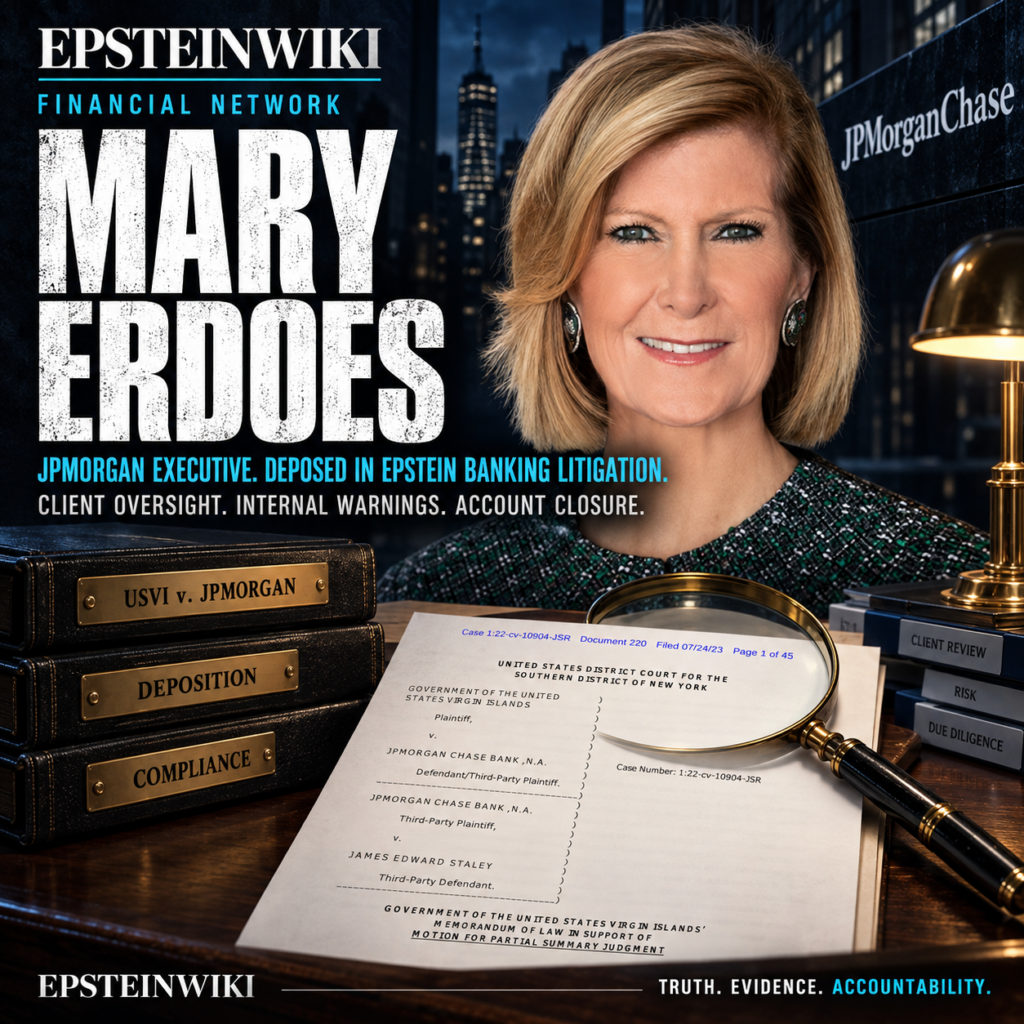
Snapshot
| Field | Detail |
|---|---|
| Full name | Mary Callahan Erdoes |
| Current role | Chief Executive Officer of JPMorganChase Asset & Wealth Management |
| JPMorgan tenure | Joined in 1996; led the Private Bank from 2005 to 2009; has led Asset & Wealth Management since 2009 |
| Epstein connection | Senior executive in the business that managed Jeffrey Epstein’s JPMorgan relationship; exchanged emails with Epstein and participated in decisions concerning his status as a client |
| Key period | 2005 to 2013, with later scrutiny from civil litigation and congressional investigators |
| Core evidence | Internal JPMorgan emails, due diligence records, Erdoes’s 2023 deposition, federal court filings, and the 2026 Senate Finance Committee staff report |
| Legal status | Erdoes has not been criminally charged in connection with Epstein and no court has found her personally liable for his crimes |
| Central question | Why did JPMorgan continue serving Epstein after repeated warnings, and what authority or responsibility did Erdoes have during that process? |
Mary Erdoes is one of the most senior JPMorgan executives documented in the bank’s long relationship with Jeffrey Epstein. The record does not show that Erdoes participated in Epstein’s sexual abuse. It does show that she knew of serious allegations involving Epstein, communicated with him after his 2008 conviction, supervised the division responsible for his banking relationship, and approved continued work involving him after JPMorgan began removing him as a direct client.
Her importance to the Epstein record is institutional. The question is not simply whether Erdoes knew Epstein. The question is how one of the world’s most powerful banking executives responded when a lucrative client presented repeated sex crime, human trafficking, cash activity, and reputational warnings.
Who Is Mary Erdoes?
JPMorganChase identifies Mary Callahan Erdoes as the Chief Executive Officer of its Asset & Wealth Management business. The bank states that the division manages more than $7 trillion in client assets. Erdoes joined the firm in 1996, became Chief Executive Officer of the Private Bank in 2005, and became head of Asset & Wealth Management in 2009. She also joined JPMorganChase’s Operating Committee, the firm’s senior management body.
That career history overlaps directly with Epstein’s years at the bank. Epstein was a JPMorgan client from 1998 until 2013. Erdoes led the Private Bank from 2005 through 2009 and then led the larger business that included it.
The bank’s 2026 proxy statement reported $31 million in compensation awarded to Erdoes for 2025 performance. In a June 2026 SEC filing, JPMorgan disclosed a separate $20 million retention and continuity award. These facts do not prove anything about Epstein. They establish Erdoes’s continuing seniority and the importance JPMorgan places on retaining her.
Why Erdoes Matters to the JPMorgan Epstein Record
Epstein was not an obscure retail customer. According to internal records summarized in the Senate Finance Committee staff report, he was one of JPMorgan’s largest private banking clients and appeared in an elite group described internally as the “wall of cash.” His balances reportedly exceeded $140 million at points, while more than $1 billion moved through his JPMorgan accounts between 2003 and 2013.
The same report states that major decisions concerning Epstein were monitored by Erdoes, Jes Staley, Stephen Cutler, and John Duffy. Relationship managers included Paul Morris, Mary Casey, and Justin Nelson.
This matters because warnings about Epstein did not remain at a low operational level. They circulated through legal, compliance, risk, private banking, and senior management channels. Erdoes’s documented role places her within that decision structure.
What Erdoes Said JPMorgan Knew by 2006
In March 2023, Erdoes gave a deposition lasting nearly nine hours in litigation concerning JPMorgan’s relationship with Epstein. The deposition transcript has not always been available as a complete public record, but portions were quoted in court filings and reported by major news organizations.
The Government of the United States Virgin Islands alleged in its Second Amended Complaint, docket 1:22-cv-10904-JSR, Document 119 that Erdoes admitted JPMorgan knew by 2006 that Epstein had been accused of paying cash to have underage girls and young women brought to his home.
The same filing alleged that a JPMorgan Rapid Response Team documented repeated cash withdrawals ranging from $40,000 to $80,000, totaling more than $750,000 annually. Those facts are allegations drawn from the government’s complaint and underlying bank records. They are not a judicial finding against Erdoes.
The Washington Post’s review of the deposition reported that Erdoes had been alerted repeatedly to Epstein’s criminal and civil legal problems. It also reported that, in a 2006 exchange concerning an article about allegations involving minors, Erdoes described the material as painful to read. Staley responded that Epstein denied the ages involved.
The evidence therefore supports a narrow but important conclusion: Erdoes knew that serious accusations involving minors existed years before JPMorgan ended the relationship. The evidence does not by itself establish that she knew the full scope of Epstein’s trafficking operation.
Warnings Continued After Epstein’s 2008 Conviction
Epstein pleaded guilty in Florida in 2008 to state charges including procuring a person under eighteen for prostitution. He served jail time and became a registered sex offender. JPMorgan nevertheless retained him until 2013.
The USVI complaint alleged that senior executives, including Erdoes, received or participated in communications concerning Epstein’s criminal exposure and trafficking allegations. It identified meetings involving Erdoes, Staley, Cutler, and Catherine Keating in various combinations during 2008, 2011, and 2013.
The complaint also alleged that Erdoes received a 2008 email asking whether Epstein was attending an event with Miley Cyrus, who was sixteen that year. The message is significant as evidence of internal culture and awareness. It does not establish that Cyrus met Epstein or that any misconduct involving her occurred.
In 2010, according to the complaint, Erdoes and Staley exchanged an email concerning a reported federal investigation of Epstein for child trafficking. In 2011, JPMorgan compliance records referenced child trafficking, molestation allegations, civil settlements, payments to models, unusually large cash withdrawals, and the bank’s financial relationship with MC2 Model Management.
These records show that Epstein’s risk profile was not limited to one old conviction. Human trafficking concerns continued to appear in the bank’s internal review process.
Direct Communications Between Erdoes and Epstein
The released records contain repeated direct and indirect communications involving Erdoes and Epstein. Contact alone does not establish criminal knowledge. The frequency, timing, and tone are relevant because much of the contact occurred after Epstein’s conviction and while the bank was reviewing his risk.
The July 2011 “21 Million Reasons” Exchange
On July 10, 2011, Epstein told Erdoes that there were “21 million reasons” he wanted to know when she would return. Erdoes indicated that she was traveling but available to talk, and Epstein sought a call that day. A direct copy of the exchange appears in EFTA00720558.
The email does not explain the $21 million reference by itself. The Senate report describes it in the context of business matters and a multimillion dollar settlement. Without the complete transaction file, the meaning should not be overstated.
The May 2011 Meeting Follow Up
In another 2011 email, Erdoes apologized for missing a message because she had spent the day in an Operating Committee meeting with Jamie Dimon. She told Epstein that she hoped the meeting went well and was anxious to hear about it. The exchange appears in a larger court exhibit preserved as EFTA02808649.
The Ritz Pool Message
In August 2011, Erdoes’s assistant relayed that Epstein had called from Paris and thought Erdoes would appreciate hearing that he had just left the pool at the Ritz. Erdoes forwarded the message to Epstein with a critical response. The underlying email is preserved in EFTA00916499.
This exchange is evidence of a familiar communications channel. It should not be misrepresented as evidence of a sexual or romantic relationship.
Staley Tells Epstein to Stop Pushing
An October 2011 exchange shows Staley telling Epstein to stop pushing. Epstein replied that he would ease off regarding Erdoes and believed he had been following a plan. The email is preserved in EFTA00921890.
The wording indicates that Epstein was persistently seeking Erdoes’s attention. It also suggests coordination involving Staley. The record does not fully explain the plan Epstein referenced.
The 2012 Birthday Email
On January 20, 2012, Erdoes wished Epstein a good birthday weekend. Epstein replied that Boris had said she was terrific. Erdoes then referenced a presentation involving Bill. The exchange appears in EFTA00928437 and related messages.
The Senate report connects Erdoes and Epstein to discussions of possible projects involving Bill Gates. The emails document business access and communication. They do not show Gates participating in Epstein’s crimes.
The “Nymphettes” Email
In September 2012, David Brigstocke, then a senior finance executive in Asset & Wealth Management, compared another wealthy client’s home with Epstein’s home. He wrote that the other home was more tasteful and had “fewer nymphettes.” Erdoes responded, “Wow.” The direct email is preserved in EFTA02811465.
The term used by Brigstocke commonly refers to sexually attractive young girls. The message is disturbing because it suggests that the presence of young females at Epstein’s home was familiar enough to become an internal joke between senior executives.
However, the exchange has evidentiary limits. It does not identify the girls, state their ages, explain what either executive personally observed, or prove that Erdoes witnessed abuse. Erdoes’s one word reply is ambiguous. The email is powerful evidence of awareness and culture, but it is not proof that she participated in trafficking.
The Decision to End Epstein’s Client Relationship
A February 2013 due diligence report stated that Epstein held more than $100 million in assets and that Erdoes and Duffy were aware of the relationship. By that point, compliance personnel had generated years of warnings.
In her deposition, according to the USVI complaint and The Washington Post, Erdoes said the bank terminated Epstein after she learned that his large withdrawals involved actual cash. She said she did not connect the cash with the allegations of sexual abuse or trafficking at the time.
Erdoes also testified that Staley’s 2013 departure removed Epstein’s internal sponsor. In her account, no one remained to vouch for him. She maintained that legal, risk, compliance, and supervisory personnel had defined responsibilities for investigating and controlling client risk.
This defense is important. Erdoes did not claim that the warning record did not exist. Her position was that investigating allegations and imposing controls belonged to the bank’s formal review structure rather than to her personally.
The unresolved governance question is whether the leader of the relevant business line could reasonably treat those repeated warnings as someone else’s responsibility, especially when she was directly communicating with Epstein and participating in decisions concerning his account.
Continued Work Through Other Client Accounts
JPMorgan began removing Epstein as a direct client in 2013. Internal correspondence shows that the bank remained interested in business opportunities introduced or influenced by him.
On August 14, 2013, Duffy told Erdoes that Epstein would be Leon Black’s primary adviser. Duffy wrote that the bank could work with Epstein through Black’s client accounts but would not work through Epstein entities. He asked whether that arrangement was acceptable. Erdoes replied, “Y.” The three page court exhibit is preserved as EFTA02811762.
This email is among the clearest records involving Erdoes. It shows approval for a structure that ended Epstein’s direct customer relationship while preserving his role as an intermediary connected to Leon Black.
The email does not establish that Erdoes approved suspicious transactions or knew the source or purpose of Black’s later payments to Epstein. It does show that JPMorgan’s institutional separation from Epstein was incomplete. The bank would no longer accept Epstein controlled entities, but it remained willing to interact with him through another wealthy client.
The Bank’s Suspicious Activity Reporting Problem
The 2026 Senate Finance Committee staff report concluded that JPMorgan likely violated federal anti money laundering requirements by failing to report Epstein’s suspicious activity in a timely manner. The report states that JPMorgan waited until 2019 to file sweeping retrospective reports covering thousands of transactions.
The report cites a September 2019 filing that flagged 4,725 wire transfers totaling nearly $1.1 billion. It also describes another 2019 filing covering 469 wire transfers totaling approximately $201 million.
These are institutional findings and allegations concerning JPMorgan’s compliance program. The public record reviewed for this article does not establish that Erdoes personally decided whether to file any specific Suspicious Activity Report. It does establish that she was a senior leader in the business responsible for the client and was involved in decisions about retaining, monitoring, and eventually exiting him.
Civil Litigation, Settlements, and JPMorgan’s Position
Two major civil cases placed JPMorgan’s Epstein relationship under intense scrutiny:
- A survivor class action accused the bank of benefiting from and facilitating Epstein’s trafficking venture.
- The Government of the United States Virgin Islands accused JPMorgan of facilitating, sustaining, and concealing the venture and of obstructing enforcement.
JPMorgan denied the allegations. The bank argued that it did not help Epstein commit his crimes, expressed regret for having him as a client, and sought to place primary responsibility on Staley.
In 2023, JPMorgan agreed to pay $290 million to resolve the survivor class action. It separately agreed to pay $75 million to resolve the USVI case, including funding directed toward victim services, charitable organizations, and law enforcement related initiatives. The settlements avoided trial and did not constitute a finding that Erdoes personally violated the law.
JPMorgan’s October 2025 response to Senator Ron Wyden stated that, apart from Staley, its executives acted with integrity and would not have retained Epstein had they known he was continuing criminal conduct. That is the bank’s position. The Senate Finance Committee staff rejected the attempt to isolate the failure to Staley and pointed to records involving Erdoes and other senior personnel.
Congressional Scrutiny in 2025 and 2026
In September 2025, Senator Ron Wyden opened a focused inquiry into what JPMorgan leaders knew and why the bank waited years to report transactions. The inquiry specifically sought information concerning Erdoes, Staley, Justin Nelson, Stephen Cutler, and William Langford.
After JPMorgan declined to provide the requested detail, Wyden sent a second letter in October 2025. He wrote that it was not credible to attribute a compliance failure of this scale to a single employee.
The Senate Finance Committee staff’s August 2026 report devoted a section to Erdoes’s contact with Epstein. It recommended that federal prosecutors and financial regulators investigate the conduct of named bankers, including Erdoes. It also urged congressional subpoenas for relevant communications.
That recommendation is not a criminal charge, regulatory finding, or announcement that a formal prosecution is underway. As of September 16, 2026, no public record reviewed for this article shows that Erdoes has been criminally charged or personally sanctioned over Epstein.
Evidence Timeline
| Date | Record | What it shows | Evidentiary limit |
|---|---|---|---|
| 2005 to 2009 | Erdoes led JPMorgan’s Private Bank | Her leadership overlapped with Epstein’s high value client relationship | Leadership does not prove knowledge of every transaction |
| 2006 | Deposition testimony and USVI complaint | JPMorgan knew of accusations involving cash payments and underage girls | The quoted testimony concerns institutional knowledge, not complete personal knowledge |
| 2008 | Epstein conviction and internal communications | JPMorgan retained Epstein after a public sex crime conviction | Retention decisions involved multiple executives and control functions |
| 2010 | Internal email described in the USVI complaint | Erdoes and Staley were alerted to reported child trafficking scrutiny | The complete context of every message is not public |
| July 2011 | EFTA00720558 | Direct business communication between Epstein and Erdoes | The $21 million reference is not fully explained by the email alone |
| August 2011 | EFTA00916499 | Familiar direct contact after Epstein’s conviction | It does not establish criminal knowledge |
| October 2011 | EFTA00921890 | Epstein was pressing Erdoes and referred to a plan | The plan is not defined |
| January 2012 | EFTA00928437 | Erdoes sent Epstein a birthday message and continued business discussion | Social familiarity is not proof of participation in abuse |
| September 2012 | EFTA02811465 | Senior executives used sexualized language about young females at Epstein’s home | The message does not identify any victim or prove firsthand observation by Erdoes |
| February 2013 | JPMorgan due diligence record | Erdoes and Duffy were identified as aware of the client relationship | Awareness of the relationship is not the same as awareness of every account detail |
| August 2013 | EFTA02811762 | Erdoes approved work involving Epstein through Leon Black’s accounts | It does not prove knowledge of Black’s later payments or Epstein’s use of them |
| March 2023 | Erdoes deposition | Erdoes explained her knowledge, role, and view of internal responsibility | The complete transcript should be consulted if released without redactions |
| 2023 | Survivor and USVI settlements | JPMorgan paid a combined $365 million to resolve major Epstein related cases | Settlements are not admissions or personal findings against Erdoes |
| 2025 to 2026 | Senate Finance inquiry and report | Congressional investigators sought further scrutiny of Erdoes and other bankers | A congressional recommendation is not a criminal adjudication |
Network of Relevant Decision Makers
| Person | Role in the record | Connection to Erdoes |
|---|---|---|
| Jes Staley | Senior JPMorgan executive and Epstein’s internal advocate | Erdoes’s former supervisor; participated in Epstein reviews and communications |
| Jamie Dimon | JPMorgan Chairman and Chief Executive Officer | Erdoes served on his Operating Committee; Dimon denied knowing about Epstein before 2019 |
| Stephen Cutler | JPMorgan General Counsel | Legal executive associated with decisions to retain Epstein after compliance reviews |
| John Duffy | Chief Executive Officer of the United States Private Bank | Communicated with Erdoes about Epstein, cash activity, and Leon Black |
| David Brigstocke | Asset & Wealth Management finance executive | Sent Erdoes the 2012 “nymphettes” email |
| Justin Nelson | JPMorgan private banker | Participated in business discussions involving Epstein referrals and Leon Black |
| Leon Black | Billionaire client who paid Epstein large sums for financial advice | His accounts became a channel through which JPMorgan remained willing to work with Epstein |
| Bill Gates | Subject of proposed philanthropic and financial projects | Records describe Erdoes, Staley, and Epstein discussing potential projects; this does not imply wrongdoing by Gates |
What the Evidence Establishes
The available evidence establishes that:
- Erdoes held senior authority over the JPMorgan business serving Epstein.
- She knew by 2006 that serious allegations involving underage girls had been raised against Epstein.
- She continued communicating with Epstein after his 2008 conviction.
- Compliance and risk warnings concerning trafficking, cash withdrawals, and reputational danger circulated while Epstein remained a client.
- Erdoes participated in the process that ended Epstein’s direct client relationship in 2013.
- She approved continued work involving Epstein through Leon Black’s client accounts.
- Congressional investigators have recommended further federal scrutiny of her conduct and that of other bankers.
What the Evidence Does Not Establish
The available evidence does not establish that:
- Erdoes participated in Epstein’s sexual abuse or trafficking.
- She knew the identity of every victim or the full scope of Epstein’s criminal enterprise.
- She personally approved every transaction in Epstein’s accounts.
- She personally decided whether JPMorgan should file each Suspicious Activity Report.
- The “nymphettes” email proves that she witnessed minors being abused.
- A court or regulator has found her personally liable for Epstein’s crimes.
- A public criminal charge has been filed against her in connection with Epstein.
Unanswered Questions
- What did Erdoes understand about the relationship between Epstein’s cash withdrawals and the allegations involving girls and young women?
- What authority did Erdoes possess to remove Epstein before 2013, and what approvals were required?
- Why did repeated warnings in 2006, 2008, 2010, and 2011 not result in an earlier exit?
- What was the “plan” Epstein referenced when Staley told him to stop pushing Erdoes?
- What was the complete business context for the “21 million reasons” email?
- What did Erdoes, Duffy, Nelson, and other executives understand about Epstein’s role for Leon Black?
- Why did JPMorgan permit work through third party client accounts after deciding that Epstein controlled entities were unacceptable?
- When did Erdoes learn that JPMorgan had not contemporaneously reported the full scale of Epstein’s suspicious activity?
- Did JPMorgan’s board review Erdoes’s conduct after the 2019 arrest, the 2023 litigation, or the 2025 and 2026 congressional findings?
- Will regulators or Congress obtain and publish the complete Erdoes deposition, related due diligence records, and internal communications without unnecessary redactions?
Fact Check Assessment
Confirmed: Erdoes led the relevant JPMorgan businesses during much of Epstein’s relationship with the bank, communicated with Epstein, knew of serious allegations, participated in his 2013 exit, and approved continued work involving him through another client’s accounts.
Alleged in litigation: The USVI alleged that JPMorgan knowingly facilitated and concealed Epstein’s trafficking venture and obstructed enforcement. JPMorgan denied wrongdoing and settled the case without trial.
Congressional finding: Senate Finance Committee staff concluded that JPMorgan likely violated anti money laundering requirements and recommended investigation of Erdoes and other bankers. This is an investigative conclusion, not a court judgment.
Not established: No reviewed evidence proves that Erdoes participated in sexual abuse, and no public criminal charge or personal liability finding against her has been identified.
Key Takeaways
- Mary Erdoes is significant because she was not a peripheral contact. She was a senior executive with authority over the business that served Epstein.
- The record documents knowledge of serious allegations years before JPMorgan ended the relationship.
- Direct emails show that contact continued after Epstein’s conviction.
- The 2013 exit did not end every business interaction involving Epstein.
- The strongest accountability question concerns institutional responsibility: who had the authority to act, who received the warnings, and why the bank waited.
- Careful reporting must distinguish evidence of contact and governance failure from proof of participation in Epstein’s crimes.
Related EpsteinWiki Articles
- Jeffrey Epstein
- JPMorgan Chase and Jeffrey Epstein
- Jes Staley
- Jamie Dimon
- Stephen Cutler
- John Duffy
- Leon Black
- Bill Gates
- Ghislaine Maxwell
- Leslie Wexner
- Glenn Dubin
Sources
- Senate Finance Committee staff report, Looking the Other Way: How Wall Street Banks Enabled Jeffrey Epstein’s Sex Trafficking, August 2026
- Government of the United States Virgin Islands v. JPMorgan Chase Bank, N.A., Second Amended Complaint, Document 119
- Consolidated court exhibit concerning JPMorgan communications with Epstein
- July 2011 Erdoes and Epstein email chain
- August 2011 Ritz pool message
- October 2011 “stop pushing” email chain
- January 2012 birthday email chain
- September 2012 Brigstocke and Erdoes email
- August 2013 Duffy and Erdoes email concerning work through Leon Black’s accounts
- JPMorganChase executive biography for Mary Callahan Erdoes
- JPMorganChase 2026 Proxy Statement
- JPMorganChase June 2026 SEC filing describing Erdoes’s retention award
- The Washington Post review of the Erdoes deposition
- Senator Wyden’s September 2025 JPMorgan inquiry
- Senator Wyden’s October 2025 follow up inquiry
- Reuters report on the $290 million survivor settlement
- Associated Press report on the $75 million USVI settlement