
358 El Brillo Way: Jeffrey Epstein’s Palm Beach Mansion
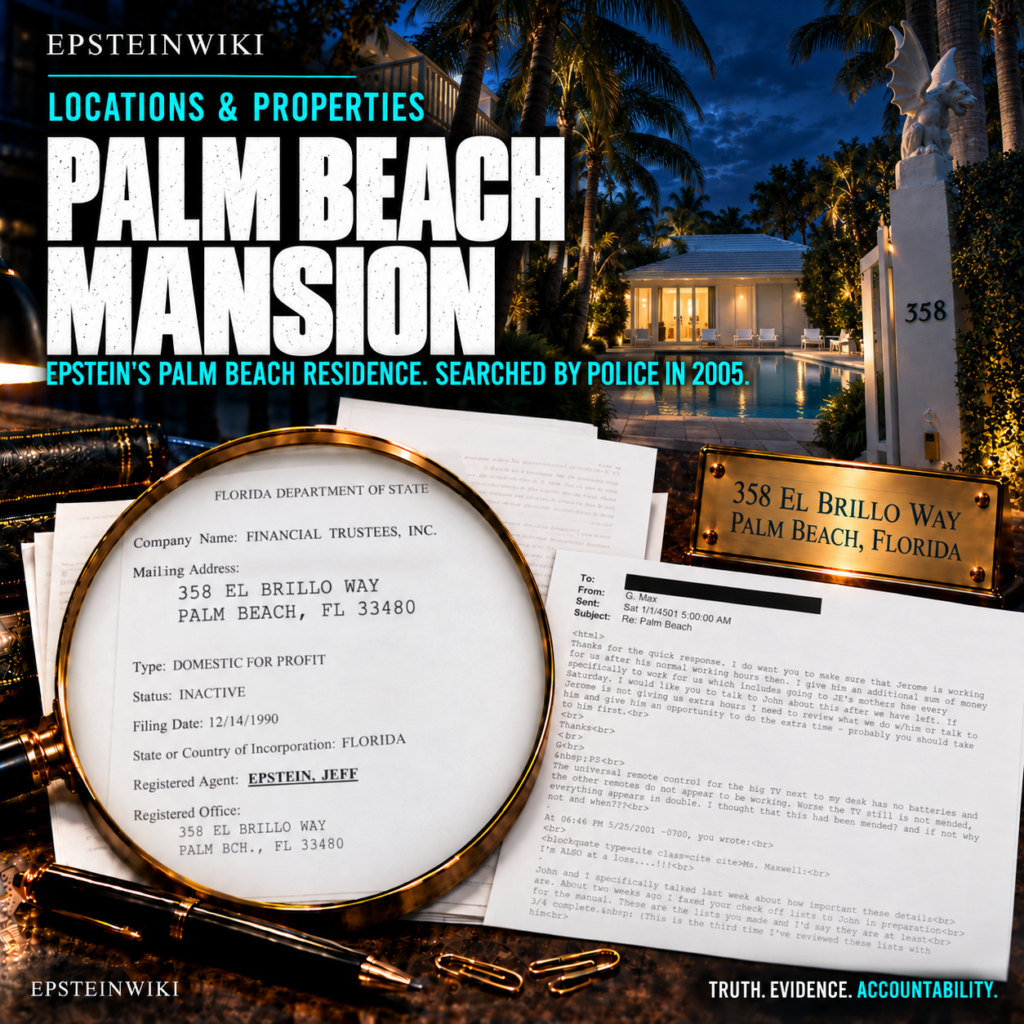
Snapshot
| Field | Finding |
|---|---|
| Historic address | 358 El Brillo Way, Palm Beach, Florida 33480 |
| Current parcel address | The rebuilt property has been reported as 360 El Brillo Way |
| Property type | Waterfront mansion with a main residence, staff quarters, pool house, garage, pool, and dock |
| Reported size | Approximately 14,000 to 14,200 square feet |
| Construction | Built in 1952 |
| Architect | John L. Volk |
| Style | West Indies inspired residential architecture |
| Epstein acquisition | September 1990 for $2.5 million |
| Later title holder | Laurel, Inc., a Virgin Islands corporation associated with Epstein |
| Central criminal significance | Palm Beach Police documented a recurring system in which teenagers were recruited and paid to give Epstein massages that allegedly escalated into sexual abuse |
| Police case | Palm Beach Police Department case 05 368 |
| Search date | October 20, 2005 |
| Lead detective | Joseph Recarey |
| Key police filing | May 1, 2006 probable cause affidavit recommending four unlawful sexual activity counts and one lewd or lascivious molestation count |
| State disposition | Epstein pleaded guilty on June 30, 2008 to felony solicitation of prostitution and procurement of a person under 18 for prostitution |
| Federal resolution | A September 24, 2007 non prosecution agreement ended the Southern District of Florida investigation without a federal prosecution |
| Maxwell trial significance | House manager Juan Alessi testified about the household, young visitors, massage routines, Maxwell’s authority, and the household manual. Palm Beach photographs, floor plans, and a massage table were admitted as exhibits |
| Post death sale | Sold by an Epstein estate entity in March 2021 for $18.5 million |
| Demolition | The mansion was demolished in April 2021 |
| Present status | The Epstein residence no longer exists. A new residence was built on the parcel and has no established connection to Epstein |
Key Takeaways
- The Palm Beach mansion was the location that produced the first sustained law enforcement investigation capable of exposing Epstein’s recruitment and abuse system.
- The case began after the family of a fourteen year old reported that Epstein had paid her following a massage appointment at the house.
- Detective Joseph Recarey documented recurring elements across survivor accounts: teenagers recruited by friends, entry through the kitchen, an upstairs massage area, Epstein appearing in a towel, sexual escalation, cash payment, and referral fees.
- Police did not rely only on interviews. They used controlled calls, a voice mail, trash pulls, telephone subpoenas, aircraft records, employee statements, a search warrant, photographs, message books, concealed cameras, and computer images.
- The mansion operated through a tightly managed household. Ghislaine Maxwell exercised authority over staff, assistants scheduled appointments, and a detailed household manual imposed strict rules and secrecy.
- Potentially important evidence was removed before the October 2005 police search. A private investigator took computers, directories, photographs, recordings, and other material from the house on October 7, 2005.
- The charge resolution was far narrower than the case police sought. Epstein admitted two Florida offenses in 2008, while the most serious allegations were never tried against him.
- Maxwell’s 2021 conviction established her criminal participation in a broader scheme involving Epstein, but it did not adjudicate every Palm Beach allegation or every person who worked at or visited the house.
- The mansion was sold and demolished in 2021. Its disappearance makes police photographs, floor plans, search records, staff testimony, property records, and survivor accounts essential historical evidence.
- Presence at the property does not establish criminal knowledge. The strongest claims concern people whose conduct is supported by testimony, communications, financial records, official findings, or convictions.
Source and Provenance
This article is built from several independent evidence groups that must be read together.
The central police record is Detective Joseph Recarey’s 22 page probable cause affidavit, released as HOUSE_OVERSIGHT_018894 through HOUSE_OVERSIGHT_018915. It summarizes sworn survivor and witness interviews, controlled calls, trash pulls, the warrant search, employee statements, telephone records, and aircraft records.
The property and evidence records include the 2005 inventory of material removed from the house in EFTA01733753, federal subpoena litigation in EFTA00222985, the storage and cloning email in EFTA00884246, and the title and appraisal reference in EFTA01684602.
The visual record comes from exhibits admitted during United States v. Maxwell. It includes exterior photographs, interior search photographs, floor plans, a redacted walkthrough video, the household manual, and the green massage table. Trial admission establishes that the jury could consider an exhibit for an authorized purpose. It does not make every possible interpretation of an exhibit a judicial finding.
The ownership and sale history is supported by deeds, corporate records, estate material, property reporting, and public sale records. Secondary reporting is used to clarify architecture, demolition, redevelopment, and the address change. Where a secondary account conflicts with a primary record, the primary record controls.
Why the Palm Beach Mansion Matters
358 El Brillo Way was more than one of Jeffrey Epstein’s luxury homes. It was a working environment in which domestic staff, assistants, visitors, drivers, recruiters, and teenagers moved through a controlled sequence of spaces.
The property matters because the physical house appears repeatedly in independent forms of evidence. Survivors described its rooms and routines. Police later observed matching features. Former employees described preparing massage areas and cleaning afterward. Appointment records and telephone evidence tracked the flow of visitors. Trial exhibits preserved the exterior, interior, floor plans, and objects recovered in the search.
This convergence makes Palm Beach different from locations supported mainly by retrospective reporting. The mansion became a documented crime scene, even though the full case built by police never reached a public criminal trial against Epstein.
Property Profile
| Feature | Reported description | Investigative relevance |
|---|---|---|
| Main residence | Two story waterfront mansion | Contained Epstein’s bedroom, bathroom, library, offices, and guest spaces |
| Floor area | About 14,000 to 14,200 square feet | Allowed private movement among residential, staff, and service areas |
| Bedrooms | Commonly reported as six | Bedroom count does not identify where every alleged act occurred |
| Staff space | Separate staff quarters or service areas | Supported a permanent household operation |
| Pool house | Separate amenity structure | Part of the broader compound, but not established as a crime location by its existence |
| Garage | Three car garage reported in sale materials | Police reported a concealed camera in a clock in the garage |
| Waterfront | Direct water frontage and dock | Increased privacy and alternative access possibilities |
| Entry | Gated property with distinctive winged figures or gargoyles | Survivors and reporters used exterior details to identify the location |
| Service route | Teenagers were commonly described as entering through the kitchen | Indicates a repeated access pattern controlled by household personnel |
Real estate listings and later reporting provide the architectural details. Police records and testimony provide the operational details. The two categories should not be confused.
Architectural History
The residence was built in 1952 and designed by Palm Beach architect John L. Volk. Published property histories describe it as a West Indies inspired house created for automobile executive Owen Ray Skelton.
Epstein bought the property in September 1990 for $2.5 million. The acquisition placed him in one of Palm Beach’s most exclusive residential areas years before the criminal investigation began.
Architecture is relevant because the physical plan shaped access and privacy. The house offered formal spaces for guests, service areas for employees, a secluded upstairs bedroom and bathroom zone, offices, a library, a garage, and waterfront grounds. The design did not cause the abuse. It gave Epstein a private environment that staff could prepare and control.
Ownership and Title History
| Date | Transaction or status | Evidentiary significance |
|---|---|---|
| September 1990 | Epstein purchased 358 El Brillo Way for $2.5 million | Establishes direct acquisition and long term control |
| 1990 through 2011 | Epstein occupied and controlled the residence | Includes the central period described by survivors and police |
| December 2011 | Property transferred to Laurel, Inc. | Internal restructuring through an Epstein associated Virgin Islands entity |
| 2019 | Property became an estate asset after Epstein’s death | Control shifted to the estate and its representatives |
| 2020 | Mansion marketed for sale | Public listing preserved additional architectural details |
| March 2021 | Property sold for $18.5 million | Generated estate liquidity during the victim compensation period |
| April 2021 | Mansion demolished | Removed the original structure documented in police and trial evidence |
| After demolition | Parcel address reportedly changed to 360 El Brillo Way | Researchers must use parcel and title records, not only street number |
EFTA01684602 records an FBI request concerning title and appraisal work for 358 El Brillo Way. The document shows that federal investigators considered the property relevant to the 2019 asset inquiry.
Laurel, Inc.
Laurel, Inc. was a Virgin Islands corporation associated with Epstein that later held title to the Palm Beach property. The December 2011 transfer occurred during a broader restructuring in which other Epstein properties moved into newly formed or related entities.
Holding property through a corporation is common and is not inherently illegal. The relevant questions are who controlled the company, who paid expenses, why the transfer occurred, how consideration was recorded, and whether the structure affected taxes, asset protection, forfeiture, or survivor recovery.
After Epstein’s death, the estate controlled the company and used it in the sale process. A corporate title holder does not change the historical fact that Epstein occupied and controlled the mansion.
The Mansion Within Epstein’s Property Network
| Property | Primary documented function | Relationship to Palm Beach |
|---|---|---|
| 9 East 71st Street, Manhattan | Main New York residence, meetings, massages, and household operations | Shared staff, assistants, guests, procedures, and travel links |
| 301 East 66th Street, Manhattan | Guest apartments, staff housing, offices, and lodging | Extended the private housing system around the New York base |
| Zorro Ranch, New Mexico | Private ranch, guest compound, aviation access, and staff operations | Survivors and employees traveled between the ranch and Palm Beach |
| Little Saint James | Private island residence and operational base | Shared personnel, aircraft, guests, and household routines |
| Great Saint James | Later island expansion and construction project | Acquired after Epstein’s Florida conviction |
| 22 Avenue Foch, Paris | International residence and social base | Connected through travel, staffing, and guest records |
| 358 El Brillo Way | Palm Beach residence and documented recruitment and abuse location | Site of the 2005 police case that exposed the wider system |
Palm Beach was not isolated. Aircraft records, staff testimony, contact books, calendars, and communications connect it to the rest of Epstein’s network.
How the Household Operated
The mansion functioned through assigned roles.
Assistants handled schedules and calls. House staff opened the property, maintained rooms, prepared massage tables, admitted visitors, cleaned bedrooms and bathrooms, purchased supplies, and responded to Epstein and Maxwell. Drivers transported people. Pilots connected the residence to other properties. Security and surveillance systems controlled information.
This division of labor allowed an abusive routine to appear as household administration. No single routine act proves criminal knowledge. The significance lies in how those acts combined around a repeated flow of teenage visitors.
The Palm Beach Household Manual
The household manual is one of the clearest records of institutional control inside the mansion. Versions are preserved in EFTA00066372, EFTA01245248, and EFTA02334777.
The manual addressed cleaning, food, flowers, guest preparation, telephones, toiletries, household supplies, staff presentation, privacy, and interaction with Epstein and Maxwell. Its detail demonstrates that the home was run as a formal service operation rather than an informal private residence.
At Maxwell’s trial, Juan Alessi testified that Maxwell gave him a manual and exercised authority over household standards. He described a culture in which employees were expected to see nothing, hear nothing, and say nothing.
The manual does not openly instruct staff to facilitate abuse. Its importance is organizational. It created disciplined secrecy, strict hierarchy, and predictable service around the people and rooms where survivors said abuse occurred.
Household Rules and Control
| Rule category | Operational effect | Investigative relevance |
|---|---|---|
| Privacy | Limited staff discussion of household events | Reduced the chance that observations would be shared |
| Hierarchy | Required deference to Epstein and Maxwell | Concentrated authority at the top |
| Eye contact and conversation | Restricted how employees addressed Epstein | Reinforced social distance and obedience |
| Guest preparation | Standardized rooms, food, flowers, and supplies | Supported frequent visitors with minimal public friction |
| Telephone procedures | Controlled messages and call handling | Created records of appointments and household traffic |
| Cleaning | Required immediate attention to rooms and objects | Could remove ordinary traces of prior occupancy |
| Massage preparation | Staff set up tables and supplies | Connected household labor to the massage routine |
| Travel readiness | Coordinated luggage, drivers, and aviation | Linked Palm Beach to other Epstein properties |
The table describes operational effects, not automatic criminal intent by every employee.
Ghislaine Maxwell’s Role at the Mansion
Juan Alessi described Maxwell as Epstein’s second in command in the Palm Beach household. He testified that she directed staff, enforced household rules, and participated in the environment around Epstein’s young visitors.
Survivor testimony in Maxwell’s federal trial established a broader pattern in which Maxwell helped recruit, groom, and normalize sexualized conduct involving minors. The jury convicted her in December 2021 on five of six counts. She later received a twenty year federal sentence.
The conviction is important because it moved Maxwell’s role beyond mere association. It does not mean that every allegation about every Palm Beach visit was separately adjudicated. Claims about a specific room, person, or date still require their own evidence.
Juan Alessi
Juan Alessi worked for Epstein in Palm Beach from about 1990 or 1991 until 2002 or 2004, depending on the record used. He was a driver, house manager, and witness to the household’s routines.
In the May 2006 police affidavit, Recarey reported that Alessi said Epstein received as many as three massages per day. Alessi observed that the visitors appeared younger toward the end of his employment, sometimes about sixteen or seventeen. He described preparing massage areas and cleaning sexual devices afterward.
At Maxwell’s trial, Alessi authenticated household practices, photographs, and the manual. He also testified that he saw teenage visitors, including the survivor identified at trial as Jane.
The sentencing judge later treated Alessi, pilot Larry Visoski, and pilot David Rodgers as unknowing participants rather than criminally responsible participants for the relevant sentencing analysis. That finding prevents responsible reporting from labeling Alessi a convicted conspirator. It does not erase the evidentiary value of what he saw and did.
Alfredo Rodriguez
Alfredo Rodriguez worked as a houseman or house manager during the period surrounding the 2005 investigation. The probable cause affidavit says he understood that some visitors were high school students and appeared too young to be professional massage therapists.
Rodriguez described preparing the house, admitting visitors through the kitchen, cleaning Epstein’s bedroom, and putting away sexual devices after appointments. He also produced a green folder containing documents related to young visitors, including a rental car arrangement.
Years later, Rodriguez attempted to sell a notebook or address book taken from Epstein. Federal authorities arrested him in December 2009. He was convicted of obstruction of justice and sentenced to eighteen months in prison.
EFTA01688596 documents police efforts to interview Rodriguez. EFTA01656198 records the federal obstruction timeline. The conviction concerned the attempted sale and handling of the notebook, not participation in Epstein’s underlying sexual offenses.
Assistants and Scheduling
The Palm Beach operation depended on scheduling. Survivors and police described female assistants confirming appointments and receiving teenagers at the house. Message books documented first names, telephone numbers, appointment times, and instructions.
The probable cause affidavit reported that calls arranging appointments clustered around Epstein’s presence in Palm Beach. Police compared telephone records with aircraft arrival and departure information.
Scheduling a massage is not criminal by itself. The investigative question is what each assistant knew about the ages of visitors, the repeated sexualized outcomes, referral payments, complaints, and requests to recruit new teenagers.
The Recruitment Pipeline
| Stage | Reported practice | Evidence source |
|---|---|---|
| Initial approach | A teenager or young woman offered a friend money for giving Epstein a massage | Survivor and witness interviews |
| Age coaching | At least one teenager was allegedly told to say she was eighteen | Probable cause affidavit |
| Scheduling | Assistants or recruiters called the house to arrange appointments | Message books, calls, and testimony |
| Arrival | Visitors commonly entered through the kitchen | Multiple survivor accounts and staff statements |
| Preparation | Massage table, oils, towels, and supplies were set upstairs | Survivor descriptions and employee testimony |
| Escalation | Epstein allegedly moved from massage to sexual touching or penetration | Sworn survivor accounts |
| Payment | Visitors commonly received $200 or $300 | Survivor accounts and controlled call evidence |
| Referral fee | Recruiters could receive about $200 for bringing a new person | Survivor accounts and police affidavit |
| Repetition | Telephone information was retained for later appointments | Message books and call records |
| Expansion | Some teenagers recruited classmates or friends | Multiple interviews |
The system could place a harmed teenager in the role of recruiter. That does not eliminate her status as a survivor or transfer primary responsibility away from the adult who designed and funded the system.
The Initial 2005 Report
The Palm Beach investigation began on March 15, 2005 after a fourteen year old and her family reported an encounter at Epstein’s home.
According to HOUSE_OVERSIGHT_018894, the teenager identified Epstein in a photographic lineup. She said another young person offered her money to provide a massage and told her to claim that she was eighteen if asked.
The teenager described entering through the kitchen and being taken upstairs. She alleged that Epstein entered wearing a towel, directed her to remove clothing, exposed himself, and used a vibrating massager against her body. Police reported that she received $300 and the recruiter received $200.
This was the initiating allegation, not the full case. Detective Recarey used it to identify witnesses, controlled communications, household records, and additional survivors.
Controlled Calls and Voice Mail
Police arranged controlled telephone calls with parental consent. HOUSE_OVERSIGHT_018896 reports that a recruiter said the more a visitor did, the more she would be paid.
Investigators also preserved a voice mail setting an April 5, 2005 appointment. A trash pull from the residence allegedly produced a telephone message identifying expected visitors and the same appointment time.
This evidence mattered because it corroborated logistics independently of later memory. The public affidavit summarizes the calls and message. A complete assessment still requires the original recordings, authenticated transcripts, message slip, and chain of custody records.
Trash Pulls
Investigators collected discarded material placed outside the mansion. The probable cause affidavit says trash pulls produced appointment messages, names, and telephone numbers connected to potential witnesses.
Trash evidence can link telephone communications to household activity without entering a residence. It can also identify patterns that support a warrant application.
The public record does not provide every collected item or a complete chain of custody in one accessible file. Researchers should distinguish Recarey’s sworn summary from the underlying evidence package.
The October 2005 Search
Palm Beach Police executed a search warrant at 358 El Brillo Way on October 20, 2005.
The search was the first official physical examination of a major Epstein residence tied to survivor allegations. Police compared the interior with descriptions already provided during interviews. They documented the upstairs massage area, bedroom and bathroom spaces, furniture, massage equipment, photographs, message books, cameras, and electronic equipment.
The search did not occur in an untouched environment. Records show that potentially important material had been removed from the house thirteen days earlier.
Search Evidence Chart
| Evidence | Police description | What it supports | Important limit |
|---|---|---|---|
| Massage tables | Several tables located in or associated with the residence | Repeated massage activity | A table alone does not prove abuse |
| Massage products | Oils and related supplies | Preparation described by survivors and staff | Ordinary massage products are lawful |
| Telephone message books | Names, numbers, dates, confirmations, and references to girls | Scheduling and repeated visitor traffic | Each entry requires identity and context verification |
| Photographs | Nude young females of indeterminate age and images throughout the house | Sexualized environment and possible corroboration | Age and legality cannot be assumed from appearance |
| High school transcript | Transcript associated with a survivor or young visitor | Awareness of school age status may be relevant | Possession alone does not establish its purpose |
| Sexual devices | Objects police believed were used in sexual activity | Corroborates some staff and survivor accounts | Object ownership does not identify a particular incident |
| Concealed clock cameras | One in the garage and one behind Epstein’s library desk | Covert surveillance capacity | Does not prove recording in every room |
| Computer images | Recarey reported images apparently captured behind the desk | Possible surveillance of interviewees | Complete forensic report is not public in the affidavit |
| Computer peripherals | Monitors and keyboards found without expected central units | Supports missing computer questions | Public accounts differ on what separate equipment police reviewed |
| Floor layout | Matched survivor descriptions of stairs, couch, bedroom, and bathroom area | Spatial corroboration | Matching layout does not independently prove every alleged act |
The Upstairs Massage Area
Survivors repeatedly described being taken upstairs to an area near Epstein’s bedroom and bathroom. The space contained a massage table or could be quickly prepared with one. Epstein was frequently described as appearing in a towel.
The repeated route matters. It suggests a normalized household process rather than an unexpected event. Visitors entered through a service area, moved to a private upper floor, and encountered a room prepared before Epstein arrived.
The floor plans admitted at Maxwell’s trial allow researchers to compare testimony with the building layout. GX 297, GX 298, and GX 299 preserve those plans.
The Library and Concealed Camera
Recarey reported a camera hidden inside a clock behind Epstein’s desk in the library. He wrote that investigators reviewed a computer believed to contain images from the system and saw people previously interviewed by police.
The camera evidence is important because it confirms covert recording capacity at the property. It does not establish that every visitor was recorded, that sexual conduct was captured, or that recordings were used for blackmail.
Claims about a blackmail system require evidence showing recording, retention, access, intent, and use. The Palm Beach record supports covert surveillance concerns, but not every theory built around them.
The Garage Camera
Police also reported a camera concealed in a clock in the garage. A garage camera can have an ordinary security purpose, but concealment changes the privacy analysis.
The public affidavit does not identify the full field of view, recording schedule, storage system, or people captured. It also does not explain whether the garage and library cameras were part of one network.
Technical diagrams, purchase records, installation invoices, device serial numbers, and forensic images could clarify the system.
The 2014 Hidden Camera Email
A later email shows that Epstein continued seeking covert camera equipment years after the police case and his Florida conviction.
In EFTA02580827, Epstein asked for three motion detecting hidden cameras capable of recording. Larry Visoski replied that he had purchased two motion sensor cameras from a surveillance equipment store in Fort Lauderdale and was working to conceal them inside tissue boxes.
The email does not identify the intended property or room. It does not prove successful installation, operation, or use against any particular person. It does establish a direct request for disguised recording devices.
Photographs and Sexualized Decor
Police and trial exhibits documented nude and sexualized images throughout the residence. Some photographs appeared young to investigators, but age could not always be determined from appearance.
The presence of nude art is not criminal. The evidentiary relevance comes from context, including survivor descriptions, photographs believed to depict interviewed people, massage routines, and concealed cameras.
Researchers must not identify a person in a photograph based on resemblance alone. Images that may involve survivors require privacy review before republication.
Message Books and Appointment Records
The message books recorded names, telephone numbers, appointment confirmations, and household communications over an extended period. They can be compared with flight logs, calls, calendars, staff schedules, and survivor accounts.
An entry can prove that a message was recorded. It does not prove that an appointment occurred or reveal what happened during a visit.
Message books are most powerful when several records converge on the same date: Epstein’s arrival, an assistant’s call, a written appointment, a visitor entry, and a witness account.
Telephone and Aircraft Corroboration
HOUSE_OVERSIGHT_018915 says police subpoenaed cellular and residential telephone records and compared them with Epstein’s 2005 aircraft records from Jet Aviation.
Recarey reported that appointment calls occurred shortly before Epstein arrived in Palm Beach or while he was present. That comparison supports the existence of an organized scheduling system responsive to his travel.
The released affidavit does not include the complete call detail records, subscriber information, aircraft data, or comparison spreadsheet. Its conclusion is sworn law enforcement evidence, but the underlying datasets remain necessary for independent replication.
Survivor Accounts and Corroboration
| Recurring detail | Survivor account | Independent support reported by police |
|---|---|---|
| Kitchen entry | Multiple teenagers described entering through the kitchen | Staff statements described admitting visitors there |
| Upstairs route | Survivors described stairs leading to the massage area | Search and floor plans matched the layout |
| Prepared table | Survivors described a ready massage table | Police found tables and staff described preparation |
| Towels and oils | Common elements of the appointment routine | Search recovered massage supplies |
| Payment | Survivors described $200 or $300 payments | Controlled call and Western Union evidence supported payment practices |
| Referral fee | Recruiters described receiving money for new visitors | Multiple interviews described the same incentive |
| Appointment calls | Survivors described calls arranging visits | Voice mail, message books, telephone records, and trash evidence |
| Teenage status | Several said they were fourteen through seventeen | Transcript, school references, employee observations, and interviews |
| Covert recording fears | Some survivors feared cameras | Police located concealed cameras and reported computer images |
Corroboration strengthens a case without making every detail identical. Trauma, time, fear, and different vantage points can produce variation among truthful accounts.
Age, Payment, and Consent
Epstein’s defense attacked the credibility of teenagers, emphasized payment, and argued about whether some misrepresented their ages.
Those arguments must be separated from the governing law and power imbalance. An adult cannot convert unlawful sexual activity with a minor into lawful conduct by paying her, calling the encounter a massage, or claiming she appeared older. A teenager’s financial need, return visits, or referral of friends does not make the adult’s conduct lawful.
Payment and recruitment are relevant because they reveal how the system reproduced itself. They are not evidence that the teenagers designed or controlled the enterprise.
Survivor Recruitment and Dual Status
Some young people were both harmed and later paid to bring friends. This dual status creates one of the most difficult reporting problems in the Palm Beach case.
Calling every recruiter a willing participant erases grooming, age, financial pressure, and prior victimization. Calling every act of recruitment irrelevant erases the harm experienced by newly recruited teenagers.
The responsible approach is to describe conduct precisely while preserving the power structure. Epstein was the wealthy adult who paid for access and rewarded expansion. A minor caught inside that structure may hold responsibility for specific conduct without becoming equivalent to the adult who created it.
Evidence Removed Before the Search
On October 7, 2005, thirteen days before police executed the warrant, private investigator Paul Lavery removed material from 358 El Brillo Way. A memorandum prepared by William Riley says Lavery acted under instructions attributed to defense attorney Roy Black and transferred the property to Riley for inventory and safekeeping.
The record is preserved in EFTA01733753.
The removal is established. The complete purpose and legal advice are not. Defense investigators may lawfully preserve evidence for counsel. The critical questions are whether police access was obstructed, whether the items were maintained intact, and whether all originals and copies were later produced under lawful process.
Removed Material Inventory
| Category | Items listed | Investigative value |
|---|---|---|
| Computers | Three desktop computers | Email, images, schedules, communications, and surveillance data |
| Directories | Twenty nine bound telephone directories | Contacts, staff, guests, businesses, and massage related entries |
| Printed listings | Individual directory pages with a Florida massage reference | Possible recruitment and appointment evidence |
| Video | Commercial and personal recordings, including an 8 millimeter tape | Content, dates, subjects, and provenance required forensic review |
| Photographs | Nude or partially nude women of undetermined age | Potential victim identification and privacy concerns |
| Sexual material | Adult magazines and sexual devices | Contextual evidence requiring careful attribution |
| Identification | Epstein identification cards and a Florida concealed weapons permit | Confirms possession of personal documents |
| Calendar | A 2005 calendar | Travel, appointments, guests, and staff chronology |
| Paper records | Additional files and household documents | Could corroborate communications and occupancy |
The inventory does not prove that any listed image was unlawful. It establishes possession and removal of material described as potentially evidentiary.
The Missing Computer Problem
Federal prosecutors later stated that police found computer peripherals but not the central processing units expected at the house. See EFTA00222985 and EFTA00224253.
The probable cause affidavit also says investigators reviewed a computer believed to contain images from concealed cameras. The public record does not fully reconcile these accounts. Police may have reviewed a different machine, an available storage system, or images obtained through another route.
The discrepancy should remain visible. It is not responsible to claim that police found no usable computer evidence at all, nor to claim that every removed system was recovered and examined.
Storage and Cloning of the Drives
In EFTA00884246, William Riley wrote in 2009 that the computers and paperwork remained locked in storage. He also stated that the drives had been cloned by forensic specialist Dave Kleiman under Roy Black’s direction.
Federal grand jury subpoenas sought computers and relationship records from Riley and the Riley Kiraly firm in 2007. Epstein’s lawyers challenged the subpoenas through privilege, work product, constitutional, and overbreadth arguments.
The public record does not provide a complete final accounting of every original drive, forensic copy, hash value, subpoena response, storage location, or later transfer. That missing chain remains one of the most important unresolved evidence issues connected to the house.
Evidence Preservation Timeline
| Date | Event | Evidence significance |
|---|---|---|
| March 15, 2005 | Initial family report to Palm Beach Police | Investigation begins |
| April 2005 | Controlled calls, voice mail, and trash work | Police develop independent corroboration |
| October 7, 2005 | Paul Lavery removes computers and other material | Potential evidence leaves the property |
| October 9, 2005 | William Riley prepares inventory | Creates a written list and custody point |
| October 20, 2005 | Police execute search warrant | House photographed and physical evidence collected |
| May 1, 2006 | Recarey swears probable cause affidavit | Police summarize evidence and recommended charges |
| June 2007 | Federal grand jury subpoenas prepared | Government seeks removed material and records |
| August 2009 | Riley says material remains in storage and drives were cloned | Confirms continued private custody years later |
| December 2009 | FBI seizes Rodriguez notebook during obstruction case | Separate household record enters federal custody |
| 2021 | Palm Beach exhibits used at Maxwell trial | House evidence reaches a federal jury |
| 2021 | Mansion demolished | Original physical site no longer available for inspection |
The Probable Cause Affidavit
Detective Joseph Recarey swore a 22 page probable cause affidavit on May 1, 2006. The complete released range runs from HOUSE_OVERSIGHT_018894 through HOUSE_OVERSIGHT_018915.
The affidavit summarizes five victims and seventeen witnesses, controlled calls, voice mail, trash pulls, physical search evidence, employee statements, telephone records, aircraft records, and payments.
Recarey concluded that probable cause supported four counts of unlawful sexual activity with a minor and one count of lewd or lascivious molestation.
Probable cause is not proof beyond a reasonable doubt. The importance of the affidavit is that it preserves what local police believed they could charge before the case was narrowed.
Police Recommendations and State Charges
| Stage | Proposed or actual action | Legal meaning |
|---|---|---|
| May 2006 police submission | Four unlawful sexual activity counts and one lewd or lascivious molestation count | Detective’s probable cause conclusion |
| July 2006 grand jury | One felony solicitation of prostitution count | Formal state indictment, much narrower than police request |
| 2007 federal negotiations | Draft federal prosecution reportedly reached as many as sixty counts | Proposed federal charging document, not an indictment returned at trial |
| September 2007 | Federal non prosecution agreement | Government agreed not to prosecute in exchange for state resolution |
| June 2008 plea | Felony solicitation of prostitution and procurement of a person under eighteen for prostitution | Adjudicated guilty plea and conviction |
The difference among these stages is crucial. A police recommendation is not a conviction. A grand jury charge is not proof. A draft indictment is not a filed judgment. The guilty plea is the conduct Epstein formally admitted in court.
Barry Krischer and the State Attorney’s Office
Palm Beach Police and the State Attorney’s Office sharply disagreed about the case.
Chief Michael Reiter believed the evidence supported far more serious charges. His May 1, 2006 transmittal letter criticized the unusual course of the prosecution and raised the possibility that State Attorney Barry Krischer should be disqualified.
Assistant State Attorney Lanna Belohlavek later told the Department of Justice Office of Professional Responsibility that prosecutors and police disagreed over what could ethically be charged under Florida law.
Epstein’s defense team submitted extensive attacks on survivor credibility. Krischer later described Alan Dershowitz as overly aggressive and recalled a threat to destroy the witnesses. That statement documents the litigation environment. It does not establish that every defense argument or investigative act was unlawful.
The FBI Referral
Palm Beach Police turned to federal authorities because local officials believed the state response did not reflect the evidence.
Assistant United States Attorney Ann Marie Villafaña opened a federal investigation with supervisory approval. Federal agents absorbed the Palm Beach Police materials, interviewed additional witnesses, used grand jury process, and developed a proposed federal case.
The federal investigation demonstrated that local evidence could support a broader theory involving recruitment, travel, assistants, and multiple victims. It ended through negotiation rather than trial.
The Non Prosecution Agreement
The Southern District of Florida signed a non prosecution agreement with Epstein on September 24, 2007. In exchange for a state plea, federal prosecutors agreed not to prosecute Epstein and extended protection to four named people and any potential co conspirators.
Survivors were not told about the agreement before it was signed. The deal was kept confidential while prosecutors continued communicating with victims about the investigation.
The agreement transformed the legal meaning of the Palm Beach mansion. A house supported by evidence of repeated abuse became the foundation for a limited state resolution rather than a public federal trial.
For the broader case, see Florida Investigation and First Criminal Case and Non Prosecution Agreement Era.
The 2008 Guilty Plea
On June 30, 2008, Epstein pleaded guilty in Florida state court to felony solicitation of prostitution and procurement of a person under eighteen for prostitution.
The court imposed consecutive terms totaling eighteen months, followed by community control. Epstein served fewer than thirteen months and obtained unusually permissive work release conditions.
The plea is an adjudicated fact. It does not amount to a finding on every allegation described by survivors or police. It also does not erase the conduct that investigators believed supported more serious charges.
Home Detention and Continued Use
After release from county custody in July 2009, Epstein served a period of home detention. The Palm Beach residence remained part of his life after conviction.
This continued use matters because criminal justice intervention did not permanently remove him from the environment described by survivors. Staff, travel, guests, and private property operations continued.
Any assertion about a particular visitor after 2008 still requires dated evidence. The fact that Epstein was a registered sex offender and lived at the property does not establish misconduct by every guest.
Maxwell Trial Exhibits From the Mansion
The 2021 federal trial of Ghislaine Maxwell preserved the most complete public visual record of 358 El Brillo Way.
| Exhibit group | Description | Public evidence |
|---|---|---|
| GX 201 through 222 | Exterior photographs | Examples include EFTA02825706, EFTA02825707, and EFTA02825724 |
| GX 223 through 294 | Interior search photographs | Examples include EFTA02825728, EFTA02825737, and EFTA02825750 |
| GX 296 R | Redacted walkthrough video | Admission record in EFTA02828233 |
| GX 297 through 299 | Floor plans | EFTA02825786, EFTA02825787, and EFTA02825788 |
| GX 606 | Household manual | Public copies include EFTA00066372 and related productions |
| Physical exhibit | Green massage table | Displayed in court and authenticated through testimony |
Admission of an exhibit means the jury was permitted to consider it for an allowed purpose. It does not make every interpretation of the image or object correct.
The Green Massage Table
A green folding massage table seized from the Palm Beach residence was physically displayed during Maxwell’s trial. The object connected survivor accounts and employee testimony to the house.
The table alone does not prove sexual abuse. Its value came from context: repeated massage scheduling, staff preparation, survivor descriptions, payments, the room layout, and Epstein’s established use of massages as an entry point for sexual conduct.
Physical evidence becomes meaningful through corroborated use, not sensational presentation.
Floor Plans and Spatial Evidence
The floor plans allow investigators to test descriptions of movement through the house.
| Reported location | Described function | Evidentiary question |
|---|---|---|
| Front gate and drive | Controlled property entry | Who arrived, by which vehicle, and who admitted them |
| Kitchen entrance | Common entry route for young visitors | Whether the route kept them away from formal guest spaces |
| Stairs | Path to upstairs private area | Whether accounts match the physical plan |
| Bedroom area | Epstein’s private suite | Which objects and records were located nearby |
| Bathroom area | Massage preparation and cleanup described | Whether staff observations corroborate survivor accounts |
| Library | Office and surveillance location | Camera placement, computer connection, and people recorded |
| Garage | Vehicle and equipment area | Camera field of view and access records |
| Staff quarters | Employee workspace or lodging | Which workers were present during appointments |
| Pool and dock | Exterior private access | Whether visitor or security records covered these routes |
The public plans should not be used to encourage trespass at the current residence. The original building is gone.
Visitors, Guests, and Guilt by Association
Epstein hosted employees, lawyers, business contacts, friends, public figures, models, and personal guests in Palm Beach. A person’s presence at the house is evidence of presence, not proof of knowledge or participation in abuse.
Guest claims require a date and source. A message slip may show an intended call. A photograph may show a social event. A flight log may show travel to Palm Beach. None alone proves entry into the mansion or awareness of activity upstairs.
The article therefore focuses on the systems and people supported by direct evidence rather than creating a celebrity guest list.
The Mar a Lago Connection
Virginia Giuffre said Ghislaine Maxwell approached her while she was working as a teenager at the spa at Mar a Lago and recruited her into Epstein’s orbit. That account makes the short geographic distance between the club and 358 El Brillo Way historically relevant.
Giuffre’s account does not establish that Mar a Lago management knew she would be abused. It does establish, through her testimony, a recruitment pathway from a nearby workplace into Epstein’s household.
The Palm Beach social environment gave Epstein access to wealth, service workers, young employees, private clubs, aviation, and a culture that often deferred to prominent residents.
Wealth, Privacy, and Local Power
The mansion sat behind gates in an enclave where private security, household staff, lawyers, and social status could insulate residents from ordinary scrutiny.
Epstein’s wealth allowed him to pay teenagers, reward recruiters, retain elite lawyers, employ private investigators, maintain aircraft, and control multiple residences. Those resources shaped the investigation after survivors spoke.
Wealth does not prove guilt. In this case, Epstein’s 2008 guilty plea established criminal conduct, while police, federal records, and Maxwell’s conviction demonstrate that the mansion operated within a broader abuse network.
Witness Pressure and Defense Investigations
Police received reports that survivors or families experienced pressure and surveillance. The defense assembled material about teenagers’ criminal records, social media activity, sexual histories, and credibility. A private investigator was reported driving aggressively through a survivor’s neighborhood.
Defense investigation is lawful and essential to due process. It becomes an accountability issue when tactics may intimidate witnesses, invade privacy, or distort a teenager’s credibility through irrelevant sexualized material.
The Palm Beach record should identify the source of each claim and avoid turning allegations into findings where no court ruled on them.
Alfredo Rodriguez’s Notebook
Rodriguez took a notebook or address book from the household and later attempted to sell it to a lawyer representing an Epstein survivor. The FBI intervened through an undercover operation, arrested Rodriguez, and seized the book.
Contemporary correspondence characterized the notebook as containing names, photographs, emails, or notes relevant to the network. Some of those descriptions came from civilians rather than formal FBI findings.
The notebook is distinct from the twenty nine directories removed by private investigators in 2005. Researchers should not merge all address books, directories, message books, and notebooks into one object.
Evidence Matrix
| Evidence category | Example | Relative strength | Limitation |
|---|---|---|---|
| Guilty plea | Epstein’s 2008 Florida plea | Adjudicated fact | Covers only admitted offenses |
| Jury verdict | Maxwell’s 2021 convictions | Adjudicated beyond reasonable doubt | Does not decide every Palm Beach allegation |
| Sworn affidavit | Recarey’s May 2006 probable cause affidavit | Strong contemporaneous investigative evidence | Not cross examined at trial |
| Survivor testimony | Police interviews, civil testimony, trial testimony | Direct evidence of experience | Must be assessed with context and corroboration |
| Employee testimony | Alessi and Rodriguez accounts | Direct operational observations | Knowledge and dates vary |
| Physical exhibit | Massage table, photographs, message books | Tangible evidence | Meaning depends on provenance and context |
| Digital evidence | Camera images and removed computers | Potentially powerful | Public chain and forensic record are incomplete |
| Property record | Deed, title report, appraisal, sale | Strong for ownership and value | Does not prove conduct inside the house |
| News report | Sale, demolition, trial observation | Useful secondary confirmation | Should not replace primary records |
| Attorney allegation | Claim in a motion or deposition question | Identifies a litigating position | Not a factual finding by itself |
Reliability and Limitations
The Palm Beach evidence is unusually strong because separate evidence types converge. Survivors described the same route, rooms, payments, massage routine, and escalation. Employees described preparing and cleaning the same spaces. Police then documented matching rooms, tables, supplies, messages, photographs, and cameras.
Important limitations remain. Recarey’s affidavit is a probable cause document, not a trial verdict. Much of the underlying evidence, including complete interview recordings, telephone datasets, aircraft comparison work, camera forensics, and chain of custody records, is not assembled in one public release.
The mansion was searched after material had already been removed. The computer record is incomplete and internally difficult to reconcile. Later civil filings contain allegations and deposition questions that were never adjudicated. Property reporting sometimes rounds the size, price, room count, or transaction date.
Survivor memories may differ without invalidating the common pattern. Employee testimony establishes what a witness says they observed, not what occurred outside their presence. Trial exhibits establish objects and spaces, but their meaning depends on context.
Every claim in this article is therefore classified as an adjudicated fact, official record, sworn allegation, witness testimony, documentary inference, or secondary report. Those categories must not be collapsed.
What the Evidence Establishes
The evidence establishes that Epstein owned and controlled the Palm Beach mansion for decades. Teenagers visited the house for paid massages. Multiple survivors described sexual contact and a referral payment system. Police found physical and documentary evidence that corroborated important parts of those accounts.
The evidence establishes that the household was highly organized, that staff prepared rooms and managed access, and that Maxwell exercised substantial authority. It establishes covert camera capacity at the residence and a later Epstein request for disguised cameras.
It establishes that potential evidence was removed before the search, stored privately, and cloned. It establishes that police recommended serious charges, that the state case was narrowed, and that Epstein ultimately pleaded guilty to two offenses.
What the Evidence Does Not Establish
The record does not establish the identity or age of every visitor. It does not prove that every employee knew sexual abuse occurred. It does not prove that every photograph was illegal or that every massage became sexual.
The record does not provide a complete public chain of custody for the removed computers. It does not prove that covert recordings were used for blackmail. It does not establish that every guest, neighbor, lawyer, driver, or contractor participated in criminal activity.
The property’s later sale and demolition do not erase evidence, but they prevent new inspection of the original structure.
Common Errors and Myths
| Claim | Correction |
|---|---|
| The 2005 search began the investigation | The investigation began in March 2005. The search occurred in October |
| Police found no evidence | Police documented extensive physical, testimonial, telephone, scheduling, and surveillance evidence |
| Epstein was convicted of every act described by police | He pleaded guilty to two state offenses. Most allegations were not tried against him |
| Every teenager was brought by an adult recruiter | The system often used peers and prior victims to recruit friends |
| Payment proves consent | Payment does not legalize sexual activity with minors or eliminate coercion |
| Every staff member was a convicted conspirator | No. The evidence and legal findings differ by person |
| The removed computers were destroyed | The public record says drives were cloned and materials remained in storage. Their complete later disposition is unresolved |
| Hidden cameras prove a blackmail operation | They prove covert surveillance capacity, not the purpose or use of every recording |
| The mansion still stands | The original residence was demolished in 2021 |
| The current property is an Epstein site | The parcel has been redeveloped. Current owners and occupants are not connected by the historic address alone |
Sale, Demolition, and Address Change
The estate marketed the mansion in 2020 and sold it to developer Todd Michael Glaser in March 2021 for $18.5 million. Demolition began the following month.
CBS Miami reported the demolition as the removal of a notorious structure associated with Epstein’s crimes. Later reporting says the address changed from 358 to 360 El Brillo Way and a new residence was constructed.
The sale price belongs to the 2021 transfer, not the value of the later rebuilt home. The current property must not be photographed, entered, or treated as a public crime scene.
Why Demolition Complicates the Record
Demolition ended the possibility of later examination of original walls, wiring, concealed spaces, camera placements, and renovations. It also severed the visual connection between present day Palm Beach and the site survivors described.
The destruction does not imply evidence tampering. The house was sold after extensive law enforcement documentation and after trial exhibits preserved many visual records.
Researchers must now rely on photographs, video, plans, deeds, permit records, testimony, and forensic files. Exact exhibit identification has become more important because casual site observation is no longer possible.
Survivor Safety and Privacy Review
The history of 358 El Brillo Way belongs first to the girls and young women who described what happened there.
Many entered through a kitchen rather than a formal front door. They moved through service spaces in a wealthy household and were taken to a private room prepared for an adult man. Money, secrecy, age differences, social status, and repeated referrals shaped the encounter before a massage began.
Some returned. Some recruited friends. Some did not disclose everything during the first interview. Some accepted money. None of those facts should be used to erase age, coercion, grooming, economic vulnerability, or the adult’s legal responsibility.
Survivor names and images should not be republished merely because they appear in a public file. Public interest lies in accountability and institutional failure, not renewed exposure.
Institutional Significance
The Palm Beach mansion connects abuse evidence to institutional decisions.
Police built a serious case. State prosecutors narrowed it. Federal prosecutors developed a broader case and then negotiated a secret agreement. Jail officials later granted extraordinary work release. Defense investigators held removed material. Courts spent years addressing survivor rights and record access.
The property is therefore both a crime scene and an institutional case study. It shows how strong evidence can produce weak accountability when wealth, discretion, fragmented jurisdiction, and secrecy converge.
Timeline
| Date | Event | Significance |
|---|---|---|
| 1952 | Mansion completed | Establishes architectural origin |
| September 1990 | Epstein purchases property for $2.5 million | Begins his long term control |
| 1990s | Household staff and Maxwell manage residence | Operational system develops |
| 2001 | Household manual associated with Palm Beach operations | Documents rules, hierarchy, and service procedures |
| March 2004 | Police receive an unverified complaint concerning a seventeen year old giving topless massages | Earlier warning not developed into full investigation |
| November 2004 | Police receive information about young women entering and leaving | No case opened at that time |
| March 15, 2005 | Family of fourteen year old reports encounter | Formal investigation begins |
| April 2005 | Controlled calls, voice mail, and trash evidence collected | Independent corroboration develops |
| October 7, 2005 | Potential evidence removed by defense investigator | Creates evidence preservation dispute |
| October 9, 2005 | Riley inventory prepared | Documents removed items |
| October 20, 2005 | Police execute search warrant | House becomes documented crime scene |
| November 21, 2005 | Alessi interviewed | Former manager describes massage routine and young visitors |
| January 4, 2006 | Rodriguez gives sworn statement | Former employee describes visitor ages and household cleanup |
| May 1, 2006 | Recarey signs probable cause affidavit | Police recommend serious felony charges |
| July 19, 2006 | Grand jury returns one solicitation count | State case sharply narrows |
| May 2007 | Federal draft indictment and prosecution memorandum submitted | Federal case approaches charging stage |
| September 24, 2007 | Non prosecution agreement signed | Federal prosecution abandoned through negotiated resolution |
| June 30, 2008 | Epstein pleads guilty to two Florida offenses | Formal conviction entered |
| October 2008 | Work release begins | Epstein receives unusually broad daily release |
| July 2009 | Epstein released to home detention | Returns to private residential control |
| December 2009 | Rodriguez arrested and notebook seized | Separate obstruction evidence enters FBI custody |
| December 2011 | Property transferred to Laurel, Inc. | Corporate title restructuring |
| February 2014 | Hidden camera email exchange | Shows later request for disguised recording equipment |
| July 2019 | Epstein arrested in New York | Property becomes relevant to federal asset inquiry |
| August 2019 | Epstein dies in federal custody | Mansion enters estate administration |
| 2020 | Property listed for sale | Architecture and value documented publicly |
| December 2021 | Maxwell convicted | Jury finds her criminal participation in the broader scheme |
| March 2021 | Property sold for $18.5 million | Estate liquidates asset |
| April 2021 | Original mansion demolished | Physical crime scene ceases to exist |
| July 2024 | Palm Beach grand jury material released under new Florida law | Adds transparency to the state process |
| 2025 and 2026 | Additional House and federal releases expand the record | New documents clarify evidence, surveillance, and property operations |
Fact Check
Claim: Epstein purchased 358 El Brillo Way in 1990 for $2.5 million
Verified. Property and transaction records place the September 1990 acquisition at $2.5 million.
Claim: The mansion was approximately 14,000 square feet
Verified with a minor source variation. Public listings and architectural reporting describe approximately 14,000 to 14,200 square feet.
Claim: Palm Beach Police opened the investigation after a report involving a fourteen year old
Verified. Recarey’s affidavit and the Department of Justice review identify the March 15, 2005 family report as the beginning of the sustained investigation.
Claim: Police found evidence beyond survivor testimony
Verified. The affidavit describes controlled calls, a voice mail, trash pulls, appointment messages, telephone data, aircraft records, hidden cameras, computer images, message books, massage equipment, photographs, and former employee statements.
Claim: Police recommended more serious charges than Epstein ultimately faced
Verified. Recarey identified probable cause for four unlawful sexual activity counts and one lewd or lascivious molestation count. The grand jury returned one solicitation count, and Epstein later pleaded guilty to two narrower state offenses.
Claim: Private investigators removed computers before the police search
Verified. EFTA01733753 records removal on October 7, 2005. Police executed the search on October 20.
Claim: All removed computer evidence disappeared forever
Not established. A 2009 email says the drives were cloned and that computers and paperwork remained in storage. The complete later chain of custody is unresolved.
Claim: Hidden cameras prove Epstein operated a blackmail scheme
Not established. Police documented concealed cameras, and a later email documents a request for disguised cameras. The public evidence does not establish a complete blackmail operation.
Claim: Every employee knew about the abuse
False as a categorical statement. Knowledge varied. The Maxwell sentencing court treated several employees as unknowing participants for its sentencing analysis.
Claim: The original mansion still exists at 358 El Brillo Way
False. The structure was demolished in April 2021. The redeveloped parcel has been reported under the address 360 El Brillo Way.
Questions for Further Investigation
Property and ownership
- What is the complete deed and beneficial ownership history from 1990 through the 2021 sale?
- What consideration and tax treatment accompanied the 2011 transfer to Laurel, Inc.?
- Which officers, directors, and signatories controlled Laurel during each year?
- What renovations occurred during Epstein’s ownership?
- Do permits identify surveillance wiring, concealed rooms, or security equipment?
- What appraisals did the FBI and estate obtain after the 2019 arrest?
- How were sale proceeds allocated among taxes, estate expenses, creditors, and survivor compensation?
- What parcel identifier links the historic and current street addresses?
Household operations
- Which version of the household manual governed each period?
- Who wrote, edited, printed, and distributed each manual?
- Which employees held keys, alarm codes, or surveillance access?
- Who prepared massage tables and rooms on each documented date?
- Which assistants scheduled Palm Beach appointments?
- Were staff calendars preserved?
- Did staff receive training concerning minors, privacy, or mandatory reporting?
- Which household employees were interviewed by police, the FBI, civil lawyers, or congressional investigators?
- What did each employee understand about referral payments?
- Did employment agreements contain confidentiality clauses?
Survivors and recruitment
- How many survivors identified 358 El Brillo Way in sworn statements?
- How many were minors during their first visit?
- Which schools, workplaces, clubs, or social groups became recruitment points?
- Who supplied cash used for visitor and referral payments?
- Were payments recorded in household or bank ledgers?
- Which survivors were offered travel, education, employment, or modeling opportunities?
- Were any visitors transported across state or national boundaries in connection with Palm Beach appointments?
- What support is available to survivors whose identities were exposed in released files?
- Which redactions remain inconsistent or unsafe?
Police search and physical evidence
- Where is the complete search warrant application, return, and inventory?
- Which items were photographed but not seized?
- What became of every message book?
- Where is the high school transcript described in official summaries?
- Were fingerprints or biological samples collected from massage equipment?
- What did forensic review establish about the clock cameras?
- What was the camera field of view in the library and garage?
- Which computer was reviewed for camera images?
- Were those images copied, hashed, and preserved?
- Did police recover any camera control system after the warrant search?
- Were additional recording devices discovered during later inspections?
Removed computers and storage
- Who authorized Paul Lavery to remove material on October 7, 2005?
- When did each person learn that a warrant was possible?
- What chain of custody record accompanied the three computers?
- What were the make, model, serial number, and storage capacity of each system?
- Did Dave Kleiman create forensic images or ordinary file copies?
- What hash values were recorded?
- Who received the cloning results?
- Where were the original drives and copies stored?
- What did the 2007 federal grand jury subpoenas ultimately produce?
- Did any court issue a final public ruling on the subpoena dispute?
- Were the twenty nine directories ever produced to law enforcement?
- Were any images or recordings identified as evidence of a crime?
- What became of the material after 2009?
Prosecutorial decisions
- Which charges did police present to the State Attorney’s Office?
- Which witnesses testified before the 2006 grand jury?
- What instructions did prosecutors give the grand jury?
- Why was the resulting charge so much narrower than Recarey’s affidavit?
- Which defense submissions influenced the state decision?
- What portions of the federal draft indictment concerned Palm Beach conduct?
- Why did federal supervisors choose a state resolution?
- Which potential co conspirators received protection through the agreement?
- What evidence was never presented because the case ended through negotiation?
Surveillance and later operations
- Was the 2014 hidden camera request intended for the Palm Beach house?
- Were cameras concealed inside tissue boxes installed anywhere?
- Who could access recordings from Epstein properties?
- Were recordings retained locally, transmitted remotely, or overwritten?
- Did any employee report viewing sexual conduct on a surveillance system?
- Did federal agents search the Palm Beach house again after the 2019 arrest?
- What records were removed before the 2021 sale and demolition?
- Were archives, servers, security systems, or hidden storage spaces inspected before demolition?
Related EpsteinWiki Pages
- Florida Investigation and First Criminal Case
- Non Prosecution Agreement Era
- Ghislaine Maxwell
- Virginia Roberts Giuffre
- Riley Kiraly
- Missing Evidence Chain of Custody
- EFTA00224943: Complete Epstein Investigation Timeline
- Deutsche Bank’s Presentation on Jeffrey Epstein’s Financial Network
- Palm Beach Police Department Investigation
- Palm Beach Police Probable Cause Affidavit
- Juan Alessi
- Alfredo Rodriguez
- Joseph Recarey
- Michael Reiter
- Barry Krischer
- Lanna Belohlavek
- Ann Marie Villafaña
- Alexander Acosta
- Maxwell Criminal Trial
- Crime Victims’ Rights Act Litigation
Primary Receipts and Evidence Index
| Record | Description | Evidentiary use |
|---|---|---|
| HOUSE_OVERSIGHT_018894 | Opening of Recarey affidavit | Initial report, case dates, contemplated charges |
| HOUSE_OVERSIGHT_018895 | House and massage room description | Entry route, layout, and first survivor account |
| HOUSE_OVERSIGHT_018896 | Controlled call and trash pull | Independent appointment corroboration |
| HOUSE_OVERSIGHT_018903 | Rental car and repeated visits | Transportation and household access |
| HOUSE_OVERSIGHT_018905 | Serious survivor allegation and investigator contact | Alleged forced conduct and witness pressure context |
| HOUSE_OVERSIGHT_018909 | Western Union payment | Financial corroboration |
| HOUSE_OVERSIGHT_018911 | Search observations | Message books, cameras, photographs, computer images |
| HOUSE_OVERSIGHT_018914 | Alessi and Rodriguez statements | Employee observations and household routine |
| HOUSE_OVERSIGHT_018915 | Telephone and aircraft comparison | Final probable cause conclusion |
| EFTA00066372 | Palm Beach household manual | Household hierarchy and procedures |
| EFTA01245248 | Related household manual production | Version comparison |
| EFTA02334777 | Palm Beach household manual record | Earlier household operations |
| EFTA01733753 | Inventory of removed property | Computers, directories, photographs, recordings, and other material |
| EFTA00222985 | Federal response in subpoena litigation | Missing computer units and government position |
| EFTA00224251 | Riley Kiraly records subpoena | Federal effort to obtain removed evidence |
| EFTA00224253 | Government summary | Removal chronology and subpoena dispute |
| EFTA00884246 | Storage and drive cloning email | Private custody and forensic copying |
| EFTA01688596 | Police incident report | Effort to interview Alfredo Rodriguez |
| EFTA01656198 | FBI obstruction timeline | Rodriguez arrest and notebook seizure |
| EFTA01684602 | FBI property work | Title report and appraisal request |
| EFTA02580827 | Hidden camera email | Later request for recording devices concealed in tissue boxes |
| EFTA02825706 | Maxwell trial exterior photograph | Visual record of the property |
| EFTA02825728 | Maxwell trial interior photograph | Visual record of searched rooms |
| EFTA02825786 | First floor plan exhibit | Spatial analysis |
| EFTA02825787 | Second floor plan exhibit | Spatial analysis |
| EFTA02825788 | Additional floor plan exhibit | Spatial analysis |
| EFTA02828233 | Trial admission record for walkthrough video | Exhibit provenance |
Sources
- Palm Beach Police probable cause affidavit, HOUSE OVERSIGHT 018894 through 018915
- Department of Justice Office of Professional Responsibility executive summary
- House Oversight Committee release of additional Epstein estate documents
- Reuters, massage table and Palm Beach evidence shown at Maxwell trial
- ABC News, Juan Alessi and the Palm Beach household manual
- CBS Miami, demolition of the former Palm Beach mansion
- Architectural Digest, Palm Beach mansion listing and property features
- Realtor.com, demolition, address change, and redevelopment
- Associated Press, Florida law authorizing release of Epstein grand jury records
- DocumentCloud, Government Exhibit 606 household manual