
9 East 71st Street: Jeffrey Epstein’s Manhattan Townhouse
Snapshot
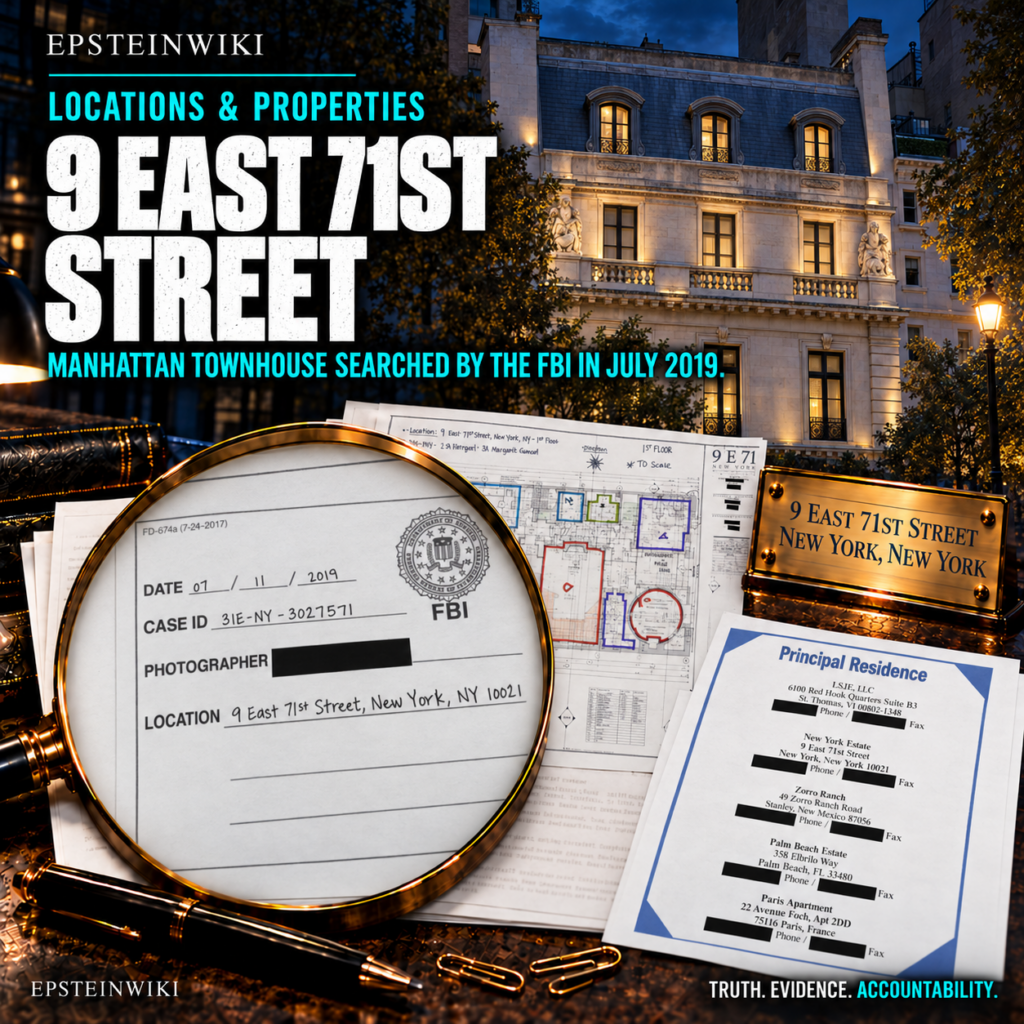
9 East 71st Street is a monumental limestone townhouse on Manhattan’s Upper East Side, between Fifth and Madison Avenues. Jeffrey Epstein occupied and controlled the residence from the 1990s until his arrest in July 2019. The property served as his New York home, office, social venue, household workplace, archive, and an alleged site of sexual abuse and trafficking.
The federal indictment returned in July 2019 identified the townhouse as Epstein’s “New York Residence.” Prosecutors alleged that between approximately 2002 and 2005, Epstein recruited and sexually abused numerous minor girls there through a system presented as paid massage work. The indictment said some victims were as young as fourteen and that employees helped schedule appointments.
The property is also connected to allegations outside the indictment period. In a 2019 civil complaint, a survivor using the protected pseudonym V.E. alleged that Epstein sexually abused her during two visits to the townhouse in 2001, when she was sixteen. Virginia Giuffre and other women have separately described abuse, coercive sexual activity, massage work, or disturbing encounters connected to the residence.
The Federal Bureau of Investigation searched the townhouse on July 6 and 7, 2019. Agents recovered massage tables, photographs, compact discs, computers, phones, storage media, sexual devices, cash, handcuffs, a whip, an Austrian passport bearing Epstein’s photograph, and blueprints for the residence. Prosecutors later described the seized photographs as a vast collection that included sexually suggestive images of nude young women and girls.
The property’s ownership history is unusually opaque. Leslie Wexner acquired it through Nine East 71st Street Corporation in 1989 and financed an extensive renovation. Epstein was occupying the mansion and publicly describing it as his by 1996, but the first later deed visible in New York City records was recorded in 2012. That deed transferred the property from Nine East 71st Street Corporation to Maple, Inc., a United States Virgin Islands corporation, for stated consideration of ten dollars. Epstein signed as president of the transferring corporation.
After Epstein’s death, the estate listed the townhouse for sale. Former Goldman Sachs executive Michael Daffey purchased it in 2021 for approximately $51 million. The sale proceeds helped fund the Epstein Victims’ Compensation Program. Daffey undertook a major renovation that removed much of Epstein’s interior design and equipment while retaining the historic exterior.
Key Takeaways
- 9 East 71st Street was Epstein’s principal Manhattan residence and one of the central locations named in the 2019 federal sex trafficking prosecution.
- The federal indictment alleged that Epstein recruited and sexually abused minor girls at the townhouse from approximately 2002 through 2005.
- The charged recruitment method involved paid massages that escalated into sexual contact. Employees allegedly contacted victims and scheduled appointments.
- V.E. separately alleged that she was sixteen when another minor brought her to the residence for a paid massage in 2001. Her case ended through the compensation program without a trial or merits ruling.
- Virginia Giuffre described a camera equipped massage room at the townhouse and alleged severe abuse there. Her accounts must be identified as survivor testimony rather than a judicial finding about every detail.
- The FBI search recovered several massage tables and a large quantity of photographs, compact discs, digital devices, sexual items, cash, and property records.
- A photograph, contact entry, calendar notation, visitor statement, or presence at the townhouse does not by itself prove participation in abuse or knowledge of criminal conduct.
- The evidence inventory documents physical and digital evidence but does not publicly disclose the full forensic results, identities of every person depicted, or final disposition of every item.
- The mansion had security and audiovisual systems. Public evidence supports surveillance concerns, but it does not establish the claim that every room recorded every visitor or that Epstein operated a proven intelligence blackmail system from the property.
- Leslie Wexner acquired the townhouse in 1989 and paid for an elaborate renovation. Epstein occupied it before a clear public deed showed title in an Epstein controlled Virgin Islands entity.
- The 2011 deed, recorded in 2012, stated consideration of ten dollars. That document does not establish that ten dollars was the total economic value exchanged over the entire history of the transfer.
- Official and reported estimates of the building’s floor area range from approximately 19,000 to 51,000 square feet because sources appear to use different measurement methods.
- The government sought forfeiture of the townhouse in the 2019 criminal case. Epstein’s death ended the prosecution before a forfeiture judgment was entered.
- The estate sold the property for approximately $51 million in 2021, far below the original $88 million asking price and below several 2019 government valuations.
- The sale produced money for the victim compensation program. It did not erase the building’s evidentiary or survivor history.
- The current residence has been extensively remodeled. The historic façade remains, but many Epstein era interiors and systems were removed or altered.
Property Profile Chart
| Field | Documented information |
|---|---|
| Address | 9 East 71st Street, New York, New York 10021 |
| Neighborhood | Upper East Side, Manhattan |
| Location | North side of East 71st Street between Fifth and Madison Avenues |
| Block and lot | Block 1386, Lot 10 |
| Historic name | Herbert N. Straus House |
| Exterior architect | Horace Trumbauer |
| Reported room count | Approximately 40 rooms |
| Reported stories | Seven stories in FBI testimony; nine levels in some published descriptions |
| Official search description | Nearly 19,000 square feet |
| Other published measurements | Approximately 21,000 to 51,000 square feet |
| Wexner acquisition | 1989 through Nine East 71st Street Corporation |
| Reported Wexner purchase price | $13.2 million |
| Epstein era title holder in 2019 | Maple, Inc. |
| 2011 deed consideration | $10 stated consideration |
| 2019 city assessed value | $55,931,000 |
| 2019 federal estimate | $77 million |
| 2019 broker price opinion | $81 million |
| 2021 sale price | Approximately $51 million |
| Current owner | Michael Daffey through the purchasing ownership structure |
Why the Townhouse Matters
The townhouse is one of the clearest places where survivor accounts, a federal indictment, property records, employee evidence, search warrants, seized objects, photographs, and civil litigation converge.
It was not simply a residence where Epstein happened to live. It was an organized environment with controlled entry, household employees, assistants, telephones, schedules, massage rooms, offices, guest spaces, computers, cameras, artwork, storage areas, and financial records. That environment allowed legitimate domestic and business activity to coexist with the conduct alleged by survivors and prosecutors.
The Manhattan location also undermines the idea that Epstein’s abuse depended entirely on a remote island or isolated ranch. The townhouse stood in one of the most visible and expensive residential blocks in New York City. Minors could enter through its enormous front doors while staff, contractors, neighbors, visitors, service providers, and professional advisers moved around the same institution like property.
Its significance is both physical and systemic. The building shows how wealth, privacy, corporate ownership, domestic labor, elite social access, and ordinary scheduling systems can combine to conceal abuse in the middle of a major city.
Location and Urban Context
The townhouse stands a short distance from Central Park and Fifth Avenue. The lot is approximately 50 feet wide and 102 feet deep. Its broad limestone façade and unusually tall entrance make it visually dominant among neighboring townhouses.
The location offered Epstein several advantages. It was close to financial institutions, museums, luxury hotels, private clubs, restaurants, medical offices, and the homes of wealthy associates. Cars could deliver visitors directly to the entrance. Staff could coordinate arrivals with little public visibility beyond the sidewalk.
Unlike Little Saint James, the property was not geographically isolated. Its privacy came from architecture, wealth, household control, and social deference. A visitor could be physically close to thousands of people while still being isolated inside a residence controlled by Epstein and his employees.
The building’s scale allowed different activities to occur at once. Business meetings, social visits, household work, massages, meals, office activity, storage, and private encounters could take place on different floors without every occupant seeing the others.
Construction Date and Architectural History
The building’s reported construction date varies by source. A United States Marshals Service worksheet lists 1910. Architectural histories connect the present mansion to Herbert N. Straus, who commissioned Horace Trumbauer in the early 1930s. The exterior was substantially completed around 1932, but Straus died in 1933 before the interior was finished.
The discrepancy may reflect tax records, an earlier structure or filing associated with the parcel, and the date of the Trumbauer mansion. A careful account should not flatten those records into one unquestioned year.
The Straus family later gave the property to a hospital. The Birch Wathen School purchased it in 1962 and used it as a school building for roughly twenty seven years. This institutional history helps explain the building’s size and capacity before its conversion into a single family residence.
The property is often described as Beaux Arts or French classical in appearance. Its architectural importance is tied principally to its limestone exterior and association with Trumbauer.
Leslie Wexner’s 1989 Acquisition
On September 6, 1989, the Birch Wathen School conveyed the property to Nine East 71st Street Corporation. A title record preserved as EFTA00020929 documents the conveyance and a New York State transfer tax of $52,800.
Contemporary reporting placed the price at approximately $13.2 million, then a record level for a Manhattan townhouse. Wexner, the retail billionaire behind The Limited and Victoria’s Secret, controlled the purchasing structure and financed a major conversion of the former school into a private residence.
The renovation included luxury finishes, custom woodwork, expensive art and furnishings, separate wine storage, security systems, and highly individualized rooms. Published accounts said the cost was at least comparable to the acquisition price.
Wexner did not make the townhouse his regular New York home. Epstein increasingly occupied and controlled it. The lack of a simple, contemporaneous public deed from Wexner personally to Epstein later became one of the most discussed mysteries in Epstein’s asset history.
The Wexner Renovation and Security Design
The renovation took years and was featured by Architectural Digest in 1995. Reports described rosewood doors and tables, Art Deco furnishings, Russian antiques, major artworks, wine rooms, communications equipment, and security cameras.
One reported feature was a concealed bathroom or refuge space beneath a stairway. Published descriptions said it had lead lining, closed circuit television screens, and a telephone. The existence of security architecture is relevant, but it should not be confused with proof of a criminal recording system.
The house’s design emphasized separation and control. Large reception areas could display status. Smaller rooms could host private meetings. Service routes and staff areas allowed employees to move without becoming part of the social scene. Security systems could monitor entrances and parts of the building.
These features were not inherently criminal. Their investigative importance lies in determining who controlled them, which rooms they covered, whether recordings were retained, and whether those systems intersected with survivor accounts.
Ownership and Control Chart
| Period | Title or control evidence | Entity or person | What is established | What remains uncertain |
|---|---|---|---|---|
| Early 1930s | Architectural history | Herbert N. Straus family | Straus commissioned the mansion | Relationship between tax dates and present structure |
| 1944 to 1962 | Reported institutional history | Hospital ownership | Straus family donated the residence | Complete deed and occupancy details |
| 1962 to 1989 | School history and deed chain | Birch Wathen School | Property used as a school | Full renovation history during school ownership |
| 1989 onward | EFTA00020929 | Nine East 71st Street Corporation | Corporation acquired the property in the Wexner era | Complete beneficial ownership by year |
| Mid 1990s | Epstein statements and reporting | Jeffrey Epstein in possession | Epstein occupied and represented the mansion as his | Exact date and consideration for beneficial control |
| 1998 reported | EFTA00076625 | NES, LLC | Reporting described an Epstein affiliated transfer | No corresponding New York deed was identified |
| 2011 deed, recorded 2012 | EFTA00022151 | Maple, Inc. | Deed transferred title for stated consideration of $10 | Broader economic agreement behind nominal deed |
| 2019 | Indictment and title work | Maple, Inc. | Maple held record title when Epstein was arrested | Complete beneficial ownership and financing records |
| 2021 onward | Sale reporting and deed records | Michael Daffey purchasing structure | Estate sold property for about $51 million | Private financing beyond public records |
Epstein’s Occupancy Before the Recorded Deed
Epstein was living at the townhouse by the mid 1990s. In a 1996 interview, he reportedly said the mansion was now his. Pilot Lawrence Visoski later testified that Epstein moved from a residence on East 69th Street to the East 71st Street townhouse in the early 1990s.
Legal title, beneficial ownership, possession, and practical control are not always the same. A person can occupy and control property owned by a corporation or trust. A corporation can also change beneficial owners without a new real estate deed if the title holding entity remains the same.
The public record reviewed for the original EpsteinWiki page did not reveal a conventional deed transferring the property directly from a Wexner named owner to Epstein during the 1990s. Reporting described an intermediate relationship involving NES, LLC, but the publicly identified New York deed appears years later.
This gap remains a financial and corporate question. It does not justify declaring that Wexner gave Epstein a mansion for one dollar, that no value was exchanged, or that the lack of a deed proves a specific criminal arrangement.
The 2011 Transfer to Maple, Inc.
The deed dated December 23, 2011 and recorded January 10, 2012 transferred the property from Nine East 71st Street Corporation to Maple, Inc. The official record appears in EFTA00022151.
The deed lists stated consideration of ten dollars. It identifies Maple as a United States Virgin Islands corporation and gives a St. Thomas address associated with Epstein’s business network. Jeffrey Epstein signed as president of Nine East 71st Street Corporation. The deed was returned to attorney Erika Kellerhals in the Virgin Islands.
News reporting said Epstein signed for both sides of the transaction. The deed page reviewed directly confirms his signature for the grantor. Any statement about his execution for the grantee should remain attributed to reporting unless a separate signature page is produced.
Nominal consideration is common in deeds involving related entities. The ten dollar figure is not reliable evidence of the property’s true market value, the complete financial arrangement, or all earlier transfers of beneficial ownership.
Epstein Affiliated Property Entities
Nine East 71st Street Corporation acquired the property in 1989 and remained central to the title chain. Epstein signed the 2011 deed as its president. V.E. later sued the corporation on a negligent security theory based on its alleged ownership during 2001.
NES, LLC appears in reporting and litigation as an Epstein affiliated entity connected to the property and household operations. V.E. alleged that an NES employee escorted her and another minor inside. NES disputed whether the complaint pleaded sufficient facts connecting it to the alleged abuse.
Maple, Inc. became the record title holder through the deed recorded in 2012. The 2019 federal indictment named the property as owned by Maple in its forfeiture allegations.
Financial Trust Company, Inc. did not appear as record owner in the 2019 forfeiture allegation, but V.E. alleged that it employed or supported Epstein and asserted negligent retention or supervision theories. The court never decided that claim on its merits.
These entities should not be treated as interchangeable. Ownership, payroll, staffing, administration, financing, and beneficial control are separate questions requiring separate records.
Physical Scale and Measurement Disputes
Federal search materials described the residence as nearly 19,000 square feet. The New York Times reported approximately 21,000 square feet. A Vanity Fair profile described nine floors and repeated a much larger figure of approximately 51,000 square feet.
The variation may reflect usable interior area, gross floor area, cellar and mechanical spaces, roof additions, interconnected levels, or journalistic repetition of Epstein’s own claims.
FBI grand jury testimony called it a seven story home. Other sources count as many as nine levels. A cellar, subcellar, mezzanine, penthouse, or roof structure can change the count without changing the basic building.
For evidentiary purposes, the search warrant description is the safest figure for the premises federal agents intended to search. The full city plans and alteration filings would be needed to reconcile every measurement.
Exterior and Interior Features
The townhouse has a massive limestone façade, tall arched openings, an upper balcony, and a roughly fifteen foot oak entrance door. During Epstein’s occupancy, a plaque near the entrance reportedly bore his initials. The sidewalk was heated to melt snow.
Published descriptions identify a two story reception room, multiple bedrooms, guest suites, offices, a computer room, dining rooms, a library or study, service areas, wine storage, and at least one massage room.
Grand jury testimony preserved in EFTA00008631 confirmed that the property included a room used for massages. The same testimony was later read during Maxwell proceedings in EFTA00008744.
Blueprints seized in 2019 were stamped as received in 2003. Their inclusion in the evidence list provides a potential way to compare room locations, circulation, cameras, and later renovations, but the complete public blueprint set has not been fully analyzed.
Decorative Objects and Social Signaling
The townhouse became notorious for unusual décor. Published accounts described framed artificial eyes, a large sculpture of a nude warrior, custom chess figures modeled on staff, a female figure suspended from a chandelier, leopard print furniture, a prison mural depicting Epstein, celebrity photographs, and theatrical rooms.
These objects communicated wealth, transgression, humor, power, and deliberate discomfort. Visitors described the interior as a curated extension of Epstein’s personality.
Décor is not proof of a crime. It can provide context about how Epstein constructed status and destabilized normal boundaries. A guest entering an overwhelming mansion filled with sexualized, surveillant, or bizarre imagery might understand that ordinary rules did not apply in the same way.
Investigators must distinguish between objects documented by the FBI, objects described by identified visitors, and details repeated through secondary reporting. Internet retellings often merge these categories.
Household Operations and Controlled Access
The townhouse required staff capable of managing entrances, phones, calendars, meals, cleaning, maintenance, technology, vehicles, luggage, guests, and massages.
The 2019 indictment alleged that a New York employee contacted victims by telephone and scheduled appointments. V.E.’s complaint alleged that an employee escorted two minors through the residence. Visoski testified that he visited to collect luggage and install audiovisual equipment.
These records show that employees could form the bridge between the street and Epstein’s private rooms. They do not establish that every employee knew a visitor’s age, understood what occurred behind a closed door, or participated in a crime.
The key questions are role specific. Who answered the phone? Who maintained the massage calendar? Who opened the door? Who escorted visitors? Who handled cash? Who cleaned the room? Who controlled cameras? Collective references to “the staff” can obscure those distinctions.
Survivor Evidence Overview Chart
| Survivor or source | Connection to townhouse | Evidence category | Important limitation |
|---|---|---|---|
| V.E. | Alleged two abusive encounters in 2001 when she was sixteen | Federal civil complaint and program record | Case ended without trial or merits ruling |
| Virginia Giuffre | Described abuse and a camera equipped massage room | Sworn testimony, litigation, interviews, and memoir | Details must be tied to exact source and date |
| Federal indictment victims | Prosecutors alleged numerous minors were recruited and abused there from about 2002 through 2005 | Grand jury indictment | Epstein died before trial |
| Anonymous and protected survivors | Other New York allegations appear in civil and investigative records | Complaints, interviews, and claims | Identities and records remain sealed or redacted |
| Household witnesses | Described visitors, staffing, rooms, and operations | FBI summaries and testimony | Recollection may be incomplete and does not prove every event |
V.E.’s Allegations
V.E. filed a federal civil action in August 2019 under a court protected pseudonym. Her First Amended Complaint, EFTA02846045, alleged that she was sixteen when another minor told her she could earn $300 by giving a massage to a man in Manhattan.
According to the complaint, the other minor brought V.E. to 9 East 71st Street in the fall of 2001. V.E. alleged that an employee escorted them inside and toward the massage area. She said the other minor entered first and that she was later sent into the room alone.
V.E. alleged that Epstein converted the supposed massage into sexual contact despite her discomfort. She said she was paid $300. The complaint alleged that she returned within days and experienced a second, more severe assault involving forcible sexual contact and penetration.
The complaint sought damages from Epstein’s estate and asserted separate negligence theories against Nine East 71st Street Corporation, Financial Trust Company, and NES. The defendants challenged most counts. The court did not rule on the merits because V.E. entered the compensation program and resolved her claims.
Her case was dismissed with prejudice in December 2020. That means the resolved claims could not be filed again. It does not mean a court found the allegations true or false.
The V.E. Corporate Liability Claims
V.E.’s lawsuit asked whether organizations surrounding a private residence could bear responsibility beyond Epstein’s personal acts.
She alleged that Nine East 71st Street Corporation failed to provide a reasonably safe property. She alleged that Financial Trust negligently retained or supervised Epstein. She alleged that NES personnel helped operate access, massage scheduling, payments, transportation, or household services.
The defendants argued that the pleading used group allegations and did not identify facts showing that each corporation knew an assault would occur. They also raised limitations and damages arguments.
The motion to dismiss was fully briefed but later denied administratively after the case was stayed. Administrative denial did not resolve the legal questions. No public discovery record established which entity employed each worker or what each organization knew.
The case remains evidence of a survivor’s allegations and legal theory, not a judicial finding of corporate negligence.
Virginia Giuffre and the Manhattan Residence
Virginia Giuffre described Epstein’s Manhattan residence in litigation, interviews, and her posthumously published memoir. Her accounts connected the house to sexual abuse, coercive control, massage work, travel, and Epstein’s wider network.
Giuffre described a dark massage space that she called the dungeon and said cameras were present. Reporting about her memoir described restraints and violent abuse at the townhouse while she was a teenager.
Her description is consistent with broader evidence that the house contained massage rooms, sexual items, surveillance technology, and a controlled household system. It is not interchangeable with the FBI inventory. The inventory confirms objects and devices, while Giuffre’s account describes how she experienced the environment.
Giuffre also alleged sexual encounters involving other men in Epstein’s network, including Prince Andrew. Andrew denied her allegations and settled her civil lawsuit without admitting liability. Presence at the Manhattan house must be analyzed separately from specific conduct she alleged.
Other Survivors and Protected Witnesses
The 2019 indictment did not publicly name the minor victims associated with the New York charges. Protecting those identities remains essential.
Civil cases, compensation materials, FBI records, and public survivor accounts indicate that the townhouse was connected to more people than can be responsibly named. Some were minors. Some were recruited by friends. Some were introduced through massage work, modeling, education, art, or employment opportunities.
The public record is incomplete because grand jury information is protected, compensation claims were confidential, many interview summaries are redacted, and survivors have different preferences about public identification.
An exhaustive property history should document the scale of the record without treating silence as absence. It should avoid crowdsourcing survivor identities from initials, dates, photographs, or contextual clues.
The 2019 Federal Indictment
The July 2019 federal indictment charged Epstein with sex trafficking conspiracy and sex trafficking of minors. It identified 9 East 71st Street as the New York Residence.
Prosecutors alleged that between approximately 2002 and 2005, Epstein abused numerous minor victims there by causing them to be recruited for paid sexual activity. The indictment said some victims were as young as fourteen.
The alleged pattern began with a massage. Victims were directed to undress partially or completely. Prosecutors alleged that Epstein escalated the contact into sexual acts and paid the girls afterward. Some victims were allegedly paid to recruit additional girls.
The indictment also alleged that employees and associates helped facilitate the scheme, including by contacting victims and scheduling appointments. It did not charge every employee or visitor.
Epstein pleaded not guilty. He died before trial. The indictment is an authoritative record of federal charges and allegations, not a conviction on those counts.
The Massage Recruitment System
The massage framework gave the household a repeatable method for bringing young women and girls into a private room while making the appointment appear ordinary.
The system reduced barriers. A recruiter could describe the work as simple, paid, and nonsexual. A friend’s participation could make the invitation seem safe. Staff could schedule a massage without openly discussing abuse. Cash payment could occur immediately. Referral money could encourage a victim to bring someone else.
Once inside, the power imbalance was severe. Epstein controlled the property, money, employees, doors, and future opportunities. A minor with no massage training might not know what professional boundaries should look like or how to challenge an adult billionaire in his own home.
The same basic recruitment architecture appeared in Palm Beach and New York. The local staff and individual survivors differed, but the alleged use of massage work as an entry point was consistent.
Payment, Scheduling, and Referral Evidence
The indictment alleged that victims were paid in cash after sexualized massage encounters. It also alleged that some received money for recruiting other girls.
V.E. said she was offered and later received $300. The FBI inventory recorded cash disbursement documents, notes, sealed envelopes of currency, employee contact information, and other records that could illuminate payment practices.
The existence of cash in a wealthy person’s home is not itself proof of trafficking. The question is whether denominations, envelopes, names, dates, calendars, messages, and witness accounts connect particular payments to particular appointments.
Scheduling evidence is contextual. A calendar entry may document presence but not what occurred. A telephone message may identify who arranged the appointment but not what that person knew. Strong findings require comparison across records.
Cameras, Audiovisual Systems, and Surveillance Claims
Multiple sources support the presence of security and audiovisual equipment at the townhouse. The Wexner era renovation reportedly included security cameras. Visoski testified that he installed audiovisual equipment. Giuffre described a camera in the massage room. The FBI seized computers, storage media, cameras, and electronics.
Those facts justify serious investigation into surveillance. They do not prove the broadest claims circulated online.
Publicly released evidence has not established that every bedroom or massage room was continuously recorded, that Epstein maintained a complete video archive of every prominent visitor, or that a government intelligence service directed a blackmail operation from the townhouse.
The most important unanswered questions concern camera placement, wiring diagrams, recording devices, storage duration, overwritten data, remote access, equipment installers, and forensic results. Blueprints and renovation records may help answer some of them.
Visitors, Photographs, and the Presence Problem
The townhouse hosted business contacts, friends, employees, scientists, politicians, royalty, attorneys, artists, models, contractors, and service workers. An FBI interview summary in EFTA00157613 reported that a household witness recalled prominent visitors including Donald Trump, Prince Andrew, Leslie Wexner, Alan Dershowitz, and Robert F. Kennedy Jr.
That witness summary documents what the interviewee reported. It does not establish the date, duration, purpose, or conduct of every visit. It also does not prove that every named person observed abuse.
Framed photographs create a similar problem. A signed photograph can show social signaling or a claimed relationship. It does not prove that the person entered the house. A photograph taken inside may show presence but not knowledge of activities elsewhere in the building.
Visitor evidence becomes stronger when records converge. Calendars, entry logs, driver records, emails, photographs, telephone messages, staff testimony, financial records, and the visitor’s own account can establish a more reliable timeline.
The July 2019 Arrest and Search
The FBI prepared an operations order preserved as EFTA00037984. It coordinated Epstein’s arrest after his aircraft returned to Teterboro Airport and execution of a search warrant at the Manhattan residence.
Agents searched 9 East 71st Street on July 6 and 7, 2019. The search occurred at the beginning of the new federal prosecution, while investigators sought evidence about victims, recruitment, sexual conduct, photographs, communications, finances, and potential coconspirators.
The warrant described the premises as a nearly 19,000 square foot multistory single family residence. Agents documented and removed a large volume of evidence from different parts of the building.
The search became central to the government’s bail argument. Prosecutors said the material found demonstrated dangerousness, access to wealth and false identification, and the existence of a large archive of sexually suggestive photographs.
What the Search Warrant Authorized
EFTA00021303 authorized seizure of massage tables, massage related items, representations of female torsos, nude or partially nude photographs in the massage room, sexual devices, and taxidermied dogs.
Other provisions covered records relating to victims, recruitment, communications, travel, payments, associates, and electronic storage. A later warrant in EFTA00020130 authorized examination of compact discs seized from the residence for images of victims and sexually explicit material.
The specificity indicates that investigators had information about the interior and expected evidence before entering. Supporting affidavits and witness information are therefore important for reconstructing how agents identified rooms and objects.
A warrant authorizes a search based on probable cause. It does not mean every listed object was found or that every seized item ultimately proved criminal conduct.
FBI Evidence Inventory Chart
| Evidence category | Examples recorded | Investigative value | Limitation |
|---|---|---|---|
| Massage equipment | Green, beige, and brown massage tables | Corroborates designated massage activity | Does not identify a specific survivor or event |
| Photographs | Framed nude images, albums, Polaroids, boxes and binders | May identify victims, associates, locations, or chronology | Context and age require forensic review |
| Compact discs | Discs labeled for girls, nudes, and photographs | May organize image collections or identify subjects | Labels alone do not establish contents or creator |
| Computers and storage | Computers, phones, tablets, drives, cards, and USB devices | Communications, files, metadata, and account evidence | Complete forensic results are not public |
| Sexual items | Handcuffs, whip, restraints, condoms, costumes, and devices | May corroborate survivor descriptions or room use | Possession alone does not prove a charged act |
| Cash and records | Currency envelopes, disbursements, notes, contacts, financial papers | May connect payments to appointments | Requires names, dates, and accounting context |
| Identification | Austrian passport bearing Epstein’s photograph | Relevant to identity, travel, and flight risk | Issuance and intended use remain incompletely explained |
| Property records | Blueprints stamped received in 2003 | Can map rooms, access, equipment, and renovations | Complete plans are not fully public |
Photographs, Binders, and Compact Discs
The evidence list recorded ten black binders containing photographs and compact discs, a box of older women’s photographs, framed nude images, photo albums, negatives, Polaroids, and numerous labeled discs.
The government’s detention filing described hundreds or possibly thousands of sexually suggestive photographs of nude young women and girls. Prosecutors referred to photographic trophies and cited disc labels that appeared to identify young subjects or categories of nude images.
This is among the strongest physical evidence connected to the townhouse. It also requires disciplined language. The government’s characterization was made during contested bail proceedings. A complete public forensic catalog identifying ages, subjects, dates, creators, and legality of every image has not been released.
Images of survivors should not be republished merely because they appear in an evidence release. Redaction failures do not eliminate privacy obligations.
Computers, Phones, and Digital Storage
The inventory included desktop computers, laptops, iPads, iPhones, cameras, recorders, hard drives, USB devices, memory cards, compact discs, and other electronic media.
Potential evidence includes email, contacts, calendars, photographs, videos, metadata, backups, internet history, messaging accounts, financial records, visitor information, and connections to remote servers.
The public inventory is not a forensic report. It shows that devices were seized, not what examiners recovered from each device. Some devices may have been encrypted, obsolete, empty, duplicated, damaged, or unrelated to charged conduct.
An exhaustive investigation should seek extraction reports, evidence numbers, chain of custody records, search protocols, privilege review logs, and derivative investigative leads.
Sexual Items, Restraints, and Massage Tables
The inventory recorded a whip, copper handcuffs, cuffs, a leash, costumes, a wig, sexual devices, condoms, and multiple massage tables.
These objects matter because survivor accounts described sexualized massages, coercive acts, restraints, or themed encounters. Physical items can corroborate that certain tools or environments existed.
They do not automatically prove which person used an object, when it was used, whether it was used consensually in another context, or whether it was connected to a charged offense.
The strongest analysis compares object location, biological evidence, photographs, purchase records, fingerprints, witness testimony, and room documentation. The released inventory does not answer all of those questions.
Cash, Disbursements, and Household Records
Agents recorded cash stored in envelopes, including envelopes with initials and dates. They also seized cash disbursement papers, handwritten notes, employee contact information, financial documents, and a day planner.
These materials may be important because the alleged recruitment system used immediate cash payments. A disbursement record can connect household administration to massage appointments if it contains matching names, dates, amounts, or instructions.
The public evidence list does not supply that full analysis. Initials may refer to employees, guests, expenses, or people unrelated to abuse. Dates may mark storage rather than payment.
The unresolved question is whether prosecutors created a unified ledger linking appointments, telephone contacts, cash withdrawals, payments, recruiters, transportation, and image evidence.
The Austrian Passport
Agents found an Austrian passport bearing Epstein’s photograph. Prosecutors raised the document at the detention hearing as evidence relevant to flight risk.
Court reporting described it as issued in the 1980s under another name and listing a residence in Saudi Arabia. Defense counsel characterized it as an old document acquired for personal protection during foreign travel.
Its presence does not prove it was valid in 2019 or recently used. Its significance depends on authenticity, issue records, expiration, visas, stamps, correspondence, and evidence of intended use.
It mattered to bail because Epstein had extraordinary wealth, international transportation, multiple residences, and the ability to leave the United States.
Blueprints and Room Reconstruction
The federal evidence list recorded blueprints for 9 East 71st Street stamped received in 2003. The date falls within the period charged in the indictment.
Blueprints can help identify massage rooms, bedrooms, offices, staff areas, stairs, elevators, concealed spaces, camera wiring, equipment rooms, storage, and paths through the house.
They can also distinguish between credible room descriptions and internet fiction. If a survivor recalled a route, investigators could compare that memory with the plan in effect at the time.
Later renovations complicate the record. Wexner era plans, Epstein era changes, 2003 blueprints, 2019 scene photographs, and post sale construction documents should be treated as separate architectural layers.
Chain of Custody and Evidence Limits
The evidence list provides categories and evidence numbers, but it is not a substitute for full chain of custody documentation.
For every important item, investigators need to know the room and exact location where it was found, the agent who collected it, packaging, transfer history, forensic testing, copies created, search authority, and final disposition.
This is especially important for photographs and digital media. Files can be duplicated across devices. A disc label may have been written by someone other than the person who created its contents. A computer may have had several users.
Epstein’s death changed the litigation path. The government did not present the townhouse evidence at his trial, and defense counsel did not test it before a jury. Some evidence later appeared in the Maxwell investigation, civil litigation, and public releases, but the record remains fragmented.
Grand Jury and Maxwell Trial Evidence
An FBI agent testified before a federal grand jury in June 2020 about Epstein’s properties. EFTA00008631 described the Manhattan property as a seven story home near Central Park and reportedly the largest private residence in Manhattan. The agent confirmed that it contained a massage room.
The substance of that testimony was later read in Maxwell related proceedings recorded in EFTA00008744.
Pilot Lawrence Visoski also testified about visiting the property, collecting luggage, recognizing the exterior, and installing audiovisual equipment. His testimony helps establish Epstein’s occupancy and household technology but does not answer who controlled recordings or what every device captured.
Evidence from the Maxwell case should be tied to the specific witness and purpose for which it was admitted. A fact introduced to establish a property detail does not automatically prove every allegation connected to that location.
Bail, Valuation, and Forfeiture
At Epstein’s July 2019 bail proceedings, defense materials listed a city assessed value of $55,931,000. The United States Attorney’s Office estimated the property at approximately $77 million.
The government cited the townhouse as evidence of enormous wealth, access to resources, and ability to flee. It also relied on the search results, passport, cash, photographs, and other evidence when arguing that Epstein posed a danger and flight risk. The court denied bail.
The indictment sought forfeiture of the land, building, improvements, fixtures, and related interests. Records in EFTA00030126, EFTA00031555, and EFTA00040006 document the government’s claim.
A Marshals Service worksheet in EFTA00031559 recorded an $81 million broker opinion and estimated net equity of approximately $77.55 million. Epstein died before judgment, so the criminal forfeiture did not produce a final order against the townhouse.
Valuation and Sale Comparison Chart
| Date | Measure | Amount | Meaning |
|---|---|---|---|
| 1989 | Reported purchase price | $13.2 million | Wexner era acquisition |
| June 2019 | City assessed value | $55.931 million | Tax assessment, not necessarily market price |
| July 2019 | Federal estimate | $77 million | Prosecutorial estimate used in bail context |
| August 2019 | Broker price opinion | $81 million | Pre seizure market opinion |
| 2020 | Original asking price | $88 million | Estate listing price |
| 2021 | Reported sale price | Approximately $51 million | Actual estate transaction |
Estate Administration and Victim Compensation
After Epstein died, Darren Indyke and Richard Kahn administered the estate as coexecutors. The townhouse was one of its largest identifiable assets.
The Epstein Victims’ Compensation Program created a confidential process through which eligible survivors could present claims. The program required reliable funding from estate assets.
By early 2021, the program temporarily paused payments because the estate reported liquidity problems. The townhouse sale generated approximately $51 million and allowed additional funding to move into the program.
The fact that sale proceeds funded compensation is documented. Individual amounts paid to most claimants, their submissions, and the administrator’s reasoning remain confidential.
Compensation was not a substitute for a criminal trial. It provided monetary resolution while leaving many questions about facilitators, institutions, evidence, and accountability unanswered.
V.E. and the Compensation Program
V.E. elected to participate in the compensation program while her federal case was pending. Status reports show that she submitted a claim, received an award amount, considered it, and ultimately resolved her claims.
The parties filed a stipulation of dismissal in December 2020. The court dismissed the case with prejudice.
The public docket does not disclose V.E.’s award, supporting materials, administrator findings, or release terms. It is inaccurate to claim that the program publicly verified every allegation or rejected any part of her account.
Her litigation preserves a detailed allegation from 2001, identifies the property and corporate defendants, and illustrates how a minor could allegedly be brought through the front door under the pretext of massage work.
The 2021 Sale and Later Renovation
The estate initially listed the townhouse for $88 million. It sold in March 2021 for approximately $51 million to former Goldman Sachs executive Michael Daffey.
The sale price was lower than the asking price, the 2019 federal estimate, and the Marshals Service broker opinion. The property’s stigma, renovation needs, market conditions, and estate liquidity may all have affected the transaction.
The new owner undertook a substantial renovation. Later reporting described removal of Epstein era finishes, furnishings, surveillance equipment, and distinctive decorative elements. Mechanical, electrical, security, and interior systems were modernized.
By 2025, real estate coverage reported that the alterations were substantially complete. The historic limestone façade remained, while the inside was redesigned for contemporary residential use. The current owner is not implicated by the property’s prior criminal history merely by purchasing or renovating it.
Timeline Chart
| Date | Event | Evidence or source |
|---|---|---|
| Early 1930s | Herbert N. Straus commissions Horace Trumbauer | Architectural histories |
| 1944 | Straus family transfers property to a hospital | Historical reporting |
| 1962 | Birch Wathen School acquires building | Property history |
| September 1989 | Nine East 71st Street Corporation acquires property | EFTA00020929 |
| 1989 to 1995 | Wexner era conversion and renovation | Contemporary reporting |
| Mid 1990s | Epstein occupies and publicly claims residence | Interviews and witness accounts |
| Fall 2001 | V.E. alleged two abusive encounters at age sixteen | EFTA02846045 |
| 2002 to 2005 | Federal indictment period for alleged abuse of minors | Federal indictment |
| December 2011 | Corporation executes deed to Maple, Inc. | EFTA00022151 |
| January 2012 | Deed is recorded | EFTA00022151 |
| July 2, 2019 | Federal indictment is returned | Federal indictment |
| July 6 and 7, 2019 | FBI searches townhouse | EFTA00037984 |
| July 2019 | Government files notice of pendency and argues for detention | EFTA00030126 |
| August 10, 2019 | Epstein dies in federal custody | Federal record |
| August 14, 2019 | V.E. files civil lawsuit | EFTA02845999 |
| December 2020 | V.E.’s case ends after program resolution | EFTA02846453 and EFTA02846454 |
| March 2021 | Estate sells townhouse for about $51 million | Sale reporting |
| 2021 to 2025 | New owner undertakes extensive renovation | Property reporting |
Myths, Errors, and Unsupported Claims Chart
| Claim | Assessment | Reason |
|---|---|---|
| Wexner personally deeded mansion to Epstein for one dollar | Unsupported simplification | Reviewed deed states ten dollars and involves corporations |
| House was exactly 51,000 square feet | Disputed | Official and published measurements vary |
| Every room was secretly recorded | Not established | Equipment existed, but complete coverage has not been proved |
| Every famous visitor participated in abuse | False reasoning | Presence does not establish conduct or knowledge |
| FBI found no evidence in the house | False | Federal inventory records extensive evidence |
| Every seized photograph depicted a minor | Not established | Complete public age analysis does not exist |
| Townhouse was criminally forfeited | False | Epstein died before final forfeiture judgment |
| Current owner demolished entire mansion | Misleading | Interior changed extensively, but historic façade remained |
| Full digital forensic results are public | False | Releases identify devices and selected evidence, not every extraction |
Evidence Strength Chart
| Claim | Evidence strength | Basis |
|---|---|---|
| Epstein occupied and controlled townhouse | Very strong | Deeds, testimony, searches, photographs, and records |
| Residence contained massage rooms and equipment | Very strong | Testimony, warrants, inventory, and photographs |
| Prosecutors alleged abuse of minors there | Conclusive as to allegation | Official indictment |
| V.E. alleged abuse there in 2001 at age sixteen | Very strong as to allegation | Filed complaint and docket |
| FBI seized photographs, discs, devices, cash, and sexual items | Very strong | Federal inventory |
| Employees helped schedule massages | Strong as charged allegation | Indictment and operations materials |
| Wexner entity acquired property in 1989 | Very strong | Deed and title record |
| Epstein paid fair market value for control | Unknown | Complete economic transfer record is not public |
| Every camera served a blackmail system | Unsupported | No complete public proof |
| Every prominent visitor knew of abuse | Unsupported as group claim | Knowledge must be established person by person |
| Sale helped fund survivor compensation | Strong | Estate, program, and sale reporting |
What the Evidence Establishes
- Epstein lived at and controlled 9 East 71st Street for many years.
- The townhouse contained at least one massage room and multiple massage tables.
- Federal prosecutors identified the residence as a location where minors were allegedly recruited and sexually abused.
- The alleged method used paid massages, escalation into sexual contact, cash payments, and referrals.
- Employees performed access, scheduling, communications, transportation, household, and technology functions.
- V.E. publicly filed a protected civil complaint alleging two abusive encounters there when she was sixteen.
- The FBI recovered a large quantity of photographs, discs, digital devices, cash, records, sexual items, and property materials.
- Record title moved through corporations associated first with Wexner and later with Epstein.
- The government sought forfeiture and valued the property as a major Epstein asset.
- The estate sold the townhouse and used proceeds to support the compensation program.
What the Evidence Does Not Establish
- It does not prove that every employee knew about or facilitated abuse.
- It does not prove that every visitor witnessed criminal conduct.
- It does not prove that every photograph or disc contained illegal material.
- It does not disclose the full forensic findings from every seized device.
- It does not establish the exact economic terms through which Epstein gained beneficial control.
- It does not establish that the nominal ten dollar deed represented the property’s true value.
- It does not prove that every room was wired for covert recording.
- It does not prove a specific intelligence directed blackmail operation.
- It does not convert the 2019 indictment into a conviction because Epstein died before trial.
- It does not convert civil settlements or compensation awards into judicial findings.
Survivor Centered Evidence Assessment
The townhouse should not be remembered primarily for bizarre décor or celebrity photographs. Its central meaning comes from survivors who described entering a mansion controlled by an older, extraordinarily wealthy man and being subjected to sexual conduct under the pretext of paid work.
Architecture mattered because it structured power. Employees controlled doors and schedules. Epstein controlled money and private rooms. A minor could be brought into a celebrated mansion, paid in cash, and sent back into the city without surrounding institutions stopping the pattern.
Survivor accounts should be quoted only to the level needed to understand the system. Graphic repetition can turn evidence into spectacle. Images and identifying information require special protection even when a government release fails to redact them properly.
The record also shows why criminal prosecution alone was inadequate. Epstein died before trial. The compensation program offered financial resolution, but it did not publicly answer who enabled the household, who ignored warning signs, or what the seized archives revealed.
Investigative Significance
9 East 71st Street offers a rare opportunity to study Epstein’s system at the intersection of property, corporate control, domestic staffing, social access, financial administration, technology, and sexual exploitation.
The most productive next step is not another celebrity list. It is a joined evidence model connecting property plans, staff roles, appointment records, telephone contacts, cash disbursements, visitor data, photographs, device extractions, and survivor timelines.
The ownership gap deserves continued financial investigation. Determining when Epstein gained beneficial control, what value was exchanged, and which advisers documented the transaction could clarify the Wexner relationship and Epstein’s accumulation of wealth.
The house is also a case study in lost physical context. Once the interior was renovated, federal scene photography, blueprints, permits, and seized records became even more important to preserve.
Questions for Further Investigation
- When did Epstein first obtain legal, beneficial, or practical control of the townhouse?
- What agreements existed between Wexner, Nine East 71st Street Corporation, NES, Maple, and Epstein?
- Was any market value consideration paid before the nominal 2011 deed?
- Who were the shareholders, directors, officers, and beneficial owners of each entity by year?
- Which entity paid taxes, utilities, insurance, security, renovations, and household expenses?
- Which entity employed each townhouse worker during periods alleged by survivors?
- Who answered telephones and maintained massage schedules?
- Who opened the door for minors and escorted them to massage rooms?
- Who prepared cash envelopes and recorded massage payments?
- Were recruiters paid through cash, checks, wires, gifts, or other methods?
- What appointment books, telephone logs, and calendars survive from 1994 through 2019?
- Can V.E.’s alleged 2001 visits be matched to schedules, messages, or cash records?
- What evidence did V.E. submit to the compensation program?
- Which other protected survivors identified the townhouse as an abuse location?
- How many alleged victims were connected specifically to the New York Residence?
- How many were minors at their first visit?
- Which recruiters were themselves minors or survivors?
- Which staff members knew visitors’ ages?
- How many massage rooms existed at different times?
- Where were the seized massage tables found?
- Do the 2003 blueprints identify rooms described by survivors?
- Where were cameras installed during the Wexner renovation?
- Who installed later audiovisual systems?
- Which cameras recorded locally, remotely, or not at all?
- Were any systems connected to offsite servers?
- What surveillance media were recovered?
- Did examiners recover deleted recordings?
- What did investigators find on each seized device?
- Which devices were associated with Epstein, employees, guests, or household systems?
- How many seized images depicted identified survivors?
- How many images were determined to depict minors?
- Who created, labeled, organized, and accessed the compact disc archive?
- Were photo binders cross referenced with contacts, calendars, or payments?
- Were victims notified about images depicting them?
- What chain of custody records exist for photographs and devices?
- Was biological evidence collected from massage rooms or restraints?
- What was the origin and travel history of the Austrian passport?
- Was the passport authentic, valid, expired, or altered?
- Which visitors are documented by more than one independent source?
- Which visitor claims rest only on one witness’s memory?
- Did visitor logs or security records survive?
- What did employees tell the FBI about minors, cameras, and payments?
- Which interview summaries remain sealed or heavily redacted?
- What townhouse evidence was used in the Maxwell investigation?
- What evidence was never introduced at trial?
- Why did floor area figures differ so dramatically?
- What alterations were filed between 1989 and 2019?
- What physical features were removed after 2021?
- Were renovation materials examined for concealed equipment or storage?
- Did agents preserve a complete photographic record of every room?
- What assets from the house were sold, destroyed, returned, or retained?
- How much of the sale price ultimately reached survivor compensation?
- What expenses, liens, taxes, and commissions were deducted first?
- Which institutional failures allowed the alleged system to operate for years?
Related EpsteinWiki Pages
- Jeffrey Epstein
- V.E. v. Nine East 71st Street Corp.
- United States v. Epstein, Southern District of New York 2019
- Virginia Roberts Giuffre
- Ghislaine Maxwell
- Leslie Wexner
- Darren Indyke
- Richard Kahn
- Little Saint James
- Great Saint James
- Paris Apartment
- Zorro Ranch
- Epstein Victims’ Compensation Program
- Jeffrey Epstein Litigation Index
Evidence Index
| Evidence record | Description |
|---|---|
| EFTA00008631 | FBI grand jury testimony describing residence and massage room |
| EFTA00008744 | Maxwell proceeding readback concerning property and massage room |
| EFTA00015838 | Estate and trust administration record |
| EFTA00018778 | Virgin Islands complaint listing New York property as estate asset |
| EFTA00020130 | Warrant concerning compact discs seized from townhouse |
| EFTA00020929 | Title and deed record for Block 1386, Lot 10 |
| EFTA00021252 | Indictment version containing property forfeiture allegation |
| EFTA00021303 | Warrant attachment listing specific seizure categories |
| EFTA00022151 | 2011 deed from Nine East 71st Street Corporation to Maple, Inc. |
| EFTA00022654 | Background record listing property corporation among Epstein associations |
| EFTA00028388 | Search warrant description of premises |
| EFTA00030126 | Lien search and notice of pendency record |
| EFTA00031555 | Notice of pendency for forfeiture claim |
| EFTA00031559 | Marshals Service net equity worksheet |
| EFTA00037984 | FBI operations order for arrest and search |
| EFTA00040006 | Forfeiture notice materials |
| EFTA00066191 | Federal opinion discussing assets and forfeiture |
| EFTA00076625 | News materials concerning ownership, value, and reported NES transfer |
| EFTA00076657 | News materials concerning description, Wexner acquisition, and renovation |
| EFTA00128820 | Background summary referring to Manhattan townhouse |
| EFTA00157613 | FBI witness interview summary concerning visitors and observations |
| EFTA02845999 | V.E. original civil complaint |
| EFTA02846045 | V.E. First Amended Complaint |
| EFTA02846083 | V.E. motion to proceed anonymously |
| EFTA02846195 | Defendants’ motion to dismiss |
| EFTA02846246 | Memorandum supporting dismissal |
| EFTA02846267 | Anonymity order and nondisclosure protections |
| EFTA02846274 | V.E. opposition to dismissal |
| EFTA02846294 | Defendants’ dismissal reply |
| EFTA02846443 | Order staying V.E.’s case for program participation |
| EFTA02846452 | Status report confirming V.E. received award amount |
| EFTA02846453 | Joint stipulation of dismissal |
| EFTA02846454 | Court ordered dismissal with prejudice |
Sources
- United States Department of Justice, 2019 indictment of Jeffrey Epstein
- United States Department of Justice, evidence list
- CourtListener docket for V.E. v. Nine East 71st Street Corp.
- V.E. First Amended Complaint, EFTA02846045
- FBI operations order, EFTA00037984
- Townhouse search warrant, EFTA00028388
- Compact disc warrant, EFTA00020130
- Specific seizure categories, EFTA00021303
- 1989 title record, EFTA00020929
- 2011 deed to Maple, Inc., EFTA00022151
- Marshals Service property worksheet, EFTA00031559
- FBI grand jury testimony, EFTA00008631
- Maxwell proceeding testimony, EFTA00008744
- Virgin Islands estate complaint, EFTA00018778
- ABC News, 2021 townhouse sale and compensation funding
- The Real Deal, renovation of the former Epstein townhouse
- New York City property deed and record guidance
- New York Magazine, interior history of the townhouse
- Reuters, Maxwell deposition concerning massages and Epstein’s New York home
- Federal witness interview summary, EFTA00157613