
Enhanced Education
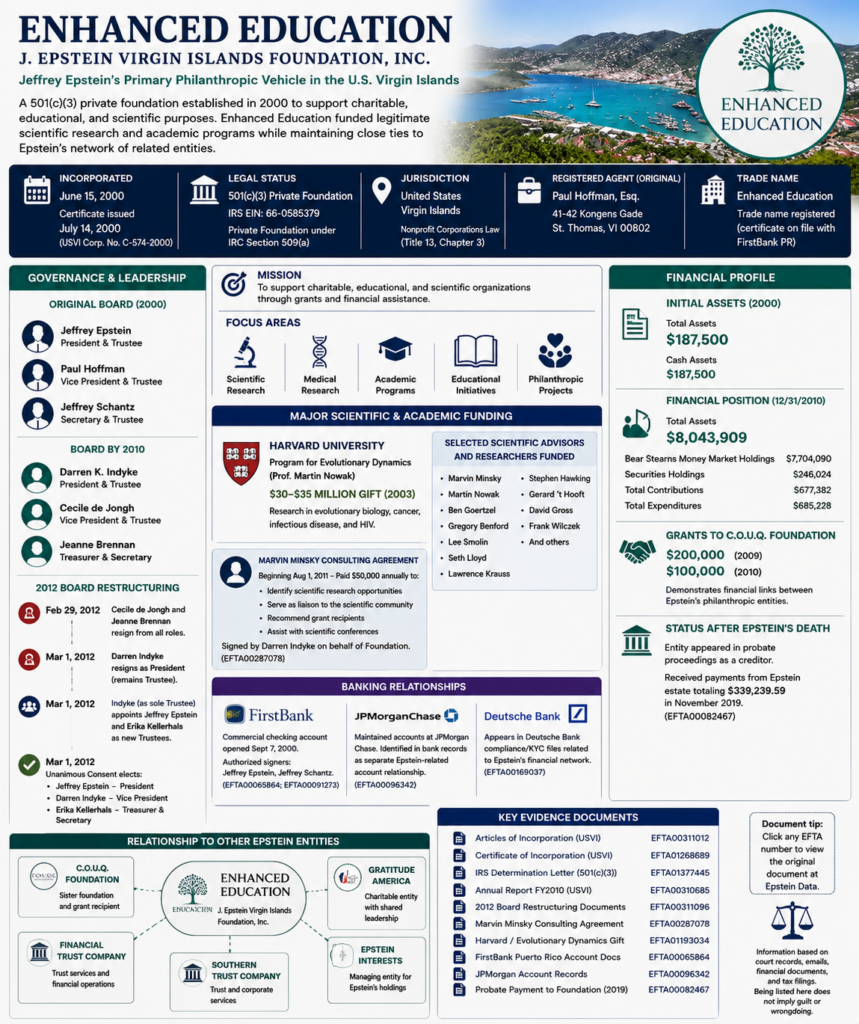
Snapshot
- Legal name: J. Epstein Virgin Islands Foundation, Inc.
- Trade name: Enhanced Education
- Other public references: Jeffrey Epstein VI Foundation, J. Epstein VI Foundation, Epstein VI Foundation
- Entity type: United States Virgin Islands nonprofit corporation and private foundation
- Federal tax identification number: 66-0585379
- Founded: June 2000
- Registered address: 6100 Red Hook Quarter, Suite B-3, St. Thomas, United States Virgin Islands 00802
- Founder and controlling figure: Jeffrey Epstein
- Documented officers across different periods: Jeffrey Epstein, Darren K. Indyke, Cecile R. de Jongh, Jeanne Brennan-Wiebracht, Richard Kahn, and Erika Kellerhals
- Stated purpose: Educational, scientific, and charitable grantmaking
- Documented functions: Donations, research funding, consulting agreements, institutional sponsorship, bank and brokerage accounts, and payments questioned in later litigation
- Network role: Epstein controlled philanthropic, financial, and reputation building vehicle
- EpsteinWiki involvement level: Level 5. Enhanced Education was an Epstein owned and controlled institutional vehicle that operated within his core financial and reputational infrastructure.
- Legal status: Public sources describe the foundation as defunct after Epstein’s death, but its exact corporate dissolution and final tax status require confirmation from complete Virgin Islands and IRS records.
- Article status: Organization profile and financial evidence investigation
- Fact checked through: September 8, 2026
Overview
Enhanced Education was the trade name used by the J. Epstein Virgin Islands Foundation, Inc., a private foundation created and controlled by Jeffrey Epstein. It was incorporated in the United States Virgin Islands in June 2000 and used the tax identification number 66-0585379.
The organization publicly presented itself as a source of support for science, education, artificial intelligence, academic conferences, environmental work, arts organizations, scholarships, and charitable initiatives. It funded or proposed funding for researchers and institutions including Harvard University’s Program for Evolutionary Dynamics, the Massachusetts Institute of Technology, Arizona State University’s Origins Project, the American Foundation for the University of British Columbia, WildAid, the Tribeca Film Institute, and the Barbro Ehnbom Fund.
That charitable activity was real in the limited sense that identifiable payments reached legitimate recipients. It was also part of a larger system through which Epstein pursued access, prestige, institutional legitimacy, and relationships with scientists, university leaders, donors, and public figures after his 2008 sex offense conviction.
The organization’s role was not confined to ordinary charitable grants. Bank documents show millions of dollars held in its accounts and identify Epstein and members of his professional staff as officers or signatories. The Government of the United States Virgin Islands later alleged that foundation money was used for payments to young women, an immigration lawyer involved in a marriage arrangement, private parties with no clear charitable connection, and a $160,000 environmental penalty connected to construction on Great St. James. Those are civil allegations, not criminal convictions or findings against every person named in the records.
Enhanced Education should therefore be understood as both a philanthropic entity and a component of Epstein’s core financial infrastructure. Its history illustrates how formally charitable organizations can serve several functions at once: making legitimate grants, building reputation, opening elite networks, holding financial assets, and creating a respectable institutional label for transactions that require closer scrutiny.
Legal Identity and Naming
The legal entity was the J. Epstein Virgin Islands Foundation, Inc. “Enhanced Education” was a trade name or doing business as designation, not a separate charitable organization.
This distinction matters because the names appear inconsistently across bank records, grant correspondence, institutional databases, media reports, and Epstein controlled websites. A researcher who searches only “Enhanced Education” will miss records filed under the legal name. A researcher who searches only the legal name will miss donations and correspondence recorded under the trade name.
Common references include:
- J. Epstein Virgin Islands Foundation, Inc.
- J Epstein Virgin Islands Foundation Inc
- Jeffrey Epstein VI Foundation
- J. Epstein VI Foundation
- Epstein VI Foundation
- Enhanced Education
- Enhanced Education Foundation
The evidence does not support treating all Epstein charities as the same legal entity. Enhanced Education must be distinguished from C.O.U.Q. Foundation, Gratitude America Ltd., Epstein Interests, the Florida Science Foundation, and other Epstein connected organizations. Staff sometimes moved between entities or used similar addresses, but each entity requires its own records and transaction history.
Formation and Tax Status
Court records state that the foundation was formed in June 2000 and registered in the Virgin Islands. A FirstBank response to a federal grand jury subpoena identifies a commercial checking account for the J. Epstein Virgin Islands Foundation trading as Enhanced Education, opened on September 7, 2000.
The organization was described in corporate and banking records as a tax exempt private foundation under section 501(c)(3) of the Internal Revenue Code. Public access to its tax filings was unusually limited. In 2015, Reuters reported that the most recent tax return it could locate was from 2002. ProPublica’s Nonprofit Explorer contains data for the same employer identification number but warns that the organization does not appear in the IRS’s most recent list of tax exempt organizations.
Deutsche Bank personnel confronted the same problem in 2018. An internal review found an IRS determination letter but could not confirm current status through the IRS or obtain a satisfactory certificate of status. A bank employee wrote that the absence could mean the entity was no longer tax exempt or active and asked for additional documentation.
That correspondence establishes uncertainty inside the bank’s own due diligence process. It does not by itself prove that the foundation had lost exemption or was legally inactive. A definitive conclusion requires the complete IRS account transcript, revocation history, Virgin Islands corporate file, and final dissolution records.
Address and Administrative Base
Corporate reports and bank records list the foundation at 6100 Red Hook Quarter, Suite B-3, St. Thomas, United States Virgin Islands. That address also appears in records for other Epstein controlled businesses and organizations.
The shared address supports the conclusion that Enhanced Education was administered within Epstein’s broader Virgin Islands office structure. It does not establish that every organization using that address was legally identical or that every employee at the location participated in all foundation decisions.
Epstein’s lawyers, accountants, assistants, and Virgin Islands office personnel appear in the organization’s records. The available evidence indicates that the foundation did not operate as an independent institution with a public staff, grant committee, or governance system separate from Epstein’s personal network.
Ownership, Control, and Officers
Officer titles changed across documents and years. The records collectively show that Epstein controlled the foundation while legal, accounting, and administrative professionals handled formal functions.
Documented roles include:
- Jeffrey Epstein: Founder, president, controlling figure, and authorized signatory in multiple records
- Darren K. Indyke: President or vice president, director, and bank signatory depending on the date and document
- Cecile R. de Jongh: Vice president in earlier records; resignation effective February 29, 2012
- Jeanne Brennan-Wiebracht: Secretary and treasurer in entity schedules and corporate reports; a separate resignation record appears in the released files
- Richard Kahn: Treasurer in some internal entity schedules and Epstein’s principal accountant and financial administrator
- Erika Kellerhals: Treasurer and secretary in later Deutsche Bank due diligence records
The variation does not necessarily indicate error. Corporate officers can change, and informal internal spreadsheets can lag behind formal filings. Researchers should record the date, document type, and exact title rather than merging every role into one permanent board list.
There is no public evidence that Enhanced Education maintained an independent board capable of overruling Epstein. The organization’s grant decisions, bank relationships, public claims, and correspondence repeatedly lead back to Epstein or his core staff.
Financial Scale
Internal entity schedules show that Enhanced Education held substantial cash:
- One internal schedule listed approximately $6.94 million.
- A later schedule listed approximately $6.74 million.
- A JPMorgan account summary listed approximately $3,016,809 in cash.
These figures appear to come from different dates and should not be added together. They are snapshots, not a cumulative total.
The foundation also maintained bank and brokerage relationships. Records identify accounts at FirstBank, JPMorgan, and Deutsche Bank or its securities affiliate. The full movement of assets between those institutions has not been reconstructed publicly.
The financial scale is important because public reporting long struggled to determine how much the foundation donated. A large cash balance does not tell researchers how much was granted, invested, transferred, or used for noncharitable purposes. A complete analysis requires annual statements, general ledgers, canceled checks, wire records, investment statements, grant files, tax returns, and final liquidation accounting.
Public Mission and Actual Operating Model
Enhanced Education presented itself as a supporter of science and education. Its visible activities included grants, research sponsorships, consulting contracts, conferences, charitable gifts, and connections between researchers and other funders.
The documented operating model was highly personalized. Epstein selected researchers, discussed projects directly, approved payments, hosted scientists, cultivated donors, and used his staff to issue checks and prepare agreements. This gave him influence disproportionate to the amount of any single grant.
The foundation offered at least five forms of value:
- Money for research, travel, conferences, scholarships, and charitable programs
- Introductions to wealthy donors and foundations
- Access to Epstein’s properties and social network
- Public association with scientific and educational work
- A formal charitable label through which payments could be made
Some recipients dealt with Enhanced Education without knowing that it was controlled by Epstein. Others knew Epstein personally or communicated with him directly. Those circumstances must be evaluated recipient by recipient. Receipt of a grant does not establish awareness of abuse, participation in trafficking, or any criminal conduct.
Harvard and the Program for Evolutionary Dynamics
The foundation’s largest and most consequential academic relationship concerned Harvard University’s Program for Evolutionary Dynamics, directed by Martin Nowak.
In 2003, Epstein gave Harvard $6.5 million to establish and support the program. Contemporary publicity sometimes described a much larger pledge, often $30 million. Harvard’s 2020 review concluded that the university received $6.5 million for the program, not the full publicized amount. Harvard reported total gifts connected to Epstein of $9.179 million before the university stopped accepting money from him after his conviction.
After the original funds were spent, Epstein continued to involve himself in Nowak’s funding strategy. He introduced other donors and remained connected to discussions about the program. A December 2015 letter on Enhanced Education letterhead proposed that the foundation partner with the John Templeton Foundation on a project involving Nowak. The letter referred to $1,500,328 previously allocated to a Harvard fund.
Harvard’s review found that Nowak sought a letter from Epstein even though Epstein’s original gift had long been spent. The review also found that a grant application substituted Enhanced Education for a more direct reference to Epstein and his associates. Some foundation staff knew Enhanced Education was connected to Epstein, but the review could not determine what every reviewer understood about the funding source.
This episode demonstrates how the foundation’s name could create distance between Epstein and a funding proposal. It does not prove that the Templeton Foundation accepted Epstein money or that every person involved knew the full history.
Massachusetts Institute of Technology
Enhanced Education was one of the entity names recorded in MIT’s donor systems during Epstein’s postconviction relationship with the institute.
MIT’s independent 2020 review documented donations from Epstein connected entities to faculty and Media Lab accounts. Relevant payments included support for Seth Lloyd, Joi Ito’s discretionary fund, Joscha Bach, and Neri Oxman. The exact sending entity varied by payment, and not every Epstein donation came through Enhanced Education.
Later reporting attributed the June 2012 $50,000 payment supporting Seth Lloyd to Enhanced Education. MIT’s review documents that payment as part of Epstein’s giving but does not identify the sending foundation in the narrative passage. The same review documents a broader series consisting of $100,000 for Joi Ito’s discretionary fund in May 2013, $150,000 for Joscha Bach in November 2013, another $150,000 for Bach across July and September 2014, and $125,000 for Neri Oxman related work across 2015 and 2017. These amounts describe Epstein’s MIT donation series. They should not all be assigned to Enhanced Education without the individual gift records.
MIT’s review found that the institution accepted Epstein’s postconviction gifts while attempting to keep his name out of public donor listings. Internal records for Epstein, Epstein Interests, and Enhanced Education were marked as sensitive, and some later gifts were recorded as anonymous.
The review concluded that faculty members cultivated Epstein as a donor despite his criminal record. It did not find evidence that the money attributed to Bill Gates or Leon Black was secretly Epstein’s money, and it did not conclude that all MIT leadership knew every detail of the relationship.
Enhanced Education’s significance at MIT lies in its use as a formal donor identity and in the institution’s handling of that identity after Epstein’s conviction.
Arizona State University and the Origins Project
Enhanced Education donated approximately $250,000 to Arizona State University’s Origins Project between 2010 and 2017 while Lawrence Krauss led the program.
Reporting also identified approximately $2 million donated to the Origins Project by Leon and Debra Black. Those were separate donations and should not be described as Enhanced Education funds without transaction level proof.
The university later returned remaining funds associated with the project. Public reporting indicates that $25,000 was returned to Enhanced Education and $460,000 to the Blacks at a donor’s request.
The donations occurred after Epstein’s 2008 conviction. They document continued access to an elite academic program. They do not establish that ASU personnel knew of crimes beyond the conviction or that every event funded by the project involved Epstein.
University of British Columbia
In 2011, Enhanced Education donated $25,000 to the American Foundation for the University of British Columbia. The funds supported Sea Around Us, a university based research initiative concerning fisheries and marine ecosystems.
UBC said it did not know that Enhanced Education was connected to Epstein until contacted by reporters in 2019. The university stated that neither the gift documentation nor its due diligence identified him and that university personnel had no interaction with Epstein.
This example shows why trade names and intermediary foundations matter. A recipient can receive money from a legally registered charity without recognizing the person controlling it.
WildAid and the Richard Branson Referral
In November 2013, Enhanced Education donated $50,000 to WildAid. The donation followed correspondence in which Epstein sought a charity preferred by Richard Branson. Jean Oelwang of Virgin Unite directed Epstein’s assistant toward WildAid after Virgin personnel performed due diligence and decided that Virgin Unite would not accept Epstein’s money directly.
WildAid told the Financial Times that it received one unsolicited $50,000 gift from Enhanced Education for general support, disclosed it in its annual report, and never met Epstein or representatives of the foundation.
Virgin Group said Branson and Virgin Unite had no control over WildAid’s acceptance of donations. It also said due diligence concerning Epstein led Virgin Unite to reject the proposed gift and Branson to end contact.
The evidence establishes the route and amount of the WildAid donation. It does not establish that WildAid knew Enhanced Education was Epstein controlled at the time or that Branson directed WildAid to accept the money.
Stockholm School of Economics and the Barbro Ehnbom Fund
Enhanced Education and C.O.U.Q. Foundation donated over several years to the Barbro Ehnbom Fund, a separate operation associated with the Stockholm School of Economics. The fund supported the Female Economist of the Year scholarship and network.
The school said it did not actively control incoming donations to the fund and did not initially know that the two foundations were connected to Epstein. It acknowledged that its donor controls were insufficient. After leadership learned of the relationship in 2015, the school separated from Ehnbom, took responsibility for the scholarship, and later discontinued it.
Newer document releases have produced disputes over the total amount reflected in Epstein’s records versus the amount located in the school’s own accounting. The discrepancy remains unresolved.
Reports that some scholarship recipients were introduced to Epstein raise serious safeguarding questions. They do not establish that every recipient met him, knew the source of funding, or experienced misconduct. Survivor and scholarship recipient identities should not be published without consent or a compelling, documented public interest.
Other Documented Grants and Payments
The public record identifies additional Enhanced Education transactions. Some were conventional charitable gifts. Others require more explanation.
Tribeca Film Institute
An internal 2011 email records a $25,000 check from Enhanced Education to the Tribeca Film Institute. The same email records a separate $50,000 C.O.U.Q. Foundation check to the YIVO Institute. The entities and payments should not be combined.
Maccabi World Union
In April 2013, Epstein approved a $60,000 wire from what staff called the “enhanced” account to Maccabi World Union. The underlying wire and recipient records should be reviewed before assigning the payment to a specific program.
Metropolitan Museum of Art
Released records and later research identify a $5,000 Enhanced Education payment connected to the 2014 Costume Institute Benefit. The payment establishes a small institutional touchpoint, not a major philanthropic relationship.
Education Advance
Reporting based on tax records identified a $55,000 contribution from the J. Epstein Virgin Islands Foundation to Education Advance. The recipient’s 2017 revenue was reported as $56,500, making the donation financially significant to that organization. The public record should be checked for the precise purpose and date.
Miss Virgin Islands scholarship
Contemporary reporting described a foundation scholarship connected to the Miss Virgin Islands pageant, including tuition, room, and board at the University of the Virgin Islands. The available record establishes public sponsorship claims but does not yet provide a complete grant agreement, payment ledger, or recipient consent for further identification.
Proposed campus rape conference contribution
A 2016 letter in the released files shows a former University of Texas at Austin professor seeking support from the J. Epstein Virgin Islands Foundation for a conference concerning consent, campus rape policy, and due process. A request is not proof that a grant was approved or paid.
Consulting Agreements and Scientific Network Building
Enhanced Education also used consulting agreements rather than only charitable grants.
A 2011 agreement with artificial intelligence pioneer Marvin Minsky proposed $50,000 for consulting over a defined period. The described work included advising the foundation, identifying projects and researchers, and assisting with scientific conferences. Darren Indyke signed on behalf of the foundation.
Correspondence and draft agreements also connect the foundation to scientists and technologists including Ben Goertzel and to discussions involving Martin Nowak, Barnaby Marsh, the John Templeton Foundation, and other research networks.
Such agreements could serve legitimate scholarly purposes. They also increased Epstein’s access to researchers and institutions. The existence of a contract does not show that a scientist knew of abuse or participated in a crime. The relevant questions are what services were performed, how much was paid, what access resulted, and whether the relationship continued after Epstein’s conviction.
Reputation Building and Philanthropic Cover
Epstein repeatedly described himself as a science philanthropist. Enhanced Education gave that claim a formal institutional vehicle.
The foundation’s name appeared in press releases, institutional records, contracts, donor correspondence, and websites promoting Epstein’s scientific interests. This helped connect him to respected universities, laboratories, conferences, charities, and prominent researchers.
The reputation function became particularly important after his 2008 conviction. Donations could generate meetings, invitations, introductions, favorable publicity, and continued association with elite institutions. Even a relatively small gift could produce an acknowledgment, correspondence with leadership, or a reason for continued contact.
Epstein controlled websites sometimes exaggerated or mischaracterized his giving. Harvard confirmed that the widely publicized scale of the Program for Evolutionary Dynamics pledge exceeded what the university received. MIT found that an Epstein foundation press release inaccurately claimed support for an art restoration project. Researchers should therefore verify every claimed donation with the recipient and transaction record rather than relying on foundation publicity.
Alleged Payments Inconsistent With Charitable Purpose
The Government of the United States Virgin Islands alleged in civil litigation that Enhanced Education was used for transactions with no clear connection to its charitable mission.
The government’s second amended complaint against Epstein’s estate alleged that:
- Darren Indyke signed foundation checks totaling more than $400,000 to young female models and actresses between September 2015 and June 2019.
- More than $380,000 allegedly went to one former Russian model through monthly payments of $8,333 over more than three and a half years.
- A November 2017 foundation check was made to an immigration lawyer involved in one or more marriages allegedly arranged to secure a victim’s immigration status.
- A 2017 foundation check for $160,000 paid a penalty for construction violations on Great St. James and allegedly attempted to present the payment as charitable.
- The estate later repaid the $160,000 to the foundation after questions were raised.
In separate litigation against JPMorgan, the Virgin Islands alleged that Epstein or his representatives used Enhanced Education funds to pay $124,232 to Leslie Wexner and $15,000 to a firm owned by a former Epstein girlfriend. The complaint characterized these as payments without a clear charitable nexus.
These allegations are central because they challenge the assumption that every foundation payment was a grant. They were made in civil pleadings and must not be presented as criminal convictions. The public record does not establish that every recipient understood the source, purpose, or legality of a payment.
Use of Foundation Letterhead for Immigration Assistance
In 2026 congressional testimony, Richard Kahn said he prepared a letter on Enhanced Education letterhead for a woman seeking assistance with a visa. According to Kahn’s testimony, the woman had previously traveled with Epstein to Seattle in connection with a visit involving Bill Gates and wanted to perform charity work in Africa.
This testimony suggests that the foundation’s institutional identity could be used to support immigration or travel related requests for women in Epstein’s orbit.
The currently identified documentary corpus does not independently establish the full letter, the woman’s identity, the visa result, or any involvement by Gates in the request. Kahn’s sworn account is evidence, but it remains testimony that requires corroboration. The woman should not be identified without a verified public record and survivor centered justification.
Bank Relationships and Compliance Questions
Enhanced Education maintained relationships with multiple financial institutions over its lifespan.
FirstBank
A 2020 response to a Southern District of New York grand jury subpoena identifies a commercial checking account opened in September 2000 under the legal name and trade name. Jeffrey Epstein and Jeffrey A. Schantz were listed as authorized signers. The account status was described as allowing credits only at the time of the response.
JPMorgan
Internal records place the foundation within Epstein’s JPMorgan relationship. One summary listed more than $3 million in cash. Virgin Islands litigation later alleged that JPMorgan processed foundation payments inconsistent with charitable purposes and failed to respond adequately to warning signs. JPMorgan disputed the government’s allegations and settled related litigation without admitting liability.
Deutsche Bank
The foundation later held Deutsche Bank accounts and a securities relationship. Bank personnel treated the relationship as high risk and conducted periodic reviews. A 2018 review listed Epstein as president and authorized signatory, Indyke as vice president and authorized signatory, and Erika Kellerhals as treasurer, secretary, and authorized signatory.
The review also recorded difficulty confirming the foundation’s current tax exempt or active status. Another bank record shows a brokerage account in the legal foundation name. A July 2019 communication indicates that the relationship was changed to inactive shortly after Epstein’s arrest.
The records establish that banks knew the entity was connected to Epstein and subjected it to enhanced review. They do not establish what suspicious activity reports were filed, what regulators received, or why every transaction was permitted.
Congressional and Regulatory Scrutiny
Enhanced Education remains within the scope of congressional efforts to obtain Epstein related bank and Treasury records.
Senator Ron Wyden and the Senate Finance Committee have repeatedly included the J. Epstein Virgin Islands Foundation among the entities for which financial records, suspicious activity reports, and bank compliance materials are sought. The committee’s requests place the foundation alongside Epstein, his professional staff, other foundations, trusts, companies, and financial institutions.
In January 2026, House Judiciary Committee Democrats asked Columbia University for records of payments from Epstein connected people and entities, expressly naming Enhanced Education and the J. Epstein Virgin Islands Foundation.
These inquiries establish continuing investigative interest. They are not findings that every named institution or recipient committed wrongdoing.
Timeline
- June 2000: J. Epstein Virgin Islands Foundation, Inc. is formed in the United States Virgin Islands.
- September 7, 2000: A FirstBank commercial checking account is opened under the legal name trading as Enhanced Education.
- 2002: The latest publicly located tax return identified by Reuters is filed for this early period.
- 2003: Epstein gives Harvard $6.5 million to establish and support the Program for Evolutionary Dynamics. Public claims describe a much larger intended pledge.
- October 2007: Virgin Islands records list Darren Indyke as foundation president.
- 2008: Epstein is convicted in Florida. Enhanced Education continues operating afterward.
- 2010 through 2017: Enhanced Education makes approximately $250,000 in payments to Arizona State University’s Origins Project.
- 2011: The organization donates $25,000 to the American Foundation for UBC and supports Sea Around Us.
- March 2011: Epstein staff records a $25,000 Enhanced Education check to the Tribeca Film Institute.
- August 2011: A consulting agreement is prepared with Marvin Minsky.
- February 29, 2012: Cecile de Jongh’s resignation becomes effective.
- June 2012: Enhanced Education provides $50,000 associated with Seth Lloyd’s work at MIT.
- 2013: The foundation makes payments connected to MIT, the Origins Project, Maccabi World Union, and WildAid.
- November 2013: WildAid receives $50,000 from Enhanced Education after Virgin Unite declines to accept Epstein’s proposed money directly.
- 2014: Enhanced Education makes additional MIT connected payments and a $5,000 payment connected to the Met Costume Institute Benefit.
- 2015: Stockholm School of Economics leadership says it learns that Enhanced Education and C.O.U.Q. Foundation are connected to Epstein and begins separating from the Barbro Ehnbom Fund arrangement.
- December 2015: Enhanced Education proposes a funding partnership involving the John Templeton Foundation and Harvard’s Program for Evolutionary Dynamics.
- September 2015 through June 2019: The Virgin Islands later alleges that more than $400,000 in foundation checks went to young models and actresses.
- 2017: The Virgin Islands alleges that foundation funds paid an immigration lawyer and a $160,000 environmental penalty.
- 2018: Deutsche Bank conducts a high risk account review and questions whether the foundation remains tax exempt or active.
- July 2019: Epstein is arrested. A Deutsche Bank record shortly afterward indicates the foundation relationship was made inactive.
- August 2019: Epstein dies in federal custody.
- 2019 and 2020: Universities, journalists, courts, and Epstein’s estate examine donations and foundation activity.
- 2020: MIT and Harvard publish institutional reviews. FirstBank responds to a federal grand jury subpoena. Virgin Islands litigation challenges foundation payments.
- 2023: The Virgin Islands’ JPMorgan complaint details alleged noncharitable payments from Enhanced Education accounts.
- 2025 and 2026: Senate and House investigators continue seeking records concerning the foundation, its banks, and its recipients.
Evidence Appearances
Each entry explains both the evidentiary value and its limits. Epstein Data is a discovery and viewing tool. Researchers should inspect the page image and linked official production because OCR and automated summaries can contain errors.
EFTA00284691: Virgin Islands annual reports
- Evidence type: Corporate annual report records
- Appearance: The filing names Enhanced Education and identifies it as the J. Epstein Virgin Islands Foundation, Inc. It lists the Red Hook address and officers for the reporting period.
- What it establishes: The trade name and legal entity were formally connected in Virgin Islands corporate filings.
- What it does not establish: One annual report does not establish officer roles for every year or describe all financial activity.
- Direct record: EFTA00284691
EFTA01424496: Board and signatory resolution
- Evidence type: Corporate and banking resolution
- Appearance: The record identifies Epstein as president, Indyke as vice president, and Erika Kellerhals as treasurer and secretary in a later governance configuration.
- What it establishes: Core Epstein professionals held formal authority for the foundation.
- What it does not establish: Titles alone do not reveal who initiated each grant or whether every officer knew the purpose of every transaction.
- Direct record: EFTA01424496
EFTA01362078: Enhanced Education trade name
- Evidence type: Corporate consent or resolution
- Appearance: The document uses Enhanced Education as the corporation’s operating name.
- What it establishes: Enhanced Education was a formal alias or trade name of the J. Epstein Virgin Islands Foundation.
- What it does not establish: It does not merge the foundation with Epstein’s other charities.
- Direct record: EFTA01362078
EFTA01118590: Entity schedule and cash balance
- Evidence type: Internal financial and tax entity schedule
- Appearance: The schedule identifies the foundation, tax number, officers, Epstein ownership, and approximately $6.94 million in cash.
- What it establishes: Enhanced Education was tracked as part of Epstein’s entity structure and held substantial cash at the date of the schedule.
- What it does not establish: The snapshot is not a complete ledger and should not be added to balances from other dates.
- Direct record: EFTA01118590
EFTA01118648: Later entity schedule
- Evidence type: Accounting schedule
- Appearance: The record identifies the legal name, trade name, tax status, officers, and approximately $6.74 million in cash. It also records accounting fees paid by the foundation in earlier years.
- What it establishes: The entity remained integrated into Epstein’s tax and accounting system.
- What it does not establish: It does not independently verify that every listed title or balance was current on every page date.
- Direct record: EFTA01118648
EFTA01940002: JPMorgan cash summary
- Evidence type: Investment or relationship summary
- Appearance: Enhanced Education is listed with approximately $3,016,809 in cash.
- What it establishes: The foundation held a multimillion dollar cash position within Epstein’s JPMorgan relationship at the relevant date.
- What it does not establish: It does not show the source or later use of every dollar.
- Direct record: EFTA01940002
EFTA01252357: FirstBank subpoena response
- Evidence type: Bank response to a Southern District of New York grand jury subpoena, dated March 9, 2020
- Appearance: The bank lists a commercial checking account for the J. Epstein Virgin Islands Foundation trading as Enhanced Education, opened September 7, 2000, with Epstein and Jeffrey A. Schantz as authorized signers.
- What it establishes: The foundation had a FirstBank account from its first year and Epstein held signature authority.
- What it does not establish: The summary does not provide the full transaction history or explain the later credits only restriction.
- Direct record: EFTA01252357
EFTA01438495: Deutsche Bank high risk review
- Evidence type: 2018 know your customer and periodic review correspondence
- Appearance: Bank personnel identify Epstein, Indyke, and Kellerhals as relevant parties, call the accounts high risk, and question the foundation’s current tax exempt or active status.
- What it establishes: Deutsche Bank knew the entity was part of Epstein’s relationship and found unresolved compliance documentation.
- What it does not establish: A request for documentation is not proof that the foundation had lost exemption or that the bank filed a suspicious activity report.
- Direct record: EFTA01438495
EFTA01356008: KYC approval explanation
- Evidence type: Deutsche Bank compliance record
- Appearance: The document sets out reasons bank personnel considered the foundation relationship acceptable for approval.
- What it establishes: The bank performed and documented a compliance decision concerning the foundation.
- What it does not establish: Internal approval does not prove that all risks were identified or that later transactions were appropriate.
- Direct record: EFTA01356008
EFTA01444780: Brokerage account snapshot
- Evidence type: Deutsche Bank Securities account record
- Appearance: The J. Epstein Virgin Islands Foundation appears as the holder of a brokerage account.
- What it establishes: Enhanced Education had investment assets or securities activity in addition to checking accounts.
- What it does not establish: The snapshot does not provide a complete investment history or identify the charitable purpose of each holding.
- Direct record: EFTA01444780
EFTA00311096: Cecile de Jongh resignation
- Evidence type: Corporate resignation record
- Appearance: Cecile de Jongh resigns from her position with Enhanced Education effective February 29, 2012.
- What it establishes: De Jongh held a formal role and ended it on the stated effective date.
- What it does not establish: The resignation document does not explain her duties, knowledge, reason for leaving, or involvement in individual transactions.
- Direct record: EFTA00311096
EFTA00287078: Marvin Minsky consulting agreement
- Evidence type: Consulting agreement dated August 1, 2011
- Appearance: Enhanced Education proposes paying Marvin Minsky $50,000 to advise the foundation, identify research and projects, and assist with scientific conferences. Darren Indyke signs for the foundation.
- What it establishes: The foundation formally retained or proposed retaining scientific advisers and used contracts to build its research network.
- What it does not establish: The agreement does not prove that all services were performed, that payment was completed, or that Minsky knew of Epstein’s abuse.
- Direct record: EFTA00287078
EFTA00306058: Templeton and Nowak proposal
- Evidence type: December 2, 2015 foundation letter
- Appearance: Enhanced Education proposes a partnership involving the John Templeton Foundation and Martin Nowak’s research, referring to $1,500,328 allocated to a Harvard fund.
- What it establishes: Epstein’s foundation sought a formal role in cofunding or validating a major academic proposal after his conviction.
- What it does not establish: It does not prove that Templeton accepted Epstein money or that the full proposed amount was newly available.
- Direct record: EFTA00306058
EFTA00333696: Drafting the Templeton letter
- Evidence type: Internal email concerning the proposal
- Appearance: Indyke sends Epstein a revised letter and asks for approval before transmitting it to Barnaby Marsh.
- What it establishes: Epstein retained decision making authority over foundation correspondence and Indyke prepared formal documents.
- What it does not establish: It does not prove that Marsh or Templeton accepted the proposal.
- Direct record: EFTA00333696
EFTA02337796: Tribeca Film Institute check
- Evidence type: March 22, 2011 internal payment email
- Appearance: Bella Klein tells Lesley Groff that she prepared a $25,000 Enhanced Education check to the Tribeca Film Institute.
- What it establishes: Epstein’s staff processed a specific charitable payment through the foundation.
- What it does not establish: It does not explain the funded program or prove awareness by the recipient of Epstein’s control.
- Direct record: EFTA02337796
EFTA01898372: Maccabi World Union payment
- Evidence type: April 2013 payment correspondence
- Appearance: Staff records Epstein’s approval to wire $60,000 from the “enhanced” account to Maccabi World Union.
- What it establishes: Epstein personally approved a substantial transfer from an account understood by staff as Enhanced Education.
- What it does not establish: The email alone does not identify the final program, restrictions, or recipient knowledge.
- Direct record: EFTA01898372
EFTA02040177: Barbro Ehnbom Fund correspondence
- Evidence type: Email and payment correspondence
- Appearance: Enhanced Education appears in discussions of money connected to the Barbro Ehnbom Fund.
- What it establishes: The foundation was a funding source within the Ehnbom scholarship network.
- What it does not establish: It does not show that every scholarship recipient knew the donor’s identity or met Epstein.
- Direct record: EFTA02040177
EFTA01431630: Account made inactive
- Evidence type: Deutsche Bank relationship communication dated July 2019
- Appearance: The bank record indicates that the J. Epstein Virgin Islands Foundation relationship was changed from active to inactive shortly after Epstein’s arrest.
- What it establishes: The bank changed the account relationship status during the immediate post arrest period.
- What it does not establish: The timing does not establish the precise reason, whether all assets were liquidated, or whether the corporation itself dissolved.
- Direct record: EFTA01431630
EFTA01648787: Suspicious activity review universe
- Evidence type: Financial investigation or bank entity list
- Appearance: Enhanced Education appears among people and entities reviewed in connection with thousands of transfers flagged for investigation.
- What it establishes: The foundation fell within a broader universe of Epstein related financial activity examined by investigators.
- What it does not establish: Inclusion in a review list does not mean every transfer involving the foundation was suspicious or unlawful.
- Direct record: EFTA01648787
What the Evidence Establishes
The present public record establishes that:
- Enhanced Education was the trade name of the J. Epstein Virgin Islands Foundation, Inc.
- Epstein founded and controlled the organization.
- The foundation existed from at least 2000 through the period immediately surrounding Epstein’s 2019 arrest.
- It maintained accounts at multiple banks and held multimillion dollar balances.
- Epstein and core professional staff held officer or signatory authority.
- The foundation made real payments to recognized universities, researchers, charities, arts organizations, and international programs.
- It continued making donations and cultivating institutions after Epstein’s 2008 conviction.
- Some recipient institutions did not recognize Enhanced Education as an Epstein controlled entity.
- Harvard and MIT later identified failures, unusual handling, or reputational concerns connected to Epstein funding.
- Virgin Islands authorities alleged that foundation money was also used for payments unrelated or inconsistent with charitable purpose.
- Banks possessed enough information to identify the foundation as part of Epstein’s relationship and to classify it as high risk.
- The foundation remains relevant to congressional investigations of Epstein’s financial network.
What the Evidence Does Not Establish
The evidence does not establish that:
- Every Enhanced Education payment was illegal or improper.
- Every grant recipient knew the organization was controlled by Epstein.
- Receipt of a grant proves participation in abuse, trafficking, or another crime.
- Every scientist funded by the foundation had the same relationship with Epstein.
- All public donation claims made by Epstein or his websites were accurate.
- The foundation’s trade name made it a separate legal entity.
- Every officer knew the purpose of every payment.
- A high risk bank classification is a finding of criminal conduct.
- Every transfer in a suspicious activity review was suspicious.
- The Virgin Islands’ civil allegations resulted in criminal convictions against the foundation’s officers.
- The present public record provides a complete grant list, asset ledger, or final dissolution accounting.
Institutional Responses
Institutional responses have varied.
- Harvard University published a review that documented Epstein’s giving, rejected the inflated public description of his major pledge, and examined continued faculty contact and funding discussions.
- MIT published an independent review that documented postconviction donations, anonymous recording practices, faculty cultivation, campus visits, and inaccurate publicity by Epstein connected sources.
- Arizona State University reviewed Origins Project funding and returned remaining money associated with the project.
- University of British Columbia said it had not known Enhanced Education was connected to Epstein and had no interaction with him.
- Stockholm School of Economics acknowledged inadequate donor controls, ended its relationship with Barbro Ehnbom, and discontinued the related scholarship program.
- WildAid confirmed one $50,000 unsolicited donation, said it never met Epstein or foundation representatives, and noted that the gift was publicly disclosed.
- Virgin Unite said it rejected Epstein’s proposed direct donation after due diligence.
These responses should be quoted and evaluated individually. An institution’s internal review is valuable evidence but is not a substitute for independent access to bank records and communications.
Sleuth Findings and Document Corroboration
Independent researcher Heather Ashley’s survey of Epstein entities identified Enhanced Education in internal financial schedules, annual reports, bank records, and the later Deutsche Bank status change. Her research highlights the foundation’s cash balances, officer structure, shared Red Hook address, and position among Epstein related entities.
R. Howard Stone’s Epstein Data project indexes hundreds of pages containing Enhanced Education or the legal foundation name. Its research reports connect the entity to bank balances, board resolutions, the Templeton and Nowak proposal, and congressional testimony concerning use of foundation letterhead.
These tools are valuable discovery aids. The source document remains controlling. Search result totals should not be reported as unique transactions because collections contain duplicate emails, attachments, repeated productions, OCR variants, and adjacent pages from the same record.
Reliability and Limitations
This article uses corporate filings, bank records, court pleadings, institutional reviews, congressional materials, investigative reporting, recipient statements, and EFTA documents.
Important limitations remain:
- Public tax filings are incomplete.
- Officer titles differ by year and source.
- Account snapshots reflect different dates.
- Civil complaints contain allegations rather than adjudicated findings.
- Some records are redacted to protect survivors or private individuals.
- OCR can corrupt names, amounts, dates, and entity titles.
- Epstein controlled press releases exaggerated some grants.
- Institutional reviews depend partly on records and witnesses available to the institution.
- The final disposition of every bank account and foundation asset is not public.
The correct approach is to cite the exact record, preserve the date and document type, identify the speaker or litigant, and state what the record cannot prove.
Fact Check
- Claim: Enhanced Education was a school. False. It was a trade name for Epstein’s Virgin Islands private foundation.
- Claim: Enhanced Education and the Jeffrey Epstein VI Foundation were unrelated. False. Records connect the trade name to the legal foundation.
- Claim: Epstein gave Harvard $30 million through the foundation. Misleading. Harvard reported receiving $6.5 million for the Program for Evolutionary Dynamics and $9.179 million in total Epstein connected gifts before ending acceptance.
- Claim: Every donation announced by Epstein was verified. False. Institutional reviews found exaggerated or inaccurate publicity.
- Claim: Every recipient knew Enhanced Education belonged to Epstein. False. UBC and other recipients said they did not know at the time.
- Claim: Every payment from the foundation was charitable. Unsupported. Virgin Islands litigation alleged several substantial payments without a charitable nexus.
- Claim: Every recipient of an allegedly improper payment committed wrongdoing. Unsupported. Receipt alone does not establish knowledge, intent, or legal responsibility.
- Claim: The organization had no money because its public tax records were sparse. False. Internal bank and entity records show multimillion dollar balances.
- Claim: The foundation’s accounts were treated as ordinary low risk charity accounts. False. Deutsche Bank records identify the relationship as high risk.
- Claim: The exact final dissolution status is fully documented. Not yet. Public sources call the foundation defunct, but complete corporate and IRS closure records should be obtained.
- Claim: Enhanced Education made political campaign contributions. No verified federal campaign contribution by the foundation was identified in the reviewed public record. As a 501(c)(3) private foundation, it would have been prohibited from participating in candidate campaign activity. This does not rule out payments to policy organizations, public institutions, or politically connected charities.
Related People and Organizations
- Jeffrey Epstein, founder and controlling figure
- Darren K. Indyke, officer, signatory, and legal administrator
- Richard Kahn, accountant and financial administrator
- Cecile R. de Jongh, former vice president
- Jeanne Brennan-Wiebracht, former secretary and treasurer
- Erika Kellerhals, later treasurer, secretary, and signatory
- Martin Nowak, director of Harvard’s Program for Evolutionary Dynamics
- Lawrence Krauss, former director of Arizona State University’s Origins Project
- Marvin Minsky, proposed or retained scientific consultant
- Seth Lloyd, MIT professor and funding recipient
- Joi Ito, former MIT Media Lab director
- Joscha Bach, researcher whose work received Epstein connected support
- Neri Oxman, MIT professor whose fund received Epstein connected support
- Barnaby Marsh and the John Templeton Foundation, participants in a proposed funding partnership
- Barbro Ehnbom and the Barbro Ehnbom Fund
- Harvard University
- Massachusetts Institute of Technology
- Arizona State University
- American Foundation for the University of British Columbia
- Stockholm School of Economics
- WildAid
- Virgin Unite
- Tribeca Film Institute
- Maccabi World Union
- JPMorgan Chase
- Deutsche Bank
- FirstBank Puerto Rico
- C.O.U.Q. Foundation
- Gratitude America Ltd.
- Epstein Interests
Questions That Still Need Answers
- What was the foundation’s exact legal formation date and original charter language?
- When was the Enhanced Education trade name registered, renewed, or abandoned?
- What is the complete officer and director history from 2000 through dissolution?
- What duties did each officer actually perform?
- Did the foundation maintain minutes, conflict disclosures, grant policies, or an independent review committee?
- What IRS determination, examination, penalty, revocation, or termination records exist for EIN 66-0585379?
- Why did Deutsche Bank personnel struggle to verify the foundation’s active tax status in 2018?
- What were the foundation’s assets, liabilities, grants, and administrative expenses for every year?
- Why are so few tax returns publicly available?
- What was the source of the approximately $6.94 million and $6.74 million cash balances?
- When and why did the JPMorgan balance fall to approximately $3.02 million?
- Which assets moved from JPMorgan to Deutsche Bank?
- What investments were held in the Deutsche Bank brokerage account?
- Which banks filed suspicious activity reports concerning the foundation?
- What did those reports identify, and when were they sent to the Treasury Department?
- What was the full grant list, including dates, amounts, purposes, and recipient acknowledgments?
- Which grants were announced publicly but never paid?
- Which grants were larger or smaller than Epstein’s publicity claimed?
- Which recipients knew Enhanced Education was controlled by Epstein?
- What due diligence did each recipient perform after Epstein’s 2008 conviction?
- Did any recipient return, redirect, or donate equivalent funds after learning the source?
- What services were delivered under the Marvin Minsky consulting agreement?
- Was Minsky paid the full $50,000?
- What consulting agreements existed with other scientists or advisers?
- Did the John Templeton Foundation approve the proposed Enhanced Education partnership?
- What did Harvard Fund 347150 receive, and from whom?
- Why was Enhanced Education used in the 2015 proposal when Epstein’s original Harvard gift had been spent?
- What was the complete Enhanced Education payment history to MIT related accounts?
- Who at MIT knew the trade name belonged to Epstein?
- Which Enhanced Education payments were recorded as anonymous?
- What was the precise funding history of the Barbro Ehnbom Fund?
- Why do Stockholm School of Economics records differ from amounts appearing in newly released Epstein files?
- Were scholarship recipients told who funded the program?
- Were any recipients introduced to Epstein, and what safeguarding procedures existed?
- What program received the $60,000 Maccabi World Union transfer?
- What did the $25,000 Tribeca Film Institute donation support?
- What was the purpose of the $55,000 Education Advance contribution?
- Was funding ever provided for the proposed University of Texas conference?
- Who authorized payments to young models and actresses alleged by the Virgin Islands?
- What documentation classified those payments as grants, salary, support, or another category?
- What services or charitable purposes, if any, supported the alleged $124,232 payment to Leslie Wexner?
- What entity received the alleged $15,000 payment to a former girlfriend’s firm, and what was its purpose?
- Why was a $160,000 construction penalty paid from foundation funds?
- Who directed the estate to reimburse that amount?
- Which immigration lawyer was paid in 2017, and what work was performed?
- Was Enhanced Education letterhead used for other visa, work permit, or immigration requests?
- Who was the intended beneficiary of the visa letter described by Richard Kahn?
- When were the foundation’s bank accounts restricted, closed, or liquidated?
- What happened to remaining assets after Epstein’s death?
- Was a final Form 990-PF, liquidation plan, or dissolution report filed?
- Did any remaining charitable assets transfer to another nonprofit or to the estate?
- Which questions can be answered without exposing survivors or private grant recipients?
Sources
Official records and institutional reports
- Government of the United States Virgin Islands Second Amended Complaint against Epstein estate representatives, allegations concerning foundation payments, paragraphs 83 through 88.
- Government of the United States Virgin Islands v. JPMorgan Chase Bank, N.A., Second Amended Complaint, allegations concerning charitable accounts and bank compliance, especially paragraph 68.
- Harvard University, Report Concerning Jeffrey E. Epstein’s Connections to Harvard University, May 2020.
- Goodwin Procter, Report Concerning Jeffrey Epstein’s Interactions With the Massachusetts Institute of Technology, January 10, 2020.
- ProPublica Nonprofit Explorer, Enhanced Education, EIN 66-0585379.
- Senate Finance Committee, Senator Wyden letter seeking Epstein financial records, September 2, 2025.
- Senate Finance Committee, Epstein survivors announce support for Wyden financial disclosure bill, December 2, 2025.
- House Judiciary Committee Democrats, Letter to Columbia University concerning Epstein connected payments, January 14, 2026.
Recipient statements and investigative reporting
- Reuters, Some charities to refuse money from U.S. financier accused in sex case, February 2, 2015.
- Associated Press, Epstein philanthropy since sex plea included all girl school, July 12, 2019.
- Financial Times, Epstein donated $50,000 to Branson linked charity at Virgin’s suggestion, February 5, 2026.
- Stockholm School of Economics, Clarification regarding media reporting on Ehnbom and Epstein, institutional response.
- The Ubyssey, Jeffrey Epstein donated to UBC in 2011, September 7, 2019.
- The State Press, Former ASU professor Lawrence Krauss received $250,000 from Jeffrey Epstein, July 12, 2019.
- The State Press, Origins Project received $2 million from associates of Jeffrey Epstein, August 28, 2019.
- Spectrum News, Former UT Austin professor asked Epstein foundation for conference donation, February 12, 2026.
Sleuth research and document indexes
- Heather Ashley, Epstein’s Financial Web: An Extensive Report on His Many Companies, independent research index. Individual claims should be verified against the linked records.
- R. Howard Stone, Epstein Data, searchable source document archive and research platform.
- United States Department of Justice Epstein Library, official EFTA production.
- KPMG, International Peace Institute Forensic Review, December 18, 2020.
- Direct EFTA documents listed individually in the Evidence Appearances section.