EFTA 012281: FBI Taped Statement Transcript in State of Florida v. Jeffrey Epstein
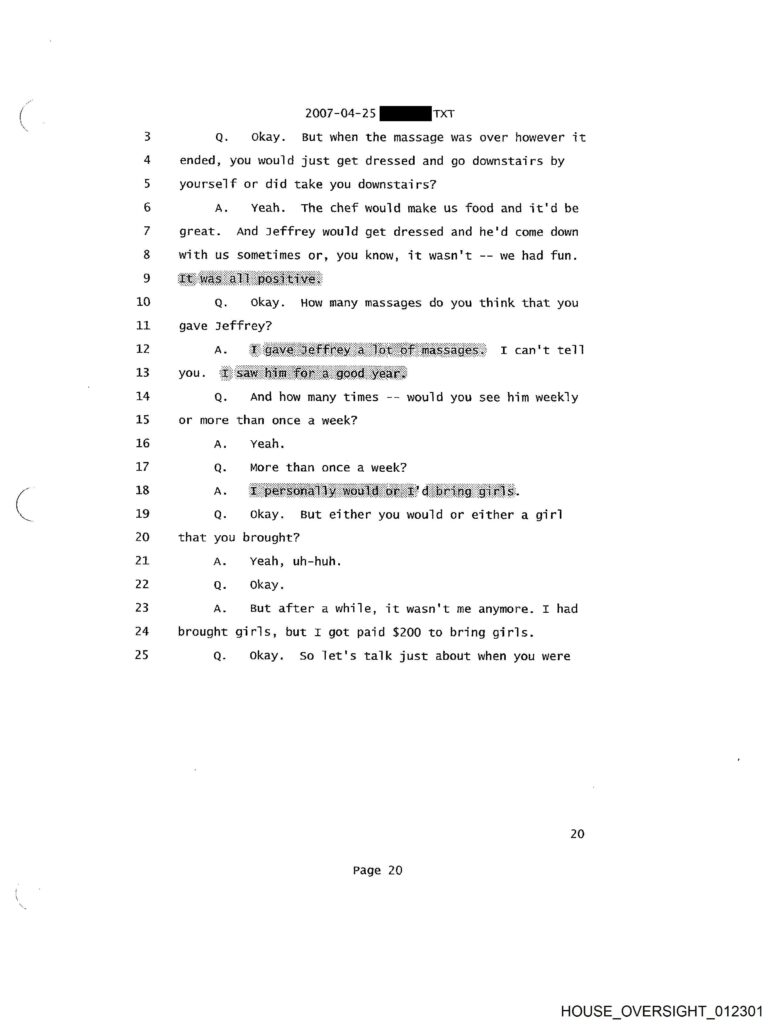
Tab 6 contains a 62 page transcript of an April 24, 2007 taped interview conducted by federal investigators during the criminal investigation of Jeffrey Epstein. The witness, whose name and identifying information are redacted, said she first met Epstein when she was 16 after another young woman offered her $200 for a short massage. She later began bringing other girls and young women to Epstein and receiving $200 for each referral.
The transcript is a major record of the recruitment system described in the Epstein investigation. It documents payment for massages, payment for referrals, repeat appointments, household scheduling, transportation costs, Epstein’s interest in “different faces,” and the witness’s estimate that she may have brought about 30 people to the Palm Beach residence. It also records her acknowledgment that some young women left the massage room shocked and may have felt scared or obligated to agree.
The witness described her own relationship with Epstein in affectionate and voluntary terms. That perspective must be preserved without allowing it to define the experiences of others. Her statements about what other young women knew, wanted, or consented to were frequently based on assumptions, and she admitted that she was not present in the room during their massages.
Snapshot
Evidence range: HOUSE_OVERSIGHT_012281 through HOUSE_OVERSIGHT_012344
Tab: Tab 6
Caption: State of Florida v. Jeffrey Epstein, Circuit Court of the Fifteenth Judicial Circuit in and for Palm Beach County, Florida
Document type: Transcript of a taped federal interview
Interview date: April 24, 2007
Interview time: 4:21 p.m. through 5:34 p.m.
Federal participants: FBI Special Agent Jason Richards, FBI Special Agent Nesbit Kirkendall, and Assistant United States Attorney A. Marie Villafaña
Witness representatives: Attorney Jim Eisenberg and investigator Carrie Sheehan
Transcriber: Vicki S. Woodham, court reporter and Florida notary public
Certification date: April 26, 2007
Strongest evidence: The witness said she first met Epstein at 16, received $200 for massages, later received $200 for each referral, and may have brought approximately 30 girls and young women to his residence.
Central limitation: The witness’s estimate changed during questioning, many names and details are redacted, portions of the transcript are difficult to read, and her statements about other people’s experiences were often secondhand.
Key Takeaways
- The correct identifiers are
HOUSE_OVERSIGHT_012281throughHOUSE_OVERSIGHT_012344. - The interview occurred on April 24, 2007 pursuant to a subpoena served through the witness’s attorney.
- The transcript is captioned in the Florida state criminal matter, but FBI agents and a federal prosecutor conducted the interview.
- The witness said she was 16 when another young woman introduced her to Epstein’s massage arrangement.
- She testified that massages paid $200 and usually lasted about 30 minutes.
- She said Epstein or an assistant sometimes scheduled appointments and Epstein sometimes paid taxi costs.
- The witness said Epstein offered her $200 whenever she brought another girl or young woman.
- She estimated that she may have brought about 30 people, then later said she did not know the exact number.
- She acknowledged bringing at least one person who was 17.
- The witness said Epstein preferred different young women and described appearance and racial preferences attributed to him.
- She admitted that some young women emerged shocked and may have felt scared or obligated.
- She described financial assistance, gifts, modeling related offers, and an ongoing friendship with Epstein.
- The transcript was certified on April 26, 2007 as a true record of the recording to the best of the transcriber’s ability.
Identifier Correction
The 64 released evidence pages are indexed as HOUSE_OVERSIGHT_012281 through HOUSE_OVERSIGHT_012344. They should not be cited as EFTA012281 through EFTA012344.
The full prefix is required because the Epstein Data archive contains multiple document series. Similar numbers under an EFTA prefix refer to unrelated records.
Document Structure and Provenance
HOUSE_OVERSIGHT_012281 is a cover marked TAB 6. HOUSE_OVERSIGHT_012282 contains the title page for a transcript of a taped statement in State of Florida v. Jeffrey Epstein.
The interview transcript begins on page 2 and continues through page 60. Pages 61 and 62 contain the certification. HOUSE_OVERSIGHT_012344 appears to be a largely blank final production page marked as transcript page 63.
The scanned pages carry a computer header dated April 25, 2007. That header should not be confused with the interview date. Special Agent Richards stated on the recording that the interview occurred on April 24, 2007. Vicki Woodham signed the certification on April 26, 2007.
The record is captioned in the Florida state prosecution, but the interview was conducted by FBI agents and a federal prosecutor. The released pages do not explain when the federal transcript was placed in the state case file or when it became Tab 6 in the larger production.
Participants and Legal Setting
Special Agent Jason Richards opened the interview. He identified another FBI agent as Nesbit Kirkendall and identified Assistant United States Attorney A. Marie Villafaña as present. OCR repeatedly renders Villafaña’s surname incorrectly, but the federal prosecutor involved in the Epstein investigation was A. Marie Villafaña.
The witness’s attorney, Jim Eisenberg, and his investigator, Carrie Sheehan, were also present. Eisenberg stated that the participants were there pursuant to a subpoena served on him for the witness.
The presence of counsel, a subpoena, two FBI agents, and a federal prosecutor establishes that this was a formal investigative interview. The transcript does not show an oath being administered, so it should be described as a taped statement rather than sworn testimony.
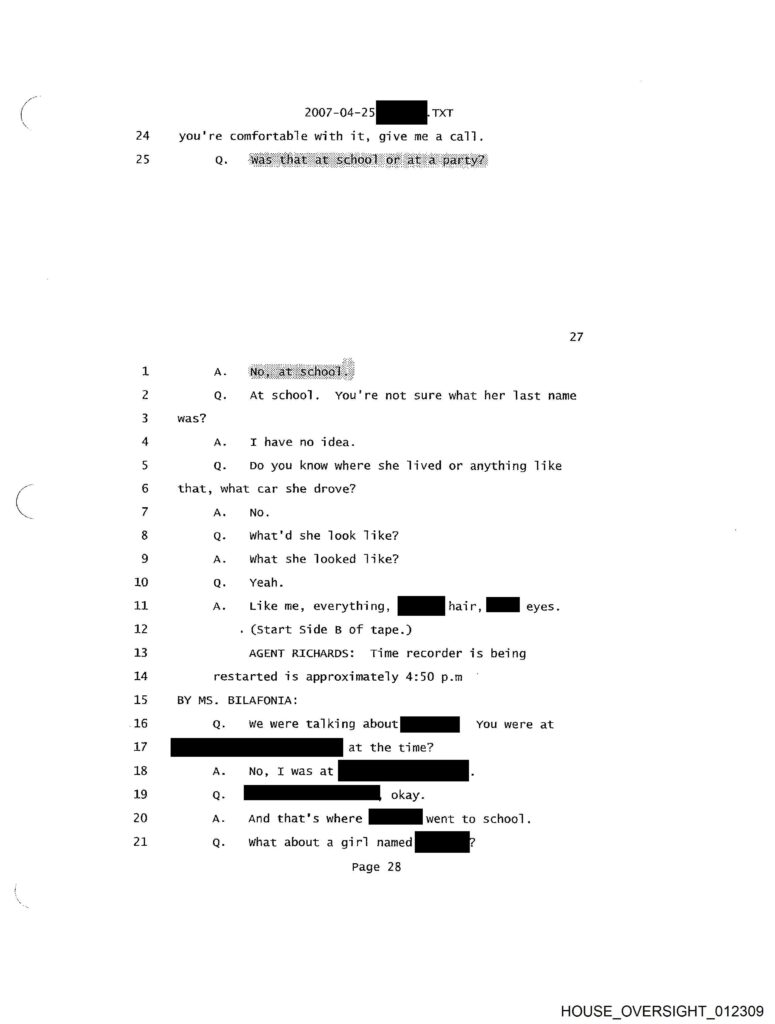
The witness’s name, birth date, address, telephone information, schools, and numerous personal associations are redacted. Those protections should remain intact.
The Witness’s Circumstances in 2007
At the time of the interview, the witness discussed earning a GED, working, considering college, pursuing modeling, and caring for a young child. She described having left school after becoming pregnant and later focusing her life on her son.
These details are relevant because they show the witness looking back on conduct that began during adolescence. They also illuminate the economic context in which $200 for a short massage or referral could be significant.
The transcript includes personal employment, family, housing, and telephone information. Most of that material is not necessary to understand the evidence and should not be used to identify the witness.
Recruitment at Age 16
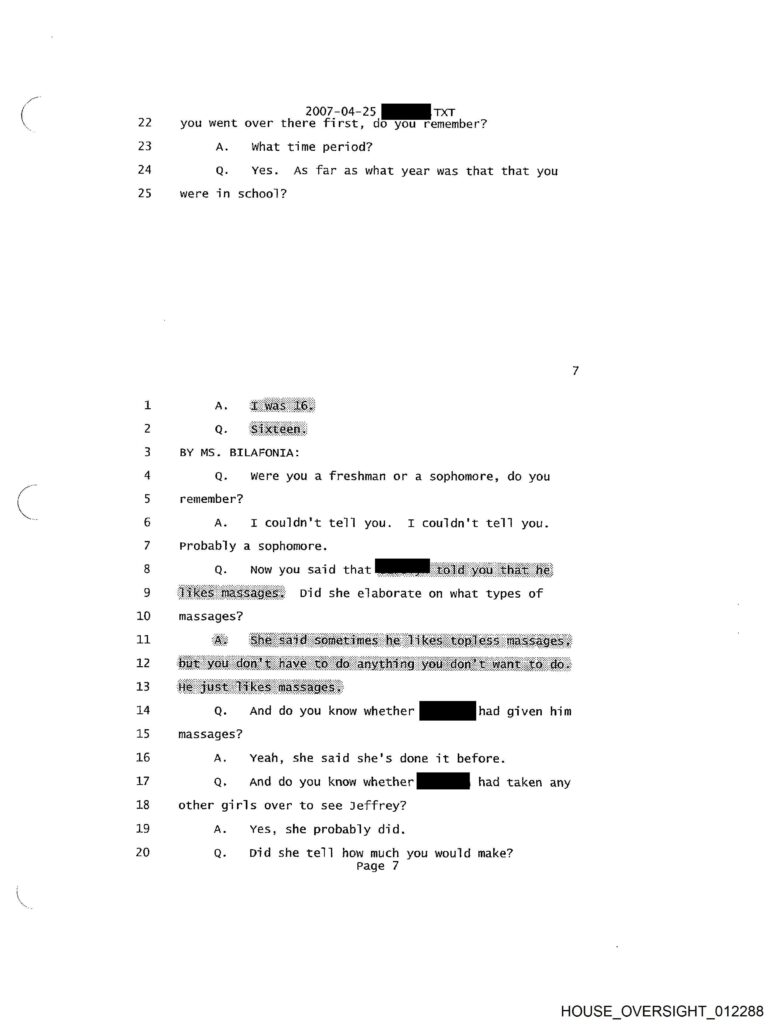
On transcript pages 5 through 8, the witness said another young woman introduced her to Epstein. The person asked whether she wanted to make money giving massages to a man who lived on Palm Beach Island.
The witness said she raised a concern about her age because she was underage. The OCR around the response is degraded, but the surviving text appears to reference claiming to be 18 and a fake identification. That passage should not be treated as a perfect quotation without review of the original image.
She testified that she was 16 and likely a high school sophomore when she first went to the residence. She was told that Epstein sometimes preferred topless massages, that she could earn $200 in approximately 30 minutes, and that she did not have to do anything she did not want to do.
The fact that the witness knew a topless massage might be requested does not establish legal or informed consent to sexual exploitation. She was a minor, and the arrangement was presented through money, peer referral, and an adult client in a private residence.
First Massage and Direct Contact With Epstein
The witness said a friend drove her and the person who introduced her to Epstein’s house. They were directed to the massage room. The person who brought her remained for several minutes and then left.
According to the witness, the first massage involved her removing her top and massaging Epstein’s neck, back, and shoulders. She characterized that first visit as voluntary and said no further sexual activity occurred during that session.
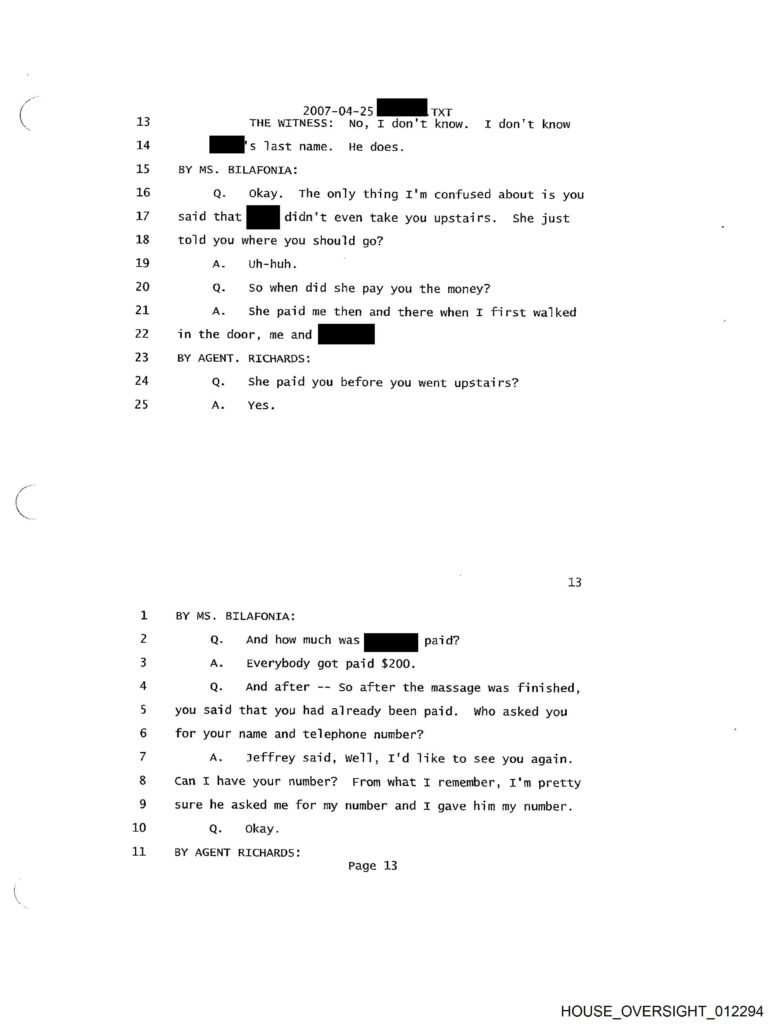
She testified that the payment was $200. Her account indicates that another person paid her at the residence before she went upstairs. Epstein then asked for her telephone number and said he wanted to see her again.
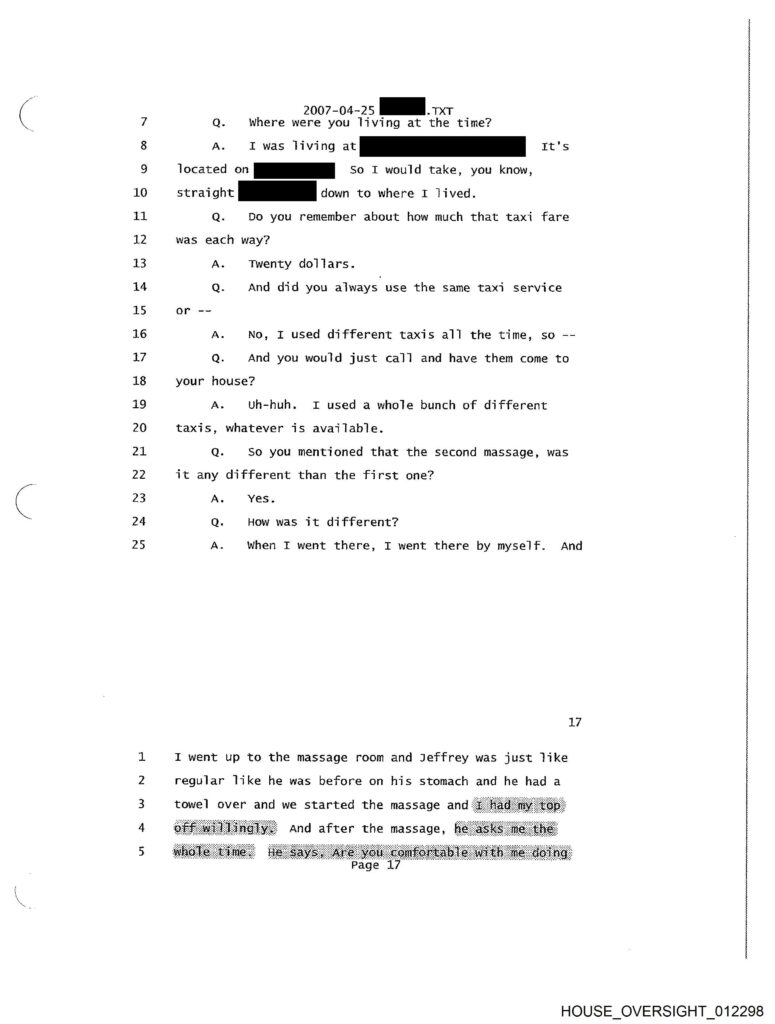
The next appointment occurred soon afterward. The witness traveled by taxi and continued communicating with Epstein or people who worked for him. She said Epstein covered taxi costs associated with later visits.
Escalation During Later Massages
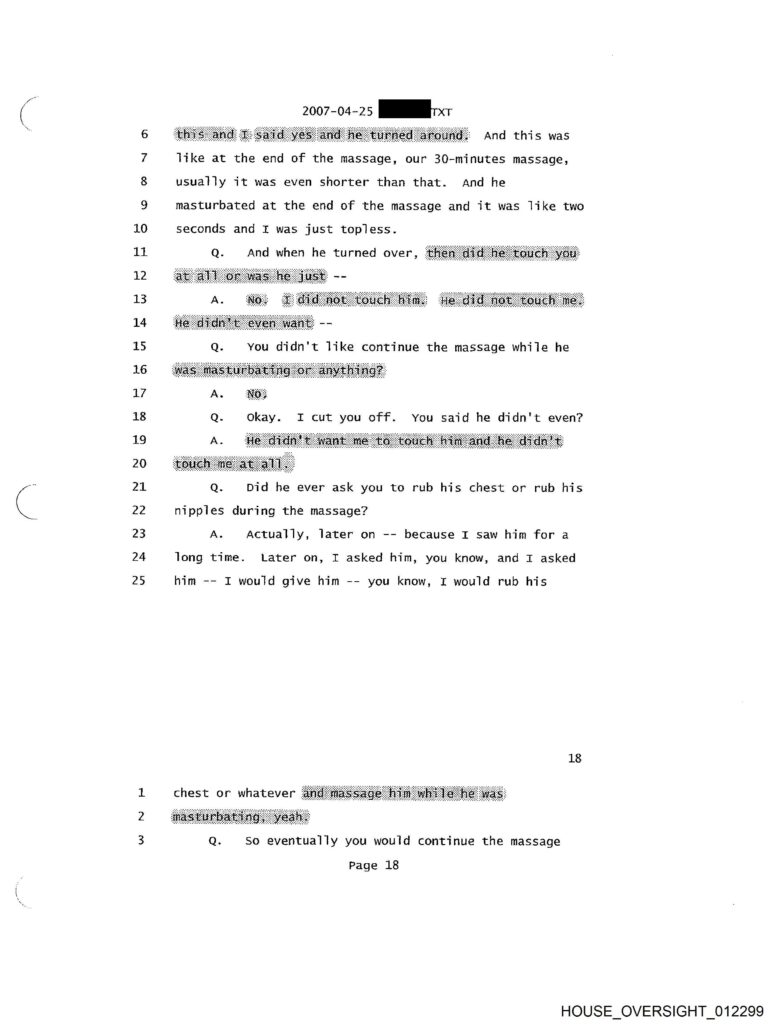
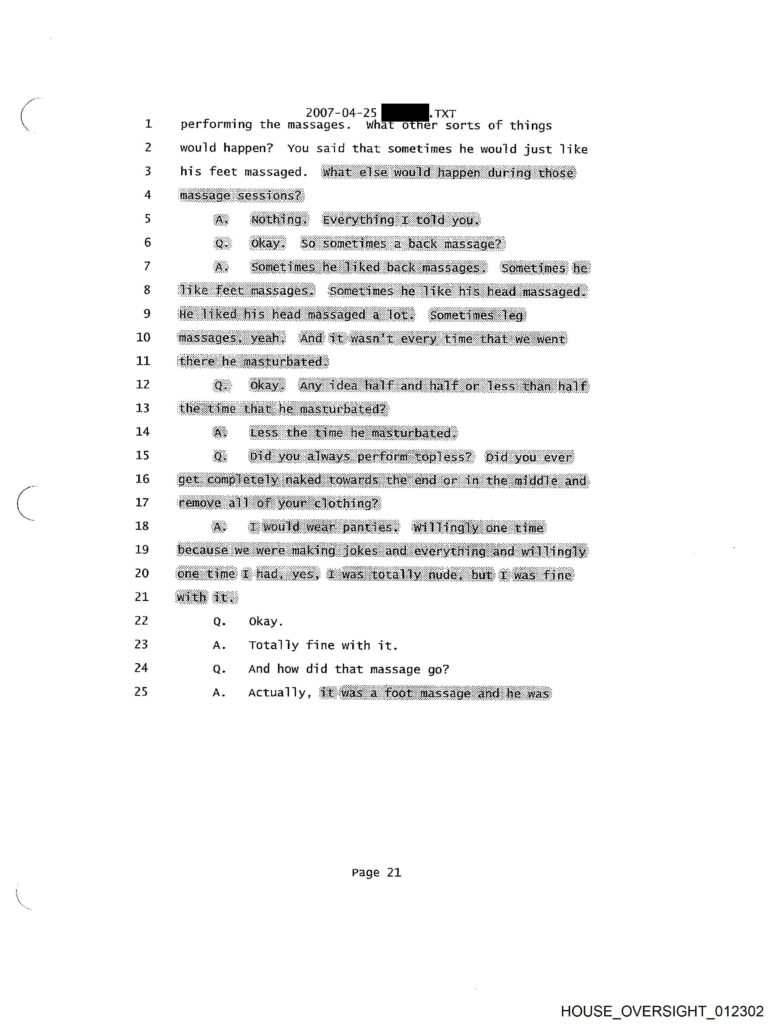
On transcript pages 17 through 21, the witness described the second massage as different from the first. She said Epstein turned over near the end and masturbated while she remained topless.
She described later sessions as varying. Some involved ordinary back, foot, head, or shoulder massage. Other sessions involved Epstein masturbating while she continued the massage. She also described one occasion on which she was completely nude and characterized her own participation as willing.
The witness repeatedly said Epstein did not sexually touch her and that she did not touch his penis. Those statements concern her own experience. They do not resolve what happened to the other girls and young women she brought to the residence.
The distinction between her experience and the experience of others became especially important later in the interview, when she acknowledged that some people left the room shocked and may have felt unable to refuse.
The Paid Referral System
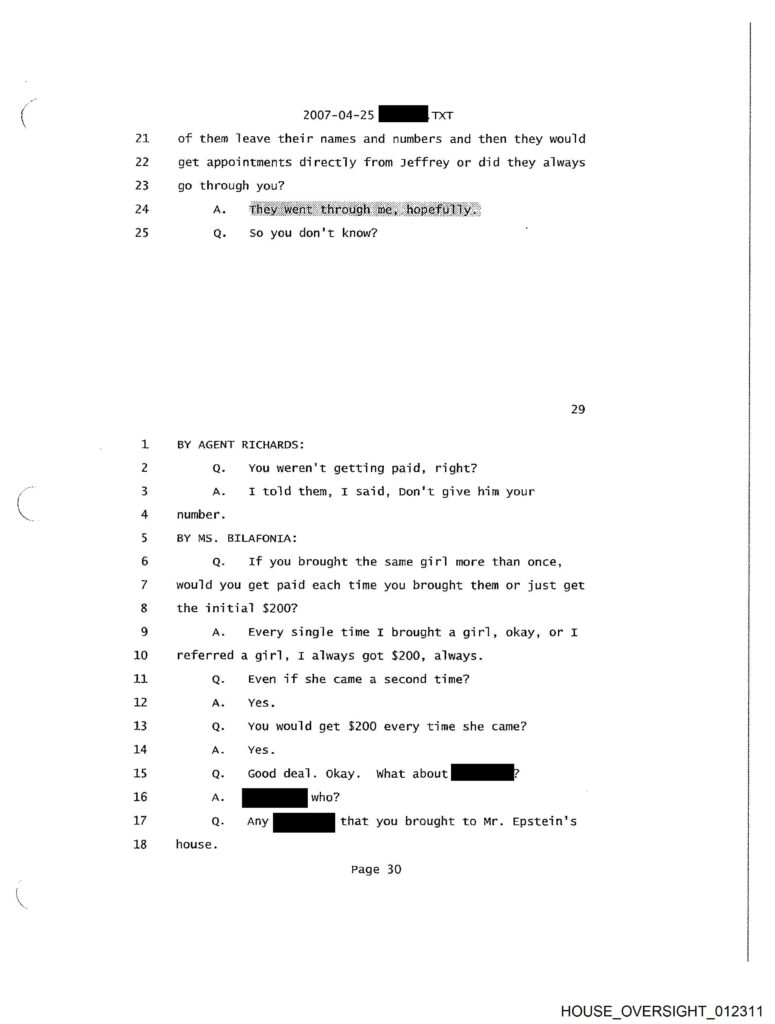
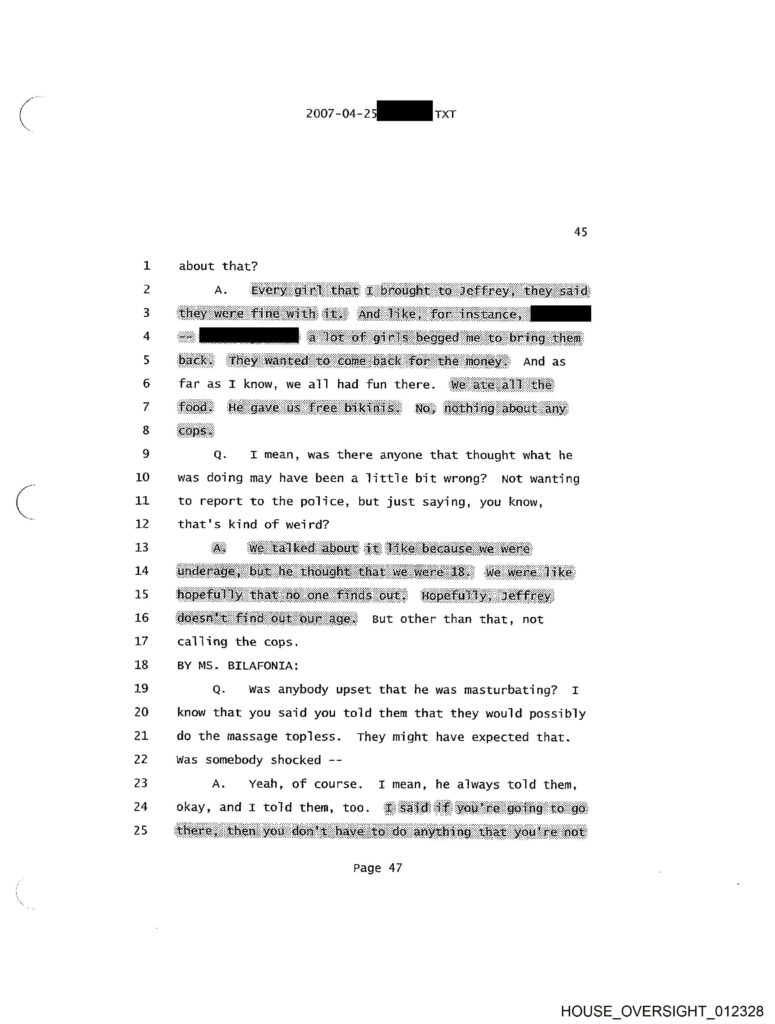
The witness said Epstein wanted to see different faces and asked whether she knew other girls or young women who could provide massages. She began making referrals and received $200 whenever she brought or referred someone.
She testified that the referral payment was not limited to a person’s first visit. According to her account, she received $200 each time someone she referred returned. This created an ongoing financial incentive to keep appointments flowing through her rather than allowing the person to schedule directly.
The witness acknowledged telling some people not to give Epstein their numbers. That would preserve her position in the referral chain and her ability to collect additional payments for repeat appointments.
This testimony describes a structured recruitment mechanism. Epstein paid the person who provided the massage and separately paid the person who supplied the referral. The record does not establish that every referral resulted in sexual conduct, but it clearly documents money attached to expanding and maintaining the pool of available young women.
Estimate of Approximately 30 Referrals
On transcript pages 28 through 30, investigators pressed the witness to estimate how many people she brought to Epstein. She initially said perhaps 30 and explained that money motivated her at the time.
Later, when agents asked her to identify additional people, she qualified the estimate and said she did not know whether she had actually brought 30. She explained that some were acquaintances or people she met only once and did not know well.
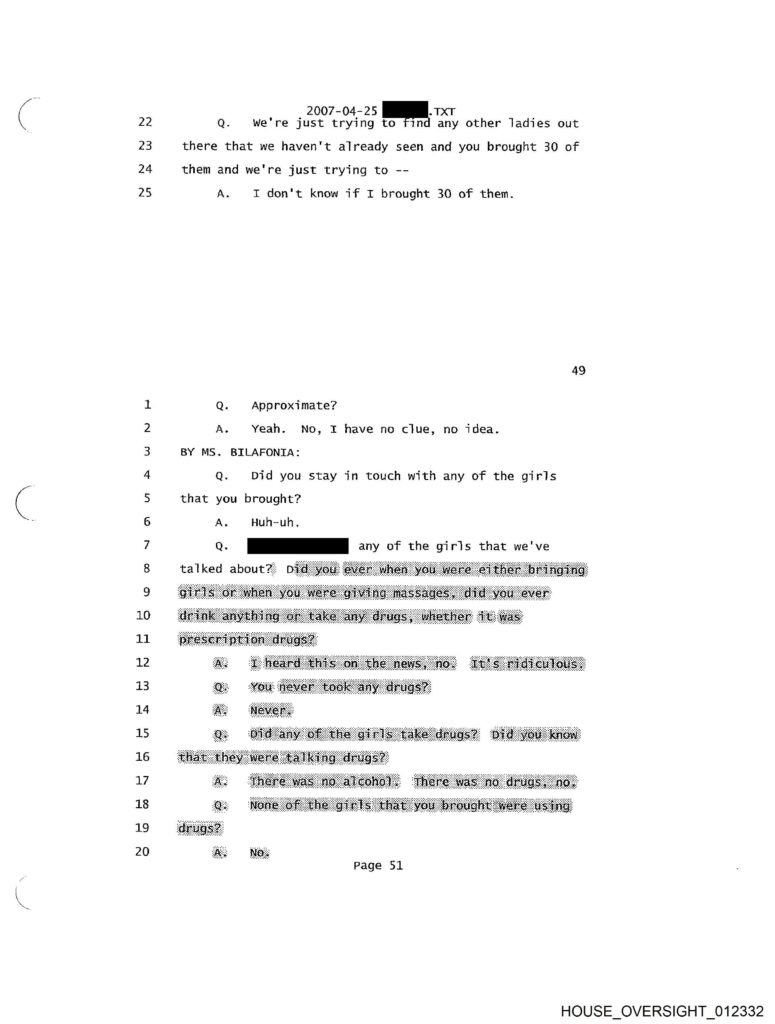
The number 30 should therefore be reported as the witness’s rough estimate, not a verified total. The transcript does not provide a complete list or enough unredacted information to count every person independently.
Even with that limitation, the estimate is significant. It describes recruitment on a scale far beyond one or two friends and demonstrates why investigators were searching message records and telephone data for additional witnesses.
Ages and Claims That Epstein Did Not Know
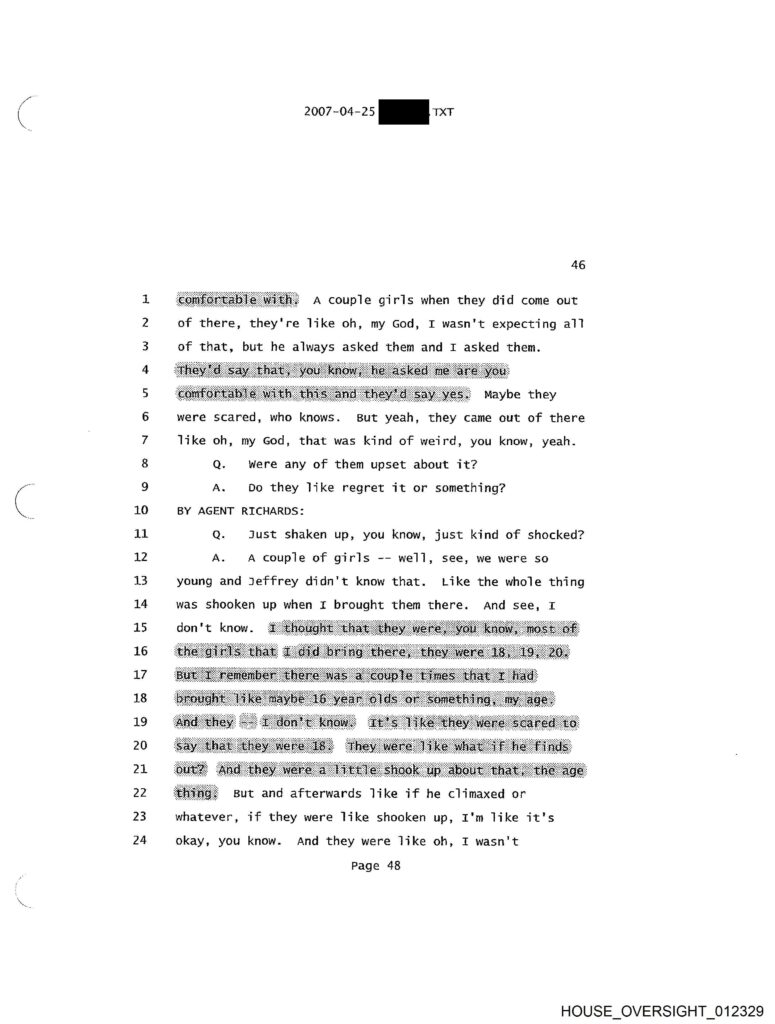
The witness acknowledged that she was 16 when she first met Epstein and discussed bringing at least one person who was 17. She also described herself and others as very young.
At several points, she claimed that Epstein did not know their true ages because they said they were 18 or used false identification. That is her explanation. The transcript does not establish what Epstein knew, what questions he asked, whether identification was actually checked, or what household staff observed.
An adult’s claimed lack of knowledge cannot be inferred merely because a minor gave a false age. The broader record must be examined for repeated exposure to high school students, visible age indicators, appointment records, staff warnings, conversations, telephone messages, and other evidence of knowledge.
The witness’s own statement that she worried about being underage shows that age was not incidental to the arrangement. It was a known concern at the point of recruitment.
Appearance and Racial Preferences
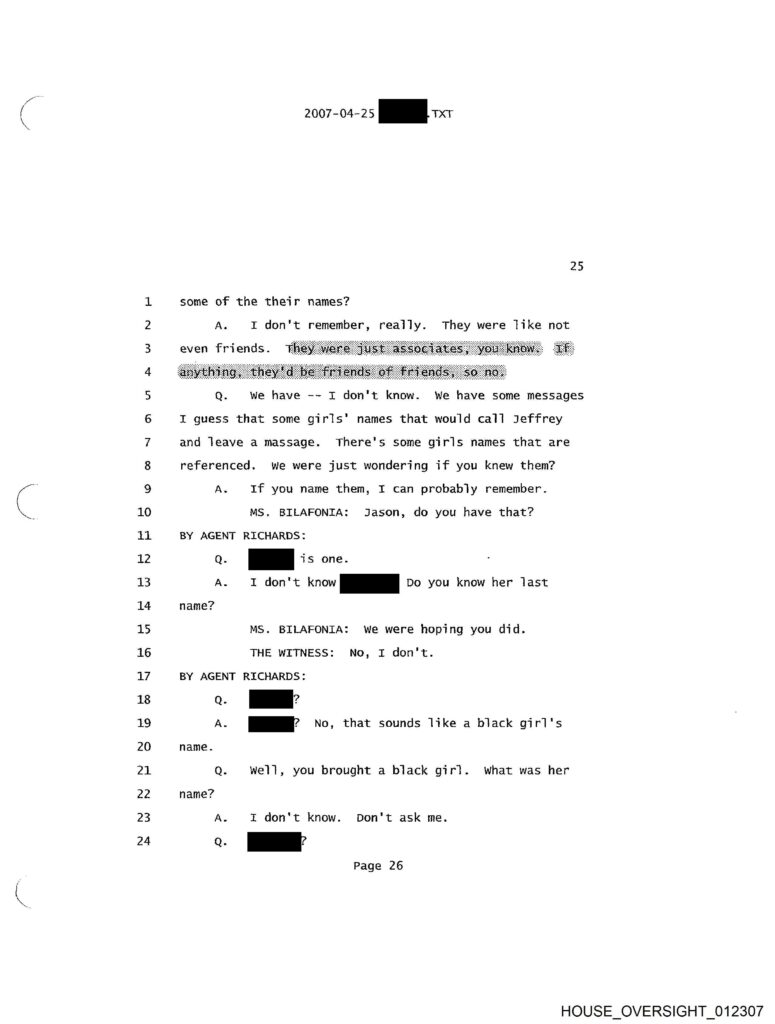
The witness said Epstein preferred thin and attractive young women and wanted different faces. She also attributed a racial preference to him after describing an occasion when she brought a Black woman and Epstein declined the massage but still paid.
She said she selected potential recruits based on what she believed Epstein found attractive. This testimony describes screening by appearance and race within the referral system.
The statement is evidence of what the witness said Epstein communicated or demonstrated. It is not a license to objectify or rank the young women discussed. Nor does a recruiter’s perception of Epstein’s preferences establish the complete criteria used by Epstein or others in the household.
Appointment and Household Infrastructure
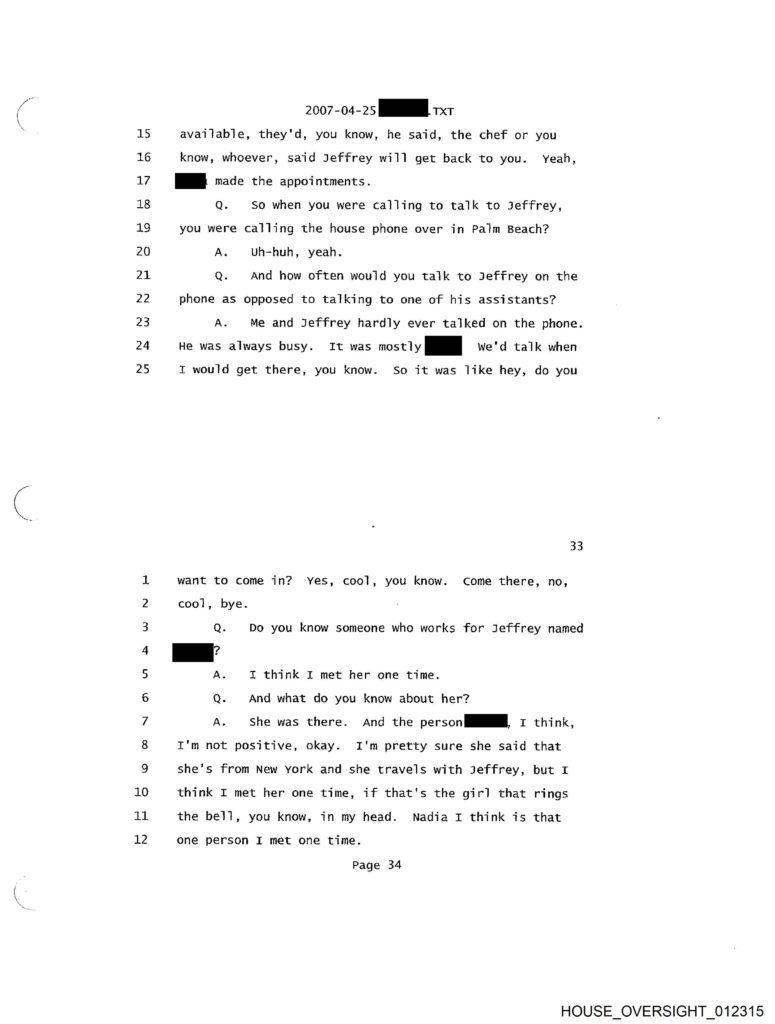
The witness described an appointment process involving telephone calls to Epstein’s Palm Beach residence and contact with an unnamed assistant. She said appointments were made when Epstein was in Palm Beach and had to fit his schedule.
If Epstein was unavailable, a chef, maid, or another household employee might answer the telephone and say he would return the call. The witness said she rarely spoke with Epstein by telephone and usually spoke with the assistant who arranged appointments.
While other girls or young women were upstairs, the witness sometimes waited downstairs and ate food prepared by the chef. She described other women with foreign accents at the residence and believed at least one traveled with Epstein from New York. Several identities are redacted or uncertain and should not be reconstructed from OCR.
These details show that the massage and referral system operated within a staffed household. Employment or presence at the residence does not by itself prove knowledge of sexual conduct. Individual responsibility requires evidence about what each person knew and did.
Reports From Other Girls and Young Women
The witness claimed that she generally told recruits the arrangement involved a topless massage, $200, and the right to refuse anything they did not want to do. She initially described the experiences as enjoyable and said people returned for the money.
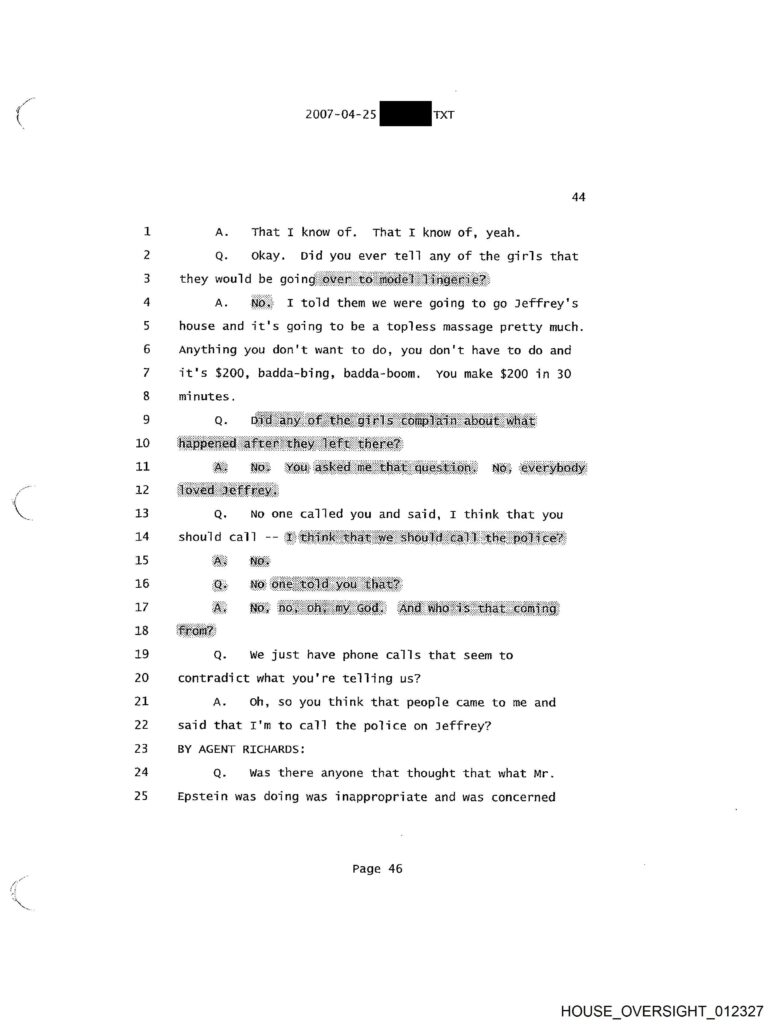
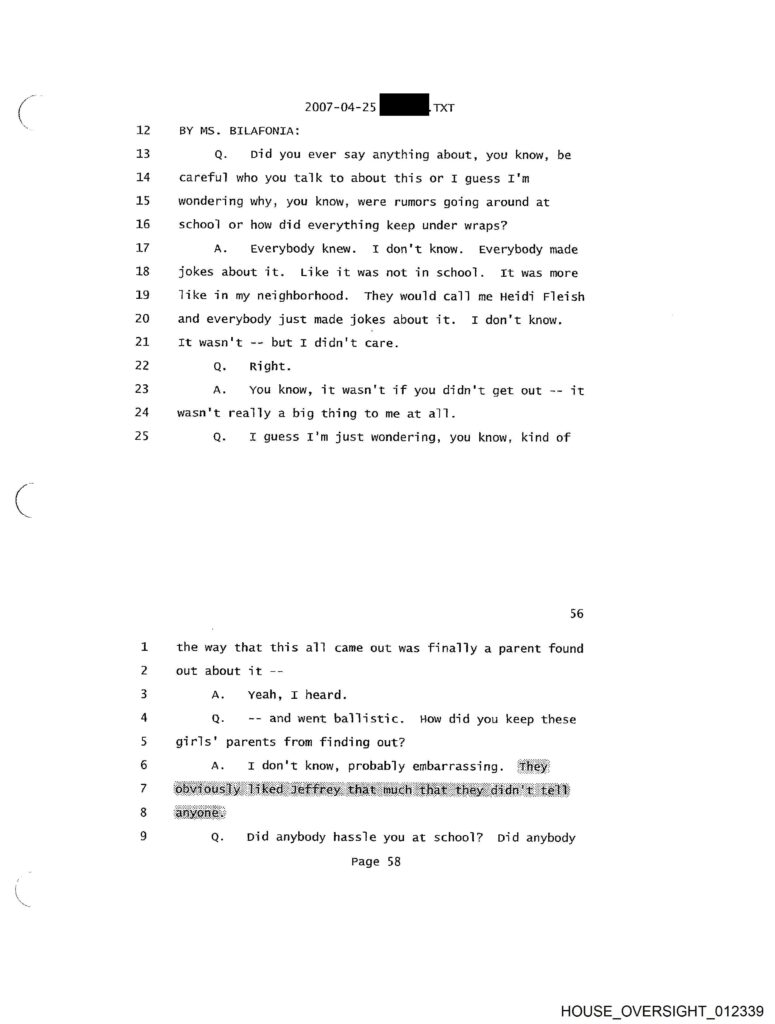
Under further questioning, she acknowledged that some came downstairs saying they had not expected everything that occurred. She described some as shocked or shaken. Most importantly, she said they may have been scared, may have felt obligated, and may not have wanted to say no.
Those acknowledgments undercut any broad claim that everyone freely consented. The witness was not upstairs during their sessions and admitted she could not know what happened in the room.
She also said that people who appeared shocked were often individuals she brought only once and did not see again. That pattern is potentially significant because nonreturning participants would be less visible in repeat appointment records and harder for the witness to identify later.
Consent, Obligation, and Survivor Centered Interpretation
The transcript repeatedly uses the language of choice, comfort, and willingness. Those words must be evaluated in context. The system involved teenagers, substantial cash for short appointments, an adult man with wealth and household staff, peer recruitment, private upstairs rooms, and payment to intermediaries.
The witness’s statement that another person said yes does not prove that the person felt free to refuse. She explicitly recognized that some may have been scared or felt obligated. Trauma responses can include freezing, complying, minimizing, returning, or avoiding disclosure.
Returning for another appointment, accepting money, recruiting a friend, or not immediately calling police does not eliminate the possibility of exploitation. It can instead reflect normalization, financial need, grooming, fear, shame, or a limited understanding of adult responsibility.
The witness herself entered the system at 16. Her later role in recruiting others must be documented, but it should not erase the vulnerability and conditioning present when the arrangement began.
Modeling, Travel, and Aspirational Access
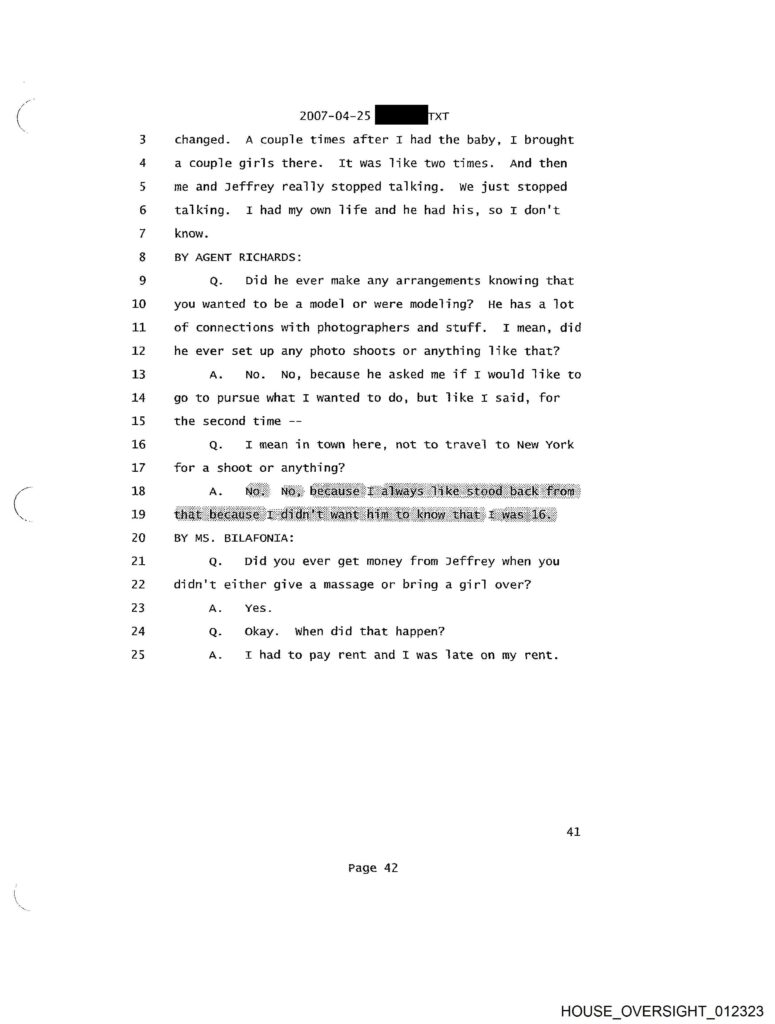
The witness said Epstein knew she wanted to model and offered to take her to New York or otherwise help her pursue that goal. She said she declined travel because she was 16 and feared getting into trouble.
She did not describe Epstein arranging local photo shoots or securing modeling work for her. The offer is therefore evidence of aspirational access, not proof that an actual modeling opportunity existed.
Offers involving travel, careers, education, or introductions can deepen a power imbalance. They may make a wealthy adult appear protective or generous while increasing dependence and access. In this transcript, the modeling discussion sits alongside massage payments, referral fees, gifts, and financial help.
Financial Assistance and Gifts
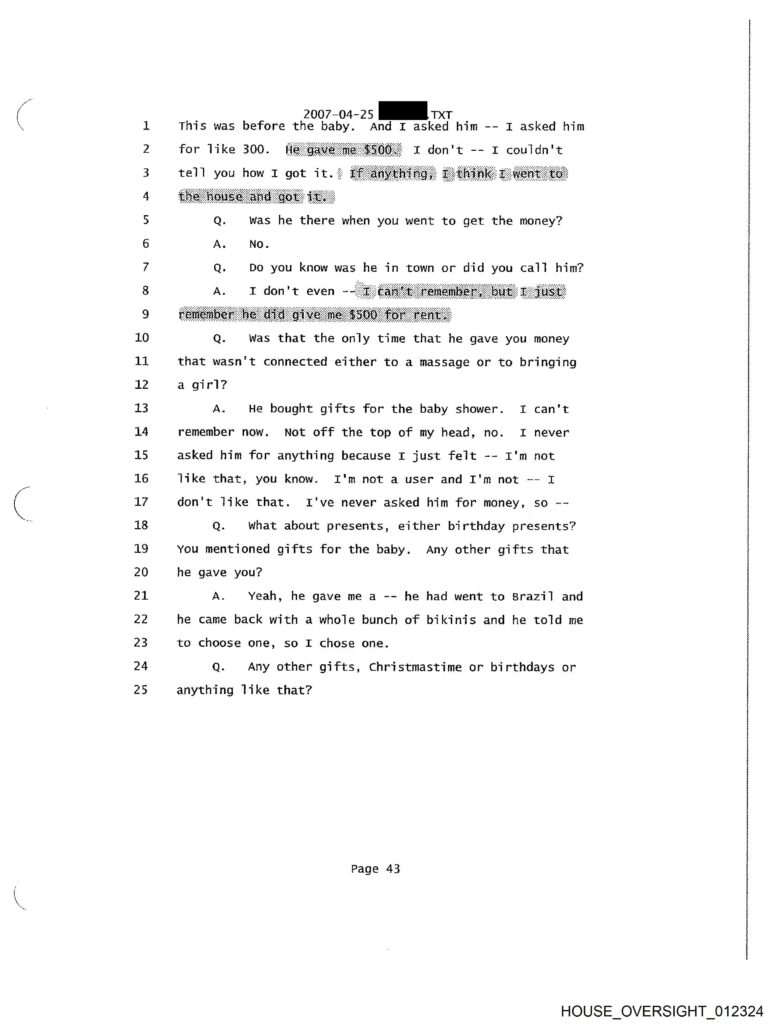
The witness described payments beyond the standard massage and referral fees. She said Epstein paid taxi costs, provided money when she was behind on rent, sent gifts for her baby shower, and gave her swimwear after a trip to Brazil.
She described these acts as generosity and said she did not consider herself someone who used him for money. She also portrayed Epstein as a friend who had done a great deal for her.
Financial assistance can coexist with exploitation and recruitment incentives. The transcript does not prove that every gift was offered for a criminal purpose. It does show a relationship in which Epstein’s money extended beyond individual massages and supported ongoing loyalty, access, and favorable feelings.
Telephone Records and Possible Contradictions
Investigators presented or referred to telephone numbers and asked the witness to identify numbers she had used. The released version redacts the actual numbers and many associated names.
At one point, an interviewer stated that telephone calls appeared to contradict part of the witness’s account. The transcript does not clearly reproduce the underlying records or explain the precise contradiction. Researchers should not guess what the calls proved.
This exchange indicates that agents were not relying only on memory. They were comparing the witness’s statement with telephone evidence and message records. The unresolved discrepancy is important because it may relate to complaints, knowledge, scheduling, or contact among participants.
Questions About Drugs and State of Mind
Agents asked about illegal drugs and prescription medication. The witness denied supplying prescription drugs and said she had smoked marijuana at 16. She stated that she was usually sober when she went to Epstein’s residence.
She also said Epstein made her feel comfortable and described herself at 18 as believing she was grown. Those remarks show her retrospective framing of the relationship, but they do not resolve her legal status when she first entered the arrangement at 16.
The questions about drugs may have been intended to assess memory, vulnerability, credibility, or whether substances were used around the massages. The excerpt does not establish drugging or forced intoxication within the experiences she described.
Ending Contact With Epstein
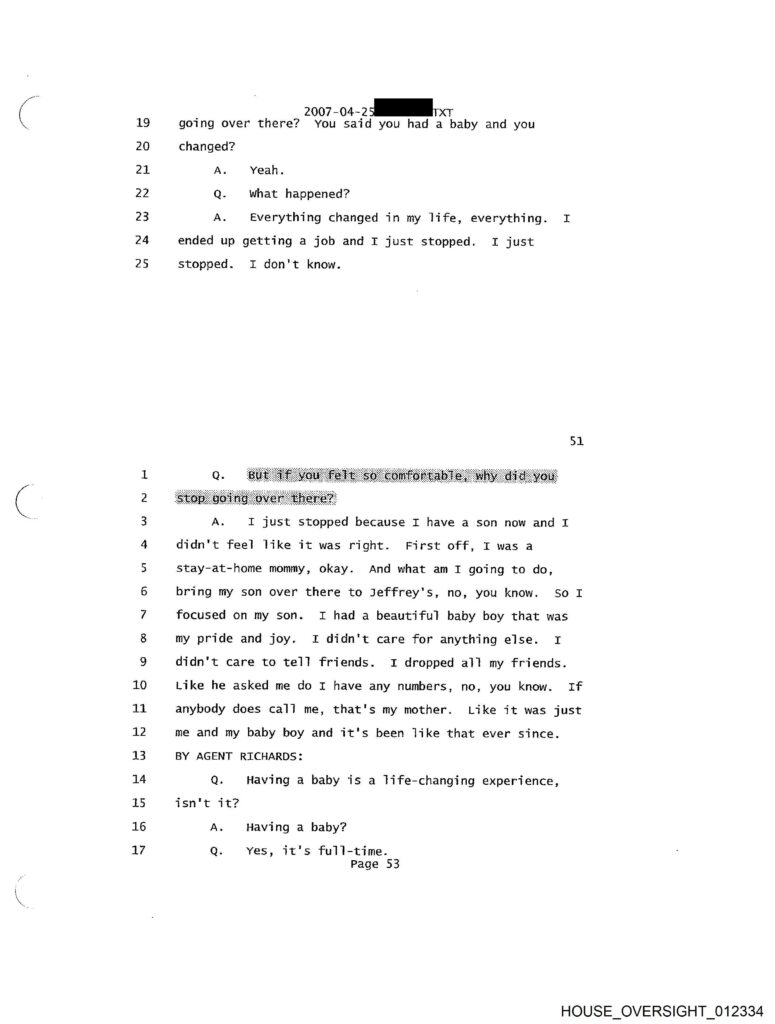
The witness said her life changed after she became a mother. She stopped performing massages and largely stopped recruiting, although she recalled bringing a small number of people after her child was born.
She described focusing on her son, distancing herself from old friends, and no longer prioritizing money in the same way. Her relationship with Epstein gradually diminished.
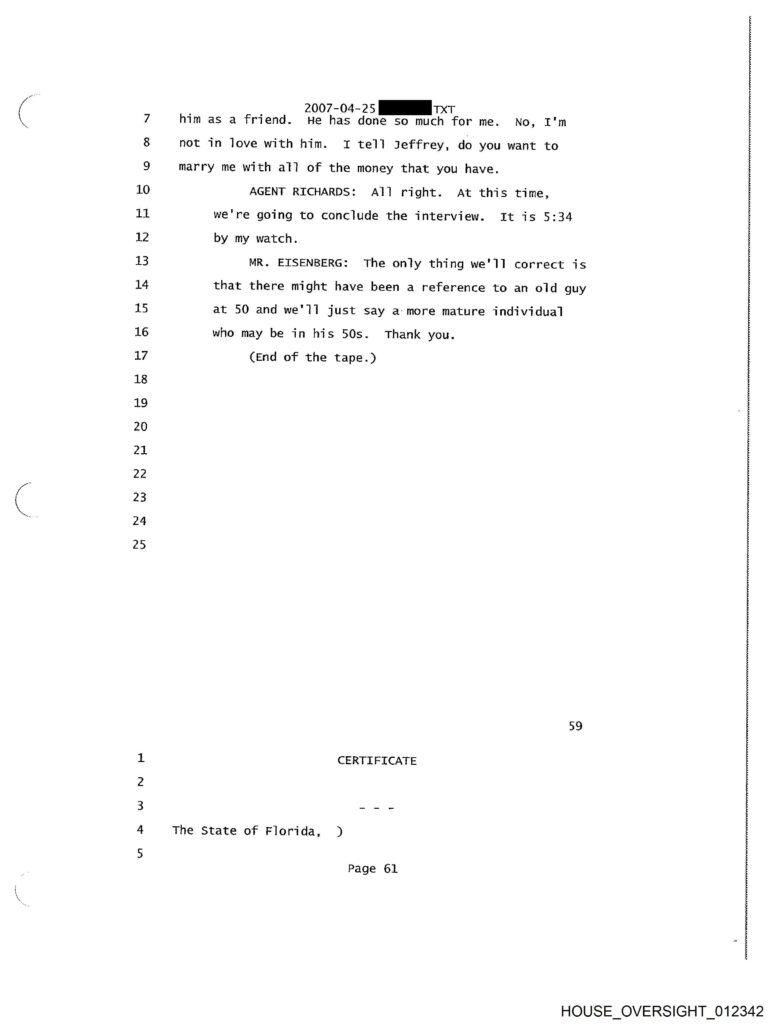
At the end of the interview, she said she was not romantically in love with Epstein but loved him as a friend. She credited him with helping her and continued to describe him in highly favorable terms.
Positive feelings toward Epstein do not invalidate evidence of recruitment or exploitation. Grooming and dependency can produce affection, loyalty, minimization, or resistance to seeing a benefactor as harmful. The transcript does not offer a clinical assessment of the witness and should not be used to diagnose her.
Interview Conclusion and Certification
Special Agent Richards concluded the interview at 5:34 p.m. Attorney Eisenberg then corrected a reference to Epstein as an “old guy,” suggesting the phrase “a more mature individual who may be in his 50s.” The tape ended after that correction.
Vicki S. Woodham certified that she was authorized to listen to and stenographically transcribe the recorded proceedings. She stated that the transcript was a true record to the best of her ability. The certificate is dated April 26, 2007.
The certification supports the transcript’s authenticity as a record of the tape. It does not certify that every witness statement was factually correct, resolve inaudible passages, or explain later redactions and OCR damage.
Relationship to the State and Federal Investigations
The Department of Justice Office of Professional Responsibility executive summary states that Palm Beach police began investigating Epstein in 2005. After the state grand jury returned a charge that police considered inadequate, the matter was referred to the FBI for possible federal prosecution.
Federal investigators discovered additional victims, and a federal prosecutor prepared a proposed 60 count indictment in May 2007. The Tab 6 interview occurred on April 24, 2007, during that federal investigative period.
The interview therefore sits at a critical point in the chronology. It documents detailed questioning about recruitment, minors, payments, appointments, telephone contacts, and people not yet located shortly before the proposed federal indictment was submitted.
The later federal nonprosecution agreement ended the Southern District of Florida investigation in exchange for a state based resolution. The agreement and later case history do not change what this April 2007 transcript records.
Page Range Guide
| Evidence range | Transcript content |
|---|---|
| HOUSE_OVERSIGHT_012281 | Tab 6 cover |
| HOUSE_OVERSIGHT_012282 | Case caption and transcript title page |
| HOUSE_OVERSIGHT_012283 through 012286 | Interview opening, participants, subpoena, personal background, introduction to Epstein |
| HOUSE_OVERSIGHT_012287 through 012296 | Recruitment at 16, first massage, payment, telephone number, repeat appointment |
| HOUSE_OVERSIGHT_012297 through 012306 | Taxis, later massages, masturbation, referral payments, Epstein’s preferences |
| HOUSE_OVERSIGHT_012307 through 012315 | Names, schools, referral estimate, recurring payments, appointment system |
| HOUSE_OVERSIGHT_012316 through 012325 | Household observations, other massages, pregnancy, modeling, rent help, gifts, telephone records |
| HOUSE_OVERSIGHT_012326 through 012334 | Additional referrals, possible contradictory calls, shock and obligation, drug questions, reasons for stopping |
| HOUSE_OVERSIGHT_012335 through 012342 | Work and family changes, recruitment language, community knowledge, school history, continuing affection, conclusion |
| HOUSE_OVERSIGHT_012343 | Court reporter certification dated April 26, 2007 |
| HOUSE_OVERSIGHT_012344 | Largely blank final production page |
What the Record Establishes
The released pages establish that:
- a federal taped interview occurred on April 24, 2007;
- the interview took place pursuant to a subpoena and with the witness’s attorney present;
- the witness said she was 16 when introduced to Epstein;
- she described receiving $200 for massages;
- she described sexualized massage sessions in which Epstein masturbated;
- she said she received $200 for each person she brought or referred;
- she said the referral fee could continue when the same person returned;
- she estimated that she may have brought approximately 30 people before qualifying the estimate;
- she acknowledged bringing at least one 17 year old;
- she described an assistant and household staff participating in scheduling and access;
- she said some young women appeared shocked and may have felt scared or obligated;
- she described financial help, gifts, travel related modeling offers, and affection for Epstein;
- investigators compared her account with telephone information;
- the interview concluded at 5:34 p.m.;
- Vicki Woodham certified the transcript on April 26, 2007.
What the Record Does Not Establish
The released pages do not establish that:
- the witness brought exactly 30 people;
- every person she brought was a minor;
- every massage involved sexual conduct;
- every person freely consented because she accepted money or returned;
- Epstein did not know participants were minors merely because the witness claimed ages were misrepresented;
- the witness personally observed what happened in the room with other people;
- every person named or discussed committed wrongdoing;
- every household employee knew about sexual activity;
- the modeling opportunity described was genuine;
- gifts or financial assistance alone prove a criminal purpose;
- the telephone records prove a specific contradiction without the underlying records;
- the transcript contains every statement or item reviewed by investigators;
- the court reporter’s certification proves the truth of the witness’s account.
Reliability and Limitations
The transcript is a formal, recorded interview conducted by FBI agents and a federal prosecutor with the witness’s attorney present. It was certified by a court reporter two days later. Those features strengthen its value as an authentic investigative record.
The witness spoke from personal knowledge about her own introduction, massages, payments, referrals, and relationship with Epstein. Her statements about other people’s private sessions were often secondhand, inferential, or based on what they said afterward.
Her estimate of approximately 30 referrals was expressly uncertain. She later said she had no exact idea. The estimate should not be converted into a verified victim count.
The scans contain extensive redactions, garbled OCR, missing words, and occasional formatting that blends consecutive transcript pages. Names and unclear phrases must be checked against the page images before quotation.
The witness’s favorable view of Epstein may have shaped her interpretations. That does not make her account worthless. It requires separating direct observations from assumptions and comparing both with telephone records, message books, testimony, payment evidence, and other interviews.
Fact Check
Claim: The range is EFTA012281 through EFTA012344.
Finding: Incorrect identifier. The pages use HOUSE_OVERSIGHT_012281 through HOUSE_OVERSIGHT_012344.
Claim: This was a Palm Beach Police interview.
Finding: Incorrect. The transcript carries a Florida state case caption, but FBI agents and a federal prosecutor conducted the interview.
Claim: The witness gave a sworn statement.
Finding: Not established. The transcript records a formal taped statement but does not show an oath being administered.
Claim: The witness was 16 when she first met Epstein.
Finding: Supported as her statement. She repeatedly described herself as 16 at the beginning of the arrangement.
Claim: She brought exactly 30 girls to Epstein.
Finding: Not established. She offered approximately 30 as an estimate and later qualified it.
Claim: Epstein paid $200 for referrals.
Finding: Supported as testimony. The witness said she received $200 whenever she brought or referred someone, including repeat visits.
Claim: All participants consented because they accepted payment.
Finding: False and unsupported. The witness acknowledged that some appeared shocked and may have felt scared or obligated.
Claim: Epstein did not know anyone was underage.
Finding: Not established. That was the witness’s belief. The transcript does not independently establish Epstein’s knowledge.
Claim: The transcript proves every household employee participated in recruitment.
Finding: Incorrect. It describes scheduling and household access but does not establish each person’s knowledge or intent.
Claim: The transcript is certified.
Finding: Supported. Vicki Woodham certified it as a true record of the tape to the best of her ability.
Questions Still Unanswered
- Who was the redacted witness, and what protections governed the use of her statement?
- What precise subpoena required her appearance?
- What did Epstein and household staff know about her age when she first arrived at 16?
- How often did Epstein or his staff request new girls and young women?
- How many people did the witness actually refer, and how many were minors?
- Which payment, calendar, message, taxi, and telephone records corroborate her account?
- Who received the referral payments, and how were those payments recorded?
- Which young women told the witness they were shocked, frightened, or felt obligated?
- Did investigators locate the one time visitors whom the witness could not name?
- What contradiction did investigators believe the telephone records revealed?
- Who controlled the appointment system and recorded telephone numbers?
- What evidence did investigators develop concerning fake identification or false age claims?
- Did Epstein use modeling or travel offers with other minors?
- How did this statement influence the proposed federal indictment submitted in May 2007?
- Why was the federal interview transcript filed or produced under the Florida state case caption?
- What parent document or litigation filing originally organized this transcript as Tab 6?
Important Epstein Data Evidence Files
- Tab 6 cover, HOUSE_OVERSIGHT_012281
- State case caption and transcript title, HOUSE_OVERSIGHT_012282
- Interview participants and subpoena, HOUSE_OVERSIGHT_012283
- Witness’s introduction to Epstein, HOUSE_OVERSIGHT_012286
- Recruitment at age 16, HOUSE_OVERSIGHT_012287
- First massage and payment structure, HOUSE_OVERSIGHT_012290
- Second massage and sexualized conduct, HOUSE_OVERSIGHT_012298
- Referral payments, HOUSE_OVERSIGHT_012301
- Epstein’s preferences and $200 referral fee, HOUSE_OVERSIGHT_012305
- Estimate of approximately 30 referrals, HOUSE_OVERSIGHT_012310
- Witness’s account of bringing a 17 year old, HOUSE_OVERSIGHT_012312
- Appointment and household infrastructure, HOUSE_OVERSIGHT_012314
- Modeling and travel discussion, HOUSE_OVERSIGHT_012322
- Financial assistance and gifts, HOUSE_OVERSIGHT_012324
- Possible telephone record contradiction, HOUSE_OVERSIGHT_012327
- Shock and possible obligation described, HOUSE_OVERSIGHT_012329
- Witness acknowledges possible fear or obligation, HOUSE_OVERSIGHT_012330
- Interview conclusion, HOUSE_OVERSIGHT_012342
- Court reporter certification, HOUSE_OVERSIGHT_012343
Related EpsteinWiki Pages
- Jeffrey Epstein
- Federal Bureau of Investigation
- A. Marie Villafaña
- State of Florida v. Jeffrey Epstein
- Palm Beach Police Department Investigation
- Epstein Nonprosecution Agreement
- Law Enforcement Interview Transcripts
- House Oversight Committee Evidence Files
Source List
- Tab 6 evidence range beginning with HOUSE_OVERSIGHT_012281
- Court reporter certification, HOUSE_OVERSIGHT_012343
- Department of Justice Office of Professional Responsibility Executive Summary
- House Oversight Committee release of additional Epstein estate documents
Exact identifier, participant name, and quotation searches did not locate a directly relevant article from an EpsteinWiki sleuth Substack. No unrelated Substack article has been inserted simply to populate the source list.