
Great St. James Island: Jeffrey Epstein’s Second Private Island
Snapshot
Great St. James is a private island near St. Thomas in the United States Virgin Islands. It is substantially larger than neighboring Little St. James, the island most closely associated with survivor accounts of Jeffrey Epstein’s sexual abuse and trafficking operation.
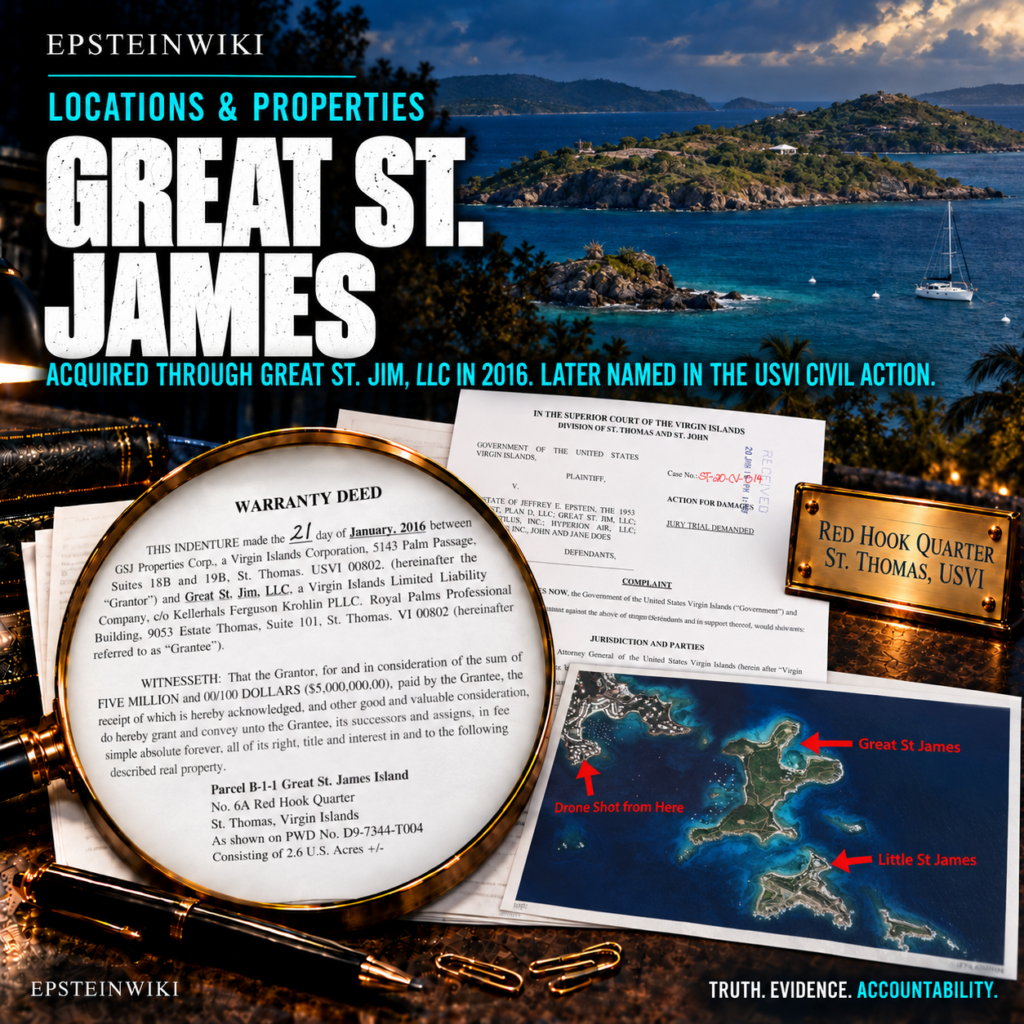
Epstein acquired Great St. James in January 2016, after his Florida conviction and registration as a sex offender. The island was purchased through Great St. Jim, LLC for $22.5 million. The transaction documents presented Dubai businessman Sultan Ahmed bin Sulayem as an individual connected to the purchase and represented that the acquisition funds came from him. Later corporate and court records identified Epstein as a manager and member of Great St. Jim, LLC and treated the island as an Epstein controlled asset.
The Government of the United States Virgin Islands alleged that a straw purchaser was used to conceal Epstein’s identity. The government further alleged that Epstein acquired Great St. James to prevent outsiders from observing Little St. James, create additional barriers to escape, and expand his criminal enterprise. Those statements are allegations from a civil enforcement complaint. They must be distinguished from the independently documented purchase, ownership, construction, and environmental records.
Construction began within months of the acquisition. Virgin Islands regulators found extensive clearing, newly cut roads, excavation, and other development for which they could not locate the required coastal permits. Great St. Jim, LLC paid a $70,000 penalty and entered a settlement with the Department of Planning and Natural Resources. Regulators later alleged that the company breached that agreement, continued unauthorized work, challenged inspections, and failed to obtain necessary permits.
The public record directly documents the purchase, the corporate structure, proposed residences and infrastructure, construction disputes, environmental damage, federal interest in the deeds, estate administration, and the eventual sale of both islands. It contains fewer Great St. James specific survivor accounts than the record for Little St. James. The island is therefore a confirmed Epstein asset and an alleged component of his criminal enterprise, but the available evidence does not establish the precise location of every alleged act.
Key Takeaways
- Great St. James is a separate island from Little St. James and is more than twice its size.
- Epstein acquired the island in January 2016 through Great St. Jim, LLC for $22.5 million.
- The purchase agreement allocated $17.5 million to one parcel and $5 million to the remaining parcels or related corporate interest.
- Transaction records presented Sultan Ahmed bin Sulayem as connected to the purchase and represented that the money came from him. Later records identify Epstein as the manager and a member of the purchasing company.
- The Virgin Islands government alleged that bin Sulayem was used as a straw purchaser to hide Epstein’s identity. The complete financial trail remains unresolved in the public record.
- Regulators documented unauthorized clearing, roads, exposed soil, excavation, and large circular cleared areas within months of the purchase.
- Great St. Jim, LLC paid a $70,000 regulatory penalty. The original potential fine was $280,000.
- Later development proposals included residential cottages, pools, terraces, storage buildings, a tennis court, driveways, large decks, landscaping, and other infrastructure.
- The Virgin Islands government said Epstein destroyed centuries old remains associated with enslaved workers. The 2022 estate settlement required $450,000 for environmental remediation.
- The government alleged that Great St. James was used to isolate victims and conceal the enterprise. Direct survivor evidence naming specific Great St. James locations remains limited compared with Little St. James.
- The FBI’s property investigation recorded two deeds for Great St. James purchased by Great St. Jim, LLC in January 2016.
- Great St. James and Little St. James were sold together in 2023 to investor Stephen Deckoff through SD Investments for $60 million.
Island Profile Chart
| Field | Documented information |
|---|---|
| Formal name | Great St. James or Great Saint James |
| Location | East of St. Thomas in the United States Virgin Islands |
| Approximate size | About 161 to 165 acres, depending on the source and parcel calculation |
| Nearby Epstein property | Little St. James |
| Purchasing entity | Great St. Jim, LLC |
| Entity formation | October 26, 2015, according to the Virgin Islands complaint |
| Purchase period | January 2016 |
| Purchase price | $22.5 million |
| Epstein’s documented company role | Manager and member |
| Primary regulator | Virgin Islands Department of Planning and Natural Resources |
| Initial enforcement matter | NOVA 04 16 STT |
| Initial potential fine | $280,000 |
| Settlement penalty | $70,000 |
| Environmental remediation payment | $450,000 under the 2022 estate settlement |
| Post Epstein sale | Sold with Little St. James in 2023 for a combined $60 million |
Great St. James and Little St. James Are Different Islands
Great St. James is frequently confused with Little St. James because both became part of Epstein’s Virgin Islands property network. The evidence must be separated by island.
| Category | Little St. James | Great St. James |
|---|---|---|
| Epstein acquisition | 1998 | 2016 |
| Approximate size | About 72 acres | About 161 to 165 acres |
| Holding structure | LSJE, LLC and later Nautilus, Inc. | Great St. Jim, LLC with Poplar, Inc. connections |
| Development status | Established residential compound | Major development and permit disputes after acquisition |
| Survivor evidence | Numerous survivor accounts and government allegations identify the island | Government allegations identify the island, but fewer public survivor accounts distinguish specific locations there |
| Government theory | Central secluded site for trafficking and abuse | Acquired to block observation, increase isolation, and expand the enterprise |
| Public access issue | Private island with controlled boat and helicopter access | Included Christmas Cove and environmentally sensitive coastal areas |
| 2022 settlement | Half of sale proceeds directed to a survivor services trust | $450,000 required for environmental remediation |
References to “Epstein’s island” usually mean Little St. James. Researchers should not automatically assign evidence concerning Little St. James to Great St. James.
Geography and Strategic Location
Great St. James lies near the eastern end of St. Thomas and close to Little St. James. Its western side includes Christmas Cove, a location historically used by boaters, charter vessels, and visitors to the surrounding marine area.
The island’s geography made it important for more than real estate value. Control of Great St. James gave Epstein control over additional shoreline, elevated observation points, possible marine landing areas, and territory near Little St. James.
The Government of the Virgin Islands alleged that Epstein wanted to prevent the island from becoming a location from which other people could observe activity and visitors on Little St. James. The government also alleged that acquiring the neighboring island created another physical barrier for victims seeking escape or assistance.
These allegations are plausible investigative theories grounded in the islands’ proximity. They are not the same as direct proof that Epstein purchased the island for a criminal purpose. The purchase contract itself describes a real estate transaction and does not state an illicit purpose.
Ownership Before Epstein
The purchase agreement identifies Christian Kjaer and GSJ Properties, Corp. as the sellers. It states that the sellers owned the land and improvements making up Great St. James and that Kjaer held a submerged land permit associated with an existing dock.
Public reporting describes earlier divided ownership and prior disputes involving the property. Those earlier events matter because Great St. James was not acquired through a single simple deed. The final transaction involved multiple parcels, a corporate stock interest in one version of the agreement, and the transfer of dock related rights.
The most reliable starting point for Epstein’s acquisition is the actual purchase agreement and the deeds referenced by the FBI.
Great St. Jim, LLC
Great St. Jim, LLC was organized in the Virgin Islands on October 26, 2015, shortly before the acquisition. The Virgin Islands complaint states that the company owned at least three properties forming Great St. James.
The complaint identifies three parcel groupings with assessed values of approximately $17.5 million, $2.8 million, and $2.7 million. Together, those figures total about $23 million. The recorded purchase agreement states a transaction price of $22.5 million.
The complaint further states that Epstein was listed as a manager and member of Great St. Jim, LLC and that the company’s business was described as holding assets.
That corporate evidence is central. Whatever representations appeared during negotiations, Great St. Jim, LLC ultimately became an Epstein controlled property company in the public corporate and estate record.
The $22.5 Million Purchase Agreement
EFTA00787660 contains a purchase and sale agreement between Christian Kjaer, GSJ Properties, Corp., and Great St. Jim, LLC. EFTA00582997 contains another version of the transaction documents.
The agreement states a purchase price of $22.5 million, payable in cash at closing. It allocates $17.5 million to Parcel A and $5 million to the remaining parcels or, in one version, to the seller’s stock interest in GSJ Properties, Corp.
The contract required a $2.25 million earnest money deposit. It also required the purchaser to verify that funds were available in the Virgin Islands.
The legal description identifies parcels totaling approximately 162.6 acres before any survey or measurement adjustment. This is consistent with published descriptions placing the island near 161 to 165 acres.
The documents excluded tools, machinery, vehicles, all terrain vehicles, heavy equipment, boats, personal watercraft, and other personal property from the real estate transaction.
Purchase Price Allocation Chart
| Component | Contract amount | Share of total price |
|---|---|---|
| Parcel A | $17,500,000 | 77.8 percent |
| Remaining parcels or corporate stock interest | $5,000,000 | 22.2 percent |
| Total purchase price | $22,500,000 | 100 percent |
| Required earnest money | $2,250,000 | 10 percent of total price |
The allocation changed slightly in wording between versions of the agreement. One version describes a purchase of parcels. Another describes the $5 million component as payment for a stock interest associated with the remaining property. That difference should be examined alongside the executed deeds and corporate share records.
Sultan Ahmed bin Sulayem and the Source of Funds Representation
Sultan Ahmed bin Sulayem was a prominent Emirati businessman who led DP World for many years. His name appears directly in the Great St. James transaction documents.
One purchase agreement version includes a line for bin Sulayem to sign individually. A funds verification page in EFTA00582997 states that the source of the acquisition funds had been verified as bin Sulayem.
The executed material in EFTA00787660 identifies attorney Erika Kellerhals as signing for Great St. Jim, LLC. The pages also display bin Sulayem’s name in the purchaser signature section. Researchers should inspect the original page images because OCR cannot reliably determine which signature lines were completed in every version.
The representation that funds came from bin Sulayem does not, standing alone, prove that he supplied the final purchase money. It records what the transaction documents represented. Bank wires, escrow ledgers, source of funds reviews, and reimbursement records are required to establish the actual financial path.
The Alleged Straw Purchaser
In EFTA00018778, the Government of the Virgin Islands alleged that the Epstein enterprise used a straw purchaser to hide Epstein’s identity when acquiring Great St. James.
The government’s theory draws support from the contrast between the transaction presentation and the later ownership record. The contract associated bin Sulayem with the funds, while corporate records listed Epstein as manager and member of Great St. Jim, LLC. Epstein’s estate later treated Great St. James as an estate asset.
This creates significant questions about beneficial ownership, but it does not by itself resolve bin Sulayem’s knowledge or intent. Earlier reporting stated that bin Sulayem’s identity was used without his authorization. Later document releases reportedly showed a much closer relationship with Epstein and knowledge of Epstein’s island development interests. Bin Sulayem has not been criminally charged in connection with the acquisition.
In February 2026, bin Sulayem left his leadership positions at DP World after renewed scrutiny of his Epstein relationship. That later employment consequence does not determine whether he knowingly participated in the 2016 property structure.
Poplar, Inc. and the Ownership Structure
The Virgin Islands complaint identifies Poplar, Inc. as another company connected to Great St. James.
Poplar, Inc. was incorporated in 2011. The complaint states that Epstein served as president and director, while Darren Indyke and Richard Kahn held secretary and treasurer roles. Its stated purpose was holding property for personal use.
According to the complaint, a certificate of incumbency authorized Poplar personnel to conduct permitting transactions for Great St. Jim, LLC. Poplar also signed the 2017 annual report for Great St. Jim, LLC, and the estate probate petition reportedly listed Poplar as holding title to Great St. James.
The relationship among Great St. Jim, LLC, Poplar, Inc., Epstein, Indyke, Kahn, Kellerhals, and the transaction representatives is essential to understanding both formal title and practical control.
Ownership Structure Chart
| Person or entity | Documented role | Evidentiary limitation |
|---|---|---|
| Great St. Jim, LLC | Purchaser and registered property owner | Does not alone reveal the original source of funds |
| Jeffrey Epstein | Listed manager and member | Exact beneficial ownership dates require full company records |
| Sultan Ahmed bin Sulayem | Named individually in transaction papers and represented as source of funds | Actual wire trail and knowledge remain unresolved |
| Erika Kellerhals | Signed transaction material for Great St. Jim, LLC and represented the company in regulatory matters | Professional role does not establish knowledge of criminal conduct |
| Poplar, Inc. | Connected to permitting, annual reporting, and estate ownership records | Relationship to title varied across records |
| Christian Kjaer | Seller of major island property | Seller knowledge beyond transaction terms is not established here |
| GSJ Properties, Corp. | Seller or corporate interest involved in remaining parcels | Complete shareholder transfer records are needed |
| Epstein estate | Administered the property after Epstein’s death | Estate control does not resolve the original acquisition funding |
Acquisition Timeline
| Date | Event |
|---|---|
| October 26, 2015 | Great St. Jim, LLC organized in the Virgin Islands |
| Late 2015 | Purchase agreement prepared and negotiated |
| January 2016 | Transaction documents executed and parcels transferred |
| January 28, 2016 | Virgin Islands complaint identifies acquisition date for at least three parcel groups |
| April 18, 2016 | DPNR inspection observes extensive development and serves cease and desist order |
| April 22, 2016 | NOVA 04 16 STT issued |
| April 25, 2016 | Violation notice served on representative Erika Kellerhals |
| August 2016 | Great St. Jim, LLC enters regulatory settlement and agrees to pay $70,000 |
| October 2016 | Regulators question concrete trucks and work beyond the collected permit |
| November 2016 | DPNR issues notice to cure alleged breach |
| December 2016 | DPNR issues notice of failure to cure |
| 2017 | Multiple permit applications and modifications submitted |
| 2018 | Revised applications submitted after Hurricane delays |
| March 2019 | DPNR confirms cease and desist order remains in effect |
| July 2019 | Public and regulatory scrutiny increases shortly before Epstein’s arrest |
| August 2019 | FBI records inventory the two Great St. James deeds |
| 2020 | Virgin Islands files and later amends its civil enforcement complaint |
| November 2022 | Estate settlement requires sale and environmental remediation |
| May 2023 | Great St. James and Little St. James sold together for $60 million |
Development Began Within Months
EFTA00300105 contains the settlement between Great St. Jim, LLC and the Virgin Islands Department of Planning and Natural Resources.
The agreement states that public complaints prompted a search of Coastal Zone Management records. Regulators found no permits or authorization letters for development or maintenance other than a permit for an existing dock at Shallow Bay that was being assigned to the new owner.
On April 18, 2016, Special Projects Coordinator David Rosa inspected the property. The agreement states that he observed development in multiple areas and served a written and verbal cease and desist order on an employee of the beneficial owner identified as Anna.
Rosa reported newly cut road paths, extensive bare soil, four large circular cleared areas, fresh track hoe marks, and an excavation site. DPNR asserted that these activities violated the Coastal Zone Management Act. Great St. Jim, LLC disputed DPNR’s determinations.
The timing is striking. The inspection occurred less than three months after the January acquisition.
The First Regulatory Settlement
The 2016 settlement required Great St. Jim, LLC to pay $70,000. It also required the company to stop any development requiring DPNR approval until it obtained the necessary coastal permit or authorization.
The company agreed to submit permit applications and a detailed work plan for future activity. It also agreed to conduct a joint property walk through with regulators.
Failure to comply after notice and an opportunity to cure could restore the original $280,000 fine and expose the company to additional enforcement.
The settlement expressly stated that the recitals were not admissions by Great St. Jim, LLC. It also did not release the company from compliance with other territorial or federal laws.
Alleged Breach and the Historical Trust Payment
EFTA00795553 contains a supplemental consent agreement describing what happened next.
DPNR served a notice to cure an alleged breach on November 4, 2016. It required the removal of unpermitted development and structures. DPNR then served a notice of failure to cure on December 15, 2016.
The supplemental agreement states that Great St. Jim, LLC took action to address the government’s concerns. It also cites a $160,000 grant by affiliated nonprofit Gratitude America, Ltd. to the St. Thomas Historical Trust for work on a wall at Fort Christian.
The government agreed to discontinue further action under the cited notice and failure to cure. The agreement again stated that compliance did not excuse future violations or violations governed by other laws.
Later reporting questioned the handling and total amount of Historical Trust related checks. The clearest primary record reviewed here documents the $160,000 commitment in the supplemental agreement. Any claim involving a larger amount should be traced to the actual checks, bank records, and trust accounting.
Concrete Trucks and Continuing Work
EFTA00813272 contains an October 26, 2016 email from DPNR official Jean Pierre Oriol. He reported that staff observed three concrete trucks on top of the island and had received public reports of truck activity.
Oriol asked why concrete work appeared to be occurring when the permit collected that week did not authorize concrete pouring.
Cecile de Jongh forwarded the regulator’s message to Epstein. Epstein then forwarded it to Ann Rodriguez. This email establishes that concerns about potentially unauthorized work reached Epstein directly.
It does not establish who ordered the work or whether every observed truck discharged concrete.
Proposed Construction and Permit Applications
EFTA00808732 is a March 12, 2019 DPNR letter responding to attorney Erika Kellerhals. It supplies a detailed permit history.
Application CZT 28 17L proposed a residential cottage, swimming pool, terrace, and storage buildings on Plot Rem A.
Application CZT 29 17L proposed a residential cottage, tennis court, and storage building on Plot C1.
An attempted modification of Permit CZT 05 17L proposed expanded brush and debris removal, island wide driveway stabilization, two 80 foot flagpoles, a tiki bar, a 75 foot diameter deck, a 25 by 75 foot concrete deck, landscaping, and two access driveways.
DPNR concluded that the two 2017 applications had effectively been withdrawn because deficiencies were not corrected within the required period. The agency also said the requested modification had not been approved.
Public reporting described a much broader planning vision that included residences, cottages, marine facilities, security infrastructure, utilities, gardens, and an underwater office and pool. Those larger concepts should be described as reported plans unless matched to an identified permit drawing or EFTA page.
The Radyca Redesign and the “Ladies’ Residence”
Business Insider’s review of newly released Justice Department records reports that Epstein hired Florida design firm Radyca in late 2017 to redesign both of his islands. An assistant described Epstein as owning two Caribbean islands that he wanted completely redone. The report states that Epstein paid the firm at least $150,000 over eight months.
For Great St. James, the plans reportedly placed a large master retreat near a separate building labeled the “ladies’ residence.” Other concepts included guest pavilions, a cinema, a funhouse area, and outbuildings. The proposed master retreat measured about 7,700 square feet. Epstein reportedly requested a bedroom isolated from noise and daylight.
The terminology deserves scrutiny because Epstein records sometimes used euphemistic labels for women and girls. A label on an architectural plan does not establish who was intended to occupy the building and does not prove criminal use. The plan should be compared with staffing records, visitor lists, travel records, occupancy schedules, payments, messages, and survivor testimony.
The report states that Epstein ended the Radyca relationship in June 2018 after repeated disputes and that the full redesign was not completed. The proposal nevertheless documents Epstein’s ambition to expand Great St. James shortly before his 2019 arrest.
Hart Howerton and the Development Vision
EFTA02044177 contains a September 2016 email from Hart Howerton chief executive Jim Tinson. He wrote that he had discussed with Epstein how the firm’s planners, architects, landscape architects, and interior designers could help establish the vision for Great St. James.
The message confirms that Epstein personally discussed a coordinated development concept with a major design firm. The attached introduction package may show the firm’s capabilities, but the email does not prove that Hart Howerton received a final commission or designed every later project.
Firm proposals, contracts, invoices, drawings, and payment records would be necessary to establish the scope of any engagement.
The 2019 Cease and Desist Dispute
The March 2019 DPNR letter states that Great St. Jim, LLC claimed its work was properly permitted and objected to how regulators conducted inspections.
DPNR rejected the company’s position. The agency concluded that the relevant applications were not active and that a coastal approval would not eliminate the separate requirement for a building permit. DPNR said Great St. Jim, LLC had not shown that a building permit covered the ongoing work.
The agency therefore maintained Cease and Desist Order C and D 01 19 STT. DPNR also stated that it had the legal authority to enter and inspect property covered by an active permit at reasonable times without first obtaining the owner’s permission.
This dispute matters because it was not simply a paperwork delay. It concerned whether a powerful property owner could control regulatory access to an environmentally sensitive island while construction continued.
July 2019 Earthmoving Concerns
EFTA01616541 contains a July 2, 2019 inquiry sent to DPNR Commissioner Jean Pierre Oriol. The inquiry included images of apparent new earthmoving and asked whether the activity violated the existing stop work order.
A social media image quoted in the record alleged that a new road had been cut beside a salt pond wetland without sediment barriers and warned that runoff could damage a reef.
The document proves that DPNR received the inquiry and that apparent earthmoving generated public concern. It does not, by itself, prove every environmental claim made in the attached social media post.
Environmental and Cultural Destruction
Great St. James lies within an environmentally sensitive coastal and marine area. Road cutting, exposed soil, concrete work, shoreline changes, docks, and uncontrolled runoff can threaten reefs, wetlands, vegetation, and protected wildlife.
The most serious confirmed cultural finding appears in the Virgin Islands Department of Justice settlement announcement. The government stated that Epstein razed the remains of centuries old historical structures associated with enslaved workers to make room for development.
The estate agreed to pay $450,000 to remediate environmental damage around Great St. James.
This was not merely a dispute over landscaping. The government’s statement describes the destruction of material history connected to enslaved people, followed by development undertaken for one of the wealthiest property owners in the territory.
Construction and Enforcement Chart
| Evidence | Documented activity | Status or response |
|---|---|---|
| April 2016 inspection | Roads, exposed soil, circular clearings, track hoe marks, excavation | Cease and desist order and violation notice |
| August 2016 settlement | Unauthorized coastal development allegations | $70,000 penalty and corrective action agreement |
| October 2016 email | Three concrete trucks and reported truck activity | Regulator questioned whether permit authorized concrete |
| November 2016 notice | Alleged failure to remove unpermitted work | Notice to cure |
| December 2016 notice | Alleged failure to cure | Enforcement notice |
| 2017 applications | Cottages, pools, terrace, tennis court, storage | Deficiency notices issued |
| Permit modification request | Driveways, flagpoles, tiki bar, large decks, landscaping | Modification not approved according to DPNR |
| March 2019 letter | Continued dispute over permits and inspections | Cease and desist order remained active |
| July 2019 inquiry | Apparent new road and earthmoving | Public and regulatory concern documented |
| 2022 estate settlement | Environmental and historic damage | $450,000 remediation payment required |
Government Allegations Concerning Trafficking and Concealment
The Virgin Islands complaint in EFTA00018778 alleged that Great St. James and Little St. James were used by the Epstein enterprise for trafficking, isolation, sexual abuse, and concealment.
The government alleged that Great St. James was acquired so that outsiders could not use it to observe Little St. James. It further alleged that control of both islands increased the difficulty of escape or obtaining help.
The complaint also alleged that construction after 2016 was intended to continue and conceal the trafficking operation. It characterized Great St. James as an instrumentality of the enterprise.
These are serious government allegations based on an investigation. The civil case ended in a settlement rather than a trial verdict deciding every factual allegation. The settlement did not require the estate or other defendants to admit every claim.
Survivor Centered Evidence Assessment
Survivors have described abuse, coercion, isolation, transportation, and inability to leave Epstein’s Virgin Islands properties without assistance. The strongest location specific public accounts overwhelmingly concern Little St. James, which Epstein owned throughout the principal period described by many survivors.
Great St. James entered Epstein’s property network in 2016, long after several of the best known survivors had escaped his control. That timing explains why many earlier accounts do not mention it.
The absence of a large body of publicly identified Great St. James survivor testimony does not disprove later criminal use. It means that researchers must not relocate Little St. James accounts to Great St. James or claim that a specific structure hosted abuse without evidence.
Survivors and witnesses who encountered the Virgin Islands operation after 2016 should have confidential and trauma informed channels to identify buildings, landing areas, workers, vehicles, boats, and movement between the islands.
Privacy, Isolation, and Regulatory Exclusion
The government’s concealment theory is supported by a broader pattern of controlled access.
Epstein’s island properties were reachable by private vessel or aircraft. Employees operated under confidentiality expectations. Regulators documented objections to inspections. The Virgin Islands complaint alleged that Epstein treated the entire island as his home and invoked privacy to resist government entry.
The physical acquisition of Great St. James extended that control over a larger neighboring landmass. Construction proposals added roads, separate residential areas, docks, security facilities, and utility systems that could support a more self contained compound.
Privacy is not inherently evidence of a crime. In this case, however, privacy measures must be evaluated alongside Epstein’s conviction, the established abuse record on Little St. James, the alleged use of a straw purchaser, and repeated resistance to regulatory oversight.
FBI and Forfeiture Records
EFTA01684602 contains an FBI serial report for the criminal and forfeiture investigation. The index records “Two Deeds for Great St James Island purchased by GREAT ST JIM LLC in January 2016.”
The same investigative record contains title and appraisal activity for other Epstein properties and identifies a forfeiture subfile connected to the 2019 criminal case.
The deed entry confirms federal collection or review of the Great St. James title documents. It does not establish that agents conducted the same type of physical search, laser scanning, or evidence recovery on Great St. James that records document for Little St. James.
That distinction is important. Public images of the 2019 FBI activity largely show Little St. James. Researchers should not label those searches as Great St. James without location confirmation.
Photographic Property Assessment
EFTA00506228 begins a 152 page property assessment that continues through EFTA00506379. Most of the document concerns Little St. James.
EFTA00506370 through EFTA00506378 contain a short Great St. James section. The images show outdoor furniture, shoreline areas, a landing area, boats, vegetation, and stone steps. One page instructs that a boat be removed.
The presentation does not identify its author or creation date. It does not prove who occupied the depicted areas or whether any criminal act occurred there. Its value is architectural, geographic, and chronological.
Estate Litigation and the 2022 Settlement
The Government of the Virgin Islands sued Epstein’s estate, Darren Indyke, Richard Kahn, and multiple Epstein entities under territorial laws addressing criminal enterprises, trafficking, child exploitation, and fraud.
The November 2022 settlement required more than $105 million in cash payments and the return of more than $80 million in economic development tax benefits. It also required the sale of Little St. James and Great St. James to independent third parties.
Half of the proceeds from Little St. James were directed to a Virgin Islands trust supporting survivors of sexual assault, trafficking, sexual misconduct, and child sexual abuse. The agreement separately required $450,000 to address environmental damage around Great St. James.
The settlement resolved the government’s claims against the named parties. It was not a criminal conviction or a trial finding that every allegation in the complaint was proven.
Listing and 2023 Sale
The two islands were initially marketed together in 2022 at a reported asking price of $125 million. Later reporting described a reduced listing price of approximately $110 million.
NPR reporting states that investor Stephen Deckoff purchased both islands through SD Investments for $60 million in May 2023.
| Stage | Amount |
|---|---|
| Epstein’s 2016 Great St. James purchase | $22.5 million |
| Combined 2019 estate valuation for both islands | $86 million |
| Initial combined 2022 asking price | $125 million |
| Later reported combined asking price | $110 million |
| Combined 2023 sale price | $60 million |
The sale price cannot be used to calculate Great St. James appreciation because the 2023 transaction combined both islands. The amount also reflected stigma, settlement requirements, development risks, environmental liabilities, and the unusual market for private islands.
Current Ownership and Resort Plans
Deckoff announced plans to create a high end resort and said the project would respect the region’s culture and natural environment. Early reporting suggested a possible 2025 opening.
Later reporting indicated that the project had not advanced on that schedule and that planning applications had not been submitted as of August 2025. No reviewed official record establishes that the proposed resort has opened.
The islands remain sensitive locations. Curiosity about Epstein does not create a lawful right to enter private property. Unauthorized visits can also disturb evidence, damage historic resources, invade the privacy of workers, and undermine serious research.
Evidence Strength Chart
| Claim | Assessment | Basis |
|---|---|---|
| Epstein controlled Great St. James | Confirmed | Corporate records, complaint, estate treatment, and sale records |
| Purchase price was $22.5 million | Confirmed | Purchase agreement |
| Great St. Jim, LLC purchased the property | Confirmed | Contract, deeds, and FBI index |
| Transaction documents identified bin Sulayem | Confirmed | Purchase agreement and funds verification page |
| Bin Sulayem supplied the final purchase money | Unresolved | Representation exists, but complete bank trail is not public |
| A straw purchaser concealed Epstein’s identity | Government allegation with supporting corporate inconsistencies | Civil complaint and later ownership records |
| Epstein personally knew about regulatory concerns | Strongly supported | Regulator email forwarded directly to Epstein |
| Unauthorized development occurred in 2016 | Strongly supported | DPNR inspection, violation notice, settlement, and penalty |
| Great St. Jim, LLC breached the settlement | Alleged by DPNR and addressed by later agreement | Notice to cure and supplemental consent agreement |
| Construction continued without all required permits | Strongly supported by regulator findings | 2019 DPNR letter and cease and desist order |
| Radyca prepared an extensive Great St. James redesign | Strongly supported by reported released records | Plans, renderings, invoices, and correspondence reviewed by Business Insider |
| The complete Radyca redesign was built | Not established | Reporting states the firm was dismissed and the plan was not completed |
| Historic structures linked to enslaved workers were destroyed | Officially asserted by Virgin Islands government | 2022 settlement announcement |
| Great St. James was used to conceal trafficking and abuse | Alleged by Virgin Islands government | Civil enforcement complaint |
| A particular survivor was abused in a specific Great St. James building | Not established by reviewed evidence | No matching location specific public record located |
| FBI physically searched all of Great St. James in 2019 | Not established | Public investigative records chiefly document Little St. James search activity |
What the Evidence Establishes
The evidence establishes that Epstein expanded his Virgin Islands holdings in 2016 through a newly formed company. It establishes that the acquisition cost $22.5 million and that transaction records associated bin Sulayem with the purchase while later company records identified Epstein as manager and member.
It establishes that major earthmoving and clearing began quickly, that regulators could not locate the necessary approvals, and that Great St. Jim, LLC paid a penalty and entered a corrective agreement.
It establishes continuing disagreements over concrete work, permits, applications, inspections, roads, cottages, pools, decks, and other development.
It establishes federal interest in the deeds, estate control after Epstein’s death, a $450,000 remediation obligation, and the eventual joint sale of the islands.
What the Evidence Does Not Establish
The reviewed evidence does not establish the complete flow of the $22.5 million purchase funds. It does not resolve whether bin Sulayem knowingly financed or facilitated the purchase, whether his name was used without full authority, or whether Epstein reimbursed another party.
It does not establish that every proposed building was constructed. It does not prove the claimed purpose of an underwater office, resort concept, security building, or other reported planning feature without the matching plan set.
It does not establish who occupied Great St. James on specific dates. It does not provide a complete visitor log, employee roster, vessel manifest, aircraft manifest, access record, or surveillance archive.
It does not permit researchers to treat every Little St. James survivor account as a Great St. James event.
The civil settlement did not produce a verdict proving every allegation in the government complaint.
Investigative Significance
Great St. James is significant because Epstein acquired it after his conviction, after becoming subject to sex offender monitoring, and while continuing to maintain relationships with powerful people and institutions.
The transaction shows that his criminal status did not prevent him from expanding his secluded compound. The purchasing structure raises questions about beneficial ownership and the use of another powerful businessman’s identity or money. The construction history shows rapid development followed by repeated conflict with regulators.
The property also illustrates how environmental enforcement, corporate filings, architectural records, and estate litigation can expose parts of a trafficking network that criminal case files alone may miss.
Great St. James should be treated neither as an innocent footnote nor as a proven location for every island allegation. It is a documented Epstein controlled expansion project and an alleged instrumentality of the wider enterprise whose precise operational role remains incompletely disclosed.
Questions for Further Investigation
- Which bank account supplied the $2.25 million earnest money deposit?
- Which account supplied the remaining purchase price at closing?
- Did bin Sulayem sign the final agreement or authorize use of his name?
- What document did the sellers accept as proof that bin Sulayem supplied the funds?
- Did Epstein reimburse bin Sulayem, Great St. Jim, LLC, or another intermediary?
- Who was the ultimate beneficial owner disclosed to the escrow agent, bank, title insurer, and Virgin Islands government?
- Why do the transaction versions describe the $5 million component differently?
- Who owned and transferred the shares of GSJ Properties, Corp.?
- What roles did Poplar, Inc., Indyke, Kahn, Kellerhals, and other representatives play in the ownership structure?
- Did the sellers know Epstein would control the property after closing?
- Who was the employee identified as Anna during the April 2016 inspection?
- Who ordered the initial clearing, road cutting, circular excavation areas, and concrete activity?
- Which contractors, engineers, architects, barge operators, and equipment companies worked on the island?
- What work did Hart Howerton perform after the September 2016 discussion?
- Which Radyca concepts were only preliminary, which reached construction drawings, and which were submitted to regulators?
- Who was intended to occupy the building labeled the “ladies’ residence,” and how was that term used in related messages and schedules?
- Where are the complete drawings, native design files, budgets, invoices, and project schedules?
- Which structures were approved, constructed, altered, or removed?
- What was the intended purpose of each residence, cottage, deck, dock, security facility, and proposed underwater space?
- Which historic structures connected to enslaved workers were destroyed, and were they documented before demolition?
- How was the $450,000 remediation payment used, and what work was completed?
- What happened to the Historical Trust payment or payments?
- Did any government employee, contractor, attorney, or intermediary receive improper benefits connected to permitting or enforcement?
- Did the EPA, Coast Guard, FBI, or other federal agency issue findings concerning Great St. James?
- Did the FBI search Great St. James physically or restrict its evidence collection to deeds and asset records?
- Were visitor records, boat logs, helicopter logs, employee schedules, cameras, access systems, or electronic devices recovered?
- Which people visited Great St. James between January 2016 and July 2019?
- Did any survivor or witness identify a Great St. James structure, shoreline, boat landing, or work site?
- Did construction continue after the 2019 cease and desist order?
- What remains of Epstein era construction under the current ownership?
- Were all environmental and historic preservation obligations satisfied before the 2023 sale?
- What deed restrictions or settlement conditions govern future development of the islands?
Related EpsteinWiki Pages
- Little St. James
- Jeffrey Epstein
- Government of the United States Virgin Islands v. Estate of Jeffrey Epstein
- Estate of Jeffrey Epstein
- Sultan Ahmed bin Sulayem
- Erika Kellerhals
- Darren K. Indyke
- Richard D. Kahn
- United States Virgin Islands Government
- EFTA00506228: Little Saint James Property Assessment and Renovation Plan
Evidence Index
| Evidence | Description |
|---|---|
| EFTA00018778 | Virgin Islands first amended complaint describing ownership, alleged concealment, construction, and enterprise use |
| EFTA00300105 | DPNR settlement documenting the 2016 inspection, alleged violations, $70,000 penalty, and corrective requirements |
| EFTA00582997 | Purchase agreement version containing price allocation and funds source representation |
| EFTA00787660 | Purchase agreement and execution materials for Great St. James |
| EFTA00795553 | Supplemental consent agreement addressing alleged breach and Historical Trust grant |
| EFTA00808732 | DPNR letter explaining permit deficiencies and continuing cease and desist order |
| EFTA00813272 | Concrete truck email forwarded to Epstein and Ann Rodriguez |
| EFTA01616541 | July 2019 earthmoving inquiry and environmental concerns |
| EFTA01684602 | FBI serial report recording two Great St. James deeds and the forfeiture investigation |
| EFTA02044177 | Hart Howerton email about setting the development vision for Great St. James |
| EFTA00506370 through EFTA00506378 | Great St. James photographs within the wider island property assessment |
Sources
- Government of the United States Virgin Islands v. Estate of Jeffrey E. Epstein, first amended complaint
- Virgin Islands Department of Justice, 2022 settlement announcement
- EFTA00018778, Virgin Islands first amended complaint
- EFTA00300105, DPNR settlement agreement
- EFTA00582997, purchase and sale agreement
- EFTA00787660, purchase and execution documents
- EFTA00795553, supplemental consent agreement
- EFTA00808732, DPNR permit and inspection letter
- EFTA00813272, concrete activity correspondence
- EFTA01616541, earthmoving inquiry
- EFTA01684602, FBI forfeiture and deed record
- EFTA02044177, Hart Howerton correspondence
- EFTA00506228 through EFTA00506379, photographic property assessment
- WLRN and Miami Herald, For Jeffrey Epstein, One Island Hideaway Wasn’t Enough
- NPR, Financier buys Jeffrey Epstein’s private islands
- Reuters, correction of false claims concerning the islands’ buyer
- Associated Press, DP World replaces Sultan Ahmed bin Sulayem after Epstein document scrutiny
- Business Insider, Epstein files reveal unbuilt island renovation designs
- The Wall Street Journal, Epstein’s private islands listed for $125 million
- The Wall Street Journal, islands later offered for $55 million each