
Caroline Kaufman: Survivor Allegations, the 2010 Manhattan Townhouse, and Andrew’s Visit
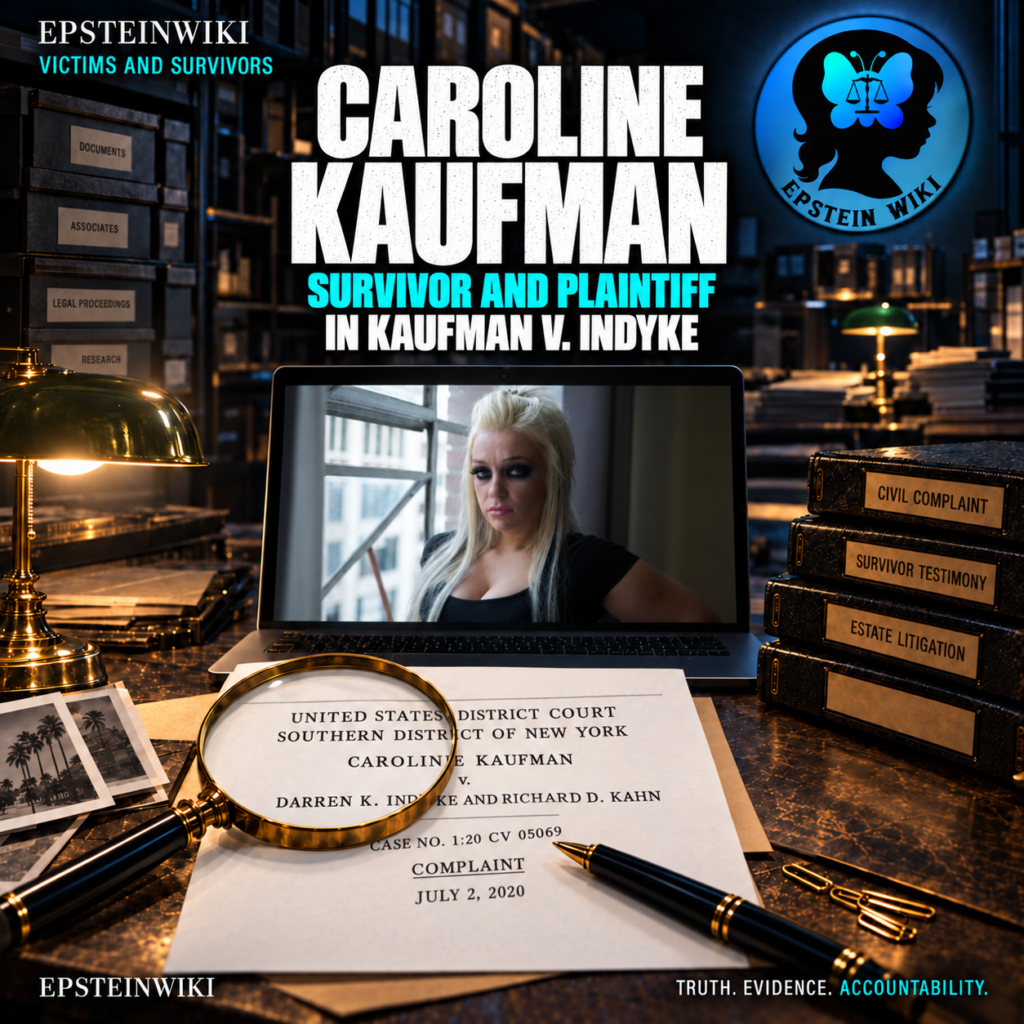
Snapshot
Caroline Kaufman is a publicly named survivor who alleged that Jeffrey Epstein raped her at his Manhattan townhouse in December 2010, when she was seventeen. She said an Epstein associate, Susan Hamblin, had approached her months earlier at a horse show in Lake Placid, New York, and presented Epstein as someone who could help her enter modeling. Kaufman alleged that an older woman she later believed was [[Ghislaine Maxwell]] photographed her undressed, brought her to a room where Epstein was waiting, and facilitated the encounter in which Epstein assaulted her. She said she screamed, received no help, and was later given $500 and threatened into silence.
Kaufman’s account is especially significant because she said the assault occurred after Epstein’s 2008 Florida conviction and during Andrew Mountbatten-Windsor’s documented December 2010 stay at Epstein’s house. In a federal complaint filed in 2020, she said she met Andrew in the townhouse before the assault but did not accuse him of participating in it. In a separate 2026 interview, she added that Andrew’s hand brushed her chest while he greeted her at a party, that he asked her age, and that he backed away after she answered that she was seventeen. Those later details must not be silently projected backward into the 2020 pleading.
Kaufman sued the executors of Epstein’s estate in the Southern District of New York. The case, Kaufman v. Indyke et al., No. 1:20-cv-05069, was filed on July 2, 2020 and terminated on December 7, 2022. The publicly accessible docket index confirms the dates, but the sources reviewed for this article do not establish the reason for termination or a judicial finding on the truth of Kaufman’s allegations.
Evidence status: Kaufman’s allegations are documented in a federal civil complaint and repeated in named interviews. Independent records corroborate Andrew’s presence at Epstein’s townhouse and a dinner there on December 2, 2010. The reviewed public record does not independently prove the alleged rape, identify Kaufman in an unredacted EFTA document, or establish that other dinner guests witnessed or knew about the alleged assault.
Content note: This article discusses alleged rape, grooming, threats, and the exploitation of a minor. It avoids unnecessary graphic detail.
Key Findings
| Finding | Evidence status | What the record supports |
|---|---|---|
| Kaufman was a minor when the alleged assault occurred | Alleged in a filed complaint and consistently reported | She said she was sixteen when approached and seventeen in December 2010 |
| Susan Hamblin recruited her through a modeling pretext | Alleged in the complaint | Hamblin allegedly approached Kaufman at a Lake Placid horse show and offered access to a modeling opportunity |
| The alleged assault occurred at Epstein’s Manhattan townhouse | Alleged in the complaint | Kaufman identified Epstein’s Upper East Side residence as the location |
| Maxwell photographed and escorted her | Identification based on Kaufman’s later understanding | The complaint described an older woman whom Kaufman believed was Maxwell |
| Epstein raped Kaufman and she screamed for help | Alleged in the complaint | No public adjudication on the merits was located |
| A woman paid her $500 and threatened her afterward | Alleged in the complaint | The woman was not conclusively identified in the reviewed sources |
| Andrew was present in the townhouse during the relevant period | Alleged by Kaufman and independently corroborated as to his December 2010 stay and dinner | Emails, press coverage, and photographs document Andrew’s visit, but do not independently place Kaufman with him |
| Andrew touched Kaufman’s chest while greeting her | Later allegation first located in a March 2026 interview | This detail was not included in the 2020 complaint reporting reviewed for this article |
| Kaufman sought compensation for medical and psychological harm | Documented through litigation and interviews | She linked a painful jaw condition to the attack, but no public medical adjudication was located |
| Kaufman’s federal case ended in 2022 | Confirmed by the docket index | The reason for termination was not established by the accessible index |
Identity and Disambiguation
Caroline Kaufman was twenty-six when her complaint became public in July 2020, twenty-seven in June 2021 reporting, and thirty-two in March 2026 reporting. Those age references place her birth approximately in 1993 or 1994. A precise birth date should not be inferred or published without a reliable public source.
This Caroline Kaufman should not be confused with other people of the same name, including writers, artists, psychologists, academics, and professionals who have no demonstrated connection to Epstein. The identity used here is limited to the publicly named plaintiff in Kaufman v. Indyke et al. and the woman interviewed about those allegations.
No unnecessary address, family information, medical documentation, or other private identifying detail is included. Her public decision to use her name does not eliminate the need for survivor-centered privacy.
Timeline
| Date | Event | Source and certainty |
|---|---|---|
| Early 2010 | Kaufman said Susan Hamblin approached her at a horse show in Lake Placid and asked whether she was a model | Allegation in the 2020 complaint |
| Early 2010 | Kaufman said she told Hamblin she was sixteen | Allegation in the 2020 complaint |
| November 22, 2010 | Epstein asked a publicist for “young fun people” for Andrew during the week beginning November 29 | EFTA email records |
| November 29 to December 5, 2010 | Contemporary planning records placed Andrew in the United States | EFTA email records and later reporting |
| December 2, 2010 | Epstein hosted a dinner for Andrew at the Manhattan townhouse | Independently corroborated by contemporaneous email records |
| December 2010 | Kaufman said she entered the townhouse for what she believed was a modeling interview and was raped by Epstein | Allegation in the 2020 complaint; she later specified December 2 |
| July 2, 2020 | Kaufman filed Kaufman v. Indyke et al., No. 1:20-cv-05069, in the Southern District of New York | Federal docket index and complaint |
| 2020 to 2021 | The civil case was reportedly paused while Kaufman pursued the Epstein Victims’ Compensation Program | Public reporting |
| June 2021 | Kaufman said she rejected the program’s offer and intended to continue litigation seeking $500 million | Named interview and reporting; demand is not an award |
| December 7, 2022 | The federal case was terminated | Docket index; termination reason not verified here |
| March 14, 2026 | Kaufman gave an expanded public account of the party and her encounter with Andrew | Interview published by The Sun |
Recruitment at the Lake Placid Horse Show
Kaufman’s complaint described a recruitment pattern based on aspiration, status, and misrepresentation. She said Hamblin approached her at a horse show in Lake Placid in early 2010, asked if she was a model, and said her “boss” could help her enter the modeling industry. Kaufman said she made clear that she was only sixteen.
The modeling approach is material for three reasons. First, it allegedly created a legitimate-seeming reason for a teenager to communicate with an adult stranger. Second, it framed access to Epstein as a career opportunity rather than a sexual encounter. Third, Kaufman’s stated disclosure of her age, if accurate, would mean the recruiter knew from the outset that she was a minor.
The reviewed sources do not establish what Hamblin told Epstein or his staff about Kaufman, whether any written casting materials existed, or whether other intermediaries participated in arranging the visit. Hamblin’s alleged role comes from Kaufman’s complaint and later reporting. This article does not treat that allegation as a criminal conviction or judicial finding.
The Trip to Epstein’s Manhattan Townhouse
Kaufman alleged that she was invited to Epstein’s residence at 9 East 71st Street for a modeling interview. Her 2026 account added that a friend drove her from Connecticut on December 2, 2010. She said she expected a photoshoot and believed the opportunity might be her break into modeling.
In the 2020 complaint, Kaufman said she was introduced to several people after entering the house, including Andrew. The complaint did not accuse Andrew of taking part in the rape. It placed him in the house before the alleged assault.
The December 2 date is consistent with independent records showing a dinner for Andrew at Epstein’s townhouse that night. Date consistency is corroboration of the surrounding setting, not proof that Kaufman attended the dinner or that the alleged assault occurred.
Alleged Photography by Ghislaine Maxwell
Kaufman alleged that, after a short period in the residence, an older woman escorted her to a private area and instructed her to undress. The woman photographed her. Kaufman said she later came to believe the woman was Ghislaine Maxwell.
According to the complaint, the woman left the room with the camera, returned, said her boss wanted to meet Kaufman, told her to put her bikini back on, and escorted her to a massage room. Epstein was allegedly nude on the massage table when Kaufman entered.
The identification requires careful phrasing. The complaint did not describe a contemporaneous formal identification procedure. It described Kaufman’s later belief and understanding that the woman was Maxwell. Maxwell was not named as a defendant in Kaufman’s captioned case, which was brought against estate executors Darren Indyke and Richard Kahn. Maxwell’s later conviction in a separate federal prosecution established her participation in Epstein’s abuse scheme generally, but it did not adjudicate Kaufman’s individual allegation.
Alleged Rape by Jeffrey Epstein
Kaufman alleged that Epstein raped her in the massage room while she was seventeen. The complaint said she screamed for help and no one came to assist her. After Epstein left, she dressed and began hyperventilating.
The alleged date makes the account a post-conviction allegation. Epstein had pleaded guilty in Florida in 2008 to state prostitution-related offenses, including an offense involving a minor, and had already served his custodial sentence by the time of the alleged December 2010 attack. Kaufman’s account therefore alleges that Epstein continued abusing a minor after a conviction that was already public and while he remained a registered sex offender.
No criminal charge concerning Kaufman’s allegation was located. Epstein died in federal custody in August 2019 before Kaufman filed her civil complaint. The estate litigation could seek monetary relief, but could not produce a criminal trial of Epstein.
The $500 Payment and Alleged Threat
Kaufman alleged that a woman handed her $500 as she left the massage room and warned that Epstein was powerful, knew presidents, and would kill Kaufman and her family if she spoke.
The payment and threat are central to her explanation of delayed disclosure. In her account, the money was not ordinary compensation for modeling work. It followed the alleged assault and was paired with an explicit threat. The public reporting reviewed here does not conclusively identify the woman who allegedly made the payment and threat.
Delayed reporting does not by itself prove or disprove an allegation. In Kaufman’s account, she was a minor confronted with wealth, social power, and a direct threat against her family. Later reporting said she experienced severe psychological distress and had at one point become suicidal. Those effects are reported claims, not independent clinical findings presented in the public docket material reviewed here.
Andrew’s Presence: What Kaufman Said in 2020
The 2020 complaint said Kaufman was introduced inside Epstein’s mansion to Andrew Albert Christian Edward, then widely known as Prince Andrew, Duke of York. Reporting on the complaint emphasized that Kaufman did not claim Andrew participated in the alleged rape. His stated relevance was presence in the house shortly beforehand.
Andrew’s representatives declined to comment to The Independent on Kaufman’s specific claim in July 2020. Andrew has denied wrongdoing connected to Epstein more broadly and has denied knowledge of Epstein’s abuse.
The distinction between presence and participation is essential. A person’s presence in a building does not establish knowledge of every event inside it. At the same time, the independently documented visit makes Kaufman’s placement of Andrew at the townhouse during that period testable against external records rather than purely isolated recollection.
Kaufman’s Expanded 2026 Account
In March 2026, Kaufman gave The Sun a more detailed description of December 2, 2010. She said the house contained dozens of girls and other men, that girls were directed to wear similar tight black dresses and eyeliner, and that the atmosphere felt like a “meat market.” She estimated that as many as one hundred girls may have been present. That number is her recollection, not an independently verified count.
Kaufman alleged that Andrew wore a black tuxedo, approached girls, and appeared to be the focus of the event. She said his hand brushed her chest as he greeted her. According to Kaufman, he asked her age and seemed to withdraw after she said she was seventeen. She said she remained at the event for about forty minutes before being taken upstairs and raped by Epstein.
These assertions are later allegations published nearly sixteen years after the event. The reviewed description of the 2020 complaint mentioned an introduction to Andrew but not the alleged brushing of her chest, a standardized dress requirement, or the estimate of one hundred girls. The absence of those details from earlier reporting does not automatically disprove the later account, but readers should know that the public narrative expanded.
Kaufman also said she believed a later-released, undated photograph appearing to show Andrew crouched over a woman was taken in Epstein’s dining room, although likely on another day because Andrew’s clothing differed. She said she believed she knew the woman’s identity. That is Kaufman’s interpretation. The public photograph does not establish its date, the woman’s identity, or a connection to Kaufman’s alleged assault.
Comparing the 2020 and 2026 Accounts
| Subject | 2020 complaint and reporting | 2026 interview | Assessment |
|---|---|---|---|
| Date | December 2010 | December 2, 2010 | Later account becomes more specific and aligns with a documented dinner date |
| Purpose of visit | Modeling interview | Photoshoot and hoped-for modeling break | Substantively consistent |
| Andrew | Introduced to him before the alleged rape; no claim he participated | Alleged that his hand brushed her chest and he asked her age | Material later detail, not located in the 2020 account |
| Other girls | Not central in the reviewed complaint coverage | Dozens present; Kaufman estimated as many as one hundred | Later detail, not independently counted |
| Clothing | Kaufman put on a bikini for photographs | Girls were also directed to wear similar black dresses and eyeliner | Later description adds a party staging claim |
| Time before assault | After a short period | About forty minutes | Compatible but more specific |
| Epstein | Alleged rape in a massage room | Repeated allegation of rape upstairs | Core allegation remains consistent |
| Maxwell | Older woman believed to be Maxwell photographed and escorted her | The later article focused more heavily on the party and Andrew | No clear contradiction established |
The careful conclusion is not that the accounts are identical. The core recruitment, location, age, and assault allegations remained stable, while the later interview added substantial environmental and Andrew-specific details.
Independent Evidence of Andrew’s December 2010 Visit
Andrew’s stay with Epstein in New York is independently documented. He was photographed walking with Epstein in Central Park. Contemporary emails show planning for his visit from November 29 through December 5, preparations for a dinner, and follow-up messages about the event.
The following records corroborate the surrounding timeline:
| EFTA record | Documented point | Limits |
|---|---|---|
| EFTA01980953 | Epstein asked for “young fun people” for Andrew during the week beginning November 29 | Does not identify Kaufman or prove who attended |
| EFTA02409986 | Duplicate or related production of the same planning exchange | Same limitation |
| EFTA00776666 | Additional production of the “young fun people” exchange | Same limitation |
| EFTA00898495 | Additional production of the planning email | Same limitation |
| EFTA01786706 | Dinner preparations included gold ballroom chairs and flowers | Does not establish the complete guest list |
| EFTA02414211 | Related production concerning table preparations | Does not identify Kaufman |
| EFTA02318163 | A correspondent asked the time of dinner at Epstein’s house and said Maxwell might stop by | Does not prove Maxwell attended or identify Kaufman |
| EFTA00749561 | Peggy Siegal’s December 3 message described the prior evening as sensational and praised the table and food | Corroborates a dinner, not an assault |
| EFTA02413967 | A December 3 message referred to the prior night’s dinner for Andrew | Does not establish all attendees |
| EFTA01981593 | A December 4 message from Epstein referred to Andrew and himself together | Corroborates continuing contact during the visit |
| EFTA01794995 | Contemporary press material covered Andrew at the townhouse | Secondary press material contained in the production |
The documentary record corroborates three important contextual facts: Andrew was in Epstein’s orbit during the relevant week, Epstein organized social activity around him, and a dinner occurred at the townhouse on December 2. It does not independently identify Kaufman as a guest or establish what happened to her inside the house.
The “Young Fun People” Email
On November 22, 2010, Epstein wrote to a publicist asking for “young fun people” for Andrew during the week of November 29. Multiple EFTA productions preserve the exchange, including EFTA01980953, EFTA02409986, EFTA00776666, and EFTA00898495.
The wording is relevant to Kaufman’s 2026 description of an event populated by young women. It is not, by itself, proof that the request produced the gathering she described. The email does not name Kaufman, state that minors were requested, or document an intent to facilitate sexual abuse. Its evidentiary value is contextual: Epstein was actively seeking young social company for Andrew’s visit shortly before the date Kaufman identified.
The December 2 Dinner
Contemporaneous emails document a dinner at Epstein’s townhouse on December 2, 2010. Publicist Peggy Siegal wrote to Epstein the following day, described the evening as successful, referred to a conversation with Andrew, praised the table and food, and discussed copies of The King’s Speech left for him. Other released communications concerned chairs, flowers, and the timing of dinner.
Later reporting identified prominent invitees or attendees, but the public record is not a complete, authenticated guest ledger. Names appearing in planning emails should not automatically be described as confirmed attendees. Likewise, no reviewed dinner email names Kaufman.
The dinner evidence narrows the possible timeline and independently confirms social activity at the house on the date Kaufman later specified. It does not reveal whether an assault occurred elsewhere in the residence before, during, or after the gathering.
Security and Royal Protection
Released correspondence also concerned accommodations for Andrew and two protection officers. Records include EFTA02415281, EFTA02318530, and EFTA02318446. A separate message, EFTA00561016, referred to Royal Protection officers and private security arranged by Epstein.
The presence of protection personnel may be relevant to reconstructing movements, entrances, staffing, and contemporaneous logs. It does not mean those officers witnessed or knew about Kaufman’s alleged assault. No reviewed public document identifies a protection officer as a witness to her arrival or departure.
Potentially probative but not publicly located materials include visitor logs, duty books, vehicle records, radio logs, staff rosters, security-camera records, and statements from the friend who Kaufman said drove her from Connecticut.
Federal Civil Case
Kaufman filed Kaufman v. Indyke et al., No. 1:20-cv-05069, in the United States District Court for the Southern District of New York on July 2, 2020. The defendants were Darren Indyke and Richard Kahn in their capacities connected to Epstein’s estate. The complaint sought damages for alleged rape, sexual assault, and resulting harm.
The case index identifies Judge J. Paul Oetken and classifies the matter as a personal-injury tort action. It records termination on December 7, 2022. The accessible sources reviewed for this article do not show whether termination followed settlement, voluntary dismissal, procedural disposition, or another event. It would be inaccurate to claim that Kaufman won, lost on the merits, or received a specific sum without the terminating filing or another reliable source.
The complaint remains important evidence of what Kaufman formally alleged under her own name. A complaint is a statement of claims, not proof by itself. Its allegations should be attributed unless independently established.
Epstein Victims’ Compensation Program
Reporting in 2021 said Kaufman’s civil proceedings were paused while she applied to the Epstein Victims’ Compensation Program. She said she rejected the offer she received because it was too low to cover surgery and described it as offensive. She then said she intended to proceed in court.
The program allowed claimants to accept or reject individual offers. Acceptance generally required a release of claims, while rejection left a claimant free to pursue litigation. Public program documents described those rules at a general level.
EFTA00094739 is a defense subpoena concerning the compensation program in the Maxwell criminal case. Accuser identities are redacted. It is useful for understanding the program’s records and procedures, but it cannot be attributed specifically to Kaufman on the public page reviewed here.
No public source reviewed for this article establishes the amount offered to Kaufman, the program’s reasoning, or whether she later accepted any payment through the program or a separate settlement.
The $500 Million Demand and Medical Claims
In June 2021, Kaufman and attorney Spencer Kuvin said they intended to seek $500 million from Epstein’s estate. That figure was a litigation demand, not a judgment, settlement, or documented payment.
Kaufman said she suffered from osteomyelitis affecting her jaw and believed the condition resulted from Epstein striking or nicking her jaw while restraining her during the alleged assault. She described pain, muscle spasms, facial swelling, emergency-room treatment, medication, missed work, difficulty eating, exhaustion, and a need for surgery. She also said she hoped compensation could fund treatment and support a charity for other survivors.
The causal link between the alleged assault and osteomyelitis was Kaufman’s stated belief. The reviewed public record does not contain medical records, expert testimony, or a judicial finding establishing causation. The article therefore distinguishes the reported diagnosis and symptoms from the unadjudicated explanation of their cause.
Susan Hamblin’s Alleged Role
Kaufman identified Susan Hamblin as the person who approached her at the Lake Placid horse show and connected her to Epstein under a modeling pretext. According to Kaufman’s account, Hamblin knew she was sixteen when contact began.
The evidence reviewed for this article does not establish whether Hamblin attended the December 2010 event, entered the townhouse with Kaufman, received money for the introduction, or participated in the alleged post-assault threat. Some secondary summaries collapse the recruiter, photographer, escort, payer, and threatening woman into one person. The complaint reporting does not justify that collapse. These roles should remain separate unless a primary record identifies them.
No criminal conviction or adjudicated civil finding against Hamblin concerning Kaufman was located. Her inclusion is based on a named allegation in Kaufman’s lawsuit.
Evidence Map
| Person or entity | Alleged or documented connection to Kaufman | Evidence level |
|---|---|---|
| [[Jeffrey Epstein]] | Alleged to have raped Kaufman at age seventeen | Filed allegation; no merits adjudication located |
| [[Ghislaine Maxwell]] | Believed by Kaufman to be the older woman who photographed and escorted her | Alleged identification based on later understanding |
| [[Susan Hamblin]] | Allegedly recruited Kaufman through a modeling pretext after learning she was sixteen | Filed allegation |
| Andrew Mountbatten-Windsor | Kaufman said she met him in the house; later alleged his hand brushed her chest | Filed presence allegation plus later interview; visit independently corroborated |
| Darren Indyke | Defendant as an executor of Epstein’s estate | Federal docket |
| Richard Kahn | Defendant as an executor of Epstein’s estate | Federal docket |
| Spencer Kuvin | Publicly identified as Kaufman’s attorney | Reporting and quoted statements |
| Epstein Victims’ Compensation Program | Kaufman reportedly applied and rejected an offer | Reporting; individual file not public |
EFTA Name Audit
An exact-name review of the searchable EFTA corpus did not locate an unredacted released document that directly names Caroline Kaufman. Broader searches produced false positives in which “Caroline” and “Kaufman” appeared separately or in unrelated material.
| Record or search result | What was found | Conclusion |
|---|---|---|
| Exact phrase search for “Caroline Kaufman” | No verified unredacted direct match | No direct EFTA appearance established |
| EFTA01497384 | Banking material without a verified Kaufman reference | Unrelated false positive |
| EFTA00463782 | Redacted apartment-related email without a visible Kaufman identification | Cannot be attributed to her |
| EFTA02629601 | Redacted employment or assistance request without a visible Kaufman identification | Cannot be attributed to her |
| EFTA00094739 | Compensation-program subpoena with claimant identities redacted | Relevant background, not a direct Kaufman record |
The absence of an unredacted name match does not disprove Kaufman’s account. Survivor names are frequently redacted, and her central allegations entered the public record through civil litigation rather than an unredacted Epstein email. It also means no EFTA page should be presented as hers without additional identification evidence.
What Is Independently Corroborated
The following points are corroborated independently of Kaufman’s recollection:
- Epstein owned and used the Manhattan townhouse at 9 East 71st Street.
- Epstein had already been convicted in Florida before December 2010.
- Andrew stayed with Epstein and was in New York during the relevant period.
- Epstein’s circle planned social activity for Andrew during the week beginning November 29, 2010.
- Epstein asked for “young fun people” for Andrew’s visit.
- A dinner for Andrew occurred at the townhouse on December 2, 2010.
- Preparations involved staff, invited guests, food, furniture, and flowers.
- Andrew traveled with royal protection personnel, and Epstein arranged additional private security.
- Kaufman filed a federal civil complaint on July 2, 2020.
- The case docket records termination on December 7, 2022.
These points strengthen the chronological plausibility of the setting Kaufman described. They do not independently establish that she was present or that Epstein assaulted her.
What Remains Allegation or Unresolved
The following points remain allegations, later recollections, or unresolved questions in the reviewed public record:
- Hamblin’s recruitment of Kaufman and knowledge of her age.
- Kaufman’s presence at the townhouse on December 2, 2010.
- Maxwell’s identity as the woman who allegedly photographed and escorted her.
- The alleged rape by Epstein.
- The alleged screams and absence of intervention.
- The $500 payment and threat against Kaufman and her family.
- Andrew’s alleged physical contact with Kaufman’s chest.
- The number and ages of girls present at the event.
- Whether the event was organized for Andrew to select women or girls.
- The identity and role of every staff member, guest, driver, security officer, or witness.
- The medical cause of Kaufman’s osteomyelitis.
- The amount offered by the compensation program.
- The reason the federal case terminated and whether any confidential resolution occurred.
What the Record Does Not Establish
The reviewed evidence does not establish that Andrew witnessed Kaufman’s alleged rape, heard her screams, knew in advance that she would be assaulted, or participated in the assault by Epstein. It does not establish that every person invited to the December 2 dinner attended. It does not establish that the women or girls described in Kaufman’s 2026 interview were all minors, trafficking victims, or recruited for sexual activity.
The record also does not establish that Kaufman’s allegations were rejected as false. A terminated civil docket is not equivalent to a merits judgment, and a compensation offer is not a public adjudication of credibility. No verified public finding resolving her account was located.
Survivor-Centered Significance
Kaufman’s account shifts attention from Epstein’s famous guest to the alleged experience of a minor inside a residence protected by wealth, staff, social prestige, and security. Her story alleges that Epstein’s known status as a convicted sex offender did not prevent continued access to a teenager through a modeling pretext.
The surrounding records demonstrate why survivor accounts must not be reduced to celebrity adjacency. Andrew’s presence is historically and evidentially relevant because it helps date the visit and illustrates Epstein’s continued elite access. The central allegation, however, is that Kaufman was recruited, isolated, photographed, assaulted, paid, and threatened.
The public record also shows the limits imposed on survivors seeking accountability after Epstein’s death. Kaufman’s options were civil litigation and a compensation program administered against the estate. Neither route could put Epstein on trial for her allegation.
Fact-Check and Methodology
This article applies the following rules:
- Allegations in a complaint are attributed to the plaintiff.
- Later interviews are dated and separated from the original pleading.
- Documentary corroboration of time and place is not described as proof of assault.
- Repeated EFTA productions are listed as duplicates or related copies, not as multiple independent witnesses.
- Redacted records are not assigned to Kaufman without identifying evidence.
- A litigation demand is not described as money received.
- Case termination is not described as a merits victory or defeat without the terminating filing.
- Kaufman’s stated medical causation is not presented as an expert conclusion.
- The spelling “Kaufman” is used. Some image captions and secondary items have rendered her surname as “Kauffman.”
- Research was current through September 21, 2026.
The principal primary source is Kaufman’s federal complaint. Contemporaneous EFTA emails are used to reconstruct the December 2010 setting. News reporting is used for interviews, later claims, and context. Tabloid-originated details are expressly attributed and are not upgraded into established fact through repetition by other outlets.
Questions for Further Research
- What does the December 7, 2022 terminating docket entry say, and was the case dismissed voluntarily, resolved confidentially, or ended on another basis?
- Do unsealed filings identify the amount or terms of any settlement?
- Can the friend who allegedly drove Kaufman from Connecticut corroborate the date, route, arrival, or her condition afterward?
- Do townhouse visitor logs, staff calendars, vehicle records, telephone records, or security materials identify Kaufman?
- Which staff members worked at 9 East 71st Street on December 2, 2010?
- Do Royal Protection records document entrances, exits, or unusual activity at the house that day?
- Was Maxwell present at the townhouse, and can her movements be reconstructed from independent records?
- Did investigators interview Susan Hamblin about Kaufman’s allegation?
- Are there surviving photographs from the alleged modeling session, and were any seized by law enforcement?
- Who handed Kaufman the alleged $500, and who made the alleged threat?
- What contemporaneous medical or personal records document Kaufman’s reported injuries or disclosures?
- What amount did the compensation program offer, and what categories of harm did its administrator recognize?
- Did prosecutors or investigators interview the two witnesses whom Kaufman’s attorney reportedly said could place her at the location and time?
- Can the undated photograph discussed in 2026 be reliably dated and located within the townhouse?
- Are any redacted EFTA records capable of lawful identification as Kaufman records through docket exhibits or metadata?
Source List
- Kaufman v. Indyke et al., No. 1:20-cv-05069 (S.D.N.Y.), complaint filed July 2, 2020: https://storage.courtlistener.com/recap/gov.uscourts.nysd.539607/gov.uscourts.nysd.539607.2.0_2.pdf
- CourtListener docket index, Kaufman v. Indyke, filing and termination dates: https://www.courtlistener.com/docket/17317768/authorities/kaufman-v-indyke/
- PACER Monitor case index, Kaufman v. Indyke et al.: https://www.pacermonitor.com/public/case/35074598/Kaufman_v_Indyke_et_al
- Richard Hall, “Woman claims she was raped as a teenager by Epstein in New York mansion while Prince Andrew was visiting,” The Independent, July 3, 2020: https://www.the-independent.com/news/world/americas/caroline-kaufman-prince-andrew-jeffrey-epstein-rape-new-york-ghislaine-maxwell-a9600656.html
- Gustaf Kilander, “Epstein accuser sues estate for $500m claiming he gave her bone disease,” The Independent, June 15, 2021: https://www.the-independent.com/news/world/americas/crime/jeffrey-epstein-caroline-kaufman-lawsuit-b1866402.html
- Rebecca Rosenberg, “Jeffrey Epstein accuser sues for $500M over bone disease,” New York Post, June 15, 2021: https://nypost.com/2021/06/15/jeffrey-epstein-accuser-sues-for-500m-over-bone-disease/
- EJ Dickson, “The Fight Against Jeffrey Epstein and Ghislaine Maxwell’s Sex Ring Is Far From Over,” Rolling Stone, December 31, 2021: https://www.rollingstone.com/culture/culture-features/ghislaine-maxwell-jeffrey-epstein-prince-andrew-lawsuits-1277191/
- Scarlet Howes, “Andrew ‘brushed my boobs when I was 17’ at Epstein mansion,” The Sun, March 14, 2026: https://www.thesun.co.uk/royals/38516718/andrew-mountbatten-windsor-brushed-my-boobs-epstein-mansion/
- Ellie Ng, “Andrew was given copies of The King’s Speech at Epstein dinner in New York, email shows,” The Standard, February 6, 2026: https://www.standard.co.uk/news/politics/andrew-epstein-dinner-new-york-december-2010-kings-speech-b1269858.html
- Karla Adam, “Epstein file photos appear to show Andrew crouched over female on floor,” The Washington Post, January 31, 2026: https://www.washingtonpost.com/world/2026/01/31/epstein-andrew-buckingham-palace-photos/
- EFTA planning email concerning “young fun people”: https://epstein-data.com/EFTA01980953
- EFTA duplicate or related production of planning email: https://epstein-data.com/EFTA02409986
- EFTA duplicate or related production of planning email: https://epstein-data.com/EFTA00776666
- EFTA duplicate or related production of planning email: https://epstein-data.com/EFTA00898495
- EFTA Peggy Siegal post-dinner email: https://epstein-data.com/EFTA00749561
- EFTA dinner preparation record: https://epstein-data.com/EFTA01786706
- EFTA related dinner preparation record: https://epstein-data.com/EFTA02414211
- EFTA dinner timing and possible Maxwell attendance message: https://epstein-data.com/EFTA02318163
- EFTA December 3 message concerning dinner for Andrew: https://epstein-data.com/EFTA02413967
- EFTA December 4 message referring to Epstein and Andrew: https://epstein-data.com/EFTA01981593
- EFTA contemporary press material on Andrew at the townhouse: https://epstein-data.com/EFTA01794995
- EFTA Royal Household accommodation correspondence: https://epstein-data.com/EFTA02415281
- EFTA related protection-officer accommodation record: https://epstein-data.com/EFTA02318530
- EFTA related Royal Household record: https://epstein-data.com/EFTA02318446
- EFTA message concerning Royal Protection and private security: https://epstein-data.com/EFTA00561016
- EFTA compensation-program subpoena: https://epstein-data.com/EFTA00094739