
Adriana Ross: Epstein Assistant Named in the 2007 Nonprosecution Agreement
Snapshot
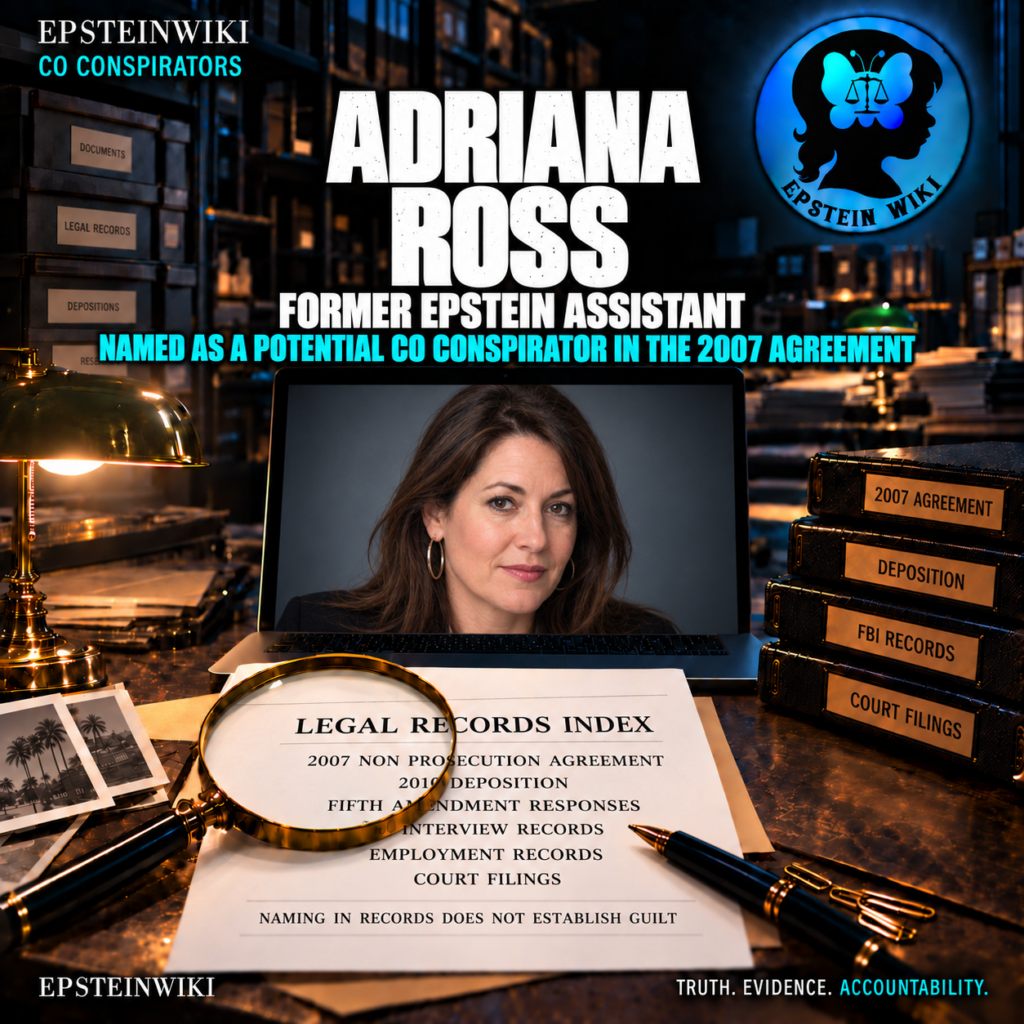
Adriana Ross, also recorded as Adriana Mucinska, worked as one of Jeffrey Epstein’s assistants in the 2000s. Pilot Lawrence Visoski confirmed her assistant role under oath at Ghislaine Maxwell’s trial. An FBI chart attributes a proffer about scheduling massage appointments to Ross. Federal investigators subpoenaed her records, and prosecutors included her in an unfiled proposed indictment. The 2007 nonprosecution agreement expressly named her among people covered by a promise not to bring federal charges against Epstein’s potential coconspirators. Ross was not convicted of an Epstein related crime. These records include allegations and investigative assessments, not findings of individual guilt.
The Maxwell trial transcript, DOJ-OGR-00011773, records Visoski’s identification of Mucinska as an Epstein assistant. The nonprosecution agreement, DOJ-OGR-00000290, contains the clause naming Ross.
Names and Work in Epstein’s Household
The March 2008 grand jury transcript, DOJ-OGR-00004663, captions her as “Adriana Ross, a/k/a Adriana Mucinska.” A separate Palm Beach County docket compilation, EFTA00606813, uses Adriana Mucinska Ross. A Maxwell voir dire list, DOJ-OGR-00008863, uses Adriana Ross Salazar. These are record variants for the same person, not additional associates.
Ross’s March 15, 2010 deposition transcript, archived with the Edwards v. Epstein attachments, records her own account of her earlier life. She said she grew up in Poland, worked as a model in Europe, and came to the United States in fall 2002 after an invitation through Elite Models. She described marrying Duncan Ross in 2003 and studying accounting after receiving an associate degree from Miami Dade College in 2008. Her statements about modeling and education are biographical testimony, not evidence that modeling agencies participated in Epstein’s crimes. The transcript is embedded in a much larger compilation, so its printed deposition page numbers are more useful than the compilation’s PDF page numbers.
Visoski’s November 30, 2021 testimony, DOJ-OGR-00011773, establishes that he remembered Mucinska, agreed she became one of Epstein’s assistants in the 2000s, and said he interacted with her to a lesser extent than with some other staff. The trial exchange establishes employment and contact. It does not, by itself, establish that she committed a crime.
An FBI link analysis chart, EFTA01653420, gives a more specific account. Its entry for “Adriana Mucinska (Ross)” says she admitted in a proffer that Sarah Kellen Vickers trained her to schedule Florida and New York massage appointments for Epstein. It also says Vickers instructed her to remove items from Epstein’s Palm Beach and Virgin Islands homes and have them destroyed during the Palm Beach investigation. The chart does not say Ross actually destroyed those items. Its final qualification says investigators did not know whether she recruited or abused victims. Those qualifications matter when describing her role.
A filing in Giuffre v. Maxwell reproduced in the Second Circuit unsealing record says house manager Janusz Banasiak testified that Ross removed computers from Epstein’s home. The filing cites Banasiak’s deposition at 54:7–22 and also cites detective Joseph Recarey’s testimony that computers were absent when the search warrant was executed. This is a litigant’s characterization of testimony in a contested civil case. It supports reporting the allegation, but the cited passage alone does not establish what Ross did with the computers, when they were removed, or whether any data was destroyed. It should not be merged with the FBI chart’s separate account of an instruction to remove and destroy items.
Operation Leap Year and the Grand Jury
The federal investigation timeline, EFTA00224943, records a November 13, 2006 subpoena to Adriana Mucinska, described as a former assistant, and another issued December 18, 2006. The Operation Leap Year subpoena log, EFTA00193068, identifies the entries as OLY 24 and OLY 24 2. It describes the requested material as employment records, contact information, and massage appointments, and records a February 6, 2007 return date for the second subpoena. A subpoena establishes an investigative request, not guilt.
The March 18, 2008 grand jury transcript, DOJ-OGR-00004663, has a caption naming Epstein, Sarah Kellen, Ross, and Nadia Marcinkova as defendants. The body describes investigative work with assistants’ telephone records and contacts with Jane Does. A caption in a grand jury record is not a public indictment or a conviction. Researchers should distinguish this caption from the federal charges that ultimately were not brought in the Southern District of Florida.
The 77 page Operation Leap Year presentation outline, EFTA00192670, includes a proposed indictment naming “ADRIANA ROSS, a/k/a Adriana Mucinska” alongside Epstein and other staff. Its proposed overt acts attribute calls from Ross to a telephone used by Jane Doe #14 in March 2005. This was a prosecutorial draft, not a filed indictment or a judicial determination; the phone attribution and its significance remain allegations in that draft. Its hand dated April 25, 2008 pages also show why the date of the grand jury materials should not be confused with the September 2007 agreement.
The 2007 Nonprosecution Agreement
The agreement reproduced as DOJ-OGR-00000290 promised that, if Epstein fulfilled its terms, the United States would not institute criminal charges against “any potential co-conspirators of Epstein,” specifically naming Sarah Kellen, Adriana Ross, Lesley Groff, and Nadia Marcinkova. The phrase describes the agreement’s scope. It is not a judicial finding that each named person committed a specified offense. The agreement also anticipated that it would not become part of a public record.
DOJ’s Office of Professional Responsibility review, DOJ-OGR-00003177, found that the broad coconspirator provision was added with little prosecutorial discussion or consideration. The review records prosecutor Marie Villafaña’s understanding that the four named women were the people the provision was intended to cover and that the office focused on Epstein as the principal target. The breadth and secrecy of this provision remain central to the survivors’ challenge to the agreement.
Another copy of the agreement, EFTA00176610, contains a separate immigration provision. The federal office agreed that it would not request, initiate, or encourage immigration authorities to bring proceedings against Ross or Marcinkova. This provision is distinct from the promise concerning criminal charges. The agreement does not establish Ross’s precise immigration status or explain why the parties negotiated this protection.
The Eleventh Circuit’s Courtney Wild opinion describes the clause and the lack of victim notice. The Second Circuit’s 2024 Maxwell opinion, DOJ-OGR-00000002, quotes it again but holds that the Florida agreement did not bind prosecutors in the Southern District of New York in Maxwell’s case. That ruling concerned Maxwell. It should not be presented as an individual adjudication of Ross’s conduct or liability.
Depositions and What Her Refusals Mean
The 138 page transcript of Ross’s March 15, 2010 videotaped deposition shows that she answered questions about her background but declined many substantive questions about Epstein. Filed excerpts, EFTA00188608, reproduce some of those refusals. A statement filed by attorney Bradley Edwards, EFTA00081180, describes Ross, Kellen, and Marcinkova invoking the privilege against self incrimination during civil discovery. Exercising that privilege is not an admission that a question’s premise was true.
Some questioning concerned Prince Andrew and Sandy Berger. Questions about whether a person was involved with underage girls or alerted Epstein to a search do not establish that the alleged event occurred. Ross’s refusal supplies no affirmative answer. Numerical claims about how many times she invoked the Fifth Amendment require a defined counting method across the full transcript, so this article does not substitute an estimate for that count.
The Palm Beach County docket compilation, EFTA00606813, also records a 2013 notice to take a deposition under the name Adriana Mucinska Ross. A notice does not show that a second deposition took place or what testimony was given.
Travel and the Limits of the Logs
Ross also appears as Mucinska in flight records. A passenger manifest filed in Giuffre v. Maxwell, exhibit page 76, names Adriana Mucinska for an August 18, 2005 flight from Teterboro, New Jersey, to West Palm Beach, Florida. The Maxwell trial flight log release contains additional handwritten records. Differently transcribed names and duplicate log or manifest entries can inflate automated totals, so a comprehensive flight count requires reconciliation against the original pages. A passenger entry alone does not prove knowledge of abuse or participation in it.
Later Court References and Accountability Questions
The Maxwell court exhibit, DOJ-OGR-00008863, lists “Adriana Ross Salazar” among names used for jury selection. It does not show that she testified. The Second Circuit opinion, DOJ-OGR-00000002, explains why Maxwell could still be prosecuted in New York despite the Florida agreement. Neither document adjudicates Ross’s conduct.
The record leaves several material questions open. Which computers did Banasiak mean, and what does his full deposition establish about their removal and custody? Were the other items mentioned in the FBI chart removed or destroyed? What did Ross’s proffer say in full? Which appointments can be independently tied to her rather than another assistant? What, if anything, did investigators establish about her knowledge of the ages of people scheduled? The released chart expressly leaves recruitment and abuse unresolved.
Evidence Appearances
| Record | What it contains | What it establishes |
|---|---|---|
| DOJ-OGR-00000290 | September 2007 nonprosecution agreement | Ross is expressly named in the potential coconspirator clause. |
| DOJ-OGR-00003177 | DOJ professional responsibility review | Explains the negotiation and limited discussion of the clause. |
| EFTA00176610 | Another copy of the agreement | Contains the separate immigration provision naming Ross and Marcinkova. |
| DOJ-OGR-00004663 | March 18, 2008 grand jury transcript | Uses Ross’s name and Mucinska alias in the caption; discusses telephone evidence. |
| DOJ-OGR-00011773 | Maxwell trial testimony of Lawrence Visoski | Identifies Mucinska as an Epstein assistant. |
| EFTA01653420 | FBI employee link analysis chart | Attributes a scheduling proffer to Ross and records an instruction concerning removal of items, with explicit uncertainty about recruitment and abuse. |
| EFTA00224943 | Operation Leap Year investigation timeline | Dates two late 2006 subpoenas to Mucinska. |
| EFTA00193068 | Grand jury subpoena log | States the material sought and the second subpoena’s return entry. |
| EFTA00192670 | Federal grand jury presentation outline | Shows Ross was included in a proposed prosecutorial presentation; it is not a filed indictment. |
| Giuffre appellate filing, p. 56 | Litigant’s summary of Banasiak and Recarey depositions | Attributes computer removal to Ross in Banasiak’s testimony; does not establish disposal or destruction. |
| Ross deposition in Edwards attachments | Full 138 page transcript embedded in a larger compilation | Records her biographical answers and refusals to answer Epstein related questions. |
| EFTA00188608 | Filed excerpts of Ross’s 2010 deposition | Shows refusals to answer substantive questions. |
| EFTA00081180 | Edwards statement of facts in civil litigation | Characterizes the deposition refusals as Fifth Amendment invocations. |
| EFTA00606813 | Palm Beach County docket compilation | Records a later notice of deposition under a name variant. |
| August 18, 2005 passenger manifest | Flight record filed in Giuffre v. Maxwell | Names Mucinska on a Teterboro to West Palm Beach flight. |
| DOJ-OGR-00008863 | Maxwell jury selection name list | Records the variant Adriana Ross Salazar, without proving testimony. |
| DOJ-OGR-00000002 | Second Circuit Maxwell opinion | Quotes the agreement and limits its binding effect on New York prosecutors. |
Related EpsteinWiki Pages
- Jeffrey Epstein
- Ghislaine Maxwell
- Sarah Kellen
- Nadia Marcinkova
- 2007 Nonprosecution Agreement
- Alexander Acosta
Questions for Further Research
- Will the complete Ross proffer and underlying FBI interview notes be released with survivor identifying details protected?
- Can investigators document the identity and disposition of the items mentioned in the FBI chart?
- Which dated flight log pages name Ross or Mucinska, and which names are uncertain handwriting readings?
- Did the government document an individual assessment of Ross’s conduct before adding her to the agreement?
- What does the full Banasiak deposition say about the date, destination, and fate of the computers?
Sources
- 2007 nonprosecution agreement, DOJ-OGR-00000290. The signed agreement names Ross in the potential coconspirator clause and sets the condition for the federal charging promise.
- Agreement copy with immigration provision, EFTA00176610. This version records a separate promise concerning immigration proceedings against Ross and Marcinkova.
- DOJ professional responsibility review, DOJ-OGR-00003177. The department’s retrospective review describes how the coconspirator clause was negotiated and assessed.
- FBI link analysis, EFTA01653420. The chart summarizes Ross’s scheduling proffer, an instruction about removing property, and investigators’ stated uncertainty about recruiting or abuse.
- Operation Leap Year timeline, EFTA00224943. The chronology dates the two subpoenas to Mucinska in late 2006.
- Grand jury subpoena log, EFTA00193068. The log identifies requested employment, contact, and appointment records and a return date.
- March 2008 grand jury transcript, DOJ-OGR-00004663. Its caption uses both Ross and Mucinska and its testimony discusses investigative telephone work.
- Proposed indictment and presentation, EFTA00192670. Prosecutorial working material names Ross and includes proposed overt acts concerning calls; the draft was not a filed charge.
- Banasiak testimony as characterized in a Giuffre filing. The civil litigant cites his deposition at 54:7–22 for the claim that Ross removed computers; the filing also cites Recarey on the search.
- Full Ross deposition in the Edwards attachments. The March 15, 2010 transcript records biographical answers and repeated refusals on substantive questions.
- Filed Ross deposition excerpts, EFTA00188608. These pages reproduce selected questions and refusals from the civil deposition.
- Bradley Edwards statement, EFTA00081180. The attorney’s civil filing describes Fifth Amendment invocations by Ross and other deponents.
- Palm Beach County docket compilation, EFTA00606813. It records a later deposition notice using the Mucinska Ross name variant.
- Lawrence Visoski trial transcript, DOJ-OGR-00011773. The pilot identified Mucinska as an Epstein assistant in sworn testimony.
- Maxwell jury selection list, DOJ-OGR-00008863. The list includes the name Adriana Ross Salazar; it does not establish that she testified.
- Second Circuit Maxwell opinion, DOJ-OGR-00000002. The court quotes the agreement and holds that it did not bind New York prosecutors in Maxwell’s case.
- Maxwell trial flight log release. The handwritten passenger records provide the underlying material for checking individual travel entries.
- August 18, 2005 passenger manifest, Giuffre v. Maxwell. The filed exhibit names Mucinska on the Teterboro to West Palm Beach flight.
- Eleventh Circuit opinion in Courtney Wild’s case. The opinion recounts the agreement’s terms and the dispute over notice to victims.