
Ariel M. Smith
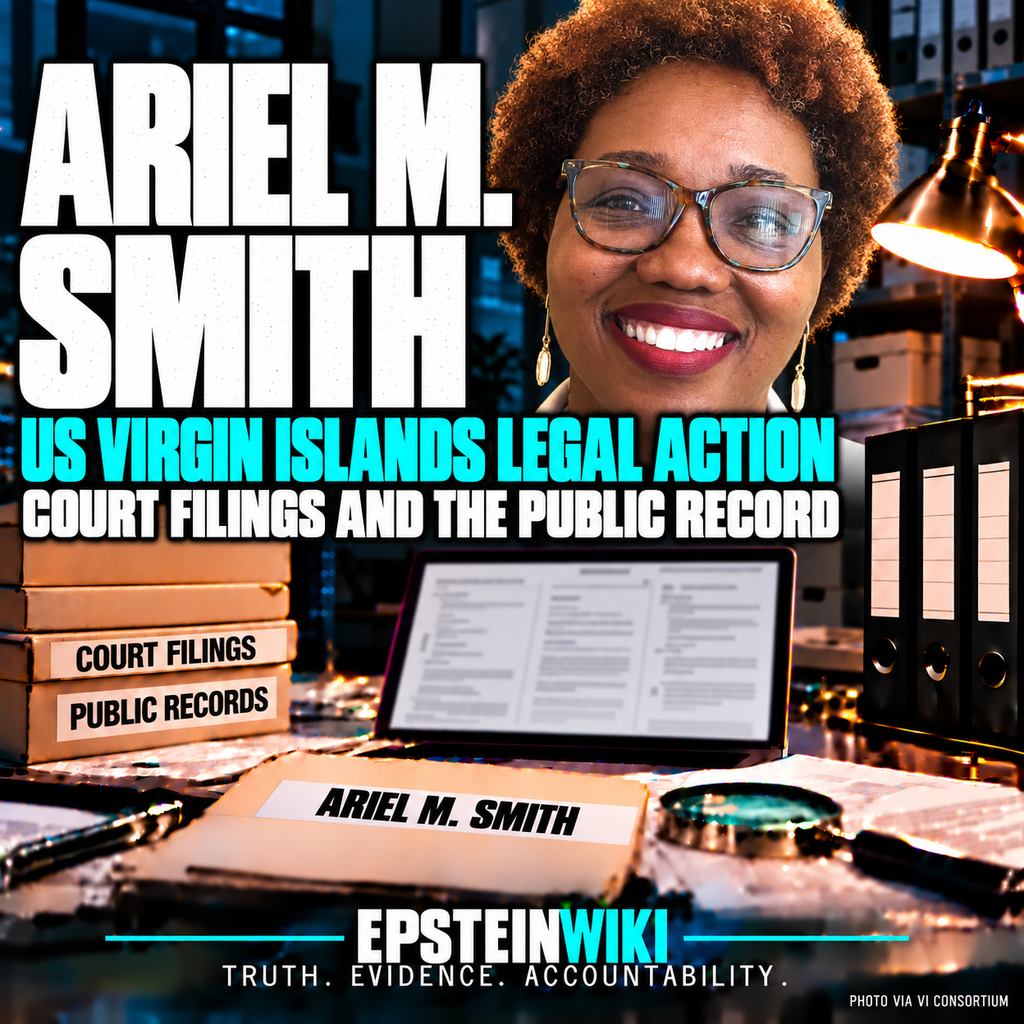
Snapshot
| Field | Documented information |
|---|---|
| Name | Ariel M. Smith |
| Professional role | Virgin Islands government lawyer; Civil Division chief before serving as attorney general in 2023 and 2024 |
| Direct Epstein connection | Government counsel in estate-related litigation and attorney general during the final stages of the JPMorgan case |
| Personally signed filing | July 10, 2020 motion to intervene in Maxwell v. Estate of Jeffrey Epstein |
| Later personally signed filing | February 21, 2023 withdrawal of the intervention motion after the separate estate settlement |
| Estate settlement role | Named as Civil Division chief on Denise George’s litigation team in the November 30, 2022 announcement |
| Attorney general nomination | Sent to the Legislature on March 20, 2023 |
| Legislative confirmation | June 14, 2023 |
| JPMorgan settlement | Announced September 26, 2023; $75 million total |
| End of attorney general tenure | Resignation effective March 15, 2024 |
| Later verified office | Chief Civil Division in a government complaint dated June 18, 2026 |
| Last checked | October 7, 2026 |
Ariel M. Smith’s connection to the Epstein record is as a government lawyer who helped pursue the Virgin Islands’ civil response to Jeffrey Epstein’s trafficking operation. Her work spans efforts to preserve estate assets, a proposed intervention in Ghislaine Maxwell’s legal-fee lawsuit, and the later litigation against JPMorgan Chase. She became attorney general after participating in that work as a career lawyer.
Smith announced the $75 million JPMorgan settlement in September 2023. The settlement concluded a case initiated under Denise George, continued through Carol Thomas-Jacobs’s acting tenure, and litigated with government and outside counsel. Smith’s documented role is substantial, but the record does not support attributing every pleading, discovery decision or earlier investigation personally to her.
The filings discussed here identify Smith as counsel or an officeholder, not as an Epstein associate or an accused participant in his abuse. Court submissions made under her name must also be distinguished from findings by a judge. The bank settlement involved no admission of liability, and its announcement was followed by a judicial dismissal rather than a liability trial.
Important Points
- Smith personally signed the government’s July 2020 application to intervene in Maxwell’s estate litigation. The application sought both protection of estate assets and assistance enforcing investigative subpoenas.
- Her February 2023 withdrawal filing expressly tied that procedural step to the government’s separate settlement with the Epstein estate. It did not withdraw the JPMorgan case.
- The November 2022 estate settlement was announced by Denise George. Smith was identified as Civil Division chief and a member of the legal team, not as attorney general at that date.
- Nomination, legislative confirmation and later use of the attorney general title are separate events. A May 2023 bank filing still called Smith Attorney General Nominee.
- The $190 million figure sought during the JPMorgan case comprised at least $150 million in penalties or fines and at least $40 million in disgorgement or restitution. It was a request, not a judgment.
- The September 2023 settlement totaled $75 million, including $20 million in attorneys’ fees. The separate $10 million mental-health fund was within the announced funding allocation, not an additional payment above $75 million.
- The $75 million government settlement and JPMorgan’s separate $290 million survivor class settlement resolved different claims.
- Smith left the attorney general position in March 2024. A June 2026 signed government complaint identifies her as Chief Civil Division.
Evidence Appearances
| Record | Date | What it establishes | Limit |
|---|---|---|---|
| Maxwell v. Estate, motion to intervene, ST-20-CV-155 | Dated July 10, 2020; court archive labels the filing July 13 | Smith’s signature and the government’s two asserted grounds for intervention | An application for relief, not an order granting intervention |
| USVI estate settlement announcement | November 30, 2022; posted December 1 | Smith named as Civil Division chief on the litigation team | Official account of the settlement; does not allocate each lawyer’s individual work |
| Withdrawal of motion to intervene; EFTA02822416 | February 21, 2023 | Smith signs under Acting Attorney General Carol Thomas-Jacobs and cites the separate estate settlement | The associated proposed order is not proof of a signed judicial ruling |
| JPMorgan docket 139 | May 8, 2023 | Filing under Smith as Attorney General Nominee, signed by Linda Singer | Counsel’s request to strike defenses, not a merits ruling |
| JPMorgan docket 226-50 | Dated July 19; filed July 24, 2023 | Government’s supplemental interrogatory response identifies categories and amounts of requested relief | Signed by David Ackerman under Smith’s office heading; not an award |
| JPMorgan docket 220 | July 24, 2023 | Government’s motion brief argues for partial summary judgment | Signed by Mimi Liu; arguments were not converted into a liability finding by the later settlement |
| USVI settlement announcement and JPMorgan announcement | September 26, 2023 | Amount, stated allocation and the parties’ different descriptions of the resolution | No admission of liability; the announcements are not substitutes for every contractual term |
| JPMorgan docket 348 | October 18, 2023 | Court grants dismissal requests and denies pending motions as moot | Procedural closure, not a trial verdict |
| USVI complaint, signature page 31 | June 18, 2026 | Smith signs as Chief Civil Division under Attorney General Gordon Rhea | Unrelated litigation used only to verify her later professional title |
Career and the Correct Office Titles
Government House’s March 2023 nomination announcement states that Smith had led the Civil Division since 2016, after seven years as an assistant attorney general in that division. It describes earlier work as a territorial public defender and in private civil practice, and identifies a law degree from Rutgers. That background helps explain her involvement in complex government litigation without suggesting an Epstein-specific relationship before the public cases.
The announcement uses the middle initial K. By contrast, the signed estate papers, the Legislature’s nomination materials, the September 2023 DOJ release and the June 2026 signature page use Ariel M. Smith. The article follows the name on those litigation records. This variation should not be used to create two different people or to merge Smith with unrelated people who share her first and last names.
The Rules and Judiciary Committee considered her nomination on May 10, 2023. Its approval sent the nomination to the full Legislature; committee approval was not the final confirmation. Contemporary reporting records the Legislature’s June 14 vote approving her nomination. The distinction is independently reflected in the May 8 JPMorgan filing, whose office heading still described her as nominee.
Her succession matters for assigning responsibility. George initiated the estate enforcement action and the December 2022 bank lawsuit. Thomas-Jacobs served as acting attorney general during the transition. Smith’s attorney general tenure belongs to the later bank litigation and settlement, while her own estate work began well before she held the top office.
The July 2020 Maxwell Intervention Motion
The July 2020 motion concerns Maxwell’s suit against the Epstein estate, its executors and NES, LLC. Maxwell sought indemnification and advancement of expenses associated with proceedings arising from her employment relationship with Epstein and his businesses. The government was not asking in this filing to pay Maxwell’s lawyers. It sought to enter that separate civil action because the same estate assets were potentially available for public enforcement claims.
Smith signed the submission as an assistant attorney general under Attorney General Denise George. Its first stated interest was to prevent estate funds from being depleted by Maxwell’s claims for defense expenses. The government argued that the estate assets should remain available for the remedies sought in its CICO action, including forfeiture, disgorgement, penalties and damages. Those were the government’s positions about competing claims on a finite estate.
The second stated interest involved investigative subpoenas. The motion described efforts to obtain documents from Maxwell and correspondence about service through her lawyers. It argued that Maxwell’s decision to bring her own Virgin Islands lawsuit supplied a practical route for addressing the government’s outstanding demands. The filing requested intervention as of right or, alternatively, by permission under Virgin Islands Rule of Civil Procedure 24.
These are distinct legal objectives. Preserving a pool of money would protect the potential recovery in one case; obtaining records could advance an investigation even before separate claims were filed against Maxwell. A summary that describes Smith only as opposing legal fees misses that second investigative purpose. Conversely, the motion does not itself prove that the subpoenas were enforced or that Maxwell produced the requested records.
The document is dated July 10, while the court’s public document container labels the filing July 13. The later withdrawal refers to the motion as filed July 10. Keeping both labels visible avoids assigning a false single date to the signature, submission and archive entry. Nothing in this timing discrepancy changes who signed the application or the relief it requested.
The Estate Settlement and the February 2023 Withdrawal
The estate settlement announcement named Smith alongside Chief Deputy Attorney General Carol Thomas-Jacobs, Solicitor General Pamela Tepper and Motley Rice. George announced a $105 million cash settlement, a government share of Little St. James sale proceeds and a separate environmental payment. The announcement is direct evidence that Smith was part of the government’s legal team, but does not disclose her share of negotiations or assign her sole authorship of the agreement.
The estate resolution and the Maxwell intervention had a practical connection: the government’s proposed participation in Maxwell’s suit had been designed partly to preserve assets for its own claims. Once those claims were settled, the government could reassess the need to remain a proposed intervenor in the separate legal-expense dispute.
Smith’s February 21, 2023 withdrawal makes that connection explicit. Signed under Acting Attorney General Thomas-Jacobs, it withdraws the July 2020 motion in light of the government’s recent settlement of the separate estate action. The filing is reproduced in the released record under EFTA02822416. It is evidence of the government’s procedural decision, not a declaration that all matters involving the estate or Maxwell had ended.
A proposed order accompanied the withdrawal. An unsigned proposed order cannot be treated as an executed judicial decision merely because it contains language granting a request. The withdrawal itself is sufficient to document Smith’s action; it does not require inventing a ruling date. It also supplies no basis to claim that Smith abandoned or settled the government’s separate case against JPMorgan.
Taking Over the JPMorgan Litigation
The original bank complaint was filed December 27, 2022 in the Southern District of New York, case 1:22-cv-10904. It alleged that JPMorgan had financially benefited from and facilitated Epstein’s trafficking venture. Smith inherited an existing lawsuit, with an established factual investigation and litigation team. Calling it a case she personally filed as attorney general would erase that chronology.
Judge Jed Rakoff’s May 8, 2023 order preserved Counts I and V of the government’s second amended complaint and dismissed Counts II through IV. The surviving counts involved the federal Trafficking Victims Protection Act; the dismissed counts concerned territorial CICO and consumer-fraud theories. Survival of a pleading challenge meant those claims could proceed. It did not establish that the bank had committed the alleged acts.
The same day’s government brief on affirmative defenses was filed under Smith’s nominee heading and signed by Motley Rice lawyer Linda Singer. It sought to strike defenses through which JPMorgan tried to shift responsibility toward the government, including comparative or contributory fault. The government argued that alleged failures by public authorities did not defeat its enforcement claims. That argument should not be mistaken for a judicial finding that every Virgin Islands official had acted properly.
The signature blocks are informative. Smith’s office headed the submissions, while named lawyers carried responsibility for particular signed papers. Institutional leadership, participation on a litigation team and personal authorship are different levels of attribution. The records establish Smith’s leadership role without showing that she personally wrote every argument or took every deposition.
The Relief Requested Before Settlement
The July 19, 2023 supplemental interrogatory response supplies a precise statement of the requested monetary remedies. Filed as docket 226-50 on July 24, it sought at least $150 million in civil penalties or appropriate fines and at least $40 million in disgorgement or restitution. It also described other damages, an injunction and fees to be determined. The familiar $190 million headline therefore described specified components of a demand, rather than a court-approved valuation.
The response expressly distinguished damages from the other categories of relief. That distinction prevents two errors: treating all $190 million as direct compensation for survivors, or saying the court awarded that amount before it was reduced. Neither follows from a discovery response identifying what a plaintiff intends to request at trial.
The July 24 partial-summary-judgment brief argued that the bank’s knowledge, financial services and benefits supported liability under the TVPA. It assembled a theory from discovery concerning Epstein’s banking relationship, internal information and suspicious transactions. The brief also argued against the bank’s fault-shifting defenses. It was advocacy supported by cited evidence, rather than a neutral account adopted wholesale by the court.
The later dismissal matters when reading those papers. A reader can examine the underlying exhibits independently, but the settlement did not transform each contested assertion into a judicial finding. Nor does Smith’s name in the office heading make her a witness with personal knowledge of transactions that occurred years before the litigation.
The $75 Million Resolution
Smith’s September 26, 2023 announcement presented the settlement as a major success for survivors and government enforcement. It emphasized measures for detecting trafficking risks, notifying law enforcement, terminating accounts supported by credible trafficking information and applying due diligence before opening private-bank accounts. Those are the purposes and commitments the territory said it had secured.
JPMorgan’s own announcement described an agreement in principle with $55 million for charitable and government purposes, plus $20 million in legal fees. It identified $30 million for USVI charities and survivor support and $25 million for law-enforcement infrastructure and capacity. The bank stated that it admitted no liability, regretted its association with Epstein and would not have continued banking him had it believed its services were being used for his crimes.
| Allocation | Amount | How to read it |
|---|---|---|
| Charitable and survivor support | $30 million | Includes the mental-health allocation described by the territory |
| Law-enforcement infrastructure and capacity | $25 million | Government and public-safety component |
| Attorneys’ fees | $20 million | Part of the $75 million total |
| Total | $75 million | Separate from the survivor class settlement |
Smith’s subsequent explanation divided the charitable component into $20 million for broader services and a $10 million mental-health fund for Epstein survivors. Adding that $10 million again to the $75 million total would double count it. Her article also emphasized prevention and longer-term support rather than treating the entire settlement as direct individual compensation.
JPMorgan disputed the policy characterization, telling Axios the measures reflected existing efforts rather than new contractual obligations.
The parties’ different descriptions make precise attribution essential. Smith can be credited with announcing and defending the settlement and its stated public purposes. The accessible announcements do not establish that every listed policy was newly created, independently enforceable under the agreement or later implemented in a particular way. The settlement amount and the bank’s no-admission position are clearer than those broader characterizations.
Dismissal, Separate Resolutions and What Was Not Decided
The October 18, 2023 court order granted dismissal of the government’s claims and related third-party claims against former banker Jes Staley. The judge explained that earlier stipulations did not satisfy the rule requiring all appearing parties’ signatures, and treated them as requests for court-approved dismissal. After reviewing the underlying settlement terms privately, he approved the dismissals and denied outstanding motions as moot.
This procedural detail prevents an important misreading of the docket. A pending summary-judgment motion is not a successful liability ruling simply because the case later settles for a substantial sum. The court’s order closed the action; it did not produce a verdict on the factual disputes argued in the July briefs.
JPMorgan separately resolved its claims against Staley on confidential terms. That agreement should not be included in Smith’s $75 million total without evidence of its terms. Likewise, the bank’s $290 million survivor class settlement was a different resolution involving individual claimants and their counsel. Smith’s office represented the territory in its public civil action, rather than serving as counsel for every survivor in the class case.
The January 20, 2023 Leon Black agreement also belongs to a different part of the Virgin Islands response. Its government signatory was Acting Attorney General Carol Thomas-Jacobs. It should not be retrospectively attributed to Smith as an agreement she executed while attorney general. Distinguishing these resolutions clarifies how the government’s estate, bank and individual settlement work continued across different officeholders.
Departure From the Attorney General Position and Later Service
Government House announced Smith’s resignation with an effective date of March 15, 2024. The brief announcement did not explain a reason. WTJX’s contemporaneous reporting said Smith’s resignation letter described leaving at the governor’s specific request. Those accounts support describing the end of her tenure; they do not establish an Epstein-related motive for it.
A government complaint dated June 18, 2026 provides a later, direct professional identifier. Its signature page lists Gordon Rhea as attorney general and Ariel M. Smith as Chief Civil Division. The complaint concerns an unrelated Medicaid matter and is relevant here only because it verifies that Smith’s departure from the top position did not mean the end of her government legal work.
Accordingly, an article checked in October 2026 should describe Smith as a former attorney general and identify her later role by the date of the record supporting it. It should not recycle a 2023 release’s present-tense title as if she remained the attorney general indefinitely.
Chronology
| Date | Event | Significance |
|---|---|---|
| 2016 | Begins Civil Division leadership, according to the 2023 nomination announcement | Predates the estate and bank litigation |
| July 10, 2020 | Signs Maxwell intervention motion | Direct evidence of her estate-related litigation role |
| November 30, 2022 | Named on team in estate settlement announcement | George remains the announcing attorney general |
| December 27, 2022 | Government files JPMorgan complaint | Bank case begins before Smith becomes attorney general |
| February 21, 2023 | Signs withdrawal of Maxwell intervention motion | Filing cites the separate estate settlement |
| March 20, 2023 | Nomination submitted to Legislature | Beginning of the documented appointment process |
| May 8, 2023 | Bank defense motion brief uses nominee title | Title is date-specific |
| June 14, 2023 | Legislature confirms nomination | Distinguishes confirmation from nomination |
| July 2023 | Government specifies remedies and seeks partial summary judgment | Requests remain contested |
| September 26, 2023 | Announces $75 million JPMorgan settlement | Resolution without admission of liability |
| October 18, 2023 | Court grants dismissal | Pending motions denied as moot |
| March 15, 2024 | Resignation as attorney general takes effect | End of that officeholding |
| June 18, 2026 | Signs unrelated complaint as Chief Civil Division | Later government service is directly documented |
Key Takeaways
- Smith’s Epstein significance lies in government litigation and institutional continuity, with direct signatures identifying specific work.
- The Maxwell intervention, estate settlement and JPMorgan settlement are connected but separate proceedings with different dates and decision makers.
- A requested remedy, an official settlement announcement and a signed court order establish different things. They should be read together without collapsing those distinctions.
- The strongest current account credits Smith’s documented role while preserving the contributions of her predecessors, colleagues, outside counsel and the survivors whose evidence supported the cases.
Related Articles
- JPMorgan Chase
- Government of the United States Virgin Islands v. JPMorgan: 2022 complaint
- Maxwell v. Estate of Jeffrey Epstein
- Estate of Jeffrey Epstein
- Virgin Islands Government Litigation
- Ghislaine Maxwell
Source List
- Virgin Islands Superior Court, July 2020 intervention motion
- USVI withdrawal, February 21, 2023
- Epstein Data, EFTA02822416 document identifier
- USVI DOJ, November 30, 2022 estate settlement announcement
- Government House, March 2023 Smith nomination
- Virgin Islands Legislature, May 10, 2023 committee report
- Virgin Islands Consortium, June 16, 2023 confirmation report
- JPMorgan docket 1, original complaint
- JPMorgan docket 135, May 8, 2023 order
- JPMorgan docket 139, affirmative-defense brief
- JPMorgan docket 226-50, supplemental interrogatory response
- JPMorgan docket 220, partial-summary-judgment brief
- USVI DOJ, September 26, 2023 settlement announcement
- JPMorgan Chase, September 26, 2023 company statement via Nasdaq
- Ariel Smith, October 14, 2023 explanation of settlement funding
- Axios, September 30, 2023
- JPMorgan docket 348, October 18, 2023 dismissal order
- Leon Black settlement, signed January 20, 2023, Senate Finance Committee copy
- Government House, Smith resignation announcement
- WTJX, March 15, 2024 resignation and succession report
- USVI complaint dated June 18, 2026, signature page 31