
William Blaine Richardson III
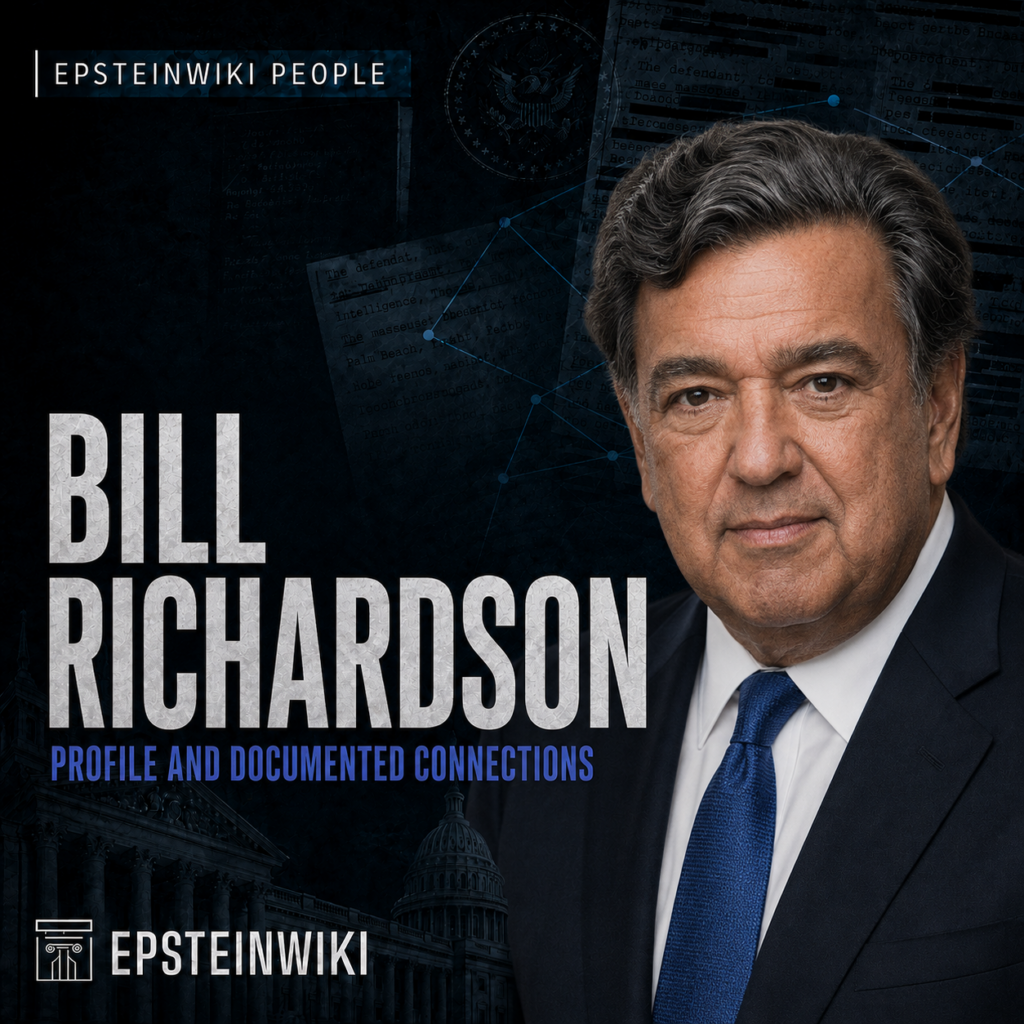
Involvement level: 4 of 5
Status: Accused in sworn testimony of repeated sexual contact arranged through Jeffrey Epstein and Ghislaine Maxwell. Richardson denied the allegation. He was never charged, and no court adjudicated the allegation.
Primary nexus: Zorro Ranch, New Mexico politics, campaign finance, private aviation, post conviction social contact, and Virginia Giuffre’s trafficking testimony.
Content warning: This article discusses sexual abuse, rape allegations, trafficking, and the exploitation of minors.
Snapshot
William Blaine Richardson III was a United States congressman, United Nations ambassador, energy secretary, governor of New Mexico, presidential candidate, and private diplomat. Jeffrey Epstein cultivated a relationship with him through political donations, travel, social meetings, and access to New Mexico’s political establishment.
The public record contains four separate categories of evidence that must not be collapsed into one claim.
First, Virginia Giuffre testified under oath that Ghislaine Maxwell directed her to have sex with Richardson. Later reporting on the deposition states that Giuffre described more than two encounters when she was approximately seventeen to eighteen years old. The 2026 New Mexico Survivors’ Truth Commission summarized the allegation as trafficking to New Mexico to have sex with Richardson. Giuffre also said she gave Richardson’s name to the FBI.
Second, campaign records and contemporary reporting document major Epstein contributions to Richardson’s gubernatorial campaigns. Epstein gave $50,000 to Richardson’s 2002 campaign and another $50,000 to his 2006 reelection campaign. After Epstein’s conduct became public in Florida, Richardson directed the 2006 contribution to charity. Returning or redirecting that contribution did not end the relationship.
Third, flight records, schedules, emails, and later reporting document recurring contact. The New Mexico commission counted Richardson on five flights connected to Albuquerque or Santa Fe. Records released in 2025 and 2026 show planned meetings after Epstein’s 2008 conviction, including a dinner scheduled for September 19, 2016. A 2011 helicopter manifest listed Richardson, Epstein, Richardson aide Brian Condit, and three people identified by congressional investigators as alleged victims. Condit said the flight went from Richard Branson’s island to the United States Virgin Islands and did not visit Epstein’s island.
Fourth, federal correspondence undermines claims that prosecutors formally cleared Richardson. Richardson’s 2019 public statement said his lawyer had been told he was neither a target, subject, nor witness. Internal Southern District of New York correspondence said that description remained inaccurate. The record indicates that prosecutors had said they did not then intend to subpoena or interview him. That is different from an exoneration.
Richardson’s rating is Level 4 because the record combines a direct and repeated trafficking allegation with documented financial, travel, and post conviction access. The rating describes the seriousness and density of the Epstein connection. It is not a criminal verdict and does not establish that Richardson managed Epstein’s trafficking operation.
Identity and public career
William Blaine Richardson III was born in Pasadena, California, on November 15, 1947. He grew up in Mexico City and later attended school in Massachusetts. He earned a bachelor’s degree from Tufts University in 1970 and a master’s degree from the Fletcher School of Law and Diplomacy in 1971.
Richardson represented New Mexico’s Third Congressional District from 1983 until 1997. President Bill Clinton appointed him United States ambassador to the United Nations in 1997 and secretary of energy in 1998. He served as governor of New Mexico from January 2003 through January 2011 and sought the Democratic presidential nomination in 2008.
After leaving office, Richardson built a second public career as a private diplomatic negotiator. Through the Richardson Center for Global Engagement, he worked on hostage and prisoner releases in countries including North Korea, Iran, Russia, and Myanmar. He died in Chatham, Massachusetts, on September 1, 2023, at age seventy five.
His stature matters to the Epstein record. Richardson had access to national leaders, foreign governments, donors, diplomatic institutions, and New Mexico agencies. Epstein repeatedly sought proximity to people with precisely that kind of influence.
Why Richardson matters to the Epstein record
Richardson is not important merely because his name appears in a contact book or on a guest list. The connection is layered.
- A survivor accused him under oath of being a recipient of Epstein and Maxwell’s trafficking.
- Epstein financed Richardson’s state political campaigns at an unusually high level.
- Richardson appears in aviation records connected to Epstein and New Mexico.
- The relationship continued after Epstein became a convicted sex offender.
- Epstein sought Richardson’s help while pursuing executive clemency in Florida.
- Richardson’s staff explored Epstein linked aircraft support for a high profile diplomatic trip.
- Richardson’s public claim of prosecutorial clearance was disputed inside the prosecutor’s office.
- Richardson governed the state where Epstein maintained Zorro Ranch, a property that survivors identified as a site of grooming, sexual abuse, and trafficking.
No single item proves every allegation. Together, however, these records establish that the relationship was sustained, consequential, and deserving of scrutiny.
Epstein’s New Mexico base
Epstein purchased the core of what became Zorro Ranch in 1993. County records reviewed by Reuters and the New Mexico commission identify the sellers as Governor Bruce King and members of the King family. The available evidence does not show that Richardson owned or sold the property.
That distinction is necessary because former ranch employee Larry Morrison testified that he thought Richardson had owned part of the land. The New Mexico commission expressly rejected that recollection as unsupported. The relevant deposition appears in EFTA01110312. Property material also appears in EFTA01110271 and EFTA00310887.
The ranch grew into a secluded complex with a main residence, guest facilities, staff housing, a hangar, and a private airstrip. Survivors and witnesses described massages, grooming, coercion, and sexual abuse there. Maxwell’s federal indictment identified New Mexico as one of the locations where she groomed a minor for Epstein.
The 2026 New Mexico interim report described evidence concerning at least five women and girls who reported abuse at the ranch. The commission stressed that its interim account was not a set of final findings. It also warned that decades of delay, lost material, and incomplete federal cooperation had impaired the investigation.
Richardson was governor for eight years during the ranch’s active period. Holding office in the same state does not itself establish knowledge or responsibility. His personal relationship with Epstein, campaign support from Epstein, travel record, and Giuffre’s allegation make his connection more direct than jurisdiction alone.
Campaign contributions
Epstein gave Richardson $50,000 during the 2002 gubernatorial campaign. He gave another $50,000 during Richardson’s 2006 reelection campaign. These were substantial state campaign contributions and helped place Epstein among Richardson’s significant donors.
Records collected in the later federal production include contemporary material about the 2006 contribution and its disposition. Relevant documents include EFTA01481096, EFTA01480609, EFTA01481013, EFTA01480610, and EFTA01481014.
After allegations against Epstein became public in Florida in 2006, Richardson directed the $50,000 reelection contribution to charity. Reporting does not establish that the 2002 contribution was also returned or donated. The most precise description is therefore that Richardson redirected the 2006 contribution, not necessarily the full $100,000 received across both election cycles.
Epstein also funded other New Mexico political figures and campaigns. Reuters calculated that he gave just over $160,000 across five state races from 2002 to 2014. Reuters found no evidence that Epstein received an official favor in exchange. That absence of a proven exchange is important. The donations still show how Epstein purchased political access and social legitimacy in the state where he operated his largest property.
Richardson’s decision to dispose of the 2006 contribution acknowledged the reputational problem created by Epstein’s conduct. Later calendars and travel records show that the gesture did not produce a durable personal break.
The 2007 Sudan aircraft request
In late 2006, Richardson prepared for a diplomatic mission to Sudan on behalf of the Save Darfur Coalition. Emails later released in the Epstein material show Richardson’s scheduling operation communicating with Maxwell about air transportation. One message asked Maxwell to cover half of a charter price reported as $183,000.
The episode is evidence that Richardson’s office treated Maxwell and the Epstein circle as a possible source of expensive transportation for official looking private diplomacy. It also places Maxwell in a practical coordination role, not merely at a social event. Related material appears in EFTA00597016.
Sources conflict on what happened next. Later independent reporting described Epstein as providing the aircraft or covering costs. Contemporary reporting on the actual January 2007 trip said Richardson traveled on a private jet owned by SlimFast founder S. Daniel Abraham and arranged through the Save Darfur Coalition. The record therefore supports the request and negotiation with Maxwell. It does not conclusively establish that the completed Sudan trip occurred on Epstein’s aircraft.
That distinction is important because a proposed arrangement is not the same as completed travel. The correspondence nevertheless demonstrates direct logistical contact involving a major diplomatic mission.
Flight records and New Mexico travel
The New Mexico Survivors’ Truth Commission reviewed flight records covering 227 flights to or from Albuquerque and Santa Fe between December 1992 and May 2019. Eighty of those records contained no passenger information. Within that incomplete set, the commission counted Richardson on five flights.
The commission cautioned that passenger logs can be incomplete or inaccurate and that a flight to Albuquerque or Santa Fe does not, by itself, prove a visit to Zorro Ranch. The ranch had its own airstrip, and additional evidence is required to establish the destination and purpose of any particular trip.
Relevant aviation material cited by the commission includes EFTA00090043 and EFTA00090061. The responsible conclusion is that Richardson repeatedly traveled within Epstein’s aviation network and appears in the New Mexico subset. The logs alone do not prove sexual conduct or knowledge of trafficking.
The 2011 Virgin Islands helicopter flight
CBS reported in October 2025 that a previously unreported 2011 helicopter log listed Richardson on a flight from the British Virgin Islands to the United States Virgin Islands. The manifest also listed Epstein, Richardson chief of staff Brian Condit, and three people whom the House Oversight Committee identified as alleged victims.
Condit told CBS that the group traveled from Richard Branson’s island to the United States Virgin Islands. He said they did not visit Epstein’s private island and that he did not remember the other passengers.
The manifest establishes shared travel if accurate. It does not establish that Richardson visited Little Saint James, that every listed passenger boarded, or that wrongdoing occurred on the flight. The presence of alleged victims is relevant context and must not be converted into a claim about conduct unsupported by the log.
Continued contact after Epstein’s conviction
Epstein pleaded guilty in Florida in 2008 to state charges involving prostitution and a minor. He became a registered sex offender. For many associates, that conviction marked the end of public or private contact. Richardson’s relationship continued.
Records released under the Epstein Files Transparency Act show that Richardson arranged or was scheduled to meet Epstein at least nine times after the conviction, according to the Santa Fe New Mexican. The records also show planned telephone calls. A scheduled meeting is evidence of intended contact, but it is not proof that every appointment occurred.
CBS separately reported that Richardson remained in Epstein’s orbit through at least September 19, 2016, when the two were scheduled for dinner. The date came eight years after Epstein’s conviction and years after Richardson had left the governor’s office.
The post conviction period matters because it narrows the available explanation. Richardson and his campaign knew enough about Epstein’s conduct in 2006 to redirect a major contribution to charity. Continued meetings after the 2008 conviction cannot be explained solely as innocent contact before Epstein’s criminal history was known.
At the same time, calendars are not transcripts. They do not reveal the content of a meeting, whether it occurred, or whether Richardson knew about additional crimes. They establish access and continuity.
Epstein’s clemency effort
After completing his Florida jail term and house arrest, Epstein sought executive clemency from then Governor Charlie Crist. Emails released in 2026 show that Epstein tried to enlist Richardson’s assistance in that effort.
Crist said he had no involvement with Epstein and denied speaking with him about a pardon. No clemency was granted. The available reporting does not establish that Richardson successfully contacted Crist, endorsed the application, or caused any official action.
The significance lies in Epstein’s choice of intermediary. He believed Richardson was a person he could approach for help with a request that could reduce the legal consequences of his sex offense conviction. That belief is consistent with a relationship based on political access rather than incidental acquaintance.
Virginia Giuffre’s allegation
Virginia Giuffre stated that Epstein and Maxwell trafficked her to powerful men while she was a teenager. In a May 2016 deposition in Giuffre v. Maxwell, she named Richardson among the people Maxwell directed her to have sex with.
The transcript was part of civil discovery. It was given under oath, but the Richardson allegation was not tried on the merits. The defamation case settled in 2017. Unsealing litigation later made the deposition public in stages, including releases in August 2019 and January 2024.
Later reporting on the transcript states that Giuffre said she was trafficked to Richardson more than twice while she was approximately seventeen to eighteen years old. She also said that she had supplied his name to the FBI. In the Epstein system, Giuffre explained, an instruction to provide a massage carried a sexual meaning.
The 2026 New Mexico Survivors’ Truth Commission summarized the allegation in direct geographic terms: its interim report said Jane Doe 4 testified that she was trafficked to New Mexico to have sex with Richardson. The commission cited the Second Circuit record in Giuffre v. Maxwell, docket 24 182, dated July 23, 2025.
An accusation of sex obtained through trafficking is an allegation of rape or sexual assault because trafficking and coercion negate meaningful consent. The legal labels can vary by jurisdiction, date, and the survivor’s age. The underlying allegation is that Giuffre was compelled by Epstein and Maxwell to engage in sexual activity with Richardson, not that she freely chose the encounter.
Giuffre’s account deserves to be stated without euphemism. It must also be described with procedural accuracy. Richardson was never prosecuted for the alleged conduct, never faced Giuffre in a civil trial over it, and was never found liable by a court.
Giuffre’s posthumous memoir
Giuffre died in April 2025. Her memoir, Nobody’s Girl, was published posthumously in October 2025. In it, she described political men to whom Epstein trafficked her and explained that she sometimes learned identities later by recognizing faces in photographs.
Reporting on the memoir connects its description of a Western gubernatorial candidate with her prior allegation against Richardson. The memoir should be read together with, rather than as a substitute for, her sworn 2016 testimony. Where the memoir uses descriptions instead of names, the identification should remain qualified.
The memoir also provides important context about coercion. Epstein and Maxwell’s method relied on control, dependency, threats, normalization, and the authority of the powerful people surrounding them. That context explains why the word massage in their instructions did not describe an ordinary therapeutic appointment.
Richardson’s denials
Richardson denied Giuffre’s allegation. In 2019, spokesperson Madeleine Mahoney called it completely false. A separate statement said that Richardson had never met Giuffre and that, during his limited interactions with Epstein, he had never seen Epstein with young or underage girls.
Those are distinct denials.
- Richardson denied meeting Giuffre.
- He denied sexual contact with her.
- He denied witnessing Epstein with underage girls.
- He characterized his interactions with Epstein as limited.
Later records complicate the last characterization because they document campaign contributions, travel, aircraft discussions, scheduled meetings, and contact extending years beyond Epstein’s conviction.
In May 2021, Richardson and his representatives participated in a videoconference concerning the allegations. A federal record of that presentation refers to broad denials, claimed damage to his reputation and finances, and polygraph material offered on his behalf. See EFTA00024683.
A privately commissioned polygraph is advocacy evidence. It is not a judicial finding, and courts often restrict polygraph evidence because of reliability concerns. The record does not show that Giuffre’s allegation was resolved through adversarial testimony, cross examination, or a verdict.
The disputed claim that prosecutors cleared Richardson
On August 21, 2019, Richardson issued a statement saying he had offered assistance to the Southern District of New York through attorney Jeffrey Brown. The statement asserted that Brown had been told Richardson was neither a target, subject, nor witness and that no allegation against him was being actively investigated. It then drew the broader conclusion that prosecutors did not believe Richardson had participated in or witnessed Epstein’s criminal activity.
The public statement appears in EFTA00032235, EFTA00030967, and related copies.
Internal federal correspondence shows that prosecutors did not accept the statement as fully accurate. An assistant United States attorney explained that the office did not then intend to subpoena Richardson or request an interview. The same correspondence said it was not accurate to infer that Richardson fell into none of the categories of target, subject, or witness. See EFTA00027244.
Other internal emails record frustration over the public language. See EFTA00014372 and EFTA00014374.
The correct conclusion is narrow. Prosecutors apparently were not preparing to compel Richardson’s testimony at that moment and were not treating him as a target. The released correspondence does not amount to a formal clearance, exoneration, or factual rejection of Giuffre’s testimony.
Epstein’s sex offender status in New Mexico
Epstein’s Florida conviction created a separate institutional question in New Mexico. In 2010, he appeared at the Santa Fe County Sheriff’s Office to address registration. State and local records reflected tension between New Mexico law and the federal Sex Offender Registration and Notification Act.
The New Mexico Department of Public Safety reportedly advised that state law did not require registration. Other records said federal law did require him to register when present in New Mexico. Epstein or his lawyer then notified the sheriff’s office of intended travel on multiple occasions between 2010 and 2015.
The commission found evidence of an initial August 2010 appearance but had not located evidence of the annual in person verification that federal law appeared to require. A related bail filing appears in EFTA00105512.
This occurred during the final months of Richardson’s governorship. The presently available evidence does not show that Richardson personally made, reviewed, or influenced the registration decision. It belongs in the article because it concerns how Epstein continued using a major property within Richardson’s state after conviction, but it should not be misrepresented as a proven act by Richardson.
The 2007 FBI contact with the ranch manager
The federal record shows that the FBI interviewed ranch manager Brice Gordon on February 13, 2007. Gordon discussed ranch operations and potential payment records. According to the New Mexico commission, he then received a call from the main office directing him to stop speaking with the FBI. The interview record appears in EFTA00269599.
This episode predates Epstein’s Florida plea and occurred while Richardson was governor. No released evidence identified Richardson as the person who directed Gordon to stop. Its relevance is institutional: federal investigators had a New Mexico lead during the ranch’s active years, yet the property was not comprehensively searched.
The 2019 New Mexico investigation
After Epstein’s July 2019 federal arrest, New Mexico Attorney General Hector Balderas opened an inquiry. State investigators identified potential victims, examined the ranch and its corporate structure, and considered whether the property could be seized for the benefit of survivors. A request discussing forfeiture appears in EFTA00015190.
Federal correspondence shows that the Southern District of New York asked New Mexico to stop its sex trafficking investigation and send the material already collected. A September 2019 email memorialized that arrangement. See EFTA00019190 and EFTA00019183.
New Mexico and federal officials continued discussing possible questions for victim interviews and an offer of assistance with a search warrant. See EFTA00019192 and EFTA00019188.
The state inquiry did not produce charges. The 2026 commission reported that New Mexico either did not retain or could no longer locate a copy of all the investigative material it had transferred. The Southern District did not later provide the state with the promised New Mexico evidence, according to the commission.
The failure matters to Richardson’s profile because his denial and public statement were being handled during the same period that state investigators were told to stand down. Internal records show federal communication with Richardson’s lawyer while New Mexico’s attorney general later complained that his office lacked comparable access and follow through.
The 2026 criminal investigation
On February 19, 2026, New Mexico Attorney General Raúl Torrez formally reopened the state criminal investigation into activity at Zorro Ranch. His office cited newly released federal records and the incompleteness of the earlier process.
Investigators conducted the first comprehensive law enforcement search of the property on March 9 and 10, 2026. The search used cadaver dogs and ground penetrating radar. The interim commission report said no human remains had been found as of March 24.
The search was not a criminal charge against Richardson, who had died in 2023. It was an investigation of conduct at the ranch, possible additional perpetrators, evidence, and institutional failures.
The state then sought unredacted federal files. The Justice Department said victim privacy laws, court orders, and federal law restricted disclosure. New Mexico accused the federal government of obstructing its investigation.
On August 5, 2026, New Mexico filed suit against the United States government seeking access to unredacted Epstein material. The lawsuit alleged that federal noncooperation impaired the state’s ability to identify witnesses, offenders, and crimes connected to the ranch. This is an active records and intergovernmental dispute. It has not produced a merits finding about Richardson.
The New Mexico Survivors’ Truth Commission
New Mexico lawmakers created a bipartisan Survivors’ Truth Commission in February 2026. The commission received subpoena power and a multimillion dollar budget. Its assignment includes survivor testimony, Zorro Ranch operations, public corruption, sex offender registration failures, and the conduct of state and federal institutions.
The commission issued subpoenas to the Governor’s Office, Department of Public Safety, State Land Office, Attorney General, Santa Fe County Sheriff, federal prosecutors, banks, the Federal Aviation Administration, and other entities. The Governor’s Office reported full compliance with its June 8 subpoena. Several federal recipients provided only partial responses or refused.
The commission’s August 5 interim report included Richardson in three important contexts.
- It recorded Giuffre’s allegation that she was trafficked to New Mexico to have sex with him.
- It counted him on five flights in the Albuquerque and Santa Fe aviation records.
- It included his August 2019 public statement among the records received from the United States Attorney’s Office.
The report expressly warned that allegations and information in the document were not final findings. That caution applies to Richardson as well as every other named person.
The commission expected to continue work through the end of 2026. Any final report, criminal referral, or newly released subpoena return should be incorporated into this profile when published.
What the new records add
The 2019 and 2024 unsealings made Giuffre’s allegation widely visible. The 2025 and 2026 releases added a different kind of evidence.
They documented relationship continuity after conviction. They showed Epstein or Maxwell involved in proposed diplomatic travel logistics. They surfaced the 2011 helicopter manifest. They revealed scheduled post conviction dinners and calls. They showed Epstein seeking Richardson’s assistance with clemency. They also exposed disagreement between Richardson’s public claim of clearance and the prosecutor’s internal description.
None of those records independently proves Giuffre’s sexual allegation. They do, however, weaken a narrative of merely incidental or remote contact. They also demonstrate why the allegation belongs within a broader record of access rather than in isolation.
What is established
The documentary record establishes the following facts.
- Epstein was a major donor to Richardson’s 2002 and 2006 gubernatorial campaigns.
- Richardson redirected the 2006 Epstein contribution to charity after Epstein’s conduct became public.
- Richardson and his staff had direct contact with Maxwell or the Epstein network about private aviation for the Sudan mission.
- Richardson appears on five flights in the New Mexico commission’s Albuquerque and Santa Fe dataset.
- A 2011 helicopter manifest listed Richardson and Epstein on the same Virgin Islands flight.
- Schedules show planned contact between Richardson and Epstein after Epstein’s conviction, extending to at least September 2016.
- Epstein sought Richardson’s assistance while pursuing Florida clemency.
- Giuffre testified under oath that Maxwell directed her to have sex with Richardson.
- Giuffre’s allegation was reported to the FBI, according to her testimony.
- Richardson denied meeting Giuffre and denied the sexual allegation.
- Federal prosecutors did not charge Richardson.
- Internal federal correspondence did not support the broad public claim that Richardson had been formally cleared.
- The New Mexico commission included Richardson in its 2026 interim account while expressly withholding final findings.
What is not established
The current public record does not establish the following propositions.
- It does not show that Richardson owned or sold Zorro Ranch.
- It does not prove that every scheduled meeting took place.
- It does not prove that every flight landed at the ranch or Epstein’s island.
- It does not establish that the 2007 Sudan mission ultimately used Epstein’s aircraft.
- It does not establish that Richardson obtained clemency or any official benefit for Epstein.
- It does not prove that Richardson controlled New Mexico’s sex offender registration decision.
- It does not show a court judgment finding Richardson liable for sexual assault or trafficking.
- It does not show a criminal charge, conviction, or formal prosecutorial exoneration.
- It does not establish that Richardson directed Epstein’s staff or managed the trafficking enterprise.
These limits do not erase Giuffre’s allegation. They define its legal and evidentiary posture.
Evidence index
| Evidence | What it supports | What it does not prove |
|---|---|---|
| Giuffre’s 2016 sworn deposition | Direct allegation that Maxwell directed her to have sex with Richardson | A court finding or conviction |
| 2026 New Mexico interim report | Official state summary that Giuffre alleged trafficking to Richardson in New Mexico | Final commission findings |
| 2002 and 2006 campaign records | $100,000 in combined political support across two campaigns | A quid pro quo |
| Five New Mexico flight entries | Repeated presence in Epstein linked aviation records | The purpose of each trip or a ranch visit in every instance |
| 2011 helicopter manifest | Shared listed travel with Epstein and alleged victims | A visit to Little Saint James or wrongdoing during the flight |
| Post conviction schedules | Continued intended access after Epstein’s conviction | Completion or content of every meeting |
| Clemency correspondence | Epstein sought Richardson’s political help | That Richardson acted or influenced Crist |
| Sudan aircraft correspondence | Richardson staff sought Maxwell’s help with charter costs | That Epstein’s aircraft completed the trip |
| 2019 public statement and federal emails | Richardson claimed clearance and prosecutors disputed its breadth | A judicial resolution of the allegation |
| 2021 presentation | Richardson renewed denials and submitted advocacy material | Independent adjudication |
Key EFTA documents
- EFTA00022133: Federal compilation containing victim allegations, including Richardson.
- EFTA00024683: Record of Richardson’s 2021 presentation and denials.
- EFTA00027244: Prosecutor’s explanation disputing the inference that Richardson fell into none of the investigative categories.
- EFTA00014372: Internal correspondence reflecting frustration over the public clearance statement.
- EFTA00014374: Related prosecutor and counsel discussion of the allegation.
- EFTA00032235: Richardson’s August 2019 public statement as circulated within the United States Attorney’s Office.
- EFTA00030967: Related copy of the Richardson statement and correspondence.
- EFTA01481096: Contemporary material concerning New Mexico political contributions.
- EFTA01480609: Related campaign contribution material.
- EFTA01481013: Related campaign contribution material.
- EFTA01480610: Related campaign contribution material.
- EFTA01481014: Related campaign contribution material.
- EFTA00597016: Material concerning Richardson, Maxwell, aviation, and the Sudan mission.
- EFTA00090043: Aviation records cited by the New Mexico commission.
- EFTA00090061: Additional aviation records cited by the commission.
- EFTA01110312: Deposition containing the unsupported recollection that Richardson had owned ranch land.
- EFTA01110271: Zorro Ranch property material.
- EFTA00310887: Zorro Ranch acquisition material.
- EFTA00269599: 2007 FBI interview with ranch manager Brice Gordon.
- EFTA00105512: Record related to Epstein’s New Mexico registration and travel notifications.
- EFTA00015190: New Mexico request concerning possible forfeiture of Zorro Ranch.
- EFTA00019183: Federal record of New Mexico deferring its trafficking investigation.
- EFTA00019190: Correspondence stating that the state agreed to cease the trafficking inquiry and transfer material.
- EFTA00019192: Federal follow up regarding New Mexico matters.
- EFTA00019188: New Mexico questions and offer to assist with a search warrant.
Timeline
| Date | Event |
|---|---|
| 1983 to 1997 | Richardson serves in the United States House from New Mexico. |
| 1993 | Epstein acquires the core Zorro Ranch property from the King family. |
| 1997 to 1998 | Richardson serves as United States ambassador to the United Nations. |
| 1998 to 2001 | Richardson serves as secretary of energy. |
| 2002 | Epstein gives $50,000 to Richardson’s first gubernatorial campaign. |
| January 2003 | Richardson becomes governor of New Mexico. |
| 2006 | Epstein gives $50,000 to Richardson’s reelection campaign. Richardson later directs that contribution to charity. |
| Late 2006 | Richardson’s staff communicates with Maxwell about charter costs for a Sudan diplomatic mission. |
| February 2007 | The FBI interviews Zorro Ranch manager Brice Gordon. |
| 2008 | Epstein pleads guilty in Florida and becomes a registered sex offender. |
| August 2010 | Evidence indicates Epstein appears at the Santa Fe County Sheriff’s Office concerning registration. |
| January 2011 | Richardson leaves the governor’s office. |
| 2011 | A helicopter manifest lists Richardson and Epstein on a British Virgin Islands to United States Virgin Islands flight. |
| 2010 to 2018 | Released schedules show at least nine planned post conviction meetings, according to later reporting. |
| September 19, 2016 | Epstein’s calendar records a scheduled dinner with Richardson. |
| May 2016 | Giuffre testifies under oath that Maxwell directed her to have sex with Richardson. |
| 2017 | Giuffre v. Maxwell settles. |
| August 2019 | Giuffre’s Richardson allegation becomes widely public through unsealed records. Richardson denies it and offers to assist prosecutors. |
| August 21, 2019 | Richardson issues a statement claiming prosecutors had placed him in none of three investigative categories. Internal federal records dispute that breadth. |
| July to October 2019 | New Mexico’s trafficking inquiry is deferred to the Southern District of New York. |
| May 2021 | Richardson’s representatives make a presentation denying the allegations and discussing polygraph material. |
| September 1, 2023 | Richardson dies at age seventy five. |
| January 2024 | Additional unsealed filings renew attention to Giuffre’s testimony. |
| October 2025 | Giuffre’s posthumous memoir is published. |
| October 2025 | CBS reports the 2011 helicopter manifest and 2016 scheduled dinner. |
| February 2026 | New Mexico creates a Survivors’ Truth Commission and reopens the criminal investigation of Zorro Ranch. |
| March 2026 | New Mexico investigators conduct the first comprehensive law enforcement search of the ranch. |
| June 2026 | The commission subpoenas state and federal entities, including the Governor’s Office. |
| August 5, 2026 | The commission releases its interim report. New Mexico also sues the federal government for access to unredacted Epstein records. |
Institutional accountability
The Richardson record raises questions beyond personal guilt or innocence.
Why did a convicted sex offender retain access to major political figures after his conviction? Why did New Mexico’s registration system produce conflicting answers? Why was Zorro Ranch not searched in 2007, 2019, or during the Maxwell prosecution? Why did the state surrender its trafficking material without retaining a usable copy? Why did federal prosecutors communicate with Richardson’s counsel while state investigators said they were not receiving meaningful information? Why did a public statement implying exoneration remain uncorrected when internal correspondence disputed it?
These questions concern systems of access, deference, and institutional failure. They do not require inventing a conspiracy. The documented failures are serious on their own.
Related people and entities
- Jeffrey Epstein, convicted sex offender and owner of Zorro Ranch.
- Ghislaine Maxwell, convicted trafficker whom Giuffre said directed the encounter with Richardson.
- Virginia Roberts Giuffre, survivor who accused Richardson under oath.
- Zorro Ranch, Epstein’s New Mexico property and an alleged site of abuse and trafficking.
- Bruce King, governor whose family sold the core ranch land to Epstein.
- Gary King, former New Mexico attorney general and recipient of Epstein linked campaign support.
- Hector Balderas, New Mexico attorney general during the 2019 state inquiry.
- Raúl Torrez, New Mexico attorney general who reopened the criminal investigation in 2026.
- Brian Condit, Richardson aide listed on the 2011 helicopter manifest.
- Jeffrey Brown, lawyer who communicated with federal prosecutors for Richardson.
- Charlie Crist, former Florida governor from whom Epstein sought clemency.
Questions that remain
- On what dates did Richardson personally meet Epstein after the 2008 conviction, and which scheduled meetings were completed?
- What was discussed at the September 2016 dinner?
- Did Richardson take any action after Epstein sought his help with Florida clemency?
- What role did Maxwell play in arranging transportation or financing for Richardson’s diplomatic travel?
- Who paid the final costs of the 2007 Sudan flight, and which aircraft completed each leg?
- What were the dates, routes, passenger lists, and purposes of Richardson’s five New Mexico flights?
- Did Richardson visit Zorro Ranch on each or any of those trips?
- What was the full itinerary of the 2011 helicopter flight, and did every listed passenger travel?
- When did Richardson first learn the details of the Palm Beach investigation?
- Why did contact continue after his campaign publicly distanced itself from Epstein in 2006?
- What information did Giuffre provide to the FBI about Richardson, and how did agents evaluate it?
- Why was Richardson not interviewed or subpoenaed after Giuffre’s allegation became public?
- Who drafted and approved the inaccurate portions of Richardson’s 2019 public statement?
- Why did federal prosecutors not issue a public correction?
- What evidence accompanied Richardson’s 2021 presentation, and was it independently tested?
- What Richardson related records did the New Mexico Governor’s Office produce to the Truth Commission?
- What remains withheld by the Justice Department, the Federal Aviation Administration, and federal prosecutors?
- Did anyone in Richardson’s administration discuss Epstein’s sex offender registration status?
- Did Epstein receive introductions, access, or other benefits through the relationship that were not formal government favors?
- What will the commission’s final report conclude about Richardson, Zorro Ranch, and institutional responsibility?
Primary and official sources
- New Mexico Survivors’ Truth Commission, Interim Report, August 5, 2026
- United States Department of Justice, Epstein disclosures
- Giuffre deposition excerpt in Giuffre v. Maxwell, May 2016
- United States House of Representatives biography of Bill Richardson
- Biographical Directory of the United States Congress
- National Governors Association biography
- United States Mission to the Organization of American States statement on Richardson’s death
Major reporting
- Reuters, New Mexico approves comprehensive Zorro Ranch probe
- Reuters, Questions about Epstein’s links to powerful New Mexico figures
- Reuters, Justice Department says it cannot provide unredacted files
- Reuters, New Mexico sues for access to Epstein files
- Associated Press, New Mexico reopens investigation of Zorro Ranch
- Associated Press, New Mexico launches Truth Commission
- CBS News, Epstein’s celebrity and political relationships
- CBS News, New Mexico reopens the Zorro Ranch investigation
- Scripps News, New Mexico probe and the Richardson prosecutor correspondence
- ABC News, final 2024 batch of unsealed Giuffre v. Maxwell records
- KOAT, 2024 coverage of the Richardson allegation
- KOAT, Truth Commission subpoena to the Governor’s Office
- The Guardian, records concerning Zorro Ranch
- Tampa Bay Times, Epstein’s clemency effort
- Vanity Fair, Richardson’s 2019 denial and documented Epstein ties
- People, political figures described in Giuffre’s posthumous memoir
- AP obituary, Bill Richardson
Independent research and survivor focused commentary
Independent reporting is useful for locating records and identifying questions. It should be verified against court filings, government records, and original documents wherever possible.
- Ellie Leonard, reading Virginia Giuffre’s testimony
- Ellie Leonard, profile of Virginia Giuffre
- American Freakshow, Epstein and State Department access
- Greg Conners, Epstein’s New Mexico politicians
- R. Howard Stone, New Mexico campaign and aviation records
- Epstein Observer, Bill Richardson profile
Editorial standard
This profile separates documentary facts, sworn allegations, denials, investigative classifications, and adjudicated outcomes. Inclusion in a flight log, calendar, address book, or government file does not by itself establish criminal conduct. A survivor’s sworn allegation is more significant than a name appearance, but it remains an allegation unless adjudicated.
Richardson’s death prevents a future criminal trial against him. It does not eliminate the public interest in records, survivor testimony, institutional decisions, or the conduct of living witnesses and officials.