
Jean-Luc Brunel
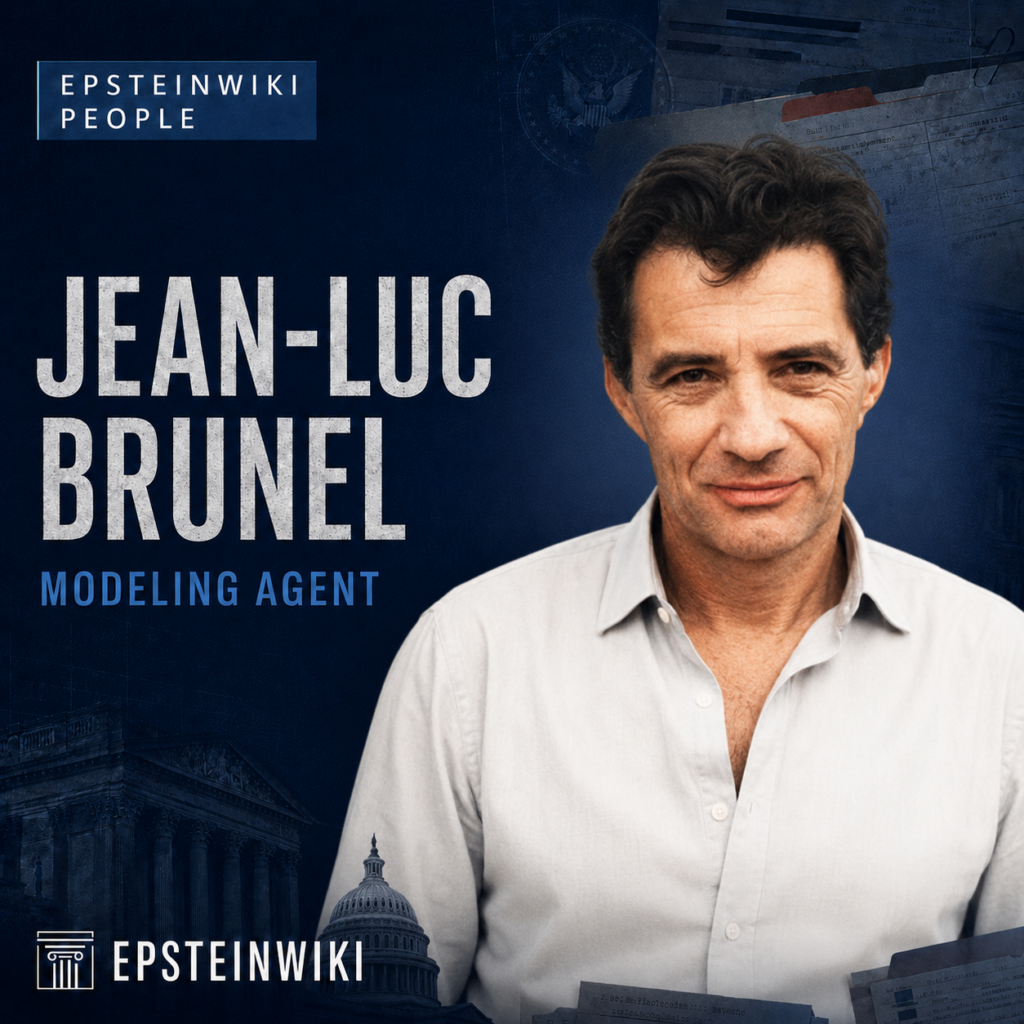
Snapshot
Jean Luc Brunel was a French model scout and agency executive whose career included senior roles at Karin Models and MC2 Model Management.
Brunel faced allegations of sexual assault and professional abuse from models beginning decades before the criminal investigations of Jeffrey Epstein and Ghislaine Maxwell. A 1988 60 Minutes investigation reported accusations that Brunel drugged and raped models. Brunel denied the allegations.
Brunel later developed a close personal and financial relationship with Epstein. Released records document numerous flights, meetings, telephone entries, emails, financial transfers, property invitations, modeling connections, and cooperation between their offices.
Epstein supplied financing to MC2 Model Management and included Brunel in earlier estate documents. Virginia Giuffre alleged that Brunel recruited young women and girls for Epstein. Other witnesses described meeting Brunel through Epstein’s properties or international modeling circles.
The evidentiary record contains several different categories of information. Some statements are survivor allegations. Some are sworn testimony. Some are investigative summaries. Others are financial records, emails, travel records, or allegations repeated in court filings. These categories should not be presented as interchangeable.
French prosecutors opened an Epstein related investigation in August 2019. Brunel was arrested at Charles de Gaulle Airport in December 2020 and placed under formal judicial investigation for rape of a minor and sexual harassment. French authorities did not charge him with human trafficking.
Brunel denied every accusation. He died by suicide in La Santé Prison in February 2022 before the case reached trial. His death ended the criminal prosecution without a verdict.
The French investigation was closed in 2023. In February 2026, Paris prosecutors announced a comprehensive reanalysis of the earlier investigation alongside new inquiries into human trafficking and financial offenses connected with the Epstein files.
Early Life and Modeling Career
Brunel was born in France in 1946.
He entered the modeling industry during the 1970s and became known for identifying young models and placing them with agencies in major fashion markets.
His work brought him into contact with photographers, agency executives, designers, wealthy clients, models, and international intermediaries. The profession depended heavily on informal introductions, travel, agency housing, casting opportunities, and the ability of senior scouts to control access to jobs.
Brunel became associated with Karin Models, an agency founded by Karin Mossberg. He eventually assumed a leading position within the business and expanded its international relationships.
His brother, Arnaud Brunel, also worked in the modeling industry.
Brunel married Swedish model Helen Hogberg and later American model Roberta Chirko. Both marriages ended.
His public reputation combined professional success with recurring allegations that he exploited the power imbalance between agency executives and young models.
Karin Models
Karin Models operated within an international system in which local agencies introduced models to larger agencies in Paris, New York, Miami, London, and other fashion centers.
Brunel used scouting relationships to identify models outside France and bring them into the Paris market. Some were teenagers travelling without established support networks.
Models commonly depended on agencies for accommodation, visas, transportation, castings, account management, and introductions. Agency expenses could be deducted from future earnings, leaving a model financially dependent before receiving meaningful income.
None of those practices automatically establishes abuse. They nevertheless created conditions in which a powerful agent could exercise considerable control over a young model’s housing, immigration status, career, and personal environment.
Multiple women later alleged that Brunel used modeling opportunities or agency social events to gain access to them.
Brunel denied using his professional position for sexual exploitation.
The 1988 CBS Investigation
Brunel’s name became publicly associated with abuse allegations long before Epstein’s 2019 arrest.
A 1988 60 Minutes investigation titled American Models in Paris examined alleged exploitation within the French modeling industry.
Models interviewed for the program accused Brunel of sexual misconduct. The accusations included claims that women had been drugged and raped.
The broadcast represented investigative journalism rather than a criminal judgment. The allegations were not resolved by a trial verdict.
Brunel denied the accusations and continued working in the modeling industry.
The historical importance of the broadcast is that allegations against Brunel were publicly documented many years before his relationship with Epstein became widely known. Later accusers described patterns resembling those reported during the 1980s, including alcohol, suspected drugging, memory loss, sexual assault, and professional vulnerability.
Allegations From Former Models
Former models have accused Brunel of misconduct allegedly occurring from the 1970s through the 2010s.
The allegations include:
- Sexual harassment during castings or professional meetings.
- Unwanted touching.
- Providing drinks followed by sudden unconsciousness or memory loss.
- Rape or attempted rape.
- Assaults occurring when the accuser was a teenager.
- Using modeling opportunities to create access to young women.
- Maintaining social environments in which professional and sexual expectations became deliberately blurred.
Several women described what French reporting calls chemical submission, meaning that a person is drugged or intoxicated to reduce resistance or prevent reliable memory.
A Guardian investigation concerning six women assembled accounts from former models who described alleged sexual assaults or predatory conduct.
Another Guardian investigation concerning three former models documented allegations that became relevant after French authorities opened their Epstein investigation.
These accounts establish that multiple women made allegations with notable similarities. They do not substitute for a criminal verdict.
Brunel consistently denied wrongdoing.
Thysia Huisman
Dutch former model Thysia Huisman publicly accused Brunel of drugging and raping her in Paris in 1991.
Huisman said she was eighteen and had recently entered the modeling industry. She alleged that she attended a gathering, consumed a drink, became incapacitated, and later realized that Brunel had raped her.
Her account became one of the most prominent public allegations against him after Epstein’s 2019 arrest.
Huisman later participated in efforts to obtain accountability through the French legal system and spoke about the difficulties created by limitation periods, missing records, the passage of time, and Brunel’s death.
Her testimony establishes what she reported and the circumstances she described. Brunel denied her accusation, and no jury reached a verdict concerning it.
The Relationship With Ghislaine Maxwell
Brunel operated within overlapping modeling and society circles that also included Ghislaine Maxwell.
Maxwell’s social network connected wealthy people, models, business executives, aristocrats, and international guests. Brunel’s profession made him useful within that environment because he could arrange introductions across multiple countries.
Public records and witness accounts associate Brunel with Maxwell at Epstein properties and social events.
The available evidence supports the conclusion that Brunel and Maxwell knew one another and participated in Epstein’s wider social network.
It does not establish that every interaction between them involved illegal conduct.
Maxwell was convicted in 2021 of five federal trafficking and conspiracy offenses. Brunel was not a defendant in her trial, and the verdict against Maxwell did not constitute a verdict against him.
The Relationship With Jeffrey Epstein
Brunel became one of Epstein’s recurring international contacts.
The relationship included:
- Modeling agency financing.
- Numerous aircraft journeys.
- Meetings in Paris, New York, Florida, and other locations.
- Visits or proposed visits to Epstein properties.
- Direct email and telephone communication.
- Introductions involving models and scouts.
- Financial support and loans.
- Inclusion in Epstein’s estate planning.
- Communication between Brunel’s agencies and Epstein’s staff.
- Continued contact after Epstein’s 2008 Florida conviction.
Brunel was therefore substantially more than a person whose name appeared incidentally in an address book.
In EFTA01746878, Brunel told Epstein in January 2015 that he did not want to speak by telephone or email. The exchange demonstrates direct contact and a desire to avoid discussing an unidentified subject through ordinary communication channels.
The message does not reveal the subject Brunel wished to discuss and should not be treated as an admission of criminal conduct.
MC2 Model Management
Brunel established MC2 Model Management in the United States with financial assistance from Epstein.
The agency maintained operations in major modeling markets, including Miami and New York. Its international connections allowed models recruited elsewhere to enter the United States through agency placements and visa arrangements.
MC2 was a legitimate modeling business that represented working models. Its existence cannot be reduced entirely to Epstein’s criminal activities.
The agency is nevertheless central to the Epstein investigation because Epstein financed it, communicated with Brunel, met models associated with the business, and maintained financial relationships with Brunel.
EFTA00105307 contains financial material documenting payments associated with MC2. The records support the conclusion that Epstein supplied substantial financial support to the agency.
The documents do not establish that every MC2 employee or model knew about Epstein’s abuse.
Immigration and Financial Dependency
Released records show how models could become dependent on an agency for immigration status and income.
In EFTA00906771, a model expressed concern about the status of her MC2 visa and whether the agency had cancelled it.
In EFTA00926192, the same model complained about income that she said the agency had not paid.
The messages document anxiety about immigration status and agency controlled money. They do not, by themselves, prove that Brunel intentionally created the problems or used them to coerce the sender.
They are important because a foreign model whose visa, accommodation, work, and unpaid earnings depend on an agency may have limited practical freedom to challenge powerful people within that system.
The records should therefore be evaluated alongside witness testimony, agency accounts, contracts, visa files, and financial transfers.
Daniel Siad and International Scouting
Daniel Siad was an international model scout who communicated with Brunel and Epstein.
A message preserved in EFTA00017956 records information forwarded to federal prosecutors stating that Brunel had described Siad as a scout or recruiter of women for Epstein.
The document establishes that this information was reported to prosecutors. It is not a verbatim admission recorded during courtroom testimony and does not independently prove every activity attributed to Siad.
Brunel, Siad, and other scouts operated through international modeling networks capable of locating women in numerous countries.
Independent researchers have examined how professional scouting, travel arrangements, model apartments, visas, and personal introductions could overlap with Epstein’s access to young women.
Each person’s conduct must be evaluated separately. A professional introduction is not automatically trafficking, while deliberate recruitment for sexual exploitation may constitute a serious offense.
Virginia Giuffre’s Allegations
Virginia Giuffre accused Brunel of functioning as a supplier of young women and girls to Epstein.
In her sworn testimony and related filings, Giuffre alleged that Brunel recruited women through the modeling industry and that Epstein told her he had sexual relations with more than one thousand women associated with Brunel.
That statement contains two evidentiary layers. Giuffre testified under oath about what Epstein allegedly told her, but the numerical claim was Epstein’s reported statement rather than a figure independently established by a court.
A public copy of Giuffre’s deposition preserves her sworn evidence and questioning by Maxwell’s attorneys.
Giuffre also alleged that Epstein forced or directed her to engage in sexual activity with Brunel. Brunel denied her allegations.
No criminal or civil verdict determined whether Brunel assaulted Giuffre.
The deposition establishes that Giuffre made the allegation under oath and faced examination by opposing counsel. It does not mean that every statement was judicially accepted as true.
Deposition Efforts Involving Brunel
Brunel became the subject of discovery efforts in United States litigation involving Epstein.
In a Florida civil proceeding, a plaintiff sought to compel Brunel to appear for a deposition. The motion to compel Jean Luc Brunel’s testimony documents the effort to obtain his evidence.
A subpoena or motion to compel establishes that a litigant considered the person’s testimony relevant. It does not establish that the witness committed a crime.
The dispute also demonstrates the difficulty survivors faced when attempting to secure testimony from internationally mobile people connected with Epstein.
Brunel was not ultimately subjected to a completed United States criminal trial concerning Epstein.
Flight Records
Brunel appears repeatedly in records associated with Epstein’s aircraft.
The surviving manifests place him on numerous journeys involving locations connected with Epstein’s residences, business activities, and international social network.
Different databases report different totals because some count a multistop journey as one trip while others count each segment separately. The safest conclusion is that Brunel was a frequent passenger rather than relying on a single disputed number.
A flight entry establishes that a person was recorded as a passenger on a particular aircraft segment. It does not reveal everything that occurred at the destination.
The cumulative travel record remains important because it corroborates a continuing relationship across several years and multiple countries.
Epstein’s Properties
Witness accounts and documentary records connect Brunel with several locations used by Epstein.
These included:
- Epstein’s Manhattan residence.
- His Palm Beach residence.
- His Paris apartment at 22 Avenue Foch.
- Properties in the United States Virgin Islands.
- International hotels and social venues.
The presence of Brunel at an Epstein property does not by itself establish an offense.
The importance of the property evidence lies in its combination with witness allegations, modeling introductions, travel records, communications, and financial support.
French investigators later searched Epstein’s Paris apartment and recovered computers, storage media, photographs, videos, emails, and a file containing women’s names.
Epstein’s Paris Operation
Epstein maintained a large apartment at 22 Avenue Foch in Paris.
French authorities searched the property in September 2019. Investigative records described computers, storage devices, photographs of young women, videos, emails, and a digital chart containing women’s names.
The French request for United States assistance is preserved in EFTA00077200.
The document describes the scope of the French investigation and summarizes witness allegations involving Epstein, Maxwell, Brunel, Karin Models, and alleged sexual offenses.
A mutual legal assistance request records what investigators were examining. It should not be represented as a verdict or as proof that every allegation summarized in the request was accurate.
The search nevertheless established that French authorities were investigating an extensive documentary record rather than relying on one isolated accusation.
The 2019 French Investigation
The Paris prosecutor opened a preliminary investigation in August 2019.
The investigation concerned alleged rape, sexual assault, offenses against minors, and possible criminal association connected with Epstein’s activities in France or involving French victims.
The inquiry followed Epstein’s July 2019 arrest and August 2019 death in federal custody.
French investigators sought to determine whether Epstein had committed offenses in France, whether French nationals had been victimized elsewhere, and whether people within his French network had assisted him.
Advocacy organizations and survivors supplied reports to prosecutors.
The investigation increasingly focused on Brunel because of his modeling agencies, relationship with Epstein, earlier public allegations, and the number of women willing to give evidence about him.
Searches and Evidence Collection
French police searched locations associated with Brunel and Epstein.
Investigators examined Brunel’s residence and premises connected with his modeling businesses. They also collected documents, electronic records, photographs, agency material, and communications.
According to later reporting on the judicial file, investigators found a chart listing young women and containing sexualized notations, including references to whether individuals were underage.
The chart is highly significant investigative evidence. Its complete provenance, authorship, purpose, and context would have required examination at trial.
Investigators also interviewed women who described alleged rapes, sexual assaults, harassment, attempted assault, and suspected drugging.
Some allegations were too old to prosecute under the applicable limitation periods. Others remained legally actionable because of the alleged victim’s age or the date and classification of the offense.
Arrest at Charles de Gaulle Airport
French authorities arrested Brunel on December 16, 2020.
He was detained at Charles de Gaulle Airport while preparing to travel to Dakar, Senegal.
The circumstances raised concern that he might leave French jurisdiction. His attorneys said the trip was professional and disputed any suggestion that he was attempting to flee.
Following questioning, Brunel was placed under formal judicial investigation and held in provisional detention.
The Guardian report on Brunel’s detention summarizes the arrest and the French investigation.
An arrest and formal investigation establish that judicial authorities found a sufficient legal basis to continue proceedings. They do not establish guilt.
The French Charges
English language reporting often described Brunel as charged, while French law uses the term mis en examen.
That status means that an investigating judge has placed a person under formal judicial investigation based on serious or consistent indications connecting the person with an offense. It is not equivalent to a conviction.
Brunel was formally investigated for rape of a minor and sexual harassment.
In June 2021, the proceeding was expanded to include an allegation that he drugged and raped a seventeen year old during the 1990s.
French authorities investigated wider allegations involving sexual assault, rape, minors, recruitment, and Epstein’s network.
Brunel was not formally prosecuted for human trafficking or for supplying women to Epstein.
That distinction is important. Evidence and allegations concerning recruitment remained part of the investigative context, but the formal case against Brunel at the time of his death concerned rape of a minor and sexual harassment.
Eleven Women Interviewed by French Investigators
French investigators interviewed at least eleven women who accused Brunel of rape, sexual assault, or sexual harassment.
The alleged conduct spanned from the 1970s through 2016.
Several women described a recurring pattern:
- Contact through modeling or fashion circles.
- An invitation to a professional or social gathering.
- A drink supplied by Brunel or someone near him.
- Sudden impairment, unconsciousness, or memory loss.
- Physical signs or fragmentary memories consistent with sexual activity.
- Fear that reporting the incident would destroy the model’s career.
- Delayed disclosure caused by shame, uncertainty, or professional dependence.
Similarities among allegations can be relevant to an investigation, particularly when witnesses did not know one another.
Similarity alone does not prove every allegation. Investigators must examine dates, communications, witnesses, medical evidence, travel, opportunity, and the possibility of shared public information.
Brunel denied all the accusations.
Brunel’s Denials
Brunel repeatedly denied sexually assaulting women or recruiting victims for Epstein.
He maintained that his relationship with Epstein involved friendship, modeling, business, and financing rather than trafficking.
During the French proceeding, Brunel told the investigating judge that he operated modeling agencies and was not a pimp.
His attorneys argued that media coverage treated allegations as established facts and that the age of many accusations made a fair defense difficult.
They also emphasized that Brunel had not been formally charged with human trafficking.
These denials form part of the record and must be included in any responsible account.
A denial does not erase an accusation. An accusation does not erase the presumption of innocence. The purpose of a trial would have been to test the evidence through an adversarial process.
That trial never occurred.
United States and French Cooperation
United States investigators sought assistance from French authorities concerning Brunel.
EFTA00030842 contains material concerning a mutual legal assistance process and communications involving the United States Embassy in Paris after Brunel’s arrest.
The document demonstrates that federal investigators were actively pursuing information through French legal channels.
It does not establish that the United States intended to charge Brunel or that prosecutors had completed a criminal case against him.
Cooperation was necessary because witnesses, businesses, properties, electronic evidence, and alleged offenses crossed national boundaries.
Different limitation periods, evidentiary rules, privacy laws, and criminal procedures complicated the investigation.
Financial Dependence on Epstein
Epstein’s financial relationship with Brunel extended beyond a single business investment.
Released financial records document payments connected with MC2 and loans or financial support associated with Brunel.
Epstein also included Brunel in estate planning documents.
EFTA01266359 contains an estate provision allocating five million dollars to Brunel if Brunel survived Epstein.
Other estate material addressed loans made to Brunel.
The provision demonstrates that Epstein considered Brunel financially important enough to include among intended beneficiaries.
It does not establish why Epstein selected him or whether the money represented payment for criminal activity.
The combination of agency financing, loans, direct contact, travel, and estate planning supports the conclusion that their relationship was both personal and financial.
Contact After Epstein’s Conviction
Epstein pleaded guilty in Florida in 2008 to offenses involving prostitution and a minor.
Brunel continued communicating and associating with him afterward.
Post conviction contact is significant because Epstein’s status as a convicted sex offender was publicly knowable. Continued association does not automatically establish that Brunel knew the full scope of Epstein’s abuse.
The relationship persisted through travel, messages, meetings, agency activity, and financial arrangements.
Brunel’s January 2015 message in EFTA01746878 provides direct evidence of continued communication.
Records from MC2’s Miami office also show that the agency remained aware of investigative interest. EFTA00073492 contains an FBI interview memorandum concerning contact with the MC2 office in July 2019.
An FBI memorandum is an agent’s summary rather than a verbatim transcript.
Death in La Santé Prison
Brunel was held in provisional detention at La Santé Prison in Paris.
On February 19, 2022, he was found hanged in his cell.
The Paris prosecutor opened an investigation into the death. Authorities reported no initial evidence that another person had entered the cell or participated in his death.
A Reuters report on Brunel’s death recorded that he was found hanged while detained in the French investigation.
The circumstances prompted speculation because Epstein had also died in custody before trial.
The similarity does not constitute evidence that Brunel was murdered.
French authorities concluded that Brunel died by suicide. No criminal involvement by another person was established.
The Death Investigation
The inquiry into Brunel’s death examined prison records, his condition, and whether another person had participated.
Investigators found no evidence of third party involvement.
Psychiatric material reported in connection with the inquiry described depression, suicide risk, and difficulty coping with detention and the criminal accusations.
Brunel’s attorneys later questioned whether prison authorities had responded adequately to his mental condition and risk factors.
Questions about prison supervision are legally distinct from claims that someone killed him.
The available official record supports suicide as the cause of death.
Assertions that Brunel was murdered should not be presented as fact without credible contrary evidence.
Effect of Brunel’s Death on the Criminal Case
Brunel’s death ended the criminal prosecution against him.
French criminal law does not permit a deceased defendant to be tried and punished. The investigating judges therefore could not submit the charges to a criminal court for a verdict.
Brunel was never convicted of rape, sexual assault, trafficking, or an Epstein related offense.
His death also did not produce an acquittal.
The surviving record contains formal charges, witness allegations, investigative evidence, denials, financial records, travel records, and agency material. It does not contain a final judicial determination of guilt or innocence.
For survivors, the death prevented the evidence from being tested publicly at trial.
Some complainants later pursued civil compensation from Brunel’s estate. Those proceedings are separate from the terminated criminal prosecution.
Closure of the Earlier French Investigation
The French judicial investigation was closed in 2023, after Brunel’s death.
Closing the investigation did not mean that every allegation had been disproved.
The death of the principal living defendant removed the possibility of prosecuting Brunel. Some alleged offenses were also outside the applicable limitation periods.
Evidence collected during the investigation remained relevant to survivor claims, historical analysis, and inquiries concerning other people.
Brunel’s former attorneys continued emphasizing that he had denied the accusations and had never been prosecuted for supplying women to Epstein.
The 2026 French Reanalysis
The release of millions of additional United States records produced renewed French investigative activity.
On February 18, 2026, Paris Prosecutor Laure Beccuau announced two broad investigations. One concerned human trafficking. The other concerned possible money laundering, tax fraud, breaches of public integrity, and related financial offenses.
Five magistrates were assigned to examine the newly available material alongside earlier complaints, reporting, and judicial files.
Prosecutors also announced a comprehensive reanalysis of the investigation that had focused on Brunel.
Le Monde’s report on the new French investigations states that the authorities intend to compare the earlier case file with the newly released United States documents.
Reuters also reported on the 2026 French investigations.
Brunel cannot be prosecuted after death. The evidence concerning him may nevertheless help investigators identify surviving participants, financial flows, witnesses, recruitment methods, and offenses not previously understood.
Modeling Agencies as Access Infrastructure
The Brunel record illustrates why modeling agencies became important to Epstein.
A modeling agency can legitimately provide:
- Talent identification.
- Professional representation.
- International placements.
- Immigration assistance.
- Housing.
- Transportation.
- Photography and portfolio development.
- Introductions to clients and industry professionals.
The same infrastructure can be abused when professional authority is used to obtain sexual access or place vulnerable people near predators.
Epstein benefited from environments where young women were internationally mobile, professionally ambitious, financially dependent, and accustomed to meeting wealthy strangers through intermediaries.
That does not mean that every model, scout, agency employee, photographer, or client participated in abuse.
The investigative question is whether specific people knowingly transformed professional recruitment into sexual procurement or trafficking.
EpsteinWiki Sleuth Analysis
Independent Epstein researchers have examined Brunel as a bridge between Epstein’s American properties and European modeling networks.
American Freakshow’s investigation, The French Connection, examines Epstein’s Paris relationships, modeling contacts, and the people who helped connect his French and American networks.
Bekah Day’s investigation of Daniel Siad and the wider recruitment network analyzes international scouting relationships involving Epstein, Brunel, Siad, and women recruited through modeling circles.
Ellie Leonard’s investigation of 301 East 66th Street examines an Epstein controlled Manhattan building associated with employees, associates, and models.
Rye Howard Stone’s Sleuthsletter collects document research concerning Brunel, MC2, French investigative developments, and the wider Epstein network.
These sources provide investigative synthesis and can identify patterns that are difficult to see within individual documents.
Their characterizations should remain attributed to the researchers. The underlying court records, French proceedings, financial documents, travel records, and EFTA evidence remain the primary sources.
What the Evidence Establishes
The available evidence establishes that:
- Brunel was a prominent French model scout and agency executive.
- He held a leading role at Karin Models.
- He later established MC2 Model Management with financial support from Epstein.
- Models publicly accused Brunel of abuse as early as the 1980s.
- Multiple women later accused him of rape, sexual assault, harassment, or suspected drugging.
- Brunel denied all allegations of sexual misconduct.
- Brunel maintained a recurring personal and financial relationship with Epstein.
- Brunel continued communicating with Epstein after Epstein’s 2008 conviction.
- Brunel travelled repeatedly on aircraft associated with Epstein.
- Epstein supplied money connected with MC2.
- Epstein included Brunel in estate documents and contemplated a five million dollar bequest.
- Virginia Giuffre accused Brunel of sexual assault and of recruiting women and girls for Epstein.
- Brunel’s testimony was sought in United States civil litigation.
- French prosecutors opened an Epstein related investigation in August 2019.
- Brunel was arrested at Charles de Gaulle Airport in December 2020.
- He was formally investigated for rape of a minor and sexual harassment.
- At least eleven women gave French investigators allegations concerning Brunel.
- Brunel was not formally charged with human trafficking.
- United States and French authorities exchanged investigative assistance concerning him.
- Brunel died by suicide in La Santé Prison in February 2022.
- No evidence of third party participation in his death was established.
- Brunel died before trial and was never convicted of an Epstein related offense.
- His death terminated the criminal prosecution without an acquittal or guilty verdict.
- French prosecutors announced a comprehensive reanalysis of the earlier investigation in 2026.
- Civil compensation efforts involving Brunel’s estate continued after his death.
What the Evidence Does Not Establish
The available evidence does not establish that:
- Every model represented by Karin Models or MC2 was exploited.
- Every MC2 employee knew about Epstein’s abuse.
- Every model introduced to Epstein was a minor or trafficking victim.
- Every flight involving Brunel was connected with criminal conduct.
- A person’s presence at an Epstein property proves participation in abuse.
- Epstein’s financing of MC2 proves that every agency transaction was unlawful.
- Every allegation against Brunel was independently corroborated.
- Epstein’s reported claim concerning more than one thousand women was numerically accurate.
- Giuffre’s sworn testimony constituted a verdict against Brunel.
- A motion to compel Brunel’s deposition established his guilt.
- Brunel was convicted of rape or sexual assault.
- Brunel was formally charged in France with human trafficking.
- United States prosecutors charged Brunel with an Epstein related crime.
- Brunel’s death proved that he was guilty.
- The closure of the criminal investigation proved that the allegations were false.
- Brunel was murdered in prison.
- Similarities between Brunel’s death and Epstein’s death establish a conspiracy.
- The 2026 French reanalysis permits prosecutors to conduct a criminal trial against Brunel after his death.
Investigative Assessment
Jean Luc Brunel was one of the most consequential modeling industry figures within Epstein’s network.
The relationship is supported by direct communications, financial records, estate documents, flight information, agency connections, litigation records, and French investigative material.
Brunel’s importance does not depend on a single address book entry or social photograph. Epstein financed his agency, travelled with him, communicated with him after his conviction, and treated him as a sufficiently close associate to include him in estate planning.
The allegations against Brunel also predated the public exposure of Epstein’s trafficking operation. That chronology weakens any suggestion that every accusation arose only through later publicity surrounding Epstein.
At the same time, Brunel died before the French evidence could be tested at trial. The article must therefore preserve the distinction between extensive evidence supporting investigation and a verdict establishing criminal guilt.
The most defensible description is that Brunel was a longtime Epstein associate, financially connected modeling executive, frequent traveller, and formally accused defendant whose alleged role in sexual abuse and recruitment remained unresolved when he died.
The continuing French reanalysis may clarify the conduct of surviving people and the institutional structures surrounding Brunel. It cannot produce the criminal verdict that his death prevented.
Key Takeaways
- Brunel’s relationship with Epstein was extensive and financially documented.
- Allegations against Brunel existed decades before Epstein’s 2019 arrest.
- Brunel operated Karin Models and later MC2 Model Management.
- Epstein financed MC2 and maintained continuing financial ties with Brunel.
- Virginia Giuffre accused Brunel of sexual assault and recruitment for Epstein.
- Numerous women separately accused Brunel of sexual misconduct.
- French investigators collected evidence from at least eleven women.
- Brunel denied every allegation.
- France formally investigated him for rape of a minor and sexual harassment.
- He was not formally charged with human trafficking.
- His detention was provisional and did not constitute a conviction.
- Brunel died by suicide before trial.
- French authorities found no evidence that another person caused his death.
- His death terminated the criminal prosecution without resolving the allegations.
- French prosecutors began reexamining the earlier investigation in 2026.
- Primary documents should be distinguished from researcher interpretation and media summaries.
Related EpsteinWiki Articles
- Jeffrey Epstein
- Ghislaine Maxwell
- Virginia Roberts Giuffre
- Giuffre v. Maxwell
- Witness Statements and Depositions Litigation
- Epstein’s Paris Apartment
- MC2 Model Management
- Daniel Siad
- Jeffrey Epstein Flight Records
- How to Read an Epstein Document
Primary Court, Government, and Investigative Sources
- Giuffre v. Maxwell federal docket
- Virginia Giuffre deposition transcript
- Motion to compel Jean Luc Brunel’s deposition
- United States v. Maxwell federal docket
- Official United States v. Maxwell case page
- Reuters report on Brunel’s death
- Guardian report on Brunel’s detention
- Guardian investigation concerning six accusers
- Guardian investigation concerning three former models
- Le Monde report on the 2026 French investigations
- Reuters report on the 2026 French investigations
- United States Department of Justice Epstein Library
Primary Epstein Data Evidence
- EFTA00077200 contains the French mutual legal assistance request describing the Epstein and Brunel investigation, its suspected offenses, searches, and witness accounts.
- EFTA00030842 documents United States and French legal cooperation concerning Brunel after his arrest.
- EFTA01746878 contains Brunel’s January 2015 message stating that he did not want to speak by telephone or email.
- EFTA00105307 contains financial material documenting payments associated with MC2 Model Management.
- EFTA01266359 contains an Epstein estate provision contemplating a five million dollar bequest to Brunel.
- EFTA00906771 contains a model’s concern about the status of her MC2 visa.
- EFTA00926192 contains a model’s complaint about money she said MC2 had not paid.
- EFTA00017956 records information forwarded to federal prosecutors concerning Brunel’s description of Daniel Siad as a scout or recruiter.
- EFTA00073492 contains an FBI interview summary concerning contact with the MC2 Miami office in July 2019.
- EFTA01731021 contains an investigative index identifying multiple records connected with Brunel.
Each EFTA record should be read according to its original document type. An email establishes what was written. A financial exhibit records transactions. An FBI memorandum summarizes an interview. A mutual legal assistance request describes an investigation. None is automatically equivalent to a trial verdict.
EpsteinWiki Sleuth Sources
- American Freakshow: The French Connection
- Bekah Day’s investigation of Daniel Siad and the wider network
- Ellie Leonard: The Mystery of 301 East 66th Street
- Rye Howard Stone’s Sleuthsletter
These sources provide investigative synthesis. Their conclusions should be compared with the underlying court records, French judicial material, and direct EFTA documents before publication.